
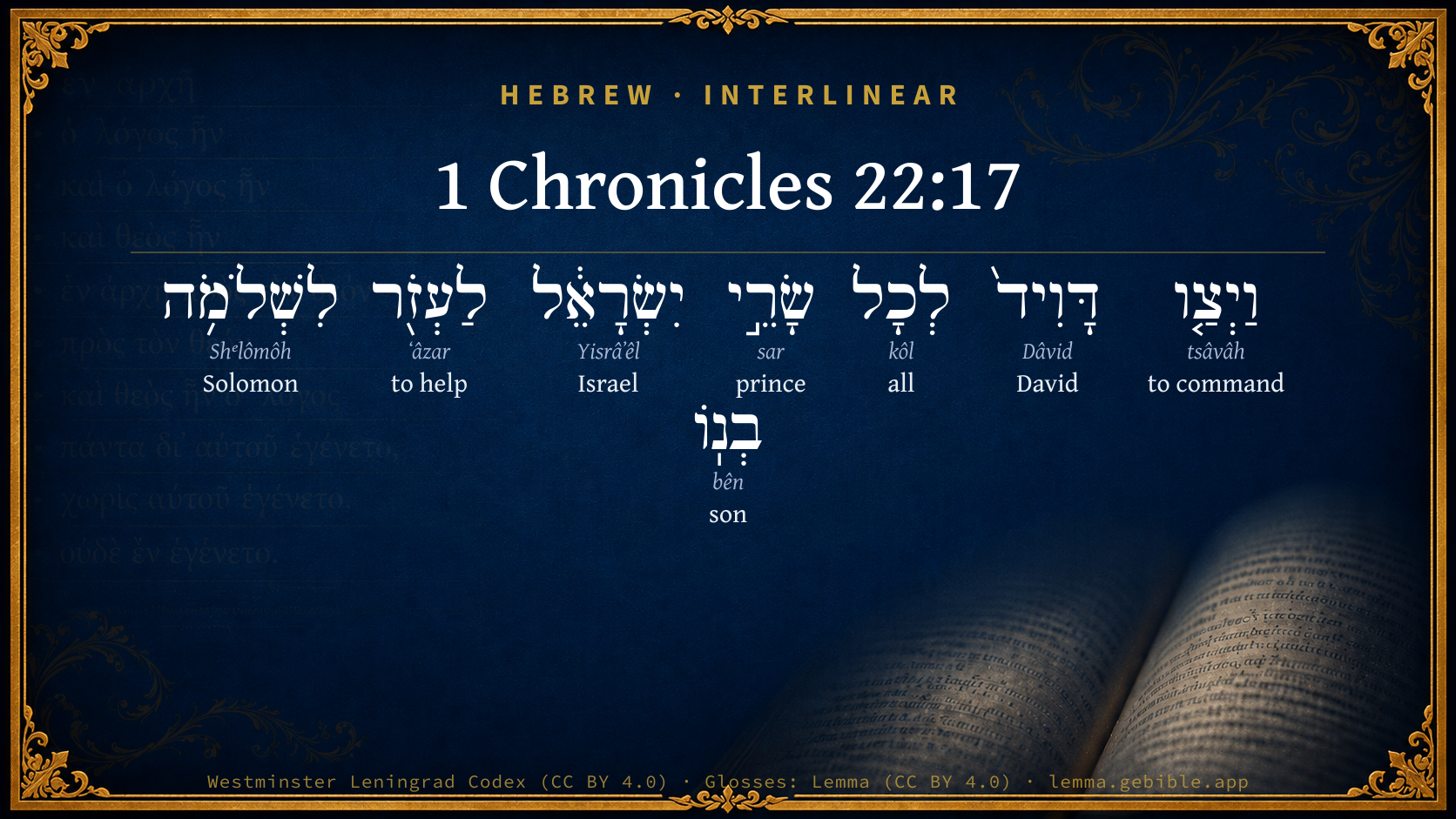
1 Chronicles 22:17

Hebrew (Westminster Leningrad Codex) 1 Chronicles 22:17 appears in the Hebrew Old Testament. The text above is from the Westminster Leningrad Codex. Each word links to its Strong’s number, a concise gloss, and parsing drawn from the Open Scriptures Hebrew Bible morphology. Click any word for its full Brown-Driver-Briggs (BDB) entry.
Download image
Cite this verse

1 Chronicles 22:17 (World English Bible). Public Domain. Lemma interlinear Bible study tool, https://lemma.gebible.app/v/1-chronicles/22/17.

Show BibTeX & RIS
BibTeX
RIS
English Translation
David also commanded all the princes of Israel to help Solomon his son, [saying],
World English Bible · Public Domain
Download a study sheet

One document with this verse’s original text, its word-by-word gloss line, the meaning frame, cross-references with their text, attributed commentary, and full source and license credits — printable, and it pastes into notes with its structure intact.

This verse Autodidact and up

Study sheet (.html) Plain text (.txt)

A passage Seminary Student

Up to 50 verses in one chapter. A passage sheet keeps up to 6 commentary sources and 12 cross-references per verse, in the order this page ranks them, and says so on the sheet whenever that leaves anything out. Ask for a single verse and you get the Autodidact verse sheet above.

Everything on this page stays free to read, with no account — the sheet is a download of what is already on screen, not access to it.

Want to remove ads? Support Godless Engineer
Compare translations 3

The same verse in 3 English versions, stacked beneath the original-language interlinear above. Click any original word for its lexicon entry.

Each is an independent rendering of the whole verse — the interlinear is not word-aligned to these translations.

Highlighted words mark where these versions differ — a whole-verse word diff, not a word-by-word alignment.

  • World English Bible Public Domain
    David also commanded all the princes of Israel to help Solomon his son, [saying],
  • King James Version Public Domain
    David also commanded all the princes of Israel to help Solomon his son, saying,
  • unfoldingWord Literal Text CC BY-SA 4.0
    And David commanded all of the rulers of Israel to help Solomon his son,

unfoldingWord Literal Text — © unfoldingWord, licensed CC BY-SA 4.0. Word-aligned USFM3 via Door43 (git.door43.org/unfoldingWord/en_ult).

Versions to compare (up to 4)

3 of 4 selected

Show all 18 translations

Every available English version of this verse, each an independent rendering of the whole verse.

  • World English Bible Public Domain
    David also commanded all the princes of Israel to help Solomon his son, [saying],
  • Berean Standard Bible Public Domain
    Then David ordered all the leaders of Israel to help his son Solomon:
  • Majority Standard Bible Public Domain
    Then David ordered all the leaders of Israel to help his son Solomon:
  • King James Version Public Domain
    David also commanded all the princes of Israel to help Solomon his son, saying,
  • American Standard Version (1901) Public Domain
    David also commanded all the princes of Israel to help Solomon his son, `saying',
  • Revised Version (1885) Public Domain
    David also commanded all the princes of Israel to help Solomon his son, saying,
  • Geneva Bible (1599) Public Domain
    Dauid also commanded all the princes of Israel to helpe Salomon his sonne, saying,
  • Douay-Rheims (1899) Public Domain
    David also charged all the princes of Israel, to help Solomon his son,
  • Young's Literal Translation Public Domain
    And David giveth charge to all heads of Israel to give help to Solomon his son,
  • Literal Standard Version CC BY-SA 4.0
    And David gives charge to all heads of Israel to give help to his son Solomon, [saying],
  • Unlocked Literal Bible CC BY-SA 4.0
    David also ordered all the leaders of Israel to help Solomon his son, saying,
  • unfoldingWord Literal Text CC BY-SA 4.0
    And David commanded all of the rulers of Israel to help Solomon his son,
  • Darby Bible Public Domain
    And David commanded all the princes of Israel to help Solomon his son, [saying,]
  • World Messianic Bible Public Domain
    David also commanded all the princes of Israel to help Solomon his son, saying,
  • Webster's Bible Public Domain
    David also commanded all the princes of Israel to help Solomon his son, saying,
  • Free Bible Version CC BY-SA 4.0
    David also ordered all the leaders in Israel to help his son Solomon.
  • Bible in Basic English Public Domain
    Then David gave orders to all the chiefs of Israel to give their help to Solomon his son, saying,
  • JPS Tanakh (1917) Public Domain
    David also commanded all the princes of Israel to help Solomon his son:

Literal Standard Version (2020), Covenant Press — licensed CC BY-SA 4.0. Text via the HelloAO Bible API (eBible.org). Unlocked Literal Bible (unfoldingWord) — licensed CC BY-SA 4.0. Text via the HelloAO Bible API (eBible.org). unfoldingWord Literal Text — © unfoldingWord, licensed CC BY-SA 4.0. Word-aligned USFM3 via Door43 (git.door43.org/unfoldingWord/en_ult). Free Bible Version, Dr. Jonathan Gallagher — licensed CC BY-SA 4.0. Text via the HelloAO Bible API (eBible.org).

Word by word

More ways to search: Search by grammar → Find every occurrence → Compare this word →

Practice this passage: Drill this verse → Learn its vocabulary →

About this verse

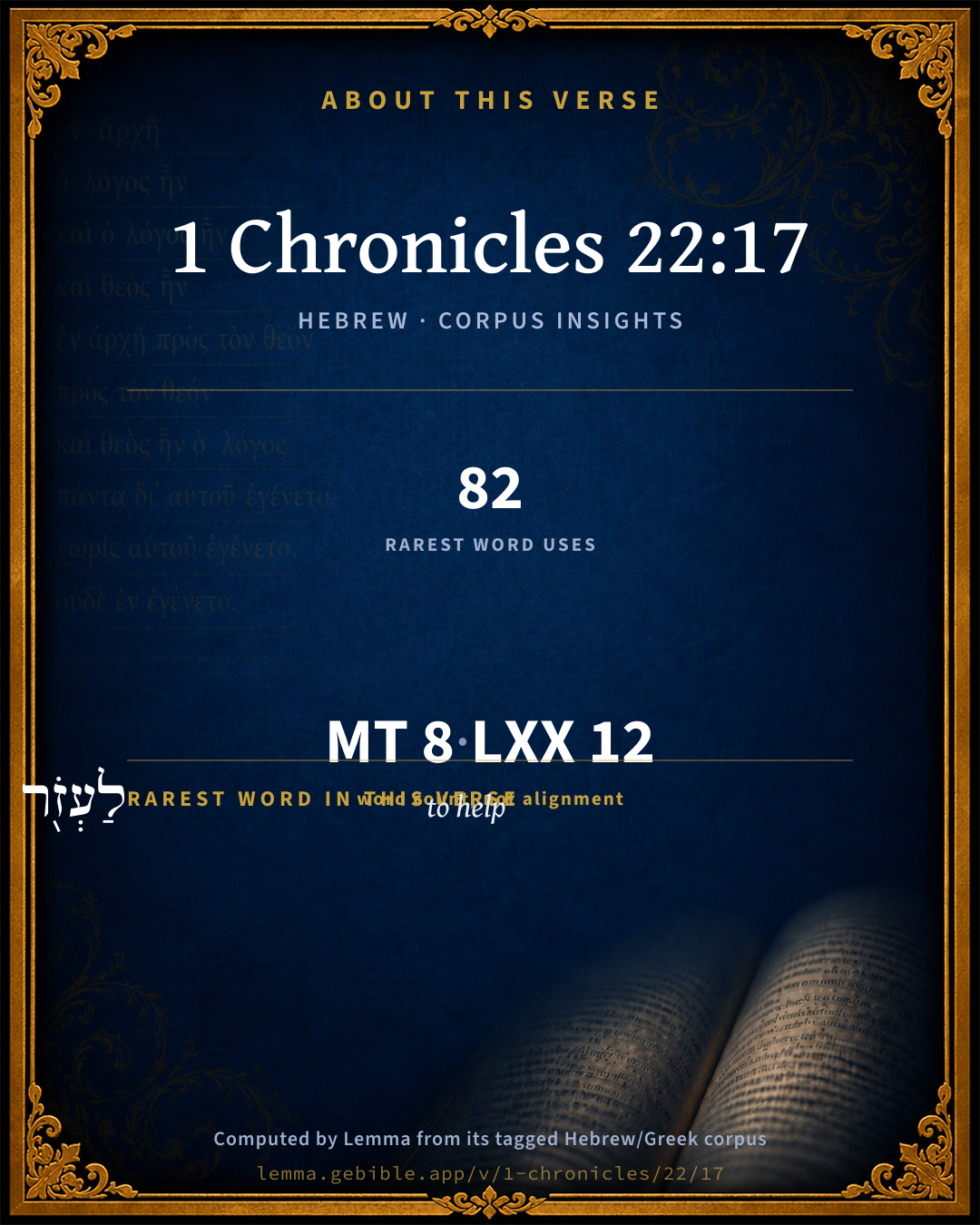
These counts appear in no published source. They are computed here, from the morphology-tagged text and Lemma’s own curated glosses. What Lemma adds →

8
words
8
distinct lemmas
Historical
section

Grammatical profile

  • 2 verbs
  • 6 nouns

Verb forms

  • וַיְצַ֤ו Piel · Sequential Imperfect
  • לַעְזֹ֖ר Qal · Infinitive Construct

Hebrew & Septuagint length

In English translation the verse runs 14 words from the Hebrew and 15 from the Septuagint (LXX English) — closely comparable.

A rough comparison of the two English renderings, which tokenize alike — not a word-level alignment.

Word counts can differ between the Hebrew and the Greek without any difference in meaning — e.g. the Hebrew direct-object marker אֵת has no separate Greek word, and Greek often adds the article ὁ.

In the original languages it is 8 Hebrew tokens and 12 Greek tokens — but the two are counted differently (Hebrew bundles its prefixes and suffixes into one token; the Greek is in lemma form), so that isn’t a like-for-like length.

Cross-references

6

Topical passages linked to 1 Chronicles 22:17 in the Treasury of Scripture Knowledge — connected by theme and wording, ordered by reader-vote popularity; previews shown in the World English Bible.

  • 1 Chronicles 28:1–6 David assembled all the princes of Israel, the princes of the tribes, and the captains of the companies who served the king by division, and the captains of thousands, and the captains of hundreds, and the rulers over all the substance and possessions of the king and of his sons, with the officers, and the mighty men, even all the mighty men of valor, to Jerusalem.
  • 1 Chronicles 28:21 Behold, there are the divisions of the priests and the Levites, for all the service of the house of God: and there shall be with you in all manner of work every willing man who has skill, for any manner of service: also the captains and all the people will be entirely at your command.
  • 1 Chronicles 29:6 Then the princes of the fathers' [houses], and the princes of the tribes of Israel, and the captains of thousands and of hundreds, with the rulers over the king's work, offered willingly;
  • Romans 16:2–3 that you receive her in the Lord, in a way worthy of the saints, and that you assist her in whatever matter she may need from you, for she herself also has been a helper of many, and of my own self.
  • Philippians 4:3 Yes, I beg you also, true yoke-fellow, help these women, for they labored with me in the Gospel, with Clement also, and the rest of my fellow workers, whose names are in the book of life.
  • 3 John 1:8 We therefore ought to receive such, that we may be fellow workers for the truth.

Cross-references courtesy of OpenBible.info (CC BY 4.0).

Hebrew and Greek witnesses Masoretic Hebrew ↔ Greek Septuagint

The same verse in the two great witnesses to the Old Testament, shown verse-for-verse.

These are two independent witnesses, not word-aligned to each other, and the Septuagint is shown in lemma (dictionary) form.

Hebrew 1 Chronicles 22:17 Masoretic · Westminster Leningrad Codex

וַיְצַ֤ו דָּוִיד֙ לְכָל שָׂרֵ֣י יִשְׂרָאֵ֔ל לַעְזֹ֖ר לִשְׁלֹמֹ֥ה בְנֽוֹ

David also commanded all the princes of Israel to help Solomon his son, [saying],

World English Bible · Public Domain

Greek LXX 1 Chronicles 22:17 Septuagint · lemma form

καί ἐντέλλομαι δαυίδ ὁ πᾶς ἄρχων ἰσραήλ ἀντιλαμβάνω ὁ σαλωμών υἱός αὐτός

And David charged all the chief men of Israel to help Solomon his son, saying,

LXX2012 (modern English Septuagint) · Public Domain

Hebrew: Westminster Leningrad Codex (CC BY 4.0). Greek: Septuagint (public domain); English from LXX2012 (modern English Septuagint) (Public Domain). How the Septuagint differs from the Hebrew →

Commentary

Notes on 1 Chronicles 22:17 from classic Christian and Jewish commentators (each source and its license shown beneath its notes). The classic Christian expositions comment on the surrounding passage and are grouped to its opening verse, so a note may address several verses; the Jewish commentaries on the Tanakh (Rashi and others) are per-verse, so they appear only where the commentator wrote on this verse.

Lemma curates 59 commentaries, every one of them public domain or Creative Commons licensed, each selected and text-cleaned for this edition rather than reprinted as found. About our sources →

Trapp's Complete Commentary

John Trapp

1Ch 22:17 David also commanded all the princes of Israel to help Solomon his son, [saying],

Ver. 17. David also commanded all the princes.] This he did out of his holy zeal, which is an extreme heat of all the affections.

John Trapp, A Commentary or Exposition upon All the Books of the Old and New Testament (1647–1656) — public domain. Text from a community e-Sword module.

Matthew Henry's Commentary

David here engages the princes of Israel to assist Solomon in the great work he had to do, and every one to lend him a hand towards the carrying of it on. Those that are in the throne cannot do the good they would, unless those about the throne set in with them. David would therefore have the princes to advise Solomon and quicken him, and make the work as easy to him as they could, by promoting it every one in his place. 1. He shows them what obligations they lay under to be zealous in this matter, in gratitude to God for the great things he had done for them. He had given them victory, and rest, and a good land for an inheritance, Ch1 22:18. The more God has done for us the more we should study to do for him. 2. He presses that upon them which should make them zealous in it (Ch1 22:19): "Set your heart and soul to seek God, place your happiness in his favour, and keep your eye upon his glory. Seek him as your chief good and highest end, and this with your heart and soul. Make religion your choice and business; and then you will grudge no pains nor cost to promote the building of his sanctuary." Let but the heart be sincerely engaged for God, and the head and hand, the estate and interest, and all will be cheerfully employed for him.

Matthew Henry's Commentary on the Whole Bible (1708–1710) — public domain (CC PDM 1.0). Text via the HelloAO Bible API.

Ellicott's Commentary for English Readers

(17) Saying.—The absence of this word from the Hebrew text may be compared with the like omission in 1Ch_16:7; 1Ch_23:4-5; 1Ch_28:19.

(17-19) David invites the cooperation of the chieftains of Israel.

A Bible Commentary for English Readers, edited by Charles John Ellicott (1878–1897) — public domain. Text from a community e-Sword module.

John Gill's Exposition

Is not the Lord your God with you?.... Blessing them with wealth and riches:

and hath he not given you rest on every side? from all enemies within and without; so that they had peace and quietness, and leisure to attend the service he recommended to them:

for he hath given the inhabitants of the land into my hand; meaning the rest of the Canaanites, who before were unsubdued, as even the Jebusites in Jerusalem:

and the land is subdued before the Lord, and before his people; and the extent of it carried to its utmost bounds, as God had promised.

John Gill's Exposition of the Whole Bible (1746–1763) — public domain (CC PDM 1.0). Text via the HelloAO Bible API.

The Pulpit Commentary

Vers. 17-19. These verses contain David"s command, accompanied by urgent argument, to the princes of Israel, to render their hearty assistance.

All the princes; i.e. those who held positions of authority as commanders, leaders, elders, heads of tribes, and chiefs of the fathers. (1Ch_27:22 1Ch_23:2 1Ch_28:1)

Vers. 17-19.

The wisdom of the strong.

We may take the "princes of Israel" as types and representatives of the strong men, the leaders in the kingdom, or Church, or society of which they are members, those who are responsible for the measures which are adopted, for the course which is chosen, for the principles which are professed. Thus regarding them, we may gather from the text

I THAT IT IS THE WISDOM OF THE STRONG TO GAIN THE FAVOUR OF GOD for themselves and for the community. "Set your heart and your soul to seek the Lord your God" (ver. 19); i.e. strenuously and perseveringly endeavour to gain God"s approval, to do his will and win his smile. That is the "beginning of wisdom" and the end of it, in all cases now, with all leaders everywhere. They are to do this by

(1) taking earnest heed to his revelation of himself;

(2) accepting him who is the Manifestation of his mind and will;

(3) fashioning their own lives and directing those of others according to his holy Word.

II THAT THE WISDOM OF THE STRONG IS IN MAKING THE MOST OF FAVOURABLE OPPORTUNITY. David urged the princes to activity on the ground that the time had come for action. "Is not the Lord your God with you? and hath he not given you rest on every side?" etc. (ver. 18). Now that the energy of the people needed not to be devoted to the art of war, it was most fitting that it should be given to the building of a house for the Lord. The time of peace is the hour of national industry and progress, when the useful arts and religious institutions should receive particular attention. It is the part of wise and conscientious leaders, in the Church as well as in the state, to watch for the time of opportunity, to make the utmost of the "golden hour," to strike when the blows will tell. Carefulness or negligence in this matter may make all the difference between success and failure. These are favourable times for

(1) reorganization,

(2) reconciliation,

(3) evangelization.

III THAT IT IS THE WISDOM OF THE STRONG TO BUILD UP THAT WHICH HOLDS THE MOST SACRED THINGS. "Build ye the sanctuary of the Lord God, to bring the ark of the covenant of the Lord, and the holy vessels of God, into the house" (ver. 19). The princes could do nothing better for Israel than build the house in which the ark would abide; for the Lord himself would dwell above the mercy-seat, and so long as Israel worshipped purely in the house they were building they might count on his presence and his favour. Our leaders do well to incite us to build

(1) houses of the Lord in which he himself will dwell, and receive the homage of his people and teach them his truth;

(2) institutions Churches, societies, families in which the holy principles Christ has taught us shall be incorporated;

(3) national character, which shall contain and embody those pure and righteous habits which are found in the lifo of the great Exemplar. These are of more value than all the "holy vessels" which David"s zeal could collect. C.

Vers. 17-19.

David"s charge to the princes of Israel.

After charging so solemnly his son, David turned to the princes of Israel, giving them an equally solemn charge to help his son Solomon in his great work. Every line of this charge to the princes is replete with spiritual instruction. The first line is a precious one: "Is not the Lord your God with you?" The presence of God is the Christian"s great power for all work. "Lo, I am with you alway, even to the end of the world." Moses knew its importance when he said, "If thy presence go not with us, lead us not up thence." The second line is equally precious: "Hath he not given you rest on every side?" The true Christian has indeed found "rest" in Christ the true David, and for the reason assigned here in David"s third line he hath given the inhabitants of the land the Canaanites into mine hand." Every enemy the child of God has is in the hand of Christ. Every sin he has committed, as well as the broken Law, and everything else that shut him out from God, have all been laid on Jesus. Everything that could injure or stand in the Christian"s way, in the present or in the future, is all in the hand of Jesus. "Subdued" is the word written by Christ"s cross on all his sins, on all his foes, on everything against him. Nay more: in all these things "he is more than conqueror through him that loved him." This being so, to what end is it all? David tells us: "Now set your heart and your soul to seek the Lord your God." Every affection, every desire, every energy, every aim, everything within us, is to be "set." And where? Christ-ward. On him who has done such great things for us. And does such grace tend to sloth or indifference? Far otherwise. "Arise therefore." Get up out of sloth, out of sin, out of earthliness of every kind. Get higher. "Nearer my God to thee, nearer to thee." And how is this rising to show itself? "Build ye the sanctuary." Let every thought and energy, every heart and every hand, be put to build up the kingdom of God the true sanctuary of God in this world. And the last word in this charge is the climax the great end to which everything points: "Build ye the sanctuary of the Lord God, to bring the ark of the covenant of the Lord, and the holy vessels of God into the house that is to be built to the Name of the Lord." Observe the sanctuary was fur this end bring in the ark of the covenant and the holy vessels." So is it now. That ark is Christ. The "holy vessels" are everything that pertains to that ark. This is the great end of every building to bring in Christ and everything that is of Christ. Is the sanctuary the believer"s soul? Then let Christ and everything Christlike be brought in there. Is the "sanctuary" a Church any of the Churches of Christ or the entire Church the body of Christ? Then see that the ark is brought in and its vessels-Christ and everything that will glorify him. The house was "to be built to the Name of the Lord." This Name is on the Christian, on every Christian Church, on every Christian duty, on every Christian nation, on every Christian work. See that the ark and its vessels are where the name is. See that we have not the name without the ark and its vessels. We may have the name in baptism, in the Holy Communion, in the Church and its ordinances, but the grand question is, "Are the ark and its vessels there? W.

The Pulpit Commentary (1880–1919), ed. H.D.M. Spence-Jones & Joseph S. Exell — public domain. Text from a community e-Sword module.

Keil & Delitzsch

C. F. Keil & F. Delitzsch

Is not the Lord your God with you?.... Blessing them with wealth and riches:

and hath he not given you rest on every side? from all enemies within and without; so that they had peace and quietness, and leisure to attend the service he recommended to them:

for he hath given the inhabitants of the land into my hand; meaning the rest of the Canaanites, who before were unsubdued, as even the Jebusites in Jerusalem:

and the land is subdued before the Lord, and before his people; and the extent of it carried to its utmost bounds, as God had promised.

Keil & Delitzsch — Biblical Commentary on the Old Testament (1861–1891) — public domain (CC PDM 1.0). Text via the HelloAO Bible API. (Old Testament only.)

unfoldingWord translationNotes

Door43 World Missions Community

Yahweh your God is with you

This is an idiom that implies that Yahweh will help Israel to prosper. (See: Idiom)

your ... you

These pronouns are plural in 1 Chronicles 22:18-19. (See: Forms of You)

has given you peace on every side

"has caused all the nations who live around Israel to live peacefully with you"

He has given the region's inhabitants into my hand

Here "hand" refers to power to defeat his enemies. AT: "He has given me power over everyone who lives around us" (See: Metonymy)

The region is subdued before Yahweh and his people

This can be stated in active form. "The other nations no longer attack Yahweh and his people" (See: Active or Passive)

Now

This word introduces something important that David is about to say.

seek Yahweh your God

Seeking Yahweh represents either 1) asking God for help or 2) thinking about God and obeying him. (See: Metaphor)

with all your heart and your soul

Here "heart" and "soul" refer to the whole person. AT: "with your whole being" (See: Synecdoche)

Get up and build the holy place

It is understood that Solomon will not do the work personally, but he will direct others to do it. AT: "Get up and direct the workers as they build the holy place" (See: Metonymy)

the house built for Yahweh's name

Here "name" refers to honor. This can be stated in active form. AT: "the temple you will build to honor Yahweh" (See: Metonymy and Active or Passive)

translationWords

David

Israel

Solomon

peace

hand

holy place

ark of the covenant

house of God

name

unfoldingWord translationNotes — © Distant Shores Media and the Door43 World Missions Community, licensed CC BY-SA 4.0. Source: git.door43.org/Door43/en_tn.

Lesson kit

Teaching starters — assembled from the data on this page, not authored interpretation. Every prompt links to the verse data it draws on. Edit before teaching.

1 Chronicles, in the Historical, opens this verse with 8 words (8 distinct Hebrew lemmas). Its most distinctive word is ʻâzar (“to help”). A historical commentator’s framing appears above. Read the whole chapter for the surrounding context.

Discussion questions

  1. The word ʻâzar carries the sense “to help.” How does it shape the verse?
  2. How does 1 Chronicles 28:1–6, which shares this passage’s theme, read alongside this verse?
  3. The translations on this page render this verse differently — a whole-verse word diff, not a word-by-word alignment. What might account for the different wordings?
  4. «וַיְצַ֤ו» is a Piel Sequential Imperfect verb. How does that grammatical form shape the action described?
  5. Compare how Trapp's Complete Commentary and Matthew Henry's Commentary read this verse. Where do they agree or differ?

Things to notice

Reading settings

Reading text

Shown beneath each verse's original-language words.

Old Testament
Old Testament edition

Read the OT as the Masoretic Hebrew (MT) or the Greek Septuagint (LXX).

English shown for the Greek Septuagint (in the Hebrew ↔ Greek comparison).

Comparing translations? Open the Compare panel on any verse page to stack up to four side by side.