1 Chronicles 29:24

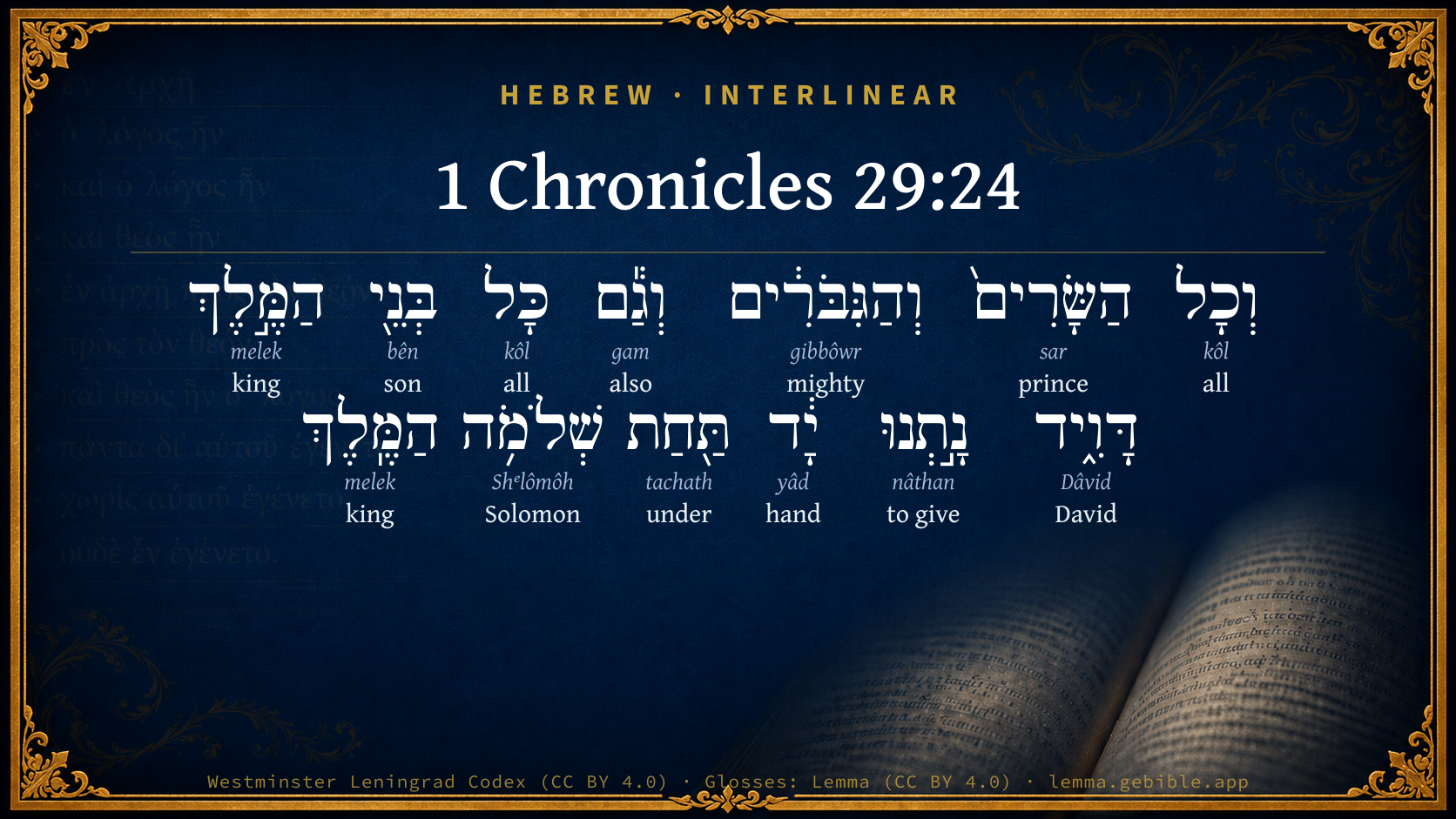
Hebrew (Westminster Leningrad Codex) 1 Chronicles 29:24 appears in the Hebrew Old Testament. The text above is from the Westminster Leningrad Codex. Each word links to its Strong’s number, a concise gloss, and parsing drawn from the Open Scriptures Hebrew Bible morphology. Click any word for its full Brown-Driver-Briggs (BDB) entry.
Download image
Cite this verse

1 Chronicles 29:24 (World English Bible). Public Domain. Lemma interlinear Bible study tool, https://lemma.gebible.app/v/1-chronicles/29/24.

Show BibTeX & RIS
BibTeX
RIS
English Translation
All the princes, the mighty men, and also all of the sons of king David submitted themselves to Solomon the king.
World English Bible · Public Domain
Download a study sheet

One document with this verse’s original text, its word-by-word gloss line, the meaning frame, cross-references with their text, attributed commentary, and full source and license credits — printable, and it pastes into notes with its structure intact.

This verse Autodidact and up

Study sheet (.html) Plain text (.txt)

A passage Seminary Student

Up to 50 verses in one chapter. A passage sheet keeps up to 6 commentary sources and 12 cross-references per verse, in the order this page ranks them, and says so on the sheet whenever that leaves anything out. Ask for a single verse and you get the Autodidact verse sheet above.

Everything on this page stays free to read, with no account — the sheet is a download of what is already on screen, not access to it.

Want to remove ads? Support Godless Engineer
Compare translations 3

The same verse in 3 English versions, stacked beneath the original-language interlinear above. Click any original word for its lexicon entry.

Each is an independent rendering of the whole verse — the interlinear is not word-aligned to these translations.

Highlighted words mark where these versions differ — a whole-verse word diff, not a word-by-word alignment.

  • World English Bible Public Domain
    All the princes, the mighty men, and also all of the sons of king David submitted themselves to Solomon the king.
  • King James Version Public Domain
    And all the princes, and the mighty men, and all the sons likewise of king David, submitted themselves unto Solomon the king.
  • unfoldingWord Literal Text CC BY-SA 4.0
    And all of the leaders and the warriors and also all of the sons of King David gave a hand under King Solomon.

unfoldingWord Literal Text — © unfoldingWord, licensed CC BY-SA 4.0. Word-aligned USFM3 via Door43 (git.door43.org/unfoldingWord/en_ult).

Versions to compare (up to 4)

3 of 4 selected

Show all 18 translations

Every available English version of this verse, each an independent rendering of the whole verse.

  • World English Bible Public Domain
    All the princes, the mighty men, and also all of the sons of king David submitted themselves to Solomon the king.
  • Berean Standard Bible Public Domain
    All the officials and mighty men, as well as all of King David’s sons, pledged their allegiance to King Solomon.
  • Majority Standard Bible Public Domain
    All the officials and mighty men, as well as all of King David’s sons, pledged their allegiance to King Solomon.
  • King James Version Public Domain
    And all the princes, and the mighty men, and all the sons likewise of king David, submitted themselves unto Solomon the king.
  • American Standard Version (1901) Public Domain
    And all the princes, and the mighty men, and all the sons likewise of king David, submitted themselves unto Solomon the king.
  • Revised Version (1885) Public Domain
    And all the princes, and the mighty men, and all the sons likewise of king David, submitted themselves unto Solomon the king.
  • Geneva Bible (1599) Public Domain
    And all the princes and men of power, and all the sonnes of King Dauid submitted them selues vnder King Salomon.
  • Douay-Rheims (1899) Public Domain
    And all the princes, and men of power, and all the sons of king David gave their hand, and were subject to Solomon the king.
  • Young's Literal Translation Public Domain
    and all the heads, and the mighty men, and also all the sons of king David have given a hand under Solomon the king;
  • Literal Standard Version CC BY-SA 4.0
    and all the heads, and the mighty men, and also all the sons of King David have given a hand under Solomon the king;
  • Unlocked Literal Bible CC BY-SA 4.0
    All the leaders, soldiers, and King David's sons gave allegiance to King Solomon.
  • unfoldingWord Literal Text CC BY-SA 4.0
    And all of the leaders and the warriors and also all of the sons of King David gave a hand under King Solomon.
  • Darby Bible Public Domain
    And all the princes, and the mighty men, and all the sons likewise of king David, submitted themselves to Solomon the king.
  • World Messianic Bible Public Domain
    All the princes, the mighty men, and also all of the sons of King David submitted themselves to Solomon the king.
  • Webster's Bible Public Domain
    And all the princes, and the mighty men, and all the sons likewise of king David, submitted themselves to Solomon the king.
  • Free Bible Version CC BY-SA 4.0
    All the officials and warriors, as well as all of King David's sons, gave a solemn promise of loyalty to King Solomon.
  • Bible in Basic English Public Domain
    And all the chiefs and the men of war and all the sons of King David put themselves under the authority of Solomon the king.
  • JPS Tanakh (1917) Public Domain
    And all the princes, and the mighty men, and all the sons likewise of king David, submitted themselves unto Solomon the king.

Literal Standard Version (2020), Covenant Press — licensed CC BY-SA 4.0. Text via the HelloAO Bible API (eBible.org). Unlocked Literal Bible (unfoldingWord) — licensed CC BY-SA 4.0. Text via the HelloAO Bible API (eBible.org). unfoldingWord Literal Text — © unfoldingWord, licensed CC BY-SA 4.0. Word-aligned USFM3 via Door43 (git.door43.org/unfoldingWord/en_ult). Free Bible Version, Dr. Jonathan Gallagher — licensed CC BY-SA 4.0. Text via the HelloAO Bible API (eBible.org).

Word by word

More ways to search: Search by grammar → Find every occurrence → Compare this word →

Practice this passage: Drill this verse → Learn its vocabulary →

וְהַגִּבֹּרִ֔ים
gibbôwr
H1368
“and · the · mighty”
Conjunction + Particle, Definite Article + Adjective, Adjective, Masculine, Plural, Absolute
Part of Speech
Conjunction + Particle + Adjective
Type
Adjective
Gender
Masculine
Number
Plural
State
Absolute
Full BDB Definition

Origin: intensive from H1396

TWOT: 310b

strong, mighty (adjective) - strong man, brave man, mighty man (noun masculine)
  1. וְכָל kôl H3605 “and · all of” Conjunction + Noun, Common, Masculine, Singular, Construct
  2. הַשָּׂרִים֙ sar H8269 “the · princes” Particle, Definite Article + Noun, Common, Masculine, Plural, Absolute
  3. וְגַ֕ם gam H1571 “and · also” Conjunction + Particle, Accusative
  4. כָּל kôl H3605 “all of” Noun, Common, Masculine, Singular, Construct
  5. בְּנֵ֖י bên H1121 “sons of” Noun, Common, Masculine, Plural, Construct
  6. הַמֶּ֣לֶךְ melek H4428 “the · king” Particle, Definite Article + Noun, Common, Masculine, Singular, Absolute
  7. דָּוִ֑יד Dâvid H1732 “David” Noun, Proper
  8. נָ֣תְנוּ nâthan H5414 “to give” Verb, Qal, Perfect, 3rd Person, Common, Plural
  9. יָ֔ד yâd H3027 “hand” Noun, Common, Both, Singular, Absolute
  10. תַּ֖חַת tachath H8478 “under” Preposition
  11. שְׁלֹמֹ֥ה Shᵉlômôh H8010 “Solomon” Noun, Proper
  12. הַמֶּֽלֶךְ melek H4428 “the · king” Particle, Definite Article + Noun, Common, Masculine, Singular, Absolute

About this verse

These counts appear in no published source. They are computed here, from the morphology-tagged text and Lemma’s own curated glosses. What Lemma adds →

13
words
11
distinct lemmas
Historical
section

Grammatical profile

  • 1 verb
  • 9 nouns
  • 1 adjective
  • 1 preposition
  • 1 particle

Verb forms

  • נָ֣תְנוּ Qal · Perfect

Repetition

Words recur within this verse — often emphatic in Hebrew:

  • וְכָל all H3605 ×2
  • הַמֶּ֣לֶךְ king H4428 ×2

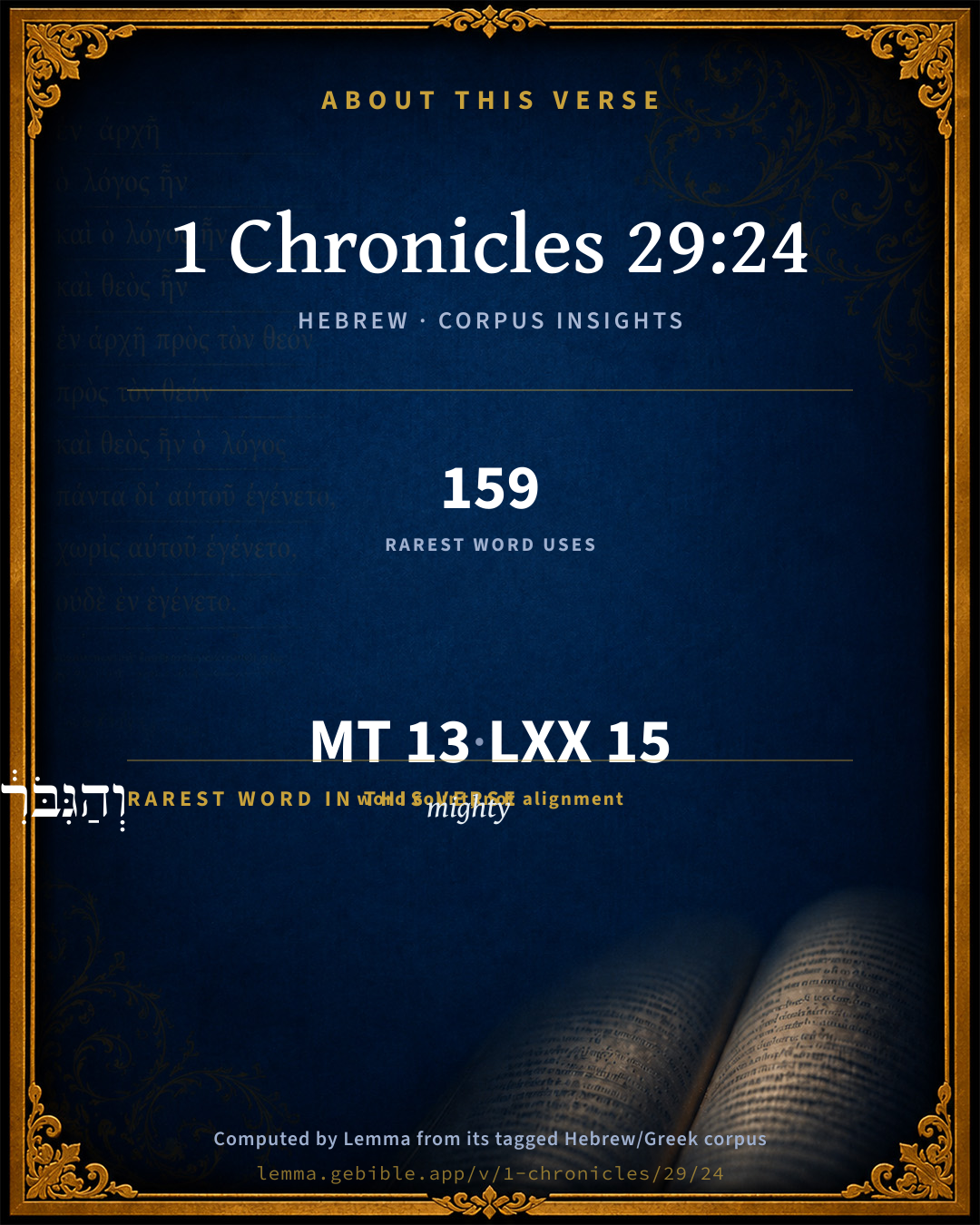
Hebrew & Septuagint length

In English translation the verse runs 21 words from the Hebrew and 19 from the Septuagint (LXX English) — closely comparable.

A rough comparison of the two English renderings, which tokenize alike — not a word-level alignment.

Word counts can differ between the Hebrew and the Greek without any difference in meaning — e.g. the Hebrew direct-object marker אֵת has no separate Greek word, and Greek often adds the article ὁ.

In the original languages it is 13 Hebrew tokens and 15 Greek tokens — but the two are counted differently (Hebrew bundles its prefixes and suffixes into one token; the Greek is in lemma form), so that isn’t a like-for-like length.

Cross-references

9

Topical passages linked to 1 Chronicles 29:24 in the Treasury of Scripture Knowledge — connected by theme and wording, ordered by reader-vote popularity; previews shown in the World English Bible.

  • Genesis 24:2 Abraham said to his servant, the elder of his house, who ruled over all that he had, "Please put your hand under my thigh.
  • Genesis 47:29 The time drew near that Israel must die, and he called his son Joseph, and said to him, "If now I have found favor in your sight, please put your hand under my thigh, and deal kindly and truly with me. Please don't bury me in Egypt,
  • 1 Kings 1:50–53 Adonijah feared because of Solomon; and he arose, and went, and caught hold on the horns of the altar.
  • 1 Kings 2:24–25 Now therefore as Yahweh lives, who has established me, and set me on the throne of David my father, and who has made me a house, as he promised, surely Adonijah shall be put to death this day.
  • 1 Chronicles 2:3–9 The sons of Judah: Er, and Onan, and Shelah; which three were born to him of Shua's daughter the Canaanitess. Er, Judah's firstborn, was wicked in the sight of Yahweh; and he killed him.
  • 1 Chronicles 22:17 David also commanded all the princes of Israel to help Solomon his son, [saying],
  • 1 Chronicles 28:21 Behold, there are the divisions of the priests and the Levites, for all the service of the house of God: and there shall be with you in all manner of work every willing man who has skill, for any manner of service: also the captains and all the people will be entirely at your command.
  • 2 Chronicles 30:8 Now don't you be stiff-necked, as your fathers were; but yield yourselves to Yahweh, and enter into his sanctuary, which he has sanctified forever, and serve Yahweh your God, that his fierce anger may turn away from you.
  • Ezekiel 17:18 For he has despised the oath by breaking the covenant; and behold, he had given his hand, and yet has done all these things; he shall not escape.

Cross-references courtesy of OpenBible.info (CC BY 4.0).

Hebrew and Greek witnesses Masoretic Hebrew ↔ Greek Septuagint

The same verse in the two great witnesses to the Old Testament, shown verse-for-verse.

These are two independent witnesses, not word-aligned to each other, and the Septuagint is shown in lemma (dictionary) form.

Hebrew 1 Chronicles 29:24 Masoretic · Westminster Leningrad Codex

וְכָל הַשָּׂרִים֙ וְהַגִּבֹּרִ֔ים וְגַ֕ם כָּל בְּנֵ֖י הַמֶּ֣לֶךְ דָּוִ֑יד נָ֣תְנוּ יָ֔ד תַּ֖חַת שְׁלֹמֹ֥ה הַמֶּֽלֶךְ

All the princes, the mighty men, and also all of the sons of king David submitted themselves to Solomon the king.

World English Bible · Public Domain

Greek LXX 1 Chronicles 29:24 Septuagint · lemma form

ὁ ἄρχων καί ὁ δυνάστης καί πᾶς υἱός ὁ βασιλεύς δαυίδ πατήρ αὐτός ὑποτάσσω αὐτός

The princes, and the mighty men, and all the sons of king David his father, were subject to him.

LXX2012 (modern English Septuagint) · Public Domain

On this verse, Haydock's Catholic Bible Commentary discusses the Septuagint’s reading. Read the note in Commentary ↓

Hebrew: Westminster Leningrad Codex (CC BY 4.0). Greek: Septuagint (public domain); English from LXX2012 (modern English Septuagint) (Public Domain). How the Septuagint differs from the Hebrew →

Commentary

Notes on 1 Chronicles 29:24 from classic Christian and Jewish commentators (each source and its license shown beneath its notes). The classic Christian expositions comment on the surrounding passage and are grouped to its opening verse, so a note may address several verses; the Jewish commentaries on the Tanakh (Rashi and others) are per-verse, so they appear only where the commentator wrote on this verse.

Lemma curates 59 commentaries, every one of them public domain or Creative Commons licensed, each selected and text-cleaned for this edition rather than reprinted as found. About our sources →

Trapp's Complete Commentary

John Trapp

1Ch 29:24 And all the princes, and the mighty men, and all the sons likewise of king David, submitted themselves unto Solomon the king.

Ver. 24. And all the sons likewise of king David.] This was much, since some of them were his elder brethren, and came of more noble mothers; but David had so clearly convinced them of God’s will that Solomon should succeed him, and God in addition so wrought their hearts, that after Adonijah’s death they all submitted themselves unto Solomon the king. Heb., Gave the hand under Solomon the king; haply they laid their hand under his thigh - that ancient ceremony, {Gen 24:2; Gen 47:29} - and sware to be faithful to him.

John Trapp, A Commentary or Exposition upon All the Books of the Old and New Testament (1647–1656) — public domain. Text from a community e-Sword module.

Joseph Benson's Commentary

1Ch 29:24. And all the sons likewise of David submitted themselves unto Solomon — Hebrew, gave, or put the hand under Solomon, that is, owned him for their king, and themselves for his subjects, and bound themselves by oath to be true to him, which they possibly did, according to the ancient ceremony used in swearing, mentioned Gen 24:2; Gen 47:29; or rather, the thing is signified by a phrase, taken from that practice formerly used, though now neglected: it being usual in all nations and languages to express present things by phrases taken from ancient customs. Though, by seniority, the title of David’s other sons to the crown was prior to that of Solomon, and they might think themselves wronged by his advancement; yet, because God was pleased to make him king, and had qualified him for that high office, they all submitted themselves to him, God doubtless inclining their hearts to do so, that Solomon’s reign might from the first be peaceable.

Joseph Benson's Commentary on the Old and New Testaments (1811–1818) — public domain. Text from a community e-Sword module.

Geneva Bible (1599)

Geneva Bible translators

Hebrew, gave the hand.

Geneva Bible (1599) marginal notes — public domain. Text via Bolls.life.

Jamieson, Fausset & Brown

Robert Jamieson, A. R. Fausset & David Brown

submitted themselves--Hebrew, "put their hands under Solomon," according to the custom still practised in the East of putting a hand under the king's extended hand and kissing the back of it (Kg2 10:15).

Jamieson, Fausset & Brown — Commentary Critical and Explanatory on the Whole Bible (1871) — public domain (CC PDM 1.0). Text via the HelloAO Bible API.

Adam Clarke's Commentary

Verse 24. Submitted themselves] נתנו יד תחת שלמה nathenu yad tachath Shelomoh. "They gave the hand under Solomon;" they swore fealty to him. We have already seen that putting the hand under the thigh (super sectionem circumcisionis) was the form of taking an oath. See Clarke on Ge 24:9.

Adam Clarke's Commentary on the Bible (1810–1826) — public domain. Text from a community e-Sword/MySword module.

Ellicott's Commentary for English Readers

(24) And all the princes (sârîm).—The grandees of 1Ch_27:1-34; 1Ch_28:1; 1Ch_29:6; not members of the royal house, who are designated as “the king’s sons.”

Submitted themselves.—See marginal rendering. The Vulg. has the exegetical expansion, “dederunt manum et subjeeti fuerunt Salomoni regi.” The Hebrew phrase “put (nâthan) hand under . . .” is not met with elsewhere. (Comp. Gen_24:2; Gen_24:9.) It appears to be different from “give hand to . . .” in token of good faith or submission. (Comp. 2Ch_30:8; Lam_5:6; Eze_17:18.) An ancient mode of doing homage may be intended. The whole sentence may contain an allusive reference to the attempt of Adonijah (1Ki_1:5-53).

A Bible Commentary for English Readers, edited by Charles John Ellicott (1878–1897) — public domain. Text from a community e-Sword module.

The Cambridge Bible for Schools and Colleges

gen. ed. J. J. S. Perowne

24. the mighty men] Cp. 1Ki_1:10; 1Ki_1:38, from which it is clear that the faithfulness of Benaiah and the Cherethites and Pelethites was the main factor in the elevation of Solomon.

all the sons] The Chronicler glances at the submission of Adonijah (1Ki_1:53).

The Cambridge Bible for Schools and Colleges (gen. ed. J. J. S. Perowne; Cambridge University Press, 1878–1918) — public domain. Text from a community e-Sword module.

John Gill's Exposition

And the Lord magnified Solomon exceedingly before all Israel,.... By giving him such a large share of wisdom and understanding in government:

and bestowed upon him such royal majesty; not only such wealth and riches, but such honour and reverence:

as had not been on any king before him in Israel; not on Saul, nor even on David.

John Gill's Exposition of the Whole Bible (1746–1763) — public domain (CC PDM 1.0). Text via the HelloAO Bible API.

Haydock's Catholic Bible Commentary

Gave. Hebrew, "placed their hands upon Solomon." Septuagint, "were subject to him." (Calmet) --- The latter words in the Vulgate explain the meaning of the ceremony. (Menochius) --- It seems to have been similar to that used by Abraham required an oath of his servant, Genesis xxiv. 2. Vassals placed their hands within those of their Lord, under whom they hold lands; (Calmet) and the descendants of the Germans testify their submission, by putting their hands between a person’s knees. --- The nobles took the oath of fidelity to Solomon, by some such method. (Calmet)

George Leo Haydock (1774–1849), Haydock's Catholic Family Bible and Commentary, 1859 edition — public domain. Excludes Psalms (Douay-Rheims chapter numbering differs from Protestant) and Deuterocanonical books (Catholic canon only).

Matthew Poole's English Annotations

Heb. Put their hands under Solomon, i.e. they owned him for their king, and themselves for his subjects, and swore fealty to him; which possibly they now did after the ancient manner, with that ceremony of putting their hands under his thigh, which was used in swearing, Gen 24:2; 47:29; or at least the thing is signified by a phrase taken from that practice formerly used, though now neglected; it being usual in all nations and languages to signify present things by phrases taken from ancient customs.

Matthew Poole's English Annotations on the Holy Bible (1683–1685) — public domain. Text from a community e-Sword/MySword module.

John Wesley's Explanatory Notes

Of the Lord - On the throne of Israel, which is called the throne of the Lord, because the Lord himself was in a peculiar manner the king and governor of Israel. He had the founding, he had the filling of their throne, by immediate direction.

John Wesley, Explanatory Notes Upon the Whole Bible (1754–1765) — public domain. Text via the GEBible commentary corpus.

Keil & Delitzsch

C. F. Keil & F. Delitzsch

And the Lord magnified Solomon exceedingly before all Israel,.... By giving him such a large share of wisdom and understanding in government:

and bestowed upon him such royal majesty; not only such wealth and riches, but such honour and reverence:

as had not been on any king before him in Israel; not on Saul, nor even on David.

Keil & Delitzsch — Biblical Commentary on the Old Testament (1861–1891) — public domain (CC PDM 1.0). Text via the HelloAO Bible API. (Old Testament only.)

unfoldingWord translationNotes

Door43 World Missions Community

gave allegiance to King Solomon

"told King Solomon that they would be faithful to him"

Yahweh greatly honored Solomon before all Israel ... bestowed on him greater power

These two phrases emphasize that Solomon received special favor from Yahweh, which made him Israel's greatest and most powerful king. (See: Parallelism)

translationWords

David

Yahweh

honor

power

unfoldingWord translationNotes — © Distant Shores Media and the Door43 World Missions Community, licensed CC BY-SA 4.0. Source: git.door43.org/Door43/en_tn.

Rashi

Rabbi Shlomo Yitzchaki (Rashi)

And all the leaders and the mighty men unlike Adoniah, as it is written (I Kings 1:8): “... and David’s mighty men were not with Adoniah.”

and also all King David’s sons placed their hand unlike Adoniah, under whom they did not place their hand.

placed their hand In faith they gave their handclasp to Solomon to serve him wholeheartedly.

Rashi on the Tanakh — English translations: “The Judaica Press complete Tanach with Rashi, translated by A. J. Rosenberg” (CC BY 4.0); “Pentateuch with Rashi's commentary by M. Rosenbaum and A.M. Silbermann, 1929-1934” (public domain); “The Metsudah Tanach series, Lakewood, N.J” (CC BY 4.0); and “The Book of Joshua, Metsudah Publications, 1997” (CC BY 4.0). Text via Sefaria.

Lesson kit

Teaching starters — assembled from the data on this page, not authored interpretation. Every prompt links to the verse data it draws on. Edit before teaching.

1 Chronicles, in the Historical, opens this verse with 13 words (11 distinct Hebrew lemmas). Its most distinctive word is gibbôwr (“mighty”). A historical commentator’s framing appears above. Read the whole chapter for the surrounding context.

Discussion questions

  1. What does “mighty” (gibbôwr) contribute to the verse as a whole?
  2. Genesis 24:2 shares this passage’s theme. How do the two illuminate each other?
  3. “all” occurs 2× in this one verse. What is the effect of the repetition?
  4. The translations on this page render this verse differently — a whole-verse word diff, not a word-by-word alignment. What might account for the different wordings?
  5. The verb «נָ֣תְנוּ» is Qal Perfect. How does its form color the action?
  6. Reading how Trapp's Complete Commentary and Joseph Benson's Commentary read this verse, where do the two commentators agree and where do they part?

Things to notice

Reading settings

Reading text

Shown beneath each verse's original-language words.

Old Testament
Old Testament edition

Read the OT as the Masoretic Hebrew (MT) or the Greek Septuagint (LXX).

English shown for the Greek Septuagint (in the Hebrew ↔ Greek comparison).

Comparing translations? Open the Compare panel on any verse page to stack up to four side by side.