
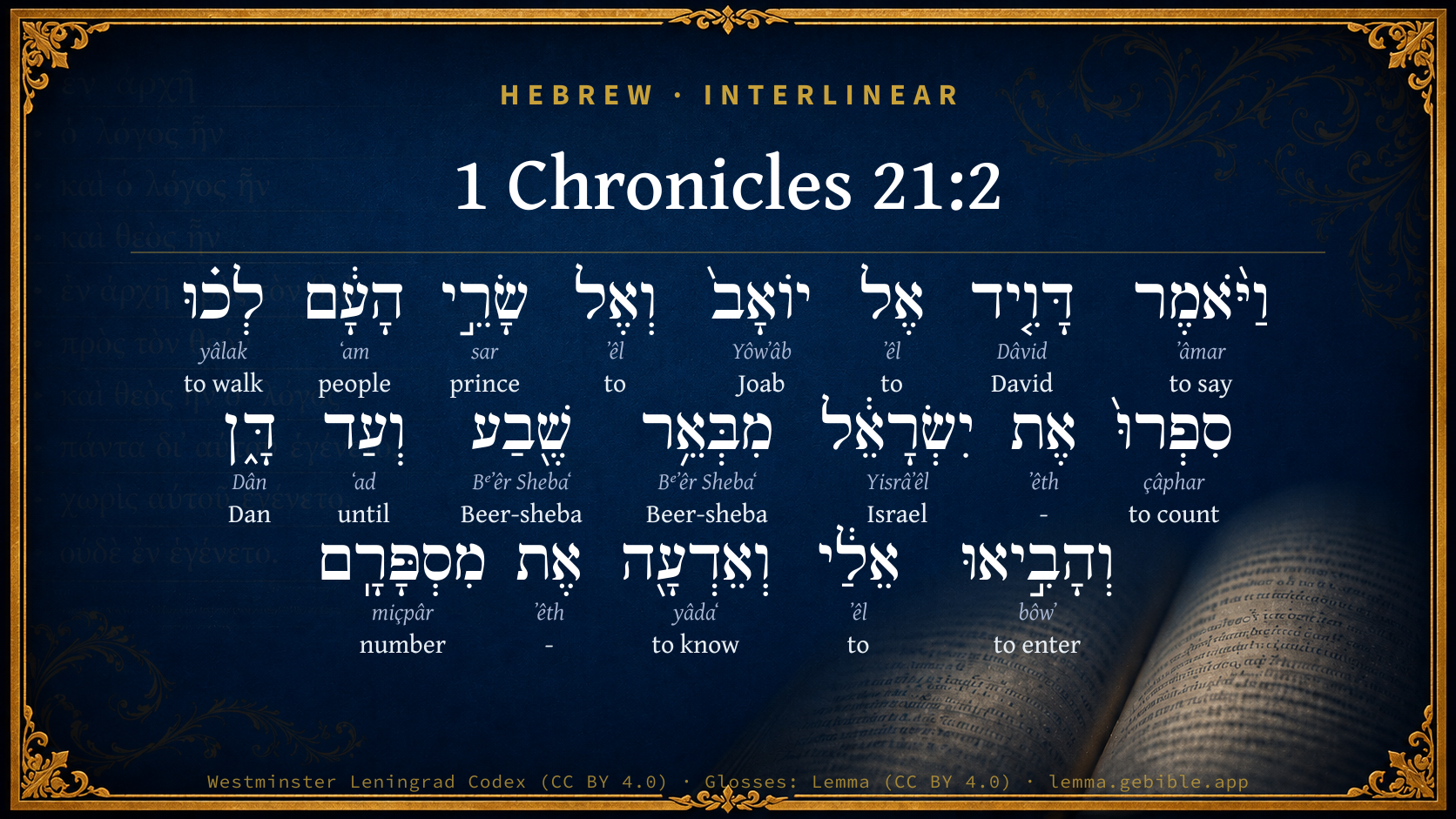
1 Chronicles 21:2

Hebrew (Westminster Leningrad Codex) 1 Chronicles 21:2 appears in the Hebrew Old Testament. The text above is from the Westminster Leningrad Codex. Each word links to its Strong’s number, a concise gloss, and parsing drawn from the Open Scriptures Hebrew Bible morphology. Click any word for its full Brown-Driver-Briggs (BDB) entry.
Download image
Cite this verse

1 Chronicles 21:2 (World English Bible). Public Domain. Lemma interlinear Bible study tool, https://lemma.gebible.app/v/1-chronicles/21/2.

Show BibTeX & RIS
BibTeX
RIS
English Translation
David said to Joab and to the princes of the people, Go, number Israel from Beersheba even to Dan; and bring me word, that I may know the sum of them.
World English Bible · Public Domain
Download a study sheet

One document with this verse’s original text, its word-by-word gloss line, the meaning frame, cross-references with their text, attributed commentary, and full source and license credits — printable, and it pastes into notes with its structure intact.

This verse Autodidact and up

Study sheet (.html) Plain text (.txt)

A passage Seminary Student

Up to 50 verses in one chapter. A passage sheet keeps up to 6 commentary sources and 12 cross-references per verse, in the order this page ranks them, and says so on the sheet whenever that leaves anything out. Ask for a single verse and you get the Autodidact verse sheet above.

Everything on this page stays free to read, with no account — the sheet is a download of what is already on screen, not access to it.

Want to remove ads? Support Godless Engineer
Compare translations 3

The same verse in 3 English versions, stacked beneath the original-language interlinear above. Click any original word for its lexicon entry.

Each is an independent rendering of the whole verse — the interlinear is not word-aligned to these translations.

Highlighted words mark where these versions differ — a whole-verse word diff, not a word-by-word alignment.

  • World English Bible Public Domain
    David said to Joab and to the princes of the people, Go, number Israel from Beersheba even to Dan; and bring me word, that I may know the sum of them.
  • King James Version Public Domain
    And David said to Joab and to the rulers of the people, Go, number Israel from Beersheba even to Dan; and bring the number of them to me, that I may know it.
  • unfoldingWord Literal Text CC BY-SA 4.0
    And David said to Joab and to the commanders of the people, “Go, count Israel from Beersheba and to Dan, and bring to me, that I may know their number.”

unfoldingWord Literal Text — © unfoldingWord, licensed CC BY-SA 4.0. Word-aligned USFM3 via Door43 (git.door43.org/unfoldingWord/en_ult).

Versions to compare (up to 4)

3 of 4 selected

Show all 18 translations

Every available English version of this verse, each an independent rendering of the whole verse.

  • World English Bible Public Domain
    David said to Joab and to the princes of the people, Go, number Israel from Beersheba even to Dan; and bring me word, that I may know the sum of them.
  • Berean Standard Bible Public Domain
    So David said to Joab and the commanders of the troops, “Go and count the Israelites from Beersheba to Dan and bring me a report, so that I may know their number.”
  • Majority Standard Bible Public Domain
    So David said to Joab and the commanders of the troops, “Go and count the Israelites from Beersheba to Dan and bring me a report, so that I may know their number.”
  • King James Version Public Domain
    And David said to Joab and to the rulers of the people, Go, number Israel from Beersheba even to Dan; and bring the number of them to me, that I may know it.
  • American Standard Version (1901) Public Domain
    And David said to Joab and to the princes of the people, Go, number Israel from Beer-sheba even to Dan; and bring me word, that I may know the sum of them.
  • Revised Version (1885) Public Domain
    And David said to Joab and to the princes of the people, Go, number Israel from Beer-sheba even to Dan; and bring me word, that I may know the sum of them.
  • Geneva Bible (1599) Public Domain
    Therefore Dauid said to Ioab, and to the rulers of the people, Go, and nomber Israel from Beer-sheba euen to Dan, and bring it to me, that I may knowe the nomber of them.
  • Douay-Rheims (1899) Public Domain
    And David said to Joab, and to the rulers of the people: Go, and number Israel from Bersabee even to Dan, and bring me the number of them that I may know it.
  • Young's Literal Translation Public Domain
    And David saith unto Joab, and unto the heads of the people, `Go, number Israel from Beer-Sheba even unto Dan, and bring unto me, and I know their number.'
  • Literal Standard Version CC BY-SA 4.0
    and David says to Joab and to the heads of the people, “Go, number Israel from Beer-Sheba even to Dan, and bring [the account] to me, and I know their number.”
  • Unlocked Literal Bible CC BY-SA 4.0
    David said to Joab and to the commanders of the army, “Go, count the people of Israel from Beersheba to Dan and report back to me, that I may know their number.”
  • unfoldingWord Literal Text CC BY-SA 4.0
    And David said to Joab and to the commanders of the people, “Go, count Israel from Beersheba and to Dan, and bring to me, that I may know their number.”
  • Darby Bible Public Domain
    And David said to Joab and to the princes of the people, Go, number Israel from Beer-sheba even to Dan; and bring the number of them to me, that I may know it.
  • World Messianic Bible Public Domain
    David said to Joab and to the princes of the people, “Go, count Israel from Beersheba even to Dan; and bring me word, that I may know how many there are.”
  • Webster's Bible Public Domain
    And David said to Joab and to the rulers of the people, Go, number Israel from Beer-sheba even to Dan; and bring the number of them to me, that I may know it.
  • Free Bible Version CC BY-SA 4.0
    So David told Joab and the army commanders, “Go and count the Israelites from Beersheba to Dan. Then report back to me so I can have a total number.”
  • Bible in Basic English Public Domain
    And David said to Joab and the captains of the people, Now let all Israel, from Beer-sheba to Dan, be numbered; and give me word so that I may be certain of their number.
  • JPS Tanakh (1917) Public Domain
    And David said to Joab and to the princes of the people: 'Go, number Israel from Beersheba even to Dan; and bring me word, that I may know the sum of them.'

Literal Standard Version (2020), Covenant Press — licensed CC BY-SA 4.0. Text via the HelloAO Bible API (eBible.org). Unlocked Literal Bible (unfoldingWord) — licensed CC BY-SA 4.0. Text via the HelloAO Bible API (eBible.org). unfoldingWord Literal Text — © unfoldingWord, licensed CC BY-SA 4.0. Word-aligned USFM3 via Door43 (git.door43.org/unfoldingWord/en_ult). Free Bible Version, Dr. Jonathan Gallagher — licensed CC BY-SA 4.0. Text via the HelloAO Bible API (eBible.org).

Word by word

More ways to search: Search by grammar → Find every occurrence → Compare this word →

Practice this passage: Drill this verse → Learn its vocabulary →

מִבְּאֵ֥ר
Bᵉʼêr Shebaʻ
H884
“from · Beer-sheba”
Preposition + Noun, Proper
Part of Speech
Preposition + Noun
Type
Proper
Full BDB Definition

Origin: from H875 and H7651 (in the sense of H7650 )

TWOT: None

Beer-sheba = "well of the sevenfold oath" - a city at the south edge of Israel
  1. וַיֹּ֨אמֶר ʼâmar H559 “and · to say” Conjunction + Verb, Qal, Sequential Imperfect, 3rd Person, Masculine, Singular
  2. דָּוִ֤יד Dâvid H1732 “David” Noun, Proper
  3. אֶל ʼêl H413 “to” Preposition
  4. יוֹאָב֙ Yôwʼâb H3097 “Joab” Noun, Proper
  5. וְאֶל ʼêl H413 “and · to” Conjunction + Preposition
  6. שָׂרֵ֣י sar H8269 “princes of” Noun, Common, Masculine, Plural, Construct
  7. הָעָ֔ם ʻam H5971 “the · people” Particle, Definite Article + Noun, Common, Masculine, Singular, Absolute
  8. לְכ֗וּ yâlak H3212 “walk” Verb, Qal, Imperative, 2nd Person, Masculine, Plural
  9. סִפְרוּ֙ çâphar H5608 “count” Verb, Qal, Imperative, 2nd Person, Masculine, Plural
  10. אֶת ʼêth H853 “-” Particle, Direct Object
  11. יִשְׂרָאֵ֔ל Yisrâʼêl H3478 “Israel” Noun, Proper
  12. שֶׁ֖בַע Bᵉʼêr Shebaʻ H884 “Beer-sheba” Adjective, Cardinal number, Feminine, Singular, Absolute
  13. וְעַד ʻad H5704 “and · until” Conjunction + Preposition
  14. דָּ֑ן Dân H1835 “Dan” Noun, Proper
  15. וְהָבִ֣יאוּ bôwʼ H935 “and · enter” Conjunction + Verb, Hiphil, Imperative, 2nd Person, Masculine, Plural
  16. אֵלַ֔י ʼêl H413 “to · me” Preposition + Suffix, Personal, 1st Person, Common, Singular
  17. וְאֵדְעָ֖ה yâdaʻ H3045 “and · to know” Conjunction + Verb, Qal, Cohortative, 1st Person, Common, Singular
  18. אֶת ʼêth H853 “-” Particle, Direct Object
  19. מִסְפָּרָֽם miçpâr H4557 “number · their” Noun, Common, Masculine, Singular, Construct + Suffix, Personal, 3rd Person, Masculine, Plural

About this verse

These counts appear in no published source. They are computed here, from the morphology-tagged text and Lemma’s own curated glosses. What Lemma adds →

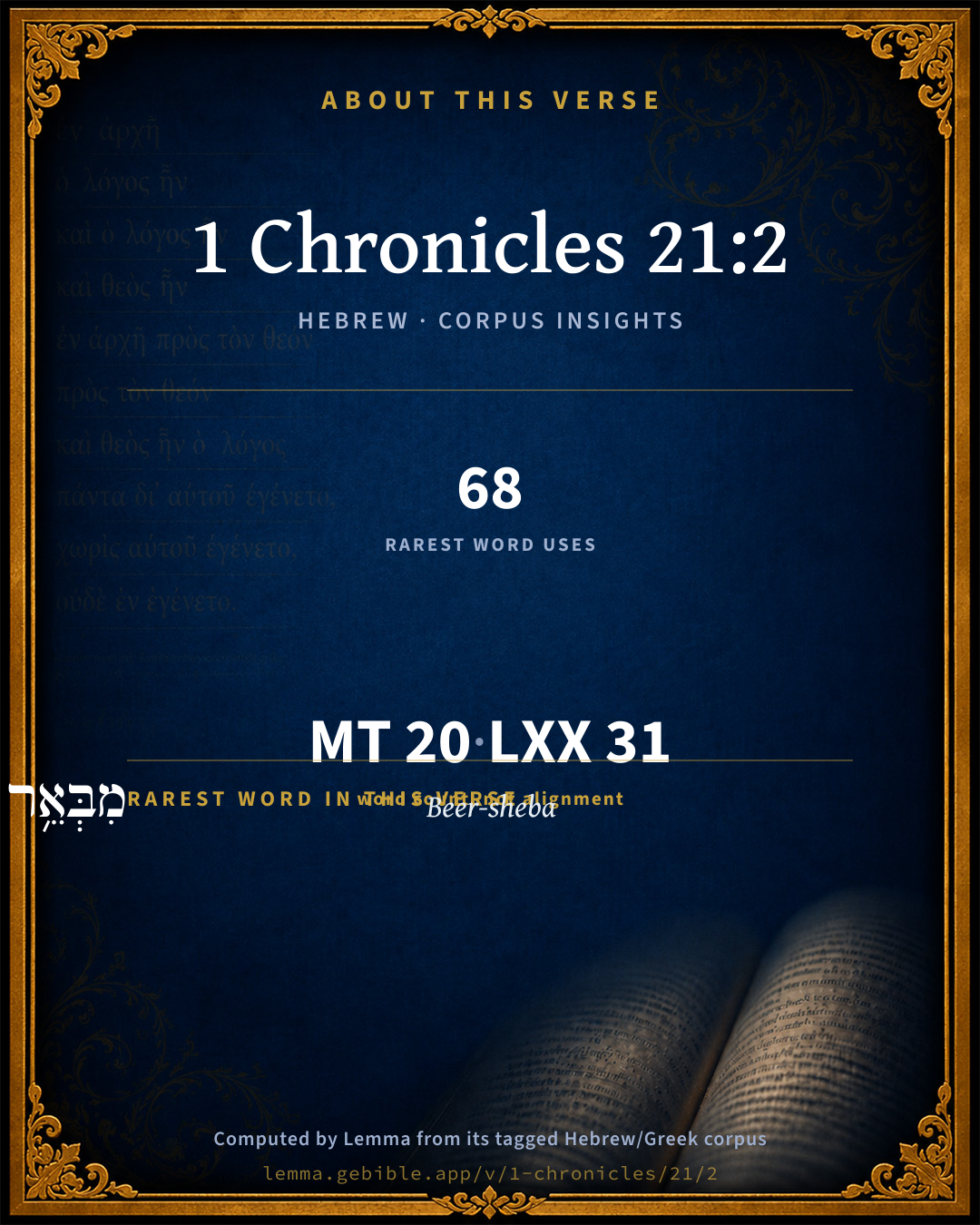
20
words
16
distinct lemmas
Historical
section

Grammatical profile

  • 5 verbs
  • 8 nouns
  • 1 adjective
  • 4 prepositions
  • 2 particles

Verb forms

  • וַיֹּ֨אמֶר Qal · Sequential Imperfect
  • לְכ֗וּ Qal · Imperative
  • סִפְרוּ֙ Qal · Imperative
  • וְהָבִ֣יאוּ Hiphil · Imperative
  • וְאֵדְעָ֖ה Qal · Cohortative

Repetition

Words recur within this verse — often emphatic in Hebrew:

  • מִבְּאֵ֥ר Beer-sheba H884 ×2
  • אֶל to H413 ×3

Hebrew & Septuagint length

In English translation the verse runs 31 words from the Hebrew and 32 from the Septuagint (LXX English) — closely comparable.

A rough comparison of the two English renderings, which tokenize alike — not a word-level alignment.

Word counts can differ between the Hebrew and the Greek without any difference in meaning — e.g. the Hebrew direct-object marker אֵת has no separate Greek word, and Greek often adds the article ὁ.

In the original languages it is 20 Hebrew tokens and 31 Greek tokens — but the two are counted differently (Hebrew bundles its prefixes and suffixes into one token; the Greek is in lemma form), so that isn’t a like-for-like length.

Cross-references

13

Topical passages linked to 1 Chronicles 21:2 in the Treasury of Scripture Knowledge — connected by theme and wording, ordered by reader-vote popularity; previews shown in the World English Bible.

  • 1 Chronicles 27:23–24 But David didn't take the number of them from twenty years old and under, because Yahweh had said he would increase Israel like the stars of the sky.
  • Deuteronomy 8:13–17 and when your herds and your flocks multiply, and your silver and your gold is multiplied, and all that you have is multiplied;
  • Judges 20:1 Then all the children of Israel went out, and the congregation was assembled as one man, from Dan even to Beersheba, with the land of Gilead, to Yahweh at Mizpah.
  • 1 Samuel 3:20 All Israel from Dan even to Beersheba knew that Samuel was established to be a prophet of Yahweh.
  • 2 Samuel 3:10 to transfer the kingdom from the house of Saul, and to set up the throne of David over Israel and over Judah, from Dan even to Beersheba.
  • 2 Samuel 17:11 But I counsel that all Israel be gathered together to you, from Dan even to Beersheba, as the sand that is by the sea for multitude; and that you go to battle in your own person.
  • 2 Samuel 24:2–4 The king said to Joab the captain of the host, who was with him, Go now back and forth through all the tribes of Israel, from Dan even to Beersheba, and number you the people, that I may know the sum of the people.
  • 2 Samuel 24:15 So Yahweh sent a pestilence on Israel from the morning even to the time appointed; and there died of the people from Dan even to Beersheba seventy thousand men.
  • 1 Kings 4:25 Judah and Israel lived safely, every man under his vine and under his fig tree, from Dan even to Beersheba, all the days of Solomon.
  • 2 Chronicles 30:5 So they established a decree to make proclamation throughout all Israel, from Beersheba even to Dan, that they should come to keep the Passover to Yahweh, the God of Israel, at Jerusalem: for they had not kept it in great numbers in such sort as it is written.
  • Proverbs 29:23 A man's pride brings him low, But one of lowly spirit gains honor.
  • 2 Corinthians 12:7 By reason of the exceeding greatness of the revelations, that I should not be exalted excessively, there was given to me a thorn in the flesh, a messenger of Satan to buffet me, that I should not be exalted excessively.
  • 2 Chronicles 32:25–26 But Hezekiah didn't render again according to the benefit done to him; for his heart was lifted up: therefore there was wrath on him, and on Judah and Jerusalem.

Cross-references courtesy of OpenBible.info (CC BY 4.0).

Hebrew and Greek witnesses Masoretic Hebrew ↔ Greek Septuagint

The same verse in the two great witnesses to the Old Testament, shown verse-for-verse.

These are two independent witnesses, not word-aligned to each other, and the Septuagint is shown in lemma (dictionary) form.

Hebrew 1 Chronicles 21:2 Masoretic · Westminster Leningrad Codex

וַיֹּ֨אמֶר דָּוִ֤יד אֶל יוֹאָב֙ וְאֶל שָׂרֵ֣י הָעָ֔ם לְכ֗וּ סִפְרוּ֙ אֶת יִשְׂרָאֵ֔ל מִבְּאֵ֥ר שֶׁ֖בַע וְעַד דָּ֑ן וְהָבִ֣יאוּ אֵלַ֔י וְאֵדְעָ֖ה אֶת מִסְפָּרָֽם

David said to Joab and to the princes of the people, Go, number Israel from Beersheba even to Dan; and bring me word, that I may know the sum of them.

World English Bible · Public Domain

Greek LXX 1 Chronicles 21:2 Septuagint · lemma form

καί εἶπον ὁ βασιλεύς δαυίδ πρός ιωαβ καί πρός ὁ ἄρχων ὁ δύναμις πορεύομαι ἀριθμέω ὁ ἰσραήλ ἀπό βηρσαβεε καί ἕως δαν καί φέρω πρός ἐγώ καί γιγνώσκω ὁ ἀριθμός αὐτός

And king David said to Joab and to the captains of the forces, Go, number Israel from Bersabee even to Dan, and bring me the account, and I shall know their number.

LXX2012 (modern English Septuagint) · Public Domain

Hebrew: Westminster Leningrad Codex (CC BY 4.0). Greek: Septuagint (public domain); English from LXX2012 (modern English Septuagint) (Public Domain). How the Septuagint differs from the Hebrew →

Commentary

Notes on 1 Chronicles 21:2 from classic Christian and Jewish commentators (each source and its license shown beneath its notes). The classic Christian expositions comment on the surrounding passage and are grouped to its opening verse, so a note may address several verses; the Jewish commentaries on the Tanakh (Rashi and others) are per-verse, so they appear only where the commentator wrote on this verse.

Lemma curates 59 commentaries, every one of them public domain or Creative Commons licensed, each selected and text-cleaned for this edition rather than reprinted as found. About our sources →

Trapp's Complete Commentary

John Trapp

1Ch 21:2 And David said to Joab and to the rulers of the people, Go, number Israel from Beersheba even to Dan; and bring the number of them to me, that I may know [it].

Ver. 2. That I may know it.] But what needs that, now that there was a general aut pax aut pactio, peace or truce with all nations? Curiosity it was, at least: yea, it was pride and creature confidence that pricked David on to this numbering of the people, and made him so peremptory. The herbalists write of a certain plant which they call the Devil’s bit: because, being of sovereign use for mankind, the devil is thought, by simple people, of malice to bite off the root of it, which is found very small, or none at all. Humility is like unto this root, and may be called devil’s bit: not because he can ever bite it off, but for that he never leaveth nibbling at it.

John Trapp, A Commentary or Exposition upon All the Books of the Old and New Testament (1647–1656) — public domain. Text from a community e-Sword module.

Geneva Bible (1599)

Geneva Bible translators

That is, from South to North.

Geneva Bible (1599) marginal notes — public domain. Text via Bolls.life.

Ellicott's Commentary for English Readers

(2) And to the rulers (captains) of the people.—Omitted in Samuel, which reads, “Joab, the captain of the host, who was with him.” The “captains of the host” are, however, associated in the work of the census with Joab (2Sa_24:4). The fact that Joab and his staff were deputed to take the census seems to prove that it was of a military character.

Go.—Plural.

Number.—Enrol, or register (sifrû). A different word (mânâh) is used in 1Ch_21:1, and in the parallel place. Samuel has, “Run over, I pray, all the tribes of Israel from Dan to Beersheba,” using the very word (shût) which, in the prologue of Job (1Ch_1:7; 1Ch_2:2) Satan uses of his own wanderings over the earth.

From Beersheba even to Dan.—As if the party were to proceed from south to north. (See 1Ch_21:4.) The reverse order is usual. (See Jdg_20:1; 1Sa_3:20.)

A Bible Commentary for English Readers, edited by Charles John Ellicott (1878–1897) — public domain. Text from a community e-Sword module.

The Cambridge Bible for Schools and Colleges

gen. ed. J. J. S. Perowne

2. to Joab] The object being to number “those who drew sword,” the captain of the host was the most suitable person to entrust with the business.

rulers] R.V. princes.

from Beer-sheba even to Dan] From the extreme south even unto the extreme north of the land.

Dan] The modern Tell-el-Kâdî, about forty minutes distance from Bâniâs (Paneas), north of Lake Huleh (Waters of Merom). Bädeker, p. 264.

that I may know it] Either with a view to imposing a tax or to undertaking some fresh great military expedition.

The Cambridge Bible for Schools and Colleges (gen. ed. J. J. S. Perowne; Cambridge University Press, 1878–1918) — public domain. Text from a community e-Sword module.

The Pulpit Commentary

And to the rulers of the people. So Num_1:4, "And with you there shall be a man of every tribe; every one head of the house of his fathers" (see also 1Ch_27:22-24; 2Sa_24:4, 2Sa_24:5)

The sin of self-gratulation.

The narrative does not clearly and explicitly state David"s intention in thus commanding a census of the people to be made. Probably he desired to know the numbers of the people of his kingdom as it had been extended by successful war; but this he wished rather for his own self-glorying than for national purposes. It was an act of self-will, and it failed from full loyalty to the theocratic idea which had been so well maintained during David"s reign. In just this lay its sin and its mischief. Dean Stanley calls the taking of this census "an attempt not unnaturally suggested by the increase of his power, but implying a confidence and pride alien to the spirit inculcated on the kings of the chosen people. The apprehension of a Nemesis on any overweening display of prosperity, if not consistent with the highest revelations of the Divine nature in the gospel, pervades all ancient, especially all Oriental, religions." And Ewald says, "The only satisfactory explanation of this measure is that it was intended as the foundation of an organized and vigorous government, like that of Egypt or Phoenicia, under which the exact number of the houses and inhabitants of every city and village would have to be obtained so as to be able to summon the people for general taxation. But it is well known what a profound aversion and what an instinctive abhorrence certain nations, ancient and modern, harbour against any such design which they dimly suspect, not perhaps without good reason, is likely to result in a dangerous extension of the governing power, and its encroachment on the sanctity of the private home." We may notice what peril often lies in the return of temptation upon a man after he has conquered it. David had warred in loyal dependence on God, but he fell when attempting to gather up the results of his victory. A camp is never so exposed to attack as in the time of exhaustion and over-confidence that immediately succeeds a victory. Illustrate from the power that lies in the backward suck of a broken wave.

I SELF-GRATULATION ON ACCOUNT OF RESULTS OF LABOUR. Compare Nebuchadnezzar"s boasting over great Babylon. Contrast the spirit manifested in St. Paul"s boastings. He says, "By the grace of God I am what I am." Show how keen we are for results, both in business and in religious spheres. The miser delights to count up his hoards, and the religious man is in peril of self-satisfaction in reckoning up his converts. Few of us can bear to have the true fruitage of our life-labour shown us yet; and we learn to think it most wise and good of our great Master that he puts off the harvest-day until by-and-by. Then we may venture to come "bringing our sheaves with us." Enough now for us is the joy of workers in their work.

II SELF-GRATULATION ON ACCOUNT OF SPIRITUAL TRIUMPHS. Illustrate from the peril of the hermit, monk, or nun; persons who devote themselves wholly to spiritual culture. Show that the humility they seek is ever slipping from their grasp, and subtle pride is asserting its place. St. Simeon Stylites on his pillar was probably prouder than any king. And so now exclusive attention to the training of feelings and emotions tends to self-gratulation. Perhaps more men are proud of their goodness than proud of their greatness. Against this subtle and insidious form of evil we all need to watch. And the great Heart-searcher needs to cleanse the very thoughts and heart, finding out for us our secret wicked ways.

III The SINFULNESS of all self-gratulation is seen in the evil influence of it on others. Some it excites to imitations. Others it impresses with our insincerity, and so with an idea of the worthlessness of all religion. It prevents our exercising a good influence on others. Nothing more certainly shuts up a man"s power than the impression he may produce of his pride and self-conceit. Whatever we may win, one law applies dont boast.

R.T.

The Pulpit Commentary (1880–1919), ed. H.D.M. Spence-Jones & Joseph S. Exell — public domain. Text from a community e-Sword module.

Lesson kit

Teaching starters — assembled from the data on this page, not authored interpretation. Every prompt links to the verse data it draws on. Edit before teaching.

1 Chronicles, in the Historical, opens this verse with 20 words (16 distinct Hebrew lemmas). Its most distinctive word is Bᵉʼêr Shebaʻ (“Beer-sheba”). A historical commentator’s framing appears above. Read the whole chapter for the surrounding context.

Discussion questions

  1. The word Bᵉʼêr Shebaʻ carries the sense “Beer-sheba.” How does it shape the verse?
  2. 1 Chronicles 27:23–24 shares this passage’s theme. How do the two illuminate each other?
  3. “Beer-sheba” occurs 2× in this one verse. What is the effect of the repetition?
  4. These translations render this verse differently; the difference is in the English rendering, not the original. What questions does that raise?
  5. The verb «וַיֹּ֨אמֶר» is Qal Sequential Imperfect. How does its form color the action?
  6. Reading how Trapp's Complete Commentary and Geneva Bible (1599) read this verse, where do the two commentators agree and where do they part?

Things to notice

Reading settings

Reading text

Shown beneath each verse's original-language words.

Old Testament
Old Testament edition

Read the OT as the Masoretic Hebrew (MT) or the Greek Septuagint (LXX).

English shown for the Greek Septuagint (in the Hebrew ↔ Greek comparison).

Comparing translations? Open the Compare panel on any verse page to stack up to four side by side.