

1 Chronicles 22:2

Hebrew (Westminster Leningrad Codex) 1 Chronicles 22:2 appears in the Hebrew Old Testament. The text above is from the Westminster Leningrad Codex. Each word links to its Strong’s number, a concise gloss, and parsing drawn from the Open Scriptures Hebrew Bible morphology. Click any word for its full Brown-Driver-Briggs (BDB) entry.
Download image
Cite this verse

1 Chronicles 22:2 (World English Bible). Public Domain. Lemma interlinear Bible study tool, https://lemma.gebible.app/v/1-chronicles/22/2.

Show BibTeX & RIS
BibTeX
RIS
English Translation
David commanded to gather together the foreigners who were in the land of Israel; and he set masons to hew worked stones to build the house of God.
World English Bible · Public Domain
Highlights
  • 1 first appearance in the Hebrew Bible
Full analysis ↓
Download a study sheet

One document with this verse’s original text, its word-by-word gloss line, the meaning frame, cross-references with their text, attributed commentary, and full source and license credits — printable, and it pastes into notes with its structure intact.

This verse Autodidact and up

Study sheet (.html) Plain text (.txt)

A passage Seminary Student

Up to 50 verses in one chapter. A passage sheet keeps up to 6 commentary sources and 12 cross-references per verse, in the order this page ranks them, and says so on the sheet whenever that leaves anything out. Ask for a single verse and you get the Autodidact verse sheet above.

Everything on this page stays free to read, with no account — the sheet is a download of what is already on screen, not access to it.

Want to remove ads? Support Godless Engineer
Compare translations 3

The same verse in 3 English versions, stacked beneath the original-language interlinear above. Click any original word for its lexicon entry.

Each is an independent rendering of the whole verse — the interlinear is not word-aligned to these translations.

Highlighted words mark where these versions differ — a whole-verse word diff, not a word-by-word alignment.

  • World English Bible Public Domain
    David commanded to gather together the foreigners who were in the land of Israel; and he set masons to hew worked stones to build the house of God.
  • King James Version Public Domain
    And David commanded to gather together the strangers that were in the land of Israel; and he set masons to hew wrought stones to build the house of God.
  • unfoldingWord Literal Text CC BY-SA 4.0
    And David said to gather the foreigners who in the land of Israel. And he appointed cutters to cut out stones of hewing to build the house of God.

unfoldingWord Literal Text — © unfoldingWord, licensed CC BY-SA 4.0. Word-aligned USFM3 via Door43 (git.door43.org/unfoldingWord/en_ult).

Versions to compare (up to 4)

3 of 4 selected

Show all 18 translations

Every available English version of this verse, each an independent rendering of the whole verse.

  • World English Bible Public Domain
    David commanded to gather together the foreigners who were in the land of Israel; and he set masons to hew worked stones to build the house of God.
  • Berean Standard Bible Public Domain
    So David gave orders to gather the foreigners in the land of Israel, from whom he appointed stonecutters to prepare finished stones for building the house of God.
  • Majority Standard Bible Public Domain
    So David gave orders to gather the foreigners in the land of Israel, from whom he appointed stonecutters to prepare finished stones for building the house of God.
  • King James Version Public Domain
    And David commanded to gather together the strangers that were in the land of Israel; and he set masons to hew wrought stones to build the house of God.
  • American Standard Version (1901) Public Domain
    And David commanded to gather together the sojourners that were in the land of Israel; and he set masons to hew wrought stones to build the house of God.
  • Revised Version (1885) Public Domain
    And David commanded to gather together the strangers that were in the land of Israel; and he set masons to hew wrought stones to build the house of God.
  • Geneva Bible (1599) Public Domain
    And Dauid commanded to gather together the strangers that were in the lande of Israel, and he set masons to hewe and polish stones to builde the house of God.
  • Douay-Rheims (1899) Public Domain
    And he commanded to gather together all the proselytes of the land of Israel, and out of them he appointed stonecutters to hew stones and polish them, to build the house of God.
  • Young's Literal Translation Public Domain
    And David saith to gather the sojourners who `are' in the land of Israel, and appointeth hewers to hew hewn-stones to build a house of God.
  • Literal Standard Version CC BY-SA 4.0
    And David says to gather the sojourners who [are] in the land of Israel, and appoints hewers to hew hewn-stones to build a house of God.
  • Unlocked Literal Bible CC BY-SA 4.0
    So David ordered his servants to gather together the foreigners living in the land of Israel. He assigned them to be stonecutters, to cut stone blocks, in order to build God's house.
  • unfoldingWord Literal Text CC BY-SA 4.0
    And David said to gather the foreigners who in the land of Israel. And he appointed cutters to cut out stones of hewing to build the house of God.
  • Darby Bible Public Domain
    And David commanded to collect the strangers that were in the land of Israel; and he set masons to hew wrought stones to build the house of God.
  • World Messianic Bible Public Domain
    David gave orders to gather together the foreigners who were in Eretz-Israel; and he set masons to cut dressed stones to build God’s house.
  • Webster's Bible Public Domain
    And David commanded to assemble the strangers that were in the land of Israel; and he set masons to hew wrought stones to build the house of God.
  • Free Bible Version CC BY-SA 4.0
    So David gave orders to summon the foreigners living in the land of Israel, and he assigned stonecutters to prepare dressed stones to build the house of God.
  • Bible in Basic English Public Domain
    And David gave orders to get together all the men from strange lands who were in the land of Israel; and he put stone-cutters to work, cutting stones for building the house of God.
  • JPS Tanakh (1917) Public Domain
    And David commanded to gather together the strangers that were in the land of Israel; and he set masons to hew wrought stones to build the house of God.

Literal Standard Version (2020), Covenant Press — licensed CC BY-SA 4.0. Text via the HelloAO Bible API (eBible.org). Unlocked Literal Bible (unfoldingWord) — licensed CC BY-SA 4.0. Text via the HelloAO Bible API (eBible.org). unfoldingWord Literal Text — © unfoldingWord, licensed CC BY-SA 4.0. Word-aligned USFM3 via Door43 (git.door43.org/unfoldingWord/en_ult). Free Bible Version, Dr. Jonathan Gallagher — licensed CC BY-SA 4.0. Text via the HelloAO Bible API (eBible.org).

Word by word

More ways to search: Search by grammar → Find every occurrence → Compare this word →

Practice this passage: Drill this verse → Learn its vocabulary →

לִכְנוֹס֙
kânaç
H3664
“to gather”
Preposition + Verb, Qal, Infinitive Construct
Part of Speech
Preposition + Verb
Stem
Qal
Form
Infinitive Construct
Full BDB Definition

Origin: a primitive root

TWOT: 1000

to gather, collect, wrap - (Qal) to gather - (Piel) to gather - (Hithpael) to gather together, wrap oneself up
  1. וַיֹּ֣אמֶר ʼâmar H559 “and · to say” Conjunction + Verb, Qal, Sequential Imperfect, 3rd Person, Masculine, Singular
  2. דָּוִ֔יד Dâvid H1732 “David” Noun, Proper
  3. אֶת ʼêth H853 “-” Particle, Direct Object
  4. הַגֵּרִ֔ים gêr H1616 “the · sojourners” Particle, Definite Article + Noun, Common, Masculine, Plural, Absolute
  5. אֲשֶׁ֖ר ʼăsher H834 “which” Particle, Relative
  6. בְּאֶ֣רֶץ ʼerets H776 “in/at · land of” Preposition + Noun, Common, Both, Singular, Construct
  7. יִשְׂרָאֵ֑ל Yisrâʼêl H3478 “Israel” Noun, Proper
  8. וַיַּעֲמֵ֣ד ʻâmad H5975 “and · to stand” Conjunction + Verb, Hiphil, Sequential Imperfect, 3rd Person, Masculine, Singular
  9. חֹֽצְבִ֗ים châtsab H2672 “hewing” Verb, Qal, Participle Active, Masculine, Plural, Absolute
  10. לַחְצוֹב֙ châtsab H2672 “to hew” Preposition + Verb, Qal, Infinitive Construct
  11. אַבְנֵ֣י ʼeben H68 “stones of” Noun, Common, Feminine, Plural, Construct
  12. גָזִ֔ית gâzîyth H1496 “hewing” Noun, Common, Feminine, Singular, Absolute
  13. לִבְנ֖וֹת bânâh H1129 “to build” Preposition + Verb, Qal, Infinitive Construct
  14. בֵּ֥ית bayith H1004 “house of” Noun, Common, Masculine, Singular, Construct
  15. הָאֱלֹהִֽים ʼĕlôhîym H430 “the · God(s)” Particle, Definite Article + Noun, Common, Masculine, Plural, Absolute

About this verse

These counts appear in no published source. They are computed here, from the morphology-tagged text and Lemma’s own curated glosses. What Lemma adds →

16
words
15
distinct lemmas
Historical
section

Notable vocabulary

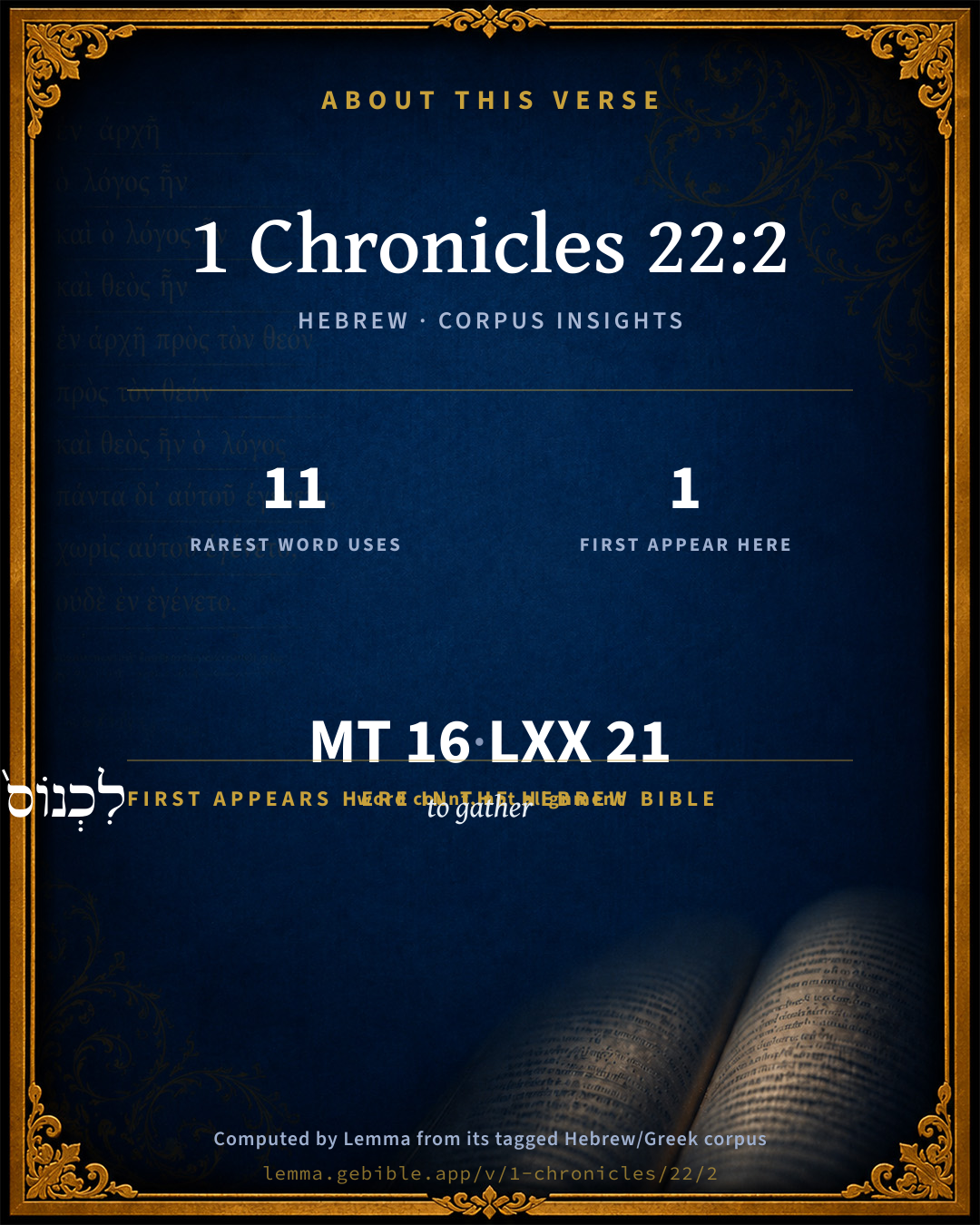
The rarest word here is לִכְנוֹס֙ to gather H3664 — appearing just 11 times in the whole Hebrew Bible.

First appearance in Scripture

This word makes its first canonical appearance in the Hebrew Bible here:

  • לִכְנוֹס֙ to gather H3664

Shared distinctive vocabulary

לִכְנוֹס֙ to gather H3664 occurs in 11 verses of the Hebrew Bible. Also found in:

Grammatical profile

  • 6 verbs
  • 8 nouns
  • 2 particles

Verb forms

  • וַיֹּ֣אמֶר Qal · Sequential Imperfect
  • לִכְנוֹס֙ Qal · Infinitive Construct
  • וַיַּעֲמֵ֣ד Hiphil · Sequential Imperfect
  • חֹֽצְבִ֗ים Qal · Participle Active
  • לַחְצוֹב֙ Qal · Infinitive Construct
  • לִבְנ֖וֹת Qal · Infinitive Construct

Repetition

A word recurs within this verse — often emphatic in Hebrew:

  • חֹֽצְבִ֗ים to hew H2672 ×2

Hebrew & Septuagint length

In English translation the verse runs 28 words from the Hebrew and 30 from the Septuagint (LXX English) — closely comparable.

A rough comparison of the two English renderings, which tokenize alike — not a word-level alignment.

Word counts can differ between the Hebrew and the Greek without any difference in meaning — e.g. the Hebrew direct-object marker אֵת has no separate Greek word, and Greek often adds the article ὁ.

In the original languages it is 16 Hebrew tokens and 21 Greek tokens — but the two are counted differently (Hebrew bundles its prefixes and suffixes into one token; the Greek is in lemma form), so that isn’t a like-for-like length.

Cross-references

14

Topical passages linked to 1 Chronicles 22:2 in the Treasury of Scripture Knowledge — connected by theme and wording, ordered by reader-vote popularity; previews shown in the World English Bible.

  • 1 Kings 5:17–18 The king commanded, and they hewed out great stones, costly stones, to lay the foundation of the house with worked stone.
  • 1 Kings 9:20–21 As for all the people who were left of the Amorites, the Hittites, the Perizzites, the Hivites, and the Jebusites, who were not of the children of Israel;
  • 2 Chronicles 2:17 Solomon numbered all the foreigners who were in the land of Israel, after the numbering with which David his father had numbered them; and they were found one hundred fifty-three thousand six hundred.
  • 2 Samuel 5:11 Hiram king of Tyre sent messengers to David, and cedar trees, and carpenters, and masons; and they built David a house.
  • 1 Kings 6:7 The house, when it was in building, was built of stone made ready at the quarry; and there was neither hammer nor axe nor any tool of iron heard in the house, while it was in building.
  • 1 Kings 7:9–12 All these were of costly stones, even of hewn stone, according to measure, sawed with saws, inside and outside, even from the foundation to the coping, and so on the outside to the great court.
  • 2 Kings 12:12 and to the masons and the stone cutters, and for buying timber and hewn stone to repair the breaches of the house of Yahweh, and for all that was laid out for the house to repair it.
  • 2 Kings 22:6 to the carpenters, and to the builders, and to the masons, and for buying timber and hewn stone to repair the house.
  • 1 Chronicles 14:1 Hiram king of Tyre sent messengers to David, and cedar trees, and masons, and carpenters, to build him a house.
  • 2 Chronicles 8:7–8 As for all the people who were left of the Hittites, and the Amorites, and the Perizzites, and the Hivites, and the Jebusites, who were not of Israel;
  • Ezra 3:7 They gave money also to the masons, and to the carpenters; and food, and drink, and oil, to them of Sidon, and to them of Tyre, to bring cedar trees from Lebanon to the sea, to Joppa, according to the grant that they had of Cyrus king of Persia.
  • Isaiah 61:5–6 Strangers shall stand and feed your flocks, and foreigners shall be your plowmen and your vine-dressers.
  • Ephesians 2:12 that you were at that time separate from Christ, alienated from the commonwealth of Israel, and strangers from the covenants of the promise, having no hope and without God in the world.
  • Ephesians 2:19–22 So then you are no longer strangers and foreigners, but you are fellow citizens with the saints, and of the household of God,

Cross-references courtesy of OpenBible.info (CC BY 4.0).

Hebrew and Greek witnesses Masoretic Hebrew ↔ Greek Septuagint

The same verse in the two great witnesses to the Old Testament, shown verse-for-verse.

These are two independent witnesses, not word-aligned to each other, and the Septuagint is shown in lemma (dictionary) form.

Hebrew 1 Chronicles 22:2 Masoretic · Westminster Leningrad Codex

וַיֹּ֣אמֶר דָּוִ֔יד לִכְנוֹס֙ אֶת הַגֵּרִ֔ים אֲשֶׁ֖ר בְּאֶ֣רֶץ יִשְׂרָאֵ֑ל וַיַּעֲמֵ֣ד חֹֽצְבִ֗ים לַחְצוֹב֙ אַבְנֵ֣י גָזִ֔ית לִבְנ֖וֹת בֵּ֥ית הָאֱלֹהִֽים

David commanded to gather together the foreigners who were in the land of Israel; and he set masons to hew worked stones to build the house of God.

World English Bible · Public Domain

Greek LXX 1 Chronicles 22:2 Septuagint · lemma form

καί εἶπον δαυίδ συνἄγω πᾶς ὁ προσήλυτος ἐν γῆ ἰσραήλ καί καταἵστημι λατόμος λατομέω λίθος ξυστός ὁ οἰκοδομέω οἶκος ὁ θεός

And David gave orders to gather all the strangers that were in the land of Israel; and he appointed stone-hewers to hew polished stones to build the house to God.

LXX2012 (modern English Septuagint) · Public Domain

On this verse, John Gill's Exposition discusses the Septuagint’s reading. Read the note in Commentary ↓

Hebrew: Westminster Leningrad Codex (CC BY 4.0). Greek: Septuagint (public domain); English from LXX2012 (modern English Septuagint) (Public Domain). How the Septuagint differs from the Hebrew →

Commentary

Notes on 1 Chronicles 22:2 from classic Christian and Jewish commentators (each source and its license shown beneath its notes). The classic Christian expositions comment on the surrounding passage and are grouped to its opening verse, so a note may address several verses; the Jewish commentaries on the Tanakh (Rashi and others) are per-verse, so they appear only where the commentator wrote on this verse.

Lemma curates 59 commentaries, every one of them public domain or Creative Commons licensed, each selected and text-cleaned for this edition rather than reprinted as found. About our sources →

Trapp's Complete Commentary

John Trapp

1Ch 22:2 And David commanded to gather together the strangers that [were] in the land of Israel; and he set masons to hew wrought stones to build the house of God.

Ver. 2. To gather together the strangers.] A notable type of the calling of the Gentiles: and the like we may say of the temple’s being built on the ground of a Jebusite, and by the help of Tyrians and Zidonians, and adorned with the spoils of various nations. {1Ch 18:7-11}

John Trapp, A Commentary or Exposition upon All the Books of the Old and New Testament (1647–1656) — public domain. Text from a community e-Sword module.

The Biblical Illustrator

Joseph S. Exell

1Ch_22:2

And David commanded to gather together the strangers.

What we cannot destroy may be usefully employed

Whom we are not able to destroy we may be able to employ in holy service, is a doctrine which is not applicable to persons only, but has a distinct reference to emotions, passions, impulses, and sympathies. We are to hold ourselves in bondage, and often we are to drive ourselves to forced labour, and to become hewers of wood and stone, bearers of burdens, and indeed slaves to our higher manhood. (J. Parker, D. D.)

The Biblical Illustrator, edited by Joseph S. Exell (c. 1880s–1900s) — public domain. Text from a community e-Sword module.

Joseph Benson's Commentary

1Ch 22:2-3. To gather the strangers that were in the land of Israel — The same persons whom Solomon afterward employed in the same work; of which see 1Ki 5:15; 1Ki 9:20-21. He set masons to hew wrought stones — Wherein he could not do much, being prevented by death; but Solomon carried on and perfected what David had begun. For the joinings — To be used, together with melted lead, for the joining of those great and square stones together.

Joseph Benson's Commentary on the Old and New Testaments (1811–1818) — public domain. Text from a community e-Sword module.

Tyndale Open Study Notes

Tyndale Open Resources

22:2-19 God had promised David that his kingdom would be permanent and that his son would build a temple for the Lord (17:11-12). Now that the site had been chosen (21:18–22:1), David made preparations for building the Temple of God. He gathered the materials (22:2-5), and he charged both Solomon (22:6-16) and the leaders of Israel (22:17-19) with the task of building the Temple after his death.

Tyndale Open Study Notes — © Tyndale Open Resources, licensed CC BY-SA 4.0. Text via the HelloAO Bible API.

Geneva Bible (1599)

Geneva Bible translators

Meaning, cunning men of other nations which dwelt among the Jews.

Geneva Bible (1599) marginal notes — public domain. Text via Bolls.life.

Jamieson, Fausset & Brown

Robert Jamieson, A. R. Fausset & David Brown

David commanded to gather together the strangers--partly the descendants of the old Canaanites (Ch2 8:7-10), from whom was exacted a tribute of bond service, and partly war captives (Ch2 2:7), reserved for the great work he contemplated.

Jamieson, Fausset & Brown — Commentary Critical and Explanatory on the Whole Bible (1871) — public domain (CC PDM 1.0). Text via the HelloAO Bible API.

Adam Clarke's Commentary

Verse 2. The strangers that were in the land] Those who had become proselytes to the Jewish religion, at least so far as to renounce idolatry, and keep what were called the seven Noahic precepts. These were to be employed in the more servile and difficult parts of the work: see on 1Kg 9:21. For the account of building the temple, see 1 Kings 5-9, and the notes there.

Adam Clarke's Commentary on the Bible (1810–1826) — public domain. Text from a community e-Sword/MySword module.

Ellicott's Commentary for English Readers

(2) And David commanded to gather together the strangers.—The word rendered “to gather together” (kânas) is different from the terms used in 1Ch_15:3-4; 1Ch_19:7, and is late in this sense.

The strangers (gêrîm).—Sojourners, or resident foreigners, such as Israel had been in Egypt (Gen_15:13). The Canaanite population are meant, who lived on sufferance under the Israelite dominion, and were liable to forced service if the government required it. (See 2Ch_8:7-8, and 1Ki_9:20-21.) Solomon found them by census to be 153,600 souls. The census was a preliminary to apportioning their several tasks. (See 2Ch_2:17-18.) David, probably on the present occasion, had held a similar census of the Canaanite serfs (2Ch_2:17).

And he set.—Appointed (1Ch_15:16-17); literally, caused to stand.

Masons.—Hewers; selected, apparently, from among “the strangers.”

Wrought stones.—“Saxum quadratum,” square stones (1 Kings 5:31; Isa_9:9).

To build the house—i.e., for building it hereafter. It is not said that the work was begun at once, but only that the organisation of the serf labour originated with David.

(2-5) David gathers craftsmen, and accumulates materials for building the house of God.

A Bible Commentary for English Readers, edited by Charles John Ellicott (1878–1897) — public domain. Text from a community e-Sword module.

The Cambridge Bible for Schools and Colleges

gen. ed. J. J. S. Perowne

2–5. David’s Preparations for Building the Temple

2. the strangers] Cp. 2Ch_2:17; 2Ch_8:7 … 9 (R.V.). Hewing of stone was regarded as task-work unit for free men.

wrought stones] All the stone used for the building of the Temple was previously cut to the right size; cp. 1Ki_6:7.

The Cambridge Bible for Schools and Colleges (gen. ed. J. J. S. Perowne; Cambridge University Press, 1878–1918) — public domain. Text from a community e-Sword module.

John Gill's Exposition

And David commanded to gather together the strangers that were in the land of Israel,.... The proselytes, as the Septuagint and Vulgate Latin versions; that is, proselytes of the gate, who submitted to the seven precepts of Noah, were admitted to dwell in the Cities of Israel, see Gen 9:4 and these were ordered to be got together to be employed in building the temple, and making preparations for it; and that partly because they were better artificers than the Israelites, who were chiefly employed in husbandry and cattle, and partly that the Israelites, who were freemen, might not be put to hard service; but chiefly this was for the sake of a mystery in it, denoting that the Gentiles would be concerned in building the spiritual house and church of God, the temple was a type and figure of, see Zac 6:15.

and he set masons to hew wrought stones to build the house of God; to dig them out of the quarries, and fit them for the building.

John Gill's Exposition of the Whole Bible (1746–1763) — public domain (CC PDM 1.0). Text via the HelloAO Bible API.

Albert Barnes' Notes on the Bible

The strangers - i. e., the aliens the non-Israelite population of the land. Compare 2Ch 2:17.

Albert Barnes' Notes on the Bible (1834–1885) — public domain. Text from a community e-Sword/MySword module.

Haydock's Catholic Bible Commentary

Proselytes. This is the first time that the word occurs in the Vulgate. See Exodus xii. 45. It means "strangers," (Calmet) who were not allowed to live in the country, unless they would observe the natural law, and renounce idolatry. (Rabbins) --- These had embraced the Jewish religion. (Menochius) --- They were the remnants of the people of Chanaan, (3 Kings ix. 20,) and were treated as public slaves, which could not have been done, with justice or policy, with regard to those who might barely wish to reside in the country. These strangers prefigured the Gentiles, chosen to build the Christian Church.

George Leo Haydock (1774–1849), Haydock's Catholic Family Bible and Commentary, 1859 edition — public domain. Excludes Psalms (Douay-Rheims chapter numbering differs from Protestant) and Deuterocanonical books (Catholic canon only).

Matthew Poole's English Annotations

The strangers that were in the land of Israel; the same persons whom Solomon afterwards employed in the same work; of which see 1Ki 5:15, compared with 1Ki 9:20,21.

He set masons to hew wrought stones; wherein he could not do much, being prevented by death; but Solomon carried on and perfected what David had begun.

Matthew Poole's English Annotations on the Holy Bible (1683–1685) — public domain. Text from a community e-Sword/MySword module.

Whedon's Commentary on the Bible

Daniel D. Whedon

2. David commanded to gather together the strangers — These strangers were the descendants of the old Canaanitish population of the land, whom the Israelites had not been able to expel. Comp. 1Ki_9:21, and 2Ch_2:17. Having settled on the site of Jehovah’s house, the king was stimulated to make, in his last days, all possible preparations for the building of the same.

Masons to hew wrought stones — Or, stonecutters to cut hewn stones. Compare 1Ki_5:15; 1Ki_5:17.

Daniel D. Whedon (gen. ed.), Commentary on the Old and New Testaments (1874–1909) — public domain. Text from a community e-Sword module.

The Pulpit Commentary

The strangers. These are plainly called in the Septuagint "proselytes" (touv proshlutouv). They were, of course, foreign workmen, who came in pursuit of their trade. The injunctions as to "strangers," and with regard to showing them kindness, are very numerous, beginning with Exo_12:19, Exo_12:48, 49 22:21 (20); 23. 9; Lev_19:10, Lev_19:33, 34 15:14-16; Deu_10:18, Deu_10:19; Jos_8:33-35. It was not David"s object merely to gain cheap or compulsory work, (2Ch_2:17, 2Ch_2:18) but to obtain a skill, which immigrants from certain places would possess, in excess of that of his own people, (2Ch_2:7, 2Ch_2:8, 2Ch_2:13, 2Ch_2:14) especially considering the absorption of Israel in the pursuit of war, which had so largely impeded their study and practice of these the arts of peace.

HOMILIES BY R. TUCK Ver. 2

Alien help in God"s service.

David was willing to employ those who were not Israelites in the work of building the temple, and this is recorded as an indication of liberality and large-mindedness. By the "strangers" mentioned here we are to understand "aliens," the non-Israelite population of the land; and we have no ground for assuming that the persons he employed were necessarily proselytes. 2Ch_2:17 we learn that David took a census of these aliens, with the design of employing them in forced labours, as hewers of wood and stone, bearers of burdens, etc. It does not appear that the Israelites, as a people, have ever displayed mechanical or constructive skill. Their bias has been towards agriculture and trade. It is often somewhat anxiously questioned whether sanctuary belly aid in church-building, and maintenance of Christian worship and work can properly be received from worldly persons, who cannot be supposed to give themselves to God through their gifts in support of his service. Wider and nobler views of God"s relations with men, and claims upon the service of all men, would make such questioning impossible. Exclusive feelings caste sentiments grow upon us only too easily; but they are always mischievous; they need to be carefully watched and repressed; and Christians, above all men, should cultivate the most liberal and generous sentiments. It should be their joy in God, that "the God of the whole earth must he be called." Keeping in mind that the object of this homily is to correct the "narrowness" which is too often the marked feature of pious sentiments, we consider

I ALL SOULS ARE GOD"S. "All souls are mine." George Macdonald well writes, "We are accustomed to say that we are bodies, and have souls, whereas we should rather say that we are souls, and have bodies." Paul pleads with the Gentile that we are all the "offspring of God." And our Lord, in his teaching on the mount, revealed God as providing for and overshadowing all, "making his sun to rise on the evil and on the good, and sending his rain on the just and on the unjust." All souls are to come under the Divine judgment, and that judgment must be based on Divine dealings with men, and men"s response thereto.

II ALL LIVES SHOULD BE CONSECRATED TO GOD. By the claims of creation, relation, and providence, God urges upon every man the duty of surrender to him. See the familiar answer to the question, "What is the chief duty of man?" When Paul urges the Romans to "present their bodies a living sacrifice," he does but express the demand made by the God "in whose hand our breath is, and whose are all our ways." If this be established as a universal principle, then these two things follow.

1. All man"s service he claims. Whatever a man can do, God has the right to ask him to do for him. Illustrate by the sentiments of earlier times, in regard to a king"s right to claim the service of any member of his kingdom, day or night. God has the infinite right to make such claim; and the godly man fully recognizes it, and says

Take my body, spirit, soul; Only thou possess the whole.

2. All man"s possessions are for God"s use as he may require them. Not merely what a man is he is for God, but what a man has he has for God. David fully recognized this, and in presenting to God the gathered material for the temple, he said, "Of thine own have we given thee." So when a worldly man gives of his property or time to God"s service, we should feel that he is imperfectly and incompletely doing a part of the duty which rests on every man. Nothing of human service can be alien to God; and nothing should be alien to his people in working for him. We may encourage every man to do something, or give something to God, in the hope that, by-and-by, they may come to love God"s service, and God himself. R.T.

Vers. 2-5.

Willingness to do what we may when we are forbidden to do what we would.

For reasons sufficiently defined, God did not allow David to build his temple; and David received the Divine refusal in a right spirit. It might have crushed him, and led him to feel that he could do nothing; but he nobly decided that if he might not actually build, he would gather the materials for building, and make all necessary preparations. Too often, when a man"s particular plans are hindered, he throws up Christian work altogether. We therefore commend the really beautiful example of the pious David. A man should be cheerfully willing to do what he can when he cannot do what he would.

I THE PLACE FOR MAN"S WILL IN RELIGIOUS WORK. He ought to purpose, devise, and plan great things, and expect that his enterprise and energy will serve the gracious Divine purpose. Man"s will is not broken down by a true piety; it is rather quickened and renewed, though toned with submission to the Divine will.

II THE PLACE FOR THE DIVINE WILL IN RELIGIOUS WORK. That will must be regarded as the final court of appeal, and reference must be made to it. The good man"s last word is, "If the Lord will, I shall live, and do this or that." Illustrate by the expression used in the Acts concerning Paul"s travelling plans, "The Spirit suffered us not." We recognize the place of the Divine will in personal experience; we should also recognize its place in relation to Christian work. God does not always permit us to do what our hearts desire to do. The blocks in our way are Divine hindrances.

III THE TRUE SUBMISSION IS ACTIVE OBEDIENCE WITHIN DIVINE LIMITS. Most unworthy is the sullen refusal to do nothing because we cannot have our own way. True humility finds expression in cheerfully doing what God will let us do.

Apply to Church life. God expresses his will often by putting disabilities in our way, but he at the same time opens up other ways for us. If we are willing to do what we may, we shall find it fits in for the outworking of God"s perfect plan. R.T.

The Pulpit Commentary (1880–1919), ed. H.D.M. Spence-Jones & Joseph S. Exell — public domain. Text from a community e-Sword module.

Keil & Delitzsch

C. F. Keil & F. Delitzsch

And David commanded to gather together the strangers that were in the land of Israel,.... The proselytes, as the Septuagint and Vulgate Latin versions; that is, proselytes of the gate, who submitted to the seven precepts of Noah, were admitted to dwell in the Cities of Israel, see Gen 9:4 and these were ordered to be got together to be employed in building the temple, and making preparations for it; and that partly because they were better artificers than the Israelites, who were chiefly employed in husbandry and cattle, and partly that the Israelites, who were freemen, might not be put to hard service; but chiefly this was for the sake of a mystery in it, denoting that the Gentiles would be concerned in building the spiritual house and church of God, the temple was a type and figure of, see Zac 6:15.

and he set masons to hew wrought stones to build the house of God; to dig them out of the quarries, and fit them for the building.

Keil & Delitzsch — Biblical Commentary on the Old Testament (1861–1891) — public domain (CC PDM 1.0). Text via the HelloAO Bible API. (Old Testament only.)

Rashi

Rabbi Shlomo Yitzchaki (Rashi)

to gather the strangers who had converted, because he did not wish to make Israelites perform rigorous labor. And so we find with Solomon below (II Chron. 2:1): “And Solomon counted, etc.”; (ibid. verse 17): “And he made of them seventy thousand who bear burdens.” And it is written further (ibid. 8:7): “And all the people remaining from the Hittites, etc., who were not of Israel, etc.”; (ibid. verse 9): “And of the Children of Israel, whom Solomon did not make slaves, etc.”

Rashi on the Tanakh — English translations: “The Judaica Press complete Tanach with Rashi, translated by A. J. Rosenberg” (CC BY 4.0); “Pentateuch with Rashi's commentary by M. Rosenbaum and A.M. Silbermann, 1929-1934” (public domain); “The Metsudah Tanach series, Lakewood, N.J” (CC BY 4.0); and “The Book of Joshua, Metsudah Publications, 1997” (CC BY 4.0). Text via Sefaria.

Lesson kit

Teaching starters — assembled from the data on this page, not authored interpretation. Every prompt links to the verse data it draws on. Edit before teaching.

1 Chronicles, in the Historical, opens this verse with 16 words (15 distinct Hebrew lemmas). Its most distinctive word is kânaç (“to gather”). A historical commentator’s framing appears above. Read the whole chapter for the surrounding context.

Discussion questions

  1. What does “to gather” (kânaç) contribute to the verse as a whole?
  2. This is the first place “to gather” appears in Scripture (first appears here). What does its debut here establish?
  3. How does Nehemiah 12:44, which shares the word «to gather», read alongside this verse?
  4. What does the repetition of “to hew” (2× in this one verse) do in this verse?
  5. These translations render this verse differently. What is at stake in choosing one wording over another?
  6. «וַיֹּ֣אמֶר» is a Qal Sequential Imperfect verb. How does that grammatical form shape the action described?
  7. Compare how Trapp's Complete Commentary and The Biblical Illustrator read this verse. Where do they agree or differ?

Things to notice

Reading settings

Reading text

Shown beneath each verse's original-language words.

Old Testament
Old Testament edition

Read the OT as the Masoretic Hebrew (MT) or the Greek Septuagint (LXX).

English shown for the Greek Septuagint (in the Hebrew ↔ Greek comparison).

Comparing translations? Open the Compare panel on any verse page to stack up to four side by side.