
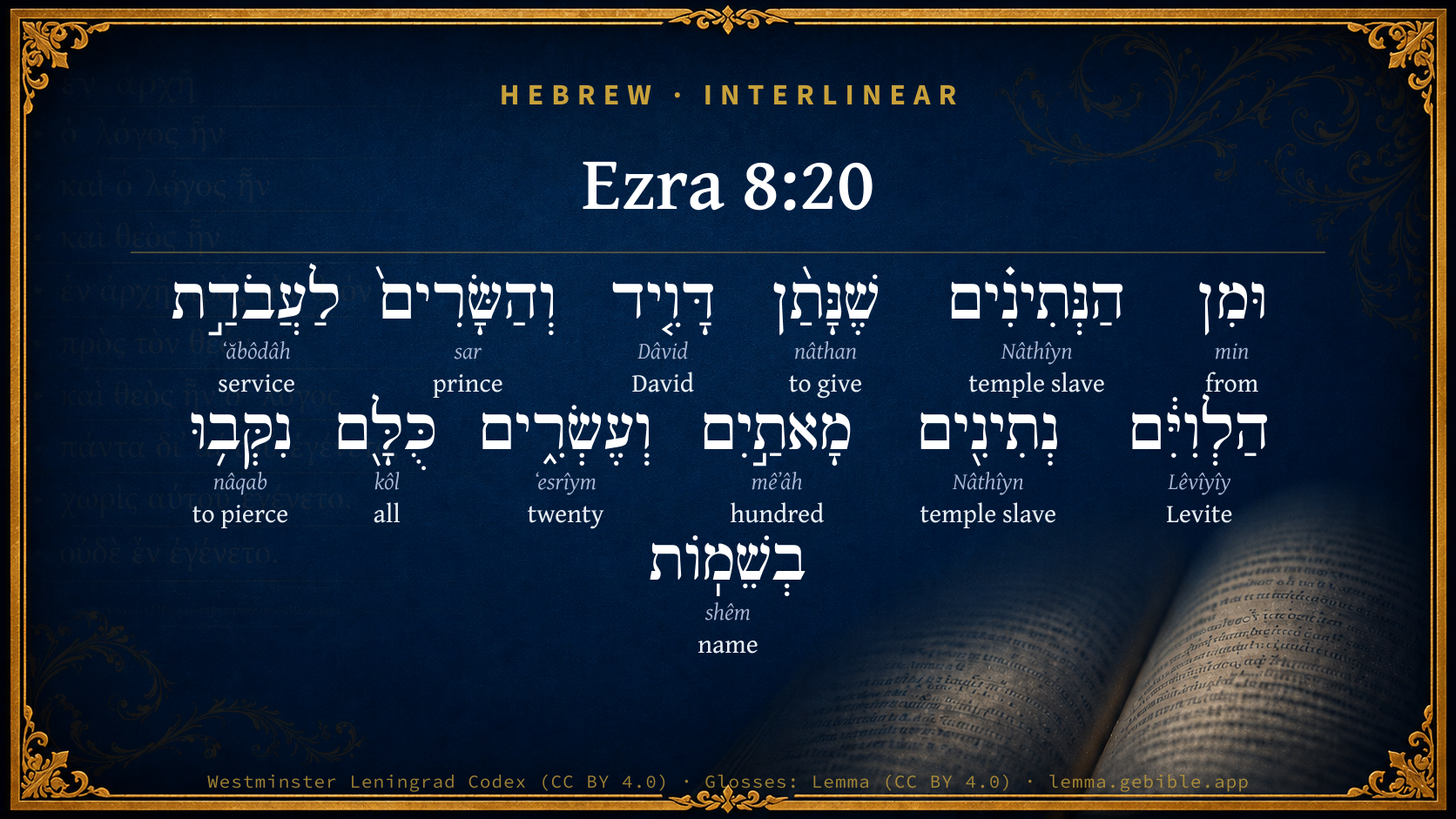
Ezra 8:20

Hebrew (Westminster Leningrad Codex) Ezra 8:20 appears in the Hebrew Old Testament. The text above is from the Westminster Leningrad Codex. Each word links to its Strong’s number, a concise gloss, and parsing drawn from the Open Scriptures Hebrew Bible morphology. Click any word for its full Brown-Driver-Briggs (BDB) entry.
Download image
Cite this verse

Ezra 8:20 (World English Bible). Public Domain. Lemma interlinear Bible study tool, https://lemma.gebible.app/v/ezra/8/20.

Show BibTeX & RIS
BibTeX
RIS
English Translation
and of the Nethinim, whom David and the princes had given for the service of the Levites, two hundred and twenty Nethinim: all of them were mentioned by name.
World English Bible · Public Domain
Download a study sheet

One document with this verse’s original text, its word-by-word gloss line, the meaning frame, cross-references with their text, attributed commentary, and full source and license credits — printable, and it pastes into notes with its structure intact.

This verse Autodidact and up

Study sheet (.html) Plain text (.txt)

A passage Seminary Student

Up to 50 verses in one chapter. A passage sheet keeps up to 6 commentary sources and 12 cross-references per verse, in the order this page ranks them, and says so on the sheet whenever that leaves anything out. Ask for a single verse and you get the Autodidact verse sheet above.

Everything on this page stays free to read, with no account — the sheet is a download of what is already on screen, not access to it.

Want to remove ads? Support Godless Engineer
Compare translations 3

The same verse in 3 English versions, stacked beneath the original-language interlinear above. Click any original word for its lexicon entry.

Each is an independent rendering of the whole verse — the interlinear is not word-aligned to these translations.

Highlighted words mark where these versions differ — a whole-verse word diff, not a word-by-word alignment.

  • World English Bible Public Domain
    and of the Nethinim, whom David and the princes had given for the service of the Levites, two hundred and twenty Nethinim: all of them were mentioned by name.
  • King James Version Public Domain
    Also of the Nethinims, whom David and the princes had appointed for the service of the Levites, two hundred and twenty Nethinims: all of them were expressed by name.
  • unfoldingWord Literal Text CC BY-SA 4.0
    and 220 temple servants from the temple servants whom David with the officials had given for the service of the Levites. All of them were designated by names.

unfoldingWord Literal Text — © unfoldingWord, licensed CC BY-SA 4.0. Word-aligned USFM3 via Door43 (git.door43.org/unfoldingWord/en_ult).

Versions to compare (up to 4)

3 of 4 selected

Show all 18 translations

Every available English version of this verse, each an independent rendering of the whole verse.

  • World English Bible Public Domain
    and of the Nethinim, whom David and the princes had given for the service of the Levites, two hundred and twenty Nethinim: all of them were mentioned by name.
  • Berean Standard Bible Public Domain
    They also brought 220 of the temple servants, all designated by name. David and the officials had appointed them to assist the Levites.
  • Majority Standard Bible Public Domain
    They also brought 220 of the temple servants, all designated by name. David and the officials had appointed them to assist the Levites.
  • King James Version Public Domain
    Also of the Nethinims, whom David and the princes had appointed for the service of the Levites, two hundred and twenty Nethinims: all of them were expressed by name.
  • American Standard Version (1901) Public Domain
    and of the Nethinim, whom David and the princes had given for the service of the Levites, two hundred and twenty Nethinim: all of them were mentioned by name.
  • Revised Version (1885) Public Domain
    and of the Nethinim, whom David and the princes had given for the service of the Levites, two hundred and twenty Nethinim: all of them were expressed by name.
  • Geneva Bible (1599) Public Domain
    And of the Nethinims, whom Dauid had set, and the Princes for the seruice of the Leuites, two hundreth and twentie of the Nethinims, which all were named by name.
  • Douay-Rheims (1899) Public Domain
    And of the Nathinites, whom David, and the princes gave for the service of the Levites, Nathinites two hundred and twenty: all these were called by their names.
  • Young's Literal Translation Public Domain
    and from the Nethinim, whom David and the heads gave for the service of the Levites, two hundred and twenty Nethinim, all of them defined by name.
  • Literal Standard Version CC BY-SA 4.0
    and from the Nethinim, whom David and the heads gave for the service of the Levites, two hundred and twenty Nethinim, all of them defined by name.
  • Unlocked Literal Bible CC BY-SA 4.0
    Of those assigned to serve in the temple, whom David and his officials gave to serve the Levites: 220, each of them assigned by name.
  • unfoldingWord Literal Text CC BY-SA 4.0
    and 220 temple servants from the temple servants whom David with the officials had given for the service of the Levites. All of them were designated by names.
  • Darby Bible Public Domain
    and of the Nethinim, whom David and the princes had appointed for the service of the Levites, two hundred and twenty Nethinim: all of them were expressed by name.
  • World Messianic Bible Public Domain
    and of the temple servants, whom David and the princes had given for the service of the Levites, two hundred twenty temple servants. All of them were mentioned by name.
  • Webster's Bible Public Domain
    Also of the Nethinims, whom David and the princes had appointed for the service of the Levites, two hundred and twenty Nethinims: all of them were expressed by name.
  • Free Bible Version CC BY-SA 4.0
    In addition they brought 220 of the Temple servants, a group appointed by David and his officials to help the Levites. These were all registered by name.
  • Bible in Basic English Public Domain
    And of the Nethinim, to whom David and the captains had given the work of helping the Levites, two hundred and twenty Nethinim, all of them specially named.
  • JPS Tanakh (1917) Public Domain
    and of the Nethinim, whom David and the princes had given for the service of the Levites, two hundred and twenty Nethinim; all of them were mentioned by name.

Literal Standard Version (2020), Covenant Press — licensed CC BY-SA 4.0. Text via the HelloAO Bible API (eBible.org). Unlocked Literal Bible (unfoldingWord) — licensed CC BY-SA 4.0. Text via the HelloAO Bible API (eBible.org). unfoldingWord Literal Text — © unfoldingWord, licensed CC BY-SA 4.0. Word-aligned USFM3 via Door43 (git.door43.org/unfoldingWord/en_ult). Free Bible Version, Dr. Jonathan Gallagher — licensed CC BY-SA 4.0. Text via the HelloAO Bible API (eBible.org).

Word by word

More ways to search: Search by grammar → Find every occurrence → Compare this word →

Practice this passage: Drill this verse → Learn its vocabulary →

הַנְּתִינִ֗ים
Nâthîyn
H5411
“the · temple slaves”
Particle, Definite Article + Noun, Common, Masculine, Plural, Absolute
Part of Speech
Particle + Noun
Type
Common
Gender
Masculine
Number
Plural
State
Absolute
Full BDB Definition

Origin: from H5414

TWOT: 1443a

Nethinims - temple slaves assigned to the Levites and priests for service in the sanctuary
  1. וּמִן min H4480 “and · from” Conjunction + Preposition
  2. שֶׁנָּתַ֨ן nâthan H5414 “who/which · to give” Particle, Relative + Verb, Qal, Perfect, 3rd Person, Masculine, Singular
  3. דָּוִ֤יד Dâvid H1732 “David” Noun, Proper
  4. וְהַשָּׂרִים֙ sar H8269 “and · the · princes” Conjunction + Particle, Definite Article + Noun, Common, Masculine, Plural, Absolute
  5. לַעֲבֹדַ֣ת ʻăbôdâh H5656 “to/for · service of” Preposition + Noun, Common, Feminine, Singular, Construct
  6. הַלְוִיִּ֔ם Lêvîyîy H3881 “the · Levites” Particle, Definite Article + Noun, Gentilic, Masculine, Plural, Absolute
  7. נְתִינִ֖ים Nâthîyn H5411 “temple slaves” Noun, Common, Masculine, Plural, Absolute
  8. מָאתַ֣יִם mêʼâh H3967 “hundred” Adjective, Cardinal number, Both, Dual, Absolute
  9. וְעֶשְׂרִ֑ים ʻesrîym H6242 “and · twenty” Conjunction + Adjective, Cardinal number, Both, Plural, Absolute
  10. כֻּלָּ֖ם kôl H3605 “all · their” Noun, Common, Masculine, Singular, Construct + Suffix, Personal, 3rd Person, Masculine, Plural
  11. נִקְּב֥וּ nâqab H5344 “to pierce” Verb, Niphal, Perfect, 3rd Person, Common, Plural
  12. בְשֵׁמֽוֹת shêm H8034 “in/at · names” Preposition + Noun, Common, Masculine, Plural, Absolute

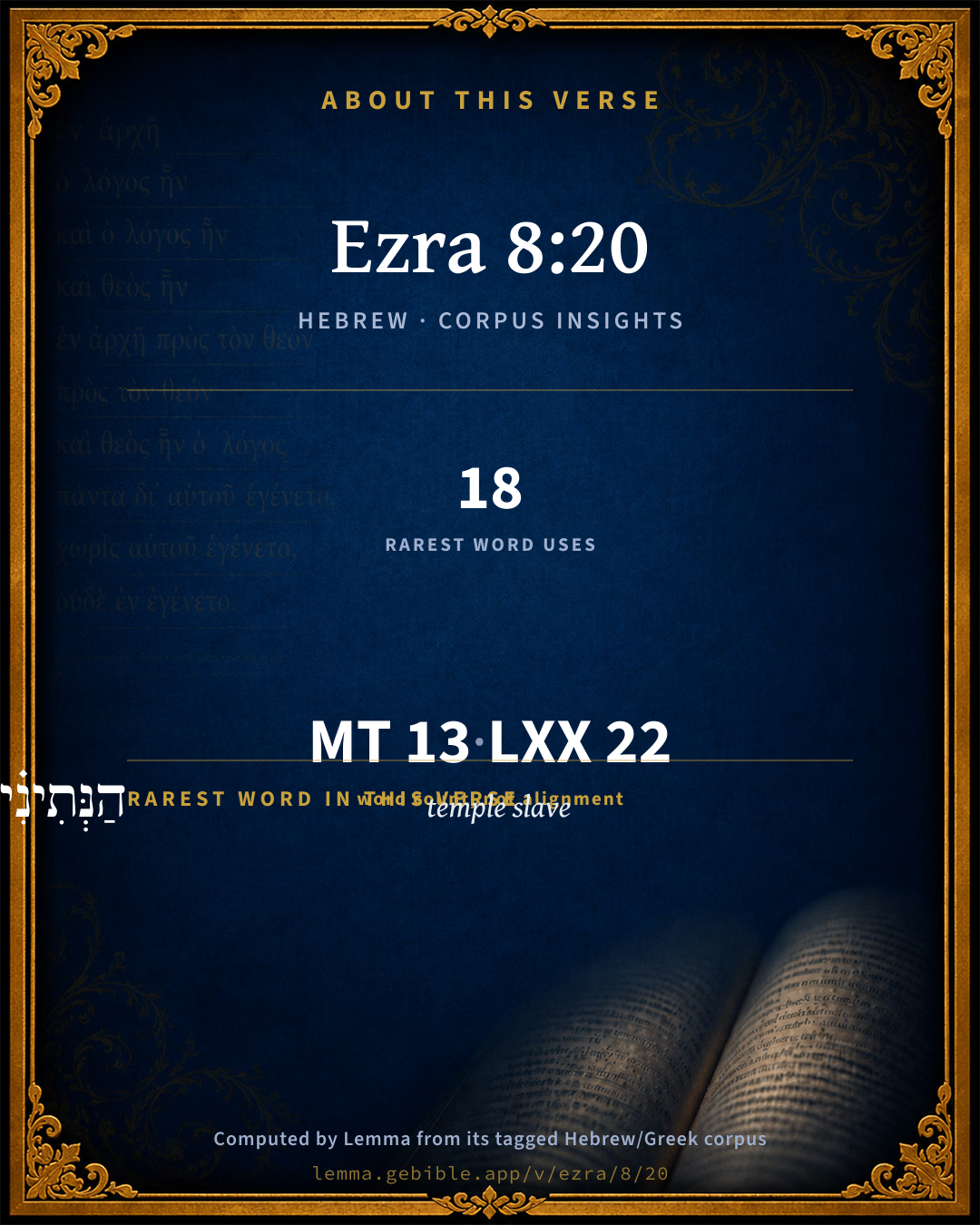
About this verse

These counts appear in no published source. They are computed here, from the morphology-tagged text and Lemma’s own curated glosses. What Lemma adds →

13
words
12
distinct lemmas
Historical
section

Notable vocabulary

The rarest word here is הַנְּתִינִ֗ים temple slave H5411 — appearing just 18 times in the whole Hebrew Bible.

Shared distinctive vocabulary

הַנְּתִינִ֗ים temple slave H5411 occurs in 15 verses of the Hebrew Bible. Also found in:

Grammatical profile

  • 2 verbs
  • 8 nouns
  • 2 adjectives
  • 1 preposition

Verb forms

  • שֶׁנָּתַ֨ן Qal · Perfect
  • נִקְּב֥וּ Niphal · Perfect

Repetition

A word recurs within this verse — often emphatic in Hebrew:

  • הַנְּתִינִ֗ים temple slave H5411 ×2

Hebrew & Septuagint length

In English translation the verse runs 29 words from the Hebrew and 30 from the Septuagint (LXX English) — closely comparable.

A rough comparison of the two English renderings, which tokenize alike — not a word-level alignment.

Word counts can differ between the Hebrew and the Greek without any difference in meaning — e.g. the Hebrew direct-object marker אֵת has no separate Greek word, and Greek often adds the article ὁ.

In the original languages it is 13 Hebrew tokens and 22 Greek tokens — but the two are counted differently (Hebrew bundles its prefixes and suffixes into one token; the Greek is in lemma form), so that isn’t a like-for-like length.

Cross-references

5

Topical passages linked to Ezra 8:20 in the Treasury of Scripture Knowledge — connected by theme and wording, ordered by reader-vote popularity; previews shown in the World English Bible.

  • Ezra 2:43 The Nethinim: the children of Ziha, the children of Hasupha, the children of Tabbaoth,
  • Ezra 7:7 There went up some of the children of Israel, and of the priests, and the Levites, and the singers, and the porters, and the Nethinim, to Jerusalem, in the seventh year of Artaxerxes the king.
  • 1 Chronicles 9:2 Now the first inhabitants who lived in their possessions in their cities were Israel, the priests, the Levites, and the Nethinim.
  • Ezra 8:17 I sent them forth to Iddo the chief at the place Casiphia; and I told them what they should tell Iddo, [and] his brothers the Nethinim, at the place Casiphia, that they should bring to us ministers for the house of our God.
  • Philippians 4:3 Yes, I beg you also, true yoke-fellow, help these women, for they labored with me in the Gospel, with Clement also, and the rest of my fellow workers, whose names are in the book of life.

Cross-references courtesy of OpenBible.info (CC BY 4.0).

Hebrew and Greek witnesses Masoretic Hebrew ↔ Greek Septuagint

The same verse in the two great witnesses to the Old Testament, shown verse-for-verse.

These are two independent witnesses, not word-aligned to each other, and the Septuagint is shown in lemma (dictionary) form.

Hebrew Ezra 8:20 Masoretic · Westminster Leningrad Codex

וּמִן הַנְּתִינִ֗ים שֶׁנָּתַ֨ן דָּוִ֤יד וְהַשָּׂרִים֙ לַעֲבֹדַ֣ת הַלְוִיִּ֔ם נְתִינִ֖ים מָאתַ֣יִם וְעֶשְׂרִ֑ים כֻּלָּ֖ם נִקְּב֥וּ בְשֵׁמֽוֹת

and of the Nethinim, whom David and the princes had given for the service of the Levites, two hundred and twenty Nethinim: all of them were mentioned by name.

World English Bible · Public Domain

Greek LXX Ezra 8:20 Septuagint · lemma form

καί ἀπό ὁ ναθινιμ ὅς δίδωμι δαυίδ καί ὁ ἄρχων εἰς δουλεία ὁ λευείτης ναθινιμ διακόσιοι καί εἴκοσι πᾶς συνἄγω ἐν ὄνομα

And of the Nathinim; whom David and the princes had appointed for the service of the Levites there were two hundred and twenty Nathinim; all were gathered by their names.

LXX2012 (modern English Septuagint) · Public Domain

In the Septuagint this is one book — Esdras B (2 Esdras): Ezra is chapters 1–10, Nehemiah 11–23.

Hebrew: Westminster Leningrad Codex (CC BY 4.0). Greek: Septuagint (public domain); English from LXX2012 (modern English Septuagint) (Public Domain). How the Septuagint differs from the Hebrew →

Commentary

Notes on Ezra 8:20 from classic Christian and Jewish commentators (each source and its license shown beneath its notes). The classic Christian expositions comment on the surrounding passage and are grouped to its opening verse, so a note may address several verses; the Jewish commentaries on the Tanakh (Rashi and others) are per-verse, so they appear only where the commentator wrote on this verse.

Lemma curates 59 commentaries, every one of them public domain or Creative Commons licensed, each selected and text-cleaned for this edition rather than reprinted as found. About our sources →

Trapp's Complete Commentary

John Trapp

Ezr 8:20 Also of the Nethinims, whom David and the princes had appointed for the service of the Levites, two hundred and twenty Nethinims: all of them were expressed by name.

Ver. 20. Whom David and the princes had appointed] i.e. Continued, confirmed, and ordered them; for they were first appointed and designed to that service by Joshua; and thence called Nethinims.

All of them were expressed by name] Verbis non solum disertis, sed et exsertis. Words not only skilfully expressed, but even uncovered.

John Trapp, A Commentary or Exposition upon All the Books of the Old and New Testament (1647–1656) — public domain. Text from a community e-Sword module.

Joseph Benson's Commentary

Ezr 8:20. Also of the Nethinims, whom David and the princes had appointed — The Gibeonites, who were devoted to the service of the Levites by Joshua and the princes of his time, (Jos 9:21,) and are said to have been appointed by David and his princes, because they were confirmed by them in their former office, and more particularly applied to the several services of the temple. Of them two hundred and twenty, upon this hasty summons, listed themselves, and had the honour to be expressed by name in Ezra’s muster-roll. This success Ezra ascribes to the good hand of God upon them. If, where ministers have been wanting, the vacancies are well supplied, let God have the glory, and his good hand, qualifying them for the service, inclining them to it, and then opening a door of opportunity for them.

Joseph Benson's Commentary on the Old and New Testaments (1811–1818) — public domain. Text from a community e-Sword module.

Tyndale Open Study Notes

Tyndale Open Resources

8:20 first instituted by King David and his officials: See 1 Chr 24–26.

Tyndale Open Study Notes — © Tyndale Open Resources, licensed CC BY-SA 4.0. Text via the HelloAO Bible API.

Geneva Bible (1599)

Geneva Bible translators

Read Ezra 2:43.

Geneva Bible (1599) marginal notes — public domain. Text via Bolls.life.

Ellicott's Commentary for English Readers

(20) The Nethinims—It is here alone recorded that David appointed these to aid the Levites.

All of them were expressed by name.—Not, as some think, that they were all famous, but that Iddo sent their names in a list not given. The relief of their coming is gratefully ascribed to the “good hand of our God upon us.”

A Bible Commentary for English Readers, edited by Charles John Ellicott (1878–1897) — public domain. Text from a community e-Sword module.

The Cambridge Bible for Schools and Colleges

gen. ed. J. J. S. Perowne

20. also of the Nethinims] R.V. and of the Nethinim.

whom David and the princes had appointed] R.V. whom David and the princes had given. ‘Given’, not ‘appointed’, more literal rendering and corresponds with meaning of Nethinim (=given). See on Ezr_2:55. The sentence illustrates the prevailing tradition as to the origin of the Nethinim.

for the service of] here as usually = “for ministration or service to”; cf. Exo_30:16 : frequent in Chron. in the phrase “the service of the house of God”. Sometimes = “service rendered by”, e.g. Exo_38:21. For its primary meaning cf. Neh_5:18 (bondage).

all … expressed by name] cf. the same phrase 1Ch_12:31; 1Ch_16:41; 2Ch_28:15; 2Ch_31:19. The metaphor of the original is that of being ‘pricked’ off on the list. The list was probably before the compiler, who does not think it worth while to occupy space with the names.

The Cambridge Bible for Schools and Colleges (gen. ed. J. J. S. Perowne; Cambridge University Press, 1878–1918) — public domain. Text from a community e-Sword module.

John Gill's Exposition

Then I proclaimed a fast there, at the river Ahava,.... After the messengers to Iddo were returned with those they brought with them:

that we might afflict ourselves before our God; humble themselves before him for their sins, confess them, and declare their repentance of them, and ask forgiveness for them:

to seek of him a right way for us; to take from thence towards Jerusalem, to be directed by him in it: either by a prophet, or by a vision in a dream, as Eben Ezra; or rather by the guidance of his providence; this they sought in prayer by the river side, where it had been usual with them, and since has been, to perform religious exercises, see Eze 1:1, hence Tertullian (z) calls the prayers of the Jews "orationes littorales"; they sought not so much which was the shortest and easiest way for them to travel in, as which was the safest:

and for our little ones and for all our substance; for the safe conveyance of them; this shows, that though males only are numbered, as before, yet they had their wives and children with them; for little ones cannot be supposed without women to take care of them.

(z) Ad nationes, l. 1. c. 13. Vid. lib. de jejuniis, c. 16.

John Gill's Exposition of the Whole Bible (1746–1763) — public domain (CC PDM 1.0). Text via the HelloAO Bible API.

Matthew Poole's English Annotations

The Gibeonites, who were devoted to this service by Joshua and the princes of his time, Jos 9:21, and are said to be appointed by David and his princes, because they were confirmed by them in their former office, and more particularly applied to the several services of the temple; though this be not distinctly related in 1Ch 24; 1Ch 25; 1Ch 26, because his business there was to give an account only of the new constitutions and alterations made by David in those matters.

Matthew Poole's English Annotations on the Holy Bible (1683–1685) — public domain. Text from a community e-Sword/MySword module.

The Pulpit Commentary

The Nethinims, whom David and the princes had appointed. We learn this fact from the present passage only; since neither in Kings nor Chronicles is there any mention made of David"s adding to the hieroduli, or temple servants. It is, however, quite in accordance with his other arrangements that he should have done so. The original Nethinims were the Gibeonites. (Jos_9:23) All were expressed by name.

Iddo sent to Ezra a list of the Nethinims, which, however, he does not think it necessary to insert.

The Pulpit Commentary (1880–1919), ed. H.D.M. Spence-Jones & Joseph S. Exell — public domain. Text from a community e-Sword module.

Rashi

Rabbi Shlomo Yitzchaki (Rashi)

And of the Nethinites And of the slaves, the Nethnites that King David had appointed, and the chefs of Israel ascended with them.

Rashi on the Tanakh — English translations: “The Judaica Press complete Tanach with Rashi, translated by A. J. Rosenberg” (CC BY 4.0); “Pentateuch with Rashi's commentary by M. Rosenbaum and A.M. Silbermann, 1929-1934” (public domain); “The Metsudah Tanach series, Lakewood, N.J” (CC BY 4.0); and “The Book of Joshua, Metsudah Publications, 1997” (CC BY 4.0). Text via Sefaria.

Lesson kit

Teaching starters — assembled from the data on this page, not authored interpretation. Every prompt links to the verse data it draws on. Edit before teaching.

Ezra, in the Historical, opens this verse with 13 words (12 distinct Hebrew lemmas). Its most distinctive word is Nâthîyn (“temple slave”). A historical commentator’s framing appears above. Read the whole chapter for the surrounding context.

Discussion questions

  1. The word Nâthîyn carries the sense “temple slave.” How does it shape the verse?
  2. 1 Chronicles 9:2 shares the word «temple slave» with this verse. How do the two illuminate each other?
  3. “temple slave” occurs 2× in this one verse. What is the effect of the repetition?
  4. These translations render this verse differently. What is at stake in choosing one wording over another?
  5. The verb «שֶׁנָּתַ֨ן» is Qal Perfect. How does its form color the action?
  6. Reading how Trapp's Complete Commentary and Joseph Benson's Commentary read this verse, where do the two commentators agree and where do they part?

Things to notice

Reading settings

Reading text

Shown beneath each verse's original-language words.

Old Testament
Old Testament edition

Read the OT as the Masoretic Hebrew (MT) or the Greek Septuagint (LXX).

English shown for the Greek Septuagint (in the Hebrew ↔ Greek comparison).

Comparing translations? Open the Compare panel on any verse page to stack up to four side by side.