
2 Chronicles 21:12

Hebrew (Westminster Leningrad Codex) 2 Chronicles 21:12 appears in the Hebrew Old Testament. The text above is from the Westminster Leningrad Codex. Each word links to its Strong’s number, a concise gloss, and parsing drawn from the Open Scriptures Hebrew Bible morphology. Click any word for its full Brown-Driver-Briggs (BDB) entry.
Download image
Cite this verse

2 Chronicles 21:12 (World English Bible). Public Domain. Lemma interlinear Bible study tool, https://lemma.gebible.app/v/2-chronicles/21/12.

Show BibTeX & RIS
BibTeX
RIS
English Translation
There came a writing to him from Elijah the prophet, saying, Thus says Yahweh, the God of David your father, Because you have not walked in the ways of Jehoshaphat your father, nor in the ways of Asa king of Judah,
World English Bible · Public Domain
Download a study sheet

One document with this verse’s original text, its word-by-word gloss line, the meaning frame, cross-references with their text, attributed commentary, and full source and license credits — printable, and it pastes into notes with its structure intact.

This verse Autodidact and up

Study sheet (.html) Plain text (.txt)

A passage Seminary Student

Up to 50 verses in one chapter. A passage sheet keeps up to 6 commentary sources and 12 cross-references per verse, in the order this page ranks them, and says so on the sheet whenever that leaves anything out. Ask for a single verse and you get the Autodidact verse sheet above.

Everything on this page stays free to read, with no account — the sheet is a download of what is already on screen, not access to it.

Want to remove ads? Support Godless Engineer
Compare translations 3

The same verse in 3 English versions, stacked beneath the original-language interlinear above. Click any original word for its lexicon entry.

Each is an independent rendering of the whole verse — the interlinear is not word-aligned to these translations.

Highlighted words mark where these versions differ — a whole-verse word diff, not a word-by-word alignment.

  • World English Bible Public Domain
    There came a writing to him from Elijah the prophet, saying, Thus says Yahweh, the God of David your father, Because you have not walked in the ways of Jehoshaphat your father, nor in the ways of Asa king of Judah,
  • King James Version Public Domain
    And there came a writing to him from Elijah the prophet, saying, Thus saith the LORD God of David thy father, Because thou hast not walked in the ways of Jehoshaphat thy father, nor in the ways of Asa king of Judah,
  • unfoldingWord Literal Text CC BY-SA 4.0
    And a writing came to him from Elijah the prophet, saying, “Thus says Yahweh, the God of David your father: ‘Because you did not walk in the ways of Jehoshaphat your father and in the ways of Asa, the king of Judah,

unfoldingWord Literal Text — © unfoldingWord, licensed CC BY-SA 4.0. Word-aligned USFM3 via Door43 (git.door43.org/unfoldingWord/en_ult).

Versions to compare (up to 4)

3 of 4 selected

Show all 18 translations

Every available English version of this verse, each an independent rendering of the whole verse.

  • World English Bible Public Domain
    There came a writing to him from Elijah the prophet, saying, Thus says Yahweh, the God of David your father, Because you have not walked in the ways of Jehoshaphat your father, nor in the ways of Asa king of Judah,
  • Berean Standard Bible Public Domain
    Then a letter came to Jehoram from Elijah the prophet, which stated: “This is what the LORD, the God of your father David, says: ‘You have not walked in the ways of your father Jehoshaphat or of Asa king of Judah,
  • Majority Standard Bible Public Domain
    Then a letter came to Jehoram from Elijah the prophet, which stated: “This is what the LORD, the God of your father David, says: ‘You have not walked in the ways of your father Jehoshaphat or of Asa king of Judah,
  • King James Version Public Domain
    And there came a writing to him from Elijah the prophet, saying, Thus saith the LORD God of David thy father, Because thou hast not walked in the ways of Jehoshaphat thy father, nor in the ways of Asa king of Judah,
  • American Standard Version (1901) Public Domain
    And there came a writing to him from Elijah the prophet, saying, Thus saith Jehovah, the God of David thy father, Because thou hast not walked in the ways of Jehoshaphat thy father, nor in the ways of Asa king of Judah,
  • Revised Version (1885) Public Domain
    And there came a writing to him from Elijah the prophet, saying, Thus saith the LORD, the God of David thy father, Because thou hast not walked in the ways of Jehoshaphat thy father, nor in the ways of Asa king of Judah;
  • Geneva Bible (1599) Public Domain
    And there came a writing to him from Elijah the Prophet, saying, Thus sayth the Lord God of Dauid thy father, Because thou hast not walked in the wayes of Iehoshaphat thy father, nor in the wayes of Asa King of Iudah,
  • Douay-Rheims (1899) Public Domain
    And there was a letter brought him from Elias the prophet, in which it was written: Thus saith the Lord the God of David thy father: Because thou hast not walked in the ways of Josaphat thy father nor in the ways of Asa king of Juda,
  • Young's Literal Translation Public Domain
    And there cometh in unto him a writing from Elijah the prophet, saying, `Thus said Jehovah, God of David thy father, Because that thou hast not walked in the ways of Jehoshaphat thy father, and in the ways of Asa king of Judah,
  • Literal Standard Version CC BY-SA 4.0
    And a writing from Elijah the prophet comes to him, saying, “Thus said YHWH, God of your father David: Because that you have not walked in the ways of your father Jehoshaphat, and in the ways of Asa king of Judah,
  • Unlocked Literal Bible CC BY-SA 4.0
    A letter from the prophet Elijah came to Jehoram. It said, “This is what Yahweh, the God of David, your ancestor, says: Because you have not walked in the ways of Jehoshaphat, your father, nor in the ways of Asa, king of Judah,
  • unfoldingWord Literal Text CC BY-SA 4.0
    And a writing came to him from Elijah the prophet, saying, “Thus says Yahweh, the God of David your father: ‘Because you did not walk in the ways of Jehoshaphat your father and in the ways of Asa, the king of Judah,
  • Darby Bible Public Domain
    And there came a writing to him from Elijah the prophet saying, Thus saith Jehovah, the God of David thy father: Because thou hast not walked in the ways of Jehoshaphat thy father, nor in the ways of Asa king of Judah,
  • World Messianic Bible Public Domain
    A letter came to him from Elijah the prophet, saying, “the LORD, the God of David your father, says, ‘Because you have not walked in the ways of Jehoshaphat your father, nor in the ways of Asa king of Judah,
  • Webster's Bible Public Domain
    And there came a writing to him from Elijah the prophet, saying, Thus saith the LORD God of David thy father, Because thou hast not walked in the ways of Jehoshaphat thy father, nor in the ways of Asa king of Judah,
  • Free Bible Version CC BY-SA 4.0
    Jehoram received a letter from Elijah the prophet that said, “This is what the Lord, the God of David your forefather says, ‘You have not followed the ways of your father Jehoshaphat, or Asa, king of Judah,
  • Bible in Basic English Public Domain
    And a letter came to him from Elijah the prophet, saying, The Lord, the God of your father David, says, Because you have not kept to the ways of your father Jehoshaphat or the ways of Asa, king of Judah,
  • JPS Tanakh (1917) Public Domain
    And there came a writing to him from Elijah the prophet, saying: 'Thus saith the LORD, the God of David thy father: Because thou hast not walked in the ways of Jehoshaphat thy father, nor in the ways of Asa king of Judah;

Literal Standard Version (2020), Covenant Press — licensed CC BY-SA 4.0. Text via the HelloAO Bible API (eBible.org). Unlocked Literal Bible (unfoldingWord) — licensed CC BY-SA 4.0. Text via the HelloAO Bible API (eBible.org). unfoldingWord Literal Text — © unfoldingWord, licensed CC BY-SA 4.0. Word-aligned USFM3 via Door43 (git.door43.org/unfoldingWord/en_ult). Free Bible Version, Dr. Jonathan Gallagher — licensed CC BY-SA 4.0. Text via the HelloAO Bible API (eBible.org).

Word by word

More ways to search: Search by grammar → Find every occurrence → Compare this word →

Practice this passage: Drill this verse → Learn its vocabulary →

מִכְתָּ֔ב
miktâb
H4385
“writing”
Noun, Common, Masculine, Singular, Absolute
Part of Speech
Noun
Type
Common
Gender
Masculine
Number
Singular
State
Absolute
Full BDB Definition

Origin: from H3789

TWOT: 1053c

writing, thing written - handwriting - thing written - writing
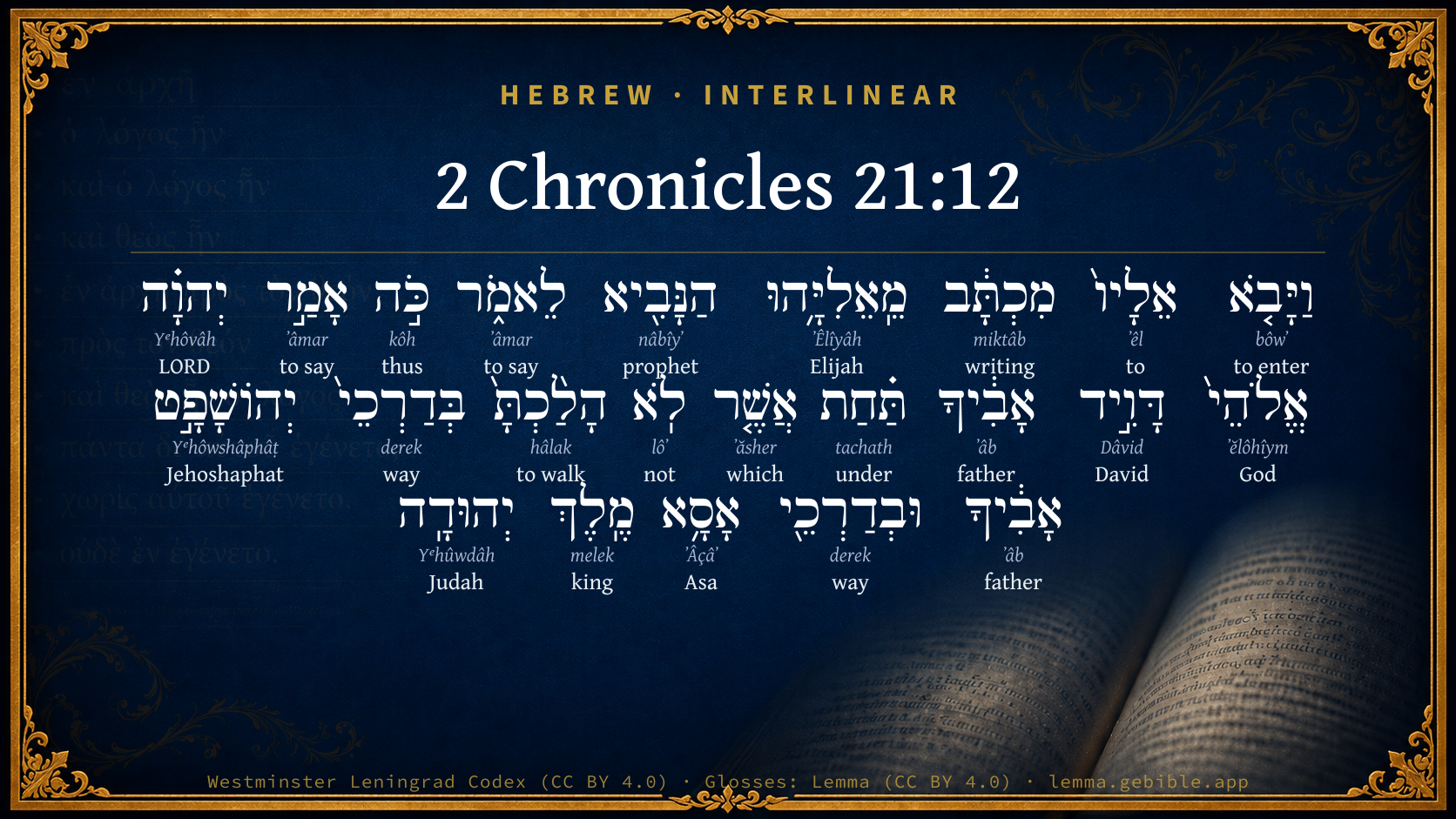
  1. וַיָּבֹ֤א bôwʼ H935 “and · to enter” Conjunction + Verb, Qal, Sequential Imperfect, 3rd Person, Masculine, Singular
  2. אֵלָיו֙ ʼêl H413 “to · him” Preposition + Suffix, Personal, 3rd Person, Masculine, Singular
  3. מֵֽאֵלִיָּ֥הוּ ʼÊlîyâh H452 “from · Elijah” Preposition + Noun, Proper
  4. הַנָּבִ֖יא nâbîyʼ H5030 “the · prophet” Particle, Definite Article + Noun, Common, Masculine, Singular, Absolute
  5. לֵאמֹ֑ר ʼâmar H559 “to say” Preposition + Verb, Qal, Infinitive Construct
  6. כֹּ֣ה kôh H3541 “thus” Adverb
  7. אָמַ֣ר ʼâmar H559 “to say” Verb, Qal, Perfect, 3rd Person, Masculine, Singular
  8. יְהוָ֗ה Yᵉhôvâh H3068 “LORD” Noun, Proper
  9. אֱלֹהֵי֙ ʼĕlôhîym H430 “God(s) of” Noun, Common, Masculine, Plural, Construct
  10. דָּוִ֣יד Dâvid H1732 “David” Noun, Proper
  11. אָבִ֔יךָ ʼâb H1 “father · your” Noun, Common, Masculine, Singular, Construct + Suffix, Personal, 2nd Person, Masculine, Singular
  12. תַּ֗חַת tachath H8478 “under” Preposition
  13. אֲשֶׁ֤ר ʼăsher H834 “which” Particle, Relative
  14. לֹֽא lôʼ H3808 “not” Particle, Negative
  15. הָלַ֨כְתָּ֙ hâlak H1980 “to walk” Verb, Qal, Perfect, 2nd Person, Masculine, Singular
  16. בְּדַרְכֵי֙ derek H1870 “in/at · ways of” Preposition + Noun, Common, Both, Plural, Construct
  17. יְהוֹשָׁפָ֣ט Yᵉhôwshâphâṭ H3092 “Jehoshaphat” Noun, Proper
  18. אָבִ֔יךָ ʼâb H1 “father · your” Noun, Common, Masculine, Singular, Construct + Suffix, Personal, 2nd Person, Masculine, Singular
  19. וּבְדַרְכֵ֖י derek H1870 “and · in/at · ways of” Conjunction + Preposition + Noun, Common, Both, Plural, Construct
  20. אָסָ֥א ʼÂçâʼ H609 “Asa” Noun, Proper
  21. מֶֽלֶךְ melek H4428 “king of” Noun, Common, Masculine, Singular, Construct
  22. יְהוּדָֽה Yᵉhûwdâh H3063 “Judah” Noun, Proper

About this verse

These counts appear in no published source. They are computed here, from the morphology-tagged text and Lemma’s own curated glosses. What Lemma adds →

23
words
20
distinct lemmas
Historical
section

Notable vocabulary

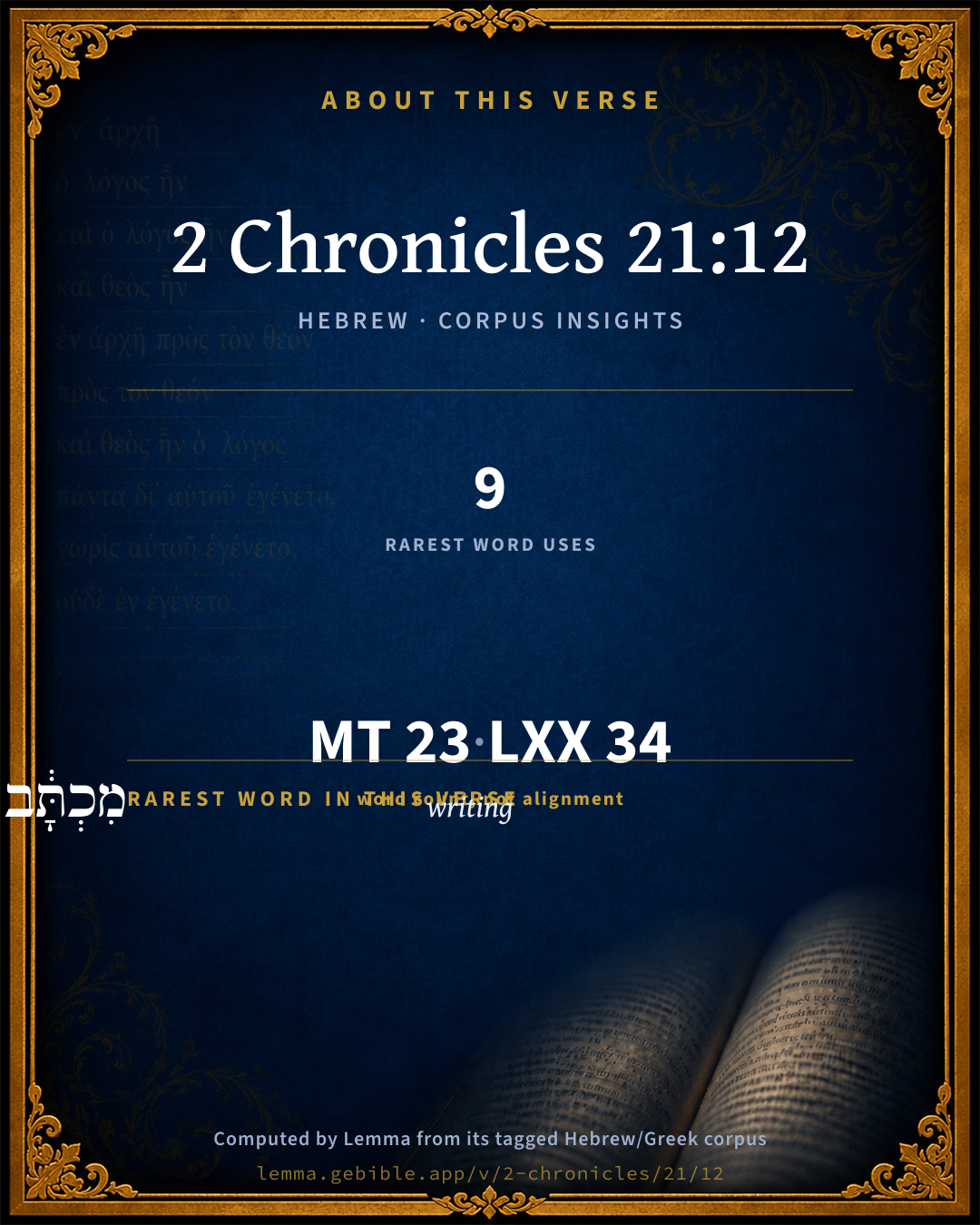
The rarest word here is מִכְתָּ֔ב writing H4385 — appearing just 9 times in the whole Hebrew Bible.

Shared distinctive vocabulary

מִכְתָּ֔ב writing H4385 occurs in 8 verses of the Hebrew Bible. Also found in:

Grammatical profile

  • 4 verbs
  • 14 nouns
  • 2 prepositions
  • 1 adverb
  • 2 particles

Verb forms

  • וַיָּבֹ֤א Qal · Sequential Imperfect
  • לֵאמֹ֑ר Qal · Infinitive Construct
  • אָמַ֣ר Qal · Perfect
  • הָלַ֨כְתָּ֙ Qal · Perfect

Repetition

Words recur within this verse — often emphatic in Hebrew:

  • לֵאמֹ֑ר to say H559 ×2
  • אָבִ֔יךָ father H1 ×2
  • בְּדַרְכֵי֙ way H1870 ×2

Hebrew & Septuagint length

In English translation the verse runs 41 words from the Hebrew and 44 from the Septuagint (LXX English) — closely comparable.

A rough comparison of the two English renderings, which tokenize alike — not a word-level alignment.

Word counts can differ between the Hebrew and the Greek without any difference in meaning — e.g. the Hebrew direct-object marker אֵת has no separate Greek word, and Greek often adds the article ὁ.

In the original languages it is 23 Hebrew tokens and 34 Greek tokens — but the two are counted differently (Hebrew bundles its prefixes and suffixes into one token; the Greek is in lemma form), so that isn’t a like-for-like length.

Cross-references

12

Topical passages linked to 2 Chronicles 21:12 in the Treasury of Scripture Knowledge — connected by theme and wording, ordered by reader-vote popularity; previews shown in the World English Bible.

  • 2 Chronicles 14:2–5 Asa did that which was good and right in the eyes of Yahweh his God:
  • 2 Chronicles 17:3–4 Yahweh was with Jehoshaphat, because he walked in the first ways of his father David, and didn't seek the Baals,
  • 2 Kings 2:1 It happened, when Yahweh would take up Elijah by a whirlwind into heaven, that Elijah went with Elisha from Gilgal.
  • 1 Kings 15:11 Asa did that which was right in the eyes of Yahweh, as did David his father.
  • 1 Kings 22:43 He walked in all the way of Asa his father; He didn't turn aside from it, doing that which was right in the eyes of Yahweh: however the high places were not taken away; the people still sacrificed and burnt incense in the high places.
  • 2 Kings 2:11 It happened, as they still went on, and talked, that behold, [there appeared] a chariot of fire, and horses of fire, which parted them both apart; and Elijah went up by a whirlwind into heaven.
  • Jeremiah 36:2 Take a scroll of a book, and write therein all the words that I have spoken to you against Israel, and against Judah, and against all the nations, from the day I spoke to you, from the days of Josiah, even to this day.
  • Jeremiah 36:23 It happened, when Jehudi had read three or four leaves, that [the king] cut it with the penknife, and cast it into the fire that was in the brazier, until all the scroll was consumed in the fire that was in the brazier.
  • Jeremiah 36:28–32 Take again another scroll, and write in it all the former words that were in the first scroll, which Jehoiakim the king of Judah has burned.
  • Daniel 5:5 In the same hour came forth the fingers of a man's hand, and wrote over against the lampstand on the plaster of the wall of the king's palace: and the king saw the part of the hand that wrote.
  • Daniel 5:25–29 This is the writing that was inscribed: MENE, MENE, TEKEL, UPHARSIN.
  • Ezekiel 2:9–10 When I looked, behold, a hand was put forth to me; and, behold, a scroll of a book was therein;

Cross-references courtesy of OpenBible.info (CC BY 4.0).

Hebrew and Greek witnesses Masoretic Hebrew ↔ Greek Septuagint

The same verse in the two great witnesses to the Old Testament, shown verse-for-verse.

These are two independent witnesses, not word-aligned to each other, and the Septuagint is shown in lemma (dictionary) form.

Hebrew 2 Chronicles 21:12 Masoretic · Westminster Leningrad Codex

וַיָּבֹ֤א אֵלָיו֙ מִכְתָּ֔ב מֵֽאֵלִיָּ֥הוּ הַנָּבִ֖יא לֵאמֹ֑ר כֹּ֣ה אָמַ֣ר יְהוָ֗ה אֱלֹהֵי֙ דָּוִ֣יד אָבִ֔יךָ תַּ֗חַת אֲשֶׁ֤ר לֹֽא הָלַ֨כְתָּ֙ בְּדַרְכֵי֙ יְהוֹשָׁפָ֣ט אָבִ֔יךָ וּבְדַרְכֵ֖י אָסָ֥א מֶֽלֶךְ יְהוּדָֽה

There came a writing to him from Elijah the prophet, saying, Thus says Yahweh, the God of David your father, Because you have not walked in the ways of Jehoshaphat your father, nor in the ways of Asa king of Judah,

World English Bible · Public Domain

Greek LXX 2 Chronicles 21:12 Septuagint · lemma form

καί ἔρχομαι αὐτός γράφω παρά ηλιου ὁ προφήτης λέγω ὅδε λέγω κύριος ὁ θεός δαυίδ ὁ πατήρ σύ ἀντί ὅς οὐ πορεύομαι ἐν ὁδός ιωσαφατ ὁ πατήρ σύ καί ἐν ὁδός ασα βασιλεύς ἰουδά

And there came to him a message in writing from Eliu the prophet, saying, Thus says the Lord God of your father David, Because you have not walked in the way of your father Josaphat, nor in the ways of Asa king of Juda,

LXX2012 (modern English Septuagint) · Public Domain

On this verse, Ellicott's Commentary for English Readers discusses the Septuagint’s reading. Read the note in Commentary ↓

Hebrew: Westminster Leningrad Codex (CC BY 4.0). Greek: Septuagint (public domain); English from LXX2012 (modern English Septuagint) (Public Domain). How the Septuagint differs from the Hebrew →

Commentary

Notes on 2 Chronicles 21:12 from classic Christian and Jewish commentators (each source and its license shown beneath its notes). The classic Christian expositions comment on the surrounding passage and are grouped to its opening verse, so a note may address several verses; the Jewish commentaries on the Tanakh (Rashi and others) are per-verse, so they appear only where the commentator wrote on this verse.

Lemma curates 59 commentaries, every one of them public domain or Creative Commons licensed, each selected and text-cleaned for this edition rather than reprinted as found. About our sources →

Matthew Henry's Commentary

Here we have, I. A warning from God sent to Jehoram by a writing from Elijah the prophet. By this it appears that Jehoram came to the throne, and showed himself what he was before Elijah's translation. It is true we find Elisha attending Jehoshaphat, and described as pouring water on the hands of Elijah, after the story of Elijah's translation (Kg2 3:11); but that might be, and that description might be given of him, while Elijah was yet on earth: and it is certain that that history is put out of its proper place, for we read of Jehoshaphat's death, and Jehoram's coming to the crown, before we read of Elijah's translation, Kg1 22:50. We will suppose that the time of his departure was at hand, so that he could not go in person to Jehoram; but that, hearing of his great wickedness in murdering his brethren, he left this writing it is probable with Elisha, to be sent him by the first opportunity, that it might either be a means to reclaim him or a witness against him that he was fairly told what would be in the end hereof. The message is sent him in the name of the Lord God of David his father (Ch2 21:12), upbraiding him with his relation to David as that which, though it was his honour, was an aggravation of his degeneracy. 1. His crimes are plainly charged upon him - his departure from the good ways of God, in which he had been educated, and which he had been directed and encouraged to walk in by the example of his good father and grandfather, who lived and died in peace and honour (Ch2 21:12) - his conformity to the ways of the house of Ahab, that impious scandalous family - his setting up and enforcing idolatry in his kingdom - and his murdering his brethren because they were better than himself, Ch2 21:13. These are the heads of the indictment against him. 2. Judgment is given against him for these crimes; he is plainly told that his sin should certainly be the ruin, (1.) Of his kingdom and family (Ch2 21:14): "With a heavy stroke, even that of war and captivity, will the Lord smite thy people and thy children," etc. Bad men bring God's judgments upon all about them. His people justly suffer because they had complied with his idolatry, and his wives because they had drawn him to it. (2.) Of his health and life: "Thou shalt have great sickness, very painful and tedious, and at last mortal," Ch2 21:15. This he is warned of before, that his blood might be upon his own head, the watchman having delivered his soul; and that when these things so particularly foretold, came to pass, it might appear that they did not come by chance, but as the punishment of his sins, and were so intended. And now if, as he had learned of Ahab to do wickedly, he had but learned even of Ahab to humble himself upon the receipt of this threatening message from Elijah - if, like (Kg1 21:27), he had rent his clothes, put on sackcloth, and fasted - who knows but, like him, he might have obtained at least a reprieve? But it does not appear that he took any notice of it; he threw it by as waste-paper; Elijah seemed to him as one that mocked. But those that will not believe shall feel.

II. The threatened judgments brought upon him because he slighted the warning. No marvel that hardened sinners are not frightened from sin and to repentance by the threatenings of misery in another world, which is future and out of sight, when the certain prospect of misery in this world, the sinking of their estates and the ruin of their healths, will not restrain them from vicious courses.

1. See Jehoram here stripped of all his comforts. God stirred up the spirit of his neighbours against him, who had loved and feared Jehoshaphat, but hated and despised him, looking upon it as a scandalous thing for a nation to change their gods. Some occasion or other they took to quarrel with him, invaded his country, but, as it should seem, fought neither against small nor great, but the king's house only; they made directly to that, and carried away all the substance that was found in it. No mention is made of their carrying any away captive but the king's wives and his sons, Ch2 21:17. Thus God made it evident that the controversy was with him and his house. Here it is only said, They carried away his sons; but we find (Ch2 22:1) that they slew them all. Blood for blood. He had slain all his brethren, to strengthen himself; and now all his sons are slain but one, and so he is weakened. If he had not been of the house of David, that one would not have escaped. When Jeroboam's house, and Baasha's, and Ahab's, were destroyed, there was none left; but David's house must not be wholly extirpated, though sometimes wretchedly degenerated, because a blessing was in it, no less a blessing than that of the Messiah.

2. See him tormented with sore diseases and of long continuance, such as were threatened in the law against those that would not fear the Lord their God, Deu 28:58, Deu 28:59. His disease was very grievous. It lay in his bowels, producing a continual griping, and with this there was a complication of other sore diseases. The affliction was moreover very tedious. Two years he continued ill, and could get no relief; for the disease was incurable, though he was in the prime of life, not forty years old. Asa, whose heart was perfect with God though in some instances he stepped aside, was diseased only in his feet; but Jehoram, whose heart was wicked, was struck in his inwards, and he that had no bowels of compassion towards his brethren was so plagued in his bowels that they fell out. Even good men, and those who are very dear to God, may be afflicted with diseases of this kind; but to them they are fatherly chastisements, and by the support of divine consolations the soul may dwell at ease even then when the body lies in pain. These sore diseases seized him just after his house was plundered and his wives and children were carried away. (1.) Perhaps his grief and anguish of mind for that calamity might occasion his sickness, or at least contribute to the heightening of it. (2.) By this sickness he was disabled to do any thing for the recovery of them or the revenge of the injury done him. (3.) It added, no doubt, very much to his grief, in his sickness, that he was deprived of the society of his wives and children and that all the substance of his house was carried away. To be sick and poor, sick and solitary, but especially to be sick and in sin, sick and under the curse of God, sick and destitute of grace to bear the affliction, and of comfort to counter-balance it - is a most deplorable case.

3. See him buried in disgrace. He reigned but eight years, and then departed without being desired, Ch2 21:20. Nobody valued him while he lived, none lamented him when he died, but all wished that no greater loss might ever come to Jerusalem. To show what little affection or respect they had for him, they would not bury him in the sepulchres of the kings, as thinking him unworthy to be numbered among them who had governed so ill. The excluding of his body from the sepulchres of his fathers might be ordered by Providence as an intimation of the everlasting separation of the souls of the wicked after death, from the spirits of just men. This further disgrace they put upon him, that they made no burning for him, like the burning of his fathers, Ch2 21:19. His memory was far from being sweet and precious to them, and therefore they did not honour it with any sweet odours or precious spices, though we may suppose that his dead body, after so long and loathsome a disease, needed something to perfume it. The generality of the people, though prone to idolatry, yet had no true kindness for their idolatrous kings. Wickedness and profaneness make men despicable even in the eyes of those who have but little religion themselves, while natural conscience itself often gives honour to those who are truly pious. Those that despise God shall be lightly esteemed, as Jehoram was.

Matthew Henry's Commentary on the Whole Bible (1708–1710) — public domain (CC PDM 1.0). Text via the HelloAO Bible API.

Ellicott's Commentary for English Readers

ELIJAH’S LETTER TO JEHORAM (2Ch_21:12-15).

(12) And there came a writing to him from Elijah the prophet.—Rather, to him a writing. This is the chronicler’s only mention of the great prophet of the northern kingdom. Elijah, though a very old man, may have been still alive. His extreme age would account for his sending a written prophecy, rather than going in person to warn Jehoram. If, however, it be supposed that the author of Kings has told the story of Elijah’s translation in its right place chronologically, and that the campaign described in the following chapter, in which Jehoshaphat took part, was really subsequent to that event, we may say that this “writing from Elijah the prophet,” containing the substance of some last utterances of his directed against Jehoram and Athaliah, was now put into written shape, and forwarded to Jehoram by one of the prophet’s pupils, perhaps by his great successor Elisha. (See 2Ki_2:15; 2Ki_3:11.) This explanation may seem to be favoured by the indefiniteness of the phrase, “a writing from Elijah” (not a letter); but 2Ki_3:11 is hardly conclusive against the assumption that Elijah was still alive. Elisha’s ministry may have begun, probably did begin, some time before his master’s ascension, and the description of him in 2Ki_3:11, “Elisha the son of Shaphat, who poured water on the hands of Elijah,” need not mean more than “Elisha the son of Shaphat, the servant of Elijah.” (Syriac, “And there was brought to him one of the discourses of Elijah the prophet, which said to him.”Vulg., wrongly, a letter, “allatae sunt autem ei litteræ ab Elia propheta.” LXX., καὶ ἦλθεν αὐτῷ ἐγγραφὴ παρὰ Ηλιου τοῦ προφήτου λέγων.)

A Bible Commentary for English Readers, edited by Charles John Ellicott (1878–1897) — public domain. Text from a community e-Sword module.

Trapp's Complete Commentary

John Trapp

2Ch 21:12 And there came a writing to him from Elijah the prophet, saying, Thus saith the LORD God of David thy father, Because thou hast not walked in the ways of Jehoshaphat thy father, nor in the ways of Asa king of Judah,

Ver. 12. And there came a writing to him.] Out of paradise, say some, by the hand of an angel, or of some faithful man, to whom Elias appeared after his death, as he did afterwards to the three disciples at Christ’s transfiguration. Others deny that this was Elijah the Tishbite - which title is not here given unto him - but another Elijah; or they say that it was Elisha, bearing the name of Elijah, because he came in the spirit of Elijah, that the writing might have the more authority and weight. This is rather to cut than to untie the knot. They do better who say, that Elijah the Tishbite, foreseeing by the Spirit {1Ki 13:2 Isa 45:1} that Jehoram would do so wickedly, wrote this epistle whilst he was yet alive, and left it with Elisha, or some other trusty person, to be sent unto Jehoram when he should see his time. Let us consider that letters are sent to us also from heaven, sc., the writings of the prophets and apostles, warning us to repent.

John Trapp, A Commentary or Exposition upon All the Books of the Old and New Testament (1647–1656) — public domain. Text from a community e-Sword module.

Joseph Benson's Commentary

2Ch 21:12. And there came a writing to him from Elijah — It is certain, Elijah was taken up into heaven in the time of Jehoshaphat. Therefore Josephus and the LXX. imagine (as Grotius observes) that from thence he sent a letter. Dr. Lightfoot is of opinion, that it is not meant of that Elijah who was carried up to heaven, but of another of his name, who sent this letter. Kimchi is of opinion that Elijah, foreseeing, by the spirit of prophecy, before he went to heaven, the wickedness of Jehoram, spake these words to one of the prophets, and charged him to put them down in writing, and send them in a letter to Jehoram, when he grew so impious, as is here related; and let him know that Elijah commanded this writing to be delivered to him: that so Jehoram, being affected with it, as if it had been sent from heaven, might be moved to repent of the evil he had done. And indeed the passage will bear this sense. He did not send a writing, but it was sent as his writing. For there is nothing in the words to intimate that this was written after his death, but only delivered after his death. So that it might have been written (for any thing that appears to the contrary) by Elijah himself before he was taken up into heaven. But, upon the whole, as we find the prophets were sent to those of their own time, and not to those who should come after, (there being a succession of prophets raised up for every age,) and as we have no mention of any other Elijah, in any other place of Scripture; and as (agreeable to what our Saviour makes Abraham say to the rich man, when he desired Lazarus to be sent from the dead to his brethren, They have Moses and the prophets,) we have no rational ground for thinking that God should employ a prophet, whom he had taken into heaven on this occasion, when there was, at that time, a prophet on the earth no ways inferior to him, namely, Elisha his successor: therefore there is ground to conclude, that the difficulty has arisen by the inaccuracy of transcribers of the Scriptures, and that it should be, and was at first written Elisha, and not Elijah.

Joseph Benson's Commentary on the Old and New Testaments (1811–1818) — public domain. Text from a community e-Sword module.

Keil & Delitzsch

C. F. Keil & F. Delitzsch

The prophet Elijah's letter against Joram, and the infliction of the punishments as announced. - Ch2 21:12. There came to him a writing from the prophet Elijah to this effect: "Thus saith Jahve, the God of thy father David, Because thou hast not walked in the ways of Jehoshaphat, ... but hast walked in the way of the kings of Israel, ... and also hast slain thy brethren, the house of thy father, who were better than thyself; behold, Jahve will send a great plague upon thy people, and upon thy sons, and thy wives, and upon all thy goods; and thou shalt have great sickness, by disease of thy bowels, until thy bowels fall out by reason of the sickness day by day." מכתב, writing, is a written prophetic threatening, in which his sins are pointed out to Joram, and the divine punishment for them announced. In regard to this statement, we need not be surprised that nothing is elsewhere told us of any written prophecies of Elijah; for we have no circumstantial accounts of his prophetic activity, by which we might estimate the circumstances which may have induced him in this particular instance to commit his prophecy to writing. But, on the other hand, it is very questionable if Elijah was still alive in the reign of Joram of Judah. His translation to heaven is narrated in 2 Kings 2, between the reign of Ahaziah and Joram of Israel, but the year of the event is nowhere stated in Scripture. In the Jewish Chronicle Seder olam, 2 Chr 17:45, it is indeed placed in the second year of Ahaziah of Israel; but this statement is not founded upon historical tradition, but is a mere deduction from the fact that his translation is narrated in 2 Kings 2 immediately after Ahaziah's death; and the last act of Elijah of which we have any record (2 Kings 1) falls in the second year of that king. Lightfoot, indeed (Opp. i. p. 85), Ramb., and Dereser have concluded from Kg2 3:11 that Elijah was taken away from the earth in the reign of Jehoshaphat, because according to that passage, in the campaign against the Moabites, undertaken in company with Joram of Israel, Jehoshaphat inquired for a prophet, and received the answer that Elisha was there, who had poured water upon the hands of Elijah. But the only conclusion to be drawn from that is, that in the camp, or near it, was Elisha, Elijah's servant, not that Elijah was no longer upon earth. The perfect יצק אשׁר seems indeed to imply this; but it is questionable if we may so press the perfect, i.e., whether the speaker made use of it, or whether it was employed only by the later historian. The words are merely a periphrasis to express the relationship of master and servant in which Elijah stood to Elisha, and tell us only that the latter was Elijah's attendant. But Elisha had entered upon this relationship to Elijah long before Elijah's departure from the earth (Kg1 19:19.). Elijah may therefore have still been alive under Joram of Judah; and Berth. accordingly thinks it "antecedently probable that he spoke of Joram's sins, and threatened him with punishment. But the letter," so he further says, "is couched in quite general terms, and gives, moreover, merely a prophetic explanation of the misfortunes with which Joram was visited;" whence we may conclude that in its present form it is the work of a historian living at a later time, who describes the relation of Elijah to Joram in few words, and according to his conception of it as a whole. This judgment rests on dogmatic grounds, and flows from a principle which refuses to recognise any supernatural prediction in the prophetic utterances. The contents of the letter can be regarded as a prophetic exposition of the misfortunes which broke in, as it were, upon Joram, only by those who deny priori that there is any special prediction in the speeches of the prophets, and hold all prophecies which contain such to be vaticinia post eventum. Somewhat more weighty is the objection raised against the view that Elijah was still upon earth, to the effect that the divine threatenings would make a much deeper impression upon Joram by the very fact that the letter came from a prophet who was no longer in life, and would thus more easily bring him to the knowledge that the Lord is the living God, who had in His hand his breath and all his ways, and who knew all his acts. Thus the writing would smite the conscience of Joram like a voice from the other world (Dchsel). But this whole remark is founded only upon subjective conjectures and presumptions, for which actual analogies are wanting.

For the same reason we cannot regard the remark of Menken as very much to the point, when he says: "If a man like Elias were to speak again upon earth, after he had been taken from it, he must do it from the clouds: this would harmonize with the whole splendour of his course in life; and, in my opinion, that is what actually occurred." For although we do not venture "to mark the limits to which the power and sphere of activity of the perfected saints is extended," yet we are not only justified, but also bound in duty, to judge of those facts of revelation which are susceptible of different interpretations, according to the analogy of the whole Scripture. But the Scriptures of the Old and New Testaments know nothing of any communications by writings between the perfected saints in heaven and men; indeed, they rather teach the contrary in the parable of the rich man

(Note: "Neque enim," says Ramb., "ulla ratione credibile est, Deum in gratiam impii regis ejusmodi quid fecisse, cujus nullum alias exemplum exstat; immo quod nec necessarium erat, quum plures aliae essent rationes, quibus Deus voluntatem suam ei manifestare poterat; coll. Luc. 16:27, 29." And, still more conclusively, Calov. declares: "Non enim triumphantium in coelis est erudire aut ad poenitentiam revocare mortales in terra. Habent Mosen et prophetas, si illos non audiant, neque si quis ex mortius resurrexerit, nedum si quis ex coelis literas perscripserit, credent Luc. 16:31.")

(Luk 16:31)

There are consequently no sufficient grounds for believing that the glorified Elijah either sent a letter to Joram from heaven by an angel, or commissioned any living person to write the letter. The statement of the narrative, "there came to him a writing from Elijah the prophet," cannot well be understood to mean anything else than that Elijah wrote the threatening prophecy which follows; but we have no certain proof that Elijah was then no longer alive, but had been already received into heaven. The time of his translation cannot be exactly fixed. He was still alive in the second year of Ahaziah of Israel; for he announced to this king upon his sick-bed that he would die of his fall (2 Kings 1). Most probably he was still alive also at the commencement of the reign of Joram of Israel, who ascended the throne twenty-three years after Ahab. Jehoshaphat died six or seven years later; and after his death, his successor Joram slew his brothers, the other sons of Jehoshaphat. Elijah may have lived to see the perpetration of this crime, and may consequently also have sent the threatening prophecy which is under discussion to Joram. As he first appeared under Ahab, on the above supposition, he would have filled the office of prophet for about thirty years; while his servant Elisha, whom he chose to be his successor as early as in the reign of Ahab (Kg1 19:16), died only under Joash of Israel (Kg2 13:14.), who became king fifty-seven years after Ahab's death, and must consequently have discharged the prophetic functions for at least sixty years. But even if we suppose that Elijah had been taken away from the earth before Jehoshaphat's death, we may, with Buddaeus, Ramb., and other commentators, accept this explanation: that the Lord had revealed to him Joram's wickedness before his translation, and had commissioned him to announce to Joram in writing the divine punishment which would follow, and to send this writing to him at the proper time. This would entirely harmonize with the mode of action of this great man of God. To him God had revealed the elevation of Jehu to the throne of Israel, and the extirpation of the house of Ahab by him, together with the accession of Hazael, and the great oppressions which he would inflict upon Israel, - all events which took place only after the death of Joram of Judah. Him, too, God had commissioned even under Ahab to anoint Jehu to be king over Israel (Kg1 19:16), which Elisha caused to be accomplished by a prophetic scholar fourteen years later (Kg2 9:1.); and to him the Lord may also have revealed the iniquity of Joram, Jehoshaphat's successor, even as early as the second year of Ahaziah of Israel, when he announced to this king his death seven years before Jehoshaphat's death, and may have then commissioned him to announce the divine punishment of his sin. But if Elijah committed the anointing of both Hazael and Jehu to his servant Elisha, why may he not also have committed to him the delivery of this threatening prophecy which he had drawn up in writing? Without bringing forward in support of this such hypotheses as that the contents of the letter would have all the greater effect, since it would seem as if the man of God were speaking to him from beyond the grave (O. v. Gerlach), we have yet a perfect right to suppose that a written word from the terrible man whom the Lord had accredited as His prophet by fire from heaven, in his struggle against Baal-worship under Ahab and Ahaziah, would be much better fitted to make an impression upon Joram and his consort Athaliah, who was walking in the footsteps of her mother Jezebel, than a word of Elisha, or any other prophet who was not endowed with the spirit and power of Elijah.

Elijah's writing pointed out to Joram two great transgressions: (1) his forsaking the Lord for the idolatrous worship of the house of Ahab, and also his seducing the people into this sin; and (2) the murder of his brothers. For the punishment of the first transgression he announced to him a great smiting which God would inflict upon his people, his family, and his property; for the second crime he foretold heavy bodily chastisements, by a dreadful disease which would terminate fatally. ימים על ימים, Ch2 21:15, is accus. of duration: days on days, i.e., continuing for days added to days; cf. שׁנה על שׁנה ספוּ, Isa 29:1. ימים Berth. takes to mean a period of a year, so that by this statement of time a period of two years is fixed for the duration of the disease before death. But the words in themselves cannot have this signification; it can only be a deduction from Ch2 21:18. These two threats of punishment were fulfilled. The fulfilment of the first is recorded in Ch2 21:16. God stirred up the spirit of the Philistines and the Arabians (רוּח את העיר, as in Ch1 5:26), so that they came up against Judah, and broke it, i.e., violently pressed into the land as conquerors (בּקע, so split, then to conquer cities by breaking through their walls; cf. Kg2 25:4, etc.), and carried away all the goods that were found in the king's house, with the wives and sons of Joram, except Jehoahaz the youngest (Ch2 22:1). Movers (Chron. S. 122), Credner, Hitz., and others on Joe 3:5, Berth., etc., conclude from this that these enemies captured Jerusalem and plundered it. But this can hardly be the case; for although Jerusalem belonged to Judah, and might be included in בּיהוּדה, yet as a rule Jerusalem is specially named along with Judah as being the chief city; and neither the conquest of Judah, nor the carrying away of the goods from the king's house, and of the king's elder sons, with certainty involves the capture of the capital. The opinion that by the "substance which was found in the king's house" we are to understand the treasures of the royal palace, is certainly incorrect. רכוּשׁ denotes property of any sort; and what the property of the king or of the king's house might include, we may gather from the catalogue of the אוצרות of David, in the country, in the cities, villages, and castles, Ch1 27:25., where they consist in vineyards, forests, and herds of cattle, and together with the המּלך אוצרות formed the property (הרכוּשׁ) of King David. All this property the conquering Philistines and Arabians who had pressed into Judah might carry away without having captured Jerusalem. But המּלך בּית denotes here, not the royal palace, but the king's family; for המּלך לבית הנּמצא does not denote what was found in the palace, but what of the possessions of the king's house they found. נמצא with ל is not synonymous with בּ נמצא, but denotes to be attained, possessed by; cf. Jos 17:16 and Deu 21:17. Had Jerusalem been plundered, the treasures of the palace and of the temple would also have been mentioned: Ch2 25:24; Ch2 12:9; Kg2 14:13. and Kg1 14:26; cf. Kuhlmey, alttestl. Studien in der Luther. Ztschr. 1844, iii. S. 82ff. Nor does the carrying away of the wives and children of King Joram presuppose the capture of Jerusalem, as we learn from the more exact account of the matter in Ch2 22:1.

Keil & Delitzsch — Biblical Commentary on the Old Testament (1861–1891) — public domain (CC PDM 1.0). Text via the HelloAO Bible API. (Old Testament only.)

Tyndale Open Study Notes

Tyndale Open Resources

21:12-15 The letter from Elijah the prophet to Jehoram announced judgment for his disobedience.

Tyndale Open Study Notes — © Tyndale Open Resources, licensed CC BY-SA 4.0. Text via the HelloAO Bible API.

Geneva Bible (1599)

Geneva Bible translators

Some think that this was Elisha, so called because he had the Spirit in abundance, as had Elijah.

Geneva Bible (1599) marginal notes — public domain. Text via Bolls.life.

Jamieson, Fausset & Brown

Robert Jamieson, A. R. Fausset & David Brown

there came a writing to him from Elijah the prophet--That prophet's translation having taken place in the reign of Jehoshaphat [Kg2 2:11-12], we must conclude that the name of Elijah has, by the error of a transcriber, been put for that of Elisha.

Jamieson, Fausset & Brown — Commentary Critical and Explanatory on the Whole Bible (1871) — public domain (CC PDM 1.0). Text via the HelloAO Bible API.

Adam Clarke's Commentary

Verse 12. There came a writing to him from Elijah the prophet] From 2Kg 2:11, it is evident that Elijah had been translated in the reign of Jehoshaphat, the father of Jehoram. How then could he send a letter to the son? Some say he sent it from heaven by an angel; others, that by the spirit of prophecy he foresaw this defection of Jehoram, and left the letter with Elisha, to be sent to him when this defection should take place; others say that Elijah is put here for Elisha; and others, that this Elijah was not the same that was translated, but another prophet of the same name. There are others who think that, as Elijah was still in the body, for he did not die, but was translated, he sent this letter from that secret place in which he was hidden by the Almighty. All the versions have Elijah, and all the MSS. the same reading. Dr. Kennicott contends that Elisha was the writer; for Elijah had been taken up to heaven thirteen years before the time of this writing. Our margin says, the letter was written before his assumption, and refers to 2Kg 2:1.

These are all conjectures; and I could add another to their number, but still we should be where we were. I should adopt the conjecture relative to Elisha, were not every Hebrew MS., and all the Oriental versions, against it; to which may be added, that the author of this book does not once mention Elisha in any part of his work. It is certainly a possible case that this writing might have been a prediction of Jehoram's impiety and miserable death, delivered in the time of the prophet, and which was now laid before this wicked king for the first time: and by it the prophet, though not among mortals, still continued to speak. I can see no solid reason against this opinion.

Adam Clarke's Commentary on the Bible (1810–1826) — public domain. Text from a community e-Sword/MySword module.

The Cambridge Bible for Schools and Colleges

gen. ed. J. J. S. Perowne

12. a writing] This is the only place in which any writing of Elijah is mentioned. Even in Jehoshaphat’s reign Elijah seems to have been no longer among the living; cp. 2Ki_3:11 (where Elisha seems already to have taken Elijah’s place). A prophecy of Elijah against Jehoram of Judah is an unlikely event, as perhaps the Chronicler himself felt. May it be that some adaptation of words of Elijah to suit Jehoram’s case was placarded by some unknown hand outside Jehoram’s palace?

the Lord God] R.V. the LORD, the God, lit. Jehovah the God.

The Cambridge Bible for Schools and Colleges (gen. ed. J. J. S. Perowne; Cambridge University Press, 1878–1918) — public domain. Text from a community e-Sword module.

John Gill's Exposition

Behold, with a great plague will the Lord smite thy people,.... They going into the same idolatry with himself willingly, at least great part of them, and therefore deserved to be smitten, and which would be a punishment to him:

and thy children, and thy wives, and all thy goods; which should be carried captive, as the event shows.

John Gill's Exposition of the Whole Bible (1746–1763) — public domain (CC PDM 1.0). Text via the HelloAO Bible API.

Albert Barnes' Notes on the Bible

This is the only notice which we have of Elijah in Chronicles. As a prophet of the northern kingdom, he engaged but slightly the attention of the historian of the southern one. The notice shows that Elijah did not confine his attention to the affairs of his own state, but strove to check the progress of idolatry in Judah. And it proves that he was alive after the death of Jehoshaphat 2Ch 21:13; a fact bearing

(1) upon the chronological order of 2Ki 2:1 (see the note), and

(2) showing that Elisha, who prophesied in the time of Jehoshaphat. 2Ki 3:11-19 commenced his public ministry before his master’s translation.

Albert Barnes' Notes on the Bible (1834–1885) — public domain. Text from a community e-Sword/MySword module.

Haydock's Catholic Bible Commentary

Elias. Le Clerc would read Eliseus. Grotius supposes that all passed in a dream. Others think that Elias had written the letter before his removal from the conversation of men, some years before, foreseeing the impiety of Joram, and leaving the letter with Eliseus, to be delivered unto him. M. Junius. --- But the most common opinion is, that the prophet wrote it in paradise, (C.) and sent it to the king by an angel, &c. Seder. xvii. Bellarmine) T. --- Elias had been taken away in the 18th year of Josaphat, who reigned 25; so he shewed this special care of Joram and his kingdom, so many years after his assumption. W. --- Thus the saints in heaven interest themselves in our defence, 2 Machabees xv. 11. H. --- Prophet. Heb. "And there came in him a writing of," &c. C.

George Leo Haydock (1774–1849), Haydock's Catholic Family Bible and Commentary, 1859 edition — public domain. Excludes Psalms (Douay-Rheims chapter numbering differs from Protestant) and Deuterocanonical books (Catholic canon only).

Matthew Poole's English Annotations

There came a writing to him from Elijah.

Quest. How could this be, when Elijah was rapt up to heaven in Jehoshaphat’s time, 2Ki 2:3,11.

Answ. Either,

1. This was Elisha, or some other prophet called Elijah, because he acted in the spirit and power of Elijah, for which cause John the Baptist also is so called. Or rather,

2. This was really written by Elijah, who by the Spirit did clearly foresee and foretell the reign and acts of Jehoram, (as others did of Josiah, 1Ki 13:2, and Isaiah of Cyrus, Isa 45:3, long before they were born,) and in consideration thereof left this prophecy with Elisha, to be delivered in due time by him, or some other person in his name, and as from his mouth.

The Lord God of David thy father; whose name he mentions either to upbraid him with his degeneration from so worthy a parent; or to take off his presumption and confidence, which was grounded upon his being the son and successor of David, in whose posterity the crown was settled for ever by God’s special appointment, and by the approbation of the people.

In the ways of Jehoshaphat thy father; whose wise counsel and good example thou hast despised.

Matthew Poole's English Annotations on the Holy Bible (1683–1685) — public domain. Text from a community e-Sword/MySword module.

Whedon's Commentary on the Bible

Daniel D. Whedon

12. There came a writing to him from Elijah — Here it appears that Elijah was still on earth in the days of Jehoram, and after the death of Jehoshaphat. Though we might naturally infer the contrary from the order of the narrative in 2 Kings, where Elijah’s ascension is recorded before the reign of Jehoram, yet such an inference is by no means necessary. The writer of Kings wished to group together the miracles of Elisha, and it was natural for him first to record the ascension of that master, Elijah, whose spirit rested so mightily upon his successor. So in his account of Elijah’s departure and of Elisha’s miracles he did not aim for chronological order, but for the grouping of certain assimilated facts. Some expositors, however, think that as Elijah committed the anointing of Hazael and Jehu (compare 1Ki_19:15-16, with 2Ki_8:13; 2Ki_9:1-3, notes) to his servant Elisha, he may also have commissioned Elisha, or some other prophet, to announce, after his ascension, this threatening prophecy to Jehoram; and so, coming from that departed prophet, whose name had been a terror to Ahab, it would be like a voice from the other world calling to the wicked king of Judah. But this hypothesis seems to be entirely unnecessary, for there is no valid evidence that Elijah had yet ascended. His ministry was chiefly in the northern kingdom, and hence this is the only notice we have of him in Chronicles; but it shows that he did not overlook the religious interests of Judah.

The prophet’s epistle charges upon Jehoram two great crimes — 1) his compelling Judah into idolatry, and 2) the slaughter of his brethren. And for these crimes he announces a twofold punishment — 1) a stroke of Divine judgment upon his people, children, wives, and goods, (2Ch_21:14,) and 2) a dreadful, incurable disease. 2Ch_21:15.

Daniel D. Whedon (gen. ed.), Commentary on the Old and New Testaments (1874–1909) — public domain. Text from a community e-Sword module.

The Pulpit Commentary

A writing. The Hebrew is bT; kmi, noun, from verb btk; This noun does not occur very frequently, but is found in the following passages, viz.: Exo_32:16 Exo_39:30; Deu_10:4; 2Ch_35:4 2Ch_36:22; Ezr_1:1; Isa_38:8. A note in Grove"s interesting article, "Elijah" (Smith"s "Bible Dictionary" vol. 1. p. 580), says that the word is almost identical with the Arabic word of the present day, while the ordinary Hebrew word for a "letter" is dp,se oftener rendered "book." There came. That this is the precise language used rather helps the persuasion that it was the well-known Prophet Elijah of Israel, who, not resident in Judah, and perhaps very near the end of his life, and in sight of his translation, was taught and directed divinely to send this message of rebuke and terror for Jehoram. Elijah the prophet. Some hold that it certainly was not the well-known prophet of the northern kingdom who is hero intended. "Time, place, and circumstance," says Professor Dr. James G. Murphy, of Belfast ("Handbook to the Books of Chronicles," p. 127), difference him "from the Tishbite." And he confidently considers him (with Cajetan) another Elijah, (Ezr_10:21) or Eliah (1Ch viii, 27; Ezr_10:26; for the form rendered so) or Eliyahu, in which form the Hebrew name appears (hY; liae. or YhY; liae, being the forms of the name found), on the grounds that the Tishbite was translated in the time of Jehoram"s father Jehoshaphat; (2Ki_3:11) that his sphere was in the northern kingdom, and himself more of one who wrought mighty works and spoke otherwise than as a prophet; and that the designation "the prophet" need by no means denote him exclusively. He adds that a "writing" from a prophet is nothing strange, which may be easily conceded but poorly instanced by 1Ch_28:19; better by Jer_36:1, Jer_36:2, Jer_36:6. On the other hand, Grove (in article above quoted) and others find no invincible difficulty in accepting this Elijah for the famous prophet. His mention here is, of course, exceedingly interesting. as the only mention of him in Chronicles a fact which very remarkably falls in with the abstinence as well as the fulness of the compiler of Chronicles. Josephus pronounces that the letter was sent during Elijah"s life ("Ant.," 9:5. surmises to the contrary having been made. While Elijah"s translation seems to have taken place before Jehoshaphat"s death, from what we read of Elisha, (2Ki_3:11) we may well account that Elisha had begun his ministry before his master"s translation. Not only the ether passages that confirm, but in especial the passage (2Ki_1:17) which tells of Jehoram"s being, before his father"s death, on the throne of Judah at the time of Elijah"s interview with Ahaziah (a passage that occurs immediately preceding the account of Eiijah"s last acts), might have led us to suppose that Elijah"s letter was before Jehoshaphat"s death, during the joint reign, but for the mention of the slaying of his sons. Bertheau, in our text in his "Chronik," points out the resemblance which the "writing" shows to the matter of the speeches of Elijah, while in certain respects of style, and the very insulated sort of introduction it has here, it greatly differs from the narrative in which it is now set. Although the calculation may seem rather a fine one, the circumstances described accurately point to the "writing" of Elijah reaching Jehoram before the chronologically misplaced translation of Elijah as given in 2Ki_2:1-11. This question may be instanced as one of the interesting moot points by no means compassed with insuperable difficulty, but challenging careful study and patient comparison of chronological and historical passages.

Vers. 12-15.

The letter of Elijah.

I THE AUTHOR OF THE WRITING. Various suggestions.

1. Elisha, who entered on the duties of his calling before the death of Jehoshaphat, (2Ki_3:11) and who accordingly would be the most likely party from whom should proceed such a communication as Jehoram received. In this case the name of Elijah must have been substituted in the text for that of Elisha (Kennicott, Jamieson).

2. A later historian, "who describes the relation of Elijah to Joram in few words, and according to his conception of it as a whole" (Bertheau); but "this judgment rests on dogmatic grounds, and flows from a principle which refuses to recognize any supernatural prediction in the prophetic utterances" (Keil).

3. Elijah, the author named in the text. Besides being in the text, the word occurs in all existing Hebrew manuscripts and in all the Oriental versions.

II THE DATE OF THE WRITING. Again different explanations.

1. After Elijahs translation. The notions that either Elijah sent the letter from heaven by an angel (Grotius), or spoke it from the clouds (Menken), may be discarded as conjectures wanting in support from any intelligible analogies (Keil).

2. Before Elijahs translation. Here two views emerge.

(1) After Jehoram had ascended the throne (Keil, Rawlinson). This assumes that Elijah was alive at the commencement of Jehoram"s reign, (2Ki_1:17) and may have learnt of the assassination of Jehoshaphat"s sons the knowledge of which crime may have moved him to send its perpetrator the divinely given announcement of his death this letter contains. The fact that Elisha accompanied Jehoshaphat to the Moabitish war (2Ki_3:11) does not prove that Elijah had then been translated, since Elijah was alive in the second year of the conjoint reign of Jehoram and Jehoshaphat his father. (2Ki_1:17 2Ki_3:1)

(2) Before Jehoram had ascended the throne (Buddaeus, Clarke). Nothing impossible in the suggestion that Elijah had the wickedness of Jehoram revealed to him before it occurred, as previously he had been informed of the elevation of Jehu to the throne of Israel, and of the accession of Hazael to that of Syria, before these events happened. (1Ki_19:16, 1Ki_19:17) Either explanation is admissible, though the latter is probably more correct.

III THE CONTENTS OF THE WRITING.

1. A twofold accusation.

(1) A charge of aggravated idolatry. Not only had Jehoram himself forsaken the way of Jehoshaphat and of Asa, i.e. the worship of Jehovah, and turned aside into the way of the kings of Israel, i.e. worship of Baal and other idols, but he had corrupted the whole house of Judah, and caused them to commit spiritual whoredom, like the house of Ahab.

(2) An indictment of infamous murder. He had slain all his brethren, the children of his father"s house, who were better than himself.

2. A twofold retribution.

(1) A great stroke upon his people, upon his house (his wives and children), upon his property (his goods or substance). As prosperity was a usual concomitant of piety, so adversity was wont, under Jehovah"s government of Israel, to dog the heels of impiety.

(2) A greater stroke upon himself, in the shape of a slow, but sure, loathsome and mortal disease which should seize upon his bowels. That it should continue for two years before terminating fatally (Bertheau) can hardly be made out from the expressions "day by day," or "days upon days." The prophet could speak with confidence, since diseases are God"s messengers who come and go at his command (Exo_15:26; Deu_28:60; Psa_103:3)

IV THE FULFILMENT OF THE WRITING.

1. The invasion of Jehorams kingdom. (Ver. 16.)

(1) The prime mover was Jehovah, as Elijah"s letter predicted. "The Lord stirred up the spirit of the Philistines," as formerly, on two several occasions, he had stirred up an adversary to Solomon, (1Ki_11:14, 1Ki_11:23) and afterwards stirred up Pul (Tiglath-Pileser) King of Assyria, against Pekah King of Israel (2Ki_15:29; 1Ch_5:26) God is said to do what, for the accomplishment of his own wise and sovereign purposes, he permits to be done, and hence is represented as working all things according to the counsel of his will (Job_9:12; Psa_66:7; Dan_4:35; Eph_1:11)

(2) The acting instruments were the Philistines, an ancient enemy of Israel (Jud_1:10:7; 1Sa_4:1) on the west; and the Arabians near the Ethiopians, i.e. the middle Arabians, exactly south of Palestine (Schurer). This juxtaposition of the Philistines and Arabians occurs in two more places in this book. (2Ch_17:11 2Ch_26:7)

(3) The extent is indicated by the details given. The savage hordes broke into Judah. That they captured the capital seems a natural inference from the plunder they carried off (Bertheau), though, had Jerusalem been sacked, "the treasures of the palace as well as of the temple would have been mentioned" (Keil). In any case, they carried off "all the substance found in the king"s house," which may signify all the property of the palace (Bertheau), or all the king"s property found in the country, in the cities, villages, and castles of Judah (Keil). Along with this, they made prisoners of the king"s wives and. sons, except Jehoahaz, or Ahaziah. What they did with the former is not recorded; the latter they slew. (2Ch_22:1)

2. The affliction of Jehorams body. Whatever the malady, a violent dysentery, or some disease of the intestines, it was

(1) sudden struck him," pointing to a mysterious and inexplicable infliction difficult to trace to any immediate physical cause, and therefore ordinarily ascribed to a supernatural origin; (Act_12:23)

(2) painful the diseases were sore;

(3) protracted his sickness continued two years;

(4) loathsome his bowels fell out towards the end of that period;

(5) mortal he succumbed beneath his ailment, and "died.

Learn:

1. God"s knowledge of the histories, characters, and actions of men. (Pro_15:3)

1. God"s ability to foresee and reveal to men the nature and tendency oftheir or others" acts (Gen_18:17 Gen_41:28; 1Sa_9:15)

2. God"s determination to be avenged of them that do wickedly withoutrespect of persons. (Psa_34:16 Psa_37:38)

3. God"s resources for executing his purposes of judgment or mercy. W.

The Pulpit Commentary (1880–1919), ed. H.D.M. Spence-Jones & Joseph S. Exell — public domain. Text from a community e-Sword module.

John Wesley's Explanatory Notes

From Elijah - By this it appears, that Jehoram came to the throne before Elijah's translation. It is true, we find Elisha attending Jehoshaphat; but that might be, while Elijah was yet on earth: for we read of Jehoram's coming to the crown, before we read of Elijah's translation, 1 Kings xxii, 50. We may suppose, the time of his departure was at hand, so that he could not go in person to Jehoram. But he left this writing, probably with Elisha, to be sent the first opportunity. The message is sent in the name of the Lord God of David his father, upbraiding him with his relation to David, as that which was no more his honour, but an aggravation of his degeneracy.

John Wesley, Explanatory Notes Upon the Whole Bible (1754–1765) — public domain. Text via the GEBible commentary corpus.

Scofield Reference Notes

C. I. Scofield

Elijah

See Elijah history. 1Ki 17:1; 2Ki 2:12.

The Scofield Reference Bible (1917 edition), notes by C. I. Scofield — public domain. Text from a community e-Sword module.

Kretzmann's Popular Commentary

Paul E. Kretzmann

The Lord’s Punishment upon Jehoram

v. 12. And there came a writing to him, Jehoram, from Elijah, the prophet, a prophetic letter evidently written or dictated by Elijah before his death, which seems to have taken place during the reign of Jehoshaphat, 2 Kings 2 :saying, Thus saith the Lord God of David, thy father, to whom alone the continuation of the dynasty was to be ascribed, Because thou hast not walked in the ways of Jehoshaphat, thy father, nor in the ways of Asa, king of Judah,

v. 13. but hast walked in the way of the kings of Israel, in all their idolatrous wickedness, and hast made Judah and the inhabitants of Jerusalem to go a-whoring, in spiritual adultery, to forsake Jehovah and become guilty of the idolatry of the heathen nations, and practice the immoral customs connected with their religion, like to the whoredoms of the house of Ahab, the extreme example of wickedness in this respect, and also hast slain thy brethren of thy father’s house, in cold-blooded, cruel murder, which were better than thyself, not so steeped in idolatry,

v. 14. behold, with a great plague, a severe scourge, will the Lord smite thy people, and thy children, and thy wives, and all thy goods, namely, by devastating invasions;

v. 15. and thou shalt have great sickness by disease of thy bowels, until thy bowels fall out by reason of the sickness day by day, during many days, for a long time. It was a singular and horrible disease, that of rotting away of the intestines in a slow disintegration.

v. 16. Moreover, the Lord, in fulfilling this prophecy, stirred up against Jehoram the spirit of the Philistines, who had been held in check for a long time, and of the Arabians that were near the Ethiopians, those of Southern Arabia.

v. 17. And they came up into Judah and brake into it, they forced their way into the country in spite of all attempted opposition, and carried away all the substance that was found in the king’s house, plundering even the royal palace and the royal domains, and his sons also and his wives, the members of his harem, so that there was never a son left him save Jehoahaz, the youngest of his sons, also called Ahaziah and Azariah.

v. 18. And after all this the Lord smote him in his bowels with an incurable disease, apparently some form of extreme dysentery.

v. 19. And it came to pass that in process of time, after the end of two years, his bowels fell out by reason of his sickness, the very intestines having been eaten away by the horrible malady; so he died of sore diseases, suffering severe pains. And his people made no burning for him like the burning of his fathers; see 2Ch 16:14, where we read that sweet spices were burned in memory of the dead.

v. 20. Thirty and two years old was he when he began to reign, and he reigned in Jerusalem eight years, and departed without being desired; no one regretted his death, it was a relief for the entire kingdom. Howbeit, they buried him in the City of David, but not in the sepulchers of the kings, he was denied even this last honor. Like Jehoram, all wicked, idolatrous people are bound for destruction. God visits them with His displeasure even here in time, and eventually, in eternity, they will have to bear the punishment of their transgressions forever.

Paul E. Kretzmann, Popular Commentary of the Bible (1921–1924) — public domain. Text from a community e-Sword module.

unfoldingWord translationNotes

Door43 World Missions Community

A letter from the prophet Elijah came to Jehoram

"Jehoram received a letter from the prophet Elijah" or "The prophet Elijah sent a letter to Jehoram"

walked in the ways

This is an idiom that means he followed their example. See how you translated this in 2 Chronicles 20:32. AT: "followed the example" (See: Idiom)

act like a prostitute

Jehoram caused the people to serve idols instead of Yahweh. People who serve other gods in order to receive something from them are spoken of as spiritual prostitutes. See how you translated a similar phrase in 2 Chronicles 21:11. AT: "leave Yahweh and serve other gods, as a prostitute serves men who are not her husband" (See: Metaphor)

the house of Ahab

The word "house" is a metonym for the family that lives in the house. In this case it refers to the descendants of Ahab. See how you translated this in 2 Chronicles 21:6. AT: "the descendants of Ahab" (See: Metonymy)

see

This tells Jehoram to pay attention to the message that follows.

strike with a great plague

"cause a great plague to happen to"

You yourself

The use of the reflexive "yourself" emphasizes that this is a personal judgment on Jehoram. (See: Reflexive Pronouns)

until your intestines fall out because of the sickness

Possible meanings are 1) his intestines will literally fall out or 2) this is a metaphor that describes intestinal problems that will result in his death. AT: "until this disease causes your death" (See: Metaphor)

translationWords

Elijah

David

walk

Jehoshaphat

Asa

Ahab

plague

unfoldingWord translationNotes — © Distant Shores Media and the Door43 World Missions Community, licensed CC BY-SA 4.0. Source: git.door43.org/Door43/en_tn.

Rashi

Rabbi Shlomo Yitzchaki (Rashi)

And a letter came to him from Elijah After he had ascended to heaven, this prophetic letter came to him [i.e., to Joram].

Rashi on the Tanakh — English translations: “The Judaica Press complete Tanach with Rashi, translated by A. J. Rosenberg” (CC BY 4.0); “Pentateuch with Rashi's commentary by M. Rosenbaum and A.M. Silbermann, 1929-1934” (public domain); “The Metsudah Tanach series, Lakewood, N.J” (CC BY 4.0); and “The Book of Joshua, Metsudah Publications, 1997” (CC BY 4.0). Text via Sefaria.

Lesson kit

Teaching starters — assembled from the data on this page, not authored interpretation. Every prompt links to the verse data it draws on. Edit before teaching.

2 Chronicles, in the Historical, opens this verse with 23 words (20 distinct Hebrew lemmas). Its most distinctive word is miktâb (“writing”). A historical commentator’s framing appears above. Read the whole chapter for the surrounding context.

Discussion questions

  1. How does “writing” (miktâb) shape what this verse is saying?
  2. Exodus 32:16 shares the word «writing» with this verse. How do the two illuminate each other?
  3. “to say” occurs 2× in this one verse. What is the effect of the repetition?
  4. These translations render this verse differently; the difference is in the English rendering, not the original. What questions does that raise?
  5. The verb «וַיָּבֹ֤א» is Qal Sequential Imperfect. How does its form color the action?
  6. Reading how Matthew Henry's Commentary and Ellicott's Commentary for English Readers read this verse, where do the two commentators agree and where do they part?

Things to notice

Reading settings

Reading text

Shown beneath each verse's original-language words.

Old Testament
Old Testament edition

Read the OT as the Masoretic Hebrew (MT) or the Greek Septuagint (LXX).

English shown for the Greek Septuagint (in the Hebrew ↔ Greek comparison).

Comparing translations? Open the Compare panel on any verse page to stack up to four side by side.