
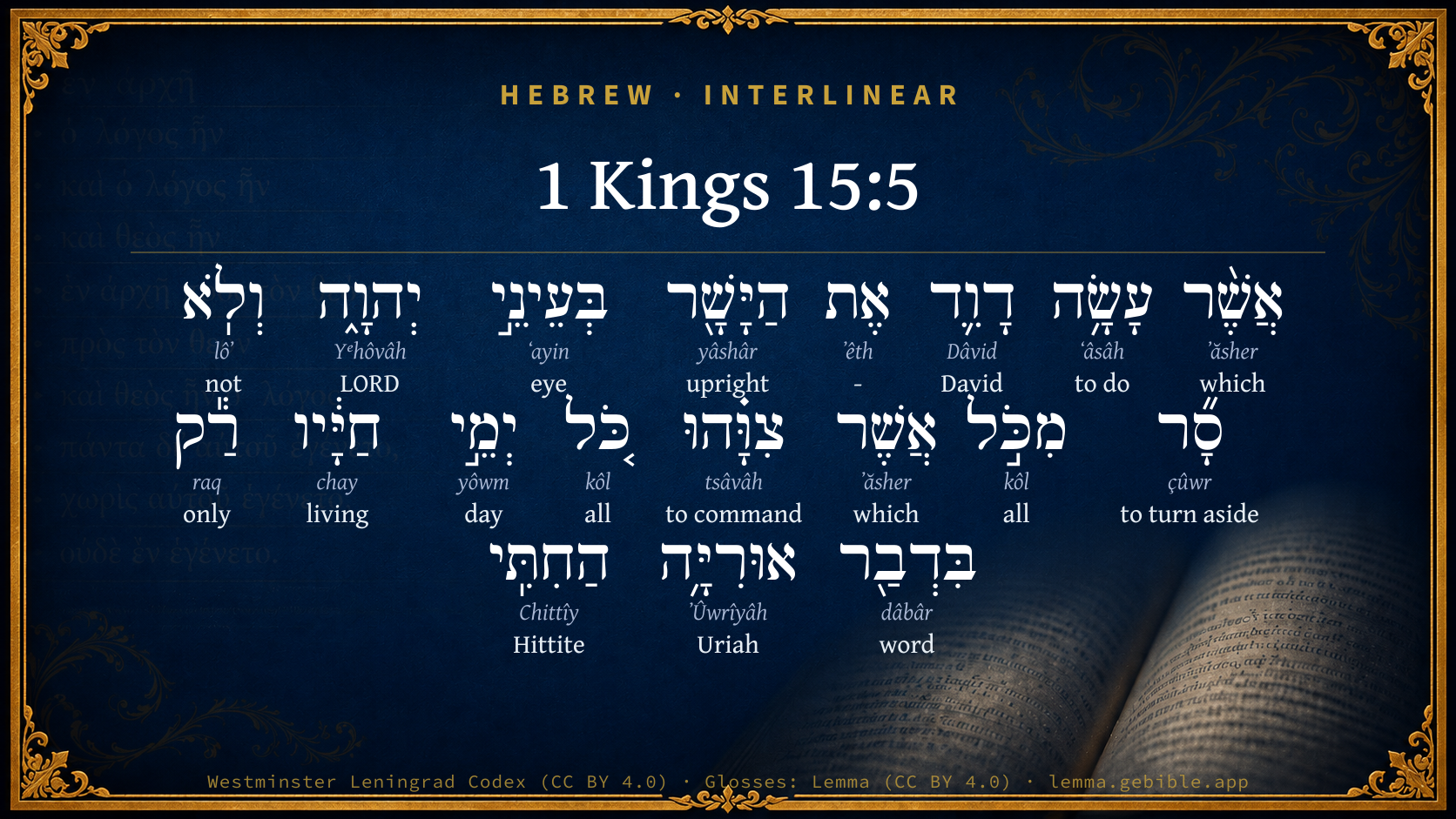
1 Kings 15:5

Hebrew (Westminster Leningrad Codex) 1 Kings 15:5 appears in the Hebrew Old Testament. The text above is from the Westminster Leningrad Codex. Each word links to its Strong’s number, a concise gloss, and parsing drawn from the Open Scriptures Hebrew Bible morphology. Click any word for its full Brown-Driver-Briggs (BDB) entry.
Download image
Cite this verse

1 Kings 15:5 (World English Bible). Public Domain. Lemma interlinear Bible study tool, https://lemma.gebible.app/v/1-kings/15/5.

Show BibTeX & RIS
BibTeX
RIS
English Translation
because David did that which was right in the eyes of Yahweh, and didn't turn aside from anything that he commanded him all the days of his life, except only in the matter of Uriah the Hittite.
World English Bible · Public Domain
Download a study sheet

One document with this verse’s original text, its word-by-word gloss line, the meaning frame, cross-references with their text, attributed commentary, and full source and license credits — printable, and it pastes into notes with its structure intact.

This verse Autodidact and up

Study sheet (.html) Plain text (.txt)

A passage Seminary Student

Up to 50 verses in one chapter. A passage sheet keeps up to 6 commentary sources and 12 cross-references per verse, in the order this page ranks them, and says so on the sheet whenever that leaves anything out. Ask for a single verse and you get the Autodidact verse sheet above.

Everything on this page stays free to read, with no account — the sheet is a download of what is already on screen, not access to it.

Want to remove ads? Support Godless Engineer
Compare translations 3

The same verse in 3 English versions, stacked beneath the original-language interlinear above. Click any original word for its lexicon entry.

Each is an independent rendering of the whole verse — the interlinear is not word-aligned to these translations.

Highlighted words mark where these versions differ — a whole-verse word diff, not a word-by-word alignment.

  • World English Bible Public Domain
    because David did that which was right in the eyes of Yahweh, and didn't turn aside from anything that he commanded him all the days of his life, except only in the matter of Uriah the Hittite.
  • King James Version Public Domain
    Because David did that which was right in the eyes of the LORD, and turned not aside from any thing that he commanded him all the days of his life, save only in the matter of Uriah the Hittite.
  • unfoldingWord Literal Text CC BY-SA 4.0
    because David had done right in the eyes of Yahweh, and he had not turned from all that he had commanded him all of the days of his life, except in the matter of Uriah the Hittite.

unfoldingWord Literal Text — © unfoldingWord, licensed CC BY-SA 4.0. Word-aligned USFM3 via Door43 (git.door43.org/unfoldingWord/en_ult).

Versions to compare (up to 4)

3 of 4 selected

Show all 18 translations

Every available English version of this verse, each an independent rendering of the whole verse.

  • World English Bible Public Domain
    because David did that which was right in the eyes of Yahweh, and didn't turn aside from anything that he commanded him all the days of his life, except only in the matter of Uriah the Hittite.
  • Berean Standard Bible Public Domain
    For David had done what was right in the eyes of the LORD and had not turned aside from anything the LORD commanded all the days of his life, except in the matter of Uriah the Hittite.
  • Majority Standard Bible Public Domain
    For David had done what was right in the eyes of the LORD and had not turned aside from anything the LORD commanded all the days of his life, except in the matter of Uriah the Hittite.
  • King James Version Public Domain
    Because David did that which was right in the eyes of the LORD, and turned not aside from any thing that he commanded him all the days of his life, save only in the matter of Uriah the Hittite.
  • American Standard Version (1901) Public Domain
    because David did that which was right in the eyes of Jehovah, and turned not aside from anything that he commanded him all the days of his life, save only in the matter of Uriah the Hittite.
  • Revised Version (1885) Public Domain
    because David did that which was right in the eyes of the LORD, and turned not aside from any thing that he commanded him all the days of his life, save only in the matter of Uriah the Hittite.
  • Geneva Bible (1599) Public Domain
    Because Dauid did that which was right in the sight of the Lord, and turned from nothing that he commanded him, all the dayes of his life, saue onely in the matter of Vriah the Hittite.
  • Douay-Rheims (1899) Public Domain
    Because David had done that which was right in the eyes of the Lord, and had not turned aside from any thing that he commanded him, all the days of his life, except the matter of Urias the Hethite.
  • Young's Literal Translation Public Domain
    in that David did that which `is' right in the eyes of Jehovah, and turned not aside from all that He commanded him all days of his life -- only in the matter of Uriah the Hittite;
  • Literal Standard Version CC BY-SA 4.0
    in that David did that which [is] right in the eyes of YHWH, and did not turn aside from all that He commanded him all [the] days of his life—except in the matter of Uriah the Hittite;
  • Unlocked Literal Bible CC BY-SA 4.0
    God did this because David had done what was right in his eyes; for all the days of his life, he had not turned away from anything that he commanded him, except only in the matter of Uriah the Hittite.
  • unfoldingWord Literal Text CC BY-SA 4.0
    because David had done right in the eyes of Yahweh, and he had not turned from all that he had commanded him all of the days of his life, except in the matter of Uriah the Hittite.
  • Darby Bible Public Domain
    because David did that which was right in the sight of Jehovah, and turned not aside from anything that he commanded him all the days of his life, except in the matter of Urijah the Hittite.
  • World Messianic Bible Public Domain
    because David did that which was right in the LORD’s eyes, and didn’t turn away from anything that he commanded him all the days of his life, except only in the matter of Uriah the Hittite.
  • Webster's Bible Public Domain
    Because David did that which was right in the eyes of the LORD, and turned not aside from any thing that he commanded him all the days of his life, save only in the matter of Uriah the Hittite.
  • Free Bible Version CC BY-SA 4.0
    For David had done what was right in the Lord's sight, and had not deviated from anything the Lord commanded throughout his lifetime, except in the case of Uriah the Hittite.
  • Bible in Basic English Public Domain
    Because David did what was right in the eyes of the Lord, and never in all his life went against his orders, but only in the question of Uriah the Hittite.
  • JPS Tanakh (1917) Public Domain
    because David did that which was right in the eyes of the LORD, and turned not aside from any thing that He commanded him all the days of his life, save only in the matter of Uriah the Hittite.

Literal Standard Version (2020), Covenant Press — licensed CC BY-SA 4.0. Text via the HelloAO Bible API (eBible.org). Unlocked Literal Bible (unfoldingWord) — licensed CC BY-SA 4.0. Text via the HelloAO Bible API (eBible.org). unfoldingWord Literal Text — © unfoldingWord, licensed CC BY-SA 4.0. Word-aligned USFM3 via Door43 (git.door43.org/unfoldingWord/en_ult). Free Bible Version, Dr. Jonathan Gallagher — licensed CC BY-SA 4.0. Text via the HelloAO Bible API (eBible.org).

Word by word

More ways to search: Search by grammar → Find every occurrence → Compare this word →

Practice this passage: Drill this verse → Learn its vocabulary →

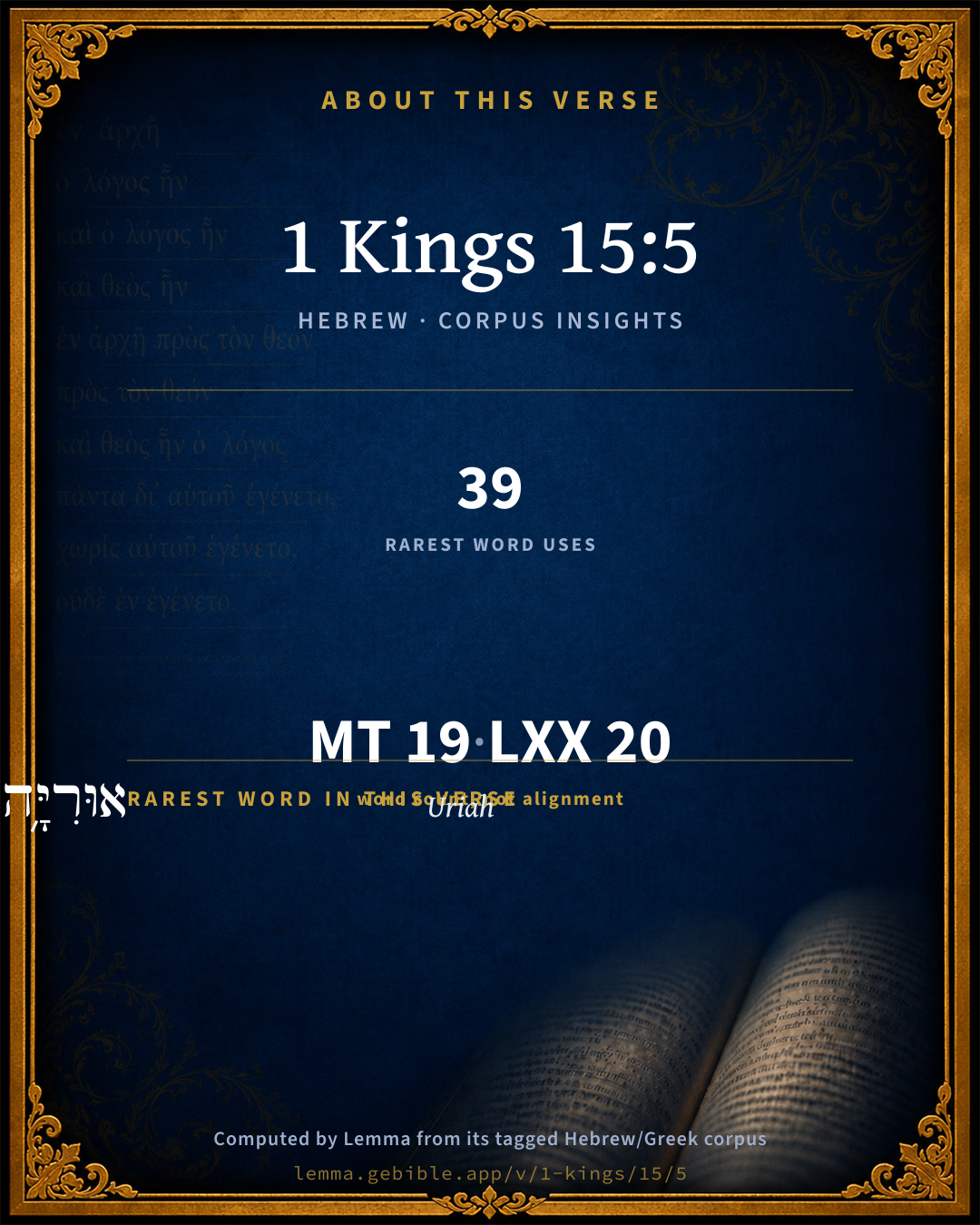
אוּרִיָּ֥ה
ʼÛwrîyâh
H223
“Uriah”
Noun, Proper
Part of Speech
Noun
Type
Proper
Full BDB Definition

Origin: from H217 and H3050

TWOT: None

Uriah or Urijah = "Jehovah (Yahweh) is my light (flame)" - Hittite husband of Bathsheba - a priest who built king Ahaz' heathen altar - a priest who rebuilt Jerusalem's wall - a prophet slain by Jehoiakim
  1. אֲשֶׁ֨ר ʼăsher H834 “which” Particle, Relative
  2. עָשָׂ֥ה ʻâsâh H6213 “to do” Verb, Qal, Perfect, 3rd Person, Masculine, Singular
  3. דָוִ֛ד Dâvid H1732 “David” Noun, Proper
  4. אֶת ʼêth H853 “-” Particle, Direct Object
  5. הַיָּשָׁ֖ר yâshâr H3477 “the · upright” Particle, Definite Article + Adjective, Adjective, Masculine, Singular, Absolute
  6. בְּעֵינֵ֣י ʻayin H5869 “in/at · eyes of” Preposition + Noun, Common, Both, Dual, Construct
  7. יְהוָ֑ה Yᵉhôvâh H3068 “LORD” Noun, Proper
  8. וְלֹֽא lôʼ H3808 “and · not” Conjunction + Particle, Negative
  9. סָ֞ר çûwr H5493 “to turn aside” Verb, Qal, Perfect, 3rd Person, Masculine, Singular
  10. מִכֹּ֣ל kôl H3605 “from · all” Preposition + Noun, Common, Masculine, Singular, Absolute
  11. אֲשֶׁר ʼăsher H834 “which” Particle, Relative
  12. צִוָּ֗הוּ tsâvâh H6680 “to command · him” Verb, Piel, Perfect, 3rd Person, Masculine, Singular + Suffix, Personal, 3rd Person, Masculine, Singular
  13. כֹּ֚ל kôl H3605 “all of” Noun, Common, Masculine, Singular, Construct
  14. יְמֵ֣י yôwm H3117 “days of” Noun, Common, Masculine, Plural, Construct
  15. חַיָּ֔יו chay H2416 “living things · his” Noun, Common, Masculine, Plural, Construct + Suffix, Personal, 3rd Person, Masculine, Singular
  16. רַ֕ק raq H7535 “only” Particle, Accusative
  17. בִּדְבַ֖ר dâbâr H1697 “in/at · word of” Preposition + Noun, Common, Masculine, Singular, Construct
  18. הַחִתִּֽי Chittîy H2850 “the · Hittite” Particle, Definite Article + Noun, Gentilic, Masculine, Singular, Absolute

About this verse

These counts appear in no published source. They are computed here, from the morphology-tagged text and Lemma’s own curated glosses. What Lemma adds →

19
words
17
distinct lemmas
Historical
section

Shared distinctive vocabulary

אוּרִיָּ֥ה Uriah H223 occurs in 33 verses of the Hebrew Bible. Also found in:

Grammatical profile

  • 3 verbs
  • 10 nouns
  • 1 adjective
  • 5 particles

Verb forms

  • עָשָׂ֥ה Qal · Perfect
  • סָ֞ר Qal · Perfect
  • צִוָּ֗הוּ Piel · Perfect

Repetition

Words recur within this verse — often emphatic in Hebrew:

  • מִכֹּ֣ל all H3605 ×2
  • אֲשֶׁ֨ר which H834 ×2

Hebrew & Septuagint length

In English translation the verse runs 37 words from the Hebrew and 30 from the Septuagint (LXX English) — closely comparable.

A rough comparison of the two English renderings, which tokenize alike — not a word-level alignment.

Word counts can differ between the Hebrew and the Greek without any difference in meaning — e.g. the Hebrew direct-object marker אֵת has no separate Greek word, and Greek often adds the article ὁ.

In the original languages it is 19 Hebrew tokens and 20 Greek tokens — but the two are counted differently (Hebrew bundles its prefixes and suffixes into one token; the Greek is in lemma form), so that isn’t a like-for-like length.

Cross-references

13

Topical passages linked to 1 Kings 15:5 in the Treasury of Scripture Knowledge — connected by theme and wording, ordered by reader-vote popularity; previews shown in the World English Bible.

  • 1 Kings 14:8 and tore the kingdom away from the house of David, and gave it you; and yet you have not been as my servant David, who kept my commandments, and who followed me with all his heart, to do that only which was right in my eyes,
  • 2 Samuel 11:15–17 He wrote in the letter, saying, Set Uriah in the forefront of the hottest battle, and retire you from him, that he may be struck, and die.
  • 1 Kings 15:3 He walked in all the sins of his father, which he had done before him; and his heart was not perfect with Yahweh his God, as the heart of David his father.
  • 2 Chronicles 34:2 He did that which was right in the eyes of Yahweh, and walked in the ways of David his father, and didn't turn aside to the right hand or to the left.
  • Psalms 51:1 Have mercy on me, God, according to your loving kindness. According to the multitude of your tender mercies, blot out my transgressions.
  • 2 Samuel 11:3–4 David send and inquired after the woman. One said, Is not this Bathsheba, the daughter of Eliam, the wife of Uriah the Hittite?
  • 2 Samuel 12:9–10 Why have you despised the word of Yahweh, to do that which is evil in his sight? You have struck Uriah the Hittite with the sword, and have taken his wife to be your wife, and have slain him with the sword of the children of Ammon.
  • Psalms 119:6 Then I wouldn't be disappointed, When I consider all of your commandments.
  • Luke 1:6 They were both righteous before God, walking blamelessly in all the commandments and ordinances of the Lord.
  • Acts 13:22 When he had removed him, he raised up David to be their king, to whom he also testified, 'I have found David the son of Jesse, a man after my heart, who will do all my will.'
  • 1 Kings 9:4 As for you, if you will walk before me, as David your father walked, in integrity of heart, and in uprightness, to do according to all that I have commanded you, and will keep my statutes and my ordinances;
  • Acts 13:36 For David, after he had in his own generation served the counsel of God, fell asleep, and was laid with his fathers, and saw decay.
  • 2 Kings 22:2 He did that which was right in the eyes of Yahweh, and walked in all the way of David his father, and didn't turn aside to the right hand or to the left.

Cross-references courtesy of OpenBible.info (CC BY 4.0).

Hebrew and Greek witnesses Masoretic Hebrew ↔ Greek Septuagint

The same verse in the two great witnesses to the Old Testament, shown verse-for-verse.

These are two independent witnesses, not word-aligned to each other, and the Septuagint is shown in lemma (dictionary) form.

Hebrew 1 Kings 15:5 Masoretic · Westminster Leningrad Codex

אֲשֶׁ֨ר עָשָׂ֥ה דָוִ֛ד אֶת הַיָּשָׁ֖ר בְּעֵינֵ֣י יְהוָ֑ה וְלֹֽא סָ֞ר מִכֹּ֣ל אֲשֶׁר צִוָּ֗הוּ כֹּ֚ל יְמֵ֣י חַיָּ֔יו רַ֕ק בִּדְבַ֖ר אוּרִיָּ֥ה הַחִתִּֽי

because David did that which was right in the eyes of Yahweh, and didn't turn aside from anything that he commanded him all the days of his life, except only in the matter of Uriah the Hittite.

World English Bible · Public Domain

Greek LXX 1 Kings 15:5 Septuagint · lemma form

ὡς ποιέω δαυίδ ὁ εὐθής ἐνώπιον κύριος οὐ ἐκκλίνω ἀπό πᾶς ὅς ἐντέλλομαι αὐτός πᾶς ὁ ἡμέρα ὁ ζωή αὐτός

Forasmuch as David did that which was right in the sight of the Lord: he turned not from any thing that he commanded him all the days of his life.

LXX2012 (modern English Septuagint) · Public Domain

On this verse, Ellicott's Commentary for English Readers discusses the Septuagint’s reading. Read the note in Commentary ↓

Hebrew: Westminster Leningrad Codex (CC BY 4.0). Greek: Septuagint (public domain); English from LXX2012 (modern English Septuagint) (Public Domain). How the Septuagint differs from the Hebrew →

Targum (Aramaic paraphrase)

1

The Targum is the ancient Jewish Aramaic paraphrase of the Hebrew Scriptures — an interpretive translation, not the Hebrew text itself. Onkelos (literal) and Pseudo-Jonathan (expansive) render the Torah, and Jonathan the Prophets. Coverage is partial: where no permissively-licensed English translation exists for a verse, only the Aramaic is shown. This is verse-level text, not a word-by-word alignment to the Hebrew.

  1. Targum Jonathan Prophets (Joshua–Malachi)
    דַעֲבַד דָוִד יַת דְכָשַׁר קֳדָם יְיָ וְלָא סְטָא מִכָּל דְפַקְדֵיהּ כָּל יוֹמֵי חַיוֹהִי לְחוֹד בְּפִתְגָמָא דְאוּרִיָה חִתָּאָה:

    (no public-domain English translation for this verse)

    Targum Jonathan — Aramaic: “Mikraot Gedolot” (public domain). English: “Sefaria Community Translation” (CC0 1.0 (public-domain dedication)); “London "Chaldee Paraphrase," 1871” (public domain). Text via Sefaria.

Commentary

Notes on 1 Kings 15:5 from classic Christian and Jewish commentators (each source and its license shown beneath its notes). The classic Christian expositions comment on the surrounding passage and are grouped to its opening verse, so a note may address several verses; the Jewish commentaries on the Tanakh (Rashi and others) are per-verse, so they appear only where the commentator wrote on this verse.

Lemma curates 59 commentaries, every one of them public domain or Creative Commons licensed, each selected and text-cleaned for this edition rather than reprinted as found. About our sources →

Trapp's Complete Commentary

John Trapp

1Ki 15:5 Because David did [that which was] right in the eyes of the LORD, and turned not aside from any [thing] that he commanded him all the days of his life, save only in the matter of Uriah the Hittite.

Ver. 5. And turned not aside from anything,] i.e., Of set purpose, against conseience, with any allowance and approbation. He had his other faults and failings, as his lies to Jonathan, {1Sa 20:6} to Ahimelech, {1Sa 21:2} to Achish, {1Sa 27:10} his unkindness to Mephibosheth, his polygamy, his fond sparing of his untoward sons, his numbering the people, &c. But as great virtues not sweetened with sincerity, are no ornament to men; so great infirmities not soured with hypocrisy, are no great deformities to them: those God acknowledgeth not; these he imputeth not.

Save only in the matter of Uriah.] There indeed he was false-hearted, and that kept him for a time from confessing it, and caused him to devise bad shifts to hide it; which doing one year, brought him many years of trouble.

John Trapp, A Commentary or Exposition upon All the Books of the Old and New Testament (1647–1656) — public domain. Text from a community e-Sword module.

Joseph Benson's Commentary

1Ki 15:5. Save only in the matter of Uriah — This, and the like phrases, are not to be understood as exclusive of every sinful action, but only of an habitual and continued apostacy from God, as the very phrase of turning aside from God, or from his commands, doth generally imply: and thus it is most true; for David’s other sins were either sudden and transient acts, soon repented of and blotted out, as in the cases of Nabal and Achish, or mistakes of his judgment, which was not fully convinced of the sinfulness of such actions; whereas that which concerned Uriah’s wife was a designed and studied sin, long continued in, defended with a succession of other sins, presumptuous and scandalous to his government, and to the true religion.

Joseph Benson's Commentary on the Old and New Testaments (1811–1818) — public domain. Text from a community e-Sword module.

Adam Clarke's Commentary

Verse 5. Save only in the matter of Uriah] Properly speaking, this is the only flagrant fault or crime in the life of David. It was a horrible offense, or rather a whole system of offenses. See the notes on 2 Sam. 11, and 12.

Adam Clarke's Commentary on the Bible (1810–1826) — public domain. Text from a community e-Sword/MySword module.

Ellicott's Commentary for English Readers

(5) Save only in the matter of Uriah.—In this passage alone do we find this qualification of the praise of David. In the Vatican MS. and other MSS. of the LXX. it is omitted. Possibly it is a marginal note which has crept into the text, or a comment of the compiler of the book on the language of the annals from which he drew.

A Bible Commentary for English Readers, edited by Charles John Ellicott (1878–1897) — public domain. Text from a community e-Sword module.

The Cambridge Bible for Schools and Colleges

gen. ed. J. J. S. Perowne

5. save only in the matter of Urijah the Hittite] See 2Sa_11:4; 2Sa_11:15. This clause is omitted in the LXX. Time would soften down the offence which David committed in numbering the people, so that the compiler of the narrative before us can pass it by in giving expression to the high estimate which was sure to be entertained of the great king David.

The Cambridge Bible for Schools and Colleges (gen. ed. J. J. S. Perowne; Cambridge University Press, 1878–1918) — public domain. Text from a community e-Sword module.

John Gill's Exposition

And there was war between Rehoboam and Jeroboam all the days of his life. Not the days of Rehoboam, though that was true, and is observed, Kg1 14:30, but all the days of Abijam, before he came to the throne, and in which, when a young man, he was concerned, and which still continued between him and Jeroboam; though some think he is called by his father's name, as Rehoboam is called David, Kg1 12:16.

.

1 Kings 15:7

kg1 15:7

kg1 15:7

kg1 15:7Now the rest of the acts of Abijam, and all that he did, are they not written in the book of the chronicles of the kings of Judah?.... Which seem to be written by Iddo the prophet, see Ch2 13:22,

and there was war between Abijam and Jeroboam; and a famous pitched battle between them we read of in Ch2 13:3.

John Gill's Exposition of the Whole Bible (1746–1763) — public domain (CC PDM 1.0). Text via the HelloAO Bible API.

Haydock's Catholic Bible Commentary

Hethite. This could not be excused. But all his other imperfections might not appear criminal in the eyes of the world, as they had some pretext of virtue; so that God reserves the judgment of them to himself, and to David’s conscience, who confessed that he had sinned, 2 Kings xxiv. 10. (Tirinus) --- Except David, Ezechias, and Josias, all the kings of Juda committed sin; (Ecclesiasticus xlix. 5.; Calmet) and not one of those who ruled over Israel, gave an example of virtue. (Haydock) --- David soon entered into himself, with respect to his other failings. But he continued for a long time involved in the guilt of adultery and murder. (Sanchez)

George Leo Haydock (1774–1849), Haydock's Catholic Family Bible and Commentary, 1859 edition — public domain. Excludes Psalms (Douay-Rheims chapter numbering differs from Protestant) and Deuterocanonical books (Catholic canon only).

Matthew Poole's English Annotations

Quest. How is this true, seeing David sinned in the matter of Nabal, 1Sa 25, and Achish, 1Sa 27, and Mephibosheth, and his indulgence to his children, Adonijah, Amnon, and Absalom, and in the numbering of the people? Answ. This and the like phrases are not to be understood as exclusive of every sinful action, but only of a sinful course or state, or of an habitual and continued apostacy from God, or from his ways, as the very phrase of turning aside from God, or from his commands, doth constantly imply, as appears from Exo 32:8; Deu 9:12,16; 1Sa 8:3; Psa 78:57; Isa 44:20; 1Ti 1:6; 5:15, &c. And thus it is most true. For David’s other sins were either sudden and transient acts, proceeding from human infirmity, and extraordinary temptations, and soon repented of and blotted out, as in the cases of Nabal and Achish; or mistakes of his judgment, which was not fully convinced of the sinfulness of such actions, as in the other cases alleged; whereas that which concerned Uriah’s wife was a designed and studied sin, long continued in, defended with a succession of other sins, presumptuous, and scandalous to his government and to the true religion, which he so eminently professed.

Matthew Poole's English Annotations on the Holy Bible (1683–1685) — public domain. Text from a community e-Sword/MySword module.

Whedon's Commentary on the Bible

Daniel D. Whedon

5. Save only in the matter of Uriah — This was David’s great, crying offence, which drew down on him the judgments of God, and is ever mentioned to his shame. But he was guilty of other sins — as the neglect to properly discipline his sons, the primal cause of Absalom’s and Adonijah’s ruin; his falsehoods before Achish, (1Sa_27:10;) and his sin in numbering Israel. 2Sa_24:10. But all these are, in comparison with his guilt in adultery with Bathsheba, and in the murder of Uriah, as sins of infirmity and ignorance. “This great, presumptuous sin,” says Bishop Sanderson, “standeth up as a pillar or monument erected to his perpetual shame in that particular, for all succeeding generations to take warning and example by.”

Daniel D. Whedon (gen. ed.), Commentary on the Old and New Testaments (1874–1909) — public domain. Text from a community e-Sword module.

The Pulpit Commentary

Because r here causative for ya y Comp. quod David did that which was right in the eyes of the Lord, and turned not aside from anything that he commanded him all the days of his life, save only in the matter of Uriah the Hittite. 2Sa_2:4. But this last clause is not found in the LXX, and such a statement was more likely to be inserted by transcribers, having first appeared in the margin as a gloss, than to be omitted, had it ever formed part of the text. And in support of this view it may be alleged that

(1) the matter of Uriah was by no means David"s only sin, and

(2) it is not the manner of our writer thus to qualify his words. See next verse.

The Pulpit Commentary (1880–1919), ed. H.D.M. Spence-Jones & Joseph S. Exell — public domain. Text from a community e-Sword module.

John Wesley's Explanatory Notes

Save only - This and the like phrases are not to be understood as exclusive of every sinful action, hut only of an habitual and continued apostasy from God, as the very phrase of turning aside from God, or from his commands, doth constantly imply. And thus it is most true. For David's other sins were either sudden and transient acts, soon repented of and blotted out, as in the cases of Nabal and Achish; or, mistakes of his judgment, which was not fully convinced of the sinfulness of such actions: whereas that which concerned Uriah's wife was a designed and studied sin, long continued in, defended with a succession of other sins, presumptuous, and scandalous to his government, and to the true religion.

John Wesley, Explanatory Notes Upon the Whole Bible (1754–1765) — public domain. Text via the GEBible commentary corpus.

Lesson kit

Teaching starters — assembled from the data on this page, not authored interpretation. Every prompt links to the verse data it draws on. Edit before teaching.

1 Kings, in the Historical, opens this verse with 19 words (17 distinct Hebrew lemmas). Its most distinctive word is ʼÛwrîyâh (“Uriah”). A historical commentator’s framing appears above. Read the whole chapter for the surrounding context.

Discussion questions

  1. How does “Uriah” (ʼÛwrîyâh) shape what this verse is saying?
  2. 2 Samuel 11:3 shares the word «Uriah» with this verse. How do the two illuminate each other?
  3. “all” occurs 2× in this one verse. What is the effect of the repetition?
  4. These translations render this verse differently. What is at stake in choosing one wording over another?
  5. The verb «עָשָׂ֥ה» is Qal Perfect. How does its form color the action?
  6. Reading how Trapp's Complete Commentary and Joseph Benson's Commentary read this verse, where do the two commentators agree and where do they part?

Things to notice

Reading settings

Reading text

Shown beneath each verse's original-language words.

Old Testament
Old Testament edition

Read the OT as the Masoretic Hebrew (MT) or the Greek Septuagint (LXX).

English shown for the Greek Septuagint (in the Hebrew ↔ Greek comparison).

Comparing translations? Open the Compare panel on any verse page to stack up to four side by side.