

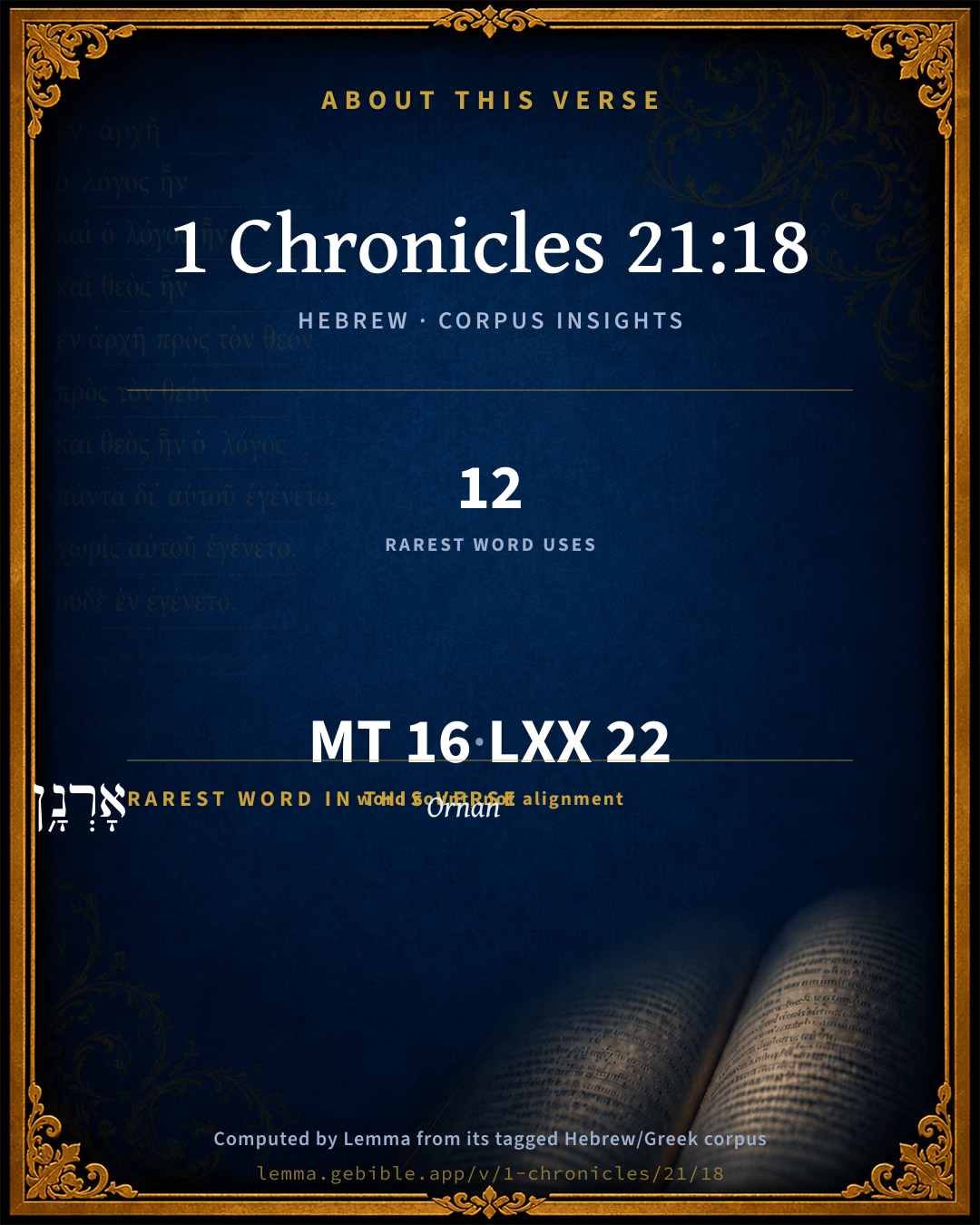
1 Chronicles 21:18

Hebrew (Westminster Leningrad Codex) 1 Chronicles 21:18 appears in the Hebrew Old Testament. The text above is from the Westminster Leningrad Codex. Each word links to its Strong’s number, a concise gloss, and parsing drawn from the Open Scriptures Hebrew Bible morphology. Click any word for its full Brown-Driver-Briggs (BDB) entry.
Download image
Cite this verse

1 Chronicles 21:18 (World English Bible). Public Domain. Lemma interlinear Bible study tool, https://lemma.gebible.app/v/1-chronicles/21/18.

Show BibTeX & RIS
BibTeX
RIS
English Translation
Then the angel of Yahweh commanded Gad to tell David, that David should go up, and raise an altar to Yahweh in the threshing floor of Ornan the Jebusite.
World English Bible · Public Domain
Download a study sheet

One document with this verse’s original text, its word-by-word gloss line, the meaning frame, cross-references with their text, attributed commentary, and full source and license credits — printable, and it pastes into notes with its structure intact.

This verse Autodidact and up

Study sheet (.html) Plain text (.txt)

A passage Seminary Student

Up to 50 verses in one chapter. A passage sheet keeps up to 6 commentary sources and 12 cross-references per verse, in the order this page ranks them, and says so on the sheet whenever that leaves anything out. Ask for a single verse and you get the Autodidact verse sheet above.

Everything on this page stays free to read, with no account — the sheet is a download of what is already on screen, not access to it.

Want to remove ads? Support Godless Engineer
Compare translations 3

The same verse in 3 English versions, stacked beneath the original-language interlinear above. Click any original word for its lexicon entry.

Each is an independent rendering of the whole verse — the interlinear is not word-aligned to these translations.

Highlighted words mark where these versions differ — a whole-verse word diff, not a word-by-word alignment.

  • World English Bible Public Domain
    Then the angel of Yahweh commanded Gad to tell David, that David should go up, and raise an altar to Yahweh in the threshing floor of Ornan the Jebusite.
  • King James Version Public Domain
    Then the angel of the LORD commanded Gad to say to David, that David should go up, and set up an altar unto the LORD in the threshingfloor of Ornan the Jebusite.
  • unfoldingWord Literal Text CC BY-SA 4.0
    And the angel of Yahweh said to Gad to say to David that David should go up to raise an altar to Yahweh at the threshing floor of Ornan the Jebusite.

unfoldingWord Literal Text — © unfoldingWord, licensed CC BY-SA 4.0. Word-aligned USFM3 via Door43 (git.door43.org/unfoldingWord/en_ult).

Versions to compare (up to 4)

3 of 4 selected

Show all 18 translations

Every available English version of this verse, each an independent rendering of the whole verse.

  • World English Bible Public Domain
    Then the angel of Yahweh commanded Gad to tell David, that David should go up, and raise an altar to Yahweh in the threshing floor of Ornan the Jebusite.
  • Berean Standard Bible Public Domain
    Then the angel of the LORD ordered Gad to tell David to go up and build an altar to the LORD on the threshing floor of Ornan the Jebusite.
  • Majority Standard Bible Public Domain
    Then the angel of the LORD ordered Gad to tell David to go up and build an altar to the LORD on the threshing floor of Ornan the Jebusite.
  • King James Version Public Domain
    Then the angel of the LORD commanded Gad to say to David, that David should go up, and set up an altar unto the LORD in the threshingfloor of Ornan the Jebusite.
  • American Standard Version (1901) Public Domain
    Then the angel of Jehovah commanded Gad to say to David, that David should go up, and rear an altar unto Jehovah in the threshing-floor of Ornan the Jebusite.
  • Revised Version (1885) Public Domain
    Then the angel of the LORD commanded Gad to say to David, that David should go up, and rear an altar unto the LORD in the threshing-floor of Ornan the Jebusite.
  • Geneva Bible (1599) Public Domain
    Then the Angel of the Lord commanded Gad to say to Dauid, that Dauid should goe vp, and set vp an altar vnto the Lord in the thresshing floore of Ornan the Iebusite.
  • Douay-Rheims (1899) Public Domain
    And David said to God: Am not I he that commanded the people to be numbered? It is I that have sinned: it is I that have done the evil: but as for this flock, what hath it deserved? O Lord my God, let thy hand be turned, I beseech thee, upon me, and upon my father's house: and let not thy people be destroyed.
  • Young's Literal Translation Public Domain
    And the messenger of Jehovah spake unto Gad, saying for David, `Surely David doth go up to raise an altar to Jehovah in the threshing-floor of Ornan the Jebusite.'
  • Literal Standard Version CC BY-SA 4.0
    And the messenger of YHWH commanded to Gad to say to David, “Surely David goes up to raise an altar to YHWH in the threshing-floor of Ornan the Jebusite.”
  • Unlocked Literal Bible CC BY-SA 4.0
    So the angel of Yahweh commanded Gad to say to David, that David should go up and build an altar for Yahweh at the threshing floor of Ornan the Jebusite.
  • unfoldingWord Literal Text CC BY-SA 4.0
    And the angel of Yahweh said to Gad to say to David that David should go up to raise an altar to Yahweh at the threshing floor of Ornan the Jebusite.
  • Darby Bible Public Domain
    And the angel of Jehovah commanded Gad to say to David, that David should go up and rear an altar to Jehovah in the threshing-floor of Ornan the Jebusite.
  • World Messianic Bible Public Domain
    Then the LORD’s angel commanded Gad to tell David that David should go up and raise an altar to the LORD on the threshing floor of Ornan the Jebusite.
  • Webster's Bible Public Domain
    Then the angel of the LORD commanded Gad to say to David, that David should go up, and erect an altar to the LORD in the threshing-floor of Ornan the Jebusite.
  • Free Bible Version CC BY-SA 4.0
    Then the angel of the Lord told Gad to tell David to go and build an altar to the Lord on the threshing floor of Ornan the Jebusite.
  • Bible in Basic English Public Domain
    Then the angel of the Lord gave orders to Gad to say to David that he was to go and put up an altar to the Lord on the grain-floor of Ornan the Jebusite.
  • JPS Tanakh (1917) Public Domain
    Then the angel of the LORD commanded Gad to say to David, that David should go up, and rear an altar unto the LORD in the threshing-floor of Ornan the Jebusite.

Literal Standard Version (2020), Covenant Press — licensed CC BY-SA 4.0. Text via the HelloAO Bible API (eBible.org). Unlocked Literal Bible (unfoldingWord) — licensed CC BY-SA 4.0. Text via the HelloAO Bible API (eBible.org). unfoldingWord Literal Text — © unfoldingWord, licensed CC BY-SA 4.0. Word-aligned USFM3 via Door43 (git.door43.org/unfoldingWord/en_ult). Free Bible Version, Dr. Jonathan Gallagher — licensed CC BY-SA 4.0. Text via the HelloAO Bible API (eBible.org).

Word by word

More ways to search: Search by grammar → Find every occurrence → Compare this word →

Practice this passage: Drill this verse → Learn its vocabulary →

אָרְנָ֥ן
ʼOrnân
H771
“Ornan”
Noun, Proper
Part of Speech
Noun
Type
Proper
Full BDB Definition

Origin: probably from H766

TWOT: None

Ornan = "light was perpetuated: their fir trees" - a Jebusite who sold, to David, a threshing floor for an altar
  1. וּמַלְאַ֧ךְ mălʼâk H4397 “and · messenger of” Conjunction + Noun, Common, Masculine, Singular, Construct
  2. יְהוָ֛ה Yᵉhôvâh H3068 “LORD” Noun, Proper
  3. אָמַ֥ר ʼâmar H559 “to say” Verb, Qal, Perfect, 3rd Person, Masculine, Singular
  4. אֶל ʼêl H413 “to” Preposition
  5. גָּ֖ד Gâd H1410 “Gad” Noun, Proper
  6. לֵאמֹ֣ר ʼâmar H559 “to say” Preposition + Verb, Qal, Infinitive Construct
  7. לְדָוִ֑יד Dâvid H1732 “to/for · David” Preposition + Noun, Proper
  8. כִּ֣י kîy H3588 “that” Conjunction
  9. יַעֲלֶ֣ה ʻâlâh H5927 “to go up” Verb, Qal, Imperfect, 3rd Person, Masculine, Singular
  10. דָוִ֗יד Dâvid H1732 “David” Noun, Proper
  11. לְהָקִ֤ים qûwm H6965 “to rise” Preposition + Verb, Hiphil, Infinitive Construct
  12. מִזְבֵּ֨חַ֙ mizbêach H4196 “altar” Noun, Common, Masculine, Singular, Absolute
  13. לַיהוָ֔ה Yᵉhôvâh H3068 “to/for · LORD” Preposition + Noun, Proper
  14. בְּגֹ֖רֶן gôren H1637 “in/at · threshing floor of” Preposition + Noun, Common, Both, Singular, Construct
  15. הַיְבֻסִֽי Yᵉbûwçîy H2983 “the · Jebusite” Particle, Definite Article + Noun, Gentilic, Masculine, Singular, Absolute

About this verse

These counts appear in no published source. They are computed here, from the morphology-tagged text and Lemma’s own curated glosses. What Lemma adds →

16
words
13
distinct lemmas
Historical
section

Notable vocabulary

The rarest word here is אָרְנָ֥ן Ornan H771 — appearing just 12 times in the whole Hebrew Bible.

Shared distinctive vocabulary

אָרְנָ֥ן Ornan H771 occurs in 10 verses of the Hebrew Bible. Also found in:

Grammatical profile

  • 4 verbs
  • 10 nouns
  • 1 preposition
  • 1 conjunction

Verb forms

  • אָמַ֥ר Qal · Perfect
  • לֵאמֹ֣ר Qal · Infinitive Construct
  • יַעֲלֶ֣ה Qal · Imperfect
  • לְהָקִ֤ים Hiphil · Infinitive Construct

Repetition

Words recur within this verse — often emphatic in Hebrew:

  • יְהוָ֛ה LORD H3068 ×2
  • אָמַ֥ר to say H559 ×2
  • לְדָוִ֑יד David H1732 ×2

Hebrew & Septuagint length

In English translation the verse runs 29 words from the Hebrew and 31 from the Septuagint (LXX English) — closely comparable.

A rough comparison of the two English renderings, which tokenize alike — not a word-level alignment.

Word counts can differ between the Hebrew and the Greek without any difference in meaning — e.g. the Hebrew direct-object marker אֵת has no separate Greek word, and Greek often adds the article ὁ.

In the original languages it is 16 Hebrew tokens and 22 Greek tokens — but the two are counted differently (Hebrew bundles its prefixes and suffixes into one token; the Greek is in lemma form), so that isn’t a like-for-like length.

Cross-references

5

Topical passages linked to 1 Chronicles 21:18 in the Treasury of Scripture Knowledge — connected by theme and wording, ordered by reader-vote popularity; previews shown in the World English Bible.

  • 2 Chronicles 3:1 Then Solomon began to build the house of Yahweh at Jerusalem on Mount Moriah, where [Yahweh] appeared to David his father, which he made ready in the place that David had appointed, in the threshing floor of Ornan the Jebusite.
  • 2 Samuel 24:18 Gad came that day to David, and said to him, Go up, rear an altar to Yahweh in the threshing floor of Araunah the Jebusite.
  • 1 Chronicles 21:11 So Gad came to David, and said to him, Thus says Yahweh, Take which you will:
  • 1 Chronicles 21:15 God sent an angel to Jerusalem to destroy it: and as he was about to destroy, Yahweh saw, and he repented him of the evil, and said to the destroying angel, It is enough; now stay your hand. The angel of Yahweh was standing by the threshing floor of Ornan the Jebusite.
  • Acts 8:26–40 But an angel of the Lord spoke to Philip, saying, "Arise, and go toward the south to the way that goes down from Jerusalem to Gaza. This is a desert."

Cross-references courtesy of OpenBible.info (CC BY 4.0).

Hebrew and Greek witnesses Masoretic Hebrew ↔ Greek Septuagint

The same verse in the two great witnesses to the Old Testament, shown verse-for-verse.

These are two independent witnesses, not word-aligned to each other, and the Septuagint is shown in lemma (dictionary) form.

Hebrew 1 Chronicles 21:18 Masoretic · Westminster Leningrad Codex

וּמַלְאַ֧ךְ יְהוָ֛ה אָמַ֥ר אֶל גָּ֖ד לֵאמֹ֣ר לְדָוִ֑יד כִּ֣י יַעֲלֶ֣ה דָוִ֗יד לְהָקִ֤ים מִזְבֵּ֨חַ֙ לַיהוָ֔ה בְּגֹ֖רֶן אָרְנָ֥ן הַיְבֻסִֽי

Then the angel of Yahweh commanded Gad to tell David, that David should go up, and raise an altar to Yahweh in the threshing floor of Ornan the Jebusite.

World English Bible · Public Domain

Greek LXX 1 Chronicles 21:18 Septuagint · lemma form

καί ἄγγελος κύριος εἶπον ὁ γαδ ὁ εἶπον πρός δαυίδ ἵνα ἀναβαίνω ὁ ἵστημι θυσιαστήριον ὁ κύριος ἐν ἅλων ορνα ὁ ιεβουσαῖος

And the angel of the Lord told Gad to tell David, that he should go up to erect an altar to the Lord, in the threshing floor of Orna the Jebusite.

LXX2012 (modern English Septuagint) · Public Domain

Hebrew: Westminster Leningrad Codex (CC BY 4.0). Greek: Septuagint (public domain); English from LXX2012 (modern English Septuagint) (Public Domain). How the Septuagint differs from the Hebrew →

Commentary

Notes on 1 Chronicles 21:18 from classic Christian and Jewish commentators (each source and its license shown beneath its notes). The classic Christian expositions comment on the surrounding passage and are grouped to its opening verse, so a note may address several verses; the Jewish commentaries on the Tanakh (Rashi and others) are per-verse, so they appear only where the commentator wrote on this verse.

Lemma curates 59 commentaries, every one of them public domain or Creative Commons licensed, each selected and text-cleaned for this edition rather than reprinted as found. About our sources →

Matthew Henry's Commentary

We have here the controversy concluded, and, upon David's repentance, his peace made with God. Though thou wast angry with me, thy anger is turned away. 1. A stop was put to the progress of the execution, Ch1 21:15. When David repented of the sin God repented of the judgment, and ordered the destroying angel to stay his hand and sheath his sword, Ch1 21:27. 2. Direction was given to David to rear an altar in the threshing-floor of Ornan, Ch1 21:18. The angel commanded the prophet Gad to bring David this direction. The same angel that had, in God's name, carried on the war, is here forward to set on foot the treaty of peace; for angels do not desire the woeful day. The angel could have given this order to David himself; but he chose to do it by his seer, that he might put an honour upon the prophetic office. Thus the revelation of Jesus Christ was notified by the angel to John, and by him to the churches. The commanding of David to build an altar was a blessed token of reconciliation; for, if God had been pleased to kill him, he would not have appointed, because he would not have accepted, a sacrifice at his hands. 3. David immediately made a bargain with Ornan for the threshing-floor; for he would not serve God at other people's charge. Ornan generously offered it to him gratis, not only in complaisance to the king, but because he had himself seen the angel (Ch1 21:20), which so terrified him that he and his four sons hid themselves, as unable to bear the brightness of his glory and afraid of his drawn sword. Under these apprehensions he was willing to do anything towards making the atonement. Those that are duly sensible of the terrors of the Lord will do all they can, in their places, to promote religion, and encourage all the methods of reconciliation for the turning away of God's wrath. 4. God testified his acceptance of David's offerings on this altar; He answered him from heaven by fire, Ch1 21:26. To signify that God's anger was turned away from him, the fire that might justly have fastened upon the sinner fastened upon the sacrifice and consumed that; and, upon this, the destroying sword was returned into its sheath. Thus Christ was made sin and a curse for us, and it pleased the Lord to bruise him, that through him God might be to us, not a consuming fire, but a reconciled Father. 5. He continued to offer his sacrifices upon this altar. The brazen altar which Moses made was at Gibeon (Ch1 21:29), and there all the sacrifices of Israel were offered; but David was so terrified at the sight of the sword of the angel that he could not go thither, Ch1 21:30. The business required haste, when the plague was begun. Aaron must go quickly, nay, he must run, to make atonement, Num 16:46, Num 16:47. And the case here was no less urgent; so that David had not time to go to Gibeon: nor durst he leave the angel with his sword drawn over Jerusalem, lest the fatal stroke should be given before he came back. And therefore God, in tenderness to him, bade him build an altar in that place, dispensing with his own law concerning one altar because of the present distress, and accepting the sacrifices offered on this new altar, which was not set up in opposition to that, but in concurrence with it. The symbols of unity were not so much insisted on as unity itself. Nay, when the present distress was over (as it should seem), David, as long as he lived, sacrificed there, though the altar at Gibeon was still kept up; for God had owned the sacrifices that were here offered and had testified his acceptance of them, Ch1 21:28. On those administrations in which we have experienced the tokens of God's presence, and have found that he is with us of a truth, it is good to continue our attendance. "Here God had graciously met me, and therefore I will still expect to meet with him."

Matthew Henry's Commentary on the Whole Bible (1708–1710) — public domain (CC PDM 1.0). Text via the HelloAO Bible API.

Jamieson, Fausset & Brown

Robert Jamieson, A. R. Fausset & David Brown

HE BUILDS AN ALTAR. (Ch1 21:18-30)

the angel of the Lord commanded Gad to say--The order about the erection of an altar, as well as the indication of its site, is described (Sa2 24:18) as brought directly by Gad. Here we are informed of the quarter whence the prophet got his commission. It is only in the later stages of Israel's history that we find angels employed in communicating the divine will to the prophets.

Jamieson, Fausset & Brown — Commentary Critical and Explanatory on the Whole Bible (1871) — public domain (CC PDM 1.0). Text via the HelloAO Bible API.

Trapp's Complete Commentary

John Trapp

1Ch 21:18 Then the angel of the LORD commanded Gad to say to David, that David should go up, and set up an altar unto the LORD in the threshingfloor of Ornan the Jebusite.

Ver. 18. Then the angel of the Lord.] Not the destroying angel, saith Diodate, but the Son of God himself, who did appear to the prophets. Eπεχω.

John Trapp, A Commentary or Exposition upon All the Books of the Old and New Testament (1647–1656) — public domain. Text from a community e-Sword module.

Joseph Benson's Commentary

1Ch 21:18. The angel commanded that David should go and set up an altar — This command was a blessed token of reconciliation. For if God had been pleased to kill him, he would not have commanded, because he would not have accepted, a sacrifice at his hands.

Joseph Benson's Commentary on the Old and New Testaments (1811–1818) — public domain. Text from a community e-Sword module.

Ellicott's Commentary for English Readers

(18) Then the angel of the Lord commanded Gad to say to David.—Rather, Now the angel had told Gad to tell David. In Samuel, the mediation of the angel is not mentioned. There we read, “And Gad came that day to David, and said unto him, Go up,” &c. No doubt it is only in the later prophetical books of the Canon that angels are introduced as the medium of communication between God and His prophets. (See Dan_8:16, ix, 21; Zec_1:9; Zec_1:12, &c.; but comp. Jdg_6:11; Jdg_6:14; Jdg_6:16, &c., and Gen_18:1-2; Gen_18:13; Gen_32:24; Gen_32:30.)

(18-27) The purchase of Ornan’s threshingfloor as a place of sacrifice.

A Bible Commentary for English Readers, edited by Charles John Ellicott (1878–1897) — public domain. Text from a community e-Sword module.

The Cambridge Bible for Schools and Colleges

gen. ed. J. J. S. Perowne

18. go up, and set up] R.V. go up, and rear; cp. 2Sa_24:18.

The Cambridge Bible for Schools and Colleges (gen. ed. J. J. S. Perowne; Cambridge University Press, 1878–1918) — public domain. Text from a community e-Sword module.

Albert Barnes' Notes on the Bible

It has been observed that it is only in books of a late period that Angels are brought forward as intermediaries between God and the prophets. This, no doubt, is true; and it is certainly unlikely that the records, from which the author of Chronicles drew, spoke of Gad as receiving his knowledge of God’s will from an angel. The touch may be regarded as coming from the writer of Chronicles himself, who expresses the fact related by his authorities in the language of his own day (see Zec 1:9, Zec 1:14, Zec 1:19; Zec 2:3; Zec 4:1; Zec 5:5; etc.); language, however, which we are not to regard as rhetorical, but as strictly in accordance with truth, since Angels were doubtless employed as media between God and the prophet as much in the time of David as in that of Zechariah.

Albert Barnes' Notes on the Bible (1834–1885) — public domain. Text from a community e-Sword/MySword module.

Haydock's Catholic Bible Commentary

Altar. Hence it appears that holy men erected altars by God’s command. (Du Hamel)

George Leo Haydock (1774–1849), Haydock's Catholic Family Bible and Commentary, 1859 edition — public domain. Excludes Psalms (Douay-Rheims chapter numbering differs from Protestant) and Deuterocanonical books (Catholic canon only).

The Pulpit Commentary

The angel. The Hebrew shows no article (see Num_22:34, Num_22:35; 1Ki_13:18 1Ki_19:5; Zec_1:9) The place where the altar was now about to be erected was that made famous by the sacrifice of Abraham, (Gen_22:2, Gen_22:9) and, though less certainly, that known to the priesthood of Melchizedek. (Gen_14:17-20)

Vers. 18-27, ch. Ge 23) this apparent generosity, accompanied with so much Eastern courtesy and politeness, is only a thin guise to cover larger expectations from those to whom it is made. This Abraham well knew when he so resolutely declined the offer of the sons of Herb. This was not the case with Ornan. His was the offspring from the noble and generous heart of one who loved and served God. The inspired penman gives us the true interpretation of Ornan"s offer when he says, (2Sa_24:23) "All these things did Araunah, as a king, give unto the king." But however kingly Araunah"s conduct was here, David felt be could not accept it. God must not be put off with that which costs us nothing. "Thou hast offered me no sweet cane with money," was God"s charge of old against Israel "Ye offer the blind and the lame for sacrifice. Is it not evil?" said Malachi. It is the law of life. That which costs us nothing is not worth having; how much less when offered to God! The widow"s two mites are of more value than all the gifts of gold in the temple chest. So David would only have the threshing-floor for the Lord"s temple at the" full price." And mark the typical character of this threshing-floor. It was there the sword of vengeance was sheathed. It was there God"s voice was heard," Stay now thine hand, it is enough." It was there the hallowed fire descended in token of God"s acceptance of the victim on the altar; and there consequently the future temple was to be erected which exceeded in glory all that Israel had ever seen. So, centuries after, the cross of Christ was the substance of which all this was only the shadow. In that cross we see the sword of God"s wrath against sin for ever sheathed. We hear God"s voice saying, "Behold the Lamb of God, which taketh away the sin of the world!" In the midnight darkness, the earthquake, the rent rocks, the opened graves, and the rent veil, we hear God"s voice again from heaven, testifying to the majesty of that Sacrifice, and drawing from the lilts of even heathen bystanders, "Surely this was the Son of God." And on that Sacrifice, that one Offering once offered, we see built the great spiritual temple of Christ"s body, the Church. "Other foundation can no man lay than that which is laid, Christ Jesus." May we take up David"s language and say," This is the house of the Lord God, and this is the altar of the burnt offering for Israel. W.

The Pulpit Commentary (1880–1919), ed. H.D.M. Spence-Jones & Joseph S. Exell — public domain. Text from a community e-Sword module.

John Wesley's Explanatory Notes

Set up an altar, &c. - The commanding of David to build an altar, was a blessed token of reconciliation. For if God had been pleased to kill him, he would not have commanded, because he would not have accepted a sacrifice at his hands.

John Wesley, Explanatory Notes Upon the Whole Bible (1754–1765) — public domain. Text via the GEBible commentary corpus.

Scofield Reference Notes

C. I. Scofield

angel

(See Scofield "Heb 1:4").

The Scofield Reference Bible (1917 edition), notes by C. I. Scofield — public domain. Text from a community e-Sword module.

Kretzmann's Popular Commentary

Paul E. Kretzmann

The Sacrifice on Ornan’s Threshing-Floor. —

v. 18. Then the angel of the Lord commanded Gad to say to David that David should go up and set up an altar unto the Lord in the threshing-floor of Ornan the Jebusite, this being located on the summit of what was afterward known as Mount Zion, the place where the Temple was built.

v. 19. And David went up at the saying of Gad which he spake in the name of the Lord.

v. 20. And Oman turned back, he turned around while busy with his work, and saw the angel; and his four sons with him hid themselves. Now, Ornan was threshing wheat, on an open threshing-floor, as is the custom in the Orient.

v. 21. And as David came to Ornan, Ornan looked and saw David, and went out of the threshing-floor, and bowed himself to David with his face to the ground, showing his sovereign all proper respect according to the Fourth Commandment.

v. 22. And David said to Ornan, Grant me the place of this threshing-floor, he needed the entire area for what he had in mind, that I may build an altar therein unto the Lord. Thou shalt grant it me for the full price that the plague may be stayed from the people.

v. 23. And Ornan said unto David, Take it to thee, and let my lord the king do that which is good in his eyes, this offer agreeing with the Oriental custom of doing business; lo, I give thee the oxen also for burnt offerings, and the threshing-instruments, the rough sledge with its rollers, for wood, and the wheat for the meat-offering; I give it all. Ornan was anxious to have the plague stayed as soon as possible, and so his offer was made for instant use.

v. 24. And King David said to Ornan, Nay; but I will verily buy it for the full price; for I will not take that which is thine for the Lord, nor offer burnt offerings without cost. It was David’s transgression, and he wanted to bear the full expense of the sacrifice.

v. 25. So David gave to Ornan for the place six hundred shekels of gold by weight (almost $6,000), paying fifty shekels of silver for the cattle and the threshing-sledge alone, 2Sa 24:24.

v. 26. And David built there an altar unto the Lord, and offered burnt offerings and peace offerings, both in atonement for his sin and to restore the proper fellowship with the Lord, and called upon the Lord; and He answered him from heaven by fire upon the altar of burnt offering. Cf Lev 9:24; 1Ki 18:21-23; 2Ki 1:12.

v. 27. And the Lord commanded the angel; and he put up his sword again into the sheath thereof, thus staying the plague.

v. 28. At that time, when David saw that the Lord had answered him in the threshing-floor of Ornan the Jebusite, then he sacrificed there, brought offerings of thanksgiving and dedicated this spot to the Lord, the Temple being erected there afterward.

v. 29. For the Tabernacle of the Lord which Moses made in the wilderness and the altar of the burnt offering were at that season in the high place at Gibeon, 1Ch 16:39, and one of the high priests officiated there until after the dedication of Solomon’s Temple.

v. 30. But David could not go before it to enquire of God; for he was afraid because of the sword of the angel of the Lord; the appearance of the angel and the great toll of the slain had left an impression of awful holiness of the place where the Lord usually revealed Himself. Note: The believers of the New Testament have a better sacrifice of atonement than that of David; for the blood of Jesus Christ, the Son of God, cleanses us from all sins, takes away the guilt of our transgressions, and stays the plague of eternal damnation.

Paul E. Kretzmann, Popular Commentary of the Bible (1921–1924) — public domain. Text from a community e-Sword module.

unfoldingWord translationNotes

Door43 World Missions Community

David should go up ... went up

This is a reference to elevation. This threshing floor which became the future site of the temple was the highest point in Jerusalem.

Ornan

See how you translated this man's name in 1 Chronicles 21:15.

as Gad instructed him to do in the name of Yahweh

Speaking "in the name of Yahweh" means speaking with his power and authority, or as his representative. AT: "as Gad, speaking for Yahweh, instructed David to do" (See: Metonymy)

hid themselves

They were afraid of the angel. This can be made explicit. AT: "hid themselves because they were afraid of the angel" (See: Assumed Knowledge and Implicit Information)

translationWords

angel

Yahweh

command

Gad

altar

thresh

Jebus

name

wheat

unfoldingWord translationNotes — © Distant Shores Media and the Door43 World Missions Community, licensed CC BY-SA 4.0. Source: git.door43.org/Door43/en_tn.

Lesson kit

Teaching starters — assembled from the data on this page, not authored interpretation. Every prompt links to the verse data it draws on. Edit before teaching.

1 Chronicles, in the Historical, opens this verse with 16 words (13 distinct Hebrew lemmas). Its most distinctive word is ʼOrnân (“Ornan”). A historical commentator’s framing appears above. Read the whole chapter for the surrounding context.

Discussion questions

  1. How does “Ornan” (ʼOrnân) shape what this verse is saying?
  2. How does 1 Chronicles 21:15, which shares the word «Ornan», read alongside this verse?
  3. What does the repetition of “LORD” (2× in this one verse) do in this verse?
  4. These translations render this verse differently. What is at stake in choosing one wording over another?
  5. «אָמַ֥ר» is a Qal Perfect verb. How does that grammatical form shape the action described?
  6. Compare how Matthew Henry's Commentary and Jamieson, Fausset & Brown read this verse. Where do they agree or differ?

Things to notice

Reading settings

Reading text

Shown beneath each verse's original-language words.

Old Testament
Old Testament edition

Read the OT as the Masoretic Hebrew (MT) or the Greek Septuagint (LXX).

English shown for the Greek Septuagint (in the Hebrew ↔ Greek comparison).

Comparing translations? Open the Compare panel on any verse page to stack up to four side by side.