
1 Samuel 24:3

Hebrew (Westminster Leningrad Codex) 1 Samuel 24:3 appears in the Hebrew Old Testament. The text above is from the Westminster Leningrad Codex. Each word links to its Strong’s number, a concise gloss, and parsing drawn from the Open Scriptures Hebrew Bible morphology. Click any word for its full Brown-Driver-Briggs (BDB) entry.
Download image
Cite this verse

1 Samuel 24:3 (World English Bible). Public Domain. Lemma interlinear Bible study tool, https://lemma.gebible.app/v/1-samuel/24/3.

Show BibTeX & RIS
BibTeX
RIS
English Translation
He came to the sheep pens by the way, where was a cave; and Saul went in to cover his feet. Now David and his men were abiding in the innermost parts of the cave.
World English Bible · Public Domain
Download a study sheet

One document with this verse’s original text, its word-by-word gloss line, the meaning frame, cross-references with their text, attributed commentary, and full source and license credits — printable, and it pastes into notes with its structure intact.

This verse Autodidact and up

Study sheet (.html) Plain text (.txt)

A passage Seminary Student

Up to 50 verses in one chapter. A passage sheet keeps up to 6 commentary sources and 12 cross-references per verse, in the order this page ranks them, and says so on the sheet whenever that leaves anything out. Ask for a single verse and you get the Autodidact verse sheet above.

Everything on this page stays free to read, with no account — the sheet is a download of what is already on screen, not access to it.

Want to remove ads? Support Godless Engineer
Compare translations 3

The same verse in 3 English versions, stacked beneath the original-language interlinear above. Click any original word for its lexicon entry.

Each is an independent rendering of the whole verse — the interlinear is not word-aligned to these translations.

Highlighted words mark where these versions differ — a whole-verse word diff, not a word-by-word alignment.

  • World English Bible Public Domain
    He came to the sheep pens by the way, where was a cave; and Saul went in to cover his feet. Now David and his men were abiding in the innermost parts of the cave.
  • King James Version Public Domain
    And he came to the sheepcotes by the way, where was a cave; and Saul went in to cover his feet: and David and his men remained in the sides of the cave.
  • unfoldingWord Literal Text CC BY-SA 4.0
    And he came to some pens of sheep on the way, and a cave there. And Saul entered to cover his feet. Now David and his men were staying in the recesses of the cave.

unfoldingWord Literal Text — © unfoldingWord, licensed CC BY-SA 4.0. Word-aligned USFM3 via Door43 (git.door43.org/unfoldingWord/en_ult).

Versions to compare (up to 4)

3 of 4 selected

Show all 18 translations

Every available English version of this verse, each an independent rendering of the whole verse.

  • World English Bible Public Domain
    He came to the sheep pens by the way, where was a cave; and Saul went in to cover his feet. Now David and his men were abiding in the innermost parts of the cave.
  • Berean Standard Bible Public Domain
    Soon Saul came to the sheepfolds along the road, where there was a cave, and he went in to relieve himself. And David and his men were hiding in the recesses of the cave.
  • Majority Standard Bible Public Domain
    Soon Saul came to the sheepfolds along the road, where there was a cave, and he went in to relieve himself. And David and his men were hiding in the recesses of the cave.
  • King James Version Public Domain
    And he came to the sheepcotes by the way, where was a cave; and Saul went in to cover his feet: and David and his men remained in the sides of the cave.
  • American Standard Version (1901) Public Domain
    And he came to the sheepcotes by the way, where was a cave; and Saul went in to cover his feet. Now David and his men were abiding in the innermost parts of the cave.
  • Revised Version (1885) Public Domain
    And he came to the sheepcotes by the way, where was a cave; and Saul went in to cover his feet. Now David and his men were abiding in the innermost parts of the cave.
  • Geneva Bible (1599) Public Domain
    Then Saul tooke three thousande chosen men out of all Israel, and went to seeke Dauid and his men vpon the rocks among the wilde goates.
  • Douay-Rheims (1899) Public Domain
    Saul therefore took three thousand chosen men out of all Israel, and went out to seek after David, and his men, even upon the most craggy rocks, which are accessible only to wild goats.
  • Young's Literal Translation Public Domain
    and he cometh in unto folds of the flock, on the way, and there `is' a cave, and Saul goeth in to cover his feet; and David and his men in the sides of the cave are abiding.
  • Literal Standard Version CC BY-SA 4.0
    and he comes to folds of the flock, on the way, and there [is] a cave, and Saul goes in to cover his feet; and David and his men are abiding in the sides of the cave.
  • Unlocked Literal Bible CC BY-SA 4.0
    He came to sheep pens on the way, where there was a cave. Saul went inside to cover his feet. Now David and his men were sitting far back in the cave.
  • unfoldingWord Literal Text CC BY-SA 4.0
    And he came to some pens of sheep on the way, and a cave there. And Saul entered to cover his feet. Now David and his men were staying in the recesses of the cave.
  • Darby Bible Public Domain
    And he came to the sheepfolds by the way, where was a cave; and Saul went in to cover his feet; and David and his men were abiding in the recesses of the cave.
  • World Messianic Bible Public Domain
    He came to the sheep pens by the way, where there was a cave; and Saul went in to relieve himself. Now David and his men were staying in the innermost parts of the cave.
  • Webster's Bible Public Domain
    \\24:2\\Then Saul took three thousand chosen men out of all Israel, and went to seek David and his men upon the rocks of the wild goats.
  • Free Bible Version CC BY-SA 4.0
    As Saul passed the sheep pens on the way, there was a cave, and he went in to relieve himself. David and his men were hiding deep inside the cave.
  • Bible in Basic English Public Domain
    Then Saul took three thousand of the best men out of all Israel, and went in search of David and his men on the rocks of the mountain goats.
  • JPS Tanakh (1917) Public Domain
    (24-4) And he came to the sheepcotes by the way, where was a cave; and Saul went in to cover his feet. Now David and his men were sitting in the innermost parts of the cave.

Literal Standard Version (2020), Covenant Press — licensed CC BY-SA 4.0. Text via the HelloAO Bible API (eBible.org). Unlocked Literal Bible (unfoldingWord) — licensed CC BY-SA 4.0. Text via the HelloAO Bible API (eBible.org). unfoldingWord Literal Text — © unfoldingWord, licensed CC BY-SA 4.0. Word-aligned USFM3 via Door43 (git.door43.org/unfoldingWord/en_ult). Free Bible Version, Dr. Jonathan Gallagher — licensed CC BY-SA 4.0. Text via the HelloAO Bible API (eBible.org).

Word by word

More ways to search: Search by grammar → Find every occurrence → Compare this word →

Practice this passage: Drill this verse → Learn its vocabulary →

גִּדְר֨וֹת
gᵉdêrâh
H1448
“walls of”
Noun, Common, Feminine, Plural, Construct
Part of Speech
Noun
Type
Common
Gender
Feminine
Number
Plural
State
Construct
Full BDB Definition

Origin: from H1447

TWOT: 318b

wall, hedge - sheepfold (construct with 'sheep')
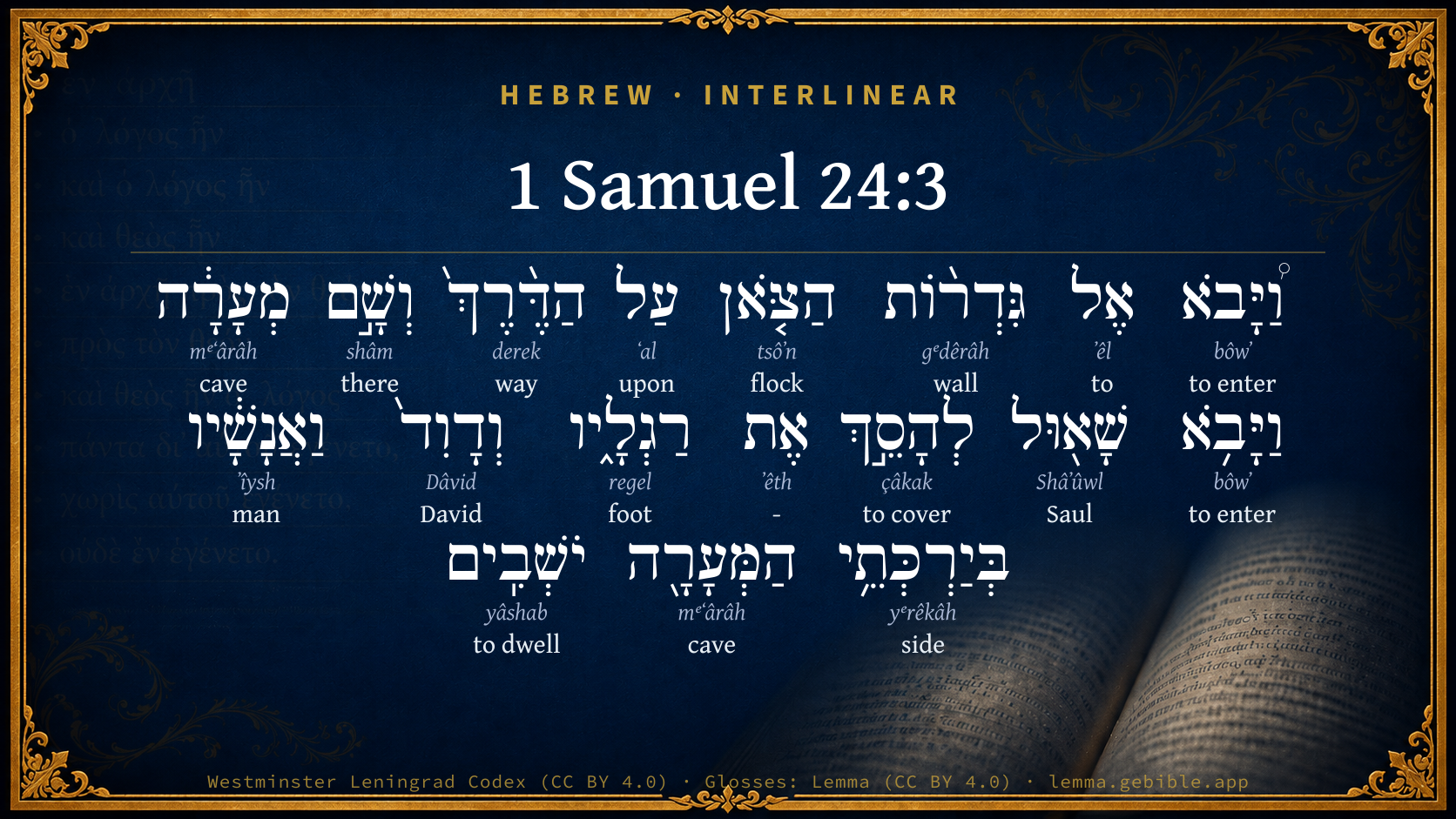
  1. וַ֠יָּבֹא bôwʼ H935 “and · to enter” Conjunction + Verb, Qal, Sequential Imperfect, 3rd Person, Masculine, Singular
  2. אֶל ʼêl H413 “to” Preposition
  3. הַצֹּ֤אן tsôʼn H6629 “the · flock” Particle, Definite Article + Noun, Common, Both, Singular, Absolute
  4. עַל ʻal H5921 “upon” Preposition
  5. הַדֶּ֨רֶךְ֙ derek H1870 “the · way” Particle, Definite Article + Noun, Common, Both, Singular, Absolute
  6. וְשָׁ֣ם shâm H8033 “and · there” Conjunction + Adverb
  7. מְעָרָ֔ה mᵉʻârâh H4631 “cave” Noun, Common, Feminine, Singular, Absolute
  8. וַיָּבֹ֥א bôwʼ H935 “and · to enter” Conjunction + Verb, Qal, Sequential Imperfect, 3rd Person, Masculine, Singular
  9. שָׁא֖וּל Shâʼûwl H7586 “Saul” Noun, Proper
  10. לְהָסֵ֣ךְ çâkak H5526 “to cover” Preposition + Verb, Hiphil, Infinitive Construct
  11. אֶת ʼêth H853 “-” Particle, Direct Object
  12. רַגְלָ֑יו regel H7272 “feet · his” Noun, Common, Feminine, Dual, Construct + Suffix, Personal, 3rd Person, Masculine, Singular
  13. וְדָוִד֙ Dâvid H1732 “and · David” Conjunction + Noun, Proper
  14. וַאֲנָשָׁ֔יו ʼîysh H376 “and · men · his” Conjunction + Noun, Common, Masculine, Plural, Construct + Suffix, Personal, 3rd Person, Masculine, Singular
  15. בְּיַרְכְּתֵ֥י yᵉrêkâh H3411 “in/at · sides of” Preposition + Noun, Common, Feminine, Dual, Construct
  16. הַמְּעָרָ֖ה mᵉʻârâh H4631 “the · cave” Particle, Definite Article + Noun, Common, Feminine, Singular, Absolute
  17. יֹשְׁבִֽים yâshab H3427 “dwelling” Verb, Qal, Participle Active, Masculine, Plural, Absolute

About this verse

These counts appear in no published source. They are computed here, from the morphology-tagged text and Lemma’s own curated glosses. What Lemma adds →

18
words
16
distinct lemmas
Historical
section

Notable vocabulary

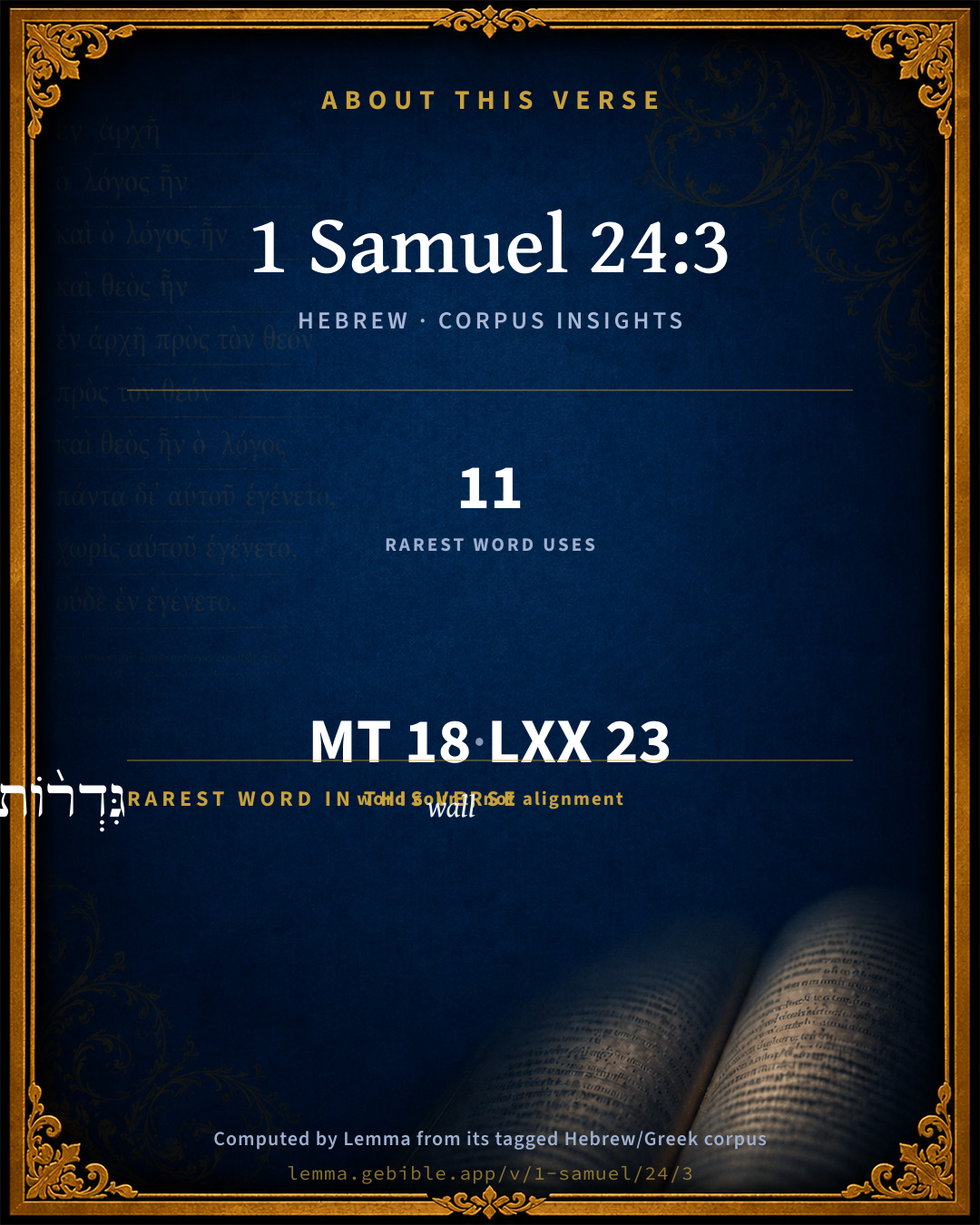
The rarest word here is גִּדְר֨וֹת wall H1448 — appearing just 11 times in the whole Hebrew Bible.

Shared distinctive vocabulary

גִּדְר֨וֹת wall H1448 occurs in 11 verses of the Hebrew Bible. Also found in:

Grammatical profile

  • 4 verbs
  • 10 nouns
  • 2 prepositions
  • 1 adverb
  • 1 particle

Verb forms

  • וַ֠יָּבֹא Qal · Sequential Imperfect
  • וַיָּבֹ֥א Qal · Sequential Imperfect
  • לְהָסֵ֣ךְ Hiphil · Infinitive Construct
  • יֹשְׁבִֽים Qal · Participle Active

Repetition

Words recur within this verse — often emphatic in Hebrew:

  • וַ֠יָּבֹא to enter H935 ×2
  • מְעָרָ֔ה cave H4631 ×2

Hebrew & Septuagint length

In English translation the verse runs 35 words from the Hebrew and 25 from the Septuagint (LXX English) — the Septuagint runs noticeably shorter here. See the side-by-side →

A rough comparison of the two English renderings, which tokenize alike — not a word-level alignment.

Word counts can differ between the Hebrew and the Greek without any difference in meaning — e.g. the Hebrew direct-object marker אֵת has no separate Greek word, and Greek often adds the article ὁ.

In the original languages it is 18 Hebrew tokens and 23 Greek tokens — but the two are counted differently (Hebrew bundles its prefixes and suffixes into one token; the Greek is in lemma form), so that isn’t a like-for-like length.

Cross-references

4

Topical passages linked to 1 Samuel 24:3 in the Treasury of Scripture Knowledge — connected by theme and wording, ordered by reader-vote popularity; previews shown in the World English Bible.

  • Judges 3:24 Now when he was gone out, his servants came; and they saw, and, behold, the doors of the upper room were locked; and they said, Surely he is covering his feet in the upper chamber.
  • Psalms 57:1–11 Be merciful to me, God, be merciful to me, For my soul takes refuge in you. Yes, in the shadow of your wings, I will take refuge, Until disaster has passed.
  • Psalms 142:1–7 I cry with my voice to Yahweh. With my voice, I ask Yahweh for mercy.
  • Psalms 141:6 Their judges are thrown down by the sides of the rock. They will hear my words, for they are well spoken.

Cross-references courtesy of OpenBible.info (CC BY 4.0).

Hebrew and Greek witnesses Masoretic Hebrew ↔ Greek Septuagint

The same verse in the two great witnesses to the Old Testament, shown verse-for-verse.

Here the Septuagint runs noticeably shorter than the Hebrew — LXX2012 (modern English Septuagint) 25 words vs World English Bible 35. A rough length comparison of the two English translations, not a word-level alignment — read both below.

These are two independent witnesses, not word-aligned to each other, and the Septuagint is shown in lemma (dictionary) form.

Hebrew 1 Samuel 24:3 Masoretic · Westminster Leningrad Codex

וַ֠יָּבֹא אֶל גִּדְר֨וֹת הַצֹּ֤אן עַל הַדֶּ֨רֶךְ֙ וְשָׁ֣ם מְעָרָ֔ה וַיָּבֹ֥א שָׁא֖וּל לְהָסֵ֣ךְ אֶת רַגְלָ֑יו וְדָוִד֙ וַאֲנָשָׁ֔יו בְּיַרְכְּתֵ֥י הַמְּעָרָ֖ה יֹשְׁבִֽים

He came to the sheep pens by the way, where was a cave; and Saul went in to cover his feet. Now David and his men were abiding in the innermost parts of the cave.

World English Bible · Public Domain

Greek LXX 1 Samuel 24:3 Septuagint · lemma form

καί λαμβάνω μετά ἑαυτοῦ τρεῖς χιλιάς ἀνήρ ἐκλεκτός ἐκ πᾶς ἰσραήλ καί πορεύομαι ζητέω ὁ δαυίδ καί ὁ ἀνήρ αὐτός ἐπί πρόσωπον σαδαιεμ

And he took with him three thousand men, chosen out of all Israel, and went to seek David and his men in front of Saddaeem.

LXX2012 (modern English Septuagint) · Public Domain

On this verse, Adam Clarke's Commentary discusses the Septuagint’s reading. Read the note in Commentary ↓

Hebrew: Westminster Leningrad Codex (CC BY 4.0). Greek: Septuagint (public domain); English from LXX2012 (modern English Septuagint) (Public Domain). How the Septuagint differs from the Hebrew →

Targum (Aramaic paraphrase)

1

The Targum is the ancient Jewish Aramaic paraphrase of the Hebrew Scriptures — an interpretive translation, not the Hebrew text itself. Onkelos (literal) and Pseudo-Jonathan (expansive) render the Torah, and Jonathan the Prophets. Coverage is partial: where no permissively-licensed English translation exists for a verse, only the Aramaic is shown. This is verse-level text, not a word-by-word alignment to the Hebrew.

  1. Targum Jonathan Prophets (Joshua–Malachi)
    וּדְבַר שָׁאוּל תְּלָתָא אַלְפִין גְבַר עוּלֵים מִכָּל יִשְׂרָאֵל וַאֲזַל לְמִבְעֵי יַת דָוִד וְגַבְרוֹהִי עַל אַפֵּי שְׁקִיפֵי כֵיפַיָא:

    (no public-domain English translation for this verse)

    Targum Jonathan — Aramaic: “Mikraot Gedolot” (public domain). English: “Sefaria Community Translation” (CC0 1.0 (public-domain dedication)); “London "Chaldee Paraphrase," 1871” (public domain). Text via Sefaria.

Commentary

Notes on 1 Samuel 24:3 from classic Christian and Jewish commentators (each source and its license shown beneath its notes). The classic Christian expositions comment on the surrounding passage and are grouped to its opening verse, so a note may address several verses; the Jewish commentaries on the Tanakh (Rashi and others) are per-verse, so they appear only where the commentator wrote on this verse.

Lemma curates 59 commentaries, every one of them public domain or Creative Commons licensed, each selected and text-cleaned for this edition rather than reprinted as found. About our sources →

Trapp's Complete Commentary

John Trapp

1Sa 24:3 And he came to the sheepcotes by the way, where [was] a cave; and Saul went in to cover his feet: and David and his men remained in the sides of the cave.

Ver. 3. And Saul went in to cover his feet.] To ease nature. See Jdg 3:24, {See Trapp on "Jdg 3:24"} Alexander Medices, duke of Florence, and son-in-law to Charles V, Emperor, was slain by his near kinsman Laurentius, as he was doing his easement. {a}

And David and his men remained in the sides of the cave.] Here and at this time it was that David said, "I will cry unto God most High, unto God that performeth all things for me," {Psa 57:2} where the Chaldee hath, Unto God who sent the spider to make a web in the mouth of the cave for me. It may very well be that Saul, seeing the entrance of the cave overgrown with cobwebs, might think that no David lurked there. The like providence is reported for the preservation of Felix, a martyr, one time from his persecutors, whereupon Paulinus singeth -

“ Sic ubi Christus adest, nobis et aranea muro est:

At cui Christus abest, et murus aranea fiet ”

{a} Gal, Hist. Epit.

John Trapp, A Commentary or Exposition upon All the Books of the Old and New Testament (1647–1656) — public domain. Text from a community e-Sword module.

The Biblical Illustrator

Joseph S. Exell

1Sa_24:3-22

Where was a cave and Saul went in . . . and David and his men remained in the sides of the cave.

Saul and David in the cave

Sauls animosity is a fire that finds constant fuel. No sooner are the Philistines repulsed than he resumes his hunt for his prey. That Saul should know so well where to look for David seems to imply that traitors were among the wanderers followers. Misinterpreted providence refused in wisdom. Sauls unexpected appearance thus unguarded would appear to Davids men as decidedly a providence. Calling to mind the meaning of the Divine anointing and the promise that David should come to the throne of Israel, they whisper, Behold the day of which the Lord said unto thee (1Sa_24:4). If Psa_7:1-17 belongs to this period, we see how great the conflict with self before this temptation. The history furnishes us with much light concerning David.

1. His tenderness of conscience is noticeable. His heart smote him for thus doubting God and stooping to dishonour His anointed king (verse 5).

2. His conscious integrity adds force to his words. How tenderly he pleads with Saul (verse 9). How tremulous with righteousness are his words (verse 11).

3. What dignity there is in truth l and withal his humility must be noticed. (verse 14). It was as if he had said, I shall not antedate the promise. God has said He will bring me to the throne. I shall wait. (verse 15). Such a time was filled with tests--a sudden opportunity to reach the desire of the heart, and an appeal to passion in the name of religion. He stood the strain. He lost not his self-command. Nearly all our falls come from trying to go before God! (H. E. Stone.)

David sparing his enemy

This scene is an episode in the life of David, whom God had chosen to succeed Saul as the king of Israel.

1. The cave. In all limestone countries such caves are common, and many of them are large enough to conceal armies. The Mammoth Cave in Kentucky and Weyers Cave in Virginia are large enough to shelter a hundred thousand men. Bruces Cave in Scotland is still shown to tourists, and history tells how Mohammed once saved his life by running into one of these mountain caves. But in this cave at Engedi we have the marvellous escape of Saul as an act of gracious forbearance on the part of David.

2. The meeting. In the solitude, of that cave, by the mysterious providence of God, are these two men, Saul and David. Saul hated David as Haman hated Mordecai, or as Herod hated Jesus when the wise men told him that a King was born in Bethlehem.

3. David restrained. It must have been a great provocation to stand there and see his inveterate enemy ungird his mantle and compose himself to sleep. But David was a man of war, brave as the lion. He was made of nobler stuff than assassins are made of. He was too much of a man to kill a king when asleep, as Richard hired men to kill the princes of England that he might ascend the throne.

4. The final appeal. But I say unto you, love your enemies. We would hardly expect to find a fulfilment of such a sentiment in that rude age of the world.

Lessons:--

1. Sin hardens. Sin puts a man in antagonism to God, makes him hate the rule of God, and makes him ignore and despise the mercy of God, and at last brings him to confront the unmitigated vengeance of God.

2. The subduing and restraining power of Gods grace. (T. W. Hooper, D. D.)

David sparing his enemy

David illustrates the peacemaker.

I. In his forbearance. Those were times of quick and savage deed. Human life was cheap. Tender sensibilities had slight leave among a people, every one of whom wore his sword on thigh, ready, on occasion, to pierce with it the heart of an offender. The spirit of the age demanded speedy redress of injury or insult. And here was one who, above all others, had, signalized himself as gifted with courage and strength in conflict. The wrongs we have suffered do rankle mightily, till an unearthly nature has been created within us. To forgive, but not forget, is the veriest empty form of words. Philip of Burgundy, being entreated to punish a prelate who had injured him, may seem to have given a holy rule in his reply, It is a fine thing to have revenge in ones power, but it is a finer thing not to use it. And a finer yet, is it not, to have no spirit of resentment burning within, however it may be reprised? Another characteristic of the peacemaker which gave David a right to the title was:

II. His conscientiousness. Though he would not harm his foe in the least, yet he did think best to obtain proof that he could have slain him if he would. We commend his prudence. But no sooner had the rent been made in the royal mantle than his heart smote him. He had lifted his hand against his fellow; if not to cut off his head, at least somewhat his dignity. The Rabbis declare that he expiated this sin in his old age, by finding no warmth in the clothes wherewith he wrapped himself. He opened his inmost heart to his murmuring associates, and we are surprised that this bronzed soldier betrays the finer sentiments of humanity. The beating of a reverent, loving heart, seeking over to he cleansed from secret faults, is felt through all this story of trial. As the string of the piano vibrates when its kindred note is sounded by other instrument or voice, so does this brief protest of a conscience, ages since, stir the readers in quick unison, as we learn that the standards of right and wrong are eternal. The peacemaker like David is--

III. Loyal to rulers. Saul had been sought out by the aged prophet, and the vial of oil had been poured upon his head. Henceforth he was a representative of Jehovah. Affront, disobedience, disrespect shown to him, was dishonour to God as well. Let him betray his trust; let him, like the stork in the fable, eat up his subjects; let him be a Herod, a Nero, a Charles, an Ashantee chief, an Alexander IV; still, the authority of his office, when once he holds it, is sacred, and must be maintained. So David reasoned, and would not for a moment think of retaliation. What a lesson of self-control and chivalrous devotion was that to the impatient, hating victims of oppression in every age! Gods time and Gods way may best be waited for. The chief attribute at the peacemaker David was--

IV. Simple trust in God. In this instance, as before and afterwards, we find him, in full view of danger, committing his ease to the Lord, whom he prayed to judge between me and thee, and plead my cause and deliver me out of thine hand. Such confidence is a sublime reality. (Monday Club Sermons.)

The Biblical Illustrator, edited by Joseph S. Exell (c. 1880s–1900s) — public domain. Text from a community e-Sword module.

Joseph Benson's Commentary

1Sa 24:3. Where was a cave — This cave being near the highway, and in the most frequented place of the wilderness, namely, near the sheep-cotes, to which the shepherds and herdsmen resorted to feed and milk their flocks, it is likely David made choice of it as being a place most unlikely to be suspected. Or, perhaps, he was pressed so near by Saul that he had no other way of escaping. That his distress and danger were very great, may be gathered from the 57th and 142d Psalms, which, it is supposed, he composed in commemoration of his deliverance. Saul went in to cover his feet — To take some rest in sleep. Being a military man, it is probable he used to sleep with his soldiers upon the ground. And it is not improbable that, being weary with his eager and almost incessant pursuit, first of David, then of the Philistines, and now of David again, he both needed and desired some sleep; God also disposing him thereto, that David might have this eminent occasion to demonstrate his integrity to Saul, and to all Israel. In the sides of the cave — For that there were vast caves in those parts is affirmed, not only by Josephus, but also by heathen authors; Strabo writes of one which could receive four thousand men.

Joseph Benson's Commentary on the Old and New Testaments (1811–1818) — public domain. Text from a community e-Sword module.

Jamieson, Fausset & Brown

Robert Jamieson, A. R. Fausset & David Brown

he came to the sheepcotes--most probably in the upper ridge of Wady Chareitun. There a large cave--I am quite disposed to say the cave--lies hardly five minutes to the east of the village ruin, on the south side of the wady. It is high upon the side of the calcareous rock, and it has undergone no change since David's time. The same narrow natural vaulting at the entrance; the same huge natural chamber in the rock, probably the place where Saul lay down to rest in the heat of the day; the same side vaults, too, where David and his men were concealed. There, accustomed to the obscurity of the cavern, they saw Saul enter, while, blinded by the glare of the light outside, he saw nothing of him whom he so bitterly persecuted.

Jamieson, Fausset & Brown — Commentary Critical and Explanatory on the Whole Bible (1871) — public domain (CC PDM 1.0). Text via the HelloAO Bible API.

Adam Clarke's Commentary

Verse 3. The sheep-cotes] Caves in the rocks, in which it is common, even to the present time, for shepherds and their flocks to lodge. According to Strabo there are caverns in Syria, one of which is capable of containing four thousand men: Ὡν ἑν και τετρακισχιλιους ανθρωπους δεξασθαι δυναμενον; lib. xvi. p. 1096. Edit. 1707.

Saul went in to cover his feet] Perhaps this phrase signifies exactly what the Vulgate has rendered it, ut purparet ventrem. The Septuagint, the Targum, and the Arabic understand it in the same way. It is likely that, when he had performed this act of necessity, he lay down to repose himself, and it was while he was asleep that David cut off the skirt of his robe. It is strange that Saul was not aware that there might be men lying in wait in such a place; and the rabbins have invented a most curious conceit to account for Saul's security: "God, foreseeing that Saul would come to this cave, caused a spider to weave her web over the mouth of it, which, when Saul perceived, he took for granted that no person had lately been there, and consequently he entered it without suspicion." This may be literally true; and we know that even a spider in the hand of God may be the instrument of a great salvation. This is a Jewish tradition, and one of the most elegant and instructive in their whole collection.

David and his men remained in the sides of the cave.] This is no hyperbole; we have not only the authority of Strabo as above mentioned, but we have the authority of the most accurate travellers, to attest the fact of the vast capacity of caves in the East.

Dr. Pococke observes: "Beyond the valley (of Tekoa) there is a very large grotto, which the Arabs call El Maamah, a hiding place; the high rocks on each side of the valley are almost perpendicular, and the way to the grotto is by a terrace formed in the rock, which is very narrow. There are two entrances into it; we went by the farthest, which leads by a narrow passage into a large grotto, the rock being supported by great natural pillars; the top of it rises in several parts like domes; the grotto is perfectly dry. There is a tradition that the people of the country, to the number of thirty thousand, retired into this grotto to avoid a bad air. This place is so strong that one would imagine it to be one of the strong holds of En-gedi, to which David and his men fled from Saul; and possibly it may be that very cave in which he cut off Saul's skirt, for David and his men might with great ease lie hid there and not be seen by him." - Pococke's Travels, vol. ii., part 1, p. 41.

Adam Clarke's Commentary on the Bible (1810–1826) — public domain. Text from a community e-Sword/MySword module.

Ellicott's Commentary for English Readers

(3) The sheepcotes.—Thomson (The Land and the Book) saw, he says, hundreds of these sheepcotes around the mouth of the caves, of which there are so many in Palestine. In that land and among these Eastern peoples, whose customs change so little, they are as common now as they were then. “These sheepcotes are generally made by piling up loose stones in front of the cave’s entrance in a circular wall, which is covered with thorns as a further protection against thieves and wild animals who would prey on the sheep. During cold storms and in the night the flocks retreat into the cave, but at other times they remain in the enclosed cote. . . . These caverns are as dark as midnight, and the keenest eye cannot see four paces inward; but one who has been long within, and looking outward toward the entrance, can observe with perfect distinctness all that takes place in that direction. David, therefore, could watch Saul as he came in . . . but Saul could see nothing but impenetrable darkness.”

From this thorny fence, so universal in the countless sheepcotes of Palestine, was very possibly derived a quaint simile in the strange passage on “Death” in the Talmud:—

“The hardest of all deaths is by a disease (some suppose quinsey), which is like the forcible extraction of prickly thorns from wool. . . . The easiest of all deaths is the Divine kiss, which is like the extracting of hair from milk. Moses, Aaron, and Miriam died by this Divine kiss.”—Treatise Berachoth, fol. 8, col.1.

Where was a cave.—The well-known traveller Van de Velde wishes to identify the cave in question with an immense cavern in a rock with many side vaults, near the ruins of Chareitum; the difficulty is, however, that this vast cavern is fifteen or twenty miles from Ain-jedy. In this cave all David’s band could well have been gathered: not only his 600 fighting men, but the camp followers and women also. In Pocock we read that the Arabs call this cavern Elmaama (hiding-place), and relate how on one occasion thirty thousand people hid themselves in it to escape an evil wind (the simoom). It is, however, quite possible that the incident about to be related, connected with Saul and David, took place in one of the much smaller caves close to En-gedi. It is not necessary to assume that all David’s band were with him in one cave. A hundred or so of his more special companions were probably with him on this occasion, the remainder of the little army being dispersed in other similar refuges in the immediate neighbourhood.

And Saul went in to cover his feet.—The meaning of this disputed passage is quite simple. Saul, fatigued with the morning’s march, some time about midday withdrew—probably with a very few attendants composing his personal staff—to take a short siesta, or sleep, in one of those dark, silent caves on the hill-side, which offered a cool resting-place after the glare and heat of a long and fatiguing march along the precipitous paths of the region. He lay down, no doubt, near the cave’s mouth, and one of his faithful attendants threw lightly over the king’s feet the royal many coloured mantle (m’il). The king and his attendants little suspected that in the dark recesses of their midday resting-place were concealed the dreaded freebooter and a great company of his devoted armed followers. As explained in the Note above, in these great rock recesses, coming from outside, from the glare of daylight, not five paces forward can be seen, but those already inside, and accustomed to the darkness, can, at a considerable distance within the cave, see distinctly all that takes place in the neighbourhood of the cavern mouth. The sharp eyes of David’s sentinels, no doubt, far in the cave, quickly saw the little party of intruders. The tall form of the king, his jewelled armour, and perhaps his many-coloured brightly-tinted cloak, betrayed to the amazed watchmen of David the rank of the wearied sleeper.

This interpretation of the words. “Saul went in to cover his feet”—namely, “to sleep”—is adopted by the Peshito Syriac Version, Michaelis, and of late, very positively, Ewald. The ordinary interpretation of the words, besides being an unusual statement, by no means suits the narrative; for it must be remembered that considerable time was necessary for the sentinel to inform David, and for David to have approached and cut off the hem of the royal garment, and again to have retired into the recesses of the cave.

In the sides of the cave.—That is, in the side vaults and passages which exist in the largest of these natural refuges.

A Bible Commentary for English Readers, edited by Charles John Ellicott (1878–1897) — public domain. Text from a community e-Sword module.

The Cambridge Bible for Schools and Colleges

gen. ed. J. J. S. Perowne

3. the sheepcotes by the way] Sheepfolds are still formed in the East by building a wall of loose stones round the mouth of a cave, which serves for shelter in case of bad weather. See The Land and the Book, p. 603.

to cover his feet] An euphemism for performing the necessities of nature.

remained, &c.] Were abiding in the recesses of the cave. Large caves with numerous side passages are found in the district. “They are as dark as midnight, and the keenest eye cannot see five paces inward: but one who has been long within, and is looking outward toward the entrance, can observe with perfect distinctness all that takes place in that direction.” Hence David and his men could watch Saul without being seen.

The Cambridge Bible for Schools and Colleges (gen. ed. J. J. S. Perowne; Cambridge University Press, 1878–1918) — public domain. Text from a community e-Sword module.

John Gill's Exposition

And he came to the sheepcotes by the way, where was a cave,.... For the sheep to be led into at noon, to shelter them from the heat: such was the cave of Polyphemus, observed by Bochart (z), in which sheep and goats lay down and slept; See Gill on Zep 2:6,

and Saul went in to cover his feet; the Targum is, to do his necessaries; and so Josephus (a); and the Jewish commentators generally understand it of easing nature; and as the eastern people used to wear long and loose garments, these, when they performed such an action, they used in modesty to gather them close about them, that no part of the body, their feet, and especially the parts of nature which should be concealed, might be seen; but the Syriac and Arabic versions render it, "and there he lay" or "slept"; which suggest, that his going into the cave was in order to take some sleep and rest, when it was usual to cover the feet, both to prevent taking cold, and the private parts of the body being exposed to view; and this accounts better for Saul not hearing David's men in the cave, and for his being insensible of David's cuttings off the skirt of his garment, and best agrees with the use of the phrase in Jdg 3:24; the only place besides this in which it is used; See Gill on Jdg 3:24,

and David and his men remained in the sides of the cave; unseen and unobserved by Saul, even six hundred of them; nor need this seem strange, since in those parts of the world there were caves exceeding large, made so either by nature or art. Vansleb (b) speaks of a cave in Egypt so extraordinary large, that, without hyperbole, a thousand horses might there draw up in battle array, and of another larger than that; and Strabo says (c), that towards Arabia and Iturea are mountains difficult to be passed, and in which are deep caves, one of which would hold four thousand men: and as the mouths of these caves were generally narrow, and the further parts of them large, and also dark, persons at the entrance of them could be seen, when those in the more remote parts could not; and this cave is said to be extremely dark (d); which accounts for Saul's being seen when he came into the cave, whereas David and his men could not be seen by him.

(z) Hierozoic. par. 1. l. 2. c. 45. col. 467, 468. (a) Antiqu. l. 6. c. 13. sect. 4. (b) Relation of a Voyage, p. 227. (c) Geograph. l. 16. p. 520. (d) Le Bruyn's Voyage to the Levant, ch. 51. p. 199.

John Gill's Exposition of the Whole Bible (1746–1763) — public domain (CC PDM 1.0). Text via the HelloAO Bible API.

Albert Barnes' Notes on the Bible

Remained in the sides - Rather, “were in the sides of the cave dwelling or abiding there.” Some of these caverns are very deep and spacious. Any one near the mouth of the cave would be visible, but those in the recesses would be quite in the dark and invisible, especially if the incident occurred at night. Psa 67:1-7, according to the title, was composed on this occasion.

Albert Barnes' Notes on the Bible (1834–1885) — public domain. Text from a community e-Sword/MySword module.

Haydock's Catholic Bible Commentary

Goats; an hyperbole. (Menochius) --- Hebrew, "upon the rocks of the wild goats." (Haydock)

George Leo Haydock (1774–1849), Haydock's Catholic Family Bible and Commentary, 1859 edition — public domain. Excludes Psalms (Douay-Rheims chapter numbering differs from Protestant) and Deuterocanonical books (Catholic canon only).

Matthew Poole's English Annotations

Some think

the sheep cotes to have been caves into which they used to drive their sheep for shelter in tempestuous weather.

To cover his feet, i.e. to ease his belly, as this phrase is thought to be used, Jdg 3:24. The reason whereof is, because the eastern and some other nations of old wore no breeches, but loose and long coats or gowns, like those which women with us wear; but shorter, whence their feet and legs were in a great part uncovered; and sometimes other parts, which also in Scripture are designed by the name of the feet, (of which See Poole "Gen 49:10"; See Poole "Deu 28:57"; See Poole "2Ki 18:27"; See Poole "Isa 7:20",) were exposed to view. But when they went to perform this office of nature, which obliged them first to lift up their garments, they afterwards disposed them so decently, that all those parts might be covered and kept out of the sight of others. But possibly the words may have another meaning, and it is not to be despised that those ancient and venerable interpreters, the Syriac and Arabic, interpret this place and phrase quite otherwise, that Saul went in to sleep there; which was no uncouth thing to Saul, who being a military man, used to sleep with his soldiers upon the bare ground, as he did 1Sa 26:7. And it is not improbable that Saul, being exceeding weary with his eager and almost incessant pursuit, first of David, then of the Philistines, and now of David again, both needed and desired some sleep God also disposing him thereunto, that David might have this eminent occasion to demonstrate his integrity to Saul, and to all Israel; and, the season possibly being hot, he might choose to sleep in the cave, for the benefit of the shade. But all the question is, how it may appear that this is the meaning of this phrase, and what is the reason and ground of it? To which many things may be said. First, That this phrase is but twice used in Scripture, as far as I remember, here, and Jdg 3:24, and this sense may conveniently enough agree to both of them; nay, this sense may seem better to agree with that place, Jdg 3, for that summer parlour or summer chamber (for both seem to be the same place, and were apparently for the same use, Jdg 3:24,25) seems to be a place far more convenient for sleeping than for easing of nature. And the servants’ long stay and waiting for their lord seems to imply that they judged him gone to sleep, (which might take up a considerable time,) rather than to that other work, which requires but a little time. See Poole "Jdg 3:24". Secondly, That there are many Hebrew phrases which do confessedly signify several things, albeit the reason of such significations be now utterly unknown to us, though it was doubtless known to the ancient Hebrews. Nor need I instance in particulars, seeing it is so in all languages, and particularly in the English tongue at this day, in which the use of many proverbs and phrases is well understood, though the reason of them be now lost; which if our modern infidels, who scoff at some passages of Scripture, which they either do not or will not understand, would consider, they would lose much of their sport. Thirdly, Although there be not that clear and full proof of this sense which some may require, (though indeed it cannot be reasonably expected in a thing so ancient, and in a phrase of so concise and narrow a language as the Hebrew is, and in an expression so rarely used in Scripture,) yet there are some intimations in Scripture which may seem to favour this interpretation. For persons composing themselves to sleep in this manner, are not only noted in the general to have been covered with a mantle, as is said of Sisera, Jdg 4:18,19; but particularly they are said to have their feet covered, as is expressly observed concerning Boaz, when he lay down to sleep in the threshing-floor, Rth 3:4,7. The reason whereof may possibly be this, that when they lay down to sleep in their garments, they were secured as to the other parts of their body, only their feet were open and visible; and therefore it was convenient to cover their feet, partly to prevent the inconveniences of cold, (for which reason we here take special care to cover our feet in such cases,) and partly for decency sake, lest their garments being loose and large below, should be disordered, and so their nakedness should appear, as it happened to Noah, Gen 9:21. Compare Exo 20:26. And therefore it cannot seem strange or forced, if in this place Saul’s covering of his feet design his composing himself to his rest. And if this be so, then the following difficulties of this history will appear to be plain and easy. For if Saul were fast asleep, which might easily be perceived by David and his men within; then it is not strange that Saul neither heard David and his men talking of him, nor felt David when he came to cut off’ his lap.

David and his men remained in the sides of the cave; for that there were vast caves in those parts is affirmed not only by Josephus, but also by heathen authors; and Strabo, in his 16th book, writes of one which could receive four thousand men.

Matthew Poole's English Annotations on the Holy Bible (1683–1685) — public domain. Text from a community e-Sword/MySword module.

Whedon's Commentary on the Bible

Daniel D. Whedon

3. The sheepcotes by the way — Not caves in the rocks, but enclosures built by the shepherds in the valley for the purpose of protecting their flocks. These sheep perhaps belonged to Nabal. Compare 1Sa_25:7.

To cover his feet — Not to lie down for sleep, for that idea could have been expressed more simply, but a euphemism for performing the necessities of nature, which was done in a sitting posture, the person covering himself with the folds of his garment. Compare Jdg_3:24.

In the sides of the cave — The note on 1Sa_22:1, on the cave of Adullam, shows that these mountain caverns afforded sufficient room for all the facts here mentioned.

Daniel D. Whedon (gen. ed.), Commentary on the Old and New Testaments (1874–1909) — public domain. Text from a community e-Sword module.

The Pulpit Commentary

He came to the sheepcotes. Rather, "to sheepcotes," there being no article in the Hebrew. Such sheepcotes were common in Palestine; for Thomson (p. 603) says, "I have seen hundreds of these sheepcotes around the mouth of caverns, and indeed there is scarcely a cave in the land, whose location will admit of being thus occupied (i.e. by the flocks), but has such a "cote" in front of it, generally made by piling up loose stones into a circular wall, which is covered with thorns, as a further protection against robbers and wild beasts. During cold storms, and in the night, the flocks retreat into the cave, but at other times they remain in this enclosed cote.... These caverns are as dark as midnight, and the keenest eye cannot see five paces inward; but one who has been long within, and is looking outward toward the entrance, can observe with perfect distinctness all that takes place in that direction. David, therefore, could watch Saul as he came in, and notice the exact place where he "covered his feet," while Saul could see nothing but "impenetrable darkness." To cover his feet. The Syriac understands this of sleeping; more correctly the Vulgate and Chaldee take it as in Jud_1:3:24, margin.

The Pulpit Commentary (1880–1919), ed. H.D.M. Spence-Jones & Joseph S. Exell — public domain. Text from a community e-Sword module.

John Wesley's Explanatory Notes

Went in - To sleep there: Saul being a military man, used to sleep with his soldiers upon the ground. And it is not improbable, that being weary with his eager and almost incessant pursuit, first of David, then of the Philistines, and now of David again, he both needed and desired some sleep, God also disposing him thereto, that David might have this eminent occasion to demonstrate his integrity to Saul, and to all Israel. Of the cave - For that there were vast caves in those parts is affirmed, not only by Josephus, but also by Heathen authors; Strabo writes of one which could receive four thousand men.

John Wesley, Explanatory Notes Upon the Whole Bible (1754–1765) — public domain. Text via the GEBible commentary corpus.

unfoldingWord translationNotes

Door43 World Missions Community

sheep pens

"sheep corrals" or "sheep enclosures"

cover his feet

This is a euphemism for "relieve himself" or "defecate" or "empty his intestines." (See: Euphemism)

cave

generally a natural hole under the ground, often with an opening in the side of a hill or cliff

David arose and quietly crept

The word "arose" is an idiom for taking action. AT: "David took action; he quietly crept" (See: Idiom)

crept

approached slowly, carefully or quietly

translationWords

ewe

Yahweh

hand

raise

cut off

robe

unfoldingWord translationNotes — © Distant Shores Media and the Door43 World Missions Community, licensed CC BY-SA 4.0. Source: git.door43.org/Door43/en_tn.

Rashi

Rabbi Shlomo Yitzchaki (Rashi)

The rocky land of the wild goats. The rocks of the wild goats.

Rashi on the Tanakh — English translations: “The Judaica Press complete Tanach with Rashi, translated by A. J. Rosenberg” (CC BY 4.0); “Pentateuch with Rashi's commentary by M. Rosenbaum and A.M. Silbermann, 1929-1934” (public domain); “The Metsudah Tanach series, Lakewood, N.J” (CC BY 4.0); and “The Book of Joshua, Metsudah Publications, 1997” (CC BY 4.0). Text via Sefaria.

Lesson kit

Teaching starters — assembled from the data on this page, not authored interpretation. Every prompt links to the verse data it draws on. Edit before teaching.

1 Samuel, in the Historical, opens this verse with 18 words (16 distinct Hebrew lemmas). Its most distinctive word is gᵉdêrâh (“wall”). The Greek Septuagint runs shorter here. A historical commentator’s framing appears above. Read the whole chapter for the surrounding context.

Discussion questions

  1. What does “wall” (gᵉdêrâh) contribute to the verse as a whole?
  2. How does Numbers 32:16, which shares the word «wall», read alongside this verse?
  3. What does the repetition of “to enter” (2× in this one verse) do in this verse?
  4. The Septuagint runs shorter here than the Hebrew. What might account for the difference?
  5. These translations render this verse differently; the difference is in the English rendering, not the original. What questions does that raise?
  6. «וַ֠יָּבֹא» is a Qal Sequential Imperfect verb. How does that grammatical form shape the action described?
  7. Compare how Trapp's Complete Commentary and The Biblical Illustrator read this verse. Where do they agree or differ?

Things to notice

Reading settings

Reading text

Shown beneath each verse's original-language words.

Old Testament
Old Testament edition

Read the OT as the Masoretic Hebrew (MT) or the Greek Septuagint (LXX).

English shown for the Greek Septuagint (in the Hebrew ↔ Greek comparison).

Comparing translations? Open the Compare panel on any verse page to stack up to four side by side.