1 Chronicles 23:27

Hebrew (Westminster Leningrad Codex) 1 Chronicles 23:27 appears in the Hebrew Old Testament. The text above is from the Westminster Leningrad Codex. Each word links to its Strong’s number, a concise gloss, and parsing drawn from the Open Scriptures Hebrew Bible morphology. Click any word for its full Brown-Driver-Briggs (BDB) entry.
Download image
Cite this verse

1 Chronicles 23:27 (World English Bible). Public Domain. Lemma interlinear Bible study tool, https://lemma.gebible.app/v/1-chronicles/23/27.

Show BibTeX & RIS
BibTeX
RIS
English Translation
For by the last words of David the sons of Levi were numbered, from twenty years old and upward.
World English Bible · Public Domain
Download a study sheet

One document with this verse’s original text, its word-by-word gloss line, the meaning frame, cross-references with their text, attributed commentary, and full source and license credits — printable, and it pastes into notes with its structure intact.

This verse Autodidact and up

Study sheet (.html) Plain text (.txt)

A passage Seminary Student

Up to 50 verses in one chapter. A passage sheet keeps up to 6 commentary sources and 12 cross-references per verse, in the order this page ranks them, and says so on the sheet whenever that leaves anything out. Ask for a single verse and you get the Autodidact verse sheet above.

Everything on this page stays free to read, with no account — the sheet is a download of what is already on screen, not access to it.

Want to remove ads? Support Godless Engineer
Compare translations 3

The same verse in 3 English versions, stacked beneath the original-language interlinear above. Click any original word for its lexicon entry.

Each is an independent rendering of the whole verse — the interlinear is not word-aligned to these translations.

Highlighted words mark where these versions differ — a whole-verse word diff, not a word-by-word alignment.

  • World English Bible Public Domain
    For by the last words of David the sons of Levi were numbered, from twenty years old and upward.
  • King James Version Public Domain
    For by the last words of David the Levites were numbered from twenty years old and above:
  • unfoldingWord Literal Text CC BY-SA 4.0
    For by the last words of David they were counting the sons of Levi from sons of 20 years and to above.

unfoldingWord Literal Text — © unfoldingWord, licensed CC BY-SA 4.0. Word-aligned USFM3 via Door43 (git.door43.org/unfoldingWord/en_ult).

Versions to compare (up to 4)

3 of 4 selected

Show all 18 translations

Every available English version of this verse, each an independent rendering of the whole verse.

  • World English Bible Public Domain
    For by the last words of David the sons of Levi were numbered, from twenty years old and upward.
  • Berean Standard Bible Public Domain
    For according to the final instructions of David, the Levites twenty years of age or older were counted,
  • Majority Standard Bible Public Domain
    For according to the final instructions of David, the Levites twenty years of age or older were counted,
  • King James Version Public Domain
    For by the last words of David the Levites were numbered from twenty years old and above:
  • American Standard Version (1901) Public Domain
    For by the last words of David the sons of Levi were numbered, from twenty years old and upward.
  • Revised Version (1885) Public Domain
    For by the last words of David the sons of Levi were numbered, from twenty years old and upward.
  • Geneva Bible (1599) Public Domain
    Therefore according to the last wordes of Dauid, the Leuites were nombred from twentie yeere and aboue,
  • Douay-Rheims (1899) Public Domain
    So according to the last precepts of David, the sons of Levi are to be numbered from twenty years old and upward.
  • Young's Literal Translation Public Domain
    for by the last words of David they `took' the number of the sons of Levi from a son of twenty years and upward,
  • Literal Standard Version CC BY-SA 4.0
    for by the last words of David they [took] the number of the sons of Levi from a son of twenty years and upward,
  • Unlocked Literal Bible CC BY-SA 4.0
    For by David's last words the Levites were counted, from twenty years old and upward.
  • unfoldingWord Literal Text CC BY-SA 4.0
    For by the last words of David they were counting the sons of Levi from sons of 20 years and to above.
  • Darby Bible Public Domain
    For by the last words of David was this [done], -- the numbering of the sons of Levi from twenty years old and upward.
  • World Messianic Bible Public Domain
    For by the last words of David the sons of Levi were counted, from twenty years old and upward.
  • Webster's Bible Public Domain
    For by the last words of David the Levites were numbered from twenty years old and above:
  • Free Bible Version CC BY-SA 4.0
    In accordance with David's final instructions, Levites twenty years of age or more were counted.
  • Bible in Basic English Public Domain
    So among the last acts of David was the numbering of the sons of Levi, from twenty years old and over.
  • JPS Tanakh (1917) Public Domain
    For by the last ordinances of David the sons of Levi were numbered from twenty years old and upward.

Literal Standard Version (2020), Covenant Press — licensed CC BY-SA 4.0. Text via the HelloAO Bible API (eBible.org). Unlocked Literal Bible (unfoldingWord) — licensed CC BY-SA 4.0. Text via the HelloAO Bible API (eBible.org). unfoldingWord Literal Text — © unfoldingWord, licensed CC BY-SA 4.0. Word-aligned USFM3 via Door43 (git.door43.org/unfoldingWord/en_ult). Free Bible Version, Dr. Jonathan Gallagher — licensed CC BY-SA 4.0. Text via the HelloAO Bible API (eBible.org).

Word by word

More ways to search: Search by grammar → Find every occurrence → Compare this word →

Practice this passage: Drill this verse → Learn its vocabulary →

הָאַ֣חֲרֹנִ֔ים
ʼachărôwn
H314
“the · behind”
Particle, Definite Article + Adjective, Adjective, Masculine, Plural, Absolute
Part of Speech
Particle + Adjective
Type
Adjective
Gender
Masculine
Number
Plural
State
Absolute
Full BDB Definition

Origin: from H309

TWOT: 68e

behind, following, subsequent, western - behind, hindermost, western (of location) - later, subsequent, latter, last (of time)
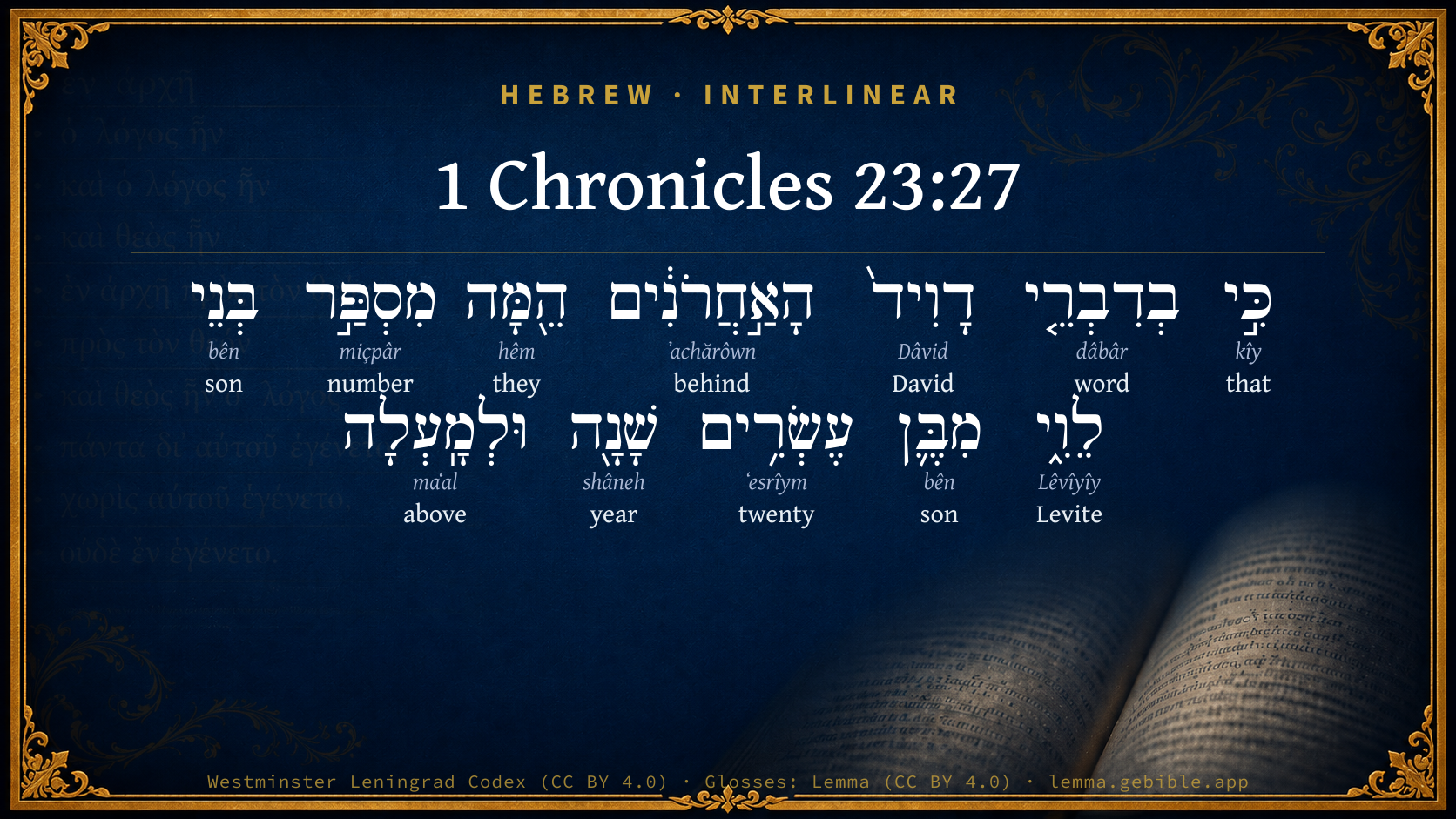
  1. כִּ֣י kîy H3588 “that” Conjunction
  2. בְדִבְרֵ֤י dâbâr H1697 “in/at · words of” Preposition + Noun, Common, Masculine, Plural, Construct
  3. דָוִיד֙ Dâvid H1732 “David” Noun, Proper
  4. הֵ֖מָּה hêm H1992 “they” Pronoun, Personal, 3rd Person, Masculine, Plural
  5. מִסְפַּ֣ר miçpâr H4557 “number of” Noun, Common, Masculine, Singular, Construct
  6. בְּנֵי bên H1121 “sons of” Noun, Common, Masculine, Plural, Construct
  7. לֵוִ֑י Lêvîyîy H3881 “Levite” Noun, Proper
  8. מִבֶּ֛ן bên H1121 “from · son of” Preposition + Noun, Common, Masculine, Singular, Construct
  9. עֶשְׂרִ֥ים ʻesrîym H6242 “twenty” Adjective, Cardinal number, Both, Plural, Absolute
  10. שָׁנָ֖ה shâneh H8141 “year” Noun, Common, Feminine, Singular, Absolute
  11. וּלְמָֽעְלָה maʻal H4605 “and · to/for · above · toward” Conjunction + Preposition + Adverb + Suffix, Demonstrative

About this verse

These counts appear in no published source. They are computed here, from the morphology-tagged text and Lemma’s own curated glosses. What Lemma adds →

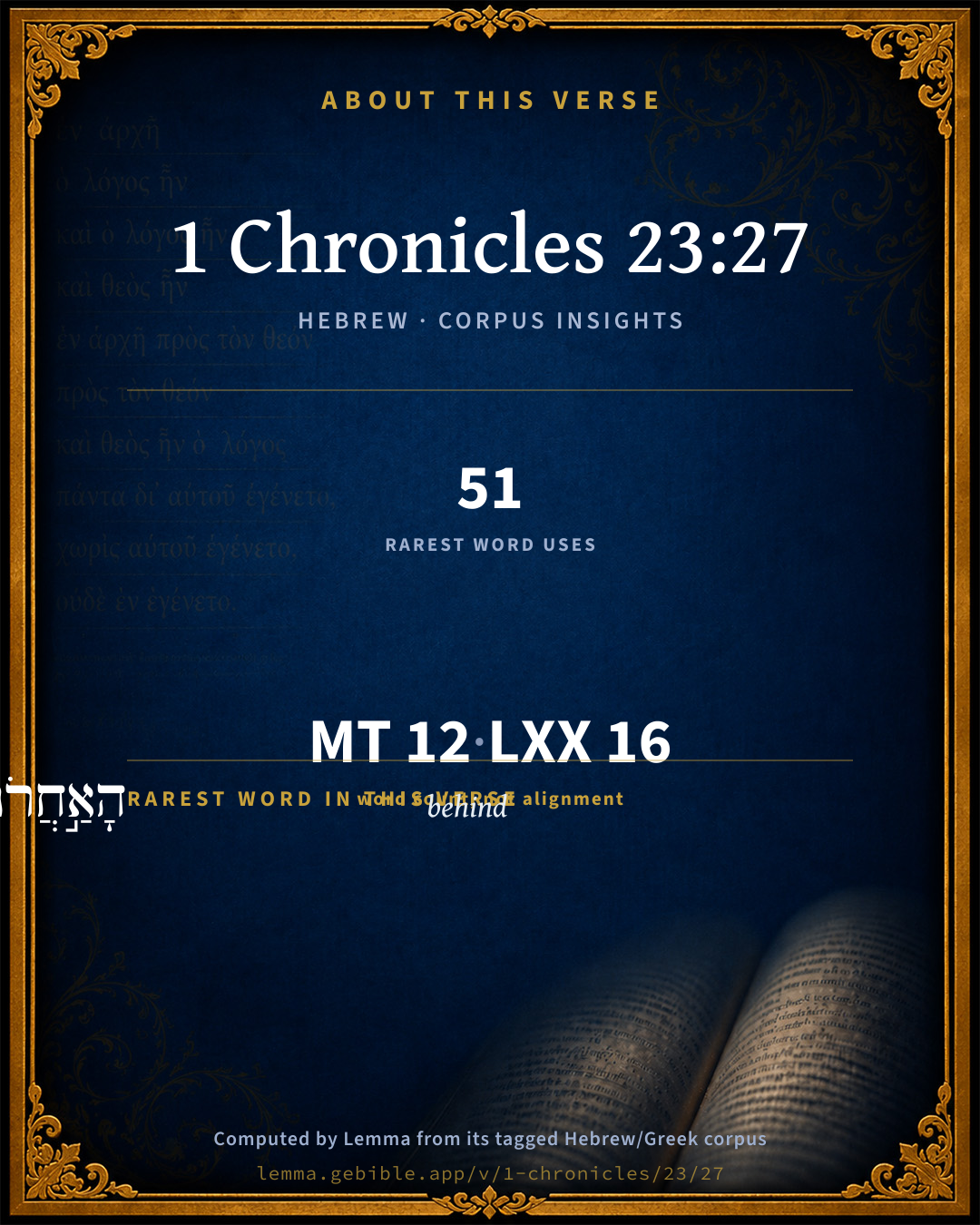
12
words
11
distinct lemmas
Historical
section

Shared distinctive vocabulary

הָאַ֣חֲרֹנִ֔ים behind H314 occurs in 48 verses of the Hebrew Bible. Also found in:

Grammatical profile

  • 7 nouns
  • 2 adjectives
  • 1 pronoun
  • 1 conjunction
  • 1 adverb

Repetition

A word recurs within this verse — often emphatic in Hebrew:

  • בְּנֵי son H1121 ×2

Hebrew & Septuagint length

In English translation the verse runs 19 words from the Hebrew and 20 from the Septuagint (LXX English) — closely comparable.

A rough comparison of the two English renderings, which tokenize alike — not a word-level alignment.

Word counts can differ between the Hebrew and the Greek without any difference in meaning — e.g. the Hebrew direct-object marker אֵת has no separate Greek word, and Greek often adds the article ὁ.

In the original languages it is 12 Hebrew tokens and 16 Greek tokens — but the two are counted differently (Hebrew bundles its prefixes and suffixes into one token; the Greek is in lemma form), so that isn’t a like-for-like length.

Cross-references

4

Topical passages linked to 1 Chronicles 23:27 in the Treasury of Scripture Knowledge — connected by theme and wording, ordered by reader-vote popularity; previews shown in the World English Bible.

  • 1 Chronicles 23:24 These were the sons of Levi after their fathers' houses, even the heads of the fathers' [houses] of those of those who were counted, in the number of names by their polls, who did the work for the service of the house of Yahweh, from twenty years old and upward.
  • 2 Samuel 23:1 Now these are the last words of David. David the son of Jesse says, The man who was raised on high says, The anointed of the God of Jacob, The sweet psalmist of Israel:
  • 1 Chronicles 23:3 The Levites were numbered from thirty years old and upward: and their number by their polls, man by man, was thirty-eight thousand.
  • Psalms 72:20 This ends the prayers by David, the son of Jesse.

Cross-references courtesy of OpenBible.info (CC BY 4.0).

Hebrew and Greek witnesses Masoretic Hebrew ↔ Greek Septuagint

The same verse in the two great witnesses to the Old Testament, shown verse-for-verse.

These are two independent witnesses, not word-aligned to each other, and the Septuagint is shown in lemma (dictionary) form.

Hebrew 1 Chronicles 23:27 Masoretic · Westminster Leningrad Codex

כִּ֣י בְדִבְרֵ֤י דָוִיד֙ הָאַ֣חֲרֹנִ֔ים הֵ֖מָּה מִסְפַּ֣ר בְּנֵי לֵוִ֑י מִבֶּ֛ן עֶשְׂרִ֥ים שָׁנָ֖ה וּלְמָֽעְלָה

For by the last words of David the sons of Levi were numbered, from twenty years old and upward.

World English Bible · Public Domain

Greek LXX 1 Chronicles 23:27 Septuagint · lemma form

ὅτι ἐν ὁ λόγος δαυίδ ὁ ἔσχατος εἰμί ὁ ἀριθμός υἱός λευί ἀπό εἰκοσαετής καί ἐπάνω

For by the last words of David was the number of the Levites taken from twenty years old and upward.

LXX2012 (modern English Septuagint) · Public Domain

Hebrew: Westminster Leningrad Codex (CC BY 4.0). Greek: Septuagint (public domain); English from LXX2012 (modern English Septuagint) (Public Domain). How the Septuagint differs from the Hebrew →

Commentary

Notes on 1 Chronicles 23:27 from classic Christian and Jewish commentators (each source and its license shown beneath its notes). The classic Christian expositions comment on the surrounding passage and are grouped to its opening verse, so a note may address several verses; the Jewish commentaries on the Tanakh (Rashi and others) are per-verse, so they appear only where the commentator wrote on this verse.

Lemma curates 59 commentaries, every one of them public domain or Creative Commons licensed, each selected and text-cleaned for this edition rather than reprinted as found. About our sources →

Joseph Benson's Commentary

1Ch 23:27. By the last words of David — By his last order and constitution, made by God’s direction, and by the Holy Spirit. This is here added to signify, that this great affair was thus settled by David, not in his younger years, when it might have been thought to have been the effect of youthful heat, presumption, and rashness, but when he was come to the greatest maturity, when he was old and near his death, and going to give up his account to his Lord and Maker of all his actions, and particularly of the alterations which he made in the service of God, which he declared was done by the Spirit of God. These were, in a manner, his dying words, which usually make the deepest impression.

Joseph Benson's Commentary on the Old and New Testaments (1811–1818) — public domain. Text from a community e-Sword module.

Ellicott's Commentary for English Readers

(27) For by the last words of David.—That is, owing to his last commands. So Vulg. (juxta praecepta David novissima) and Syriac.

The Levites were numbered.—Literally, these (are), i.e., according to the later idiom, this (is) the enumeration of the sons of Levi, from twenty years old and upward. The verse seems to mean that David towards the end of his reign instituted a census of Levites from twenty instead of thirty years old. Thus, the Authorised Version gives the sense. Others render, For in the Last words (i.e., records) of David is the number of the sons of Levi from twenty, &c., as if the chronicler were referring to some historical work in which this special census was recorded. (Comp. 1Ch_29:29. ) The verse is a parenthetic remark of the chronicler, interrupting the speech of David, which, however, is resumed in 1Ch_23:28, and continued to the end of the chapter.

A Bible Commentary for English Readers, edited by Charles John Ellicott (1878–1897) — public domain. Text from a community e-Sword module.

The Cambridge Bible for Schools and Colleges

gen. ed. J. J. S. Perowne

27. by the last words of David, the Levites were numbered, from twenty etc.] Render, in the Last Acts of Davit is contained the number of the sons of Levi from twenty years old and upward.

The Cambridge Bible for Schools and Colleges (gen. ed. J. J. S. Perowne; Cambridge University Press, 1878–1918) — public domain. Text from a community e-Sword module.

John Gill's Exposition

Both for the shewbread,.... Also to make and get that ready every week for the priests to set on the shewbread table, when they took off the other that had stood a week, see Ch1 9:32.

and for the fine flour for meat offering, and for the unleavened cakes, and for that which is baked in the pan, and for that which is fried; to deliver out the flour of which these several things were made, see Ch1 9:31, and Lev 2:1,

and for all manner of measures and size; as the hin and the ephah, and the several parts of them for things both liquid and dry, which were in their keeping, and according to which they gave out the proper quantity of oil, and wine, and fine flour, upon occasion.

John Gill's Exposition of the Whole Bible (1746–1763) — public domain (CC PDM 1.0). Text via the HelloAO Bible API.

Albert Barnes' Notes on the Bible

By the “last words of David” some understand an historical work on the latter part of his reign, drawn up probably by Gad or Nathan (compare 1Ch 27:24; 1Ch 29:29). Others suppose that he left behind him a work containing directions for the service of the sanctuary.

Albert Barnes' Notes on the Bible (1834–1885) — public domain. Text from a community e-Sword/MySword module.

Matthew Poole's English Annotations

By the last words of David; by his last order and constitution, made by God’s direction and by the Spirit, as hath been once and again noted and proved before. This is here added, to signify that this great affair was thus settled by David, not in his younger years, when it might have been thought to be the effect of youthful heat, and confidence, and presumption, and rashness; but when he was come to the greatest maturity, when he was old and near his death, and going to give up his account to his Lord and Maker of all his actions, and particularly of the alterations which he made in the service of God; which he declared was done by the Spirit of God. These were in a manner his dying words, which usually make the deepest impressions.

Matthew Poole's English Annotations on the Holy Bible (1683–1685) — public domain. Text from a community e-Sword/MySword module.

The Pulpit Commentary

The words of David. Although there are many instances of the expression, "the words of" David or some other king, as equivalent to his "doings" (1Ch_29:29; 2Ch_9:29) and not a few instances of the same phrase, standing for the "account" or "history" of any 1Ch_27:24 1Ch_29:29, three times; (2Ch_9:29) the expression here may rather parallel passages like 2Sa_23:1; 2Ch_29:30.

The Pulpit Commentary (1880–1919), ed. H.D.M. Spence-Jones & Joseph S. Exell — public domain. Text from a community e-Sword module.

Keil & Delitzsch

C. F. Keil & F. Delitzsch

Both for the shewbread,.... Also to make and get that ready every week for the priests to set on the shewbread table, when they took off the other that had stood a week, see Ch1 9:32.

and for the fine flour for meat offering, and for the unleavened cakes, and for that which is baked in the pan, and for that which is fried; to deliver out the flour of which these several things were made, see Ch1 9:31, and Lev 2:1,

and for all manner of measures and size; as the hin and the ephah, and the several parts of them for things both liquid and dry, which were in their keeping, and according to which they gave out the proper quantity of oil, and wine, and fine flour, upon occasion.

Keil & Delitzsch — Biblical Commentary on the Old Testament (1861–1891) — public domain (CC PDM 1.0). Text via the HelloAO Bible API. (Old Testament only.)

unfoldingWord translationNotes

Door43 World Missions Community

For by David's last words the Levites were counted

This can be stated in active form. AT: "For David's last command was for his men to count the Levites" (See: Active or Passive)

from twenty years old and upward

"who were 20 years old and older." See how you translated this phrase in 1 Chronicles 23:24. (See: Numbers)

bread of the presence

See the Translation Word page about "bread" for the specific definition of "bread of the presence." See how you translated this in 1 Chronicles 9:32.

flour

grain that is ground into a powder

translationWords

David

Aaron

court

pure

grain offering

unleavened bread

sacrifice

oil

unfoldingWord translationNotes — © Distant Shores Media and the Door43 World Missions Community, licensed CC BY-SA 4.0. Source: git.door43.org/Door43/en_tn.

Rashi

Rabbi Shlomo Yitzchaki (Rashi)

the sons of the Levites were numbered from twenty years old and upwards Then David established these watches, so that when Solomon his son would come, they would be prepared for him.

Rashi on the Tanakh — English translations: “The Judaica Press complete Tanach with Rashi, translated by A. J. Rosenberg” (CC BY 4.0); “Pentateuch with Rashi's commentary by M. Rosenbaum and A.M. Silbermann, 1929-1934” (public domain); “The Metsudah Tanach series, Lakewood, N.J” (CC BY 4.0); and “The Book of Joshua, Metsudah Publications, 1997” (CC BY 4.0). Text via Sefaria.

Lesson kit

Teaching starters — assembled from the data on this page, not authored interpretation. Every prompt links to the verse data it draws on. Edit before teaching.

1 Chronicles, in the Historical, opens this verse with 12 words (11 distinct Hebrew lemmas). Its most distinctive word is ʼachărôwn (“behind”). A historical commentator’s framing appears above. Read the whole chapter for the surrounding context.

Discussion questions

  1. How does “behind” (ʼachărôwn) shape what this verse is saying?
  2. How does Genesis 33:2, which shares the word «behind», read alongside this verse?
  3. What does the repetition of “son” (2× in this one verse) do in this verse?
  4. The translations on this page render this verse differently — a whole-verse word diff, not a word-by-word alignment. What might account for the different wordings?
  5. Compare how Joseph Benson's Commentary and Ellicott's Commentary for English Readers read this verse. Where do they agree or differ?

Things to notice

Reading settings

Reading text

Shown beneath each verse's original-language words.

Old Testament
Old Testament edition

Read the OT as the Masoretic Hebrew (MT) or the Greek Septuagint (LXX).

English shown for the Greek Septuagint (in the Hebrew ↔ Greek comparison).

Comparing translations? Open the Compare panel on any verse page to stack up to four side by side.