1 Kings 2:44

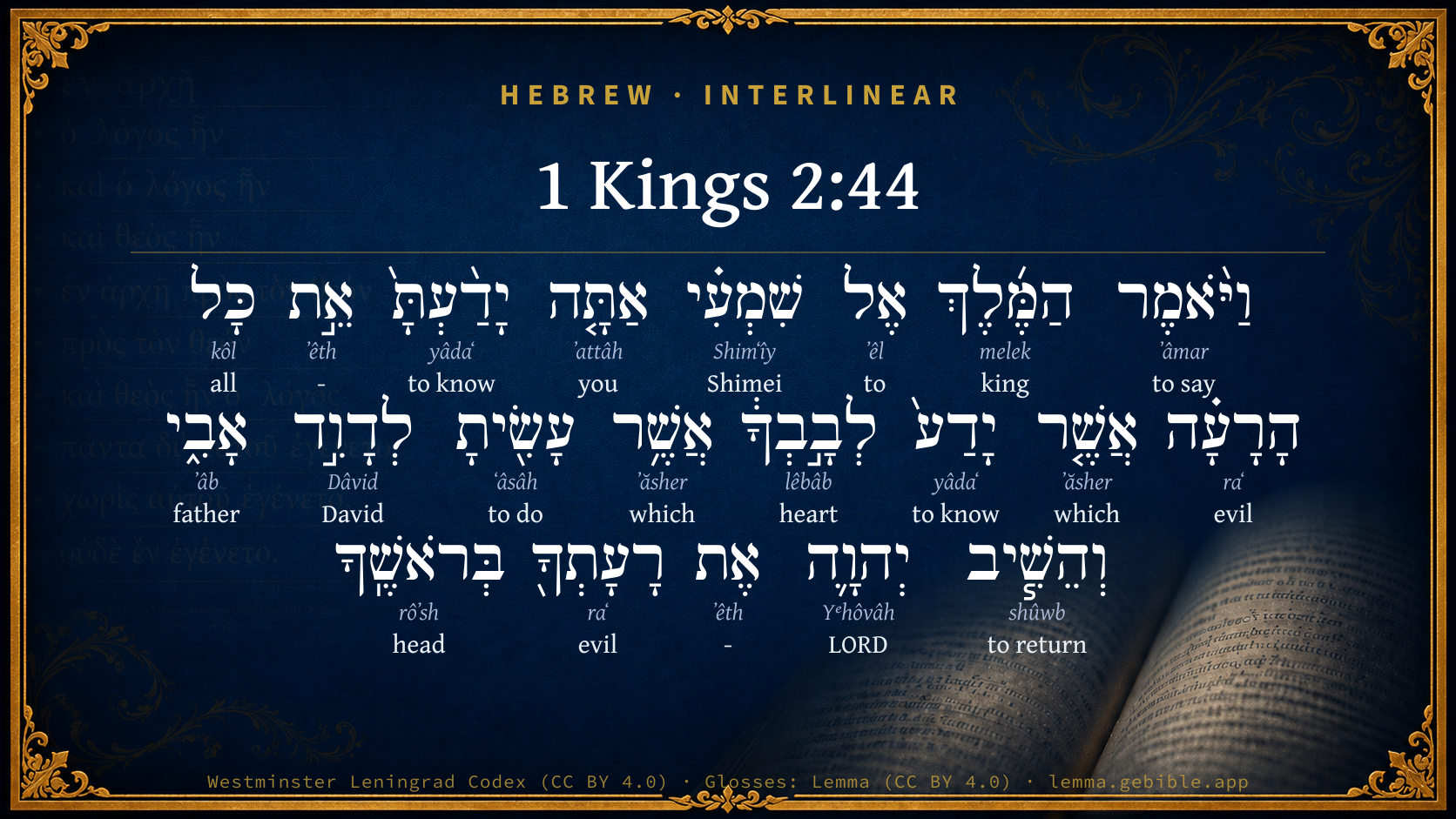
Hebrew (Westminster Leningrad Codex) 1 Kings 2:44 appears in the Hebrew Old Testament. The text above is from the Westminster Leningrad Codex. Each word links to its Strong’s number, a concise gloss, and parsing drawn from the Open Scriptures Hebrew Bible morphology. Click any word for its full Brown-Driver-Briggs (BDB) entry.
Download image
Cite this verse

1 Kings 2:44 (World English Bible). Public Domain. Lemma interlinear Bible study tool, https://lemma.gebible.app/v/1-kings/2/44.

Show BibTeX & RIS
BibTeX
RIS
English Translation
The king said moreover to Shimei, You know all the wickedness which your heart is privy to, that you did to David my father: therefore Yahweh shall return your wickedness on your own head.
World English Bible · Public Domain
Download a study sheet

One document with this verse’s original text, its word-by-word gloss line, the meaning frame, cross-references with their text, attributed commentary, and full source and license credits — printable, and it pastes into notes with its structure intact.

This verse Autodidact and up

Study sheet (.html) Plain text (.txt)

A passage Seminary Student

Up to 50 verses in one chapter. A passage sheet keeps up to 6 commentary sources and 12 cross-references per verse, in the order this page ranks them, and says so on the sheet whenever that leaves anything out. Ask for a single verse and you get the Autodidact verse sheet above.

Everything on this page stays free to read, with no account — the sheet is a download of what is already on screen, not access to it.

Want to remove ads? Support Godless Engineer
Compare translations 3

The same verse in 3 English versions, stacked beneath the original-language interlinear above. Click any original word for its lexicon entry.

Each is an independent rendering of the whole verse — the interlinear is not word-aligned to these translations.

Highlighted words mark where these versions differ — a whole-verse word diff, not a word-by-word alignment.

  • World English Bible Public Domain
    The king said moreover to Shimei, You know all the wickedness which your heart is privy to, that you did to David my father: therefore Yahweh shall return your wickedness on your own head.
  • King James Version Public Domain
    The king said moreover to Shimei, Thou knowest all the wickedness which thine heart is privy to, that thou didst to David my father: therefore the LORD shall return thy wickedness upon thine own head;
  • unfoldingWord Literal Text CC BY-SA 4.0
    And the king said to Shimei, “You, you know all of the evil that your heart knows, which you did to David my father. And Yahweh will return your evil on your head.

unfoldingWord Literal Text — © unfoldingWord, licensed CC BY-SA 4.0. Word-aligned USFM3 via Door43 (git.door43.org/unfoldingWord/en_ult).

Versions to compare (up to 4)

3 of 4 selected

Show all 18 translations

Every available English version of this verse, each an independent rendering of the whole verse.

  • World English Bible Public Domain
    The king said moreover to Shimei, You know all the wickedness which your heart is privy to, that you did to David my father: therefore Yahweh shall return your wickedness on your own head.
  • Berean Standard Bible Public Domain
    The king also said, “You know in your heart all the evil that you did to my father David. Therefore the LORD will bring your evil back upon your head.
  • Majority Standard Bible Public Domain
    The king also said, “You know in your heart all the evil that you did to my father David. Therefore the LORD will bring your evil back upon your head.
  • King James Version Public Domain
    The king said moreover to Shimei, Thou knowest all the wickedness which thine heart is privy to, that thou didst to David my father: therefore the LORD shall return thy wickedness upon thine own head;
  • American Standard Version (1901) Public Domain
    The king said moreover to Shimei, Thou knowest all the wickedness which thy heart is privy to, that thou didst to David my father: therefore Jehovah shall return thy wickedness upon thine own head.
  • Revised Version (1885) Public Domain
    The king said moreover to Shimei, Thou knowest all the wickedness which thine heart is privy to, that thou didst to David my father: therefore the LORD shall return thy wickedness upon thine own head.
  • Geneva Bible (1599) Public Domain
    The King sayde also to Shimei, Thou knowest all the wickednes whereunto thine heart is priuie, that thou diddest to Dauid my father: the Lord therefore shall bring thy wickednesse vpon thine owne head.
  • Douay-Rheims (1899) Public Domain
    And the king said to Semei: Thou knowest all the evil, of which thy heart is conscious, which thou didst to David my father: the Lord hath returned thy wickedness upon thy own head:
  • Young's Literal Translation Public Domain
    And the king saith unto Shimei, `Thou hast known all the evil that thy heart hath known, which thou didest to David my father, and Jehovah hath turned back thine evil on thy head,
  • Literal Standard Version CC BY-SA 4.0
    And the king says to Shimei, “You have known all the evil that your heart has known, which you did to my father David, and YHWH has turned back your evil on your head,
  • Unlocked Literal Bible CC BY-SA 4.0
    The king also said to Shimei, “You know in your heart all the wickedness that you did to my father David. Therefore Yahweh will return your wickedness on your own head.
  • unfoldingWord Literal Text CC BY-SA 4.0
    And the king said to Shimei, “You, you know all of the evil that your heart knows, which you did to David my father. And Yahweh will return your evil on your head.
  • Darby Bible Public Domain
    And the king said to Shimei, Thou knowest all the wickedness of which thy heart is conscious, which thou didst to David my father; and Jehovah returns thy wickedness upon thine own head;
  • World Messianic Bible Public Domain
    The king said moreover to Shimei, “You know in your heart all the wickedness that you did to David my father. Therefore the LORD will return your wickedness on your own head.
  • Webster's Bible Public Domain
    The king said moreover to Shimei, Thou knowest all the wickedness which thy heart is privy to, that thou didst to David my father: therefore the LORD will return thy wickedness upon thy own head;
  • Free Bible Version CC BY-SA 4.0
    The king also told Shimei, “Deep down you know all the evil things you did to my father David. That's why the Lord will repay you for your evil.
  • Bible in Basic English Public Domain
    And the king said to Shimei, You have knowledge of all the evil which you did to David my father; and now the Lord has sent back your evil on yourself.
  • JPS Tanakh (1917) Public Domain
    The king said moreover to Shimei: 'Thou knowest all the wickedness which thy heart is privy to, that thou didst to David my father; therefore the LORD shall return thy wickedness upon thine own head.

Literal Standard Version (2020), Covenant Press — licensed CC BY-SA 4.0. Text via the HelloAO Bible API (eBible.org). Unlocked Literal Bible (unfoldingWord) — licensed CC BY-SA 4.0. Text via the HelloAO Bible API (eBible.org). unfoldingWord Literal Text — © unfoldingWord, licensed CC BY-SA 4.0. Word-aligned USFM3 via Door43 (git.door43.org/unfoldingWord/en_ult). Free Bible Version, Dr. Jonathan Gallagher — licensed CC BY-SA 4.0. Text via the HelloAO Bible API (eBible.org).

Word by word

More ways to search: Search by grammar → Find every occurrence → Compare this word →

Practice this passage: Drill this verse → Learn its vocabulary →

שִׁמְעִ֗י
Shimʻîy
H8096
“Shimei”
Noun, Proper
Part of Speech
Noun
Type
Proper
Full BDB Definition

Origin: from H8088

TWOT: None

Shimei or Shimhi or Shimi or Shimea = "renowned" - a Benjamite, son of Gera of the house of Saul in the time of David - a Benjamite, son of Elah and commissariat officer in the time of Solomon - the Ramathite in charge of the vineyards of David - son of Gershon and grandson of Levi - a Levite, son of Jeduthun and chief of the 10th division of singers in the time of David - a Levite of the sons of Heman who took part in the purification of the temple in the time of king Hezekiah of Judah - a Levite, brother of Cononiah in charge of receiving the tithes and offerings in the reign of king Hezekiah of Judah - a Levite who had a foreign wife in the time of Ezra - a Judaite, son of Pedaiah and brother of Zerubbabel - a Simeonite, son of Zacchur - a Reubenite, son of Gog and father of Micah - one of the sons of Hashum who had a foreign wife in the time of Ezra - one of the sons of Bani who had a foreign wife in the time of Ezra - a Benjamite, son of Kish, father of Jair, and grandfather of Mordecai in the time of Esther - a Levite, son of Jahath, grandson of Gershon, and great grandson of Levi - Benjamite, father of Adaiah, Beraiah, and Shimrath. Spelled 'Shimhi'

  1. וַיֹּ֨אמֶר ʼâmar H559 “and · to say” Conjunction + Verb, Qal, Sequential Imperfect, 3rd Person, Masculine, Singular
  2. הַמֶּ֜לֶךְ melek H4428 “the · king” Particle, Definite Article + Noun, Common, Masculine, Singular, Absolute
  3. אֶל ʼêl H413 “to” Preposition
  4. אַתָּ֤ה ʼattâh H859 “you” Pronoun, Personal, 2nd Person, Masculine, Singular
  5. יָדַ֨עְתָּ֙ yâdaʻ H3045 “to know” Verb, Qal, Perfect, 2nd Person, Masculine, Singular
  6. אֵ֣ת ʼêth H853 “-” Particle, Direct Object
  7. כָּל kôl H3605 “all of” Noun, Common, Masculine, Singular, Construct
  8. הָרָעָ֗ה raʻ H7451 “the · evil” Particle, Definite Article + Noun, Common, Feminine, Singular, Absolute
  9. אֲשֶׁ֤ר ʼăsher H834 “which” Particle, Relative
  10. יָדַע֙ yâdaʻ H3045 “to know” Verb, Qal, Perfect, 3rd Person, Masculine, Singular
  11. לְבָ֣בְךָ֔ lêbâb H3824 “heart · your” Noun, Common, Masculine, Singular, Construct + Suffix, Personal, 2nd Person, Masculine, Singular
  12. אֲשֶׁ֥ר ʼăsher H834 “which” Particle, Relative
  13. עָשִׂ֖יתָ ʻâsâh H6213 “to do” Verb, Qal, Perfect, 2nd Person, Masculine, Singular
  14. לְדָוִ֣ד Dâvid H1732 “to/for · David” Preposition + Noun, Proper
  15. אָבִ֑י ʼâb H1 “father · my” Noun, Common, Masculine, Singular, Construct + Suffix, Personal, 1st Person, Common, Singular
  16. וְהֵשִׁ֧יב shûwb H7725 “and · to return” Conjunction + Verb, Hiphil, Sequential Perfect, 3rd Person, Masculine, Singular
  17. יְהוָ֛ה Yᵉhôvâh H3068 “LORD” Noun, Proper
  18. אֶת ʼêth H853 “-” Particle, Direct Object
  19. רָעָתְךָ֖ raʻ H7451 “evil · your” Noun, Common, Feminine, Singular, Construct + Suffix, Personal, 2nd Person, Masculine, Singular
  20. בְּרֹאשֶֽׁךָ rôʼsh H7218 “in/at · head · your” Preposition + Noun, Common, Masculine, Singular, Construct + Suffix, Personal, 2nd Person, Masculine, Singular

About this verse

These counts appear in no published source. They are computed here, from the morphology-tagged text and Lemma’s own curated glosses. What Lemma adds →

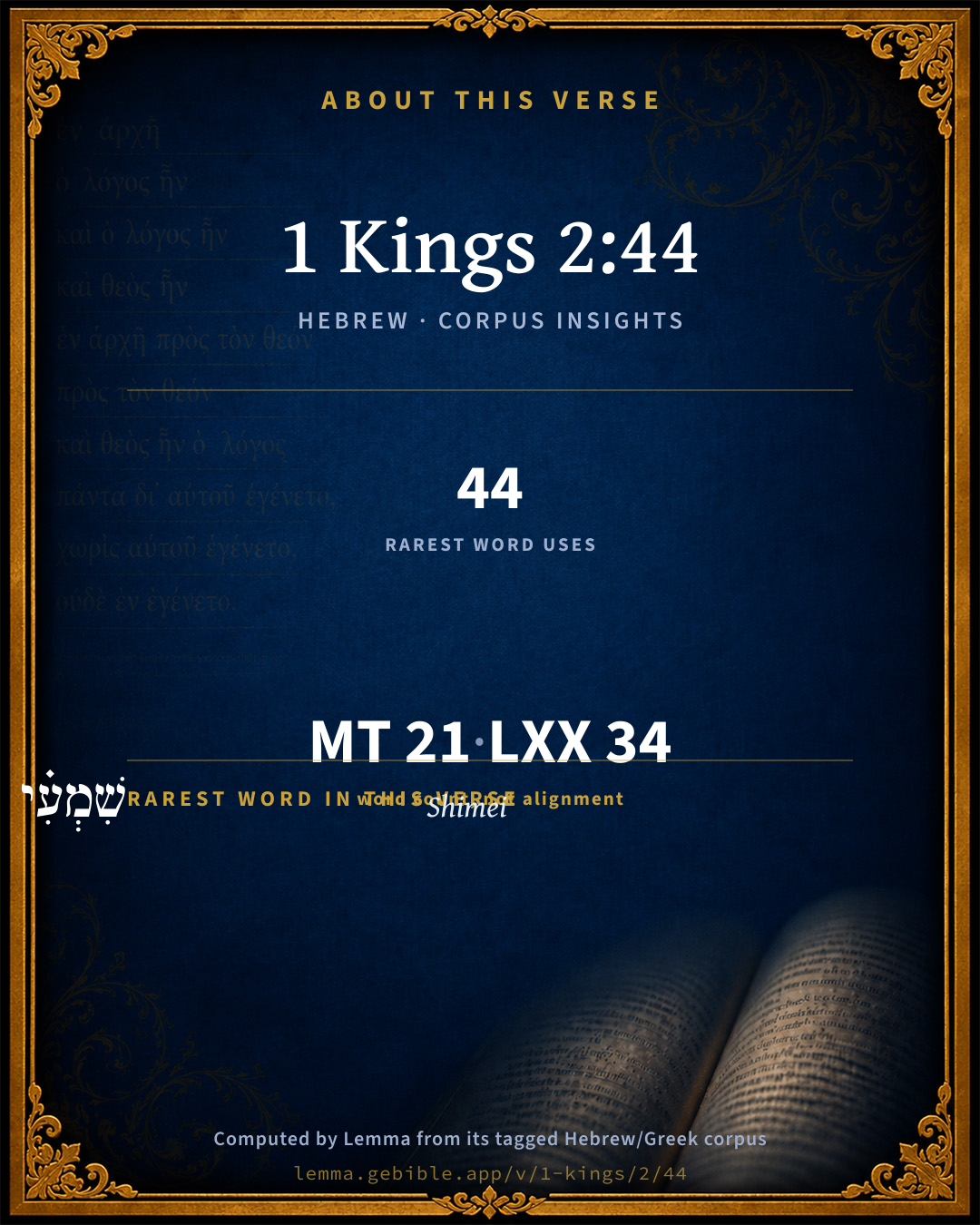
21
words
17
distinct lemmas
Historical
section

Shared distinctive vocabulary

שִׁמְעִ֗י Shimei H8096 occurs in 40 verses of the Hebrew Bible. Also found in:

Grammatical profile

  • 5 verbs
  • 10 nouns
  • 1 pronoun
  • 1 preposition
  • 4 particles

Verb forms

  • וַיֹּ֨אמֶר Qal · Sequential Imperfect
  • יָדַ֨עְתָּ֙ Qal · Perfect
  • יָדַע֙ Qal · Perfect
  • עָשִׂ֖יתָ Qal · Perfect
  • וְהֵשִׁ֧יב Hiphil · Sequential Perfect

Repetition

Words recur within this verse — often emphatic in Hebrew:

  • יָדַ֨עְתָּ֙ to know H3045 ×2
  • הָרָעָ֗ה evil H7451 ×2
  • אֲשֶׁ֤ר which H834 ×2

Hebrew & Septuagint length

In the original languages it is 21 Hebrew tokens and 34 Greek tokens — but the two are counted differently (Hebrew bundles its prefixes and suffixes into one token; the Greek is in lemma form), so that isn’t a like-for-like length.

Cross-references

10

Topical passages linked to 1 Kings 2:44 in the Treasury of Scripture Knowledge — connected by theme and wording, ordered by reader-vote popularity; previews shown in the World English Bible.

  • 2 Samuel 16:5–13 When king David came to Bahurim, behold, a man of the family of the house of Saul came out, whose name was Shimei, the son of Gera. He came out, and cursed still as he came.
  • 1 Samuel 25:39 When David heard that Nabal was dead, he said, Blessed be Yahweh, who has pleaded the cause of my reproach from the hand of Nabal, and has kept back his servant from evil: and the evil-doing of Nabal has Yahweh returned on his own head. David sent and spoke concerning Abigail, to take her to him as wife.
  • Psalms 7:16 The trouble he causes shall return to his own head. His violence shall come down on the crown of his own head.
  • Ezekiel 17:19 Therefore thus says the Lord Yahweh: As I live, surely my oath that he has despised, and my covenant that he has broken, I will even bring it on his own head.
  • 1 Kings 2:32–33 Yahweh will return his blood on his own head, because he fell on two men more righteous and better than he, and killed them with the sword, and my father David didn't know it, [to wit], Abner the son of Ner, captain of the host of Israel, and Amasa the son of Jether, captain of the host of Judah.
  • Proverbs 5:22 The evil deeds of the wicked ensnare him. The cords of his sin hold him firmly.
  • Hosea 4:9 It will be, like people, like priest; And I will punish them for their ways, And will repay them for their deeds.
  • John 8:9 They, when they heard it, being convicted by their conscience, went out one by one, beginning from the oldest, even to the last. Jesus was left alone with the woman where she was, in the middle.
  • Romans 2:15 in that they show the work of the law written in their hearts, their conscience testifying with them, and their thoughts among themselves accusing or else excusing them)
  • 1 John 3:20 because if our heart condemns us, God is greater than our heart, and knows all things.

Cross-references courtesy of OpenBible.info (CC BY 4.0).

Hebrew and Greek witnesses Masoretic Hebrew ↔ Greek Septuagint

The same verse in the two great witnesses to the Old Testament, shown verse-for-verse.

These are two independent witnesses, not word-aligned to each other, and the Septuagint is shown in lemma (dictionary) form.

Hebrew 1 Kings 2:44 Masoretic · Westminster Leningrad Codex

וַיֹּ֨אמֶר הַמֶּ֜לֶךְ אֶל שִׁמְעִ֗י אַתָּ֤ה יָדַ֨עְתָּ֙ אֵ֣ת כָּל הָרָעָ֗ה אֲשֶׁ֤ר יָדַע֙ לְבָ֣בְךָ֔ אֲשֶׁ֥ר עָשִׂ֖יתָ לְדָוִ֣ד אָבִ֑י וְהֵשִׁ֧יב יְהוָ֛ה אֶת רָעָתְךָ֖ בְּרֹאשֶֽׁךָ

The king said moreover to Shimei, You know all the wickedness which your heart is privy to, that you did to David my father: therefore Yahweh shall return your wickedness on your own head.

World English Bible · Public Domain

Greek LXX 1 Kings 2:44 Septuagint · lemma form

καί εἶπον ὁ βασιλεύς πρός σεμεϊ σύ οἶδα πᾶς ὁ κακία σύ ὅς γιγνώσκω ὁ καρδία σύ ὅς ποιέω ὁ δαυίδ ὁ πατήρ ἐγώ καί ἀντι ἀποδίδωμι κύριος ὁ κακία σύ εἰς κεφαλή σύ

No English rendering of this Greek verse — the small residue in the structurally divergent books.

On this verse, The Pulpit Commentary discusses the Septuagint’s reading. Read the note in Commentary ↓

Hebrew: Westminster Leningrad Codex (CC BY 4.0). Greek: Septuagint (public domain); English from a public-domain English Septuagint. How the Septuagint differs from the Hebrew →

Targum (Aramaic paraphrase)

1

The Targum is the ancient Jewish Aramaic paraphrase of the Hebrew Scriptures — an interpretive translation, not the Hebrew text itself. Onkelos (literal) and Pseudo-Jonathan (expansive) render the Torah, and Jonathan the Prophets. Coverage is partial: where no permissively-licensed English translation exists for a verse, only the Aramaic is shown. This is verse-level text, not a word-by-word alignment to the Hebrew.

  1. Targum Jonathan Prophets (Joshua–Malachi)
    וַאֲמַר מַלְכָּא לְשִׁמְעִי אַתְּ יְדַעְתְּ יַת כָּל בִּישְׁתָּא דִי יְדַע לְבָּךְ דַעֲבַדְתָּ לְדָוִד אַבָּא וְיָתֵיב יְיָ יַת בִּישְׁתָּךְ בְּרֵישָׁךְ:

    (no public-domain English translation for this verse)

    Targum Jonathan — Aramaic: “Mikraot Gedolot” (public domain). English: “Sefaria Community Translation” (CC0 1.0 (public-domain dedication)); “London "Chaldee Paraphrase," 1871” (public domain). Text via Sefaria.

Commentary

Notes on 1 Kings 2:44 from classic Christian and Jewish commentators (each source and its license shown beneath its notes). The classic Christian expositions comment on the surrounding passage and are grouped to its opening verse, so a note may address several verses; the Jewish commentaries on the Tanakh (Rashi and others) are per-verse, so they appear only where the commentator wrote on this verse.

Lemma curates 59 commentaries, every one of them public domain or Creative Commons licensed, each selected and text-cleaned for this edition rather than reprinted as found. About our sources →

Trapp's Complete Commentary

John Trapp

1Ki 2:44 The king said moreover to Shimei, Thou knowest all the wickedness which thine heart is privy to, that thou didst to David my father: therefore the LORD shall return thy wickedness upon thine own head;

Ver. 44. Thou knowest all the wickedness.] To know other things is science: but to know ourselves is conscience. This is the reflection of the soul upon itself. "Our transgressions are with us, and as for our iniquities, we know them." Quid tibi prodest non habere conscium, habenti couscientiam?

John Trapp, A Commentary or Exposition upon All the Books of the Old and New Testament (1647–1656) — public domain. Text from a community e-Sword module.

Geneva Bible (1599)

Geneva Bible translators

For though thou wouldest deny, yet thine own conscience would accuse thee for reviling and doing wrong to my father, 2 Sam 16:5.

Geneva Bible (1599) marginal notes — public domain. Text via Bolls.life.

The Cambridge Bible for Schools and Colleges

gen. ed. J. J. S. Perowne

44. Thou knowest] The Hebrew inserts the pronoun emphatically. It was needless for Solomon to recall the wrong with which Shimei’s own conscience would upbraid him.

the Lord shall return] The Hebrew says ‘the Lord hath returned.’ The punishment is so sure that the king speaks of it as already inflicted. He is but the Lord’s agent, and the doom of Shimei is counted as executed. This appears the best way of understanding the grammar, as there is no preceding verb from which this should derive the signification of an imperfect.

The Cambridge Bible for Schools and Colleges (gen. ed. J. J. S. Perowne; Cambridge University Press, 1878–1918) — public domain. Text from a community e-Sword module.

John Gill's Exposition

And King Solomon shall be blessed,.... With a long and peaceable reign, and large dominions, notwithstanding all the attempts to make him unhappy:

and the throne of David shall be established before the Lord for ever; the kingdom of David over Judah for a long time, in his natural line; and the kingdom of Israel, spiritual Israel, for ever in his son the Messiah; and that in the presence of the Lord, he observing, ordering, and succeeding all things to that purpose.

John Gill's Exposition of the Whole Bible (1746–1763) — public domain (CC PDM 1.0). Text via the HelloAO Bible API.

Matthew Poole's English Annotations

Thou knowest all the wickedness which thine heart is privy to; for which thy own conscience accuseth thee, and there is no need of other witnesses.

Shall return, Heb. hath returned, which seems most proper. God hath punished thee for thy former wickedness, by suffering thee to fall into further crimes, and expose thyself to thy deserved death.

Matthew Poole's English Annotations on the Holy Bible (1683–1685) — public domain. Text from a community e-Sword/MySword module.

Whedon's Commentary on the Bible

Daniel D. Whedon

44. The king said moreover to Shimei — It is to be noticed respecting all these four enemies of the king that their last offence was but the immediate occasion, not the sole cause, of their sudden ruin. It was previous guilt, contracted by former crimes or disloyalty, that now returned upon them, and by further aggravation made them ripe for destruction.

Daniel D. Whedon (gen. ed.), Commentary on the Old and New Testaments (1874–1909) — public domain. Text from a community e-Sword module.

The Pulpit Commentary

The king said, moreover Heb. And the king said Thou knowest all the wickedness which thine heart is privy to Heb. knoweth that thou didst to David my father Solomon brings a threefold charge against Shimei. He has violated a solemn oath, "by the life of Jehovah," and so has "profaned the name of his God". (Lev_19:12) He has broken his parole and set at naught the king"s commandment. He has defied and blasphemed the Lord"s anointed. He must die therefore the Lord shall return "hath returned," or "returns." LXX ajntapedwke, aor. The king regards himself as merely the instrument and dispenser of the Divine Justice. According to him, it is God, not spite, demands and has brought about Shimei"s execution thy wickedness upon thine own head Every Jew, taught to expect that "every transgression and disobedience" would receive its "just recompense of reward" in this life present would see in Shimei"s almost unaccountable infatuation the finger of God. To them he would seem delivered up to destruction.

HOMILETICS.

Vers. 44-46.

The End of the Transgressor.

Such was the end of Shimei violent, sanguinary, shameful. Old man as he is, he may not die in peace: his hoar hairs must be crimsoned with his blood. What does this teach? what its message to Christian men? It is twofold. It speaks

(1) OF THE SIN,

(2) OF THE RETRIBUTION.

I It teaches

(1) The sin of treason. He had offered insult and defiance to his lawful king. Rebellion against constituted authority can only be justified by intolerable tyranny and outrage. He who

dares to wield The regicidal steel

must answer to Him by whom kings govern. We are to "honour the king," to "be subject to the higher powers." "They that resist shall receive to themselves damnation," as did this rebel Benjamite.

2. The sin of blasphemy. "A grievous curse." Aimed at the king, it reached the King of kings. It was not only destructive of authority; not only an affront offered to the majesty of law; it was an indirect blow at the Majesty of Heaven. Men cannot "speak evil of dignities" without sin. Those who "curse God" will "die". (Job_2:9) How little do men make ofblasphemy! But Shimei had to pay for it with his life.

3. The sin of perjury. It was this in the strict sense of the word. He broke through his oath. Though he said, "the Lord liveth," he swore falsely. He thus profaned the awful incommunicable name, and incurred the Divine. (Zec_5:4) Perjuries are plentiful in our days, our police courts being witness. (Some kiss the thumb, and not the book.) "The Lord will not hold him guiltless," etc.

4. The sin of disobedience. The king had adjured him, had "protested," had said "know for certain," etc.; and even if the Kidron were mentioned arbitrarily, still it served to test his obedience. The prohibition, therefore, could not have been plainer. He disregarded it, and died. "Fool," does any one say? Stay! The great King has said, "The soul that sinneth, it shall die." He has solemnly testified what will be the doom of disobedience, and yet how often have we crossed our Kidron the bound of His law have gone after our own lusts and pleasures, and it is only because He is God and not man, only because

the heart of the Eternal Is most wonderfully kind,

that we have not died.

5. The sin and folly of presumption. Whatever may have led Shimei to go after his slaves, it was certainly presumption brought him back. He would hardly have returned had he not counted on forgiveness. No doubt he had persuaded himself either that Solomon would never know, or that, if he did, he would be magnanimous. "Allowance will be made for me," he had said; "my return will disarm suspicion and ensure clemency." But the sword of Benaiah soon undeceived him. And such will be the end death, shame, everlasting contempt of those who presume on the mercy of God. How many say, "God is so good, He will never be hard upon us," etc. But is God true? Can He deny Himself? Even Solomon could not go back from his word; and can the Holy One? Alas, if despair has slain its thousands, presumption has slain its ten thousands. It is a significant fact that since the invention of the safety lamp there have been more accidents in mines than there were before.

II As to the RETRIBUTION, we are reminded,

1. That curses commonly come home to roost. The "grievous curse" of Shimei did not hurt David. But it was his own destruction. The poisoned arrow missed its mark, but it recoiled on the archer. The engineer is hoist by his own petard. A curse rests on those who curse the king. (cf. Ecc_10:20)

2. That respite does not mean release. When David "sware" to him, Shimei thought himself safe. Surely the bitterness of death was past. We would die in his nest. We often mistake God"s forbearance for forgetfulness. He is long suffering, and men ask, "Where is the promise of His coming?" Because "He does not settle His accounts once a week" (Goethe) the heart of the sons of men is fully set in them to do evil. But the day of retribution comes as a thief, as the flood, as the sword, as the snare.

3. That if we die, it is our own fault. Shimei had his life in his own hands. It rested with him. alone whether he lived or died. He should live, if he would but live at Jerusalem. But he chose death. Men cause their own destruction. God has no pleasure in their death. "Thou hast destroyed thyself.

4. That warnings are commonly lost on the wicked. "How could Shimei be so infatuated?" we ask. What, have we not seen his infatuation paralleled? Have we never seen repeated warnings repeatedly neglected? Yes, souls, sins, warnings, results, are the same in all ages.

5. That when God reckons, He reckons for all. The sword avenged the sin of eight years before. And in the Great Assize, everything both cup of cold water and idle word will receive its just recompense of reward.

The Pulpit Commentary (1880–1919), ed. H.D.M. Spence-Jones & Joseph S. Exell — public domain. Text from a community e-Sword module.

John Wesley's Explanatory Notes

Thine heart - For which thine own conscience accuseth thee, and there is no need of other witnesses. The Lord - God hath punished thee for thy former wickedness, by suffering thee to expose thyself to thy deserved death.

John Wesley, Explanatory Notes Upon the Whole Bible (1754–1765) — public domain. Text via the GEBible commentary corpus.

Lesson kit

Teaching starters — assembled from the data on this page, not authored interpretation. Every prompt links to the verse data it draws on. Edit before teaching.

1 Kings, in the Historical, opens this verse with 21 words (17 distinct Hebrew lemmas). Its most distinctive word is Shimʻîy (“Shimei”). A historical commentator’s framing appears above. Read the whole chapter for the surrounding context.

Discussion questions

  1. The word Shimʻîy carries the sense “Shimei.” How does it shape the verse?
  2. How does Exodus 6:17, which shares the word «Shimei», read alongside this verse?
  3. What does the repetition of “to know” (2× in this one verse) do in this verse?
  4. These translations render this verse differently. What is at stake in choosing one wording over another?
  5. «וַיֹּ֨אמֶר» is a Qal Sequential Imperfect verb. How does that grammatical form shape the action described?
  6. Compare how Trapp's Complete Commentary and Geneva Bible (1599) read this verse. Where do they agree or differ?

Things to notice

Reading settings

Reading text

Shown beneath each verse's original-language words.

Old Testament
Old Testament edition

Read the OT as the Masoretic Hebrew (MT) or the Greek Septuagint (LXX).

English shown for the Greek Septuagint (in the Hebrew ↔ Greek comparison).

Comparing translations? Open the Compare panel on any verse page to stack up to four side by side.