
2 Chronicles 7:17

Hebrew (Westminster Leningrad Codex) 2 Chronicles 7:17 appears in the Hebrew Old Testament. The text above is from the Westminster Leningrad Codex. Each word links to its Strong’s number, a concise gloss, and parsing drawn from the Open Scriptures Hebrew Bible morphology. Click any word for its full Brown-Driver-Briggs (BDB) entry.
Download image
Cite this verse

2 Chronicles 7:17 (World English Bible). Public Domain. Lemma interlinear Bible study tool, https://lemma.gebible.app/v/2-chronicles/7/17.

Show BibTeX & RIS
BibTeX
RIS
English Translation
As for you, if you will walk before me as David your father walked, and do according to all that I have commanded you, and will keep my statutes and my ordinances;
World English Bible · Public Domain
Download a study sheet

One document with this verse’s original text, its word-by-word gloss line, the meaning frame, cross-references with their text, attributed commentary, and full source and license credits — printable, and it pastes into notes with its structure intact.

This verse Autodidact and up

Study sheet (.html) Plain text (.txt)

A passage Seminary Student

Up to 50 verses in one chapter. A passage sheet keeps up to 6 commentary sources and 12 cross-references per verse, in the order this page ranks them, and says so on the sheet whenever that leaves anything out. Ask for a single verse and you get the Autodidact verse sheet above.

Everything on this page stays free to read, with no account — the sheet is a download of what is already on screen, not access to it.

Want to remove ads? Support Godless Engineer
Compare translations 3

The same verse in 3 English versions, stacked beneath the original-language interlinear above. Click any original word for its lexicon entry.

Each is an independent rendering of the whole verse — the interlinear is not word-aligned to these translations.

Highlighted words mark where these versions differ — a whole-verse word diff, not a word-by-word alignment.

  • World English Bible Public Domain
    As for you, if you will walk before me as David your father walked, and do according to all that I have commanded you, and will keep my statutes and my ordinances;
  • King James Version Public Domain
    And as for thee, if thou wilt walk before me, as David thy father walked, and do according to all that I have commanded thee, and shalt observe my statutes and my judgments;
  • unfoldingWord Literal Text CC BY-SA 4.0
    And you, if you walk before me just as David your father walked, and do according to all that I have commanded you, and my statutes and my judgments you keep,

unfoldingWord Literal Text — © unfoldingWord, licensed CC BY-SA 4.0. Word-aligned USFM3 via Door43 (git.door43.org/unfoldingWord/en_ult).

Versions to compare (up to 4)

3 of 4 selected

Show all 18 translations

Every available English version of this verse, each an independent rendering of the whole verse.

  • World English Bible Public Domain
    As for you, if you will walk before me as David your father walked, and do according to all that I have commanded you, and will keep my statutes and my ordinances;
  • Berean Standard Bible Public Domain
    And as for you, if you walk before Me as your father David walked, doing all I have commanded you, and if you keep My statutes and ordinances,
  • Majority Standard Bible Public Domain
    And as for you, if you walk before Me as your father David walked, doing all I have commanded you, and if you keep My statutes and ordinances,
  • King James Version Public Domain
    And as for thee, if thou wilt walk before me, as David thy father walked, and do according to all that I have commanded thee, and shalt observe my statutes and my judgments;
  • American Standard Version (1901) Public Domain
    And as for thee, if thou wilt walk before me as David thy father walked, and do according to all that I have commanded thee, and wilt keep my statutes and mine ordinances;
  • Revised Version (1885) Public Domain
    And as for thee, if thou wilt walk before me as David thy father walked, and do according to all that I have commanded thee, and wilt keep my statutes and my judgments;
  • Geneva Bible (1599) Public Domain
    And if thou wilt walke before me, as Dauid thy father walked, to doe according vnto all that I haue commanded thee, and shalt obserue my statutes and my iudgements,
  • Douay-Rheims (1899) Public Domain
    And as for thee, if thou walk before me, as David thy father walked, and do according to all that I have commanded thee, and keep my justices and my judgments:
  • Young's Literal Translation Public Domain
    `And thou, if thou dost walk before Me as David thy father walked, even to do according to all that I have commanded thee, and My statutes and My judgments dost keep --
  • Literal Standard Version CC BY-SA 4.0
    And you, if you walk before Me as your father David walked, even to do according to all that I have commanded you, and keep My statutes and My judgments—
  • Unlocked Literal Bible CC BY-SA 4.0
    As for you, if you walk before me as David your father walked, obeying all that I have commanded you and keeping my statutes and my decrees,
  • unfoldingWord Literal Text CC BY-SA 4.0
    And you, if you walk before me just as David your father walked, and do according to all that I have commanded you, and my statutes and my judgments you keep,
  • Darby Bible Public Domain
    And [as for] thee, if thou wilt walk before me, as David thy father walked, to do according to all that I have commanded thee, and wilt keep my statutes and mine ordinances;
  • World Messianic Bible Public Domain
    “As for you, if you will walk before me as David your father walked, and do according to all that I have commanded you, and will keep my statutes and my ordinances,
  • Webster's Bible Public Domain
    And as for thee, if thou wilt walk before me, as David thy father walked, and do according to all that I have commanded thee, and shalt observe my statutes and my judgments;
  • Free Bible Version CC BY-SA 4.0
    As for you, if you follow my ways as your father David did, doing everything I've told you to do, and if you keep my laws and regulations,
  • Bible in Basic English Public Domain
    And as for you, if you will go on your way before me as David your father did, doing whatever I have given you orders to do and keeping my laws and my decisions:
  • JPS Tanakh (1917) Public Domain
    And as for thee, if thou wilt walk before Me as David thy father walked, and do according to all that I have commanded thee, and wilt keep My statutes and Mine ordinances;

Literal Standard Version (2020), Covenant Press — licensed CC BY-SA 4.0. Text via the HelloAO Bible API (eBible.org). Unlocked Literal Bible (unfoldingWord) — licensed CC BY-SA 4.0. Text via the HelloAO Bible API (eBible.org). unfoldingWord Literal Text — © unfoldingWord, licensed CC BY-SA 4.0. Word-aligned USFM3 via Door43 (git.door43.org/unfoldingWord/en_ult). Free Bible Version, Dr. Jonathan Gallagher — licensed CC BY-SA 4.0. Text via the HelloAO Bible API (eBible.org).

Word by word

More ways to search: Search by grammar → Find every occurrence → Compare this word →

Practice this passage: Drill this verse → Learn its vocabulary →

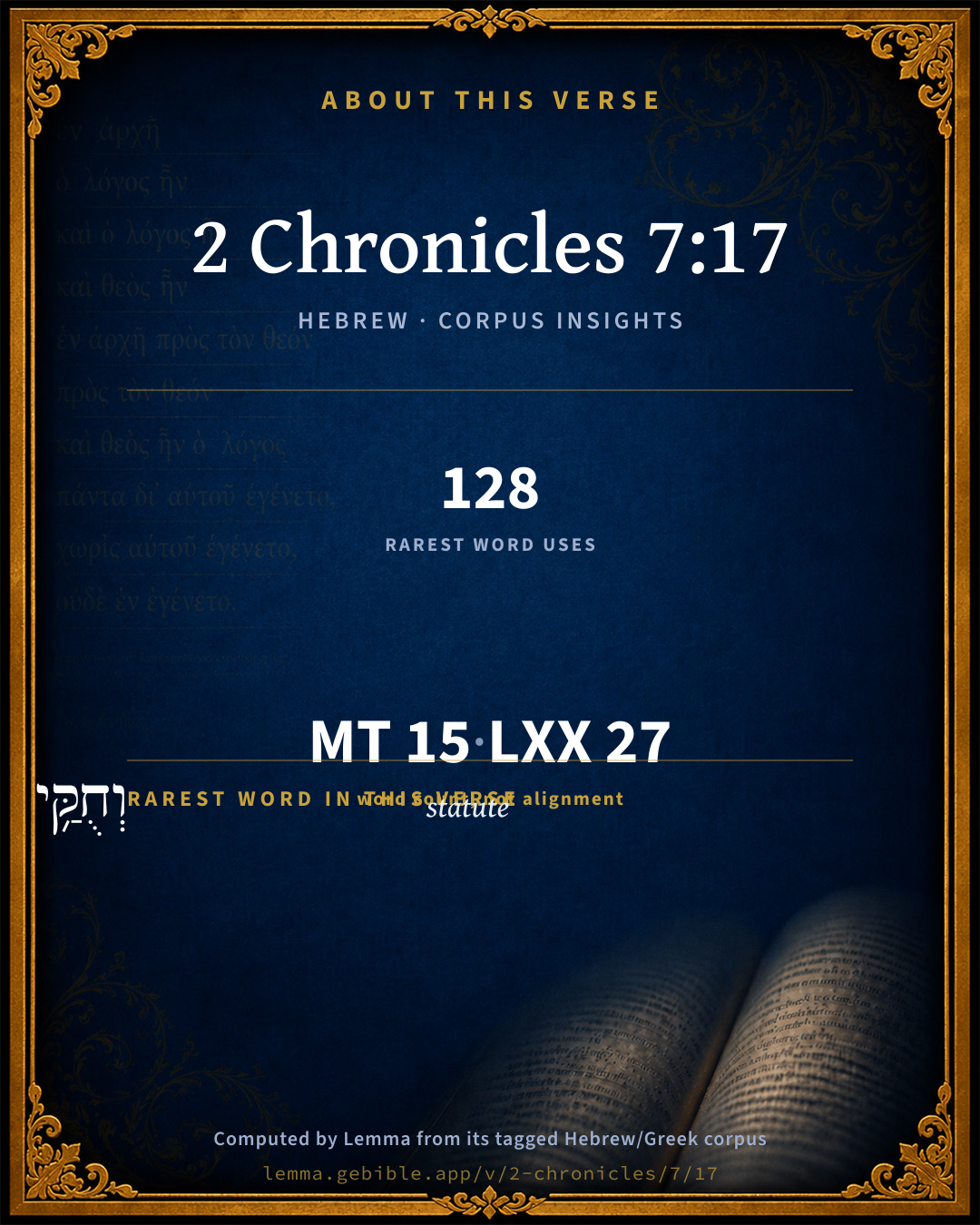
וְחֻקַּ֥י
chôq
H2706
“and · statutes · my”
Conjunction + Noun, Common, Masculine, Plural, Construct + Suffix, Personal, 1st Person, Common, Singular
Part of Speech
Conjunction + Noun
Type
Common
Gender
Masculine
Number
Plural
State
Construct
Full BDB Definition

Origin: from H2710

TWOT: 728a

statute, ordinance, limit, something prescribed, due - prescribed task - prescribed portion - action prescribed (for oneself), resolve - prescribed due - prescribed limit, boundary - enactment, decree, ordinance - specific decree - law in general - enactments, statutes - conditions - enactments - decrees - civil enactments prescribed by God
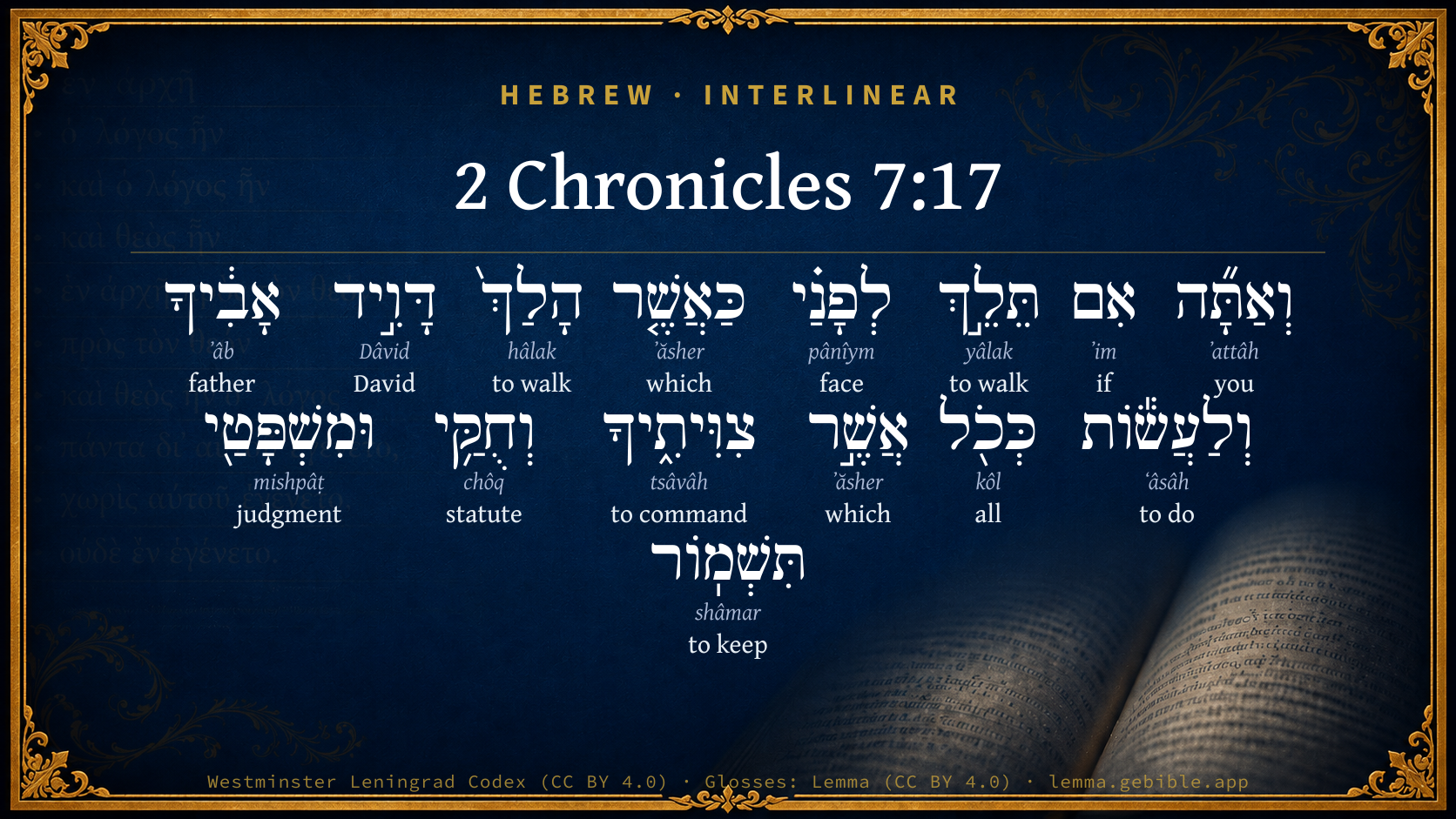
  1. וְאַתָּ֞ה ʼattâh H859 “and · you” Conjunction + Pronoun, Personal, 2nd Person, Masculine, Singular
  2. אִם ʼim H518 “if” Conjunction
  3. תֵּלֵ֣ךְ yâlak H3212 “to walk” Verb, Qal, Imperfect, 2nd Person, Masculine, Singular
  4. לְפָנַ֗י pânîym H6440 “to/for · face(s) · my” Preposition + Noun, Common, Both, Plural, Construct + Suffix, Personal, 1st Person, Common, Singular
  5. כַּאֲשֶׁ֤ר ʼăsher H834 “like/as · which” Preposition + Particle, Relative
  6. הָלַךְ֙ hâlak H1980 “to walk” Verb, Qal, Perfect, 3rd Person, Masculine, Singular
  7. דָּוִ֣יד Dâvid H1732 “David” Noun, Proper
  8. אָבִ֔יךָ ʼâb H1 “father · your” Noun, Common, Masculine, Singular, Construct + Suffix, Personal, 2nd Person, Masculine, Singular
  9. וְלַעֲשׂ֕וֹת ʻâsâh H6213 “and · to do” Conjunction + Preposition + Verb, Qal, Infinitive Construct
  10. כְּכֹ֖ל kôl H3605 “like/as · all” Preposition + Noun, Common, Masculine, Singular, Absolute
  11. אֲשֶׁ֣ר ʼăsher H834 “which” Particle, Relative
  12. צִוִּיתִ֑יךָ tsâvâh H6680 “to command · you” Verb, Piel, Perfect, 1st Person, Common, Singular + Suffix, Personal, 2nd Person, Masculine, Singular
  13. וּמִשְׁפָּטַ֖י mishpâṭ H4941 “and · judgments · my” Conjunction + Noun, Common, Masculine, Plural, Construct + Suffix, Personal, 1st Person, Common, Singular
  14. תִּשְׁמֽוֹר shâmar H8104 “to keep” Verb, Qal, Imperfect, 2nd Person, Masculine, Singular

About this verse

These counts appear in no published source. They are computed here, from the morphology-tagged text and Lemma’s own curated glosses. What Lemma adds →

15
words
14
distinct lemmas
Historical
section

Grammatical profile

  • 5 verbs
  • 6 nouns
  • 1 pronoun
  • 1 conjunction
  • 2 particles

Verb forms

  • תֵּלֵ֣ךְ Qal · Imperfect
  • הָלַךְ֙ Qal · Perfect
  • וְלַעֲשׂ֕וֹת Qal · Infinitive Construct
  • צִוִּיתִ֑יךָ Piel · Perfect
  • תִּשְׁמֽוֹר Qal · Imperfect

Repetition

A word recurs within this verse — often emphatic in Hebrew:

  • כַּאֲשֶׁ֤ר which H834 ×2

Hebrew & Septuagint length

In English translation the verse runs 32 words from the Hebrew and 31 from the Septuagint (LXX English) — closely comparable.

A rough comparison of the two English renderings, which tokenize alike — not a word-level alignment.

Word counts can differ between the Hebrew and the Greek without any difference in meaning — e.g. the Hebrew direct-object marker אֵת has no separate Greek word, and Greek often adds the article ὁ.

In the original languages it is 15 Hebrew tokens and 27 Greek tokens — but the two are counted differently (Hebrew bundles its prefixes and suffixes into one token; the Greek is in lemma form), so that isn’t a like-for-like length.

Cross-references

13

Topical passages linked to 2 Chronicles 7:17 in the Treasury of Scripture Knowledge — connected by theme and wording, ordered by reader-vote popularity; previews shown in the World English Bible.

  • Deuteronomy 4:40 You shall keep his statutes, and his commandments, which I command you this day, that it may go well with you, and with your children after you, and that you may prolong your days in the land, which Yahweh your God gives you, forever.
  • 1 Kings 11:38 It shall be, if you will listen to all that I command you, and will walk in my ways, and do that which is right in my eyes, to keep my statutes and my commandments, as David my servant did; that I will be with you, and will build you a sure house, as I built for David, and will give Israel to you.
  • Ezekiel 36:27 I will put my Spirit within you, and cause you to walk in my statutes, and you shall keep my ordinances, and do them.
  • Zechariah 3:7 "Thus says Yahweh of hosts: 'If you will walk in my ways, and if you will keep my charge, then you also shall judge my house, and shall also keep my courts, and I will give you a place of access among these who stand by.
  • Deuteronomy 28:1–14 It shall happen, if you shall listen diligently to the voice of Yahweh your God, to observe to do all his commandments which I command you this day, who Yahweh your God will set you on high above all the nations of the earth:
  • 1 Kings 2:3 and keep the charge of Yahweh your God, to walk in his ways, to keep his statutes, [and] his commandments, and his ordinances, and his testimonies, according to that which is written in the law of Moses, that you may prosper in all that you do, and wherever you turn yourself.
  • 1 Kings 3:14 If you will walk in my ways, to keep my statutes and my commandments, as your father David did walk, then I will lengthen your days.
  • 1 Kings 8:25 Now therefore, Yahweh, the God of Israel, keep with your servant David my father that which you have promised him, saying, There shall not fail you a man in my sight to sit on the throne of Israel, if only your children take heed to their way, to walk before me as you have walked before me.
  • 1 Kings 9:4–9 As for you, if you will walk before me, as David your father walked, in integrity of heart, and in uprightness, to do according to all that I have commanded you, and will keep my statutes and my ordinances;
  • 1 Chronicles 28:9 You, Solomon my son, know the God of your father, and serve him with a perfect heart and with a willing mind; for Yahweh searches all hearts, and understands all the imaginations of the thoughts: if you seek him, he will be found of you; but if you forsake him, he will cast you off forever.
  • Psalms 105:45 That they might keep his statutes, And observe his laws. Praise Yah!
  • John 14:21 One who has my commandments, and keeps them, that person is one who loves me. One who loves me will be loved by my Father, and I will love him, and will reveal myself to him."
  • John 15:10 If you keep my commandments, you will remain in my love; even as I have kept my Father's commandments, and remain in his love.

Cross-references courtesy of OpenBible.info (CC BY 4.0).

Hebrew and Greek witnesses Masoretic Hebrew ↔ Greek Septuagint

The same verse in the two great witnesses to the Old Testament, shown verse-for-verse.

These are two independent witnesses, not word-aligned to each other, and the Septuagint is shown in lemma (dictionary) form.

Hebrew 2 Chronicles 7:17 Masoretic · Westminster Leningrad Codex

וְאַתָּ֞ה אִם תֵּלֵ֣ךְ לְפָנַ֗י כַּאֲשֶׁ֤ר הָלַךְ֙ דָּוִ֣יד אָבִ֔יךָ וְלַעֲשׂ֕וֹת כְּכֹ֖ל אֲשֶׁ֣ר צִוִּיתִ֑יךָ וְחֻקַּ֥י וּמִשְׁפָּטַ֖י תִּשְׁמֽוֹר

As for you, if you will walk before me as David your father walked, and do according to all that I have commanded you, and will keep my statutes and my ordinances;

World English Bible · Public Domain

Greek LXX 2 Chronicles 7:17 Septuagint · lemma form

καί σύ ἐάν πορεύομαι ἐναντίον ἐγώ ὡς δαυίδ ὁ πατήρ σύ καί ποιέω κατά πᾶς ὅς ἐντέλλω σύ καί ὁ πρόσταγμα ἐγώ καί ὁ κρίμα ἐγώ φυλάσσω

And if you will walk before me as David your father did, and will do according to all that I have commanded you, and will keep my ordinances and my judgments;

LXX2012 (modern English Septuagint) · Public Domain

On this verse, Ellicott's Commentary for English Readers discusses the Septuagint’s reading. Read the note in Commentary ↓

Hebrew: Westminster Leningrad Codex (CC BY 4.0). Greek: Septuagint (public domain); English from LXX2012 (modern English Septuagint) (Public Domain). How the Septuagint differs from the Hebrew →

Commentary

Notes on 2 Chronicles 7:17 from classic Christian and Jewish commentators (each source and its license shown beneath its notes). The classic Christian expositions comment on the surrounding passage and are grouped to its opening verse, so a note may address several verses; the Jewish commentaries on the Tanakh (Rashi and others) are per-verse, so they appear only where the commentator wrote on this verse.

Lemma curates 59 commentaries, every one of them public domain or Creative Commons licensed, each selected and text-cleaned for this edition rather than reprinted as found. About our sources →

Joseph Benson's Commentary

2Ch 7:17-18. If thou wilt walk before me, &c. — He promises to establish and perpetuate Solomon’s kingdom, on condition that he persevered in his duty; assuring him, that if he hoped for the benefit of God’s covenant with David, he must imitate the example of David.

Joseph Benson's Commentary on the Old and New Testaments (1811–1818) — public domain. Text from a community e-Sword module.

Tyndale Open Study Notes

Tyndale Open Resources

7:17-18 God declared to Solomon that God’s Kingdom is eternal. Where 1 Kgs 9:5 states that one of his descendants will always be on the throne of Israel, the Chronicler says, One of your descendants will always rule over Israel. In the days of the Chronicler there was no throne in Israel, so his statement alludes to the Messiah (cp. Mic 5:2).

Tyndale Open Study Notes — © Tyndale Open Resources, licensed CC BY-SA 4.0. Text via the HelloAO Bible API.

Ellicott's Commentary for English Readers

(17) Walked.—Kings adds, “in perfectness of heart, and in uprightness.” So Syriac and Arabic.

And do.—So LXX., Vulg., and Arabic. The Heb. is wĕ-la‘asôth, “and to do,” a construction which the chronicler sometimes uses in continuation of a future (imperfect tense). But Kings has “to do,” an infinitive defining the former verb; and so the Syriac here.

A Bible Commentary for English Readers, edited by Charles John Ellicott (1878–1897) — public domain. Text from a community e-Sword module.

The Cambridge Bible for Schools and Colleges

gen. ed. J. J. S. Perowne

17. shalt observe] R.V. wilt keep (as 1Ki_9:4).

The Cambridge Bible for Schools and Colleges (gen. ed. J. J. S. Perowne; Cambridge University Press, 1878–1918) — public domain. Text from a community e-Sword module.

The Pulpit Commentary

Vers. 17, 18. These two verses glance at the first petition of Solomon"s prayer. (2Ch_6:15-17 See also 2Ch_3:12; 2Sa_7:12; 1Ch_22:10)

Vers. 17-22.

The Divine promise.

This is very large and generous, but it is always conditional. God never makes a promise which is absolutely unconditional. We can readily see that it is morally impossible for him to do so; it would be unrighteous, unwise, and, in the end, unkind so to do. tie must and does say, "If... then I will; if not then I will not." So was it (or so is it) with

I THE ROYAL FAMILY. God"s promise to David and to Solomon that the royal house should be established and should continue to reign was conditional on their allegiance to himself (: (1Ch_22:13 1Ch_28:7) "If thou wilt walk before me," etc. (ver. 17). The melancholy issue proved only too well that there was no possibility of the fulfilment of the hope apart from obedience to the will of God.

II THE NATION. God"s promises to Israel were great, but they, were conditional on its fidelity. In this passage the possibility of forfeiture is very fully stated (vers. 19-22). And in the long exile which the Jews suffered in Babylon, and in the terrible dispersion after the destruction of Jerusalem and the extinction of Israel as a nation, we find a fearful fulfilment of the solemn warning of the text. God deals with families and with nations now as he did with his own people. If they walk in truth, in wisdom, in righteousness, in godliness, they are established; but if they depart from faith and purity, they fall. History will furnish ample illustration of the doctrine; the observation of one long life will supply strong corroboration of its truth.

III THE INDIVIDUAL SOUL. God makes very great promises to us all; they are "exceeding great and precious". (2Pe_1:4) They include the forgiveness of sins, restoration to perfect Sonship, guidance and provision through all our earthly course, the preservation of our spiritual integrity in trial and temptation, a full response to our prayer and our Christian effort, peace in death, everlasting glory. But not one of these is promised to us irrespective of our attitude or our action. We must repent of our sin, and believe in the Lord Jesus Christ, if we would be forgiven and restored; we must seek first the kingdom of God, and ask honestly and sincerely for Divine help, if we would receive all needful blessings for the life that now is; we must shun the spiritual peril which we are not called upon to face, and strive against the enemy we have to encounter, if we would prevail against our adversaries; we must abide in Christ, if we would bear the fruits of the Spirit of God; we must be prayerful and persevering and devoted, if we would work a good work for our Lord and our race; we must be faithful unto death, if we would wear and win "the crown of life. C.

The Pulpit Commentary (1880–1919), ed. H.D.M. Spence-Jones & Joseph S. Exell — public domain. Text from a community e-Sword module.

Lesson kit

Teaching starters — assembled from the data on this page, not authored interpretation. Every prompt links to the verse data it draws on. Edit before teaching.

2 Chronicles, in the Historical, opens this verse with 15 words (14 distinct Hebrew lemmas). Its most distinctive word is chôq (“statute”). A historical commentator’s framing appears above. Read the whole chapter for the surrounding context.

Discussion questions

  1. What does “statute” (chôq) contribute to the verse as a whole?
  2. How does Deuteronomy 4:40, which shares this passage’s theme, read alongside this verse?
  3. What does the repetition of “which” (2× in this one verse) do in this verse?
  4. These translations render this verse differently. What is at stake in choosing one wording over another?
  5. «תֵּלֵ֣ךְ» is a Qal Imperfect verb. How does that grammatical form shape the action described?
  6. Compare how Joseph Benson's Commentary and Tyndale Open Study Notes read this verse. Where do they agree or differ?

Things to notice

Reading settings

Reading text

Shown beneath each verse's original-language words.

Old Testament
Old Testament edition

Read the OT as the Masoretic Hebrew (MT) or the Greek Septuagint (LXX).

English shown for the Greek Septuagint (in the Hebrew ↔ Greek comparison).

Comparing translations? Open the Compare panel on any verse page to stack up to four side by side.