1 Kings 1:37

Hebrew (Westminster Leningrad Codex) 1 Kings 1:37 appears in the Hebrew Old Testament. The text above is from the Westminster Leningrad Codex. Each word links to its Strong’s number, a concise gloss, and parsing drawn from the Open Scriptures Hebrew Bible morphology. Click any word for its full Brown-Driver-Briggs (BDB) entry.
Download image
Cite this verse

1 Kings 1:37 (World English Bible). Public Domain. Lemma interlinear Bible study tool, https://lemma.gebible.app/v/1-kings/1/37.

Show BibTeX & RIS
BibTeX
RIS
English Translation
As Yahweh has been with my lord the king, even so be he with Solomon, and make his throne greater than the throne of my lord king David.
World English Bible · Public Domain
Download a study sheet

One document with this verse’s original text, its word-by-word gloss line, the meaning frame, cross-references with their text, attributed commentary, and full source and license credits — printable, and it pastes into notes with its structure intact.

This verse Autodidact and up

Study sheet (.html) Plain text (.txt)

A passage Seminary Student

Up to 50 verses in one chapter. A passage sheet keeps up to 6 commentary sources and 12 cross-references per verse, in the order this page ranks them, and says so on the sheet whenever that leaves anything out. Ask for a single verse and you get the Autodidact verse sheet above.

Everything on this page stays free to read, with no account — the sheet is a download of what is already on screen, not access to it.

Want to remove ads? Support Godless Engineer
Compare translations 3

The same verse in 3 English versions, stacked beneath the original-language interlinear above. Click any original word for its lexicon entry.

Each is an independent rendering of the whole verse — the interlinear is not word-aligned to these translations.

Highlighted words mark where these versions differ — a whole-verse word diff, not a word-by-word alignment.

  • World English Bible Public Domain
    As Yahweh has been with my lord the king, even so be he with Solomon, and make his throne greater than the throne of my lord king David.
  • King James Version Public Domain
    As the LORD hath been with my lord the king, even so be he with Solomon, and make his throne greater than the throne of my lord king David.
  • unfoldingWord Literal Text CC BY-SA 4.0
    Just as Yahweh has been with my lord the king, so may he be with Solomon. And may he make his throne greater than the throne of my lord King David.”

unfoldingWord Literal Text — © unfoldingWord, licensed CC BY-SA 4.0. Word-aligned USFM3 via Door43 (git.door43.org/unfoldingWord/en_ult).

Versions to compare (up to 4)

3 of 4 selected

Show all 18 translations

Every available English version of this verse, each an independent rendering of the whole verse.

  • World English Bible Public Domain
    As Yahweh has been with my lord the king, even so be he with Solomon, and make his throne greater than the throne of my lord king David.
  • Berean Standard Bible Public Domain
    Just as the LORD was with my lord the king, so may He be with Solomon and make his throne even greater than that of my lord King David.”
  • Majority Standard Bible Public Domain
    Just as the LORD was with my lord the king, so may He be with Solomon and make his throne even greater than that of my lord King David.”
  • King James Version Public Domain
    As the LORD hath been with my lord the king, even so be he with Solomon, and make his throne greater than the throne of my lord king David.
  • American Standard Version (1901) Public Domain
    As Jehovah hath been with my lord the king, even so be he with Solomon, and make his throne greater than the throne of my lord king David.
  • Revised Version (1885) Public Domain
    As the LORD hath been with my lord the king, even so be he with Solomon, and make his throne greater than the throne of my lord king David.
  • Geneva Bible (1599) Public Domain
    As the Lord hath bene with my lorde the King, so be he with Salomon, and exalt his throne aboue the throne of my lorde king Dauid.
  • Douay-Rheims (1899) Public Domain
    As the Lord hath been with my lord the king, so be he with Solomon, and make his throne higher than the throne of my lord king David.
  • Young's Literal Translation Public Domain
    as Jehovah hath been with my lord the king, so is He with Solomon, and doth make his throne greater than the throne of my lord king David.'
  • Literal Standard Version CC BY-SA 4.0
    as YHWH has been with my lord the king, so is He with Solomon, and makes his throne greater than the throne of my lord King David.”
  • Unlocked Literal Bible CC BY-SA 4.0
    As Yahweh has been with my master the king, so may he be with Solomon, and make his throne greater than the throne of my master King David.”
  • unfoldingWord Literal Text CC BY-SA 4.0
    Just as Yahweh has been with my lord the king, so may he be with Solomon. And may he make his throne greater than the throne of my lord King David.”
  • Darby Bible Public Domain
    As Jehovah has been with my lord the king, even so be he with Solomon, and make his throne greater than the throne of my lord king David.
  • World Messianic Bible Public Domain
    As the LORD has been with my lord the king, even so may he be with Solomon, and make his throne greater than the throne of my lord King David.”
  • Webster's Bible Public Domain
    As the LORD hath been with my lord the king, even so let him be with Solomon, and make his throne greater than the throne of my lord king David.
  • Free Bible Version CC BY-SA 4.0
    In the same way the Lord was with my lord the king may he be with Solomon, and may he make his reign even greater than the reign of my lord King David.”
  • Bible in Basic English Public Domain
    As the Lord has been with my lord the king, even so may he be with Solomon and make the seat of his authority greater than that of my lord King David.
  • JPS Tanakh (1917) Public Domain
    As the LORD hath been with my lord the king, even so be He with Solomon, and make his throne greater than the throne of my lord king David.'

Literal Standard Version (2020), Covenant Press — licensed CC BY-SA 4.0. Text via the HelloAO Bible API (eBible.org). Unlocked Literal Bible (unfoldingWord) — licensed CC BY-SA 4.0. Text via the HelloAO Bible API (eBible.org). unfoldingWord Literal Text — © unfoldingWord, licensed CC BY-SA 4.0. Word-aligned USFM3 via Door43 (git.door43.org/unfoldingWord/en_ult). Free Bible Version, Dr. Jonathan Gallagher — licensed CC BY-SA 4.0. Text via the HelloAO Bible API (eBible.org).

Word by word

More ways to search: Search by grammar → Find every occurrence → Compare this word →

Practice this passage: Drill this verse → Learn its vocabulary →

וִֽיגַדֵּל֙
gâdal
H1431
“and · to grow”
Conjunction + Verb, Piel, Imperfect, 3rd Person, Masculine, Singular
Part of Speech
Conjunction + Verb
Stem
Piel
Form
Imperfect
Person
3rd Person
Gender
Masculine
Number
Singular
Full BDB Definition

Origin: a primitive root

TWOT: 315

to grow, become great or important, promote, make powerful, praise, magnify, do great things - (Qal) - to grow up - to become great - to be magnified - (Piel) - to cause to grow - to make great, powerful - to magnify - (Pual) to be brought up - (Hiphil) - to make great - to magnify - to do great things - (Hithpael) to magnify oneself
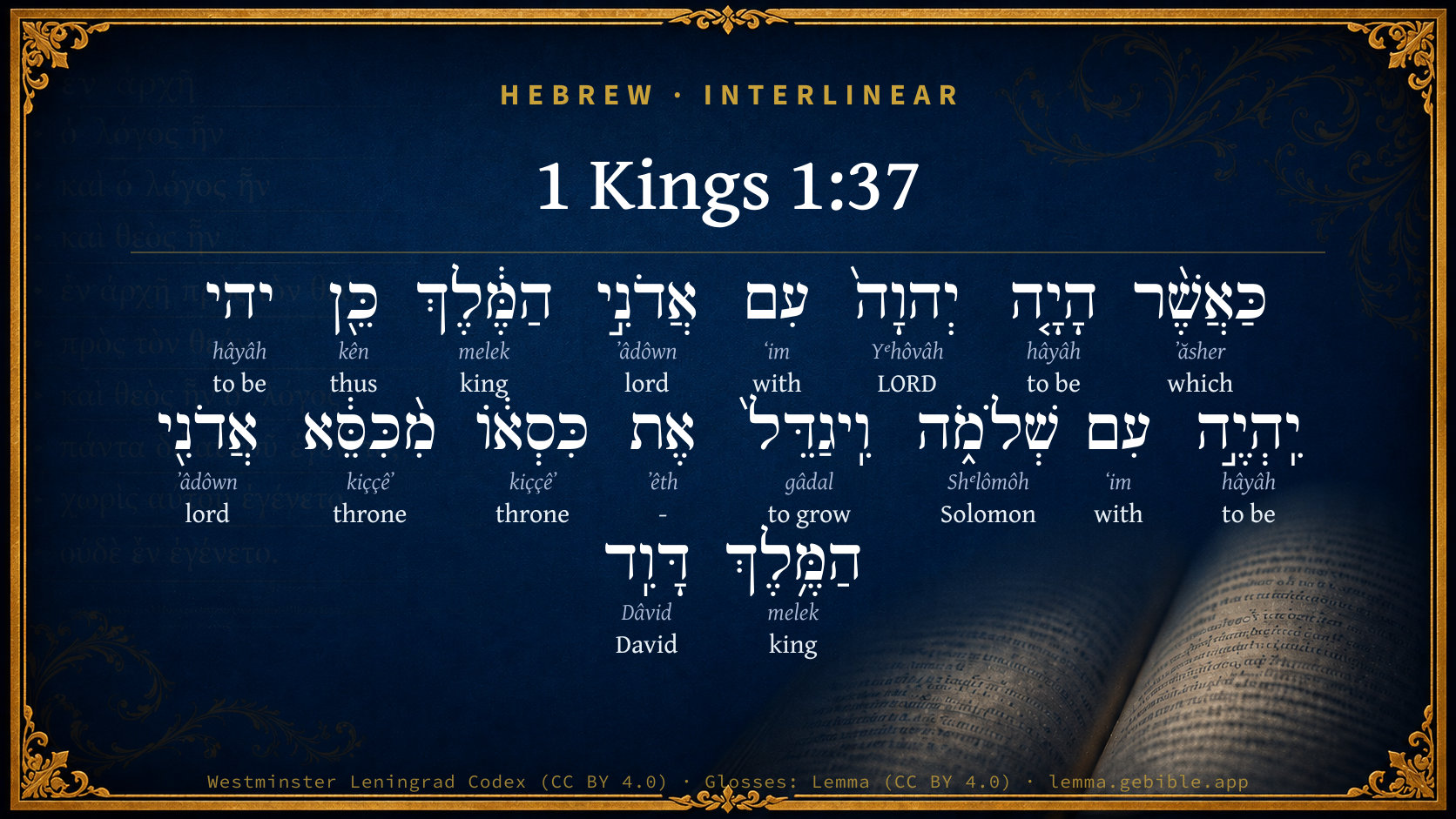
  1. כַּאֲשֶׁ֨ר ʼăsher H834 “like/as · which” Preposition + Particle, Relative
  2. הָיָ֤ה hâyâh H1961 “to be” Verb, Qal, Perfect, 3rd Person, Masculine, Singular
  3. יְהוָה֙ Yᵉhôvâh H3068 “LORD” Noun, Proper
  4. עִם ʻim H5973 “with” Preposition
  5. אֲדֹנִ֣י ʼâdôwn H113 “lord · my” Noun, Common, Masculine, Singular, Construct + Suffix, Personal, 1st Person, Common, Singular
  6. הַמֶּ֔לֶךְ melek H4428 “the · king” Particle, Definite Article + Noun, Common, Masculine, Singular, Absolute
  7. כֵּ֖ן kên H3651 “thus” Particle, Demonstrative
  8. יהי hâyâh H1961 “to be” Verb, Qal, Jussive, 3rd Person, Masculine, Singular
  9. יִֽהְיֶ֣ה hâyâh H1961 “to be” Verb, Qal, Imperfect, 3rd Person, Masculine, Singular
  10. עִם ʻim H5973 “with” Preposition
  11. שְׁלֹמֹ֑ה Shᵉlômôh H8010 “Solomon” Noun, Proper
  12. אֶת ʼêth H853 “-” Particle, Direct Object
  13. כִּסְא֔וֹ kiççêʼ H3678 “throne · his” Noun, Common, Masculine, Singular, Construct + Suffix, Personal, 3rd Person, Masculine, Singular
  14. מִ֨כִּסֵּ֔א kiççêʼ H3678 “from · throne of” Preposition + Noun, Common, Masculine, Singular, Construct
  15. אֲדֹנִ֖י ʼâdôwn H113 “lord · my” Noun, Common, Masculine, Singular, Construct + Suffix, Personal, 1st Person, Common, Singular
  16. הַמֶּ֥לֶךְ melek H4428 “the · king” Particle, Definite Article + Noun, Common, Masculine, Singular, Absolute
  17. דָּוִֽד Dâvid H1732 “David” Noun, Proper

About this verse

These counts appear in no published source. They are computed here, from the morphology-tagged text and Lemma’s own curated glosses. What Lemma adds →

18
words
12
distinct lemmas
Historical
section

Grammatical profile

  • 4 verbs
  • 9 nouns
  • 2 prepositions
  • 3 particles

Verb forms

  • הָיָ֤ה Qal · Perfect
  • יהי Qal · Jussive
  • יִֽהְיֶ֣ה Qal · Imperfect
  • וִֽיגַדֵּל֙ Piel · Imperfect

Repetition

Words recur within this verse — often emphatic in Hebrew:

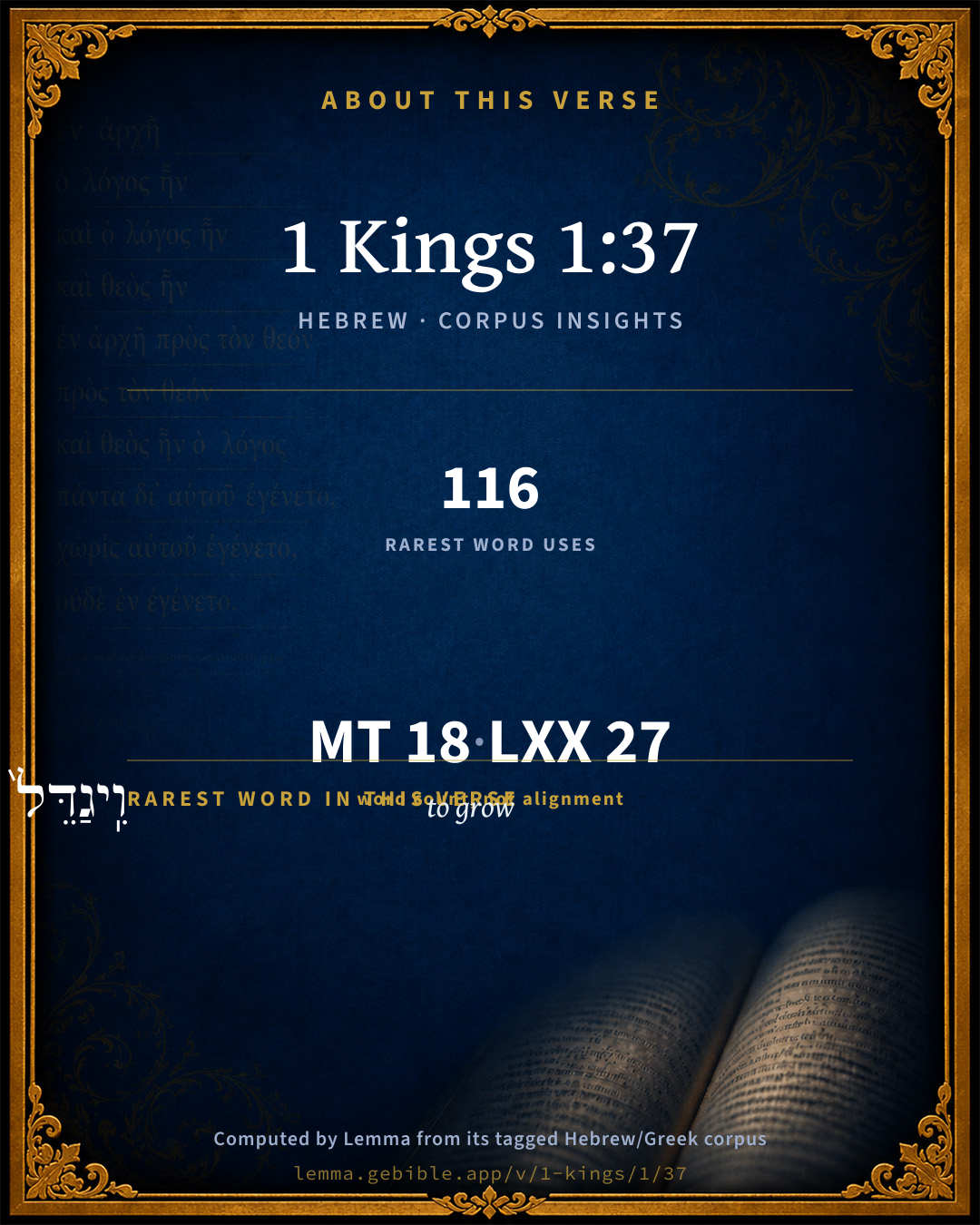
  • הָיָ֤ה to be H1961 ×3
  • אֲדֹנִ֣י lord H113 ×2
  • הַמֶּ֔לֶךְ king H4428 ×2
  • כִּסְא֔וֹ throne H3678 ×2
  • עִם with H5973 ×2

Hebrew & Septuagint length

In English translation the verse runs 28 words from the Hebrew and 29 from the Septuagint (LXX English) — closely comparable.

A rough comparison of the two English renderings, which tokenize alike — not a word-level alignment.

Word counts can differ between the Hebrew and the Greek without any difference in meaning — e.g. the Hebrew direct-object marker אֵת has no separate Greek word, and Greek often adds the article ὁ.

In the original languages it is 18 Hebrew tokens and 27 Greek tokens — but the two are counted differently (Hebrew bundles its prefixes and suffixes into one token; the Greek is in lemma form), so that isn’t a like-for-like length.

Cross-references

19

Topical passages linked to 1 Kings 1:37 in the Treasury of Scripture Knowledge — connected by theme and wording, ordered by reader-vote popularity; previews shown in the World English Bible.

  • 1 Samuel 20:13 Yahweh do so to Jonathan, and more also, should it please my father to do you evil, if I don't disclose it to you, and send you away, that you may go in peace: and Yahweh be with you, as he has been with my father.
  • 1 Kings 1:47 Moreover the king's servants came to bless our lord king David, saying, Your God make the name of Solomon better than your name, and make his throne greater than your throne: and the king bowed himself on the bed.
  • Joshua 1:5 There shall not any man be able to stand before you all the days of your life. As I was with Moses, so I will be with you; I will not fail you, nor forsake you.
  • Joshua 1:17 According as we listened to Moses in all things, so will we listen to you: only Yahweh your God be with you, as he was with Moses.
  • Exodus 3:12 He said, "Certainly I will be with you. This will be the token to you, that I have sent you: when you have brought forth the people out of Egypt, you shall serve God on this mountain."
  • 2 Samuel 24:3 Joab said to the king, Now Yahweh your God add to the people, however many they may be, one hundred times; and may the eyes of my lord the king see it: but why does my lord the king delight in this thing?
  • 1 Kings 3:7–9 Now, Yahweh my God, you have made your servant king instead of David my father: and I am but a little child; I don't know how to go out or come in.
  • 2 Kings 2:9 It happened, when they had gone over, that Elijah said to Elisha, Ask what I shall do for you, before I am taken from you. Elisha said, please let a double portion of your spirit be on me.
  • 1 Chronicles 28:20 David said to Solomon his son, Be strong and of good courage, and do it: don't be afraid, nor be dismayed; for Yahweh God, even my God, is with you; he will not fail you, nor forsake you, until all the work for the service of the house of Yahweh is finished.
  • 2 Chronicles 1:1 Solomon the son of David was strengthened in his kingdom, and Yahweh his God was with him, and magnified him exceedingly.
  • Psalms 46:7 Yahweh of Hosts is with us. The God of Jacob is our refuge. Selah.
  • Psalms 46:11 Yahweh of Hosts is with us. The God of Jacob is our refuge. Selah.
  • Psalms 72:8 He shall have dominion also from sea to sea, From the River to the ends of the earth.
  • Psalms 72:17–19 His name endures forever. His name continues as long as the sun. Men shall be blessed by him. All nations will call him blessed.
  • Psalms 89:27 I will also appoint him my firstborn, The highest of the kings of the earth.
  • Isaiah 8:10 Take counsel together, and it shall be brought to nothing; speak the word, and it shall not stand: for God is with us.
  • Daniel 7:14 There was given him dominion, and glory, and a kingdom, that all the peoples, nations, and languages should serve him: his dominion is an everlasting dominion, which shall not pass away, and his kingdom that which shall not be destroyed.
  • Matthew 1:23 "Behold, the virgin shall be with child, And shall bring forth a son. They shall call his name Immanuel;" Which is, being interpreted, "God with us."
  • Romans 8:31 What then shall we say about these things? If God is for us, who can be against us?

Cross-references courtesy of OpenBible.info (CC BY 4.0).

Hebrew and Greek witnesses Masoretic Hebrew ↔ Greek Septuagint

The same verse in the two great witnesses to the Old Testament, shown verse-for-verse.

These are two independent witnesses, not word-aligned to each other, and the Septuagint is shown in lemma (dictionary) form.

Hebrew 1 Kings 1:37 Masoretic · Westminster Leningrad Codex

כַּאֲשֶׁ֨ר הָיָ֤ה יְהוָה֙ עִם אֲדֹנִ֣י הַמֶּ֔לֶךְ כֵּ֖ן יהי יִֽהְיֶ֣ה עִם שְׁלֹמֹ֑ה וִֽיגַדֵּל֙ אֶת כִּסְא֔וֹ מִ֨כִּסֵּ֔א אֲדֹנִ֖י הַמֶּ֥לֶךְ דָּוִֽד

As Yahweh has been with my lord the king, even so be he with Solomon, and make his throne greater than the throne of my lord king David.

World English Bible · Public Domain

Greek LXX 1 Kings 1:37 Septuagint · lemma form

καθώς εἰμί κύριος μετά ὁ κύριος ἐγώ ὁ βασιλεύς οὕτως εἰμί μετά σαλωμών καί μεγαλύνω ὁ θρόνος αὐτός ὑπέρ ὁ θρόνος ὁ κύριος ἐγώ ὁ βασιλεύς δαυίδ

As the Lord was with my lord the king, so let him be with Solomon, and let him exalt his throne beyond the throne of my lord king David.

LXX2012 (modern English Septuagint) · Public Domain

Hebrew: Westminster Leningrad Codex (CC BY 4.0). Greek: Septuagint (public domain); English from LXX2012 (modern English Septuagint) (Public Domain). How the Septuagint differs from the Hebrew →

Targum (Aramaic paraphrase)

1

The Targum is the ancient Jewish Aramaic paraphrase of the Hebrew Scriptures — an interpretive translation, not the Hebrew text itself. Onkelos (literal) and Pseudo-Jonathan (expansive) render the Torah, and Jonathan the Prophets. Coverage is partial: where no permissively-licensed English translation exists for a verse, only the Aramaic is shown. This is verse-level text, not a word-by-word alignment to the Hebrew.

  1. Targum Jonathan Prophets (Joshua–Malachi)
    כְּמָא דַהֲוָה מֵימְרָא דַייָ בְסַעְדֵיהּ דְרִבּוֹנִי מַלְכָּא כֵּן יְהֵי בְּסַעֲדֵיהּ דִשְׁלֹמֹה וִירַבֵּי יַת כּוּרְסֵיהּ מִכּוּרְסֵי מַלְכוּתָא דְרִבּוֹנִי מַלְכָּא דָוִד:

    (no public-domain English translation for this verse)

    Targum Jonathan — Aramaic: “Mikraot Gedolot” (public domain). English: “Sefaria Community Translation” (CC0 1.0 (public-domain dedication)); “London "Chaldee Paraphrase," 1871” (public domain). Text via Sefaria.

Commentary

Notes on 1 Kings 1:37 from classic Christian and Jewish commentators (each source and its license shown beneath its notes). The classic Christian expositions comment on the surrounding passage and are grouped to its opening verse, so a note may address several verses; the Jewish commentaries on the Tanakh (Rashi and others) are per-verse, so they appear only where the commentator wrote on this verse.

Lemma curates 59 commentaries, every one of them public domain or Creative Commons licensed, each selected and text-cleaned for this edition rather than reprinted as found. About our sources →

Trapp's Complete Commentary

John Trapp

1Ki 1:37 As the LORD hath been with my lord the king, even so be he with Solomon, and make his throne greater than the throne of my lord king David.

Ver. 37. And make his throne greater.] God heard this prayer, and said Amen to it, set his fiat to it: for Solomon’s reign, accomplished with a civil and religious happiness, represented the triumphant Church in heaven: as David’s reign had been a figure of the Church militant upon earth.

John Trapp, A Commentary or Exposition upon All the Books of the Old and New Testament (1647–1656) — public domain. Text from a community e-Sword module.

Adam Clarke's Commentary

Verse 37. Make his throne greater than the throne of - David.] A wish of this kind a king will suffer in behalf of his son, but it is never in ordinary cases considered a compliment to say, "I hope this child will make a better man than his father," because it seems to insinuate some reflections on his father's conduct or character. Many foolish people deal in such compliments, and they may rest assured, for the reasons given above, that they are far from being either welcome or agreeable.

Claudian, in his panegyric De Quarto Consulatu Honorii Augusti, ver. 428, has words something similar to those of Benaiah, when he describes a father, worn out with toils and difficulties, committing the reins of government to the hands of his son:-

Adspice, completur votum: jam natus adaequat Te meritis; et, quod magis est optabile, vincit.

"Behold, thy desire is accomplished. Even now thy son equals thee in worth; and what is still more desirable, surpasses thee."

Adam Clarke's Commentary on the Bible (1810–1826) — public domain. Text from a community e-Sword/MySword module.

The Cambridge Bible for Schools and Colleges

gen. ed. J. J. S. Perowne

37. so be he] i.e. ‘So let him be.’ The Massoretic note corrects into ‘so shall he be,’ which makes nonsense of the verse.

make his throne greater than the throne of my lord] No doubt David’s faithful servants knew of the large promises which God had made to Solomon already, and that the heart of the king was gladdened at the thought of the future glory of his son (1Ch_17:11-27). They had therefore no fear of David’s anger when they used words such as these. That Solomon’s kingdom and grandeur did surpass David’s may be seen from the narratives in 1 Kings 10. and 2 Chronicles 9.

The Cambridge Bible for Schools and Colleges (gen. ed. J. J. S. Perowne; Cambridge University Press, 1878–1918) — public domain. Text from a community e-Sword module.

John Gill's Exposition

As the Lord hath been with my lord the king, even so be he with Solomon,.... To guide and direct him, protect and defend him, succeed and prosper him the Targum is,

"as the Word of the Lord has been the help of my lord the king, so let him be for the help of Solomon:''

and make his throne greater than the throne of my lord King David: which he knew would not displease David, who not only had an affectionate regard for Solomon his son, but wished heartily the prosperity of the kingdom of Israel; and the wish on all accounts was grateful to him, though to an envious and ambitious prince it might have been disagreeable.

John Gill's Exposition of the Whole Bible (1746–1763) — public domain (CC PDM 1.0). Text via the HelloAO Bible API.

Albert Barnes' Notes on the Bible

As the Lord hath been with my lord - This phrase expresses a very high degree of divine favor. It occurs first in the promises of God to Isaac Gen 26:3, Gen 26:24 and Jacob Gen 28:13. See further margin reference.

Albert Barnes' Notes on the Bible (1834–1885) — public domain. Text from a community e-Sword/MySword module.

Haydock's Catholic Bible Commentary

David. Parents wish their children to be still more happy than themselves, how jealous soever they may be of their own glory. (Calmet) Aspice completum votum; jam natus adæquat

Te meritis, &, quod magis est optabile, vincit. (Claud. iv. con. Honor.)

George Leo Haydock (1774–1849), Haydock's Catholic Family Bible and Commentary, 1859 edition — public domain. Excludes Psalms (Douay-Rheims chapter numbering differs from Protestant) and Deuterocanonical books (Catholic canon only).

Matthew Poole's English Annotations

Which petition, albeit it might have offended an unworthy, vain-glorious, and envious father, he knew would be welcome to so pious and generous a man as David was, and to one so kind and indulgent to his children.

Matthew Poole's English Annotations on the Holy Bible (1683–1685) — public domain. Text from a community e-Sword/MySword module.

Whedon's Commentary on the Bible

Daniel D. Whedon

37. Make his throne greater than the throne of… David — Such words as these would have stirred up jealousy and anger in many kings; but, as Theodoret remarks, Benaiah “knew that no one having a true father’s tenderness would be jealous of a child, and that it is characteristic of devoted fathers to wish their sons to appear more illustrious than themselves.”

Daniel D. Whedon (gen. ed.), Commentary on the Old and New Testaments (1874–1909) — public domain. Text from a community e-Sword module.

The Pulpit Commentary

As the Lord hath been with my lord the king cf. 1Sa_20:13. "This phrase expresses a very high degree of the Divine favour" (Rawlinson) (See Gen_26:3, 4 28:15 39:2, 21; Exodus Jos_1:5; 1Ch_22:11, etc.) even so be he with Solomon, and make has throne greater than the throne of my lord king David. This was said from a full and honest heart, not to flatter David"s vanity (Thenius). It is thoroughly characteristic of the man so far as we know him. And the prayer was fulfilled. (1Ki_3:11, 1Ki_3:12)

The Pulpit Commentary (1880–1919), ed. H.D.M. Spence-Jones & Joseph S. Exell — public domain. Text from a community e-Sword module.

Rashi

Rabbi Shlomo Yitzchaki (Rashi)

Than the throne of my lord Dovid Hamelech. From this [we derive] that a father is not envious of his son.

Rashi on the Tanakh — English translations: “The Judaica Press complete Tanach with Rashi, translated by A. J. Rosenberg” (CC BY 4.0); “Pentateuch with Rashi's commentary by M. Rosenbaum and A.M. Silbermann, 1929-1934” (public domain); “The Metsudah Tanach series, Lakewood, N.J” (CC BY 4.0); and “The Book of Joshua, Metsudah Publications, 1997” (CC BY 4.0). Text via Sefaria.

Lesson kit

Teaching starters — assembled from the data on this page, not authored interpretation. Every prompt links to the verse data it draws on. Edit before teaching.

1 Kings, in the Historical, opens this verse with 18 words (12 distinct Hebrew lemmas). Its most distinctive word is gâdal (“to grow”). A historical commentator’s framing appears above. Read the whole chapter for the surrounding context.

Discussion questions

  1. How does “to grow” (gâdal) shape what this verse is saying?
  2. 1 Samuel 20:13 shares this passage’s theme. How do the two illuminate each other?
  3. “to be” occurs 3× in this one verse. What is the effect of the repetition?
  4. These translations render this verse differently. What is at stake in choosing one wording over another?
  5. The verb «הָיָ֤ה» is Qal Perfect. How does its form color the action?
  6. Reading how Trapp's Complete Commentary and Adam Clarke's Commentary read this verse, where do the two commentators agree and where do they part?

Things to notice

Reading settings

Reading text

Shown beneath each verse's original-language words.

Old Testament
Old Testament edition

Read the OT as the Masoretic Hebrew (MT) or the Greek Septuagint (LXX).

English shown for the Greek Septuagint (in the Hebrew ↔ Greek comparison).

Comparing translations? Open the Compare panel on any verse page to stack up to four side by side.