
Nehemiah 3:16

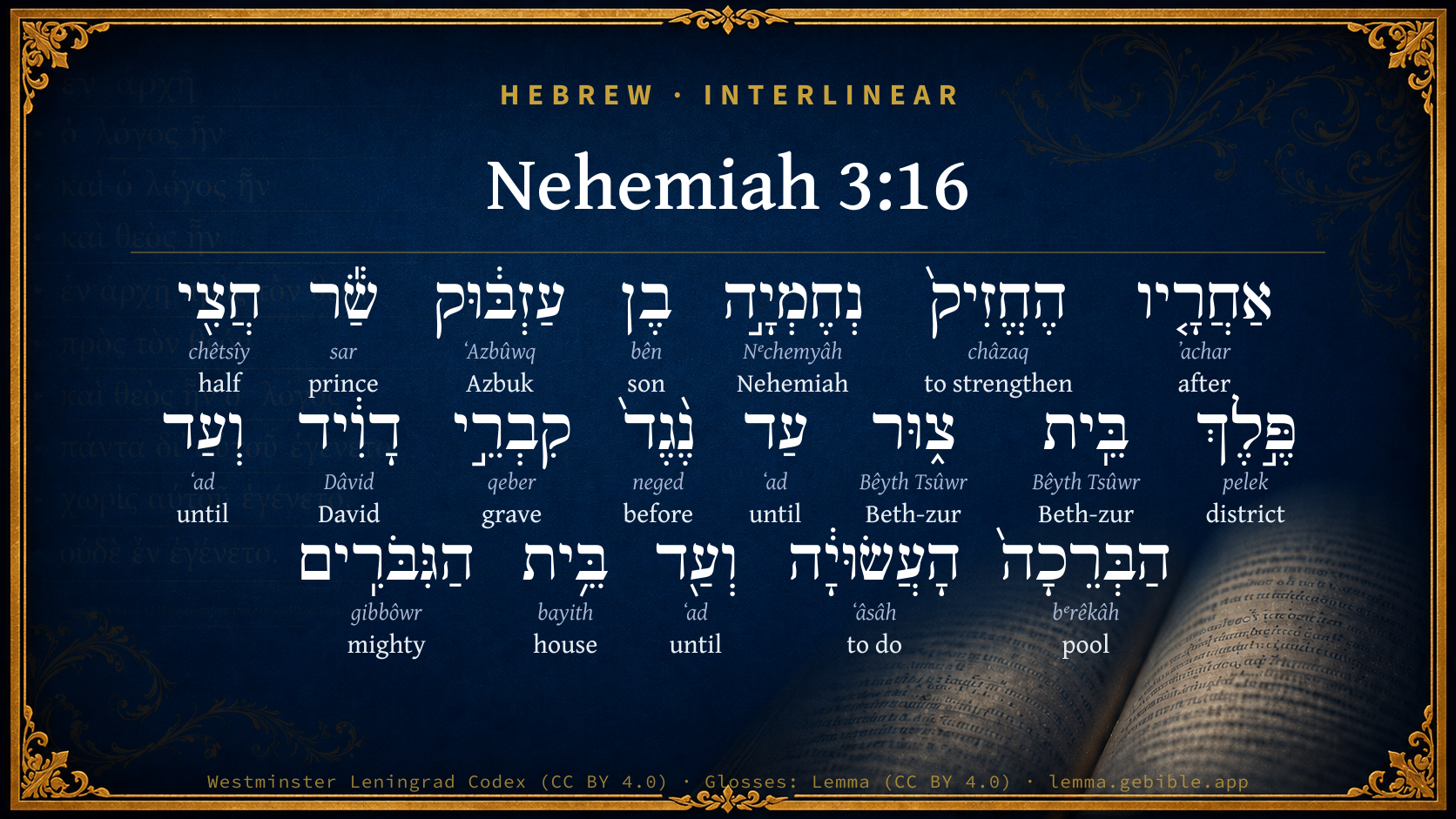
Hebrew (Westminster Leningrad Codex) Nehemiah 3:16 appears in the Hebrew Old Testament. The text above is from the Westminster Leningrad Codex. Each word links to its Strong’s number, a concise gloss, and parsing drawn from the Open Scriptures Hebrew Bible morphology. Click any word for its full Brown-Driver-Briggs (BDB) entry.
Download image
Cite this verse

Nehemiah 3:16 (World English Bible). Public Domain. Lemma interlinear Bible study tool, https://lemma.gebible.app/v/nehemiah/3/16.

Show BibTeX & RIS
BibTeX
RIS
English Translation
After him repaired Nehemiah the son of Azbuk, the ruler of half the district of Beth Zur, to the place over against the tombs of David, and to the pool that was made, and to the house of the mighty men.
World English Bible · Public Domain
Highlights
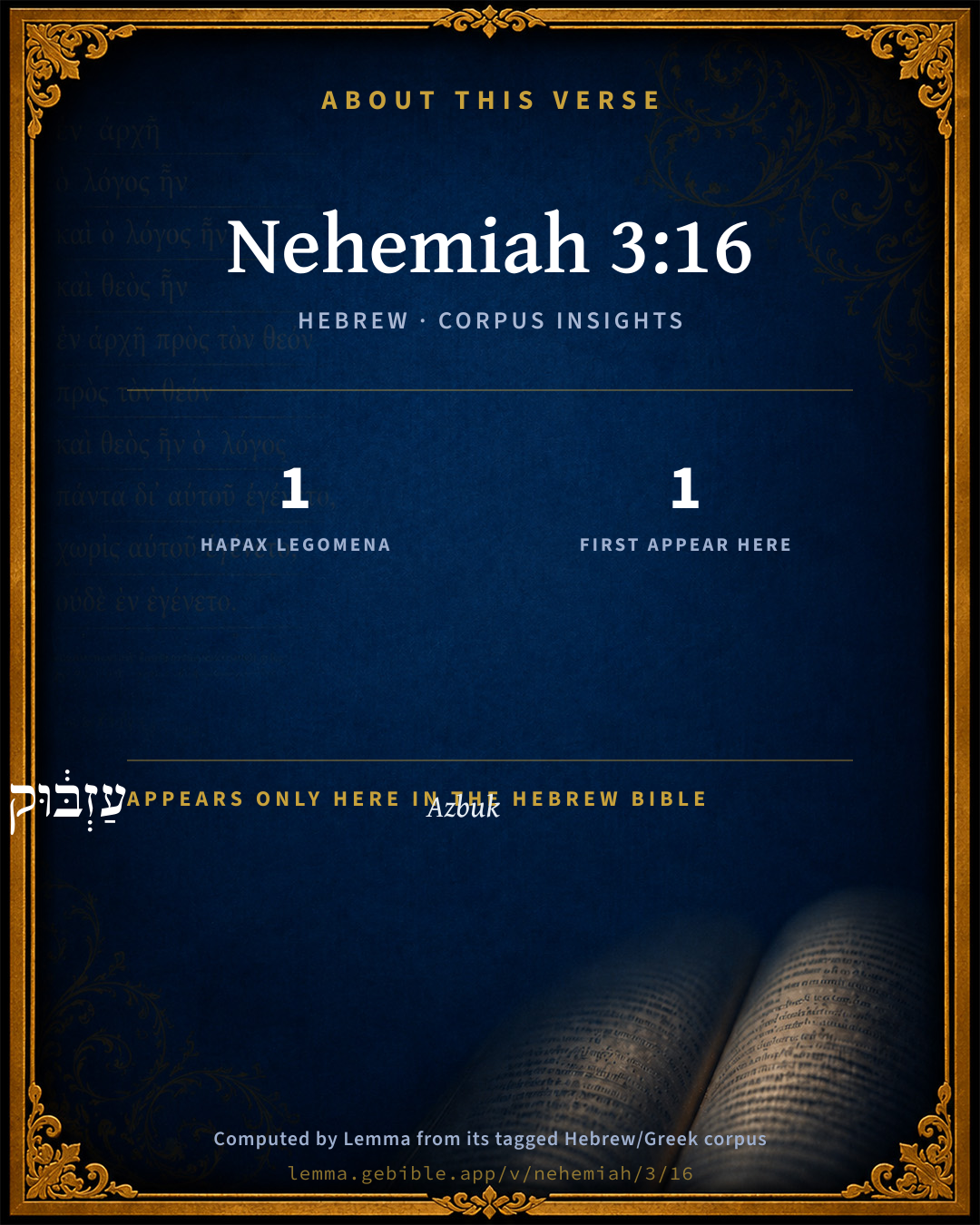
  • 1 hapax legomenon — only here in the Hebrew Bible
  • 1 first appearance in the Hebrew Bible
Full analysis ↓
Download a study sheet

One document with this verse’s original text, its word-by-word gloss line, the meaning frame, cross-references with their text, attributed commentary, and full source and license credits — printable, and it pastes into notes with its structure intact.

This verse Autodidact and up

Study sheet (.html) Plain text (.txt)

A passage Seminary Student

Up to 50 verses in one chapter. A passage sheet keeps up to 6 commentary sources and 12 cross-references per verse, in the order this page ranks them, and says so on the sheet whenever that leaves anything out. Ask for a single verse and you get the Autodidact verse sheet above.

Everything on this page stays free to read, with no account — the sheet is a download of what is already on screen, not access to it.

Want to remove ads? Support Godless Engineer
Compare translations 3

The same verse in 3 English versions, stacked beneath the original-language interlinear above. Click any original word for its lexicon entry.

Each is an independent rendering of the whole verse — the interlinear is not word-aligned to these translations.

Highlighted words mark where these versions differ — a whole-verse word diff, not a word-by-word alignment.

  • World English Bible Public Domain
    After him repaired Nehemiah the son of Azbuk, the ruler of half the district of Beth Zur, to the place over against the tombs of David, and to the pool that was made, and to the house of the mighty men.
  • King James Version Public Domain
    After him repaired Nehemiah the son of Azbuk, the ruler of the half part of Bethzur, unto the place over against the sepulchres of David, and to the pool that was made, and unto the house of the mighty.
  • unfoldingWord Literal Text CC BY-SA 4.0
    After him, Nehemiah, the son of Azbuk, the administrator for half of the district of Beth-Zur, strengthened as far as in front of the graves of David, and as far as the pool that was made, and as far as the house of the mighty men.

unfoldingWord Literal Text — © unfoldingWord, licensed CC BY-SA 4.0. Word-aligned USFM3 via Door43 (git.door43.org/unfoldingWord/en_ult).

Versions to compare (up to 4)

3 of 4 selected

Show all 18 translations

Every available English version of this verse, each an independent rendering of the whole verse.

  • World English Bible Public Domain
    After him repaired Nehemiah the son of Azbuk, the ruler of half the district of Beth Zur, to the place over against the tombs of David, and to the pool that was made, and to the house of the mighty men.
  • Berean Standard Bible Public Domain
    Beyond him, Nehemiah son of Azbuk, ruler of a half-district of Beth-zur, made repairs up to a point opposite the tombs of David, as far as the artificial pool and the House of the Mighty.
  • Majority Standard Bible Public Domain
    Beyond him, Nehemiah son of Azbuk, ruler of a half-district of Beth-zur, made repairs up to a point opposite the tombs of David, as far as the artificial pool and the House of the Mighty.
  • King James Version Public Domain
    After him repaired Nehemiah the son of Azbuk, the ruler of the half part of Bethzur, unto the place over against the sepulchres of David, and to the pool that was made, and unto the house of the mighty.
  • American Standard Version (1901) Public Domain
    After him repaired Nehemiah the son of Azbuk, the ruler of half the district of Beth-zur, unto the place over against the sepulchres of David, and unto the pool that was made, and unto the house of the mighty men.
  • Revised Version (1885) Public Domain
    After him repaired Nehemiah the son of Azbuk, the ruler of half the district of Beth-zur, unto the place over against the sepulchres of David, and unto the pool that was made, and unto the house of the mighty men.
  • Geneva Bible (1599) Public Domain
    After him fortified Nehemiah the sonne of Azbuk, the ruler of ye halfe part of Beth-zur, vntill the otherside ouer against the sepulchres of Dauid, and to the fishpoole that was repaired, and vnto the house of the mightie.
  • Douay-Rheims (1899) Public Domain
    After him built Nehemias the son of Azboc, lord of half the street of Bethsur, as far as over against the sepulchre of David, and to the pool, that was built with great labour, and to the house of the mighty.
  • Young's Literal Translation Public Domain
    After him hath Nehemiah son of Azbuk, head of the half of the district of Beth-Zur, strengthened, unto over-against the graves of David, and unto the pool that is made, and unto the house of the mighty ones.
  • Literal Standard Version CC BY-SA 4.0
    After him Nehemiah son of Azbuk, head of the half of the district of Beth-Zur, has strengthened to opposite the graves of David, and to the pool that is made, and to the house of the mighty ones.
  • Unlocked Literal Bible CC BY-SA 4.0
    Nehemiah son of Azbuk, the ruler of half the district of Beth Zur, repaired to the place across from the tombs of David, to the man-made pool, and to the house of the mighty men.
  • unfoldingWord Literal Text CC BY-SA 4.0
    After him, Nehemiah, the son of Azbuk, the administrator for half of the district of Beth-Zur, strengthened as far as in front of the graves of David, and as far as the pool that was made, and as far as the house of the mighty men.
  • Darby Bible Public Domain
    After him repaired Nehemiah the son of Azbuk, the chief of the half district of Beth-zur, even over against the sepulchres of David, and to the pool that was made, and to the house of the mighty [men].
  • World Messianic Bible Public Domain
    After him, Nehemiah the son of Azbuk, the ruler of half the district of Beth Zur, made repairs to the place opposite the tombs of David, and to the pool that was made, and to the house of the mighty men.
  • Webster's Bible Public Domain
    After him repaired Nehemiah the son of Azbuk, the ruler of the half part of Beth-zur, to the place over against the sepulchers of David, and to the pool that was made, and to the house of the mighty.
  • Free Bible Version CC BY-SA 4.0
    Past him, Nehemiah, son of Azbuk, ruler of a Beth-zur half-district, repaired up to a point opposite David's cemetery, as far as the man-made pool and the House of the Mighty Warriors.
  • Bible in Basic English Public Domain
    By his side was working Nehemiah, the son of Azbuk, ruler of half the division of Beth-zur, as far as the place opposite the last resting-places of David's family, and the pool which was made and the house of the men of war.
  • JPS Tanakh (1917) Public Domain
    After him repaired Nehemiah the son of Azbuk, the ruler of half the district of Beth-zur, unto the place over against the sepulchres of David, and unto the pool that was made, and unto the house of the mighty men.

Literal Standard Version (2020), Covenant Press — licensed CC BY-SA 4.0. Text via the HelloAO Bible API (eBible.org). Unlocked Literal Bible (unfoldingWord) — licensed CC BY-SA 4.0. Text via the HelloAO Bible API (eBible.org). unfoldingWord Literal Text — © unfoldingWord, licensed CC BY-SA 4.0. Word-aligned USFM3 via Door43 (git.door43.org/unfoldingWord/en_ult). Free Bible Version, Dr. Jonathan Gallagher — licensed CC BY-SA 4.0. Text via the HelloAO Bible API (eBible.org).

Word by word

More ways to search: Search by grammar → Find every occurrence → Compare this word →

Practice this passage: Drill this verse → Learn its vocabulary →

עַזְבּ֔וּק
ʻAzbûwq
H5802
“Azbuk”
Noun, Proper
Part of Speech
Noun
Type
Proper
Full BDB Definition

Origin: from H5794 and the root of H950

TWOT: None

Azbuk = "strong devastation" - father of Nehemiah, leader of half the district of Beth Zur, and a repairer of the walls of Jerusalem under another Nehemiah
  1. אַחֲרָ֤יו ʼachar H310 “after · him” Preposition + Suffix, Personal, 3rd Person, Masculine, Singular
  2. הֶחֱזִיק֙ châzaq H2388 “to strengthen” Verb, Hiphil, Perfect, 3rd Person, Masculine, Singular
  3. נְחֶמְיָ֣ה Nᵉchemyâh H5166 “Nehemiah” Noun, Proper
  4. בֶן bên H1121 “son of” Noun, Common, Masculine, Singular, Construct
  5. שַׂ֕ר sar H8269 “prince of” Noun, Common, Masculine, Singular, Construct
  6. חֲצִ֖י chêtsîy H2677 “half of” Noun, Common, Masculine, Singular, Construct
  7. פֶּ֣לֶךְ pelek H6418 “district of” Noun, Common, Masculine, Singular, Construct
  8. בֵּֽית Bêyth Tsûwr H1049 “Beth-zur” Noun, Proper
  9. צ֑וּר Bêyth Tsûwr H1049 “Beth-zur” Noun, Proper
  10. עַד ʻad H5704 “until” Preposition
  11. נֶ֨גֶד֙ neged H5048 “before” Preposition
  12. קִבְרֵ֣י qeber H6913 “graves of” Noun, Common, Masculine, Plural, Construct
  13. דָוִ֔יד Dâvid H1732 “David” Noun, Proper
  14. וְעַד ʻad H5704 “and · until” Conjunction + Preposition
  15. הַבְּרֵכָה֙ bᵉrêkâh H1295 “the · pool” Particle, Definite Article + Noun, Common, Feminine, Singular, Absolute
  16. הָעֲשׂוּיָ֔ה ʻâsâh H6213 “the · done” Particle, Definite Article + Verb, Qal, Participle Passive, Feminine, Singular, Absolute
  17. וְעַ֖ד ʻad H5704 “and · until” Conjunction + Preposition
  18. בֵּ֥ית bayith H1004 “house of” Noun, Common, Masculine, Singular, Construct
  19. הַגִּבֹּרִֽים gibbôwr H1368 “the · mighty” Particle, Definite Article + Adjective, Adjective, Masculine, Plural, Absolute

About this verse

These counts appear in no published source. They are computed here, from the morphology-tagged text and Lemma’s own curated glosses. What Lemma adds →

20
words
17
distinct lemmas
Historical
section

Notable vocabulary

1 hapax legomenon — a word that appears only here in the entire Hebrew Bible:

  • עַזְבּ֔וּק Azbuk H5802

First appearance in Scripture

This word makes its first canonical appearance in the Hebrew Bible here:

  • עַזְבּ֔וּק Azbuk H5802

Shared distinctive vocabulary

נְחֶמְיָ֣ה Nehemiah H5166 occurs in 8 verses of the Hebrew Bible. Also found in:

Grammatical profile

  • 2 verbs
  • 12 nouns
  • 1 adjective
  • 5 prepositions

Verb forms

  • הֶחֱזִיק֙ Hiphil · Perfect
  • הָעֲשׂוּיָ֔ה Qal · Participle Passive

Repetition

Words recur within this verse — often emphatic in Hebrew:

  • עַד until H5704 ×3
  • בֵּֽית Beth-zur H1049 ×2

Cross-references

14

Topical passages linked to Nehemiah 3:16 in the Treasury of Scripture Knowledge — connected by theme and wording, ordered by reader-vote popularity; previews shown in the World English Bible.

  • 2 Kings 20:20 Now the rest of the acts of Hezekiah, and all his might, and how he made the pool, and the conduit, and brought water into the city, aren't they written in the book of the chronicles of the kings of Judah?
  • Nehemiah 3:9 Next to them repaired Rephaiah the son of Hur, the ruler of half the district of Jerusalem.
  • Nehemiah 3:12 Next to him repaired Shallum the son of Hallohesh, the ruler of half the district of Jerusalem, he and his daughters.
  • Acts 2:29 "Brothers, I may tell you freely of the patriarch David, that he both died and was buried, and his tomb is with us to this day.
  • Joshua 15:58 Halhul, Beth Zur, and Gedor,
  • Nehemiah 3:14 The dung gate repaired Malchijah the son of Rechab, the ruler of the district of Beth Haccherem; he built it, and set up the doors of it, the bolts of it, and the bars of it.
  • Isaiah 7:3 Then Yahweh said to Isaiah, "Go out now to meet Ahaz, you, and Shearjashub your son, at the end of the conduit of the upper pool, on the highway of the fuller's field.
  • Isaiah 22:11 you made also a reservoir between the two walls for the water of the old pool. But you didn't look to him who had done this, neither did you have respect for him who purposed it long ago.
  • 1 Kings 14:27–28 King Rehoboam made in their place shields of brass, and committed them to the hands of the captains of the guard, who kept the door of the king's house.
  • 1 Chronicles 2:45 The son of Shammai was Maon; and Maon was the father of Beth Zur.
  • 2 Chronicles 11:7 Beth Zur, and Soco, and Adullam,
  • 2 Chronicles 12:10–11 King Rehoboam made in their place shields of brass, and committed them to the hands of the captains of the guard, who kept the door of the king's house.
  • 2 Chronicles 16:14 They buried him in his own tombs, which he had hewn out for himself in the city of David, and laid him in the bed which was filled with sweet odors and various kinds [of spices] prepared by the perfumers' are: and they made a very great burning for him.
  • Song of Solomon 3:7 Behold, it is Solomon's carriage! Sixty mighty men are around it, Of the mighty men of Israel.

Cross-references courtesy of OpenBible.info (CC BY 4.0).

Hebrew and Greek witnesses Masoretic Hebrew ↔ Greek Septuagint

The same verse in the two great witnesses to the Old Testament, shown verse-for-verse.

These are two independent witnesses, not word-aligned to each other, and the Septuagint is shown in lemma (dictionary) form.

Hebrew Nehemiah 3:16 Masoretic · Westminster Leningrad Codex

אַחֲרָ֤יו הֶחֱזִיק֙ נְחֶמְיָ֣ה בֶן עַזְבּ֔וּק שַׂ֕ר חֲצִ֖י פֶּ֣לֶךְ בֵּֽית צ֑וּר עַד נֶ֨גֶד֙ קִבְרֵ֣י דָוִ֔יד וְעַד הַבְּרֵכָה֙ הָעֲשׂוּיָ֔ה וְעַ֖ד בֵּ֥ית הַגִּבֹּרִֽים

After him repaired Nehemiah the son of Azbuk, the ruler of half the district of Beth Zur, to the place over against the tombs of David, and to the pool that was made, and to the house of the mighty men.

World English Bible · Public Domain

Greek LXX Structure differs

The Septuagint has no separate book of Nehemiah. Its Greek text is the second half of Esdras B (2 Esdras), chapters 11–23; Ezra is the first half (1–10).

A verse-for-verse comparison isn’t shown here because the chapters and verses don’t line up. Switch to the LXX edition with the MT / LXX toggle above to read the Greek directly.

Hebrew: Westminster Leningrad Codex (CC BY 4.0). Greek: Septuagint (public domain); English from a public-domain English Septuagint. How the Septuagint differs from the Hebrew →

Commentary

Notes on Nehemiah 3:16 from classic Christian and Jewish commentators (each source and its license shown beneath its notes). The classic Christian expositions comment on the surrounding passage and are grouped to its opening verse, so a note may address several verses; the Jewish commentaries on the Tanakh (Rashi and others) are per-verse, so they appear only where the commentator wrote on this verse.

Lemma curates 59 commentaries, every one of them public domain or Creative Commons licensed, each selected and text-cleaned for this edition rather than reprinted as found. About our sources →

Trapp's Complete Commentary

John Trapp

Neh 3:16 After him repaired Nehemiah the son of Azbuk, the ruler of the half part of Bethzur, unto [the place] over against the sepulchres of David, and to the pool that was made, and unto the house of the mighty.

Ver. 16. Over against the sepulchres of David] His burying place. The Jews had their sepulchres ready made, as the old prophet, 1Ki 13:30, Joseph of Arimathaea, &c. So had the emperors of Constantinople their tombstone presented them on their coronation day. Charles V, emperor of Germany, five years before his death caused his sepulchre to be made, with all things appertaining to it necessary for his burial. Another great prince began his tomb, and left it imperfect; commanding a servant once every day to remind him of finishing it. The Thebans had a law, that no man should set up a house for himself to dwell in, but he should first make his grave. David, it seems, had his choice of sepulchres, not far from the wall of the city of David.

And to the pool that was made] With great art and cost, by King Hezekiah, 2Ki 20:20.

And unto the house of the mighty] Where David’s mighties, or the watchmen of his city, lodged; or where youth were trained up and taught to handle their arms.

John Trapp, A Commentary or Exposition upon All the Books of the Old and New Testament (1647–1656) — public domain. Text from a community e-Sword module.

Keil & Delitzsch

C. F. Keil & F. Delitzsch

The wall from the steps leading from the city of David to the angle opposite the armoury. From Neh 3:16 onwards we find for the most part אחריו, after him, instead of ידו על, which only occurs again in Neh 3:17 and Neh 3:19. Nehemiah the son of Azbuk, the ruler of half the district of Beth-zur (see rem. on Ch2 11:7), repaired the wall as far as "opposite the sepulchres of David, and unto the pool that was made, and to the house of the heroes." The sepulchres of David are the sepulchres of the house of David in the city of David (comp. Ch2 32:33). "Opposite the sepulchres of David" is the length of wall on the eastern side of Zion, where was probably, as Thenius endeavours to show in the Zeitschr. of the deutsch morgenl. Gesellsch. xxi. p. 495f., an entrance to the burying-place of the house of David, which was within the city. The "pool that was made" must be sought at no great distance, in the Tyropoean valley, but has not yet been discovered. The view of Krafft (Topographie von Jerusalem, p. 152), that it was the reservoir artificially constructed by Hezekiah, between the two walls for the water of the old pool (Isa 22:11), rests upon incorrect combinations. "The house of the heroes" is also unknown. In Neh 3:17 and Neh 3:18, the lengths of wall repaired by the three building parties there mentioned are not stated. "The Levites, Rehum the son of Bani," stands for: the Levites under Rehum the son of Bani. There was a Rehum among those who returned with Zerubbabel, Neh 12:3; Ezr 2:2; and a Bani occurs among the Levites in Neh 9:5. After him repaired Hashabiah, the ruler of half the district of Keilah, for his district. Keilah, situate, according to Jos 15:44 and Sa1 23:1, in the hill region, is probably the village of Kila, discovered by Tobler (vol. iii. p. 151), eastward of Beit Dshibrin. By the addition לפלכּו, for his district, i.e., that half of the whole district which was under his rule, "it is expressly stated that the two halves of the district of Keilah worked apart one from the other" (Bertheau). The other half is mentioned in the verse next following.

Keil & Delitzsch — Biblical Commentary on the Old Testament (1861–1891) — public domain (CC PDM 1.0). Text via the HelloAO Bible API. (Old Testament only.)

Tyndale Open Study Notes

Tyndale Open Resources

3:16-32 These verses describe the building of the new eastern wall.

3:16 The district of Beth-zur was located just north of Hebron. • The tombs of David’s family might refer to where King David was buried (1 Kgs 2:10; 11:43; 2 Chr 21:20; Acts 2:29), and the House of the Warriors might have been a tomb for David’s mighty men (2 Sam 23:8-39).

Tyndale Open Study Notes — © Tyndale Open Resources, licensed CC BY-SA 4.0. Text via the HelloAO Bible API.

Jamieson, Fausset & Brown

Robert Jamieson, A. R. Fausset & David Brown

the sepulchres of David, and to the pool that was made, and unto the house of the mighty--that is, along the precipitous cliffs of Zion [BARCLAY].

Jamieson, Fausset & Brown — Commentary Critical and Explanatory on the Whole Bible (1871) — public domain (CC PDM 1.0). Text via the HelloAO Bible API.

Adam Clarke's Commentary

Verse 16. The pool that was made] Calmet supposes that this was the reservoir made by Hezekiah, when besieged by Sennacherib, 2Ch 32:4.

The house of the mighty.] Probably a place where a band of soldiers was kept, or the city guard.

Adam Clarke's Commentary on the Bible (1810–1826) — public domain. Text from a community e-Sword/MySword module.

Ellicott's Commentary for English Readers

(16) The sepulchres of David.—Excavated on the western side of the Temple, and never yet traced.

The pool that was made.—This may have been the reservoir of Hezekiah (Isa_22:11); and “the house of the mighty” may have been the barracks of David’s elect troops (1Ch_11:10).

A Bible Commentary for English Readers, edited by Charles John Ellicott (1878–1897) — public domain. Text from a community e-Sword module.

The Cambridge Bible for Schools and Colleges

gen. ed. J. J. S. Perowne

16. the ruler of the half part of Beth-zur] R.V. the ruler of half the district of Beth-Zur. Beth-Zur (Jos_15:58), the modern Beitsur, was about 13 miles S. of Jerusalem. It commanded the road to Hebron and was fortified by Rehoboam (2Ch_11:7). From the mention of it in this verse we may gather that it ranked as an important town on the Southern frontier. In the Maccabean Wars it appears as a strongly fortified place and the scene of three of the bloodiest conflicts (cf. 1Ma_4:29; 1Ma_11:65-66; 1Ma_14:7.

unto the place over against the sepulchres of David] This must have been a well-known spot opposite the tombs of the former kings of Judah. From the way in which these are mentioned in 2Ch_32:33 ‘they buried (Hezekiah) in the ascent of the sepulchres of the sons of David,’ they were probably on the side of the south-east or east cliff of Mt. Ophel. We may expect interesting discoveries to result from investigations instituted at this spot for the sake of identifying the royal sepulchres.

and to the pool that was made] R.V. and unto &c. From this description of ‘the pool’ some have supposed that Nehemiah regarded it as a recent construction in his own time. Others identify it with the pool constructed by Hezekiah mentioned in Isa_22:9-11.

It clearly lay north of the pool of Shelah, and was fed perhaps by the same conduit from the Virgin’s Well. Cf. Sayce, ‘Traces of this have been found by Dr Guthe, close to the so-called tree of Isaiah; and since the city wall here formed one of the walls of the reservoir, the latter must have been constructed after the walls had been built.’

the house of the mighty] R.V. the house of the mighty men. This name was probably given to the traditional site (or building on the site) of the former royal barracks erected by David for his ‘body-guard of mighty men’ (2Sa_16:6; 2Sa_23:8). That it denotes the residence of the Temple guard (cf. 1Ch_9:26; 1Ch_26:6), is a less probable explanation of the name.

Rabbi Saadiah understands by the expression ‘the Sanhedrin,’ who were mighty in the Law, and compares Psa_103:20, ‘ye mighty in strength that fulfil his word.’

The Cambridge Bible for Schools and Colleges (gen. ed. J. J. S. Perowne; Cambridge University Press, 1878–1918) — public domain. Text from a community e-Sword module.

John Gill's Exposition

After him repaired the Levites, Rehum the son of Bani,.... Who was one of them, as he that follows was another:

next unto him repaired Hashabiah, the ruler of the half part of Keilah: a city of the tribe of Judah, Jos 15:4

in his part; either with the men of that part of Keilah under his jurisdiction, or at the expense of that part of it.

John Gill's Exposition of the Whole Bible (1746–1763) — public domain (CC PDM 1.0). Text via the HelloAO Bible API.

Albert Barnes' Notes on the Bible

Beth-zur - Now Beit-sur, on the road from Jerusalem to Hebron Jos 15:58.

By “the sepulchres of David” must be understood the burial place in which David and the kings his descendants to the time of Hezekiah were interred. This was an excavation in the rock, in the near vicinity of the temple Eze 43:7-9, and on its western side. The position of the burial-place was well known until the destruction of the city by Titus; but modern research has not yet discovered it.

The pool - Probably that made by Hezekiah in the Tyropoeon valley, west of the temple area (marginal reference).

Albert Barnes' Notes on the Bible (1834–1885) — public domain. Text from a community e-Sword/MySword module.

Haydock's Catholic Bible Commentary

Labour, by Ezechias, for a reservoir, 2 Paralipomenon xxxii. 4. --- Mighty men of David, (1 Paralipomenon xi. 10.) or the king’s guards, (Calmet) or the garrison. (Menochius)

George Leo Haydock (1774–1849), Haydock's Catholic Family Bible and Commentary, 1859 edition — public domain. Excludes Psalms (Douay-Rheims chapter numbering differs from Protestant) and Deuterocanonical books (Catholic canon only).

Matthew Poole's English Annotations

Over against the sepulchres of David, i.e. the place which David appointed for his own sepulchres, and the sepulchres of his successors the kings of Israel and Judah.

The pool that was made, to wit, by Hezekiah, 2Ki 20:20; whereby it is distinguished from that pool which was natural.

The house of the mighty; or, of the valiant; which possibly was formerly appointed for the receipt of those chief captains that should attend upon the king, their courses, or of some other valiant commanders who should upon occasion resort to Jerusalem.

Matthew Poole's English Annotations on the Holy Bible (1683–1685) — public domain. Text from a community e-Sword/MySword module.

Whedon's Commentary on the Bible

Daniel D. Whedon

16. Over against the sepulchres of David — David and most of his sons who reigned after him were buried “in the city of David.” 1Ki_2:10; 1Ki_14:31; 1Ki_15:8; 1 Kings 24:22, 1 Kings 24:50. The site of this royal sepulchre is not known, but an uncertain tradition associates it with an ancient church on Zion, now known as the mosque of the tomb of David. The sepulchres being “in the city of David,” must have been somewhere on Zion, and hence we may infer that the repairs of the Nehemiah of this verse were upon a wall that ran northward along the eastern brow of Zion, and was one of the “two walls” mentioned in 2Ki_25:4, and Isa_22:11.

The pool that was made — Not the pool of Hezekiah, (2Ki_20:20,) for that was near the northwest corner of the city; nor the pool of Siloam, for this could hardly be referred to in this manner after the mention of it in Neh_3:15; nor the king’s pool, for that was not opposite or near to David’s sepulchre; but probably the “ditch [Hebrew, reservoir] between the two walls” mentioned in Isa_22:11.

House of the mighty — Probably a tower or small castle built on the wall, and formerly used as the station and headquarters of the king’s mighty men — such, for instance, as were David’s pride. Compare 2Sa_23:8.

Daniel D. Whedon (gen. ed.), Commentary on the Old and New Testaments (1874–1909) — public domain. Text from a community e-Sword module.

The Pulpit Commentary

Nehemiah the son of Azbuk. Not the writer, who was "the son of Hachaliah", (Neh_1:1) but another person of the same name. It was the frequent bearing of the same name by two or more contemporaries which made it necessary to designate men generally by their own names and the names of their fathers. Bethzur ("House of the Rock") is now Beit-Sur, and lies on the ordinary route from Jerusalem to Hebron, about fifteen miles south of Jerusalem. It is mentioned in Jos_15:58 among the cities of Judah, and appears to have become a place of considerable importance under the Maccabees. (RAPC 1Ma 4:29 6:31-50 14:7; etc.) The sepulchres of David and the kings, his descendants, to the time of Hezekiah, were excavated in the rock upon which the temple stood, (Eze_43:7-9) apparently on its western side. They have not hitherto been discovered. Here too was the pool that was made by Hezekiah when he was about to be besieged by Sennacherib. (2Ch_32:30 Isa_22:9-11) The house of the mighty the Gibborim, or "mighty men of David (2Sa_23:8 1Ch_11:10) is not elsewhere mentioned. It was no doubt the barrack where, according to tradition, David had quartered his best troops.

The Pulpit Commentary (1880–1919), ed. H.D.M. Spence-Jones & Joseph S. Exell — public domain. Text from a community e-Sword module.

John Wesley's Explanatory Notes

Made - By Hezekiah, 2 Kings xx, 20. Whereby it is distinguished from that pool which was natural. Mighty - Or, of the valiant: which possibly was formerly appointed for the receipt of those chief captains that should attend upon the king in their courses.

John Wesley, Explanatory Notes Upon the Whole Bible (1754–1765) — public domain. Text via the GEBible commentary corpus.

unfoldingWord translationNotes

Door43 World Missions Community

Nehemiah ... Azbuk ... Rehum ... Bani ... Hashabiah

These are names of men. (See: How to Translate Names)

Nehemiah son of Azbuk, the ruler

Nehemiah was the ruler, not Azbuk.

Nehemiah

This is a different man named Nehemiah from the person who authored this book.

ruler

leader or chief administrator. See how you translated this in Nehemiah 3:9.

half the district

"Half" means one part out of two equal parts. (See: Fractions)

Beth Zur ... Keilah

These are names of places. (See: How to Translate Names)

repaired to the place ... Levites repaired

These phrases refer to repairing the wall. AT: "repaired the wall up to the place ... Levites repaired the wall" (See: Ellipsis)

mighty men

"warriors"

for his district

"representing his district" or "on behalf of his district"

translationWords

son

grave

David

house

might

Levi

rule

unfoldingWord translationNotes — © Distant Shores Media and the Door43 World Missions Community, licensed CC BY-SA 4.0. Source: git.door43.org/Door43/en_tn.

Rashi

Rabbi Shlomo Yitzchaki (Rashi)

Beth Zur the name of a place.

Rashi on the Tanakh — English translations: “The Judaica Press complete Tanach with Rashi, translated by A. J. Rosenberg” (CC BY 4.0); “Pentateuch with Rashi's commentary by M. Rosenbaum and A.M. Silbermann, 1929-1934” (public domain); “The Metsudah Tanach series, Lakewood, N.J” (CC BY 4.0); and “The Book of Joshua, Metsudah Publications, 1997” (CC BY 4.0). Text via Sefaria.

Lesson kit

Teaching starters — assembled from the data on this page, not authored interpretation. Every prompt links to the verse data it draws on. Edit before teaching.

Nehemiah, in the Historical, opens this verse with 20 words (17 distinct Hebrew lemmas). Its most distinctive word is ʻAzbûwq (“Azbuk”). A historical commentator’s framing appears above. Read the whole chapter for the surrounding context.

Discussion questions

  1. How does “Azbuk” (ʻAzbûwq) shape what this verse is saying?
  2. 1 word here appears nowhere else in the Hebrew Bible. Why might the author reach for such rare wording?
  3. This is the first place “Azbuk” appears in Scripture (first appears here). What does its debut here establish?
  4. How does Ezra 2:2, which shares the word «Nehemiah», read alongside this verse?
  5. What does the repetition of “until” (3× in this one verse) do in this verse?
  6. The translations on this page render this verse differently — a whole-verse word diff, not a word-by-word alignment. What might account for the different wordings?
  7. «הֶחֱזִיק֙» is a Hiphil Perfect verb. How does that grammatical form shape the action described?
  8. Compare how Trapp's Complete Commentary and Keil & Delitzsch read this verse. Where do they agree or differ?

Things to notice

  • 1 word in this verse appears nowhere else in the Hebrew Bible.
  • 1 word makes its first canonical appearance in Scripture here.
  • These translations choose different wording for 19 words in this verse.
  • “until” occurs 3× in this single verse.
  • 17 distinct Hebrew lemmas span 20 words in this verse.

Reading settings

Reading text

Shown beneath each verse's original-language words.

Old Testament
Old Testament edition

Read the OT as the Masoretic Hebrew (MT) or the Greek Septuagint (LXX).

English shown for the Greek Septuagint (in the Hebrew ↔ Greek comparison).

Comparing translations? Open the Compare panel on any verse page to stack up to four side by side.