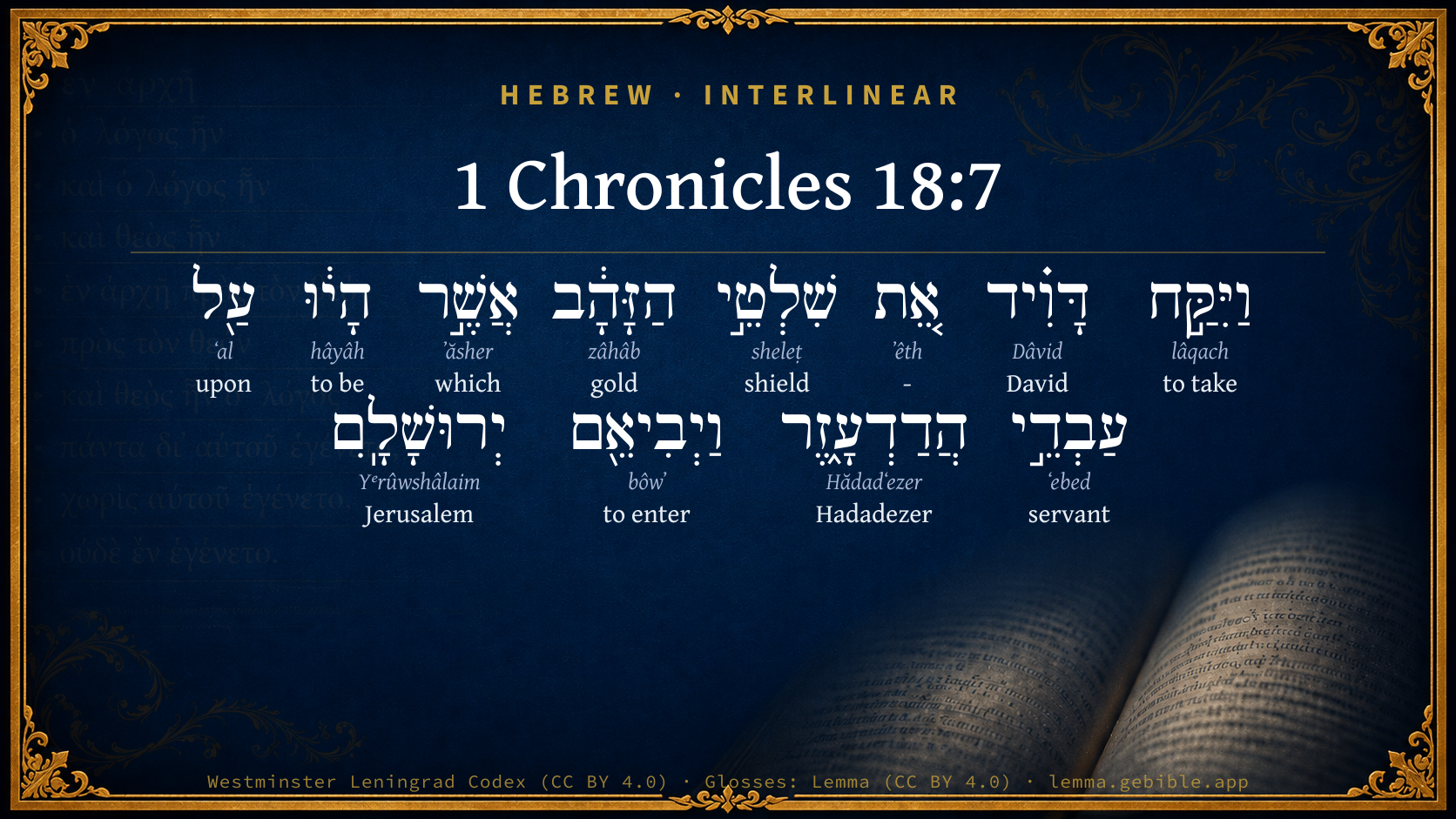
1 Chronicles 18:7

Hebrew (Westminster Leningrad Codex) 1 Chronicles 18:7 appears in the Hebrew Old Testament. The text above is from the Westminster Leningrad Codex. Each word links to its Strong’s number, a concise gloss, and parsing drawn from the Open Scriptures Hebrew Bible morphology. Click any word for its full Brown-Driver-Briggs (BDB) entry.
Download image
Cite this verse

1 Chronicles 18:7 (World English Bible). Public Domain. Lemma interlinear Bible study tool, https://lemma.gebible.app/v/1-chronicles/18/7.

Show BibTeX & RIS
BibTeX
RIS
English Translation
David took the shields of gold that were on the servants of Hadarezer, and brought them to Jerusalem.
World English Bible · Public Domain
Download a study sheet

One document with this verse’s original text, its word-by-word gloss line, the meaning frame, cross-references with their text, attributed commentary, and full source and license credits — printable, and it pastes into notes with its structure intact.

This verse Autodidact and up

Study sheet (.html) Plain text (.txt)

A passage Seminary Student

Up to 50 verses in one chapter. A passage sheet keeps up to 6 commentary sources and 12 cross-references per verse, in the order this page ranks them, and says so on the sheet whenever that leaves anything out. Ask for a single verse and you get the Autodidact verse sheet above.

Everything on this page stays free to read, with no account — the sheet is a download of what is already on screen, not access to it.

Want to remove ads? Support Godless Engineer
Compare translations 3

The same verse in 3 English versions, stacked beneath the original-language interlinear above. Click any original word for its lexicon entry.

Each is an independent rendering of the whole verse — the interlinear is not word-aligned to these translations.

Highlighted words mark where these versions differ — a whole-verse word diff, not a word-by-word alignment.

  • World English Bible Public Domain
    David took the shields of gold that were on the servants of Hadarezer, and brought them to Jerusalem.
  • King James Version Public Domain
    And David took the shields of gold that were on the servants of Hadarezer, and brought them to Jerusalem.
  • unfoldingWord Literal Text CC BY-SA 4.0
    And David took the shields of gold that were on the servants of Hadadezer, and he brought them to Jerusalem.

unfoldingWord Literal Text — © unfoldingWord, licensed CC BY-SA 4.0. Word-aligned USFM3 via Door43 (git.door43.org/unfoldingWord/en_ult).

Versions to compare (up to 4)

3 of 4 selected

Show all 18 translations

Every available English version of this verse, each an independent rendering of the whole verse.

  • World English Bible Public Domain
    David took the shields of gold that were on the servants of Hadarezer, and brought them to Jerusalem.
  • Berean Standard Bible Public Domain
    And David took the gold shields that belonged to the officers of Hadadezer and brought them to Jerusalem.
  • Majority Standard Bible Public Domain
    And David took the gold shields that belonged to the officers of Hadadezer and brought them to Jerusalem.
  • King James Version Public Domain
    And David took the shields of gold that were on the servants of Hadarezer, and brought them to Jerusalem.
  • American Standard Version (1901) Public Domain
    And David took the shields of gold that were on the servants of Hadarezer, and brought them to Jerusalem.
  • Revised Version (1885) Public Domain
    And David took the shields of gold that were on the servants of Hadarezer, and brought them to Jerusalem.
  • Geneva Bible (1599) Public Domain
    And Dauid tooke the shieldes of gold that were of the seruants of Hadarezer, and brought them to Ierusalem.
  • Douay-Rheims (1899) Public Domain
    And David took the golden quivers which the servants of Adarezer had, and he brought them to Jerusalem.
  • Young's Literal Translation Public Domain
    And David taketh the shields of gold that have been on the servants of Hadarezer, and bringeth them in to Jerusalem;
  • Literal Standard Version CC BY-SA 4.0
    And David takes the shields of gold that have been on the servants of Hadarezer, and brings them to Jerusalem;
  • Unlocked Literal Bible CC BY-SA 4.0
    David took the golden shields that were on Hadadezer's servants and brought them to Jerusalem.
  • unfoldingWord Literal Text CC BY-SA 4.0
    And David took the shields of gold that were on the servants of Hadadezer, and he brought them to Jerusalem.
  • Darby Bible Public Domain
    And David took the shields of gold that were on the servants of Hadarezer, and brought them to Jerusalem.
  • World Messianic Bible Public Domain
    David took the shields of gold that were on the servants of Hadadezer, and brought them to Jerusalem.
  • Webster's Bible Public Domain
    And David took the shields of gold that were on the servants of Hadarezer, and brought them to Jerusalem.
  • Free Bible Version CC BY-SA 4.0
    David took the shields of gold that were carried by Hadadezer's officers and brought them to Jerusalem.
  • Bible in Basic English Public Domain
    And the gold body-covers of the servants of Hadadezer, David took to Jerusalem.
  • JPS Tanakh (1917) Public Domain
    And David took the shields of gold that were on the servants of Hadarezer, and brought them to Jerusalem.

Literal Standard Version (2020), Covenant Press — licensed CC BY-SA 4.0. Text via the HelloAO Bible API (eBible.org). Unlocked Literal Bible (unfoldingWord) — licensed CC BY-SA 4.0. Text via the HelloAO Bible API (eBible.org). unfoldingWord Literal Text — © unfoldingWord, licensed CC BY-SA 4.0. Word-aligned USFM3 via Door43 (git.door43.org/unfoldingWord/en_ult). Free Bible Version, Dr. Jonathan Gallagher — licensed CC BY-SA 4.0. Text via the HelloAO Bible API (eBible.org).

Word by word

More ways to search: Search by grammar → Find every occurrence → Compare this word →

Practice this passage: Drill this verse → Learn its vocabulary →

שִׁלְטֵ֣י
sheleṭ
H7982
“shields of”
Noun, Common, Masculine, Plural, Construct
Part of Speech
Noun
Type
Common
Gender
Masculine
Number
Plural
State
Construct
Full BDB Definition

Origin: from H7980

TWOT: 2397a

shield
  1. וַיִּקַּ֣ח lâqach H3947 “and · to take” Conjunction + Verb, Qal, Sequential Imperfect, 3rd Person, Masculine, Singular
  2. דָּוִ֗יד Dâvid H1732 “David” Noun, Proper
  3. אֵ֚ת ʼêth H853 “-” Particle, Direct Object
  4. הַזָּהָ֔ב zâhâb H2091 “the · gold” Particle, Definite Article + Noun, Common, Masculine, Singular, Absolute
  5. אֲשֶׁ֣ר ʼăsher H834 “which” Particle, Relative
  6. הָי֔וּ hâyâh H1961 “to be” Verb, Qal, Perfect, 3rd Person, Common, Plural
  7. עַ֖ל ʻal H5921 “upon” Preposition
  8. עַבְדֵ֣י ʻebed H5650 “servants of” Noun, Common, Masculine, Plural, Construct
  9. הֲדַדְעָ֑זֶר Hădadʻezer H1909 “Hadadezer” Noun, Proper
  10. וַיְבִיאֵ֖ם bôwʼ H935 “and · to enter · them” Conjunction + Verb, Hiphil, Sequential Imperfect, 3rd Person, Masculine, Singular + Suffix, Personal, 3rd Person, Masculine, Plural
  11. יְרוּשָׁלִָֽם Yᵉrûwshâlaim H3389 “Jerusalem” Noun, Proper

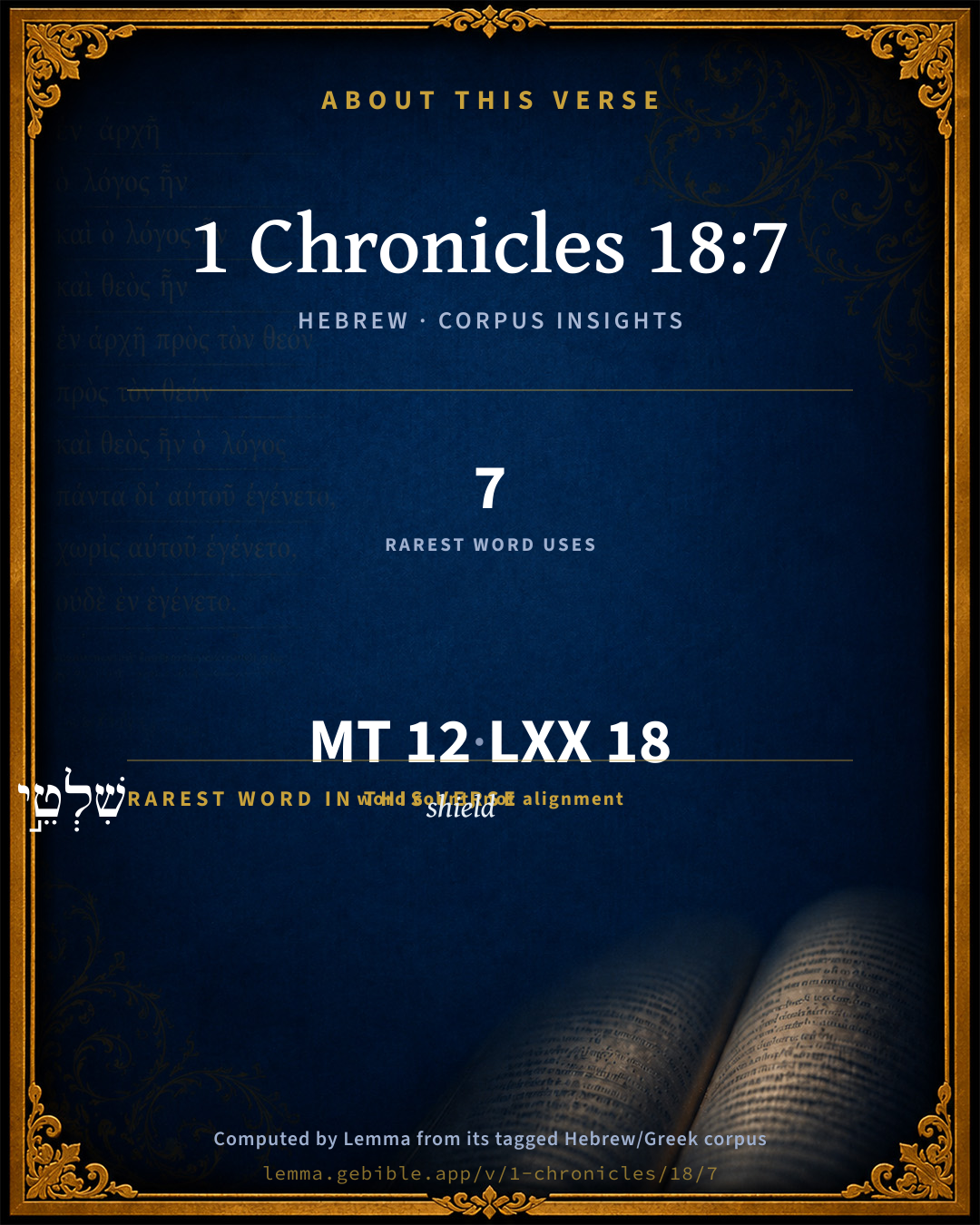
About this verse

These counts appear in no published source. They are computed here, from the morphology-tagged text and Lemma’s own curated glosses. What Lemma adds →

12
words
12
distinct lemmas
Historical
section

Notable vocabulary

The rarest word here is שִׁלְטֵ֣י shield H7982 — appearing just 7 times in the whole Hebrew Bible.

Shared distinctive vocabulary

שִׁלְטֵ֣י shield H7982 occurs in 7 verses of the Hebrew Bible. Also found in:

Grammatical profile

  • 3 verbs
  • 6 nouns
  • 1 preposition
  • 2 particles

Verb forms

  • וַיִּקַּ֣ח Qal · Sequential Imperfect
  • הָי֔וּ Qal · Perfect
  • וַיְבִיאֵ֖ם Hiphil · Sequential Imperfect

Hebrew & Septuagint length

In English translation the verse runs 18 words from the Hebrew and 18 from the Septuagint (LXX English) — the same length.

A rough comparison of the two English renderings, which tokenize alike — not a word-level alignment.

Word counts can differ between the Hebrew and the Greek without any difference in meaning — e.g. the Hebrew direct-object marker אֵת has no separate Greek word, and Greek often adds the article ὁ.

In the original languages it is 12 Hebrew tokens and 18 Greek tokens — but the two are counted differently (Hebrew bundles its prefixes and suffixes into one token; the Greek is in lemma form), so that isn’t a like-for-like length.

Cross-references

4

Topical passages linked to 1 Chronicles 18:7 in the Treasury of Scripture Knowledge — connected by theme and wording, ordered by reader-vote popularity; previews shown in the World English Bible.

  • 1 Kings 10:16–17 King Solomon made two hundred bucklers of beaten gold; six hundred [shekels] of gold went to one buckler.
  • 1 Kings 14:26–28 and he took away the treasures of the house of Yahweh, and the treasures of the king's house; he even took away all: and he took away all the shields of gold which Solomon had made.
  • 2 Chronicles 9:15–16 King Solomon made two hundred bucklers of beaten gold; six hundred [shekels] of beaten gold went to one buckler.
  • 2 Chronicles 12:9–10 So Shishak king of Egypt came up against Jerusalem, and took away the treasures of the house of Yahweh, and the treasures of the king's house: he took all away: he took away also the shields of gold which Solomon had made.

Cross-references courtesy of OpenBible.info (CC BY 4.0).

Hebrew and Greek witnesses Masoretic Hebrew ↔ Greek Septuagint

The same verse in the two great witnesses to the Old Testament, shown verse-for-verse.

These are two independent witnesses, not word-aligned to each other, and the Septuagint is shown in lemma (dictionary) form.

Hebrew 1 Chronicles 18:7 Masoretic · Westminster Leningrad Codex

וַיִּקַּ֣ח דָּוִ֗יד אֵ֚ת שִׁלְטֵ֣י הַזָּהָ֔ב אֲשֶׁ֣ר הָי֔וּ עַ֖ל עַבְדֵ֣י הֲדַדְעָ֑זֶר וַיְבִיאֵ֖ם יְרוּשָׁלִָֽם

David took the shields of gold that were on the servants of Hadarezer, and brought them to Jerusalem.

World English Bible · Public Domain

Greek LXX 1 Chronicles 18:7 Septuagint · lemma form

καί λαμβάνω δαυίδ ὁ κλοιός ὁ χρυσοῦς ὅς εἰμί ἐπί ὁ παῖς αδρααζαρ καί φέρω αὐτός εἰς ἰερουσαλήμ

And David took the golden collars that were on the servants of Adraazar, and brought them to Jerusalem.

LXX2012 (modern English Septuagint) · Public Domain

On this verse, The Cambridge Bible for Schools and Colleges discusses the Septuagint’s reading. Read the note in Commentary ↓

Hebrew: Westminster Leningrad Codex (CC BY 4.0). Greek: Septuagint (public domain); English from LXX2012 (modern English Septuagint) (Public Domain). How the Septuagint differs from the Hebrew →

Commentary

Notes on 1 Chronicles 18:7 from classic Christian and Jewish commentators (each source and its license shown beneath its notes). The classic Christian expositions comment on the surrounding passage and are grouped to its opening verse, so a note may address several verses; the Jewish commentaries on the Tanakh (Rashi and others) are per-verse, so they appear only where the commentator wrote on this verse.

Lemma curates 59 commentaries, every one of them public domain or Creative Commons licensed, each selected and text-cleaned for this edition rather than reprinted as found. About our sources →

The Cambridge Bible for Schools and Colleges

gen. ed. J. J. S. Perowne

7. shields of gold] “shields” = Heb. shĕlâtim. The meaning of the Heb. word is doubtful; most probably it does not mean “shield,” for (1) a shield would not be described as “upon” the person to whom it belonged, (2) the early authorities, i.e. the LXX. translators, the Targum, and the Peshitta (on 2Sa_8:7; 2Ki_11:10; Jer_51:11; Eze_27:11) never give “shield,” but either leave the word untranslated or give various conjectural renderings. A later authority (Targ. on 1Ch_18:7; 2Ch_23:9) gives “shield,” while LXX. gives “collars (κλοιούς),” and “arms,” or “shields” (τὰ ὅπλα) in 2 Chr.

The most probable rendering of the word is “suit of armour”; cp. R.V. mg. on Jer_51:11.

and brought them to Jerusalem] So Heb. LXX. Targ., but the Peshitta (all important MSS.) omits the words, and they may be a gloss introduced from 2Sa_8:7.

The Cambridge Bible for Schools and Colleges (gen. ed. J. J. S. Perowne; Cambridge University Press, 1878–1918) — public domain. Text from a community e-Sword module.

The Pulpit Commentary

The shields; Hebrew fl,v,. Much doubt has been entertained as to the meaning of this word. Its etymology is uncertain. Gesenius derives it from a root signifying "hardness." For the most part, however, the context of the seven places of its occurrence which he instances (2Sa_8:7; 2Ki_11:10; 1Ch_18:7 2Ch_23:9; Son_4:4; Jer_51:11; Eze_27:11) favour the rendering "shields," though the quotation from Jer_51:11 (literally, "fill ye the shields") is not so satisfactory. The wealth of Zobah is, of course, illustrated by these shields of gold.

The Pulpit Commentary (1880–1919), ed. H.D.M. Spence-Jones & Joseph S. Exell — public domain. Text from a community e-Sword module.

Ellicott's Commentary for English Readers

(7) On.—Samuel, “to” = belonging to.

A Bible Commentary for English Readers, edited by Charles John Ellicott (1878–1897) — public domain. Text from a community e-Sword module.

Haydock's Catholic Bible Commentary

Quivers. Hebrew, "the shields," &c. The term is variously translated, 2 Kings.

George Leo Haydock (1774–1849), Haydock's Catholic Family Bible and Commentary, 1859 edition — public domain. Excludes Psalms (Douay-Rheims chapter numbering differs from Protestant) and Deuterocanonical books (Catholic canon only).

unfoldingWord translationNotes

Door43 World Missions Community

Hadadezer

This was the king of Zobah. See how you translated his name in 1 Chronicles 18:3.

that were on Hadadezer's servants

"that Hadadezar's servants carried"

Tebah ... Kun

These are the names of cities. (See: How to Translate Names)

very much bronze

"a large quantity of bronze"

It was with this bronze that Solomon later made the bronze basin called "The Sea," the pillars, and the bronze equipment

The writer adds this background information to explain what would happen to this bronze at a later time. (See: Background Information)

the bronze basin called "The Sea,"

This a large bronze bowl, about 5 meters across, that was kept in the temple for ceremonial washing.

translationWords

gold

shield

Jerusalem

bronze

Solomon

column

unfoldingWord translationNotes — © Distant Shores Media and the Door43 World Missions Community, licensed CC BY-SA 4.0. Source: git.door43.org/Door43/en_tn.

Rashi

Rabbi Shlomo Yitzchaki (Rashi)

the golden quivers - Heb. שִׁלְטֵי, cuyvres, cuevres in Old French, quivers, and a like word is found in Jeremiah (51:11): “Polish the arrows, fill the quivers הַשְּׁלָטִים”.

Rashi on the Tanakh — English translations: “The Judaica Press complete Tanach with Rashi, translated by A. J. Rosenberg” (CC BY 4.0); “Pentateuch with Rashi's commentary by M. Rosenbaum and A.M. Silbermann, 1929-1934” (public domain); “The Metsudah Tanach series, Lakewood, N.J” (CC BY 4.0); and “The Book of Joshua, Metsudah Publications, 1997” (CC BY 4.0). Text via Sefaria.

Lesson kit

Teaching starters — assembled from the data on this page, not authored interpretation. Every prompt links to the verse data it draws on. Edit before teaching.

1 Chronicles, in the Historical, opens this verse with 12 words (12 distinct Hebrew lemmas). Its most distinctive word is sheleṭ (“shield”). A historical commentator’s framing appears above. Read the whole chapter for the surrounding context.

Discussion questions

  1. How does “shield” (sheleṭ) shape what this verse is saying?
  2. How does 2 Samuel 8:7, which shares the word «shield», read alongside this verse?
  3. The translations on this page render this verse differently — a whole-verse word diff, not a word-by-word alignment. What might account for the different wordings?
  4. «וַיִּקַּ֣ח» is a Qal Sequential Imperfect verb. How does that grammatical form shape the action described?
  5. Compare how The Cambridge Bible for Schools and Colleges and The Pulpit Commentary read this verse. Where do they agree or differ?

Things to notice

Reading settings

Reading text

Shown beneath each verse's original-language words.

Old Testament
Old Testament edition

Read the OT as the Masoretic Hebrew (MT) or the Greek Septuagint (LXX).

English shown for the Greek Septuagint (in the Hebrew ↔ Greek comparison).

Comparing translations? Open the Compare panel on any verse page to stack up to four side by side.