
2 Kings 20:5

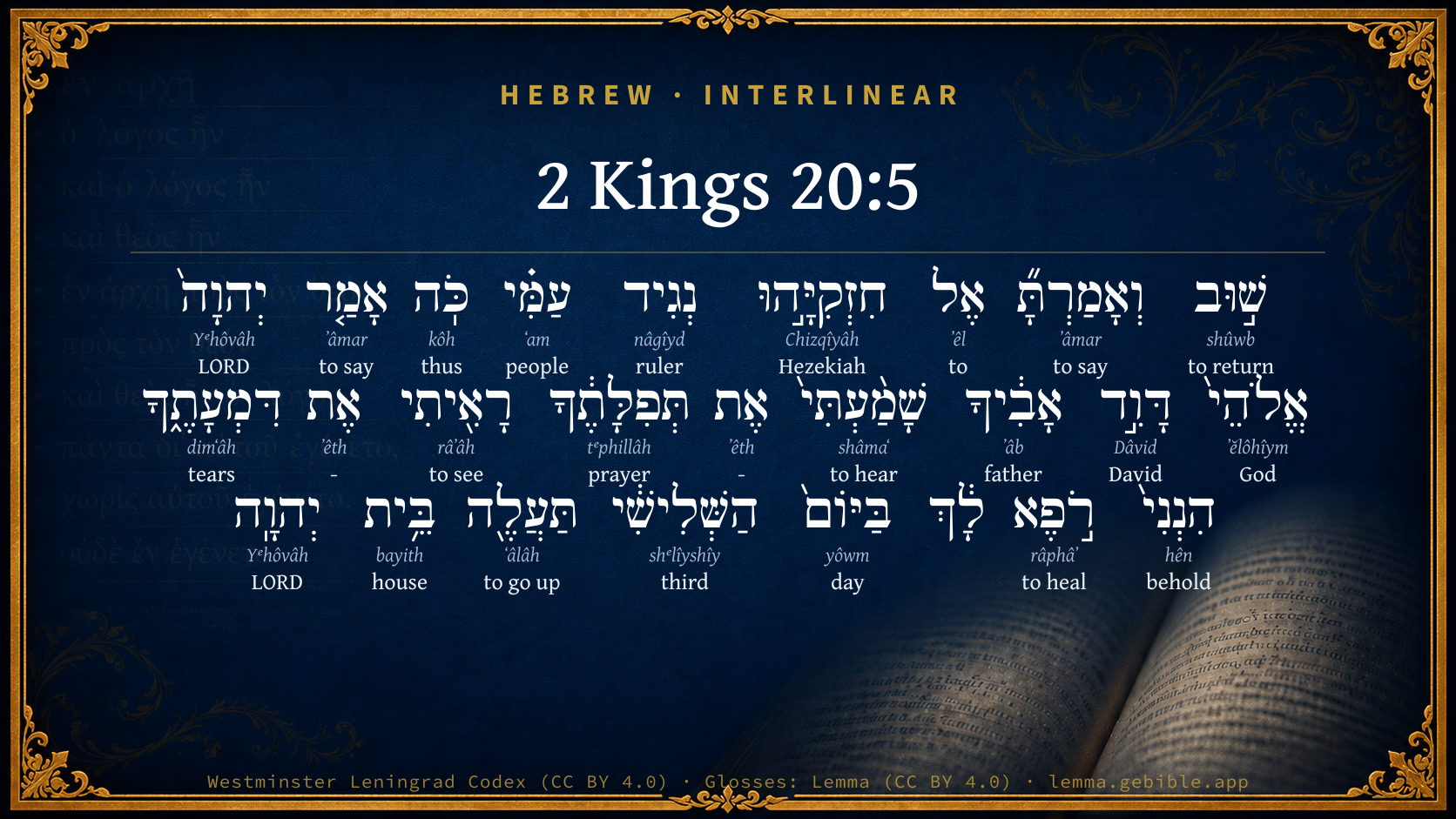
Hebrew (Westminster Leningrad Codex) 2 Kings 20:5 appears in the Hebrew Old Testament. The text above is from the Westminster Leningrad Codex. Each word links to its Strong’s number, a concise gloss, and parsing drawn from the Open Scriptures Hebrew Bible morphology. Click any word for its full Brown-Driver-Briggs (BDB) entry.
Download image
Cite this verse

2 Kings 20:5 (World English Bible). Public Domain. Lemma interlinear Bible study tool, https://lemma.gebible.app/v/2-kings/20/5.

Show BibTeX & RIS
BibTeX
RIS
English Translation
Turn back, and tell Hezekiah the prince of my people, Thus says Yahweh, the God of David your father, I have heard your prayer, I have seen your tears: behold, I will heal you; on the third day you shall go up to the house of Yahweh.
World English Bible · Public Domain
Highlights
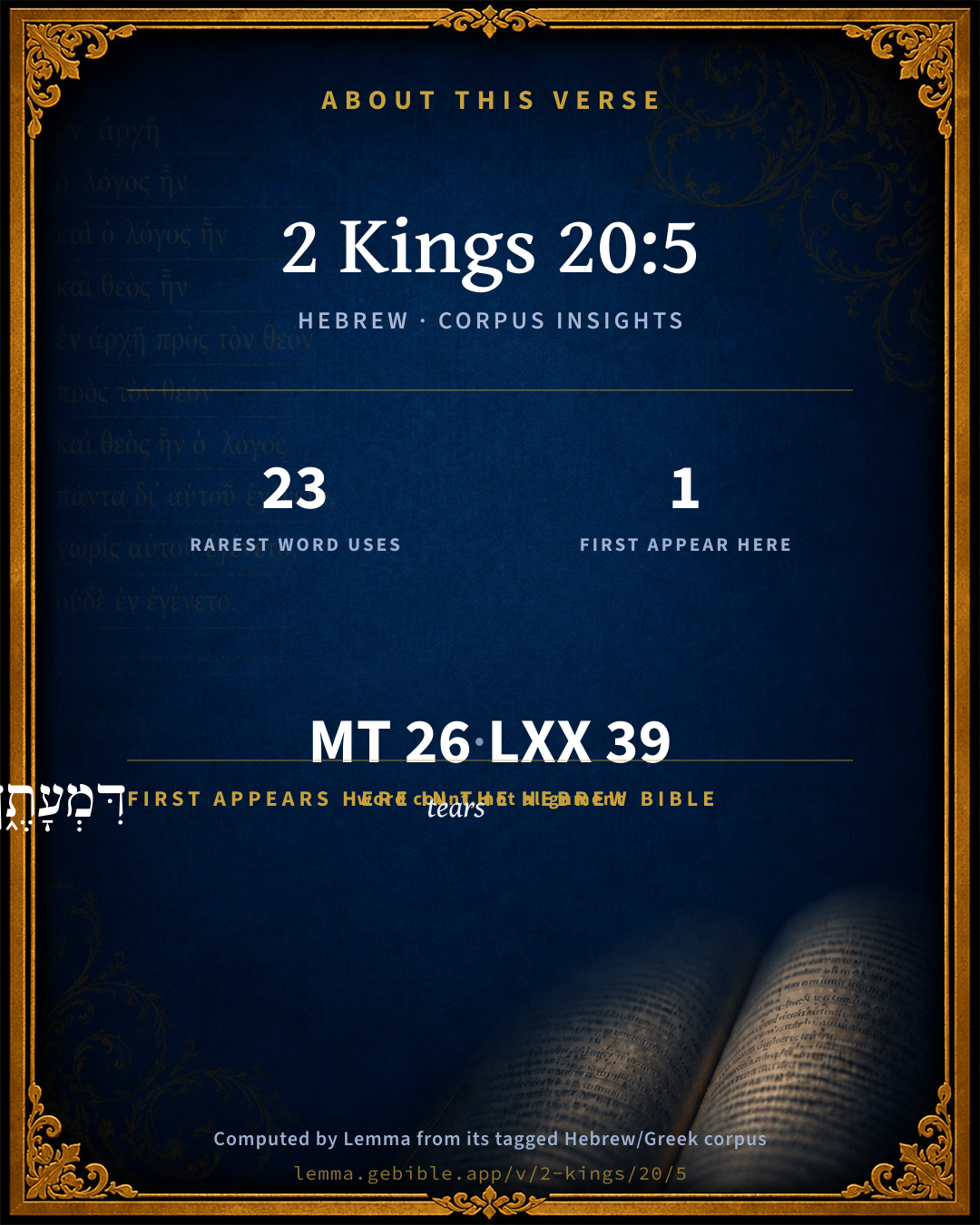
  • 1 first appearance in the Hebrew Bible
Full analysis ↓
Download a study sheet

One document with this verse’s original text, its word-by-word gloss line, the meaning frame, cross-references with their text, attributed commentary, and full source and license credits — printable, and it pastes into notes with its structure intact.

This verse Autodidact and up

Study sheet (.html) Plain text (.txt)

A passage Seminary Student

Up to 50 verses in one chapter. A passage sheet keeps up to 6 commentary sources and 12 cross-references per verse, in the order this page ranks them, and says so on the sheet whenever that leaves anything out. Ask for a single verse and you get the Autodidact verse sheet above.

Everything on this page stays free to read, with no account — the sheet is a download of what is already on screen, not access to it.

Want to remove ads? Support Godless Engineer
Compare translations 3

The same verse in 3 English versions, stacked beneath the original-language interlinear above. Click any original word for its lexicon entry.

Each is an independent rendering of the whole verse — the interlinear is not word-aligned to these translations.

Highlighted words mark where these versions differ — a whole-verse word diff, not a word-by-word alignment.

  • World English Bible Public Domain
    Turn back, and tell Hezekiah the prince of my people, Thus says Yahweh, the God of David your father, I have heard your prayer, I have seen your tears: behold, I will heal you; on the third day you shall go up to the house of Yahweh.
  • King James Version Public Domain
    Turn again, and tell Hezekiah the captain of my people, Thus saith the LORD, the God of David thy father, I have heard thy prayer, I have seen thy tears: behold, I will heal thee: on the third day thou shalt go up unto the house of the LORD.
  • unfoldingWord Literal Text CC BY-SA 4.0
    “Return, and you shall say to Hezekiah, the leader of my people, ‘Thus says Yahweh, the God of David your father, “I have heard your prayer. I have seen your weeping. Behold me, healing you. On the third day, you will go up the house of Yahweh.

unfoldingWord Literal Text — © unfoldingWord, licensed CC BY-SA 4.0. Word-aligned USFM3 via Door43 (git.door43.org/unfoldingWord/en_ult).

Versions to compare (up to 4)

3 of 4 selected

Show all 18 translations

Every available English version of this verse, each an independent rendering of the whole verse.

  • World English Bible Public Domain
    Turn back, and tell Hezekiah the prince of my people, Thus says Yahweh, the God of David your father, I have heard your prayer, I have seen your tears: behold, I will heal you; on the third day you shall go up to the house of Yahweh.
  • Berean Standard Bible Public Domain
    “Go back and tell Hezekiah the leader of My people that this is what the LORD, the God of your father David, says: ‘I have heard your prayer; I have seen your tears. I will surely heal you. On the third day from now you will go up to the house of the LORD.
  • Majority Standard Bible Public Domain
    “Go back and tell Hezekiah the leader of My people that this is what the LORD, the God of your father David, says: ‘I have heard your prayer; I have seen your tears. I will surely heal you. On the third day from now you will go up to the house of the LORD.
  • King James Version Public Domain
    Turn again, and tell Hezekiah the captain of my people, Thus saith the LORD, the God of David thy father, I have heard thy prayer, I have seen thy tears: behold, I will heal thee: on the third day thou shalt go up unto the house of the LORD.
  • American Standard Version (1901) Public Domain
    Turn back, and say to Hezekiah the prince of my people, Thus saith Jehovah, the God of David thy father, I have heard thy prayer, I have seen thy tears: behold, I will heal thee; on the third day thou shalt go up unto the house of Jehovah.
  • Revised Version (1885) Public Domain
    Turn again, and say to Hezekiah the prince of my people, Thus saith the LORD, the God of David thy father, I have heard thy prayer, I have seen thy tears: behold, I will heal thee: on the third day thou shalt go up unto the house of the LORD.
  • Geneva Bible (1599) Public Domain
    Turne againe, and tell Hezekiah the captaine of my people, Thus saith the Lord God of Dauid thy father, I haue heard thy prayer, and seene thy teares: behold, I haue healed thee, and ye third day thou shalt go vp to ye house of ye Lord,
  • Douay-Rheims (1899) Public Domain
    Go back, and tell Ezechias the captain of my people: Thus saith the Lord the God of David thy father: I have heard thy prayer, and I have seen thy tears: and behold I have healed thee; on the third day thou shalt go up to the temple of the Lord.
  • Young's Literal Translation Public Domain
    `Turn back, and thou hast said unto Hezekiah, leader of My people: Thus said Jehovah, God of David thy father, I have heard thy prayer, I have seen thy tear, lo, I give healing to thee, on the third day thou dost go up to the house of Jehovah;
  • Literal Standard Version CC BY-SA 4.0
    “Return, and you have said to Hezekiah, leader of My people, Thus said YHWH, God of your father David: I have heard your prayer, I have seen your tear, behold, I give healing to you. On the third day you go up to the house of YHWH;
  • Unlocked Literal Bible CC BY-SA 4.0
    “Turn back, and say to Hezekiah, the leader of my people, 'This is what Yahweh, the God of David your ancestor, says: “I have heard your prayer, and I have seen your tears. I am about to heal you on the third day, and you will go up to the house of Yahweh.
  • unfoldingWord Literal Text CC BY-SA 4.0
    “Return, and you shall say to Hezekiah, the leader of my people, ‘Thus says Yahweh, the God of David your father, “I have heard your prayer. I have seen your weeping. Behold me, healing you. On the third day, you will go up the house of Yahweh.
  • Darby Bible Public Domain
    Return, and tell Hezekiah the captain of my people, Thus saith Jehovah, the God of David thy father: I have heard thy prayer, I have seen thy tears; behold, I will heal thee: on the third day thou shalt go up to the house of Jehovah;
  • World Messianic Bible Public Domain
    “Turn back, and tell Hezekiah the prince of my people, ‘The LORD, the God of David your father, says, “I have heard your prayer. I have seen your tears. Behold, I will heal you. On the third day, you will go up to the LORD’s house.
  • Webster's Bible Public Domain
    Turn again, and tell Hezekiah the captain of my people, Thus saith the LORD, the God of David thy father, I have heard thy prayer, I have seen thy tears: behold, I will heal thee: on the third day thou shalt go up to the house of the LORD.
  • Free Bible Version CC BY-SA 4.0
    “Go back in and tell Hezekiah, the ruler of my people, This is what the Lord, the God of your forefather David, says: I have heard your prayer, I have seen your tears. Look! I am going to heal you. In three days time you will go to the Lord's Temple.
  • Bible in Basic English Public Domain
    Go back and say to Hezekiah, the ruler of my people, The Lord, the God of David your father, says, Your prayer has come to my ears, and I have seen your weeping; see, I will make you well: on the third day you will go up to the house of the Lord.
  • JPS Tanakh (1917) Public Domain
    'Return, and say to Hezekiah the prince of My people: Thus saith the LORD, the God of David thy father: I have heard thy prayer, I have seen thy tears; behold, I will heal thee; on the third day thou shalt go up unto the house of the LORD.

Literal Standard Version (2020), Covenant Press — licensed CC BY-SA 4.0. Text via the HelloAO Bible API (eBible.org). Unlocked Literal Bible (unfoldingWord) — licensed CC BY-SA 4.0. Text via the HelloAO Bible API (eBible.org). unfoldingWord Literal Text — © unfoldingWord, licensed CC BY-SA 4.0. Word-aligned USFM3 via Door43 (git.door43.org/unfoldingWord/en_ult). Free Bible Version, Dr. Jonathan Gallagher — licensed CC BY-SA 4.0. Text via the HelloAO Bible API (eBible.org).

Word by word

More ways to search: Search by grammar → Find every occurrence → Compare this word →

Practice this passage: Drill this verse → Learn its vocabulary →

דִּמְעָתֶ֑ךָ
dimʻâh
H1832
“tears · your”
Noun, Common, Feminine, Singular, Construct + Suffix, Personal, 2nd Person, Masculine, Singular
Part of Speech
Noun
Type
Common
Gender
Feminine
Number
Singular
State
Construct
Full BDB Definition

Origin: from H1831

TWOT: 442b

tears
  1. שׁ֣וּב shûwb H7725 “return” Verb, Qal, Imperative, 2nd Person, Masculine, Singular
  2. וְאָמַרְתָּ֞ ʼâmar H559 “and · to say” Conjunction + Verb, Qal, Sequential Perfect, 2nd Person, Masculine, Singular
  3. אֶל ʼêl H413 “to” Preposition
  4. חִזְקִיָּ֣הוּ Chizqîyâh H2396 “Hezekiah” Noun, Proper
  5. נְגִיד nâgîyd H5057 “ruler of” Noun, Common, Masculine, Singular, Construct
  6. עַמִּ֗י ʻam H5971 “people · my” Noun, Common, Masculine, Singular, Construct + Suffix, Personal, 1st Person, Common, Singular
  7. כֹּֽה kôh H3541 “thus” Adverb
  8. אָמַ֤ר ʼâmar H559 “to say” Verb, Qal, Perfect, 3rd Person, Masculine, Singular
  9. יְהוָה֙ Yᵉhôvâh H3068 “LORD” Noun, Proper
  10. אֱלֹהֵי֙ ʼĕlôhîym H430 “God(s) of” Noun, Common, Masculine, Plural, Construct
  11. דָּוִ֣ד Dâvid H1732 “David” Noun, Proper
  12. אָבִ֔יךָ ʼâb H1 “father · your” Noun, Common, Masculine, Singular, Construct + Suffix, Personal, 2nd Person, Masculine, Singular
  13. שָׁמַ֨עְתִּי֙ shâmaʻ H8085 “to hear” Verb, Qal, Perfect, 1st Person, Common, Singular
  14. אֶת ʼêth H853 “-” Particle, Direct Object
  15. תְּפִלָּתֶ֔ךָ tᵉphillâh H8605 “prayer · your” Noun, Common, Feminine, Singular, Construct + Suffix, Personal, 2nd Person, Masculine, Singular
  16. רָאִ֖יתִי râʼâh H7200 “to see” Verb, Qal, Perfect, 1st Person, Common, Singular
  17. אֶת ʼêth H853 “-” Particle, Direct Object
  18. הִנְנִי֙ hên H2005 “behold · me” Particle, Demonstrative + Suffix, Personal, 1st Person, Common, Singular
  19. רֹ֣פֶא râphâʼ H7495 “healing” Verb, Qal, Participle Active, Masculine, Singular, Absolute
  20. בַּיּוֹם֙ yôwm H3117 “in/at the · day” Preposition, Determined + Noun, Common, Masculine, Singular, Absolute
  21. הַשְּׁלִישִׁ֔י shᵉlîyshîy H7992 “the · third” Particle, Definite Article + Adjective, Ordinal number, Masculine, Singular, Absolute
  22. תַּעֲלֶ֖ה ʻâlâh H5927 “to go up” Verb, Qal, Imperfect, 2nd Person, Masculine, Singular
  23. בֵּ֥ית bayith H1004 “house of” Noun, Common, Masculine, Singular, Construct
  24. יְהוָֽה Yᵉhôvâh H3068 “LORD” Noun, Proper

About this verse

These counts appear in no published source. They are computed here, from the morphology-tagged text and Lemma’s own curated glosses. What Lemma adds →

26
words
22
distinct lemmas
Historical
section

Notable vocabulary

The rarest word here is דִּמְעָתֶ֑ךָ tears H1832 — appearing just 23 times in the whole Hebrew Bible.

First appearance in Scripture

This word makes its first canonical appearance in the Hebrew Bible here:

  • דִּמְעָתֶ֑ךָ tears H1832

Shared distinctive vocabulary

דִּמְעָתֶ֑ךָ tears H1832 occurs in 22 verses of the Hebrew Bible. Also found in:

Grammatical profile

  • 7 verbs
  • 12 nouns
  • 1 adjective
  • 2 prepositions
  • 1 adverb
  • 3 particles

Verb forms

  • שׁ֣וּב Qal · Imperative
  • וְאָמַרְתָּ֞ Qal · Sequential Perfect
  • אָמַ֤ר Qal · Perfect
  • שָׁמַ֨עְתִּי֙ Qal · Perfect
  • רָאִ֖יתִי Qal · Perfect
  • רֹ֣פֶא Qal · Participle Active
  • תַּעֲלֶ֖ה Qal · Imperfect

Repetition

Words recur within this verse — often emphatic in Hebrew:

  • וְאָמַרְתָּ֞ to say H559 ×2
  • יְהוָה֙ LORD H3068 ×2

Hebrew & Septuagint length

In English translation the verse runs 47 words from the Hebrew and 51 from the Septuagint (LXX English) — closely comparable.

A rough comparison of the two English renderings, which tokenize alike — not a word-level alignment.

Word counts can differ between the Hebrew and the Greek without any difference in meaning — e.g. the Hebrew direct-object marker אֵת has no separate Greek word, and Greek often adds the article ὁ.

In the original languages it is 26 Hebrew tokens and 39 Greek tokens — but the two are counted differently (Hebrew bundles its prefixes and suffixes into one token; the Greek is in lemma form), so that isn’t a like-for-like length.

Cross-references

31

Topical passages linked to 2 Kings 20:5 in the Treasury of Scripture Knowledge — connected by theme and wording, ordered by reader-vote popularity; previews shown in the World English Bible.

  • Psalms 66:19–20 But most assuredly, God has listened. He has heard the voice of my prayer.
  • Isaiah 38:5 Go, and tell Hezekiah, Thus says Yahweh, the God of David your father, I have heard your prayer, I have seen your tears: behold, I will add to your days fifteen years.
  • 1 Samuel 9:16 Tomorrow about this time I will send you a man out of the land of Benjamin, and you shall anoint him to be prince over my people Israel; and he shall save my people out of the hand of the Philistines: for I have looked on my people, because their cry is come to me.
  • 2 Kings 19:20 Then Isaiah the son of Amoz sent to Hezekiah, saying, Thus says Yahweh, the God of Israel, Whereas you have prayed to me against Sennacherib king of Assyria, I have heard [you].
  • Psalms 39:12 "Hear my prayer, Yahweh, and give ear to my cry. Don't be silent at my tears. For I am a stranger with you, A foreigner, as all my fathers were.
  • Psalms 126:5 Those who sow in tears will reap in joy.
  • Psalms 147:3 He heals the broken in heart, And binds up their wounds.
  • James 5:14–15 Is any among you sick? Let him call for the elders of the assembly, and let them pray over him, anointing him with oil in the name of the Lord,
  • Psalms 56:8 You number my wanderings. You put my tears into your bottle. Aren't they in your book?
  • Revelation 7:17 for the Lamb who is in the midst of the throne shepherds them, and leads them to springs of waters of life. And God will wipe away every tear from their eyes."
  • Psalms 118:17–19 I will not die, but live, And declare Yah's works.
  • Matthew 22:32 'I am the God of Abraham, and the God of Isaac, and the God of Jacob?' God is not the God of the dead, but of the living."
  • Luke 1:13 But the angel said to him, "Don't be afraid, Zacharias, because your request has been heard, and your wife, Elizabeth, will bear you a son, and you shall call his name John.
  • Exodus 15:26 and he said, "If you will diligently listen to the voice of Yahweh your God, and will do that which is right in his eyes, and will pay attention to his commandments, and keep all his statutes, I will put none of the diseases on you, which I have put on the Egyptians; for I am Yahweh who heals you."
  • Joshua 5:14–15 He said, No; but [as] prince of the host of Yahweh am I now come. Joshua fell on his face to the earth, and did worship, and said to him, What says my lord to his servant?
  • 1 Samuel 10:1 Then Samuel took the vial of oil, and poured it on his head, and kissed him, and said, Isn't it that Yahweh has anointed you to be prince over his inheritance?
  • Job 33:19–26 He is chastened also with pain on his bed, With continual strife in his bones;
  • John 5:14 Afterward Jesus found him in the temple, and said to him, "Behold, you are made well. Sin no more, so that nothing worse happens to you."
  • Deuteronomy 32:39 See now that I, even I, am he, There is no god with me: I kill, and I make alive; I wound, and I heal; There is none who can deliver out of my hand.
  • 2 Samuel 5:2 In times past, when Saul was king over us, it was you who led out and brought in Israel: and Yahweh said to you, You shall be shepherd of my people Israel, and you shall be prince over Israel.
  • 1 Chronicles 17:2–4 Nathan said to David, Do all that is in your heart; for God is with you.
  • Isaiah 38:22 Hezekiah also had said, What is the sign that I shall go up to the house of Yahweh?
  • Hebrews 2:10 For it became him, for whom are all things, and through whom are all things, in bringing many children to glory, to make the author of their salvation perfect through sufferings.
  • 2 Kings 20:7–8 Isaiah said, Take a cake of figs. They took and laid it on the boil, and he recovered.
  • Psalms 65:2 You who hear prayer, To you all men will come.
  • Psalms 116:12–14 What will I give to Yahweh for all his benefits toward me?
  • Isaiah 55:3 Turn your ear, and come to me; hear, and your soul shall live: and I will make an everlasting covenant with you, even the sure mercies of David.
  • 2 Samuel 7:3–5 Nathan said to the king, Go, do all that is in your heart; for Yahweh is with you.
  • 2 Chronicles 13:12 Behold, God is with us at our head, and his priests with the trumpets of alarm to sound an alarm against you. Children of Israel, don't you fight against Yahweh, the God of your fathers; for you shall not prosper.
  • 2 Chronicles 34:3 For in the eighth year of his reign, while he was yet young, he began to seek after the God of David his father; and in the twelfth year he began to purge Judah and Jerusalem from the high places, and the Asherim, and the engraved images, and the molten images.
  • Psalms 66:13–15 I will come into your temple with burnt offerings. I will pay my vows to you,

Cross-references courtesy of OpenBible.info (CC BY 4.0).

Hebrew and Greek witnesses Masoretic Hebrew ↔ Greek Septuagint

The same verse in the two great witnesses to the Old Testament, shown verse-for-verse.

These are two independent witnesses, not word-aligned to each other, and the Septuagint is shown in lemma (dictionary) form.

Hebrew 2 Kings 20:5 Masoretic · Westminster Leningrad Codex

שׁ֣וּב וְאָמַרְתָּ֞ אֶל חִזְקִיָּ֣הוּ נְגִיד עַמִּ֗י כֹּֽה אָמַ֤ר יְהוָה֙ אֱלֹהֵי֙ דָּוִ֣ד אָבִ֔יךָ שָׁמַ֨עְתִּי֙ אֶת תְּפִלָּתֶ֔ךָ רָאִ֖יתִי אֶת דִּמְעָתֶ֑ךָ הִנְנִי֙ רֹ֣פֶא לָ֔ךְ בַּיּוֹם֙ הַשְּׁלִישִׁ֔י תַּעֲלֶ֖ה בֵּ֥ית יְהוָֽה

Turn back, and tell Hezekiah the prince of my people, Thus says Yahweh, the God of David your father, I have heard your prayer, I have seen your tears: behold, I will heal you; on the third day you shall go up to the house of Yahweh.

World English Bible · Public Domain

Greek LXX 2 Kings 20:5 Septuagint · lemma form

ἐπιστρέφω καί εἶπον πρός εζεκιαν ὁ ἡγέομαι ὁ λαός ἐγώ ὅδε λέγω κύριος ὁ θεός δαυίδ ὁ πατήρ σύ ἀκούω ὁ προσευχή σύ ὁράω ὁ δάκρυ σύ ἰδού ἐγώ ἰάομαι σύ ὁ ἡμέρα ὁ τρίτος ἀναβαίνω εἰς οἶκος κύριος

Turn back, and you shall say to Ezekias the ruler of my people, Thus says the Lord God of your father David, I have heard your prayer, I have seen your tears: behold, I will heal you: on the third day you shall go up to the house of the Lord.

LXX2012 (modern English Septuagint) · Public Domain

Hebrew: Westminster Leningrad Codex (CC BY 4.0). Greek: Septuagint (public domain); English from LXX2012 (modern English Septuagint) (Public Domain). How the Septuagint differs from the Hebrew →

Targum (Aramaic paraphrase)

1

The Targum is the ancient Jewish Aramaic paraphrase of the Hebrew Scriptures — an interpretive translation, not the Hebrew text itself. Onkelos (literal) and Pseudo-Jonathan (expansive) render the Torah, and Jonathan the Prophets. Coverage is partial: where no permissively-licensed English translation exists for a verse, only the Aramaic is shown. This is verse-level text, not a word-by-word alignment to the Hebrew.

  1. Targum Jonathan Prophets (Joshua–Malachi)
    תּוּב וְתֵימַר לְחִזְקִיָה מַלְכָּא דְעַמִי כִּדְנַן אֲמַר יְיָ אֱלָהֵיהּ דְדָוִד אֲבוּךְ שְׁמִיעַ קֳדָמַי צְלוֹתָךְ גַלְיָא קֳדָמַי דִמְעָתָךְ הָא אֲנָא מַסֵי לָךְ בְיוֹמָא תְלִיתָאָה תִּיסַק לְבֵית מַקְדְשָׁא דַיָי:

    (no public-domain English translation for this verse)

    Targum Jonathan — Aramaic: “Mikraot Gedolot” (public domain). English: “Sefaria Community Translation” (CC0 1.0 (public-domain dedication)); “London "Chaldee Paraphrase," 1871” (public domain). Text via Sefaria.

Commentary

Notes on 2 Kings 20:5 from classic Christian and Jewish commentators (each source and its license shown beneath its notes). The classic Christian expositions comment on the surrounding passage and are grouped to its opening verse, so a note may address several verses; the Jewish commentaries on the Tanakh (Rashi and others) are per-verse, so they appear only where the commentator wrote on this verse.

Lemma curates 59 commentaries, every one of them public domain or Creative Commons licensed, each selected and text-cleaned for this edition rather than reprinted as found. About our sources →

Trapp's Complete Commentary

John Trapp

2Ki 20:5 Turn again, and tell Hezekiah the captain of my people, Thus saith the LORD, the God of David thy father, I have heard thy prayer, I have seen thy tears: behold, I will heal thee: on the third day thou shalt go up unto the house of the LORD.

Ver. 5. The captain of my people,] Antecessor. See on 1Sa 9:16.

The God of David.] To whom I promised a continued succession on the throne of Judah; and will therefore lengthen thy life, and give thee a son.

To the house of the Lord.] Hezekiah’s both duty and disposition, as a right son of David, whose song was, "I shall yet praise him in his holy temple, who is the health of my countenance, and my God."

John Trapp, A Commentary or Exposition upon All the Books of the Old and New Testament (1647–1656) — public domain. Text from a community e-Sword module.

Tyndale Open Study Notes

Tyndale Open Resources

20:5 Hezekiah’s commitment to the Lord compared favorably with that of his ancestor David (18:3). Just as God had heard David’s prayers (Pss 6:8-9; 28:6-7; 31:22; 40:1-2), he would answer Hezekiah’s plea.

Tyndale Open Study Notes — © Tyndale Open Resources, licensed CC BY-SA 4.0. Text via the HelloAO Bible API.

Geneva Bible (1599)

Geneva Bible translators

Because of his unfained repentance and prayer, God turned away his wrath.

To give thanks for thy deliverance.

Geneva Bible (1599) marginal notes — public domain. Text via Bolls.life.

Jamieson, Fausset & Brown

Robert Jamieson, A. R. Fausset & David Brown

Thus saith . . . the God of David thy father--An immediate answer was given to his prayer, containing an assurance that the Lord was mindful of His promise to David and would accomplish it in Hezekiah's experience, both by the prolongation of his life, and his deliverance from the Assyrians.

on the third day--The perfect recovery from a dangerous sickness, within so short a time, shows the miraculous character of the cure (see his thanksgiving song, Isa 38:9). The disease cannot be ascertained; but the text gives no hint that the plague was raging then in Jerusalem; and although Arab physicians apply a cataplasm of figs to plague-boils, they also do so in other cases, as figs are considered useful in ripening and soothing inflammatory ulcers.

Jamieson, Fausset & Brown — Commentary Critical and Explanatory on the Whole Bible (1871) — public domain (CC PDM 1.0). Text via the HelloAO Bible API.

Ellicott's Commentary for English Readers

(5) The captain of my people.—Or, ruler (nâgîd); a designation of honour (1Ki_1:35; 1Sa_10:1). This is wanting in Isaiah 38, as well as the end of the verse “I will heal thee,” &c. That narrative looks like an abbreviated transcript of the present, or of a common original.

On the third day.—Comp. Hos_6:2. Here, however, there is no ground for understanding the expression other than literally. The precise nature of Hezekiah’s malady cannot be ascertained.

A Bible Commentary for English Readers, edited by Charles John Ellicott (1878–1897) — public domain. Text from a community e-Sword module.

The Cambridge Bible for Schools and Colleges

gen. ed. J. J. S. Perowne

5. tell [R.V. say to] Hezekiah the captain [R.V. prince] of my people] The first of these changes is in conformity with Isaiah. The latter clause ‘the captain &c.’ is not in the parallel place in Isaiah, where, in this portion of the narrative, the whole record is much briefer.

The name ‘prince’ (Heb. nagid) is that which was applied by Jehovah Himself to the first elected king of Israel (1Sa_9:16), Saul.

behold, I will heal thee: on the third day thou shalt go up unto the house of the Lord] These words are not found in Isaiah. But there is given there the thanksgiving of Hezekiah which expresses the feelings with which the king would go up to the temple to acknowledge the goodness which had spared his life. It is called ‘the writing of Hezekiah when he had been sick and was recovered of his sickness’ (Isa_38:9), and is a sort of psalm of thanksgiving.

Though the promise of God ‘thou shalt go up unto the house of the Lord’ is omitted in Isaiah we yet see from the concluding words of Isaiah 38. that the thought of it was in the writer’s mind, for he tells us ‘Hezekiah had said, What is the sign that I shall go up to the house of the Lord?’

The Cambridge Bible for Schools and Colleges (gen. ed. J. J. S. Perowne; Cambridge University Press, 1878–1918) — public domain. Text from a community e-Sword module.

John Gill's Exposition

And I will add unto thy days fifteen years,.... See Gill on Isa 38:5.

and I will deliver thee, and this city, out of the hand of the king of Assyria; by which it appears that this sickness and recovery were before the destruction of the Assyrian army:

and I will defend this city for mine own sake, and for my servant David's sake: for the sake of his honour and glory in the temple, and the service of it, that were in Jerusalem, and for the sake of his promise to David and his seed.

John Gill's Exposition of the Whole Bible (1746–1763) — public domain (CC PDM 1.0). Text via the HelloAO Bible API.

Albert Barnes' Notes on the Bible

The captain of my people - This phrase (which does not occur elsewhere in Kings) is remarkable, and speaks for the authenticity of this full report of the actual words of the prophet’s message (abbreviated in Isa 38:1, etc.). The title, “Captain נגיד nāgı̂yd of God’s people,” commonly used of David, is applied to Hezekiah, as David’s true follower 2Ki 18:3.

Albert Barnes' Notes on the Bible (1834–1885) — public domain. Text from a community e-Sword/MySword module.

Haydock's Catholic Bible Commentary

Day, dating from the time when Isaias spoke. (Tostat) --- This shewed that the cure was miraculous, and not effected by natural remedies only. (Tirinus)

George Leo Haydock (1774–1849), Haydock's Catholic Family Bible and Commentary, 1859 edition — public domain. Excludes Psalms (Douay-Rheims chapter numbering differs from Protestant) and Deuterocanonical books (Catholic canon only).

Matthew Poole's English Annotations

The God of David thy father; I am mindful of my promise made to David and his house, and will make it good in thy person.

On the third day; which shows that the cure was miraculous.

Thou shalt go up unto the house of the Lord, to give me solemn praise for this mercy; which proves the perfection of the cure.

Matthew Poole's English Annotations on the Holy Bible (1683–1685) — public domain. Text from a community e-Sword/MySword module.

Whedon's Commentary on the Bible

Daniel D. Whedon

5. I will heal thee — This change from the former announcement, that he should not live, (2Ki_20:1,) shows that that announcement was not irrevocable but conditional.

On the third day thou shalt go up — This would be to the king a pledge and token of Divine interposition, and place beyond doubt the miraculous character of his cure.

Daniel D. Whedon (gen. ed.), Commentary on the Old and New Testaments (1874–1909) — public domain. Text from a community e-Sword module.

The Pulpit Commentary

Turn again or, turn back thy steps, and enter once more into the bedchamber of the kingand tell Hezekiah the captain of my people. An unusual title for the Jewish monarch, but one applied in 1Sa_9:16 and 10:1 to Saul, and in 1Sa_13:14 2Sa_5:2 to David. The proper meaning of dygin; is "leader who goes in front." Thus saith the Lord, the God of David thy father Hezekiah obtains mercy, both as David"s son and as David"s imitator (see 2Ki_18:3) I have heard thy prayer, I have seen thy tears. (comp. Exo_2:24 Exo_3:7; Psa_56:8) There is not a cry, not a groan, not a tear, not a sigh of his faithful ones, to which the heart of God is not open, which does not touch him, move him, draw forth his sympathy. If he does not always grant our prayers, it is because we "ask amiss without faith, or without fervor, or things not good for us. Hezekiah"s earnest, faithful, and not unwise prayer was, as such prayers always are, effectual. Behold, I will heal thee: on the third day thou shalt go up unto the house of the Lord; i.e. thou shalt be so completely recovered as to be able to quit thy palace and pay thy vows in the courts of the Lord"s house. God knows that to do this will be Hezekiah"s first wish, as soon as his sickness is past. (comp. Isa_38:20)

The Pulpit Commentary (1880–1919), ed. H.D.M. Spence-Jones & Joseph S. Exell — public domain. Text from a community e-Sword module.

John Wesley's Explanatory Notes

God of, &c. - I am mindful of my promise made to David and his house, and will make it good in thy person. Shalt go - To give me solemn praise for this mercy.

John Wesley, Explanatory Notes Upon the Whole Bible (1754–1765) — public domain. Text via the GEBible commentary corpus.

Lesson kit

Teaching starters — assembled from the data on this page, not authored interpretation. Every prompt links to the verse data it draws on. Edit before teaching.

2 Kings, in the Historical, opens this verse with 26 words (22 distinct Hebrew lemmas). Its most distinctive word is dimʻâh (“tears”). A historical commentator’s framing appears above. Read the whole chapter for the surrounding context.

Discussion questions

  1. The word dimʻâh carries the sense “tears.” How does it shape the verse?
  2. This is the first place “tears” appears in Scripture (first appears here). What does its debut here establish?
  3. How does Psalms 6:6, which shares the word «tears», read alongside this verse?
  4. What does the repetition of “to say” (2× in this one verse) do in this verse?
  5. These translations render this verse differently; the difference is in the English rendering, not the original. What questions does that raise?
  6. «שׁ֣וּב» is a Qal Imperative verb. How does that grammatical form shape the action described?
  7. Compare how Trapp's Complete Commentary and Tyndale Open Study Notes read this verse. Where do they agree or differ?

Things to notice

Reading settings

Reading text

Shown beneath each verse's original-language words.

Old Testament
Old Testament edition

Read the OT as the Masoretic Hebrew (MT) or the Greek Septuagint (LXX).

English shown for the Greek Septuagint (in the Hebrew ↔ Greek comparison).

Comparing translations? Open the Compare panel on any verse page to stack up to four side by side.