
2 Chronicles 32:5

Hebrew (Westminster Leningrad Codex) 2 Chronicles 32:5 appears in the Hebrew Old Testament. The text above is from the Westminster Leningrad Codex. Each word links to its Strong’s number, a concise gloss, and parsing drawn from the Open Scriptures Hebrew Bible morphology. Click any word for its full Brown-Driver-Briggs (BDB) entry.
Download image
Cite this verse

2 Chronicles 32:5 (World English Bible). Public Domain. Lemma interlinear Bible study tool, https://lemma.gebible.app/v/2-chronicles/32/5.

Show BibTeX & RIS
BibTeX
RIS
English Translation
He took courage, and built up all the wall that was broken down, and raised [it] up to the towers, and the other wall outside, and strengthened Millo [in] the city of David, and made weapons and shields in abundance.
World English Bible · Public Domain
Download a study sheet

One document with this verse’s original text, its word-by-word gloss line, the meaning frame, cross-references with their text, attributed commentary, and full source and license credits — printable, and it pastes into notes with its structure intact.

This verse Autodidact and up

Study sheet (.html) Plain text (.txt)

A passage Seminary Student

Up to 50 verses in one chapter. A passage sheet keeps up to 6 commentary sources and 12 cross-references per verse, in the order this page ranks them, and says so on the sheet whenever that leaves anything out. Ask for a single verse and you get the Autodidact verse sheet above.

Everything on this page stays free to read, with no account — the sheet is a download of what is already on screen, not access to it.

Want to remove ads? Support Godless Engineer
Compare translations 3

The same verse in 3 English versions, stacked beneath the original-language interlinear above. Click any original word for its lexicon entry.

Each is an independent rendering of the whole verse — the interlinear is not word-aligned to these translations.

Highlighted words mark where these versions differ — a whole-verse word diff, not a word-by-word alignment.

  • World English Bible Public Domain
    He took courage, and built up all the wall that was broken down, and raised [it] up to the towers, and the other wall outside, and strengthened Millo [in] the city of David, and made weapons and shields in abundance.
  • King James Version Public Domain
    Also he strengthened himself, and built up all the wall that was broken, and raised it up to the towers, and another wall without, and repaired Millo in the city of David, and made darts and shields in abundance.
  • unfoldingWord Literal Text CC BY-SA 4.0
    And he strengthened himself. And he built all the broken wall, and he brought up the towers and the other outer wall. And he strengthened the Millo in the city of David. And he made weapons in abundance and shields.

unfoldingWord Literal Text — © unfoldingWord, licensed CC BY-SA 4.0. Word-aligned USFM3 via Door43 (git.door43.org/unfoldingWord/en_ult).

Versions to compare (up to 4)

3 of 4 selected

Show all 18 translations

Every available English version of this verse, each an independent rendering of the whole verse.

  • World English Bible Public Domain
    He took courage, and built up all the wall that was broken down, and raised [it] up to the towers, and the other wall outside, and strengthened Millo [in] the city of David, and made weapons and shields in abundance.
  • Berean Standard Bible Public Domain
    Then Hezekiah worked resolutely to rebuild all the broken sections of the wall and to raise up towers on it. He also built an outer wall and reinforced the supporting terraces of the City of David, and he produced an abundance of weapons and shields.
  • Majority Standard Bible Public Domain
    Then Hezekiah worked resolutely to rebuild all the broken sections of the wall and to raise up towers on it. He also built an outer wall and reinforced the supporting terraces of the City of David, and he produced an abundance of weapons and shields.
  • King James Version Public Domain
    Also he strengthened himself, and built up all the wall that was broken, and raised it up to the towers, and another wall without, and repaired Millo in the city of David, and made darts and shields in abundance.
  • American Standard Version (1901) Public Domain
    And he took courage, and built up all the wall that was broken down, and raised `it' up to the towers, and the other wall without, and strengthened Millo `in' the city of David, and made weapons and shields in abundance.
  • Revised Version (1885) Public Domain
    And he took courage, and built up all the wall that was broken down, and raised it up to the towers, and the other wall without, and strengthened Millo in the city of David, and made weapons and shields in abundance.
  • Geneva Bible (1599) Public Domain
    And he tooke courage, and built all the broken wall, and made vp the towers, and another wall without, and repayred Millo in the citie of Dauid, and made many dartes and shields.
  • Douay-Rheims (1899) Public Domain
    He built up also with great diligence all the wall that had been broken down, and built towers upon it, and another wall without: and he repaired Mello in the city of David, and made all sorts of arms and shields:
  • Young's Literal Translation Public Domain
    And he strengtheneth himself, and buildeth the whole of the wall that is broken, and causeth `it' to ascend unto the towers, and at the outside of the wall another, and strengtheneth Millo, `in' the city of David, and maketh darts in abundance, and shields.
  • Literal Standard Version CC BY-SA 4.0
    And he strengthens himself, and builds the whole of the wall that is broken, and causes [it] to ascend to the towers, and at the outside of the wall [builds] another, and strengthens Millo [in] the City of David, and makes darts in abundance, and shields.
  • Unlocked Literal Bible CC BY-SA 4.0
    Hezekiah took courage and built up all the wall that was broken down. He built the towers higher, and also the other wall outside. He also strengthened the Millo in the city of David, and he made large amounts of weapons and shields.
  • unfoldingWord Literal Text CC BY-SA 4.0
    And he strengthened himself. And he built all the broken wall, and he brought up the towers and the other outer wall. And he strengthened the Millo in the city of David. And he made weapons in abundance and shields.
  • Darby Bible Public Domain
    And he strengthened himself, and built up all the wall that was broken down, and raised it up to the towers, and [built] another wall outside, and fortified the Millo of the city of David, and made darts and shields in abundance.
  • World Messianic Bible Public Domain
    He took courage, built up all the wall that was broken down, and raised it up to the towers, with the other wall outside, and strengthened Millo in David’s city, and made weapons and shields in abundance.
  • Webster's Bible Public Domain
    Also he strengthened himself, and built up all the wall that was broken, and raised it up to the towers, and another wall without, and repaired Millo in the city of David, and made darts and shields in abundance.
  • Free Bible Version CC BY-SA 4.0
    Hezekiah set to work and rebuilt all the parts of the wall that had fallen down and constructed towers on it. He also built another wall outside the first wall. He reinforced the Millo in the city of David. He also made a large quantity of weapons and shields.
  • Bible in Basic English Public Domain
    Then he took heart, building up the wall where it was broken down, and making its towers higher, and building another wall outside; and he made strong the Millo in the town of David, and got together a great store of all sorts of instruments of war.
  • JPS Tanakh (1917) Public Domain
    And he took courage, and built up all the wall that was broken down, and raised it up to the towers, and another wall without, and strengthened Millo in the city of David, and made weapons and shields in abundance.

Literal Standard Version (2020), Covenant Press — licensed CC BY-SA 4.0. Text via the HelloAO Bible API (eBible.org). Unlocked Literal Bible (unfoldingWord) — licensed CC BY-SA 4.0. Text via the HelloAO Bible API (eBible.org). unfoldingWord Literal Text — © unfoldingWord, licensed CC BY-SA 4.0. Word-aligned USFM3 via Door43 (git.door43.org/unfoldingWord/en_ult). Free Bible Version, Dr. Jonathan Gallagher — licensed CC BY-SA 4.0. Text via the HelloAO Bible API (eBible.org).

Word by word

More ways to search: Search by grammar → Find every occurrence → Compare this word →

Practice this passage: Drill this verse → Learn its vocabulary →

שֶׁ֛לַח
shelach
H7973
“weapon”
Noun, Common, Masculine, Singular, Absolute
Part of Speech
Noun
Type
Common
Gender
Masculine
Number
Singular
State
Absolute
Full BDB Definition

Origin: from H7971

TWOT: 2394a

weapon, missile, sprout - missile, weapon - sprout, shoot
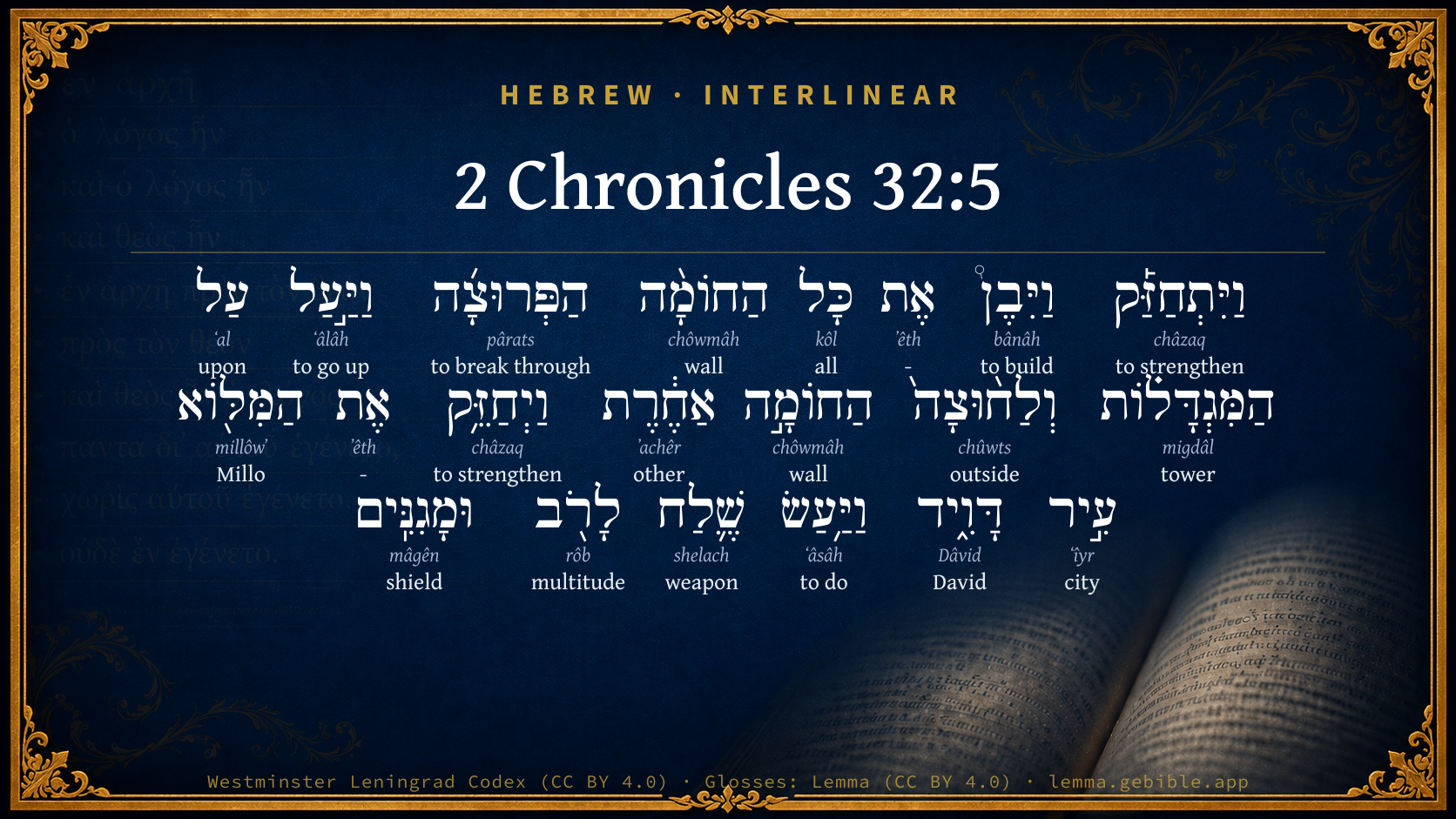
  1. וַיִּתְחַזַּ֡ק châzaq H2388 “and · to strengthen” Conjunction + Verb, Hithpael, Sequential Imperfect, 3rd Person, Masculine, Singular
  2. וַיִּבֶן֩ bânâh H1129 “and · to build” Conjunction + Verb, Qal, Sequential Imperfect, 3rd Person, Masculine, Singular
  3. אֶת ʼêth H853 “-” Particle, Direct Object
  4. כָּל kôl H3605 “all of” Noun, Common, Masculine, Singular, Construct
  5. הַחוֹמָ֨ה chôwmâh H2346 “the · wall” Particle, Definite Article + Noun, Common, Feminine, Singular, Absolute
  6. הַפְּרוּצָ֜ה pârats H6555 “the · broken through” Particle, Definite Article + Verb, Qal, Participle Passive, Feminine, Singular, Absolute
  7. וַיַּ֣עַל ʻâlâh H5927 “and · to go up” Conjunction + Verb, Hiphil, Sequential Imperfect, 3rd Person, Masculine, Singular
  8. עַל ʻal H5921 “upon” Preposition
  9. הַמִּגְדָּל֗וֹת migdâl H4026 “the · towers” Particle, Definite Article + Noun, Common, Both, Plural, Absolute
  10. וְלַח֨וּצָה֙ chûwts H2351 “and · to/for the · outside · toward” Conjunction + Preposition, Determined + Noun, Common, Masculine, Singular, Absolute + Suffix, Demonstrative
  11. הַחוֹמָ֣ה chôwmâh H2346 “the · wall” Particle, Definite Article + Noun, Common, Feminine, Singular, Absolute
  12. אַחֶ֔רֶת ʼachêr H312 “other” Adjective, Adjective, Feminine, Singular, Absolute
  13. וַיְחַזֵּ֥ק châzaq H2388 “and · to strengthen” Conjunction + Verb, Piel, Sequential Imperfect, 3rd Person, Masculine, Singular
  14. אֶת ʼêth H853 “-” Particle, Direct Object
  15. הַמִּלּ֖וֹא millôwʼ H4407 “the · Millo” Particle, Definite Article + Noun, Proper
  16. עִ֣יר ʻîyr H5892 “city of” Noun, Common, Feminine, Singular, Construct
  17. דָּוִ֑יד Dâvid H1732 “David” Noun, Proper
  18. וַיַּ֥עַשׂ ʻâsâh H6213 “and · to do” Conjunction + Verb, Qal, Sequential Imperfect, 3rd Person, Masculine, Singular
  19. לָרֹ֖ב rôb H7230 “to/for · multitude” Preposition + Noun, Common, Both, Singular, Absolute
  20. וּמָגִנִּֽים mâgên H4043 “and · shields” Conjunction + Noun, Common, Both, Plural, Absolute

About this verse

These counts appear in no published source. They are computed here, from the morphology-tagged text and Lemma’s own curated glosses. What Lemma adds →

21
words
18
distinct lemmas
Historical
section

Notable vocabulary

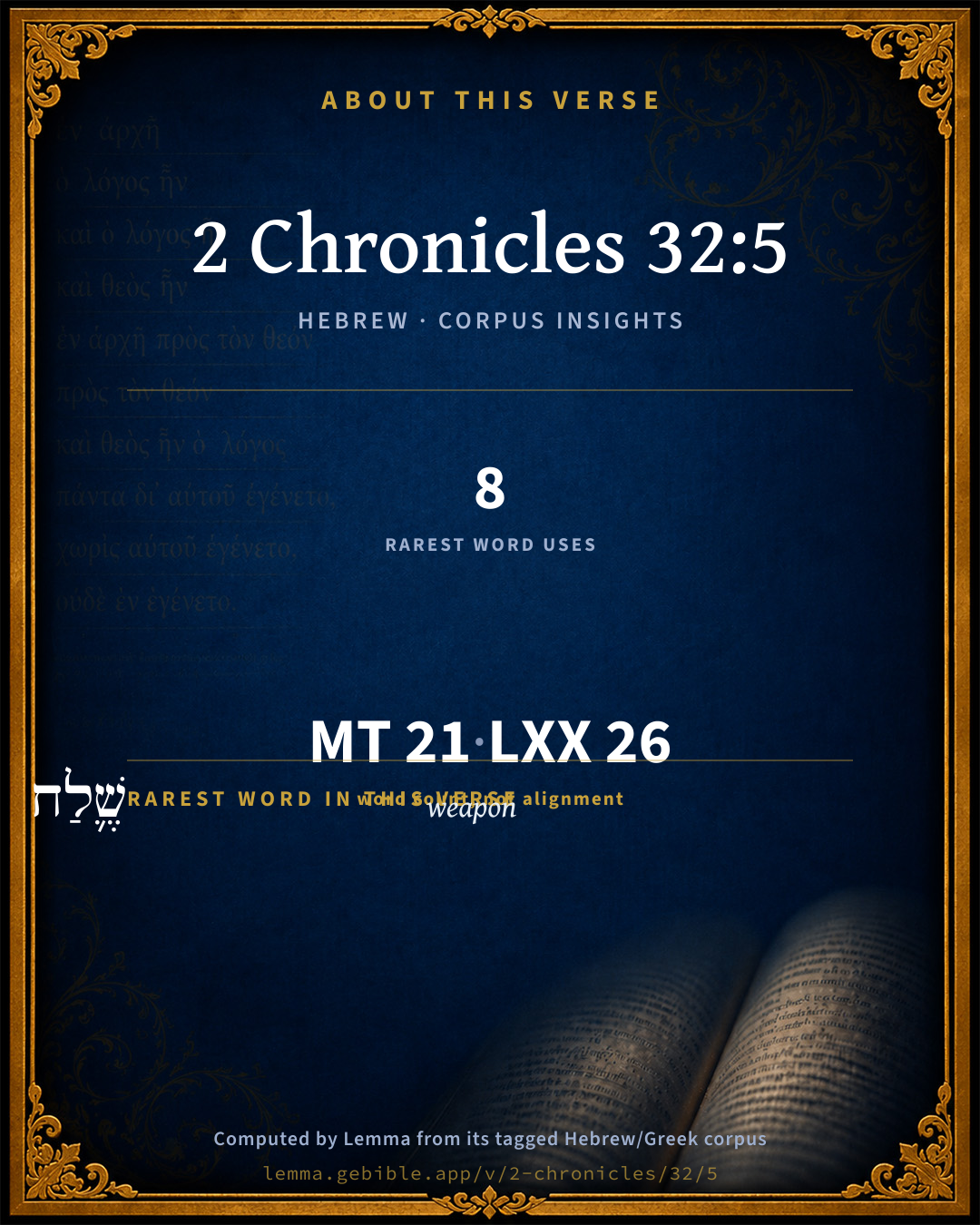
The rarest word here is שֶׁ֛לַח weapon H7973 — appearing just 8 times in the whole Hebrew Bible.

Shared distinctive vocabulary

שֶׁ֛לַח weapon H7973 occurs in 8 verses of the Hebrew Bible. Also found in:

Grammatical profile

  • 6 verbs
  • 11 nouns
  • 1 adjective
  • 1 preposition
  • 2 particles

Verb forms

  • וַיִּתְחַזַּ֡ק Hithpael · Sequential Imperfect
  • וַיִּבֶן֩ Qal · Sequential Imperfect
  • הַפְּרוּצָ֜ה Qal · Participle Passive
  • וַיַּ֣עַל Hiphil · Sequential Imperfect
  • וַיְחַזֵּ֥ק Piel · Sequential Imperfect
  • וַיַּ֥עַשׂ Qal · Sequential Imperfect

Repetition

Words recur within this verse — often emphatic in Hebrew:

  • וַיִּתְחַזַּ֡ק to strengthen H2388 ×2
  • הַחוֹמָ֨ה wall H2346 ×2

Hebrew & Septuagint length

In English translation the verse runs 40 words from the Hebrew and 38 from the Septuagint (LXX English) — closely comparable.

A rough comparison of the two English renderings, which tokenize alike — not a word-level alignment.

Word counts can differ between the Hebrew and the Greek without any difference in meaning — e.g. the Hebrew direct-object marker אֵת has no separate Greek word, and Greek often adds the article ὁ.

In the original languages it is 21 Hebrew tokens and 26 Greek tokens — but the two are counted differently (Hebrew bundles its prefixes and suffixes into one token; the Greek is in lemma form), so that isn’t a like-for-like length.

Cross-references

15

Topical passages linked to 2 Chronicles 32:5 in the Treasury of Scripture Knowledge — connected by theme and wording, ordered by reader-vote popularity; previews shown in the World English Bible.

  • 2 Chronicles 25:23 Joash king of Israel took Amaziah king of Judah, the son of Joash the son of Jehoahaz, at Beth-shemesh, and brought him to Jerusalem, and broke down the wall of Jerusalem from the gate of Ephraim to the corner gate, four hundred cubits.
  • 1 Kings 9:24 But Pharaoh's daughter came up out of the city of David to her house which [Solomon] had built for her: then did he build Millo.
  • 2 Samuel 5:9 David lived in the stronghold, and called it the city of David. David built round about from Millo and inward.
  • 2 Kings 25:4 Then a breach was made in the city, and all the men of war [fled] by night by the way of the gate between the two walls, which was by the king's garden (now the Chaldeans were against the city round about); and [the king] went by the way of the Arabah.
  • Isaiah 22:9–10 You saw the breaches of the city of David, that they were many; and you gathered together the waters of the lower pool;
  • Judges 9:6 All the men of Shechem assembled themselves together, and all the house of Millo, and went and made Abimelech king, by the oak of the pillar that was in Shechem.
  • 1 Kings 11:27 This was the reason why he lifted up his hand against the king: Solomon built Millo, and repaired the breach of the city of David his father.
  • 2 Kings 12:20 His servants arose, and made a conspiracy, and struck Joash at the house of Millo, [on the way] that goes down to Silla.
  • 2 Chronicles 12:1 It happened, when the kingdom of Rehoboam was established, and he was strong, that he forsook the law of Yahweh, and all Israel with him.
  • 2 Chronicles 14:5–7 Also he took away out of all the cities of Judah the high places and the sun-images: and the kingdom was quiet before him.
  • 2 Chronicles 17:1–2 Jehoshaphat his son reigned in his place, and strengthened himself against Israel.
  • 2 Chronicles 23:1 In the seventh year Jehoiada strengthened himself, and took the captains of hundreds, Azariah the son of Jeroham, and Ishmael the son of Jehohanan, and Azariah the son of Obed, and Maaseiah the son of Adaiah, and Elishaphat the son of Zichri, into covenant with him.
  • 2 Chronicles 26:8 The Ammonites gave tribute to Uzziah: and his name spread abroad even to the entrance of Egypt; for he grew exceeding strong.
  • 2 Chronicles 26:14–15 Uzziah prepared for them, even for all the host, shields, and spears, and helmets, and coats of mail, and bows, and stones for slinging.
  • Jeremiah 39:4 It happened that, when Zedekiah the king of Judah and all the men of war saw them, then they fled, and went forth out of the city by night, by the way of the king's garden, through the gate between the two walls; and he went out toward the Arabah.

Cross-references courtesy of OpenBible.info (CC BY 4.0).

Hebrew and Greek witnesses Masoretic Hebrew ↔ Greek Septuagint

The same verse in the two great witnesses to the Old Testament, shown verse-for-verse.

These are two independent witnesses, not word-aligned to each other, and the Septuagint is shown in lemma (dictionary) form.

Hebrew 2 Chronicles 32:5 Masoretic · Westminster Leningrad Codex

וַיִּתְחַזַּ֡ק וַיִּבֶן֩ אֶת כָּל הַחוֹמָ֨ה הַפְּרוּצָ֜ה וַיַּ֣עַל עַל הַמִּגְדָּל֗וֹת וְלַח֨וּצָה֙ הַחוֹמָ֣ה אַחֶ֔רֶת וַיְחַזֵּ֥ק אֶת הַמִּלּ֖וֹא עִ֣יר דָּוִ֑יד וַיַּ֥עַשׂ שֶׁ֛לַח לָרֹ֖ב וּמָגִנִּֽים

He took courage, and built up all the wall that was broken down, and raised [it] up to the towers, and the other wall outside, and strengthened Millo [in] the city of David, and made weapons and shields in abundance.

World English Bible · Public Domain

Greek LXX 2 Chronicles 32:5 Septuagint · lemma form

καί καταἰσχύω εζεκιας καί οἰκοδομέω πᾶς ὁ τεῖχος ὁ κατασκάπτω καί πύργος καί ἔξω προτείχισμα ἄλλος καί καταἰσχύω ὁ ἀνάλημμα πόλις δαυίδ καί κατασκευάζω ὅπλον πολύς

And Ezekias strengthened himself, and built all the wall that had been pulled down, and the towers, and another wall in front without, and fortified the strong place of the city of David, and prepared arms in abundance.

LXX2012 (modern English Septuagint) · Public Domain

On this verse, Ellicott's Commentary for English Readers discusses the Septuagint’s reading. Read the note in Commentary ↓

Hebrew: Westminster Leningrad Codex (CC BY 4.0). Greek: Septuagint (public domain); English from LXX2012 (modern English Septuagint) (Public Domain). How the Septuagint differs from the Hebrew →

Commentary

Notes on 2 Chronicles 32:5 from classic Christian and Jewish commentators (each source and its license shown beneath its notes). The classic Christian expositions comment on the surrounding passage and are grouped to its opening verse, so a note may address several verses; the Jewish commentaries on the Tanakh (Rashi and others) are per-verse, so they appear only where the commentator wrote on this verse.

Lemma curates 59 commentaries, every one of them public domain or Creative Commons licensed, each selected and text-cleaned for this edition rather than reprinted as found. About our sources →

Trapp's Complete Commentary

John Trapp

2Ch 32:5 Also he strengthened himself, and built up all the wall that was broken, and raised [it] up to the towers, and another wall without, and repaired Millo [in] the city of David, and made darts and shields in abundance.

Ver. 5. And raised it up to the towers.] Or, Mounted the warlike engines upon the towers, for his better defence.

John Trapp, A Commentary or Exposition upon All the Books of the Old and New Testament (1647–1656) — public domain. Text from a community e-Sword module.

Joseph Benson's Commentary

2Ch 32:5. He built up all the wall that was broken — Which Joash, king of Israel, had broken down, and which had not since been repaired. And raised it up to the towers — Either as high as the towers, or tops of the wall; or from the gate of Ephraim as far as the two towers, which were at the corner-gate, having been raised there for the defence of it. So that the wall, that had been broken down, was all rebuilt. See 2Ch 25:23. And repaired Millo — Of which see note on 1Ki 9:15.

Joseph Benson's Commentary on the Old and New Testaments (1811–1818) — public domain. Text from a community e-Sword module.

Geneva Bible (1599)

Geneva Bible translators

Hebrew, he was strengthened.

He made a double wall.

Read 2 Sam. 5:9.

Some read, swords or daggers.

Geneva Bible (1599) marginal notes — public domain. Text via Bolls.life.

Jamieson, Fausset & Brown

Robert Jamieson, A. R. Fausset & David Brown

he strengthened himself--He made a careful inspection of the city defenses for the purpose of repairing breaches in the wall here, renewing the masonry there, raising projecting machines to the towers, and especially fortifying the lower portion of Zion, that is, Millo, "(in) the original city of David." "In" is a supplement of our translators, and the text reads better without it, for it was not the whole city that was repaired, but only the lower portion of Zion, or the original "city of David."

Jamieson, Fausset & Brown — Commentary Critical and Explanatory on the Whole Bible (1871) — public domain (CC PDM 1.0). Text via the HelloAO Bible API.

Adam Clarke's Commentary

Verse 5. Raised it up to the towers] He built the wall up to the height of the towers, or, having built the wall, he raised towers on it.

Adam Clarke's Commentary on the Bible (1810–1826) — public domain. Text from a community e-Sword/MySword module.

Ellicott's Commentary for English Readers

(5) Also he strengthened himself.—And he took courage. (2Ch_15:8; 2Ch_18:1.)

Built up all the wall that was broken.—Isa_22:9-10, where “many breaches” are spoken of, and it is said that “houses were pulled down to fortify the wall.”

Raised it up to the towers.—Heb., and went up on the towers, or, and caused to go up on the towers. A different division of the Hebrew letters will give the sense “and raised upon it towers,” which is probably correct. Thenius prefers to keep the ordinary reading, which he understands to mean, and heightened the towers; alleging that 2Ch_26:9 shows that the wall was already furnished with towers. The LXX. has simply καί πύργους, “and towers;” the Vulgate, “et exstruxit turres desuper.” The Syriac renders, “Let them show themselves strong, and make another wall opposite the wall, and let them stop up the ditch which David made.”

Another wall without.—Literally, and on the outside of the wall (he built) another—viz., the wall enclosing the lower city or Aera, which he “built,” that is, repaired and strengthened. (See Isa_22:11, “the two walls.”)

Repaired.—2Ch_11:11.

Millo.—The rampart. See Note on 1Ch_11:8.

In the city of David.—To wit, the city of David.

Darts.—Shelah. See Note on 2Ch_23:10, and comp. 2Ch_26:14. The Hebrew is “missiles in abundance, and shields.”

A Bible Commentary for English Readers, edited by Charles John Ellicott (1878–1897) — public domain. Text from a community e-Sword module.

The Cambridge Bible for Schools and Colleges

gen. ed. J. J. S. Perowne

5. Also he strengthened himself] R.V. And he took courage. Cp. 2Ch_1:1 (note).

broken] R.V. broken down; cp. 2Ch_25:23 (note).

raised it up to the towers] Render, repaired the towers, lit. “brought up [healing, restoration] upon the towers; cp. 2Ch_24:13 (Heb.); Neh_4:1 (Heb.). The ellipse is harsh, but not too harsh for the Chronicler. Vulg. reads, “built towers upon it.”

another wall] R.V. the other wall. In Isa_22:9-11 the preparations to meet the Assyrian attack are described by the prophet who speaks of a “ditch” (R.V. “reservoir”) made at this time between “the two walls.” In Excavations at Jerusalem, 1894–1897, Dr Bliss describes a buttressed wall (pp. 96 ff.) built without lime (see his frontispiece for an illustration of it) and enclosing the pool of Siloam on the S.E, which, he says, “may date back as far as Hezekiah” (pp. 325 f.). Dr Bliss also, following up a clue given by earlier explorers found a second wall (running at an angle to the first) enclosing the pool on the west. This second wall was probably due to Herod, but Dr Bliss suggests that the line it follows may have been defended by a wall as early as Hezekiah’s day (p. 326). Thus it is not hard to infer the general course of Hezekiah’s two walls.

Millo] Cp. 1Ch_11:8, note.

darts and shields] These were meant, not for such trained soldiers as Hezekiah could collect, but for the levy en masse with which the king proposed to man the walls. A dart to throw and a shield to protect the thrower as he threw were all that the citizen-soldier needed. The Heb. word (shelaḥ) means “dart, missile”; the more general rendering of the R.V. “weapons” obscures the meaning of Hezekiah’s preparations.

The Cambridge Bible for Schools and Colleges (gen. ed. J. J. S. Perowne; Cambridge University Press, 1878–1918) — public domain. Text from a community e-Sword module.

John Gill's Exposition

And he set captains of war over the people,.... To teach them the exercises of war, to lead them on against the enemy, to direct them where to stand, and what to do in defence of the city:

and gathered them together to him in the street of the gate of the city; the street which led to the gate, and was large and commodious to assemble the people in:

and spake comfortably to them; to animate and encourage them to hold out the siege, and do all they could to repel the enemy;

saying; as follows.

John Gill's Exposition of the Whole Bible (1746–1763) — public domain (CC PDM 1.0). Text via the HelloAO Bible API.

Albert Barnes' Notes on the Bible

The breaches in the wall of Jerusalem were not entirely due to the old hostility of Joash (marginal reference); but may have been caused either by neglect and carelessness in the reign of Ahaz 2 Chr. 28, or by the simple process of natural decay. Hezekiah pulled down houses for the purpose of his repairs Isa 22:10.

On Millo, see the marginal references notes.

Albert Barnes' Notes on the Bible (1834–1885) — public domain. Text from a community e-Sword/MySword module.

Haydock's Catholic Bible Commentary

Without, of less strength. --- Mello, the palace, which was strongly situated, and Ezechias added fresh fortifications, 2 K. v. 9. --- Arms. Heb. "darts."

George Leo Haydock (1774–1849), Haydock's Catholic Family Bible and Commentary, 1859 edition — public domain. Excludes Psalms (Douay-Rheims chapter numbering differs from Protestant) and Deuterocanonical books (Catholic canon only).

Matthew Poole's English Annotations

The wall that was broken by Joash, 2Ch 25:23, and not since repaired.

Up to the towers; either,

1. As high as the towers, or the tops of the wall. Or,

2. As far as the two towers, or gates, which were made in the form of towers, and had the use of towers, to wit, that of Ephraim and the corner gate, both mentioned above, 2Ch 25:23. Or, brought up engines or instruments of defence upon the towers.

Millo; of which see 1Ki 9:24; 11:27.

Matthew Poole's English Annotations on the Holy Bible (1683–1685) — public domain. Text from a community e-Sword/MySword module.

Whedon's Commentary on the Bible

Daniel D. Whedon

5. The wall that was broken — What particular part of the walls, and when and how they were broken, is not told. Rawlinson suggests that they had fallen by neglect and carelessness in the reign of Ahaz, or by the natural process of decay, and were hastily repaired with the ruins of neighbouring houses. Isa_22:10.

Raised it up to the towers — The Hebrew text reads, literally, he brought up upon the towers, but the meaning is obscure. The text seems to be defective, and the most plausible emendation is, he raised up towers upon it; that is, he built towers upon the wall. Perhaps he merely fortified the towers which Uzziah had built. 2Ch_26:9.

Another wall without — Thought by some to be the wall of the lower city, but the reference is uncertain.

Millo — The ancient fortress or rampart which David built on Zion. See note on 2Sa_5:11.

Daniel D. Whedon (gen. ed.), Commentary on the Old and New Testaments (1874–1909) — public domain. Text from a community e-Sword module.

The Pulpit Commentary

He strengthened himself; i.e., as in our several previous instances of the occurrence of the phrase (1Ch_11:10; 2Ch_12:1 2Ch_25:11 2Ch_26:8) he took all possible means to make himself and people and city strong to withstand the invader. All the wall that was broken. (see Isa_22:9) Although we read that the devastation wrought by Joash (2Ch_25:23) was very largely repaired by Uzziah (2Ch_26:9) and by Jotham, (2Ch_27:3) it is not explicitly said that the broken four hundred cubits of wall, from the gate of Ephraim to the corner gate, were made absolutely good again, although in the matter of towers and fortifications much was evidently done. Note also the word "all" here, side by side with the "much" of (2Ch_27:3. And raised (it) up to the towers. Discard this Authorized Version rendering. The meaning cannot be certainly pronounced upon, hut perhaps it may be intended to say that he heightened the towers. The objection is that the same verb is wanted for the next clause, and that its rendering would need to be there slightly reduced again to a mere statement of raising from the ground (i.e. building) another wall without. Repaired Millo. (see note, 1Ch_11:8)

The Pulpit Commentary (1880–1919), ed. H.D.M. Spence-Jones & Joseph S. Exell — public domain. Text from a community e-Sword module.

Scofield Reference Notes

C. I. Scofield

Also he

Cf. Isa 22:1-13 The divine view at this time:

The Scofield Reference Bible (1917 edition), notes by C. I. Scofield — public domain. Text from a community e-Sword module.

unfoldingWord translationNotes

Door43 World Missions Community

Hezekiah took courage and built up ... He built ... He also ... he made

The readers should understand that Hezekiah probably commanded other people to do the actual work. AT: "Hezekiah took courage and commanded the people to build up ... They built ... They also ... they made" (See: Synecdoche)

Hezekiah took courage and built up

Possible meanings are 1) Hezekiah strengthened his position by commanding the people to repair the walls of the city. You can make this clear by using the connecting word "by." AT: "Hezekiah strengthened the city by building up" or 2) he became encouraged. AT: "Hezekiah became encouraged and built up" (See: Connecting Words)

the Millo

This is a part of the wall on the north side of Jerusalem.

translationWords

watchtower

city of David

unfoldingWord translationNotes — © Distant Shores Media and the Door43 World Missions Community, licensed CC BY-SA 4.0. Source: git.door43.org/Door43/en_tn.

Rashi

Rabbi Shlomo Yitzchaki (Rashi)

and he reinforced the millo An example is (I Kings 11:27): “built the millo.”

and he made many swords - Heb. שֶׁלַח, weapons, similar to (above 23:10): “each one with his sword (שִׁלְחוֹ) in his hand”; (Neh. 4:17): “each man took his sword (שִׁלְחוֹ) to the water.”

Rashi on the Tanakh — English translations: “The Judaica Press complete Tanach with Rashi, translated by A. J. Rosenberg” (CC BY 4.0); “Pentateuch with Rashi's commentary by M. Rosenbaum and A.M. Silbermann, 1929-1934” (public domain); “The Metsudah Tanach series, Lakewood, N.J” (CC BY 4.0); and “The Book of Joshua, Metsudah Publications, 1997” (CC BY 4.0). Text via Sefaria.

Lesson kit

Teaching starters — assembled from the data on this page, not authored interpretation. Every prompt links to the verse data it draws on. Edit before teaching.

2 Chronicles, in the Historical, opens this verse with 21 words (18 distinct Hebrew lemmas). Its most distinctive word is shelach (“weapon”). A historical commentator’s framing appears above. Read the whole chapter for the surrounding context.

Discussion questions

  1. How does “weapon” (shelach) shape what this verse is saying?
  2. 2 Chronicles 23:10 shares the word «weapon» with this verse. How do the two illuminate each other?
  3. “to strengthen” occurs 2× in this one verse. What is the effect of the repetition?
  4. These translations render this verse differently. What is at stake in choosing one wording over another?
  5. The verb «וַיִּתְחַזַּ֡ק» is Hithpael Sequential Imperfect. How does its form color the action?
  6. Reading how Trapp's Complete Commentary and Joseph Benson's Commentary read this verse, where do the two commentators agree and where do they part?

Things to notice

Reading settings

Reading text

Shown beneath each verse's original-language words.

Old Testament
Old Testament edition

Read the OT as the Masoretic Hebrew (MT) or the Greek Septuagint (LXX).

English shown for the Greek Septuagint (in the Hebrew ↔ Greek comparison).

Comparing translations? Open the Compare panel on any verse page to stack up to four side by side.