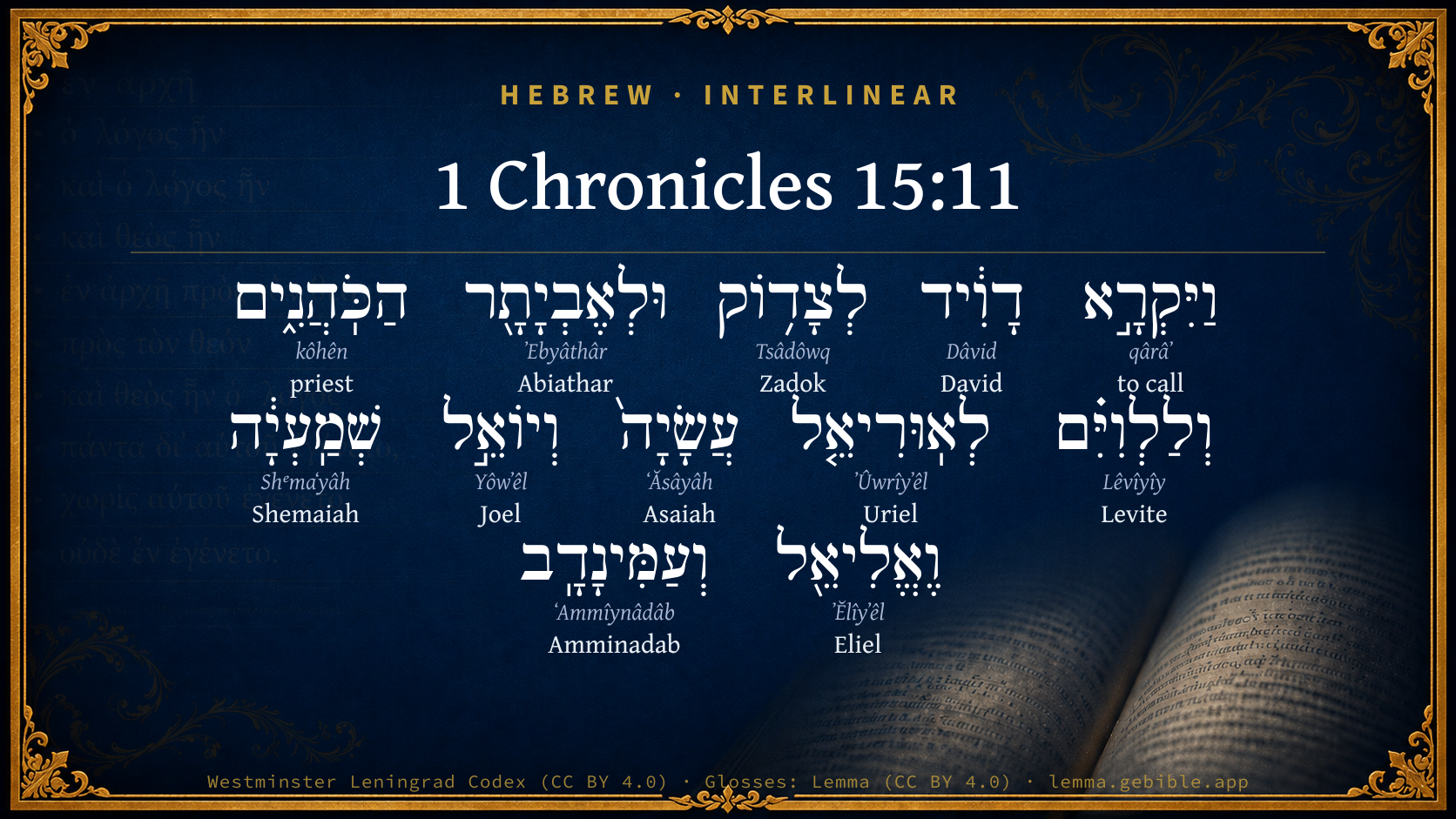
1 Chronicles 15:11

Hebrew (Westminster Leningrad Codex) 1 Chronicles 15:11 appears in the Hebrew Old Testament. The text above is from the Westminster Leningrad Codex. Each word links to its Strong’s number, a concise gloss, and parsing drawn from the Open Scriptures Hebrew Bible morphology. Click any word for its full Brown-Driver-Briggs (BDB) entry.
Download image
Cite this verse

1 Chronicles 15:11 (World English Bible). Public Domain. Lemma interlinear Bible study tool, https://lemma.gebible.app/v/1-chronicles/15/11.

Show BibTeX & RIS
BibTeX
RIS
English Translation
David called for Zadok and Abiathar the priests, and for the Levites, for Uriel, Asaiah, and Joel, Shemaiah, and Eliel, and Amminadab,
World English Bible · Public Domain
Download a study sheet

One document with this verse’s original text, its word-by-word gloss line, the meaning frame, cross-references with their text, attributed commentary, and full source and license credits — printable, and it pastes into notes with its structure intact.

This verse Autodidact and up

Study sheet (.html) Plain text (.txt)

A passage Seminary Student

Up to 50 verses in one chapter. A passage sheet keeps up to 6 commentary sources and 12 cross-references per verse, in the order this page ranks them, and says so on the sheet whenever that leaves anything out. Ask for a single verse and you get the Autodidact verse sheet above.

Everything on this page stays free to read, with no account — the sheet is a download of what is already on screen, not access to it.

Want to remove ads? Support Godless Engineer
Compare translations 3

The same verse in 3 English versions, stacked beneath the original-language interlinear above. Click any original word for its lexicon entry.

Each is an independent rendering of the whole verse — the interlinear is not word-aligned to these translations.

Highlighted words mark where these versions differ — a whole-verse word diff, not a word-by-word alignment.

  • World English Bible Public Domain
    David called for Zadok and Abiathar the priests, and for the Levites, for Uriel, Asaiah, and Joel, Shemaiah, and Eliel, and Amminadab,
  • King James Version Public Domain
    And David called for Zadok and Abiathar the priests, and for the Levites, for Uriel, Asaiah, and Joel, Shemaiah, and Eliel, and Amminadab,
  • unfoldingWord Literal Text CC BY-SA 4.0
    And David called for Zadok and for Abiathar, the priests, and for the Levites, for Uriel, Asaiah, and Joel, Shemaiah and Eliel and Amminadab.

unfoldingWord Literal Text — © unfoldingWord, licensed CC BY-SA 4.0. Word-aligned USFM3 via Door43 (git.door43.org/unfoldingWord/en_ult).

Versions to compare (up to 4)

3 of 4 selected

Show all 18 translations

Every available English version of this verse, each an independent rendering of the whole verse.

  • World English Bible Public Domain
    David called for Zadok and Abiathar the priests, and for the Levites, for Uriel, Asaiah, and Joel, Shemaiah, and Eliel, and Amminadab,
  • Berean Standard Bible Public Domain
    David summoned the priests Zadok and Abiathar and the Levites Uriel, Asaiah, Joel, Shemaiah, Eliel, and Amminadab.
  • Majority Standard Bible Public Domain
    David summoned the priests Zadok and Abiathar and the Levites Uriel, Asaiah, Joel, Shemaiah, Eliel, and Amminadab.
  • King James Version Public Domain
    And David called for Zadok and Abiathar the priests, and for the Levites, for Uriel, Asaiah, and Joel, Shemaiah, and Eliel, and Amminadab,
  • American Standard Version (1901) Public Domain
    And David called for Zadok and Abiathar the priests, and for the Levites, for Uriel, Asaiah, and Joel, Shemaiah, and Eliel, and Amminadab,
  • Revised Version (1885) Public Domain
    And David called for Zadok and Abiathar the priests, and for the Levites, for Uriel, Asaiah, and Joel, Shemaiah, and Eliel, and Amminadab,
  • Geneva Bible (1599) Public Domain
    And Dauid called Zadok and Abiathar the Priestes, and of the Leuites, Vriel, Asaiah and Ioel, Shemaiah, and Eliel, and Amminadab:
  • Douay-Rheims (1899) Public Domain
    And David called Sadoc, and Abiathar the priests, and the Levites, Uriel, Asaia, Joel, Semeia, Eliel, and Aminadab:
  • Young's Literal Translation Public Domain
    And David calleth to Zadok and to Abiathar the priests, and to the Levites, to Uriel, Asaiah, and Joel, Shemaiah, and Eliel, and Amminadab,
  • Literal Standard Version CC BY-SA 4.0
    And David calls to Zadok and to Abiathar the priests, and to the Levites, to Uriel, Asaiah, and Joel, Shemaiah, and Eliel, and Amminadab,
  • Unlocked Literal Bible CC BY-SA 4.0
    David called for Zadok and Abiathar the priests, and the Levites Uriel, Asaiah, Joel, Shemaiah, Eliel, and Amminadab.
  • unfoldingWord Literal Text CC BY-SA 4.0
    And David called for Zadok and for Abiathar, the priests, and for the Levites, for Uriel, Asaiah, and Joel, Shemaiah and Eliel and Amminadab.
  • Darby Bible Public Domain
    And David called for Zadok and Abiathar the priests, and for the Levites, for Uriel, Asaiah, and Joel, Shemaiah, and Eliel, and Amminadab;
  • World Messianic Bible Public Domain
    David called for Zadok and Abiathar the priests, and for the Levites: for Uriel, Asaiah, Joel, Shemaiah, Eliel, and Amminadab,
  • Webster's Bible Public Domain
    And David called for Zadok and Abiathar the priests, and for the Levites, for Uriel, Asaiah, and Joel, Shemaiah, and Eliel, and Amminadab,
  • Free Bible Version CC BY-SA 4.0
    Then David summoned the priests Zadok and Abiathar, and the Levites Uriel, Asaiah, Joel, Shemaiah, Eliel, and Amminadab.
  • Bible in Basic English Public Domain
    And David sent for Zadok and Abiathar the priests, and for the Levites, Uriel, Asaiah and Joel, Shemaiah and Eliel and Amminadab,
  • JPS Tanakh (1917) Public Domain
    And David called for Zadok and Abiathar the priests, and for the Levites, for Uriel, Asaiah, and Joel, Shemaiah, and Eliel, and Amminadab,

Literal Standard Version (2020), Covenant Press — licensed CC BY-SA 4.0. Text via the HelloAO Bible API (eBible.org). Unlocked Literal Bible (unfoldingWord) — licensed CC BY-SA 4.0. Text via the HelloAO Bible API (eBible.org). unfoldingWord Literal Text — © unfoldingWord, licensed CC BY-SA 4.0. Word-aligned USFM3 via Door43 (git.door43.org/unfoldingWord/en_ult). Free Bible Version, Dr. Jonathan Gallagher — licensed CC BY-SA 4.0. Text via the HelloAO Bible API (eBible.org).

Word by word

More ways to search: Search by grammar → Find every occurrence → Compare this word →

Practice this passage: Drill this verse → Learn its vocabulary →

לְאֽוּרִיאֵ֤ל
ʼÛwrîyʼêl
H222
“to/for · Uriel”
Preposition + Noun, Proper
Part of Speech
Preposition + Noun
Type
Proper
Full BDB Definition

Origin: from H217 and H410

TWOT: None

Uriel = "God (El) is my light" - chief of the Levitical line of Kohath in David's time - maternal grandfather of Abijah
  1. וַיִּקְרָ֣א qârâʼ H7121 “and · to call” Conjunction + Verb, Qal, Sequential Imperfect, 3rd Person, Masculine, Singular
  2. דָוִ֔יד Dâvid H1732 “David” Noun, Proper
  3. לְצָד֥וֹק Tsâdôwq H6659 “to/for · Zadok” Preposition + Noun, Proper
  4. וּלְאֶבְיָתָ֖ר ʼEbyâthâr H54 “and · to/for · Abiathar” Conjunction + Preposition + Noun, Proper
  5. הַכֹּֽהֲנִ֑ים kôhên H3548 “the · priests” Particle, Definite Article + Noun, Common, Masculine, Plural, Absolute
  6. וְלַלְוִיִּ֗ם Lêvîyîy H3881 “and · to/for the · Levites” Conjunction + Preposition, Determined + Noun, Gentilic, Masculine, Plural, Absolute
  7. עֲשָׂיָה֙ ʻĂsâyâh H6222 “Asaiah” Noun, Proper
  8. וְיוֹאֵ֣ל Yôwʼêl H3100 “and · Joel” Conjunction + Noun, Proper
  9. שְׁמַֽעְיָ֔ה Shᵉmaʻyâh H8098 “Shemaiah” Noun, Proper
  10. וֶאֱלִיאֵ֖ל ʼĔlîyʼêl H447 “and · Eliel” Conjunction + Noun, Proper
  11. וְעַמִּינָדָֽב ʻAmmîynâdâb H5992 “and · Amminadab” Conjunction + Noun, Proper

About this verse

These counts appear in no published source. They are computed here, from the morphology-tagged text and Lemma’s own curated glosses. What Lemma adds →

12
words
12
distinct lemmas
Historical
section

Notable vocabulary

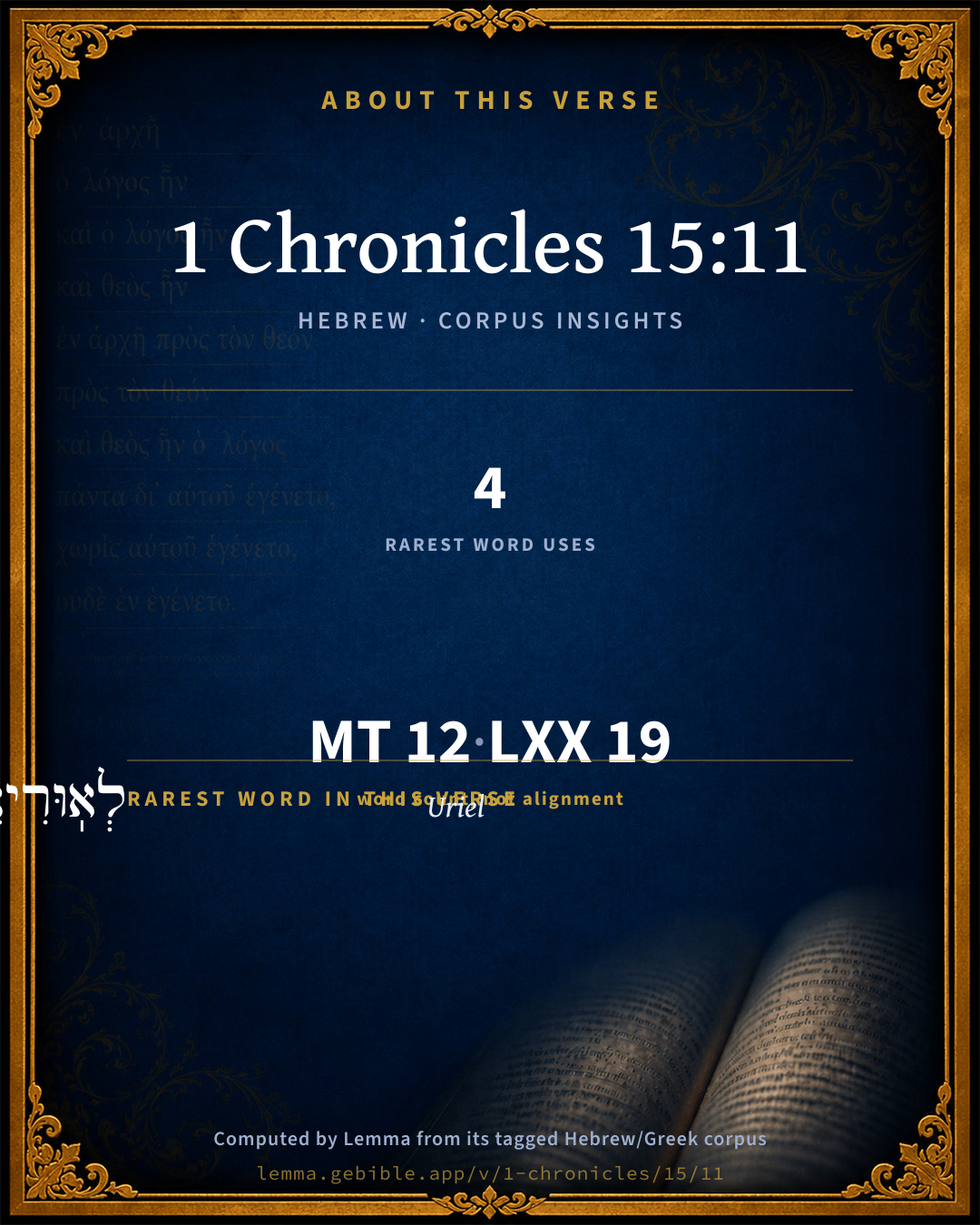
The rarest word here is לְאֽוּרִיאֵ֤ל Uriel H222 — appearing just 4 times in the whole Hebrew Bible.

Shared distinctive vocabulary

לְאֽוּרִיאֵ֤ל Uriel H222 occurs in 4 verses of the Hebrew Bible. Also found in:

Grammatical profile

  • 1 verb
  • 11 nouns

Verb forms

  • וַיִּקְרָ֣א Qal · Sequential Imperfect

Hebrew & Septuagint length

In English translation the verse runs 22 words from the Hebrew and 21 from the Septuagint (LXX English) — closely comparable.

A rough comparison of the two English renderings, which tokenize alike — not a word-level alignment.

Word counts can differ between the Hebrew and the Greek without any difference in meaning — e.g. the Hebrew direct-object marker אֵת has no separate Greek word, and Greek often adds the article ὁ.

In the original languages it is 12 Hebrew tokens and 19 Greek tokens — but the two are counted differently (Hebrew bundles its prefixes and suffixes into one token; the Greek is in lemma form), so that isn’t a like-for-like length.

Cross-references

9

Topical passages linked to 1 Chronicles 15:11 in the Treasury of Scripture Knowledge — connected by theme and wording, ordered by reader-vote popularity; previews shown in the World English Bible.

  • 1 Chronicles 12:28 and Zadok, a young man mighty of valor, and of his father's house twenty-two captains.
  • 1 Samuel 22:20–23 One of the sons of Ahimelech, the son of Ahitub, named Abiathar, escaped, and fled after David.
  • 1 Kings 2:35 The king put Benaiah the son of Jehoiada in his room over the host; and Zadok the priest did the king put in the room of Abiathar.
  • 2 Samuel 8:17 and Zadok the son of Ahitub, and Ahimelech the son of Abiathar, were priests; and Seraiah was scribe;
  • 2 Samuel 15:24–29 Behold, Zadok also [came], and all the Levites with him, bearing the ark of the covenant of God; and they set down the ark of God; and Abiathar went up, until all the people had done passing out of the city.
  • 2 Samuel 15:35 Don't you have Zadok and Abiathar the priests there with you? therefore it shall be, that whatever thing you shall hear out of the king's house, you shall tell it to Zadok and Abiathar the priests.
  • 2 Samuel 20:25 and Sheva was scribe; and Zadok and Abiathar were priests;
  • 1 Kings 2:26 To Abiathar the priest said the king, Get you to Anathoth, to your own fields; for you are worthy of death: but I will not at this time put you to death, because you bear the ark of the Lord Yahweh before David my father, and because you were afflicted in all in which my father was afflicted.
  • 1 Chronicles 18:16 and Zadok the son of Ahitub, and Abimelech the son of Abiathar, were priests; and Shavsha was scribe;

Cross-references courtesy of OpenBible.info (CC BY 4.0).

Hebrew and Greek witnesses Masoretic Hebrew ↔ Greek Septuagint

The same verse in the two great witnesses to the Old Testament, shown verse-for-verse.

These are two independent witnesses, not word-aligned to each other, and the Septuagint is shown in lemma (dictionary) form.

Hebrew 1 Chronicles 15:11 Masoretic · Westminster Leningrad Codex

וַיִּקְרָ֣א דָוִ֔יד לְצָד֥וֹק וּלְאֶבְיָתָ֖ר הַכֹּֽהֲנִ֑ים וְלַלְוִיִּ֗ם לְאֽוּרִיאֵ֤ל עֲשָׂיָה֙ וְיוֹאֵ֣ל שְׁמַֽעְיָ֔ה וֶאֱלִיאֵ֖ל וְעַמִּינָדָֽב

David called for Zadok and Abiathar the priests, and for the Levites, for Uriel, Asaiah, and Joel, Shemaiah, and Eliel, and Amminadab,

World English Bible · Public Domain

Greek LXX 1 Chronicles 15:11 Septuagint · lemma form

καί καλέω δαυίδ ὁ σαδωκ καί αβιαθαρ ὁ ἱερεύς καί ὁ λευίτης ὁ ουριηλ ασαια ιωηλ σαμαιας ελιηλ αμιναδαβ

And David called Sadoc and Abiathar the priests, and the Levites, Uriel, Asaia, and Joel, and Semaia, and Eliel, and Aminadab,

LXX2012 (modern English Septuagint) · Public Domain

Hebrew: Westminster Leningrad Codex (CC BY 4.0). Greek: Septuagint (public domain); English from LXX2012 (modern English Septuagint) (Public Domain). How the Septuagint differs from the Hebrew →

Commentary

Notes on 1 Chronicles 15:11 from classic Christian and Jewish commentators (each source and its license shown beneath its notes). The classic Christian expositions comment on the surrounding passage and are grouped to its opening verse, so a note may address several verses; the Jewish commentaries on the Tanakh (Rashi and others) are per-verse, so they appear only where the commentator wrote on this verse.

Lemma curates 59 commentaries, every one of them public domain or Creative Commons licensed, each selected and text-cleaned for this edition rather than reprinted as found. About our sources →

Trapp's Complete Commentary

John Trapp

1Ch 15:11 And David called for Zadok and Abiathar the priests, and for the Levites, for Uriel, Asaiah, and Joel, Shemaiah, and Eliel, and Amminadab,

Ver. 11. And David called for Zadok and Abiathar.] These, and those chief captains that follow, were tanquam Ephori et directores totius deductionis, directors and principal doers.

John Trapp, A Commentary or Exposition upon All the Books of the Old and New Testament (1647–1656) — public domain. Text from a community e-Sword module.

Joseph Benson's Commentary

1Ch 15:11-12. David called for Zadok and Abiathar — The chief priests: Abiathar being the high-priest, and Zadok the second priest. And said, Sanctify yourselves — By solemn purification and preparation of yourselves, both in soul and body: see notes on Gen 35:2, and Exo 19:10.

Joseph Benson's Commentary on the Old and New Testaments (1811–1818) — public domain. Text from a community e-Sword module.

Ellicott's Commentary for English Readers

(11) David’s instructions to the eight spiritual chiefs.

Zadok and Abiathar the priests were of coordinate rank, as representing the two lines of Eleazar and Ithamar. (Comp. Notes on 1Ch_6:4, sqq., and 1Ch_24:3. ) On 1Ch_15:5 the meanings of three of these names have been suggested. Of the others, Zadok imports just, perhaps equivalent to Zedekiah, Jah is just; Abiathar, the Father (i.e., God) excels; She-maiah, Jah heareth; Eliel, God (and none else) is God (i.e., Divine); Amminadab, the Clansman (i.e., the Lord) is bounteous. Thus the very names of those who conducted this great religious event expressed to themselves and others the high spiritual truths that Jehovah the Lord is righteous, the Author and Bestower of all knowledge and excellence and working power; that He alone is God; and that He hears prayers, as being a gracious Father unto all His creatures.

A Bible Commentary for English Readers, edited by Charles John Ellicott (1878–1897) — public domain. Text from a community e-Sword module.

The Cambridge Bible for Schools and Colleges

gen. ed. J. J. S. Perowne

11. Zadok and Abiathar] This double priesthood (2Sa_8:17; 2Sa_15:29; 2Sa_15:35; 2Sa_19:11; 2Sa_20:25) came to an end in the reign of Solomon (1Ki_2:27; 1Ki_2:35). Zadok is always mentioned first as being descended from Eleazar the third son of Aaron, while Ithamar from whom Abiathar (Ahimelech) was descended through Eli (1Ki_2:27) was the fourth son (1Ch_24:1; 1Ch_24:3). In two of the passages quoted in this note Abiathar (probably being confused with his father) is called Ahimelech or Abimelech (2Sa_8:17 = 1Ch_18:16; 1Ch_24:3). Conversely in Mar_2:26 Ahimelech is called Abiathar. In the Chronicler’s list of highpriests (1Ch_6:4-14) Zadok alone is mentioned, the line of Eleazar alone being given. Cp. Kirkpatrick on 2 Samuel 6 (Prefatory Note); and on ib. 2Sa_8:17.

the priests] Only the two chief priests are mentioned here. Other priests blew with the trumpets in front of the ark (1Ch_15:24).

The Cambridge Bible for Schools and Colleges (gen. ed. J. J. S. Perowne; Cambridge University Press, 1878–1918) — public domain. Text from a community e-Sword module.

John Gill's Exposition

And David called for Zadok and Abiathar the priests,.... See Sa2 8:17.

and for the Levites, for Uriel, Asaiah, and Joel, Shemaiah, and Eliel, and Amminadab; the six chiefs before mentioned.

John Gill's Exposition of the Whole Bible (1746–1763) — public domain (CC PDM 1.0). Text via the HelloAO Bible API.

Matthew Poole's English Annotations

Zadok and Abiathar the priests, i.e. the chief priests, Abiathar the high priest, and Zadok the second priest: see Num 3:32.

Matthew Poole's English Annotations on the Holy Bible (1683–1685) — public domain. Text from a community e-Sword/MySword module.

John Wesley's Explanatory Notes

The Priests - Abiathar the high-priest, and Zadok the second priest.

John Wesley, Explanatory Notes Upon the Whole Bible (1754–1765) — public domain. Text via the GEBible commentary corpus.

Keil & Delitzsch

C. F. Keil & F. Delitzsch

And David called for Zadok and Abiathar the priests,.... See Sa2 8:17.

and for the Levites, for Uriel, Asaiah, and Joel, Shemaiah, and Eliel, and Amminadab; the six chiefs before mentioned.

Keil & Delitzsch — Biblical Commentary on the Old Testament (1861–1891) — public domain (CC PDM 1.0). Text via the HelloAO Bible API. (Old Testament only.)

unfoldingWord translationNotes

Door43 World Missions Community

Uriel, Asaiah, Joel, Shemaiah, Eliel, and Amminadab

These are the names of men. See how you translated them in 1 Chronicles verses 5-6 and 1 Chronicles verses 7-10. (See: How to Translate Names)

translationWords

Zadok

Abiathar

priest

family

consecrate

brother

God

unfoldingWord translationNotes — © Distant Shores Media and the Door43 World Missions Community, licensed CC BY-SA 4.0. Source: git.door43.org/Door43/en_tn.

Lesson kit

Teaching starters — assembled from the data on this page, not authored interpretation. Every prompt links to the verse data it draws on. Edit before teaching.

1 Chronicles, in the Historical, opens this verse with 12 words (12 distinct Hebrew lemmas). Its most distinctive word is ʼÛwrîyʼêl (“Uriel”). A historical commentator’s framing appears above. Read the whole chapter for the surrounding context.

Discussion questions

  1. The word ʼÛwrîyʼêl carries the sense “Uriel.” How does it shape the verse?
  2. How does 1 Chronicles 6:24, which shares the word «Uriel», read alongside this verse?
  3. «וַיִּקְרָ֣א» is a Qal Sequential Imperfect verb. How does that grammatical form shape the action described?
  4. Compare how Trapp's Complete Commentary and Joseph Benson's Commentary read this verse. Where do they agree or differ?

Things to notice

Reading settings

Reading text

Shown beneath each verse's original-language words.

Old Testament
Old Testament edition

Read the OT as the Masoretic Hebrew (MT) or the Greek Septuagint (LXX).

English shown for the Greek Septuagint (in the Hebrew ↔ Greek comparison).

Comparing translations? Open the Compare panel on any verse page to stack up to four side by side.