1 Chronicles 29:23

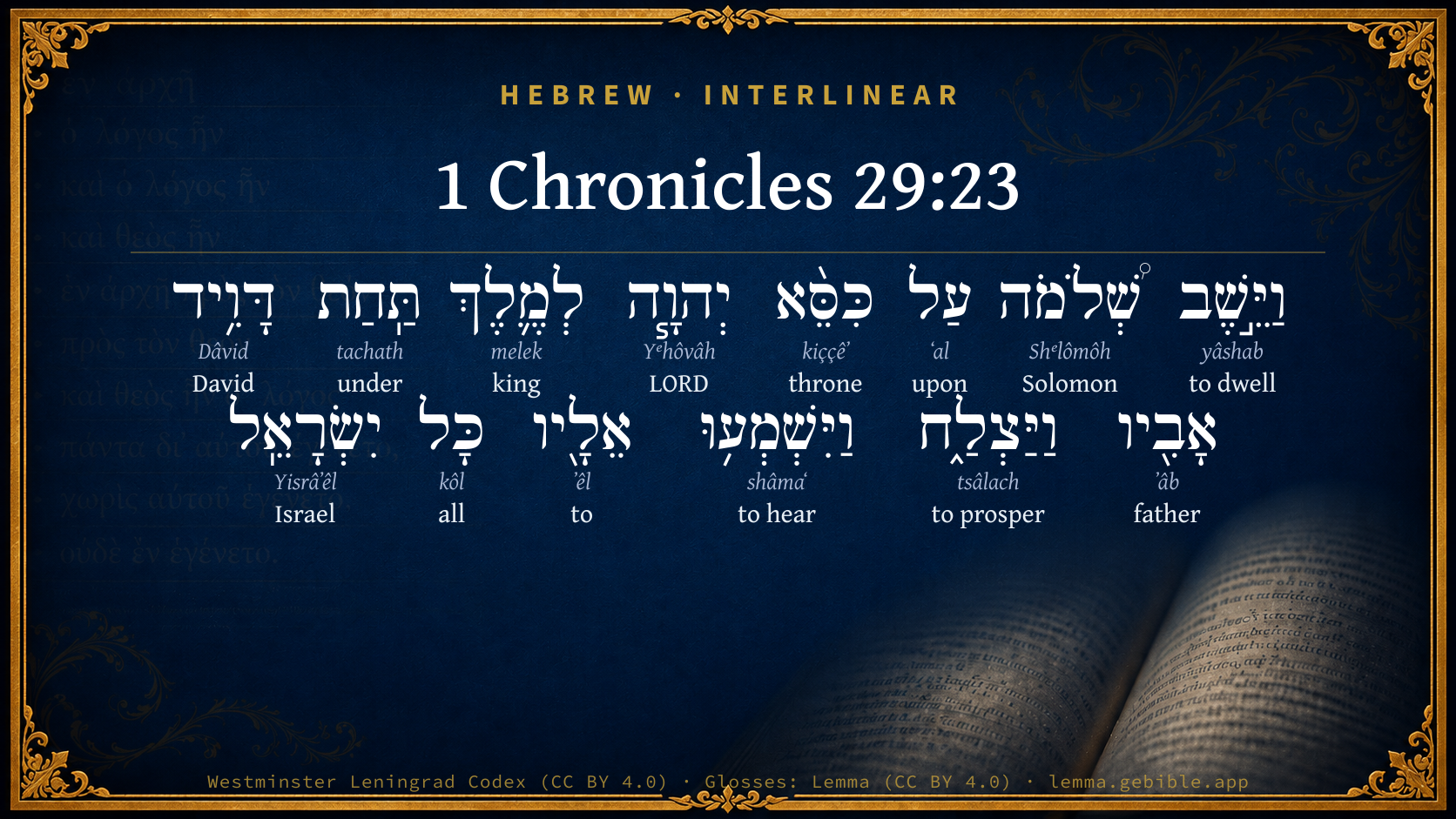
Hebrew (Westminster Leningrad Codex) 1 Chronicles 29:23 appears in the Hebrew Old Testament. The text above is from the Westminster Leningrad Codex. Each word links to its Strong’s number, a concise gloss, and parsing drawn from the Open Scriptures Hebrew Bible morphology. Click any word for its full Brown-Driver-Briggs (BDB) entry.
Download image
Cite this verse

1 Chronicles 29:23 (World English Bible). Public Domain. Lemma interlinear Bible study tool, https://lemma.gebible.app/v/1-chronicles/29/23.

Show BibTeX & RIS
BibTeX
RIS
English Translation
Then Solomon sat on the throne of Yahweh as king instead of David his father, and prospered; and all Israel obeyed him.
World English Bible · Public Domain
Download a study sheet

One document with this verse’s original text, its word-by-word gloss line, the meaning frame, cross-references with their text, attributed commentary, and full source and license credits — printable, and it pastes into notes with its structure intact.

This verse Autodidact and up

Study sheet (.html) Plain text (.txt)

A passage Seminary Student

Up to 50 verses in one chapter. A passage sheet keeps up to 6 commentary sources and 12 cross-references per verse, in the order this page ranks them, and says so on the sheet whenever that leaves anything out. Ask for a single verse and you get the Autodidact verse sheet above.

Everything on this page stays free to read, with no account — the sheet is a download of what is already on screen, not access to it.

Want to remove ads? Support Godless Engineer
Compare translations 3

The same verse in 3 English versions, stacked beneath the original-language interlinear above. Click any original word for its lexicon entry.

Each is an independent rendering of the whole verse — the interlinear is not word-aligned to these translations.

Highlighted words mark where these versions differ — a whole-verse word diff, not a word-by-word alignment.

  • World English Bible Public Domain
    Then Solomon sat on the throne of Yahweh as king instead of David his father, and prospered; and all Israel obeyed him.
  • King James Version Public Domain
    Then Solomon sat on the throne of the LORD as king instead of David his father, and prospered; and all Israel obeyed him.
  • unfoldingWord Literal Text CC BY-SA 4.0
    And Solomon sat on the throne of Yahweh as king in place of David his father. And he succeeded, and all of Israel listened to him.

unfoldingWord Literal Text — © unfoldingWord, licensed CC BY-SA 4.0. Word-aligned USFM3 via Door43 (git.door43.org/unfoldingWord/en_ult).

Versions to compare (up to 4)

3 of 4 selected

Show all 18 translations

Every available English version of this verse, each an independent rendering of the whole verse.

  • World English Bible Public Domain
    Then Solomon sat on the throne of Yahweh as king instead of David his father, and prospered; and all Israel obeyed him.
  • Berean Standard Bible Public Domain
    So Solomon sat on the throne of the LORD as king in place of his father David. He prospered, and all Israel obeyed him.
  • Majority Standard Bible Public Domain
    So Solomon sat on the throne of the LORD as king in place of his father David. He prospered, and all Israel obeyed him.
  • King James Version Public Domain
    Then Solomon sat on the throne of the LORD as king instead of David his father, and prospered; and all Israel obeyed him.
  • American Standard Version (1901) Public Domain
    Then Solomon sat on the throne of Jehovah as king instead of David his father, and prospered; and all Israel obeyed him.
  • Revised Version (1885) Public Domain
    Then Solomon sat on the throne of the LORD as king instead of David his father, and prospered; and all Israel obeyed him.
  • Geneva Bible (1599) Public Domain
    So Salomon sate on the throne of the Lord, as King in steade of Dauid his father, and prospered: and all Israel obeyed him.
  • Douay-Rheims (1899) Public Domain
    And Solomon sat on the throne of the Lord as king instead of David his father, and he pleased all: and all Israel obeyed him.
  • Young's Literal Translation Public Domain
    And Solomon sitteth on the throne of Jehovah for king instead of David his father, and prospereth, and all Israel hearken unto him,
  • Literal Standard Version CC BY-SA 4.0
    And Solomon sits on the throne of YHWH for king instead of his father David, and prospers, and all of Israel listens to him,
  • Unlocked Literal Bible CC BY-SA 4.0
    Then Solomon sat on Yahweh's throne as king instead of David his father. He prospered, and all Israel obeyed him.
  • unfoldingWord Literal Text CC BY-SA 4.0
    And Solomon sat on the throne of Yahweh as king in place of David his father. And he succeeded, and all of Israel listened to him.
  • Darby Bible Public Domain
    And Solomon sat on the throne of Jehovah as king instead of David his father, and prospered; and all Israel obeyed him.
  • World Messianic Bible Public Domain
    Then Solomon sat on the throne of the LORD as king instead of David his father, and prospered; and all Israel obeyed him.
  • Webster's Bible Public Domain
    Then Solomon sat on the throne of the LORD as king instead of David his father, and prospered; and all Israel obeyed him.
  • Free Bible Version CC BY-SA 4.0
    So Solomon took the throne of the Lord as king in place of David, his father. He was successful, and all the Israelites obeyed him.
  • Bible in Basic English Public Domain
    So Solomon was put on the seat of the Lord as king in place of his father David, and everything went well for him; and all Israel was under his authority.
  • JPS Tanakh (1917) Public Domain
    Then Solomon sat on the throne of the LORD as king instead of David his father, and prospered; and all Israel hearkened to him.

Literal Standard Version (2020), Covenant Press — licensed CC BY-SA 4.0. Text via the HelloAO Bible API (eBible.org). Unlocked Literal Bible (unfoldingWord) — licensed CC BY-SA 4.0. Text via the HelloAO Bible API (eBible.org). unfoldingWord Literal Text — © unfoldingWord, licensed CC BY-SA 4.0. Word-aligned USFM3 via Door43 (git.door43.org/unfoldingWord/en_ult). Free Bible Version, Dr. Jonathan Gallagher — licensed CC BY-SA 4.0. Text via the HelloAO Bible API (eBible.org).

Word by word

More ways to search: Search by grammar → Find every occurrence → Compare this word →

Practice this passage: Drill this verse → Learn its vocabulary →

וַיַּצְלַ֑ח
tsâlach
H6743
“and · to prosper”
Conjunction + Verb, Hiphil, Sequential Imperfect, 3rd Person, Masculine, Singular
Part of Speech
Conjunction + Verb
Stem
Hiphil
Form
Sequential Imperfect
Person
3rd Person
Gender
Masculine
Number
Singular
Full BDB Definition

Origin: a primitive root

TWOT: 1916 , 1917

(Qal) to rush - to advance, prosper, make progress, succeed, be profitable - (Qal) to prosper - (Hiphil) - to make prosperous, bring to successful issue, cause to prosper - to show or experience prosperity, prosper
  1. וַיֵּ֣שֶׁב yâshab H3427 “and · to dwell” Conjunction + Verb, Qal, Sequential Imperfect, 3rd Person, Masculine, Singular
  2. שְׁ֠לֹמֹה Shᵉlômôh H8010 “Solomon” Noun, Proper
  3. עַל ʻal H5921 “upon” Preposition
  4. כִּסֵּ֨א kiççêʼ H3678 “throne of” Noun, Common, Masculine, Singular, Construct
  5. יְהוָ֧ה Yᵉhôvâh H3068 “LORD” Noun, Proper
  6. לְמֶ֛לֶךְ melek H4428 “to/for · king” Preposition + Noun, Common, Masculine, Singular, Absolute
  7. תַּֽחַת tachath H8478 “under” Preposition
  8. דָּוִ֥יד Dâvid H1732 “David” Noun, Proper
  9. אָבִ֖יו ʼâb H1 “father · his” Noun, Common, Masculine, Singular, Construct + Suffix, Personal, 3rd Person, Masculine, Singular
  10. וַיִּשְׁמְע֥וּ shâmaʻ H8085 “and · to hear” Conjunction + Verb, Qal, Sequential Imperfect, 3rd Person, Masculine, Plural
  11. אֵלָ֖יו ʼêl H413 “to · him” Preposition + Suffix, Personal, 3rd Person, Masculine, Singular
  12. כָּל kôl H3605 “all of” Noun, Common, Masculine, Singular, Construct
  13. יִשְׂרָאֵֽל Yisrâʼêl H3478 “Israel” Noun, Proper

About this verse

These counts appear in no published source. They are computed here, from the morphology-tagged text and Lemma’s own curated glosses. What Lemma adds →

14
words
14
distinct lemmas
Historical
section

Grammatical profile

  • 3 verbs
  • 8 nouns
  • 3 prepositions

Verb forms

  • וַיֵּ֣שֶׁב Qal · Sequential Imperfect
  • וַיַּצְלַ֑ח Hiphil · Sequential Imperfect
  • וַיִּשְׁמְע֥וּ Qal · Sequential Imperfect

Hebrew & Septuagint length

In English translation the verse runs 22 words from the Hebrew and 19 from the Septuagint (LXX English) — closely comparable.

A rough comparison of the two English renderings, which tokenize alike — not a word-level alignment.

Word counts can differ between the Hebrew and the Greek without any difference in meaning — e.g. the Hebrew direct-object marker אֵת has no separate Greek word, and Greek often adds the article ὁ.

In the original languages it is 14 Hebrew tokens and 16 Greek tokens — but the two are counted differently (Hebrew bundles its prefixes and suffixes into one token; the Greek is in lemma form), so that isn’t a like-for-like length.

Cross-references

8

Topical passages linked to 1 Chronicles 29:23 in the Treasury of Scripture Knowledge — connected by theme and wording, ordered by reader-vote popularity; previews shown in the World English Bible.

  • 1 Kings 2:12 Solomon sat on the throne of David his father; and his kingdom was established greatly.
  • 1 Chronicles 28:5 Of all my sons (for Yahweh has given me many sons), he has chosen Solomon my son to sit on the throne of the kingdom of Yahweh over Israel.
  • Romans 13:1 Let every soul be in subjection to the higher authorities, for there is no authority except from God, and those who exist are ordained by God.
  • 1 Chronicles 22:11 Now, my son, Yahweh be with you; and prosper you, and build the house of Yahweh your God, as he has spoken concerning you.
  • Psalms 132:11 Yahweh has sworn to David in truth. He will not turn from it: "I will set the fruit of your body on your throne.
  • Ecclesiastes 8:2–5 I say, "Keep the king's command!" because of the oath to God.
  • Isaiah 9:6–7 For to us a child is born, to us a son is given; and the government shall be on his shoulder: and his name shall be called Wonderful, Counselor, Mighty God, Everlasting Father, Prince of Peace.
  • 1 Chronicles 17:11–12 It shall happen, when your days are fulfilled that you must go to be with your fathers, that I will set up your seed after you, who shall be of your sons; and I will establish his kingdom.

Cross-references courtesy of OpenBible.info (CC BY 4.0).

Hebrew and Greek witnesses Masoretic Hebrew ↔ Greek Septuagint

The same verse in the two great witnesses to the Old Testament, shown verse-for-verse.

These are two independent witnesses, not word-aligned to each other, and the Septuagint is shown in lemma (dictionary) form.

Hebrew 1 Chronicles 29:23 Masoretic · Westminster Leningrad Codex

וַיֵּ֣שֶׁב שְׁ֠לֹמֹה עַל כִּסֵּ֨א יְהוָ֧ה לְמֶ֛לֶךְ תַּֽחַת דָּוִ֥יד אָבִ֖יו וַיַּצְלַ֑ח וַיִּשְׁמְע֥וּ אֵלָ֖יו כָּל יִשְׂרָאֵֽל

Then Solomon sat on the throne of Yahweh as king instead of David his father, and prospered; and all Israel obeyed him.

World English Bible · Public Domain

Greek LXX 1 Chronicles 29:23 Septuagint · lemma form

καί καταἵζω σαλωμών ἐπί θρόνος δαυίδ ὁ πατήρ αὐτός καί εὐδοκέω καί ἐπιἀκούω αὐτός πᾶς ἰσραήλ

And Solomon sat upon the throne of his father David, and was highly honored; and all Israel obeyed him.

LXX2012 (modern English Septuagint) · Public Domain

Hebrew: Westminster Leningrad Codex (CC BY 4.0). Greek: Septuagint (public domain); English from LXX2012 (modern English Septuagint) (Public Domain). How the Septuagint differs from the Hebrew →

Commentary

Notes on 1 Chronicles 29:23 from classic Christian and Jewish commentators (each source and its license shown beneath its notes). The classic Christian expositions comment on the surrounding passage and are grouped to its opening verse, so a note may address several verses; the Jewish commentaries on the Tanakh (Rashi and others) are per-verse, so they appear only where the commentator wrote on this verse.

Lemma curates 59 commentaries, every one of them public domain or Creative Commons licensed, each selected and text-cleaned for this edition rather than reprinted as found. About our sources →

Matthew Henry's Commentary

These verses bring king Solomon to his throne and king David to his grave. Thus the rising generation thrusts out that which went before, and says, "Make room for us." Every one has his day.

I. Here is Solomon rising (Ch1 29:23): Solomon sat on the throne of the Lord. Not his throne which he prepared in the heavens, but the throne of Israel is called the throne of the Lord because not only is he King of all nations, and all kings rule under him, but he was in a peculiar manner King of Israel, Sa1 12:12. He had the founding, he had the filling, of their throne, by immediate direction. The municipal laws of their kingdom were divine. Urim and prophets were the privy counsellors of their princes; therefore is their throne called the throne of the Lord. Solomon's kingdom typified the kingdom of the Messiah, and his is indeed the throne of the Lord; for the Father judgeth no man, but hath committed all judgment to him; hence he calls him his King, Psa 2:6. Being set on the throne of the Lord, the throne to which God called him, he prospered. Those that follow the divine guidance may expect success by the divine blessing. Solomon prospered; for, 1. His people paid honour to him, as one to whom honour is due: All Israel obeyed him, that is, were ready to swear allegiance to him (Ch1 29:23), the princes and mighty men, and even the sons of David, though by seniority their title to the crown was prior to his, and they might think themselves wronged by his advancement. God thought fit to make him king, and made him fit to be so, and therefore they all submitted themselves to him. God inclined their hearts to do so, that his reign might, from the first, be peaceable. His father was a better man than he, and yet came to the crown with much difficulty, after long delay, and by many and slow steps. David had more faith, and therefore had it more tried. They submitted themselves (Heb. They gave the hand under Solomon), that is, bound themselves by oath to be true to him (putting the hand under the thigh was a ceremony anciently used in swearing); or they were so entirely devoted that they would put their hand under his feet to serve him. 2. God put honour upon him; for those that honour him he will honour: The Lord magnified Solomon exceedingly, Ch1 29:25. His very countenance and presence, I am apt to think, had something in them very great and awful. All he said and all he did commanded respect. None of all the judges or kings of Israel, his predecessors, made such a figure as he did nor lived in such splendour.

II. Here is David's setting, that great man going off the stage. The historian here brings him to the end of his day, leaves him asleep, and draws the curtains about him.

1. He gives a summary account of the years of his reign, Ch1 29:26, Ch1 29:27. He reigned forty years, as did Moses, Othniel, Deborah, Gideon, Eli, Samuel, and Saul, who were before him, and Solomon after him.

2. He gives a short account of his death (Ch1 29:28), that he died full of days, riches, and honour; that is, (1.) Loaded with them. He was very old, and very rich, and very much honoured both of God and man. He had been a man of war from his youth, and, as such, had his soul continually in his hand; yet he was not cut off in the midst of his days, but was preserved through all dangers of a military life, lived to a good old age, and died in peace, died in his bed, and yet in the bed of honour. (2.) Satiated with them. He was full of days, riches, and honour; that is, he had enough of this world and of the riches and honours of it, and knew when he had enough, for he was very willing to die and leave it, having said (Psa 49:15), God shall receive me, and (Psa 23:4), Thou art with me. A good man will soon be full of days, riches, and honour, but will never be satisfied with them; no satisfaction but in God's loving kindness.

3. For a fuller account of David's life and reign he refers to the histories or records of those times, which were written by Samuel while he lived, and continued, after his death, by Nathan and Gad, Ch1 29:29. There was related what was observable in his government at home and his wars abroad, the times, that is, the events of the times, that went over him, Ch1 29:29, Ch1 29:30. These registers were then in being, but are now lost. Note, Good use may be made of those histories of the church which are authentic though not sacred or of divine inspiration.

Matthew Henry's Commentary on the Whole Bible (1708–1710) — public domain (CC PDM 1.0). Text via the HelloAO Bible API.

Ellicott's Commentary for English Readers

(23) Then.—And.

Solomon sat on the throne of the Lord.—Comp. 1Ch_28:5.

As king instead of David his father.—It is not meant that David abdicated. 1Ch_29:23-25 are anticipative of the history of Solomon’s reign. At the same time, their introduction here is natural, not only as relating the immediate sequel of Solomon’s coronation, but also as showing how David’s last wishes in regard to his son were realised.

A Bible Commentary for English Readers, edited by Charles John Ellicott (1878–1897) — public domain. Text from a community e-Sword module.

Trapp's Complete Commentary

John Trapp

1Ch 29:23 Then Solomon sat on the throne of the LORD as king instead of David his father, and prospered; and all Israel obeyed him.

Ver. 23. Then Solomon sat on the throne of the Lord.] Every royal throne is the Lord’s; for he is King of kings, and all kings are a Deo aut missi, aut permissi, God’s substitutes. But the throne of Israel was the Lord’s by a specialty. Josephus calleth that commonwealth a Theocracy, or God government; and the people were called Judge; as Prosper conceiteth - because they received ius Dei, a law given by God, who himself was sovereign Lord and law giver. Solomon also, sitting upon this throne, was a lively type of the Lord Christ and his kingdom. {Luk 1:32}

And prospered.] This was the fruit of his father’s fervent prayers for him. {1Ch 22:11}

John Trapp, A Commentary or Exposition upon All the Books of the Old and New Testament (1647–1656) — public domain. Text from a community e-Sword module.

The Biblical Illustrator

Joseph S. Exell

1Ch_29:23

And prospered.

A prosperous kingdom

I. For a king and a people to be happy, the king must have a right to his kingdom.

II. The management of the sceptre should be as wise as the tenure is just and royal.

III. The people must be obedient.

IV. National fear of the Lord is essential to national blessing. (Bishop Francis Turner.)

The Biblical Illustrator, edited by Joseph S. Exell (c. 1880s–1900s) — public domain. Text from a community e-Sword module.

Joseph Benson's Commentary

1Ch 29:23. Then Solomon sat on the throne of the Lord — On the throne of Israel, which is called the throne of the Lord, because the Lord himself was, in a peculiar manner, the king and governor of Israel. He had the founding, he had the filling of their throne, by immediate direction.

Joseph Benson's Commentary on the Old and New Testaments (1811–1818) — public domain. Text from a community e-Sword module.

Geneva Bible (1599)

Geneva Bible translators

This declareth that the Kings of Judah were figures of Christ, who was the true anointed, and to whom God gave the chief government of all things.

Geneva Bible (1599) marginal notes — public domain. Text via Bolls.life.

Jamieson, Fausset & Brown

Robert Jamieson, A. R. Fausset & David Brown

Solomon sat on the throne of the Lord--As king of Israel, he was the Lord's vicegerent.

Jamieson, Fausset & Brown — Commentary Critical and Explanatory on the Whole Bible (1871) — public domain (CC PDM 1.0). Text via the HelloAO Bible API.

The Cambridge Bible for Schools and Colleges

gen. ed. J. J. S. Perowne

23–25. The Beginning of Solomon’s Reign

23. the throne of the Lord] See 1Ch_28:5, note.

The Cambridge Bible for Schools and Colleges (gen. ed. J. J. S. Perowne; Cambridge University Press, 1878–1918) — public domain. Text from a community e-Sword module.

John Gill's Exposition

And all the princes and the mighty men,.... The princes of the tribes, and the officers of the army:

and all the sons likewise of King David; as many as were living: and though they were elder than Solomon:

they submitted to Solomon the king; or "gave the hand under" (t) him, promised obedience, and swore allegiance to him, see Gen 24:2.

(t) "dederunt manum sub Selomoh", Pagninus, Montanus, Michaelis.

John Gill's Exposition of the Whole Bible (1746–1763) — public domain (CC PDM 1.0). Text via the HelloAO Bible API.

Albert Barnes' Notes on the Bible

The throne of David is called here “the throne of the Lord,” as in 1Ch 28:5 it is called “the throne of the kingdom of the Lord,” because God had set it up and had promised to establish it.

Albert Barnes' Notes on the Bible (1834–1885) — public domain. Text from a community e-Sword/MySword module.

Matthew Poole's English Annotations

On the throne of the Lord, i.e. on the throne of Israel, which is called the throne of the Lord, either more generally, as all thrones are the Lord’s, by whom kings reign, Pro 8:15, and magistrates are ordained, Rom 13:1,2; or more specially and peculiarly; either,

1. Because the Lord himself was in a peculiar manner the King and Governor of Israel, not only in the time of the judges, but afterward, Psa 44:4; 89:18; 149:2; Isa 33:22. Or,

2. Because it was the throne of Christ the Lord, whose vicegerents David, and Solomon, and their successors were, for whom this throne was reserved, and by whom it was to be established and enjoyed for ever, Luk 2:32,33. Or,

3. The throne of the Lord is put for the throne of the people of the Lord, by a concise and short manner of speech, which is frequent in the Hebrew language; as when the key of David is put for the key of the house of David; and the mountain of the Lord, for the mountain of the Lord’s house. Or,

4. Because this throne fell to Solomon not by right of inheritance, for he had elder brethren, but by the special appointment and gift of the Lord. And so this of the Lord is the genitive case of the efficient, as the learned call it, and signifies which the Lord gave him.

Matthew Poole's English Annotations on the Holy Bible (1683–1685) — public domain. Text from a community e-Sword/MySword module.

The Pulpit Commentary

For the happy expression, the throne of the Lord, see Chronicles 28:5. And for evidence that Solomon did really exercise royal authority before David"s death, see 1Ki_1:32, 45-48 2:1.

The Pulpit Commentary (1880–1919), ed. H.D.M. Spence-Jones & Joseph S. Exell — public domain. Text from a community e-Sword module.

Keil & Delitzsch

C. F. Keil & F. Delitzsch

And all the princes and the mighty men,.... The princes of the tribes, and the officers of the army:

and all the sons likewise of King David; as many as were living: and though they were elder than Solomon:

they submitted to Solomon the king; or "gave the hand under" (t) him, promised obedience, and swore allegiance to him, see Gen 24:2.

(t) "dederunt manum sub Selomoh", Pagninus, Montanus, Michaelis.

Keil & Delitzsch — Biblical Commentary on the Old Testament (1861–1891) — public domain (CC PDM 1.0). Text via the HelloAO Bible API. (Old Testament only.)

Rashi

Rabbi Shlomo Yitzchaki (Rashi)

And Solomon sat on the throne of the Lord as king Here it is appropriate to say that he reigned on the throne of the Lord because the throne is God’s to enthrone upon it whomever He wishes, and in the Midrash (Peskikta d’Rav Kahana p. 53a) it is explained that the throne was full (at its highest level) like the moon on the fifteenth of the month, because from Abraham to Solomon were fifteen generations: Abraham, Isaac, Jacob, Judah, Perez, Hezron, Ram, Amminadab, Nahshon, Salmah, Boaz, Obed, Jesse, David, and Solomon, and that is what is written: (Ps. 89:37): “...and his throne is like the sun before Me,” which never diminishes, and if you wish to compare it to the moon, it will be like the moon which will be established in the time to come. But from Solomon and onward, the kings diminished from their greatness like the moon, which continuously diminishes, until Zedekiah, (II Kings 25:7): “...and he blinded Zedekiah’ s eyes.”

and all Israel obeyed him immediately, unlike Saul, about whom it is written: (I Sam. 10:27): “And wicked men said: How will this one save us?” And also David ruled at first only in Hebron for seven years.

Rashi on the Tanakh — English translations: “The Judaica Press complete Tanach with Rashi, translated by A. J. Rosenberg” (CC BY 4.0); “Pentateuch with Rashi's commentary by M. Rosenbaum and A.M. Silbermann, 1929-1934” (public domain); “The Metsudah Tanach series, Lakewood, N.J” (CC BY 4.0); and “The Book of Joshua, Metsudah Publications, 1997” (CC BY 4.0). Text via Sefaria.

Lesson kit

Teaching starters — assembled from the data on this page, not authored interpretation. Every prompt links to the verse data it draws on. Edit before teaching.

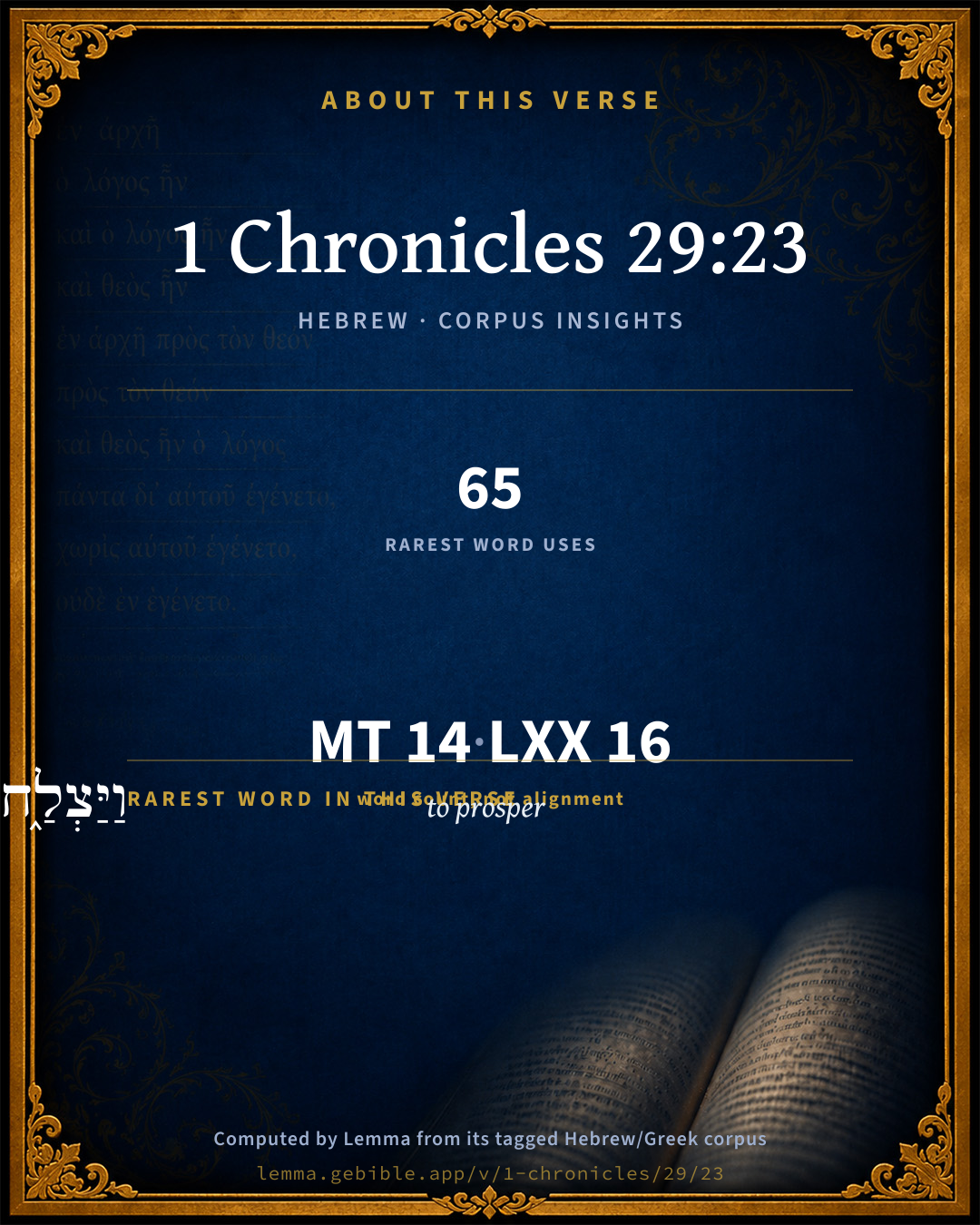
1 Chronicles, in the Historical, opens this verse with 14 words (14 distinct Hebrew lemmas). Its most distinctive word is tsâlach (“to prosper”). A historical commentator’s framing appears above. Read the whole chapter for the surrounding context.

Discussion questions

  1. The word tsâlach carries the sense “to prosper.” How does it shape the verse?
  2. How does 1 Kings 2:12, which shares this passage’s theme, read alongside this verse?
  3. The translations on this page render this verse differently — a whole-verse word diff, not a word-by-word alignment. What might account for the different wordings?
  4. «וַיֵּ֣שֶׁב» is a Qal Sequential Imperfect verb. How does that grammatical form shape the action described?
  5. Compare how Matthew Henry's Commentary and Ellicott's Commentary for English Readers read this verse. Where do they agree or differ?

Things to notice

Reading settings

Reading text

Shown beneath each verse's original-language words.

Old Testament
Old Testament edition

Read the OT as the Masoretic Hebrew (MT) or the Greek Septuagint (LXX).

English shown for the Greek Septuagint (in the Hebrew ↔ Greek comparison).

Comparing translations? Open the Compare panel on any verse page to stack up to four side by side.