
1 Chronicles 11:13

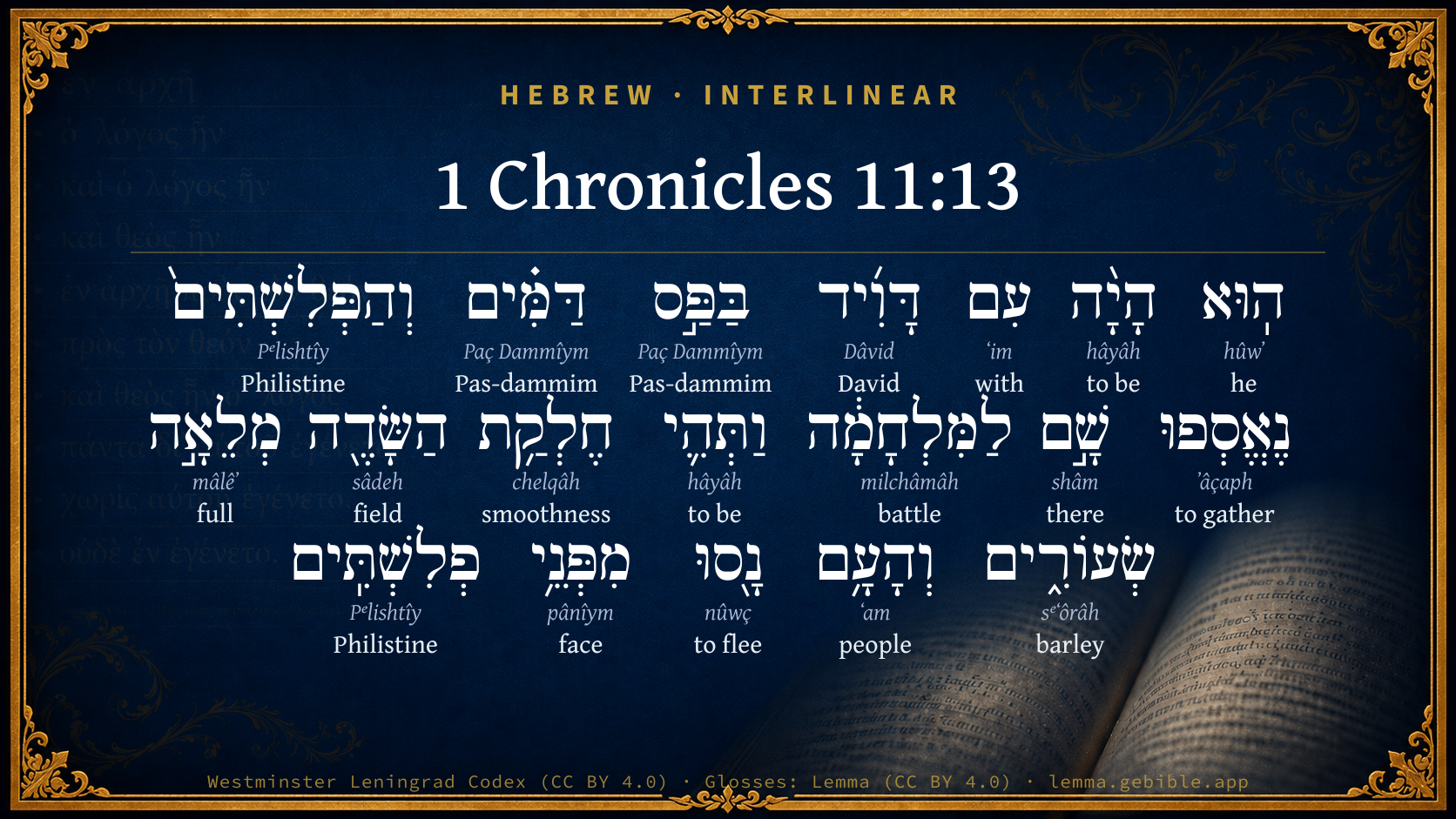
Hebrew (Westminster Leningrad Codex) 1 Chronicles 11:13 appears in the Hebrew Old Testament. The text above is from the Westminster Leningrad Codex. Each word links to its Strong’s number, a concise gloss, and parsing drawn from the Open Scriptures Hebrew Bible morphology. Click any word for its full Brown-Driver-Briggs (BDB) entry.
Download image
Cite this verse

1 Chronicles 11:13 (World English Bible). Public Domain. Lemma interlinear Bible study tool, https://lemma.gebible.app/v/1-chronicles/11/13.

Show BibTeX & RIS
BibTeX
RIS
English Translation
He was with David at Pasdammim, and there the Philistines were gathered together to battle, where was a plot of ground full of barley; and the people fled from before the Philistines.
World English Bible · Public Domain
Highlights
  • 1 first appearance in the Hebrew Bible
Full analysis ↓
Download a study sheet

One document with this verse’s original text, its word-by-word gloss line, the meaning frame, cross-references with their text, attributed commentary, and full source and license credits — printable, and it pastes into notes with its structure intact.

This verse Autodidact and up

Study sheet (.html) Plain text (.txt)

A passage Seminary Student

Up to 50 verses in one chapter. A passage sheet keeps up to 6 commentary sources and 12 cross-references per verse, in the order this page ranks them, and says so on the sheet whenever that leaves anything out. Ask for a single verse and you get the Autodidact verse sheet above.

Everything on this page stays free to read, with no account — the sheet is a download of what is already on screen, not access to it.

Want to remove ads? Support Godless Engineer
Compare translations 3

The same verse in 3 English versions, stacked beneath the original-language interlinear above. Click any original word for its lexicon entry.

Each is an independent rendering of the whole verse — the interlinear is not word-aligned to these translations.

Highlighted words mark where these versions differ — a whole-verse word diff, not a word-by-word alignment.

  • World English Bible Public Domain
    He was with David at Pasdammim, and there the Philistines were gathered together to battle, where was a plot of ground full of barley; and the people fled from before the Philistines.
  • King James Version Public Domain
    He was with David at Pasdammim, and there the Philistines were gathered together to battle, where was a parcel of ground full of barley; and the people fled from before the Philistines.
  • unfoldingWord Literal Text CC BY-SA 4.0
    He was with David at Pas Dammim. Now the Philistines had assembled themselves there for battle, and a portion of the field was full barley. And the people fled from the face of the Philistines.

unfoldingWord Literal Text — © unfoldingWord, licensed CC BY-SA 4.0. Word-aligned USFM3 via Door43 (git.door43.org/unfoldingWord/en_ult).

Versions to compare (up to 4)

3 of 4 selected

Show all 18 translations

Every available English version of this verse, each an independent rendering of the whole verse.

  • World English Bible Public Domain
    He was with David at Pasdammim, and there the Philistines were gathered together to battle, where was a plot of ground full of barley; and the people fled from before the Philistines.
  • Berean Standard Bible Public Domain
    He was with David at Pas-dammim when the Philistines gathered there for battle. At the place with a field full of barley, the troops fled from the Philistines.
  • Majority Standard Bible Public Domain
    He was with David at Pas-dammim when the Philistines gathered there for battle. At a place with a field full of barley, the troops fled from the Philistines.
  • King James Version Public Domain
    He was with David at Pasdammim, and there the Philistines were gathered together to battle, where was a parcel of ground full of barley; and the people fled from before the Philistines.
  • American Standard Version (1901) Public Domain
    He was with David at Pasdammim, and there the Philistines were gathered together to battle, where was a plot of ground full of barley; and the people fled from before the Philistines.
  • Revised Version (1885) Public Domain
    He was with David at Pasdammim, and there the Philistines were gathered together to battle, where was a plot of ground full of barley; and the people fled from before the Philistines.
  • Geneva Bible (1599) Public Domain
    He was with Dauid at Pas-dammim, and there the Philistims were gathered together to battel: and there was a parcell of ground full of barley, and the people fled before the Philistims.
  • Douay-Rheims (1899) Public Domain
    He was with David in Phesdomim, when the Philistines were gathered to that place to battle: and the field of that country was full of barley, and the people fled from before the Philistines.
  • Young's Literal Translation Public Domain
    he hath been with David in Pas-Dammim, and the Philistines have been gathered there to battle, and a portion of the field is full of barley, and the people have fled from the face of the Philistines,
  • Literal Standard Version CC BY-SA 4.0
    he has been with David in Pas-Dammim, and the Philistines have been gathered there to battle, and a portion of the field is full of barley, and the people have fled from the face of the Philistines,
  • Unlocked Literal Bible CC BY-SA 4.0
    He was with David at Pas Dammim, and there the Philistines assembled together for battle, where there was a barley field and the army fled from the Philistines.
  • unfoldingWord Literal Text CC BY-SA 4.0
    He was with David at Pas Dammim. Now the Philistines had assembled themselves there for battle, and a portion of the field was full barley. And the people fled from the face of the Philistines.
  • Darby Bible Public Domain
    He was with David at Pas-dammim, where the Philistines were gathered together to battle; and there was [there] a plot of ground full of barley; and the people had fled from before the Philistines.
  • World Messianic Bible Public Domain
    He was with David at Pasdammim, and there the Philistines were gathered together to battle, where there was a plot of ground full of barley; and the people fled from before the Philistines.
  • Webster's Bible Public Domain
    He was with David at Pas-dammim, and there the Philistines were gathered to battle, where was a parcel of ground full of barley; and the people fled from before the Philistines.
  • Free Bible Version CC BY-SA 4.0
    He was with David at Pas-dammin when the Philistines gathered for battle that took place in a field full of barley. The Israelite army ran away when the Philistines attacked,
  • Bible in Basic English Public Domain
    He was with David at Pas-dammim, where the Philistines had come together for the fight, near a bit of land full of barley; and the people went in flight before the Philistines.
  • JPS Tanakh (1917) Public Domain
    He was with David at Pas-dammim, and there the Philistines were gathered together to battle, where was a plot of ground full of barley; and the people fled from before the Philistines.

Literal Standard Version (2020), Covenant Press — licensed CC BY-SA 4.0. Text via the HelloAO Bible API (eBible.org). Unlocked Literal Bible (unfoldingWord) — licensed CC BY-SA 4.0. Text via the HelloAO Bible API (eBible.org). unfoldingWord Literal Text — © unfoldingWord, licensed CC BY-SA 4.0. Word-aligned USFM3 via Door43 (git.door43.org/unfoldingWord/en_ult). Free Bible Version, Dr. Jonathan Gallagher — licensed CC BY-SA 4.0. Text via the HelloAO Bible API (eBible.org).

Word by word

More ways to search: Search by grammar → Find every occurrence → Compare this word →

Practice this passage: Drill this verse → Learn its vocabulary →

בַּפַּ֣ס
Paç Dammîym
H6450
“in/at the · Pas-dammim”
Preposition, Determined + Noun, Proper
Part of Speech
Preposition + Noun
Type
Proper
Full BDB Definition

Origin: from H6446 and the pl. of H1818

TWOT: None

Pas-dammim = "boundary of blood" - a place in western Judah
  1. הֽוּא hûwʼ H1931 “he” Pronoun, Personal, 3rd Person, Masculine, Singular
  2. הָיָ֨ה hâyâh H1961 “to be” Verb, Qal, Perfect, 3rd Person, Masculine, Singular
  3. עִם ʻim H5973 “with” Preposition
  4. דָּוִ֜יד Dâvid H1732 “David” Noun, Proper
  5. דַּמִּ֗ים Paç Dammîym H6450 “Pas-dammim” Noun, Proper
  6. וְהַפְּלִשְׁתִּים֙ Pᵉlishtîy H6430 “and · the · Philistines” Conjunction + Particle, Definite Article + Noun, Gentilic, Masculine, Plural, Absolute
  7. נֶאֱסְפוּ ʼâçaph H622 “to gather” Verb, Niphal, Perfect, 3rd Person, Common, Plural
  8. שָׁ֣ם shâm H8033 “there” Adverb
  9. לַמִּלְחָמָ֔ה milchâmâh H4421 “to/for the · battle” Preposition, Determined + Noun, Common, Feminine, Singular, Absolute
  10. וַתְּהִ֛י hâyâh H1961 “and · to be” Conjunction + Verb, Qal, Sequential Imperfect, 3rd Person, Feminine, Singular
  11. חֶלְקַ֥ת chelqâh H2513 “smoothness of” Noun, Common, Feminine, Singular, Construct
  12. הַשָּׂדֶ֖ה sâdeh H7704 “the · field” Particle, Definite Article + Noun, Common, Masculine, Singular, Absolute
  13. מְלֵאָ֣ה mâlêʼ H4392 “full” Adjective, Adjective, Feminine, Singular, Absolute
  14. שְׂעוֹרִ֑ים sᵉʻôrâh H8184 “barley” Noun, Common, Feminine, Plural, Absolute
  15. וְהָעָ֥ם ʻam H5971 “and · the · people” Conjunction + Particle, Definite Article + Noun, Common, Masculine, Singular, Absolute
  16. נָ֖סוּ nûwç H5127 “to flee” Verb, Qal, Perfect, 3rd Person, Common, Plural
  17. מִפְּנֵ֥י pânîym H6440 “from · face(s) of” Preposition + Noun, Common, Both, Plural, Construct
  18. פְלִשְׁתִּֽים Pᵉlishtîy H6430 “Philistines” Noun, Gentilic, Masculine, Plural, Absolute

About this verse

These counts appear in no published source. They are computed here, from the morphology-tagged text and Lemma’s own curated glosses. What Lemma adds →

19
words
16
distinct lemmas
Historical
section

Notable vocabulary

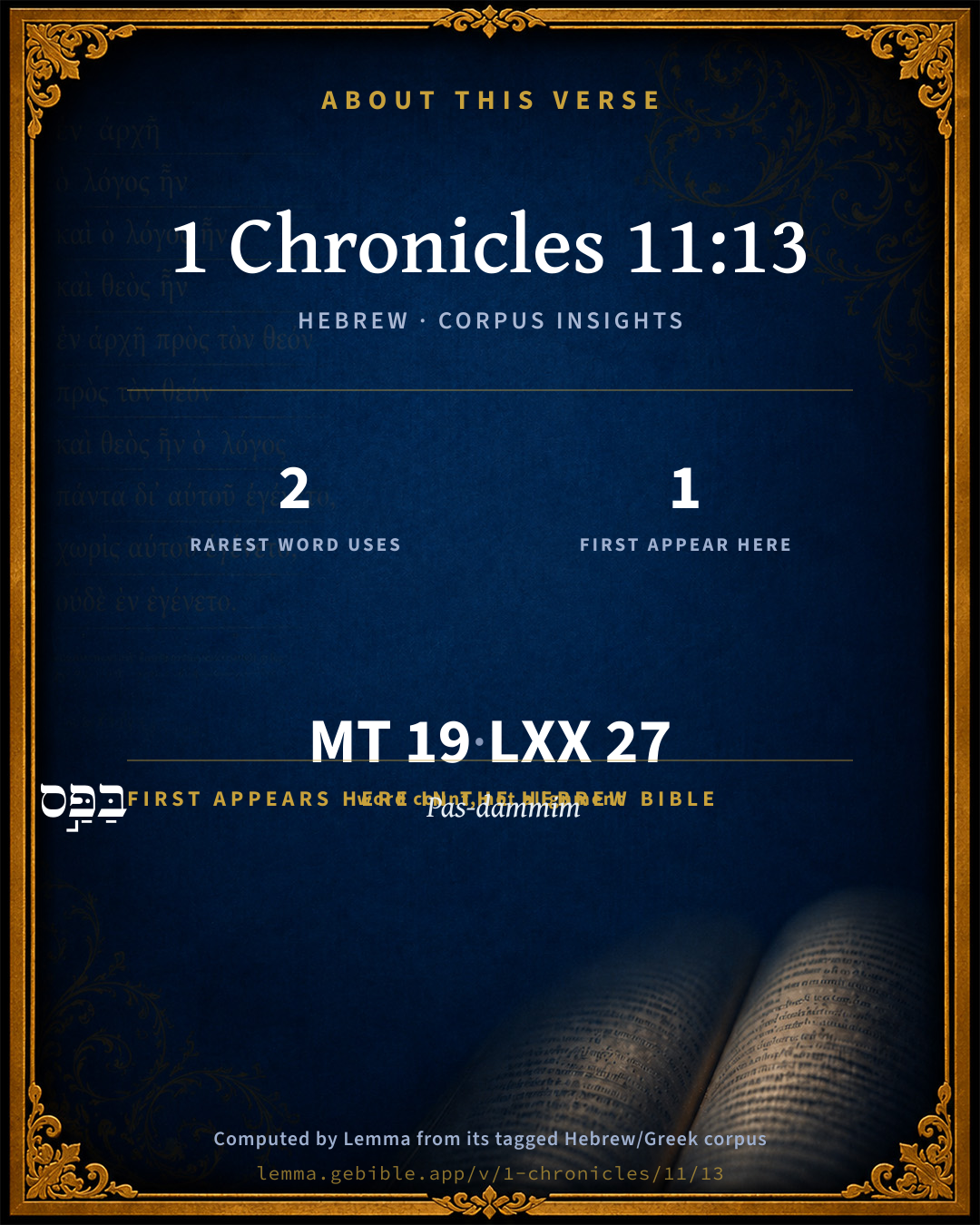
The rarest word here is בַּפַּ֣ס Pas-dammim H6450 — appearing just 2 times in the whole Hebrew Bible.

First appearance in Scripture

This word makes its first canonical appearance in the Hebrew Bible here:

  • בַּפַּ֣ס Pas-dammim H6450

Grammatical profile

  • 4 verbs
  • 11 nouns
  • 1 adjective
  • 1 pronoun
  • 1 preposition
  • 1 adverb

Verb forms

  • הָיָ֨ה Qal · Perfect
  • נֶאֱסְפוּ Niphal · Perfect
  • וַתְּהִ֛י Qal · Sequential Imperfect
  • נָ֖סוּ Qal · Perfect

Repetition

Words recur within this verse — often emphatic in Hebrew:

  • הָיָ֨ה to be H1961 ×2
  • בַּפַּ֣ס Pas-dammim H6450 ×2
  • וְהַפְּלִשְׁתִּים֙ Philistine H6430 ×2

Hebrew & Septuagint length

In English translation the verse runs 32 words from the Hebrew and 32 from the Septuagint (LXX English) — the same length.

A rough comparison of the two English renderings, which tokenize alike — not a word-level alignment.

Word counts can differ between the Hebrew and the Greek without any difference in meaning — e.g. the Hebrew direct-object marker אֵת has no separate Greek word, and Greek often adds the article ὁ.

In the original languages it is 19 Hebrew tokens and 27 Greek tokens — but the two are counted differently (Hebrew bundles its prefixes and suffixes into one token; the Greek is in lemma form), so that isn’t a like-for-like length.

Cross-references

2

Topical passages linked to 1 Chronicles 11:13 in the Treasury of Scripture Knowledge — connected by theme and wording, ordered by reader-vote popularity; previews shown in the World English Bible.

  • 1 Samuel 17:1 Now the Philistines gathered together their armies to battle; and they were gathered together at Socoh, which belongs to Judah, and encamped between Socoh and Azekah, in Ephesdammim.
  • 2 Samuel 23:11–12 After him was Shammah the son of Agee a Hararite. The Philistines were gathered together into a troop, where was a plot of ground full of lentils; and the people fled from the Philistines.

Cross-references courtesy of OpenBible.info (CC BY 4.0).

Hebrew and Greek witnesses Masoretic Hebrew ↔ Greek Septuagint

The same verse in the two great witnesses to the Old Testament, shown verse-for-verse.

These are two independent witnesses, not word-aligned to each other, and the Septuagint is shown in lemma (dictionary) form.

Hebrew 1 Chronicles 11:13 Masoretic · Westminster Leningrad Codex

הֽוּא הָיָ֨ה עִם דָּוִ֜יד בַּפַּ֣ס דַּמִּ֗ים וְהַפְּלִשְׁתִּים֙ נֶאֱסְפוּ שָׁ֣ם לַמִּלְחָמָ֔ה וַתְּהִ֛י חֶלְקַ֥ת הַשָּׂדֶ֖ה מְלֵאָ֣ה שְׂעוֹרִ֑ים וְהָעָ֥ם נָ֖סוּ מִפְּנֵ֥י פְלִשְׁתִּֽים

He was with David at Pasdammim, and there the Philistines were gathered together to battle, where was a plot of ground full of barley; and the people fled from before the Philistines.

World English Bible · Public Domain

Greek LXX 1 Chronicles 11:13 Septuagint · lemma form

οὗτος εἰμί μετά δαυίδ ἐν φασοδομιν καί ὁ ἀλλόφυλος συνἄγω ἐκεῖ εἰς πόλεμος καί εἰμί μερίς ὁ ἀγρός πλήρης κριθή καί ὁ λαός φεύγω ἀπό πρόσωπον ἀλλόφυλος

He was with David in Phasodamin, and the Philistines were gathered there to battle, and there was a portion of the field full of barley; and the people fled before the Philistines.

LXX2012 (modern English Septuagint) · Public Domain

Hebrew: Westminster Leningrad Codex (CC BY 4.0). Greek: Septuagint (public domain); English from LXX2012 (modern English Septuagint) (Public Domain). How the Septuagint differs from the Hebrew →

Commentary

Notes on 1 Chronicles 11:13 from classic Christian and Jewish commentators (each source and its license shown beneath its notes). The classic Christian expositions comment on the surrounding passage and are grouped to its opening verse, so a note may address several verses; the Jewish commentaries on the Tanakh (Rashi and others) are per-verse, so they appear only where the commentator wrote on this verse.

Lemma curates 59 commentaries, every one of them public domain or Creative Commons licensed, each selected and text-cleaned for this edition rather than reprinted as found. About our sources →

Ellicott's Commentary for English Readers

(13) He was with David at Pas-dammim.—Or Ephes-dammim, between Shochoh and Azekah in the Mountains of Judah, where David encountered Goliath. The name does not now appear in 2Sa_23:5, being probably concealed under the word rendered “when they defied.”

And there the Philistines were gathered together to battle.—After these words several lines have been lost, as may be seen by comparison of 2Sa_23:9-10. The text may be restored thus: “He was with David at Pas-dammim, and there the Philistines had gathered to the battle; and the men of Israel went up (perhaps, up the mountain side, in retreat). And he stood his ground, and smote the Philistines until his hand was benumbed, and clave to the sword. And Iahweh wrought a great victory on that day. And the people began returning (from flight) behind him only to spoil (the slain). And after him (was) Shammah ben Agê, an Hararite. And the Philistines gathered together unto Lehi (Jdg_15:9). And there there was a parcel, etc.,” 1Ch_11:13. The cause of this serious omission was perhaps the double occurrence of the phrase “the Philistines gathered together.” The eye of some copyist wandered from one to the other. What was originally told of Eleazar the second hero, was that his prowess turned the flight at Pas-dammim into a victory.

Where was a parcel of ground full of barley.—The scene of the exploit of the third hero, Shammah, son of Agê. Perhaps the Philistines were intent on carrying off the crop (1Sa_23:1). Samuel reads lentils. The Hebrew words for barley and lentils are very similar. We cannot tell which text is right.

A Bible Commentary for English Readers, edited by Charles John Ellicott (1878–1897) — public domain. Text from a community e-Sword module.

Jamieson, Fausset & Brown

Robert Jamieson, A. R. Fausset & David Brown

He was with David at Pas-dammim--It was at the time when he was a fugitive in the wilderness, and, parched with thirst under the burning heat of noonday, he wistfully thought of the cool fountain of his native village [Sa2 23:15; Ch1 11:17]. This is a notice of the achievement, to which Eleazar owed his fame, but the details are found only in Sa2 23:9-11, where it is further said that he was aided by the valor of Shammah, a fact corroborated in the passage before us (Ch1 11:14), where it is recorded of the heroes, that "they set themselves in the midst of that parcel." As the singular number is used in speaking of Shammah (Sa2 23:12), the true view seems to be that when Eleazar had given up from exhaustion, Shammah succeeded, and by his fresh and extraordinary prowess preserved the field.

barley--or lentils (Sa2 23:11). Ephes-dammim was situated between Shocoh and Azekah, in the west of the Judahite territory. These feats were performed when David acted as Saul's general against the Philistines.

Jamieson, Fausset & Brown — Commentary Critical and Explanatory on the Whole Bible (1871) — public domain (CC PDM 1.0). Text via the HelloAO Bible API.

The Cambridge Bible for Schools and Colleges

gen. ed. J. J. S. Perowne

13. at Pasdammim] The same place under the name “Ephes-dammim” is mentioned in 1Sa_17:1 as the gathering-place of the Philistines. It was in the S.W. of Judah.

a parcel of ground] R.V. a plot of ground. The same use of “parcel” occurs Gen_33:19; Rth_4:3; Joh_4:5 (even in R.V.).

barley] Samuel “lentils.” The two words resemble each other in Heb. and might be confused by an unwary scribe.

The Cambridge Bible for Schools and Colleges (gen. ed. J. J. S. Perowne; Cambridge University Press, 1878–1918) — public domain. Text from a community e-Sword module.

Albert Barnes' Notes on the Bible

Compare this passage with 2Sa 23:9-10.

Barley - In 2Sa 23:11, “lentiles.” The words for barley and lentils are so similar in the Hebrew that we may fairly explain the diversity by an accidental corruption.

Albert Barnes' Notes on the Bible (1834–1885) — public domain. Text from a community e-Sword/MySword module.

Haydock's Catholic Bible Commentary

CHAPTER XI.

And. "Who could have discovered that thirty-four words are here omitted, if they had not been preserved in 2 Kings xxiii.," though with some inaccuracy? We should read, "And when the men of Israel were fled, he arose and smote the Philistines, until his hand was weary, and his hand clave unto the sword. And the Lord wrought a great deliverance that day; and the people returned after him only to spoil. And after him was Shammah, the son of Agee, the Hararite: and the Philistines were gathered together at Lechi, where was a piece of ground full of barley....14. But he placed himself in the midst of the field, (of barley) and saved it, and smote the Philistines; and the Lord wrought a great deliverance." (Kennicott) --- The name of Samma must have been omitted by the transcriber. (Calmet) --- Without it, how will the number 37 be made out?

George Leo Haydock (1774–1849), Haydock's Catholic Family Bible and Commentary, 1859 edition — public domain. Excludes Psalms (Douay-Rheims chapter numbering differs from Protestant) and Deuterocanonical books (Catholic canon only).

The Pulpit Commentary

Pas-dammim. This word, appears in 1Sa_17:1 as spa, and is supposed to mean, in either form, "the boundary of blood;" it was the scene of frequent conflicts with the Philistines, and was the spot where they were encamped at the time of Goliath"s challenge to Israel. It was near Shocoh, or Soech, in Judah, some fourteen miles south-west of Jerusalem. Full of barley. The Authorized Version reading in the parallel passage (2Sa_23:11) is "full of lentiles," the Hebrew for "barley" is for "lentiles"

Possibly the words should be the same, one being here spelt, by accident, wrongly for the other (so Kennicott). The first Bible mention of "barley" occurs in Exo_9:31, Exo_9:32, from which verses we learn that it, together with "flax," was an earlier crop than "rye" and "wheat." It was not only used for food for man (Num_5:15; Jud_1:7:13; Eze_4:12) but also for horses. (1Ki_4:28) That it was nevertheless of the less-valued grain, we have significant indications, in its being prescribed for the "jealousy offering" (Num_5:15, comp. with, Lev_2:1) and in its being part of the purchase price of the adulteress. (Hos_3:2) Its derivation in the Hebrew, from a verbal root signifying "to bristle," is in noticeable analogy with the Latin hordeum, from horreo. Gesenius"s observation, that the singular of the word given above in the Hebrew marks the "growing crop," and the plural the "grain" itself, seems hardly corroborated by this single passage at all events. The lentile, on the other hand, was a species of bean, and used much for soup, of which Egyptian tomb-paintings furnish illustration (Gen_25:29-34; 2Sa_17:28; Eze_4:9) Sonnini, in his "Travels" (translation of Hunter, 3:288), tells us that still the Egyptian poor eat lentile-bread, but, what is more apropos of this passage, that in making it they prefer to mix a little "barley" with it. This apparent discrepancy between the parallel accounts not only counts in itself for very little, but may easily be surmounted by supposing that, though it be written that the "parcel" of ground was "full of lentiles," and again "full of barley," the description may only amount to this, that such parcels were in close juxtaposition. But if not, our allusion above to the possible error in the Hebrew words will sufficiently explain the variation.

The Pulpit Commentary (1880–1919), ed. H.D.M. Spence-Jones & Joseph S. Exell — public domain. Text from a community e-Sword module.

Rashi

Rabbi Shlomo Yitzchaki (Rashi)

in Pas-Dammim a name of a place, and in Samuel (I 17:1): “in Ephes-Dammim.”

and the Philistines gathered there for war they were eager to avenge themselves upon Israel and those mighty men who reviled them, as delineated in Samuel (II 23:9): “...when they reviled the Philistines.”

full of barley and the Philistines wished to reap it and to set it afire.

Rashi on the Tanakh — English translations: “The Judaica Press complete Tanach with Rashi, translated by A. J. Rosenberg” (CC BY 4.0); “Pentateuch with Rashi's commentary by M. Rosenbaum and A.M. Silbermann, 1929-1934” (public domain); “The Metsudah Tanach series, Lakewood, N.J” (CC BY 4.0); and “The Book of Joshua, Metsudah Publications, 1997” (CC BY 4.0). Text via Sefaria.

Lesson kit

Teaching starters — assembled from the data on this page, not authored interpretation. Every prompt links to the verse data it draws on. Edit before teaching.

1 Chronicles, in the Historical, opens this verse with 19 words (16 distinct Hebrew lemmas). Its most distinctive word is Paç Dammîym (“Pas-dammim”). A historical commentator’s framing appears above. Read the whole chapter for the surrounding context.

Discussion questions

  1. How does “Pas-dammim” (Paç Dammîym) shape what this verse is saying?
  2. This is the first place “Pas-dammim” appears in Scripture (first appears here). What does its debut here establish?
  3. How does 1 Samuel 17:1, which shares this passage’s theme, read alongside this verse?
  4. What does the repetition of “to be” (2× in this one verse) do in this verse?
  5. These translations render this verse differently. What is at stake in choosing one wording over another?
  6. «הָיָ֨ה» is a Qal Perfect verb. How does that grammatical form shape the action described?
  7. Compare how Ellicott's Commentary for English Readers and Jamieson, Fausset & Brown read this verse. Where do they agree or differ?

Things to notice

Reading settings

Reading text

Shown beneath each verse's original-language words.

Old Testament
Old Testament edition

Read the OT as the Masoretic Hebrew (MT) or the Greek Septuagint (LXX).

English shown for the Greek Septuagint (in the Hebrew ↔ Greek comparison).

Comparing translations? Open the Compare panel on any verse page to stack up to four side by side.