
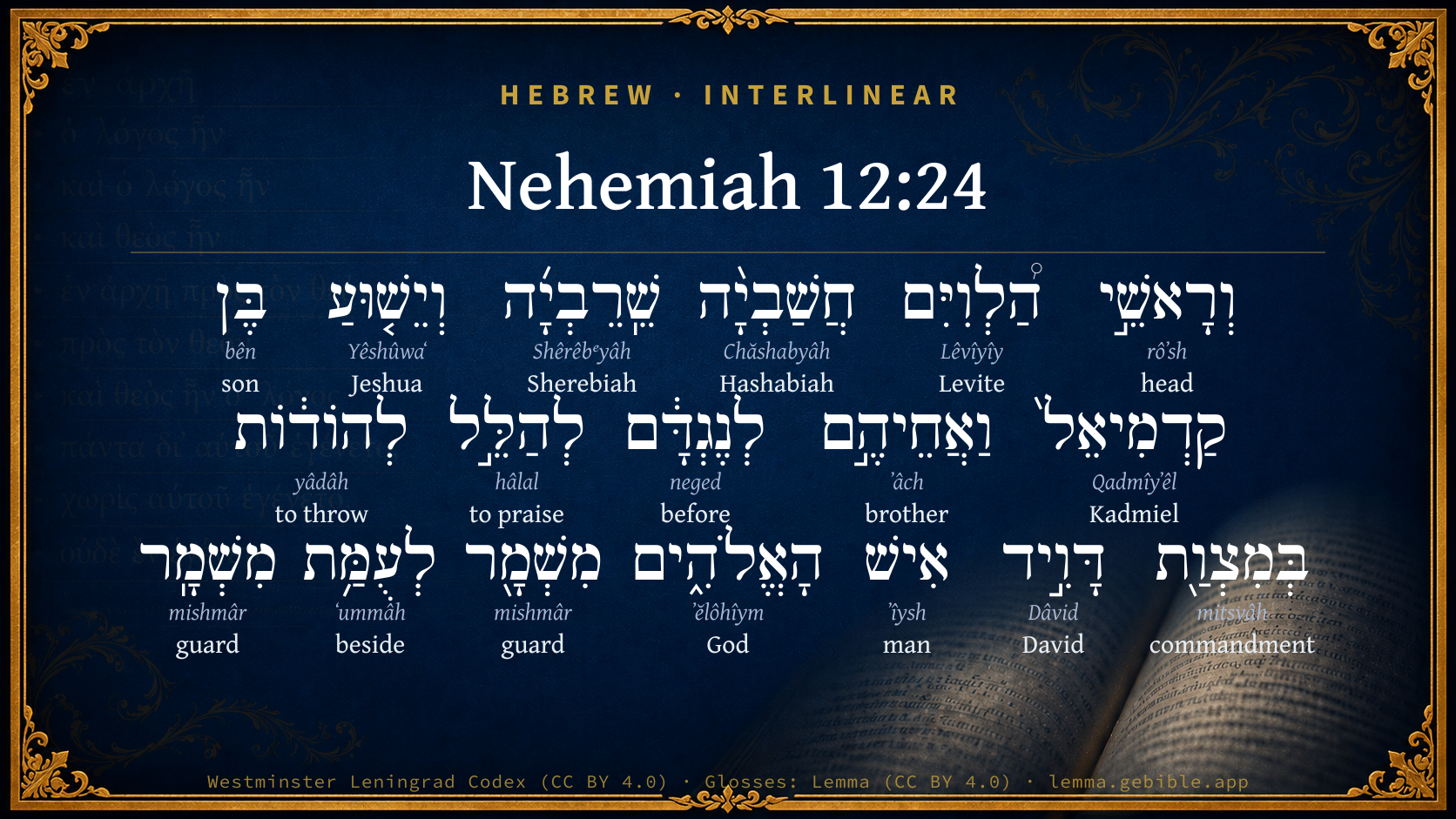
Nehemiah 12:24

Hebrew (Westminster Leningrad Codex) Nehemiah 12:24 appears in the Hebrew Old Testament. The text above is from the Westminster Leningrad Codex. Each word links to its Strong’s number, a concise gloss, and parsing drawn from the Open Scriptures Hebrew Bible morphology. Click any word for its full Brown-Driver-Briggs (BDB) entry.
Download image
Cite this verse

Nehemiah 12:24 (World English Bible). Public Domain. Lemma interlinear Bible study tool, https://lemma.gebible.app/v/nehemiah/12/24.

Show BibTeX & RIS
BibTeX
RIS
English Translation
The chiefs of the Levites: Hashabiah, Sherebiah, and Jeshua the son of Kadmiel, with their brothers over against them, to praise and give thanks, according to the commandment of David the man of God, watch next to watch.
World English Bible · Public Domain
Download a study sheet

One document with this verse’s original text, its word-by-word gloss line, the meaning frame, cross-references with their text, attributed commentary, and full source and license credits — printable, and it pastes into notes with its structure intact.

This verse Autodidact and up

Study sheet (.html) Plain text (.txt)

A passage Seminary Student

Up to 50 verses in one chapter. A passage sheet keeps up to 6 commentary sources and 12 cross-references per verse, in the order this page ranks them, and says so on the sheet whenever that leaves anything out. Ask for a single verse and you get the Autodidact verse sheet above.

Everything on this page stays free to read, with no account — the sheet is a download of what is already on screen, not access to it.

Want to remove ads? Support Godless Engineer
Compare translations 3

The same verse in 3 English versions, stacked beneath the original-language interlinear above. Click any original word for its lexicon entry.

Each is an independent rendering of the whole verse — the interlinear is not word-aligned to these translations.

Highlighted words mark where these versions differ — a whole-verse word diff, not a word-by-word alignment.

  • World English Bible Public Domain
    The chiefs of the Levites: Hashabiah, Sherebiah, and Jeshua the son of Kadmiel, with their brothers over against them, to praise and give thanks, according to the commandment of David the man of God, watch next to watch.
  • King James Version Public Domain
    And the chief of the Levites: Hashabiah, Sherebiah, and Jeshua the son of Kadmiel, with their brethren over against them, to praise and to give thanks, according to the commandment of David the man of God, ward over against ward.
  • unfoldingWord Literal Text CC BY-SA 4.0
    And the heads of the Levites were Hashabiah, Sherebiah, and Jeshua, the son of Kadmiel, with their brothers opposite them, service watch by service watch, to praise and give thanks by the commandment of David, the man of God.

unfoldingWord Literal Text — © unfoldingWord, licensed CC BY-SA 4.0. Word-aligned USFM3 via Door43 (git.door43.org/unfoldingWord/en_ult).

Versions to compare (up to 4)

3 of 4 selected

Show all 18 translations

Every available English version of this verse, each an independent rendering of the whole verse.

  • World English Bible Public Domain
    The chiefs of the Levites: Hashabiah, Sherebiah, and Jeshua the son of Kadmiel, with their brothers over against them, to praise and give thanks, according to the commandment of David the man of God, watch next to watch.
  • Berean Standard Bible Public Domain
    The leaders of the Levites were Hashabiah, Sherebiah, and Jeshua son of Kadmiel, along with their associates, who stood across from them to give praise and thanksgiving as one section alternated with the other, as prescribed by David the man of God.
  • Majority Standard Bible Public Domain
    The leaders of the Levites were Hashabiah, Sherebiah, and Jeshua son of Kadmiel, along with their associates, who stood across from them to give praise and thanksgiving as one section alternated with the other, as prescribed by David the man of God.
  • King James Version Public Domain
    And the chief of the Levites: Hashabiah, Sherebiah, and Jeshua the son of Kadmiel, with their brethren over against them, to praise and to give thanks, according to the commandment of David the man of God, ward over against ward.
  • American Standard Version (1901) Public Domain
    And the chiefs of the Levites: Hashabiah, Sherebiah, and Jeshua the son of Kadmiel, with their brethren over against them, to praise and give thanks, according to the commandment of David the man of God, watch next to watch.
  • Revised Version (1885) Public Domain
    And the chiefs of the Levites: Hashabiah, Sherebiah, and Jeshua the son of Kadmiel, with their brethren over against them, to praise and give thanks, according to the commandment of David the man of God, ward against ward.
  • Geneva Bible (1599) Public Domain
    And the chiefe of the Leuites were Hashabiah, Sherebiah, and Ieshua the sonne of Kadmiel, and their brethren about them to giue prayse and thankes, according to the ordinance of Dauid the man of God, ward ouer against warde.
  • Douay-Rheims (1899) Public Domain
    Now the chief of the Levites were Hasebia, Serebia, and Josue the son of Cedmihel: and their brethren by their courses, to praise and to give thanks ac- cording to the commandment of David the man of God, and to wait equally in order.
  • Young's Literal Translation Public Domain
    and heads of the Levites: Hashabiah, Sherebiah, and Jeshua son of Kadmiel, and their brethren, `are' over-against them, to give praise, to give thanks, by command of David the man of God, charge over-against charge.
  • Literal Standard Version CC BY-SA 4.0
    and heads of the Levites: Hashabiah, Sherebiah, and Jeshua son of Kadmiel, and their brothers, [are] opposite them, to give praise, to give thanks, by command of David the man of God, charge close by charge.
  • Unlocked Literal Bible CC BY-SA 4.0
    The leaders of the Levites were Hashabiah, Sherebiah, and Jeshua son of Kadmiel, with their associates, who stood opposite them to give praise and to give thanks, responding section by section, in obedience to the command of David, the man of God.
  • unfoldingWord Literal Text CC BY-SA 4.0
    And the heads of the Levites were Hashabiah, Sherebiah, and Jeshua, the son of Kadmiel, with their brothers opposite them, service watch by service watch, to praise and give thanks by the commandment of David, the man of God.
  • Darby Bible Public Domain
    And the chief Levites: Hashabiah, Sherebiah, and Jeshua the son of Kadmiel, with their brethren over against them, to praise [and] to give thanks, according to the commandment of David the man of God, ward over against ward.
  • World Messianic Bible Public Domain
    The chiefs of the Levites: Hashabiah, Sherebiah, and Yeshua the son of Kadmiel, with their brothers close to them, to praise and give thanks according to the commandment of David the man of God, section next to section.
  • Webster's Bible Public Domain
    And the chief of the Levites: Hashabiah, Sherebiah, and Jeshua the son of Kadmiel, with their brethren over against them, to praise and to give thanks according to the commandment of David the man of God, ward over against ward.
  • Free Bible Version CC BY-SA 4.0
    The Levite leaders were Hashabiah, Sherebiah, and Jeshua, son of Kadmiel, together with their fellow Levites, who stood opposite them, each section giving praise and thanks and responding to one another, as arranged by David, the man of God.
  • Bible in Basic English Public Domain
    And the chiefs of the Levites: Hashabiah, Sherebiah, and Jeshua, the son of Kadmiel, with their brothers opposite them, to give blessing and praise as ordered by David, the man of God, watch against watch.
  • JPS Tanakh (1917) Public Domain
    And the chiefs of the Levites: Hashabiah, Sherebiah, and Jeshua the son of Kadmiel, with their brethren over against them, to praise and give thanks, according to the commandment of David the man of God, ward against ward.

Literal Standard Version (2020), Covenant Press — licensed CC BY-SA 4.0. Text via the HelloAO Bible API (eBible.org). Unlocked Literal Bible (unfoldingWord) — licensed CC BY-SA 4.0. Text via the HelloAO Bible API (eBible.org). unfoldingWord Literal Text — © unfoldingWord, licensed CC BY-SA 4.0. Word-aligned USFM3 via Door43 (git.door43.org/unfoldingWord/en_ult). Free Bible Version, Dr. Jonathan Gallagher — licensed CC BY-SA 4.0. Text via the HelloAO Bible API (eBible.org).

Word by word

More ways to search: Search by grammar → Find every occurrence → Compare this word →

Practice this passage: Drill this verse → Learn its vocabulary →

שֵֽׁרֵבְיָ֜ה
Shêrêbᵉyâh
H8274
“Sherebiah”
Noun, Proper
Part of Speech
Noun
Type
Proper
Full BDB Definition

Origin: from H8273 and H3050

TWOT: None

Sherebiah = "Jehovah has scorched" - a Levite who assisted Ezra at the reading of the Law and who sealed the covenant with Nehemiah
  1. וְרָאשֵׁ֣י rôʼsh H7218 “and · heads of” Conjunction + Noun, Common, Masculine, Plural, Construct
  2. הַ֠לְוִיִּם Lêvîyîy H3881 “the · Levites” Particle, Definite Article + Noun, Gentilic, Masculine, Plural, Absolute
  3. חֲשַׁבְיָ֨ה Chăshabyâh H2811 “Hashabiah” Noun, Proper
  4. וְיֵשׁ֤וּעַ Yêshûwaʻ H3442 “and · Jeshua” Conjunction + Noun, Proper
  5. בֶּן bên H1121 “son of” Noun, Common, Masculine, Singular, Construct
  6. קַדְמִיאֵל֙ Qadmîyʼêl H6934 “Kadmiel” Noun, Proper
  7. וַאֲחֵיהֶ֣ם ʼâch H251 “and · brothers · their” Conjunction + Noun, Common, Masculine, Plural, Construct + Suffix, Personal, 3rd Person, Masculine, Plural
  8. לְנֶגְדָּ֔ם neged H5048 “to/for · before · them” Preposition + Preposition + Suffix, Personal, 3rd Person, Masculine, Plural
  9. לְהַלֵּ֣ל hâlal H1984 “to praise” Preposition + Verb, Piel, Infinitive Construct
  10. לְהוֹד֔וֹת yâdâh H3034 “to throw” Preposition + Verb, Hiphil, Infinitive Construct
  11. בְּמִצְוַ֖ת mitsvâh H4687 “in/at · commandment of” Preposition + Noun, Common, Feminine, Singular, Construct
  12. דָּוִ֣יד Dâvid H1732 “David” Noun, Proper
  13. אִישׁ ʼîysh H376 “man of” Noun, Common, Masculine, Singular, Construct
  14. הָאֱלֹהִ֑ים ʼĕlôhîym H430 “the · God(s)” Particle, Definite Article + Noun, Common, Masculine, Plural, Absolute
  15. מִשְׁמָ֖ר mishmâr H4929 “guard” Noun, Common, Masculine, Singular, Absolute
  16. לְעֻמַּ֥ת ʻummâh H5980 “to/for · beside of” Preposition + Noun, Common, Feminine, Singular, Construct
  17. מִשְׁמָֽר mishmâr H4929 “guard” Noun, Common, Masculine, Singular, Absolute

About this verse

These counts appear in no published source. They are computed here, from the morphology-tagged text and Lemma’s own curated glosses. What Lemma adds →

18
words
17
distinct lemmas
Historical
section

Notable vocabulary

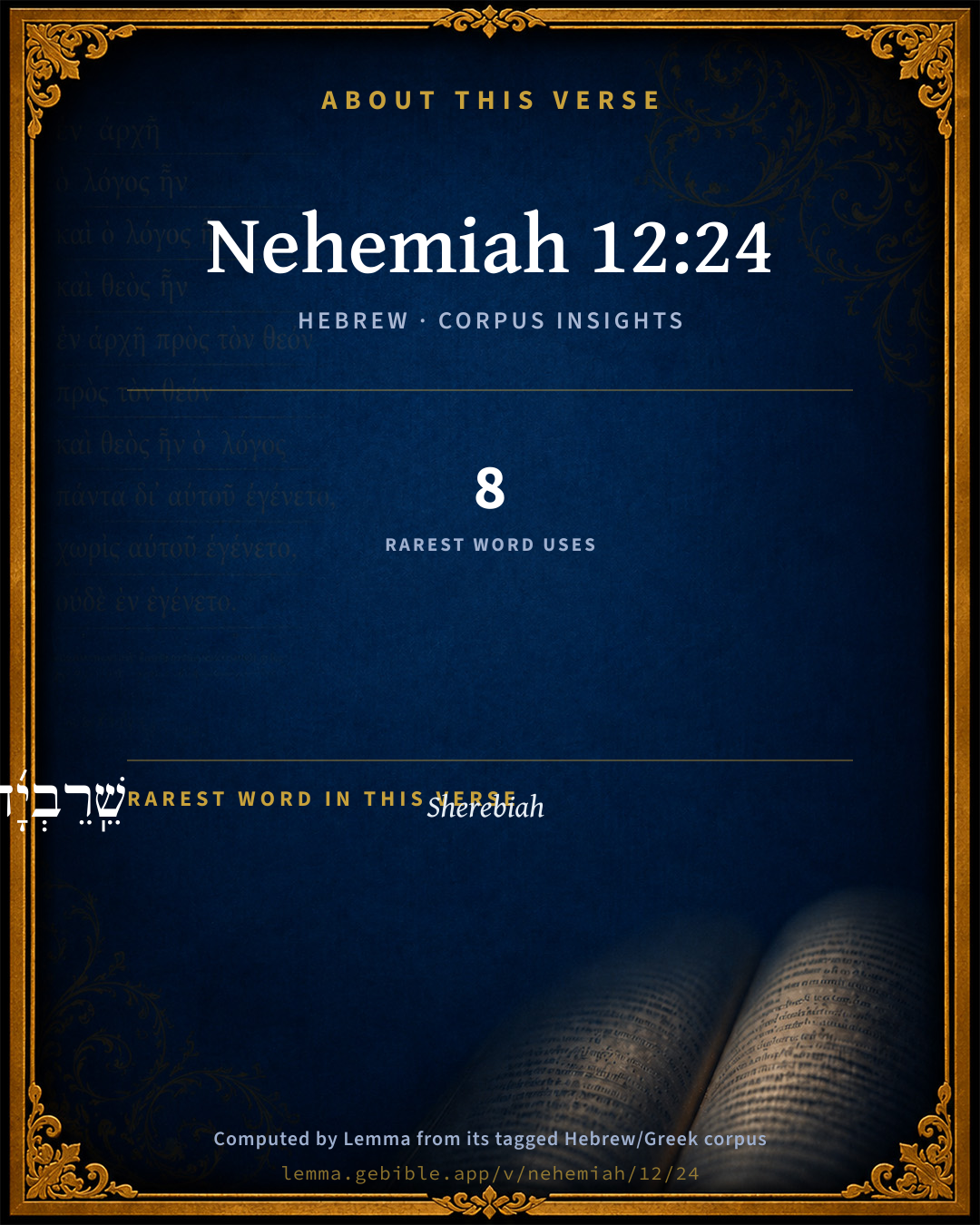
The rarest word here is שֵֽׁרֵבְיָ֜ה Sherebiah H8274 — appearing just 8 times in the whole Hebrew Bible.

Shared distinctive vocabulary

שֵֽׁרֵבְיָ֜ה Sherebiah H8274 occurs in 8 verses of the Hebrew Bible. Also found in:

Grammatical profile

  • 2 verbs
  • 15 nouns
  • 1 preposition

Verb forms

  • לְהַלֵּ֣ל Piel · Infinitive Construct
  • לְהוֹד֔וֹת Hiphil · Infinitive Construct

Repetition

A word recurs within this verse — often emphatic in Hebrew:

  • מִשְׁמָ֖ר guard H4929 ×2

Cross-references

15

Topical passages linked to Nehemiah 12:24 in the Treasury of Scripture Knowledge — connected by theme and wording, ordered by reader-vote popularity; previews shown in the World English Bible.

  • 1 Chronicles 25:1–26 Moreover, David and the captains of the host set apart for the service certain of the sons of Asaph, and of Heman, and of Jeduthun, who should prophesy with harps, with psalteries, and with cymbals: and the number of those who did the work according to their service was:
  • Deuteronomy 33:1 This is the blessing, with which Moses the man of God blessed the children of Israel before his death.
  • Joshua 14:6 Then the children of Judah drew near to Joshua in Gilgal: and Caleb the son of Jephunneh the Kenizzite said to him, You know the thing that Yahweh spoke to Moses the man of God concerning me and concerning you in Kadesh-barnea.
  • 1 Kings 17:24 The woman said to Elijah, Now I know that you are a man of God, and that the word of Yahweh in your mouth is truth.
  • 1 Chronicles 23:1–32 Now David was old and full of days; and he made Solomon his son king over Israel.
  • 2 Chronicles 8:14 He appointed, according to the ordinance of David his father, the divisions of the priests to their service, and the Levites to their offices, to praise, and to minister before the priests, as the duty of every day required; the doorkeepers also by their divisions at every gate: for so had David the man of God commanded.
  • Ezra 2:40 The Levites: the children of Jeshua and Kadmiel, of the children of Hodaviah, seventy-four.
  • Ezra 3:10–11 When the builders laid the foundation of the temple of Yahweh, they set the priests in their clothing with trumpets, and the Levites the sons of Asaph with cymbals, to praise Yahweh, after the order of David king of Israel.
  • Nehemiah 8:7 Also Jeshua, and Bani, and Sherebiah, Jamin, Akkub, Shabbethai, Hodiah, Maaseiah, Kelita, Azariah, Jozabad, Hanan, Pelaiah, and the Levites, caused the people to understand the law: and the people [stood] in their place.
  • Nehemiah 9:4 Then stood up on the stairs of the Levites, Jeshua, and Bani, Kadmiel, Shebaniah, Bunni, Sherebiah, Bani, [and] Chenani, and cried with a loud voice to Yahweh their God.
  • Nehemiah 10:9–13 The Levites: namely, Jeshua the son of Azaniah, Binnui of the sons of Henadad, Kadmiel;
  • Nehemiah 11:17 and Mattaniah the son of Mica, the son of Zabdi, the son of Asaph, who was the chief to begin the thanksgiving in prayer, and Bakbukiah, the second among his brothers; and Abda the son of Shammua, the son of Galal, the son of Jeduthun.
  • Nehemiah 12:8–9 Moreover the Levites: Jeshua, Binnui, Kadmiel, Sherebiah, Judah, [and] Mattaniah, who was over the thanksgiving, he and his brothers.
  • 1 Timothy 6:11 But you, man of God, flee these things, and follow after righteousness, godliness, faith, love, patience, and gentleness.
  • 2 Timothy 3:17 that the man of God may be complete, thoroughly equipped for every good work.

Cross-references courtesy of OpenBible.info (CC BY 4.0).

Hebrew and Greek witnesses Masoretic Hebrew ↔ Greek Septuagint

The same verse in the two great witnesses to the Old Testament, shown verse-for-verse.

These are two independent witnesses, not word-aligned to each other, and the Septuagint is shown in lemma (dictionary) form.

Hebrew Nehemiah 12:24 Masoretic · Westminster Leningrad Codex

וְרָאשֵׁ֣י הַ֠לְוִיִּם חֲשַׁבְיָ֨ה שֵֽׁרֵבְיָ֜ה וְיֵשׁ֤וּעַ בֶּן קַדְמִיאֵל֙ וַאֲחֵיהֶ֣ם לְנֶגְדָּ֔ם לְהַלֵּ֣ל לְהוֹד֔וֹת בְּמִצְוַ֖ת דָּוִ֣יד אִישׁ הָאֱלֹהִ֑ים מִשְׁמָ֖ר לְעֻמַּ֥ת מִשְׁמָֽר

The chiefs of the Levites: Hashabiah, Sherebiah, and Jeshua the son of Kadmiel, with their brothers over against them, to praise and give thanks, according to the commandment of David the man of God, watch next to watch.

World English Bible · Public Domain

Greek LXX Structure differs

The Septuagint has no separate book of Nehemiah. Its Greek text is the second half of Esdras B (2 Esdras), chapters 11–23; Ezra is the first half (1–10).

A verse-for-verse comparison isn’t shown here because the chapters and verses don’t line up. Switch to the LXX edition with the MT / LXX toggle above to read the Greek directly.

On this verse, The Cambridge Bible for Schools and Colleges discusses the Septuagint’s reading. Read the note in Commentary ↓

Hebrew: Westminster Leningrad Codex (CC BY 4.0). Greek: Septuagint (public domain); English from a public-domain English Septuagint. How the Septuagint differs from the Hebrew →

Commentary

Notes on Nehemiah 12:24 from classic Christian and Jewish commentators (each source and its license shown beneath its notes). The classic Christian expositions comment on the surrounding passage and are grouped to its opening verse, so a note may address several verses; the Jewish commentaries on the Tanakh (Rashi and others) are per-verse, so they appear only where the commentator wrote on this verse.

Lemma curates 59 commentaries, every one of them public domain or Creative Commons licensed, each selected and text-cleaned for this edition rather than reprinted as found. About our sources →

The Biblical Illustrator

Joseph S. Exell

Neh_12:24

According to the Commandment Of David the man of God.

Posthumous influence

A mans influence after he is dead. He is still present with his people.

I. By his will. The commandment of David. The grip of the dead is on our fields and churches, our schools and hospitals.

II. By his writings. Immortality of genius. Davids psalms. Solomons proverbs. The writings of Shakespeare, Milton, Bunyan, and many others.

III. By his example. David the man of God. For good or evil a man lives. For good or evil his deeds will live after him. The memory of the just is blessed. (Homiletic Commentary.)

The Biblical Illustrator, edited by Joseph S. Exell (c. 1880s–1900s) — public domain. Text from a community e-Sword module.

The Pulpit Commentary

LIST OF THE CHIEF LEVITICAL FAMILIES IN THE TIME OF JOIAKIM AND LATER. (Neh_12:24-26) That family, rather than personal, names are here intended is sufficiently shown in the final summary of ver. 26, since the same individuals cannot have flourished under Joiakim (B.C. 490-460) and also under Nehemiah (B.C. 444-430). The actual names Jeshua, Kadmiel, Hashabiah, Shersbiah, etc. are all found as family names.

Hashabiah. See above, Neh_9:5 Neh_10:11. Sherebiah. Compare Neh_9:4, 5 10:12 12:8. Jeshua, the son of Kadmiel. For ben, "son," we should probably read "Bani," a common Levitical name, (Neh_9:4, 5 10:13) in which case the passage would run as follows: the chief of the Levites were Hashabiah, Sherebiah, Jeshua, Bani, Kadmiel, with their brethren," etc. To praise and to give thanks, according to the commandment of David. Compare 1Ch_15:16 1Ch_23:5 1Ch_25:3, etc. Man of God is an epithet not often applied to David. It occurs, however, again in ver. 36, and also in 2Ch_8:14. Ward over against ward. Antiphonically division over against division.

The Pulpit Commentary (1880–1919), ed. H.D.M. Spence-Jones & Joseph S. Exell — public domain. Text from a community e-Sword module.

Keil & Delitzsch

C. F. Keil & F. Delitzsch

The names Hashabiah, Sherebiah, Jeshua, and Kadmiel, frequently occur as those of heads of Levitical orders: the two first in Neh 10:12., Ezr 8:18.; the two last in Neh 12:8, Neh 10:10, and Ezr 2:40; and the comparison of these passages obliges us to regard and expunge as a gloss the בּן before Kadmiel. Opposite to these four are placed their brethren, whose office it was "to praise (and) to give thanks according to the commandment of David," etc.: comp. Ch1 16:4; Ch1 23:30; Ch2 5:13; and בּמצות ד, Ch2 29:25. משׁמר לעמּת משׁמר, ward opposite ward, elsewhere used of the gatekeepers, Ch1 26:16, is here applied to the position of the companies of singers in divine worship. The names of the brethren, i.e., of the Levitical singers, follow, Neh 12:25, where the first three names must be separated from those which follow, and combined with Neh 12:24. This is obvious from the consideration, that Mattaniah and Bakbukiah are mentioned in Neh 11:17 as presidents of two companies of singers, and with them Abda the Jeduthunite, whence we are constrained to suppose that עבדיה is only another form for עבדּא of Neh 11:17. According, then, to what has been said, the division into verses must be changed, and Neh 12:25 should begin with the name משׁלּם. Meshullam, Talmon, and Akkub are chiefs of the doorkeepers; the two last names occur as such both in Neh 11:19 and Ezr 2:42, and even so early as Ch1 9:17, whence we perceive that these were ancient names of races of Levitical doorkeepers. In Ezr 2:42 and Ch1 9:17, שׁלוּם, answering to משׁלּם of the present verse, is also named with them. The combination משׁמר שׁוערים שׁמרים is striking: we should at least have expected משׁמר שׁמרים שׁוערים, because, while שׁוערים cannot be combined with משׁמר, שׁמרים may well be so; hence we must either transpose the words as above, or read according to Neh 11:19, בּשּׁערים שׁמרים. In the latter case, בּשּׁערים is more closely defined by the apposition השּׁערים בּאספּי: at the doors, viz., at the treasure-chambers of the doors. On 'acupiym, see rem. on Ch1 26:15, Ch1 26:17.

Keil & Delitzsch — Biblical Commentary on the Old Testament (1861–1891) — public domain (CC PDM 1.0). Text via the HelloAO Bible API. (Old Testament only.)

Geneva Bible (1599)

Geneva Bible translators

That is, one after another, and every one in his course.

Geneva Bible (1599) marginal notes — public domain. Text via Bolls.life.

Ellicott's Commentary for English Readers

(24) And the chief.—The account resumes with the Levites, and gives a list of the extant officers of the Temple, many names being the same as in earlier times.

A Bible Commentary for English Readers, edited by Charles John Ellicott (1878–1897) — public domain. Text from a community e-Sword module.

The Cambridge Bible for Schools and Colleges

gen. ed. J. J. S. Perowne

24. And the chief of the Levites] Once more a brief list is given of the chief Levite families.

Hashabiah] This name occurs in Neh_10:12, and Ezr_8:19, but not in Neh_12:8-9. Probably the same as Hashabneiah (Neh_9:5).

Sherebiah] Cf. Neh_12:8, Neh_9:5, Neh_10:13; Ezr_8:18.

Jeshua the son of Kadmiel] We have here an almost certain error in the text ‘Jeshua ben-Kadmiel’ instead of ‘Jeshua, Bani, (or Binnui), Kadmiel.’ Cf. Neh_12:8, Neh_10:9. In favour of this emendation is to be cited the reading of the LXX. υἱοὶ (b’nê) Καδμιήλ.

over against them] Cf. Neh_12:9. LXX. κατεναντίον αὐτῶν, Vulg. ‘per vices suas.’

to praise and (R.V. to) give thanks] The reference is to the anti-phonal singing of the Levites in the Temple worship.

according to the commandment of David the man of God] The reference is to the organization of the Levitical singers by David mentioned in 1Ch_16:4; 1Ch_23:30.

On the title ‘the man of God’ applied to David cf. 2Ch_8:14.

ward over (R.V. omit) against ward] The same phrase occurs in 1Ch_26:16.

The Cambridge Bible for Schools and Colleges (gen. ed. J. J. S. Perowne; Cambridge University Press, 1878–1918) — public domain. Text from a community e-Sword module.

John Gill's Exposition

Mattaniah, and Bakbukiah, Obadiah, Meshullam, Talmon, Akkub, were porters,.... At the gates of the temple, see Ch1 9:15,

keeping the ward, at the thresholds of the gates; of the temple, where they stood and watched; or "at the collection of the gates", meaning either where the people were gathered together, or where money gathered was laid up; and so some render it, "the treasuries of the gates": unless a place called Asuppim should be meant, Ch1 26:15.

John Gill's Exposition of the Whole Bible (1746–1763) — public domain (CC PDM 1.0). Text via the HelloAO Bible API.

Albert Barnes' Notes on the Bible

Jeshua the son of Kadmiel - If the reading be sound, this Jeshua must have been the head of the Levitical family of Kadmiel in the time of Joiakim; but (compare Neh 8:7; Neh 9:4), some read “Jeshua, Bani, Kadmiel,” etc.

Ward over against ward - i. e., “alternately,” one part of the choir corresponding the other.

Albert Barnes' Notes on the Bible (1834–1885) — public domain. Text from a community e-Sword/MySword module.

Haydock's Catholic Bible Commentary

Order. Hebrew, "ward over-against ward." One company kept guard while another retired. (Menochius)

George Leo Haydock (1774–1849), Haydock's Catholic Family Bible and Commentary, 1859 edition — public domain. Excludes Psalms (Douay-Rheims chapter numbering differs from Protestant) and Deuterocanonical books (Catholic canon only).

Matthew Poole's English Annotations

Of which See Poole "Neh 12:9".

Matthew Poole's English Annotations on the Holy Bible (1683–1685) — public domain. Text from a community e-Sword/MySword module.

Whedon's Commentary on the Bible

Daniel D. Whedon

24. The commandment of David — See 1Ch_16:4; 1Ch_23:30.

Ward over against ward — One company of singers opposite another company, so as to worship antiphonally. See note on Ezr_3:11.

Daniel D. Whedon (gen. ed.), Commentary on the Old and New Testaments (1874–1909) — public domain. Text from a community e-Sword module.

unfoldingWord translationNotes

Door43 World Missions Community

Hashabiah, Sherebiah ... Jeshua ... Kadmiel ... David ... Mattaniah, Bakbukiah, Obadiah, Meshullam, Talmon, and Akkub ... Joiakim ... Jeshua ... Jozadak ... Nehemiah ... Ezra

These are names of men. (See: How to Translate Names)

who stood opposite them to give praise and to give thanks, responding section by section

This refers to how they sang some of their songs in worship. A leader or one group would sing a phrase, then one or two groups that "stood opposite them" would sing a phrase in response.

obedience to the command of David

King David had commanded the Levites how they were to organize and lead worship.

in the days of Joiakim ... Jozadak, and in the days of Nehemiah the governor and of Ezra ... scribe

The date was fixed by listing those who were leading the Jews at the time. "when Joiakim ... Jozadak was high priest, and when Nehemiah was governor and Ezra ... was the scribe"

translationWords

Levi

praise

obey

David

God

Obadiah

gate

servant

son

govern

Ezra

priest

scribe

unfoldingWord translationNotes — © Distant Shores Media and the Door43 World Missions Community, licensed CC BY-SA 4.0. Source: git.door43.org/Door43/en_tn.

Rashi

Rabbi Shlomo Yitzchaki (Rashi)

a watch opposite a watch for they were divided into their watches to recite the song.

Rashi on the Tanakh — English translations: “The Judaica Press complete Tanach with Rashi, translated by A. J. Rosenberg” (CC BY 4.0); “Pentateuch with Rashi's commentary by M. Rosenbaum and A.M. Silbermann, 1929-1934” (public domain); “The Metsudah Tanach series, Lakewood, N.J” (CC BY 4.0); and “The Book of Joshua, Metsudah Publications, 1997” (CC BY 4.0). Text via Sefaria.

Lesson kit

Teaching starters — assembled from the data on this page, not authored interpretation. Every prompt links to the verse data it draws on. Edit before teaching.

Nehemiah, in the Historical, opens this verse with 18 words (17 distinct Hebrew lemmas). Its most distinctive word is Shêrêbᵉyâh (“Sherebiah”). A historical commentator’s framing appears above. Read the whole chapter for the surrounding context.

Discussion questions

  1. How does “Sherebiah” (Shêrêbᵉyâh) shape what this verse is saying?
  2. Ezra 8:18 shares the word «Sherebiah» with this verse. How do the two illuminate each other?
  3. “guard” occurs 2× in this one verse. What is the effect of the repetition?
  4. These translations render this verse differently; the difference is in the English rendering, not the original. What questions does that raise?
  5. The verb «לְהַלֵּ֣ל» is Piel Infinitive Construct. How does its form color the action?
  6. Reading how The Biblical Illustrator and The Pulpit Commentary read this verse, where do the two commentators agree and where do they part?

Things to notice

Reading settings

Reading text

Shown beneath each verse's original-language words.

Old Testament
Old Testament edition

Read the OT as the Masoretic Hebrew (MT) or the Greek Septuagint (LXX).

English shown for the Greek Septuagint (in the Hebrew ↔ Greek comparison).

Comparing translations? Open the Compare panel on any verse page to stack up to four side by side.