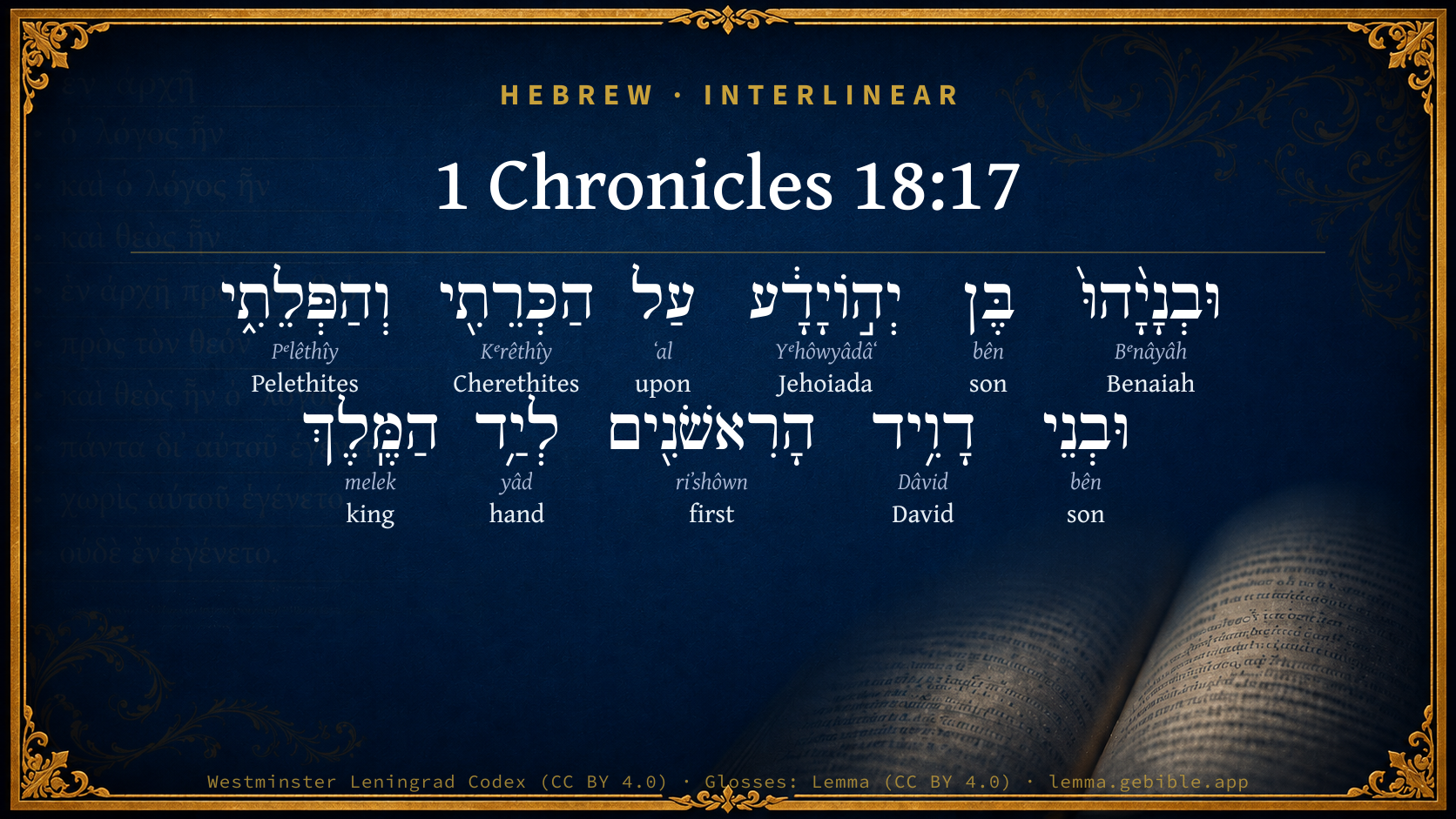
1 Chronicles 18:17

Hebrew (Westminster Leningrad Codex) 1 Chronicles 18:17 appears in the Hebrew Old Testament. The text above is from the Westminster Leningrad Codex. Each word links to its Strong’s number, a concise gloss, and parsing drawn from the Open Scriptures Hebrew Bible morphology. Click any word for its full Brown-Driver-Briggs (BDB) entry.
Download image
Cite this verse

1 Chronicles 18:17 (World English Bible). Public Domain. Lemma interlinear Bible study tool, https://lemma.gebible.app/v/1-chronicles/18/17.

Show BibTeX & RIS
BibTeX
RIS
English Translation
and Benaiah the son of Jehoiada was over the Cherethites and the Pelethites; and the sons of David were chief about the king.
World English Bible · Public Domain
Download a study sheet

One document with this verse’s original text, its word-by-word gloss line, the meaning frame, cross-references with their text, attributed commentary, and full source and license credits — printable, and it pastes into notes with its structure intact.

This verse Autodidact and up

Study sheet (.html) Plain text (.txt)

A passage Seminary Student

Up to 50 verses in one chapter. A passage sheet keeps up to 6 commentary sources and 12 cross-references per verse, in the order this page ranks them, and says so on the sheet whenever that leaves anything out. Ask for a single verse and you get the Autodidact verse sheet above.

Everything on this page stays free to read, with no account — the sheet is a download of what is already on screen, not access to it.

Want to remove ads? Support Godless Engineer
Compare translations 3

The same verse in 3 English versions, stacked beneath the original-language interlinear above. Click any original word for its lexicon entry.

Each is an independent rendering of the whole verse — the interlinear is not word-aligned to these translations.

Highlighted words mark where these versions differ — a whole-verse word diff, not a word-by-word alignment.

  • World English Bible Public Domain
    and Benaiah the son of Jehoiada was over the Cherethites and the Pelethites; and the sons of David were chief about the king.
  • King James Version Public Domain
    And Benaiah the son of Jehoiada was over the Cherethites and the Pelethites; and the sons of David were chief about the king.
  • unfoldingWord Literal Text CC BY-SA 4.0
    And Benaiah, the son of Jehoiada, over the Cherethites and the Pelethites, and the sons of David heads at the hand of the king.

unfoldingWord Literal Text — © unfoldingWord, licensed CC BY-SA 4.0. Word-aligned USFM3 via Door43 (git.door43.org/unfoldingWord/en_ult).

Versions to compare (up to 4)

3 of 4 selected

Show all 18 translations

Every available English version of this verse, each an independent rendering of the whole verse.

  • World English Bible Public Domain
    and Benaiah the son of Jehoiada was over the Cherethites and the Pelethites; and the sons of David were chief about the king.
  • Berean Standard Bible Public Domain
    Benaiah son of Jehoiada was over the Cherethites and Pelethites; and David’s sons were chief officials at the king’s side.
  • Majority Standard Bible Public Domain
    Benaiah son of Jehoiada was over the Cherethites and Pelethites; and David’s sons were chief officials at the king’s side.
  • King James Version Public Domain
    And Benaiah the son of Jehoiada was over the Cherethites and the Pelethites; and the sons of David were chief about the king.
  • American Standard Version (1901) Public Domain
    and Benaiah the son of Jehoiada was over the Cherethites and the Pelethites; and the sons of David were chief about the king.
  • Revised Version (1885) Public Domain
    and Benaiah the son of Jehoiada was over the Cherethites and the Pelethites; and the sons of David were chief about the king.
  • Geneva Bible (1599) Public Domain
    And Benaiah the sonne of Iehoiada was ouer the Cherethites and the Pelethites: and the sonnes of Dauid were chiefe about the King.
  • Douay-Rheims (1899) Public Domain
    And Banaias the son of Joiada was over the bands of the Cerethi, and the Phelethi: and the sons of David were chief about the king.
  • Young's Literal Translation Public Domain
    and Benaiah son of Jehoiada `is' over the Cherethite and the Pelethite, and the elder sons of David `are' at the hand of the king.
  • Literal Standard Version CC BY-SA 4.0
    and Benaiah son of Jehoiada [is] over the Cherethite and the Pelethite, and the chief sons of David [are] at the hand of the king.
  • Unlocked Literal Bible CC BY-SA 4.0
    Benaiah son of Jehoiada was over the Kerethites and Pelethites, and David's sons were the chief officials at the hand of the king.
  • unfoldingWord Literal Text CC BY-SA 4.0
    And Benaiah, the son of Jehoiada, over the Cherethites and the Pelethites, and the sons of David heads at the hand of the king.
  • Darby Bible Public Domain
    and Benaiah the son of Jehoiada was over the Cherethites and the Pelethites; and the sons of David were the first at the king's hand.
  • World Messianic Bible Public Domain
    and Benaiah the son of Jehoiada was over the Cherethites and the Pelethites; and the sons of David were chief officials serving the king.
  • Webster's Bible Public Domain
    And Benaiah the son of Jehoiada was over the Cherethites and the Pelethites; and the sons of David were chief about the king.
  • Free Bible Version CC BY-SA 4.0
    Benaiah, son of Jehoiada, was in charge of the Kerethites and Pelethites; and David's sons were at the king's side, serving as his chief officials.
  • Bible in Basic English Public Domain
    And Benaiah, the son of Jehoiada, was over the Cherethites and the Pelethites; and the sons of David were chief of those whose places were at the king's side.
  • JPS Tanakh (1917) Public Domain
    and Beniah the son of Jehoiada was over the Cherethites and the Pelethites; and the sons of David were chief about the king.

Literal Standard Version (2020), Covenant Press — licensed CC BY-SA 4.0. Text via the HelloAO Bible API (eBible.org). Unlocked Literal Bible (unfoldingWord) — licensed CC BY-SA 4.0. Text via the HelloAO Bible API (eBible.org). unfoldingWord Literal Text — © unfoldingWord, licensed CC BY-SA 4.0. Word-aligned USFM3 via Door43 (git.door43.org/unfoldingWord/en_ult). Free Bible Version, Dr. Jonathan Gallagher — licensed CC BY-SA 4.0. Text via the HelloAO Bible API (eBible.org).

Word by word

More ways to search: Search by grammar → Find every occurrence → Compare this word →

Practice this passage: Drill this verse → Learn its vocabulary →

וְהַפְּלֵתִ֑י
Pᵉlêthîy
H6432
“and · the · Pelethites”
Conjunction + Particle, Definite Article + Noun, Gentilic, Masculine, Singular, Absolute
Part of Speech
Conjunction + Particle + Noun
Type
Gentilic
Gender
Masculine
Number
Singular
State
Absolute
Full BDB Definition

Origin: from the same form as H6431

TWOT: None

Pelethites = "couriers" - a collective name for the guardsmen of David - probably descendants of an unknown person, perhaps Philistine mercenaries
  1. וּבְנָיָ֨הוּ֙ Bᵉnâyâh H1141 “and · Benaiah” Conjunction + Noun, Proper
  2. בֶּן bên H1121 “son of” Noun, Common, Masculine, Singular, Construct
  3. יְה֣וֹיָדָ֔ע Yᵉhôwyâdâʻ H3077 “Jehoiada” Noun, Proper
  4. עַל ʻal H5921 “upon” Preposition
  5. הַכְּרֵתִ֖י Kᵉrêthîy H3774 “the · Cherethites” Particle, Definite Article + Noun, Gentilic, Masculine, Singular, Absolute
  6. וּבְנֵי bên H1121 “and · sons of” Conjunction + Noun, Common, Masculine, Plural, Construct
  7. דָוִ֥יד Dâvid H1732 “David” Noun, Proper
  8. הָרִאשֹׁנִ֖ים riʼshôwn H7223 “the · first” Particle, Definite Article + Adjective, Adjective, Masculine, Plural, Absolute
  9. לְיַ֥ד yâd H3027 “to/for · hand of” Preposition + Noun, Common, Both, Singular, Construct
  10. הַמֶּֽלֶךְ melek H4428 “the · king” Particle, Definite Article + Noun, Common, Masculine, Singular, Absolute

About this verse

These counts appear in no published source. They are computed here, from the morphology-tagged text and Lemma’s own curated glosses. What Lemma adds →

11
words
10
distinct lemmas
Historical
section

Notable vocabulary

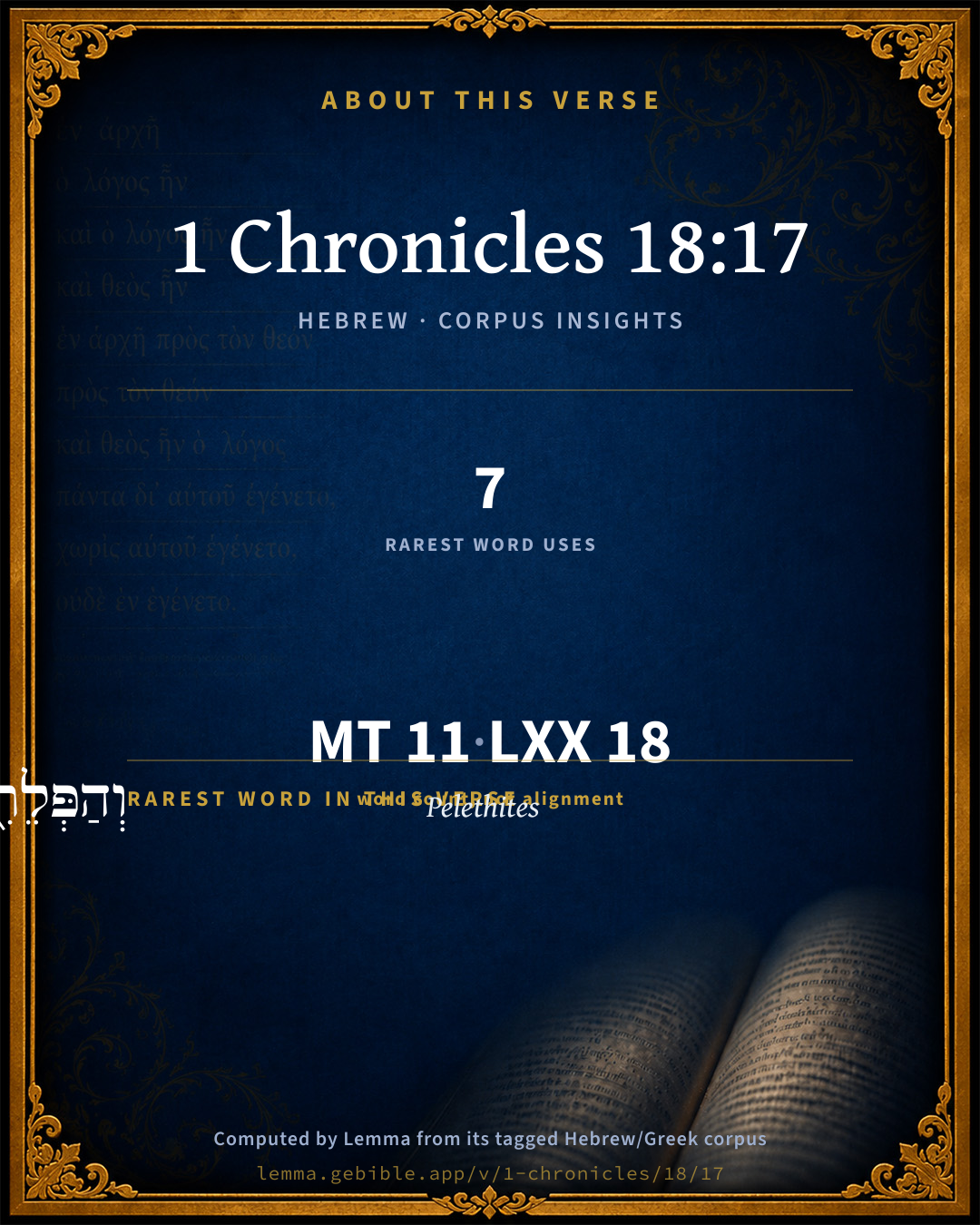
The rarest word here is וְהַפְּלֵתִ֑י Pelethites H6432 — appearing just 7 times in the whole Hebrew Bible.

Shared distinctive vocabulary

וְהַפְּלֵתִ֑י Pelethites H6432 occurs in 7 verses of the Hebrew Bible. Also found in:

Grammatical profile

  • 9 nouns
  • 1 adjective
  • 1 preposition

Repetition

A word recurs within this verse — often emphatic in Hebrew:

Hebrew & Septuagint length

In English translation the verse runs 23 words from the Hebrew and 25 from the Septuagint (LXX English) — closely comparable.

A rough comparison of the two English renderings, which tokenize alike — not a word-level alignment.

Word counts can differ between the Hebrew and the Greek without any difference in meaning — e.g. the Hebrew direct-object marker אֵת has no separate Greek word, and Greek often adds the article ὁ.

In the original languages it is 11 Hebrew tokens and 18 Greek tokens — but the two are counted differently (Hebrew bundles its prefixes and suffixes into one token; the Greek is in lemma form), so that isn’t a like-for-like length.

Cross-references

10

Topical passages linked to 1 Chronicles 18:17 in the Treasury of Scripture Knowledge — connected by theme and wording, ordered by reader-vote popularity; previews shown in the World English Bible.

  • 2 Samuel 8:18 and Benaiah the son of Jehoiada [was over] the Cherethites and the Pelethites; and David's sons were chief ministers.
  • 2 Samuel 15:18 All his servants passed on beside him; and all the Cherethites, and all the Pelethites, and all the Gittites, six hundred men who came after him from Gath, passed on before the king.
  • 2 Samuel 20:7 There went out after him Joab's men, and the Cherethites and the Pelethites, and all the mighty men; and they went out of Jerusalem, to pursue after Sheba the son of Bichri.
  • 2 Samuel 20:23 Now Joab was over all the host of Israel; and Benaiah the son of Jehoiada was over the Cherethites and over the Pelethites;
  • 2 Samuel 23:19–23 Wasn't he most honorable of the three? therefore he was made their captain: however he didn't attain to the [first] three.
  • 1 Kings 1:38 So Zadok the priest, and Nathan the prophet, and Benaiah the son of Jehoiada, and the Cherethites and the Pelethites, went down, and caused Solomon to ride on king David's mule, and brought him to Gihon.
  • 1 Kings 1:44 and the king has sent with him Zadok the priest, and Nathan the prophet, and Benaiah the son of Jehoiada, and the Cherethites and the Pelethites; and they have caused him to ride on the king's mule;
  • 1 Kings 2:34–35 Then Benaiah the son of Jehoiada went up, and fell on him, and killed him; and he was buried in his own house in the wilderness.
  • 1 Chronicles 23:28 For their office was to wait on the sons of Aaron for the service of the house of Yahweh, in the courts, and in the chambers, and in the purifying of all holy things, even the work of the service of the house of God;
  • Zephaniah 2:5 Woe to the inhabitants of the sea coast, the nation of the Cherethites! The word of Yahweh is against you, Canaan, the land of the Philistines. I will destroy you, that there will be no inhabitant.

Cross-references courtesy of OpenBible.info (CC BY 4.0).

Hebrew and Greek witnesses Masoretic Hebrew ↔ Greek Septuagint

The same verse in the two great witnesses to the Old Testament, shown verse-for-verse.

These are two independent witnesses, not word-aligned to each other, and the Septuagint is shown in lemma (dictionary) form.

Hebrew 1 Chronicles 18:17 Masoretic · Westminster Leningrad Codex

וּבְנָיָ֨הוּ֙ בֶּן יְה֣וֹיָדָ֔ע עַל הַכְּרֵתִ֖י וְהַפְּלֵתִ֑י וּבְנֵי דָוִ֥יד הָרִאשֹׁנִ֖ים לְיַ֥ד הַמֶּֽלֶךְ

and Benaiah the son of Jehoiada was over the Cherethites and the Pelethites; and the sons of David were chief about the king.

World English Bible · Public Domain

Greek LXX 1 Chronicles 18:17 Septuagint · lemma form

καί βαναιας υἱός ιωδαε ἐπί ὁ χερεθθι καί ὁ φελεθθι καί υἱός δαυίδ ὁ πρῶτος διάδοχος ὁ βασιλεύς

and Banaeas the son of Jodae was over the Cherethite and the Phelethite, and the sons of David were the chief deputies of the king.

LXX2012 (modern English Septuagint) · Public Domain

On this verse, Ellicott's Commentary for English Readers discusses the Septuagint’s reading. Read the note in Commentary ↓

Hebrew: Westminster Leningrad Codex (CC BY 4.0). Greek: Septuagint (public domain); English from LXX2012 (modern English Septuagint) (Public Domain). How the Septuagint differs from the Hebrew →

Commentary

Notes on 1 Chronicles 18:17 from classic Christian and Jewish commentators (each source and its license shown beneath its notes). The classic Christian expositions comment on the surrounding passage and are grouped to its opening verse, so a note may address several verses; the Jewish commentaries on the Tanakh (Rashi and others) are per-verse, so they appear only where the commentator wrote on this verse.

Lemma curates 59 commentaries, every one of them public domain or Creative Commons licensed, each selected and text-cleaned for this edition rather than reprinted as found. About our sources →

Geneva Bible (1599)

Geneva Bible translators

Read 2 Sam. 8:18.

Geneva Bible (1599) marginal notes — public domain. Text via Bolls.life.

Jamieson, Fausset & Brown

Robert Jamieson, A. R. Fausset & David Brown

the Cherethites and the Pelethites--who formed the royal bodyguard. The Cherethites were, most probably, those brave men who all along accompanied David while among the Philistines, and from that people derived their name (Sa1 30:14; Eze 25:16; Zep 2:5) as well as their skill in archery--while the Pelethites were those who joined him at Ziklag, took their name from Pelet, the chief man in the company (Ch1 12:3), and, being Benjamites, were expert in the use of the sling.

Next: 1 Chronicles Chapter 19

Jamieson, Fausset & Brown — Commentary Critical and Explanatory on the Whole Bible (1871) — public domain (CC PDM 1.0). Text via the HelloAO Bible API.

Adam Clarke's Commentary

Verse 17. Cherethites and the Pelethites] 2Sa 8:18.

The Targum says, "Benaiah was over the great Sanhedrin and the small Sanhedrin, and consulted Urim and Thummim. And at his command the archers and slingers went to battle."

The sons of David] These were the highest in authority.

Adam Clarke's Commentary on the Bible (1810–1826) — public domain. Text from a community e-Sword/MySword module.

Ellicott's Commentary for English Readers

(17) Cherethites and the Pelethites.—2Sa_8:18. The royal body-guard, for which office Oriental kings have always employed foreign mercenaries. Josephus calls them the body-guard (Antiq. vii. 5, § 4). The names are tribal in form, and as the Cherethites recur (Eze_25:16; Zep_2:5) in connection with the Philistines (comp. 1Sa_30:14), and the name Pelethites resembles that of Philistines, it is natural to assumo that David’s guard was recruited from two Philistine tribes. (Comp. 2Sa_15:18, where the Cherethites and Pelethites are mentioned along with a corps of Gittites.) The Targum of Samuel, and Syriac and Arabic of Chronicles, render “archers and slingers.”

Chief about the king.—Heb., the first at the king’s hand, or side, a paraphrase of what we read in Samuel: “were chief rulers” (kôhãnîm). Kôhãnîm is the common and only word for “priests,” and has just occurred in that sense (1Ch_18:16). In 1Ki_4:5, as well as here, the term is said to denote not a sacerdotal, but a secular “minister.” But this theory seems to be opposed to the facts of history. Under the monarchy the priests were brought into close relations with the king, owing to their judicial duties; and the chief priest of a royal sanctuary became one of the great officials of state (Amo_7:11; Amo_7:13). Such a position would be of sufficient importance to be filled by the princes of the blood. The chronicler, writing from the point of view of a later age, has substituted for the original term a phrase that would not offend contemporary feeling. In Samuel the LXX. renders “chief courtiers;” the other versions have “magnates,” except the Vulg., which has “priests.” Syriac of Chronicles, “magnates.”

A Bible Commentary for English Readers, edited by Charles John Ellicott (1878–1897) — public domain. Text from a community e-Sword module.

The Cambridge Bible for Schools and Colleges

gen. ed. J. J. S. Perowne

17. Benaiah] Cp. 1Ch_11:22-25.

the Cherethites and the Pelethites] David’s bodyguard. The Cherethites were almost certainly Philistines (1Sa_30:14; Eze_25:16; Zep_2:5), the Pelethites were probably also Philistines (2Sa_15:18). Neither were heard of after the time of David unless the Carites of 2Ki_11:4 (R.V.) are the Cherethites. Foreign bodyguards are well-known in history.

chief about the king] Lit., the chief at the king’s hand, i.e. formed the executive to carry out his commands; cp. Neh_11:24. In 2Sa_8:18 (R.V.) David’s sons are described as priests. (Consult Baudissin, AT liches Priesterthum, p. 191.)

The Cambridge Bible for Schools and Colleges (gen. ed. J. J. S. Perowne; Cambridge University Press, 1878–1918) — public domain. Text from a community e-Sword module.

Haydock's Catholic Bible Commentary

About. Literally, "at the hand of the king," to execute his orders, and to assist him. Septuagint, "vicegerents." Syriac, "princes." They are styled priests, 2 Kings viii. 18.

George Leo Haydock (1774–1849), Haydock's Catholic Family Bible and Commentary, 1859 edition — public domain. Excludes Psalms (Douay-Rheims chapter numbering differs from Protestant) and Deuterocanonical books (Catholic canon only).

The Pulpit Commentary

Benaiah the son of Jehoiada (see 1Ch_11:22-25; 2Sa_23:20-23) The Cherethites and the Pelethites. Two tribes of Philistines whom David attached. The meaning and derivation of these two names leave it possible to translate them at once, and to read, "the public executioners, and the public couriers," not treating them as proper names, and to this course Geseuius (see "Lexicon") gives his sanction. On the other hand, a comparison of 1Sa_30:14 and 2Sa_15:18 would lead us to treat them as the names of people, although the Pelethites are net as identifiable in this sense as the Cherethites and Gittites. Anyway, it is evident they were the special guard of the king, and were faithful to David and to Solomon after him. Their duties included those of the executioner or lictor, and the courier. They are frequently mentioned on special occasions of the king"s moving, and of danger (2Sa_15:18 2Sa_20:7, 2Sa_20:23; 1Ki_1:38, 1Ki_1:44) Chief about the king. The Hebrew text here is The word used in the parallel place is which signifies strictly "priests," but sometimes more generally" princes." This is, without doubt, the meaning of our text.

The Pulpit Commentary (1880–1919), ed. H.D.M. Spence-Jones & Joseph S. Exell — public domain. Text from a community e-Sword module.

Rashi

Rabbi Shlomo Yitzchaki (Rashi)

over the Cherethites and the Pelethites The meaning is that they were nations, as it is written, (Zeph. 2:5): “Woe to... the nation of Cherethites,” and from their nations were mighty warriors with David, and Benaiah was over them. Another instance of this (II Sam. 15:18): “... and all his servants passed beside him, and all the Cherethites and all the Pelethites and all the Gittites.”

and the sons of David were first at the king’s hand The meaning is that David’s sons were always first beside the king to perform all his necessities.

Rashi on the Tanakh — English translations: “The Judaica Press complete Tanach with Rashi, translated by A. J. Rosenberg” (CC BY 4.0); “Pentateuch with Rashi's commentary by M. Rosenbaum and A.M. Silbermann, 1929-1934” (public domain); “The Metsudah Tanach series, Lakewood, N.J” (CC BY 4.0); and “The Book of Joshua, Metsudah Publications, 1997” (CC BY 4.0). Text via Sefaria.

Lesson kit

Teaching starters — assembled from the data on this page, not authored interpretation. Every prompt links to the verse data it draws on. Edit before teaching.

1 Chronicles, in the Historical, opens this verse with 11 words (10 distinct Hebrew lemmas). Its most distinctive word is Pᵉlêthîy (“Pelethites”). A historical commentator’s framing appears above. Read the whole chapter for the surrounding context.

Discussion questions

  1. The word Pᵉlêthîy carries the sense “Pelethites.” How does it shape the verse?
  2. 2 Samuel 8:18 shares the word «Pelethites» with this verse. How do the two illuminate each other?
  3. “son” occurs 2× in this one verse. What is the effect of the repetition?
  4. The translations on this page render this verse differently — a whole-verse word diff, not a word-by-word alignment. What might account for the different wordings?
  5. Reading how Geneva Bible (1599) and Jamieson, Fausset & Brown read this verse, where do the two commentators agree and where do they part?

Things to notice

Reading settings

Reading text

Shown beneath each verse's original-language words.

Old Testament
Old Testament edition

Read the OT as the Masoretic Hebrew (MT) or the Greek Septuagint (LXX).

English shown for the Greek Septuagint (in the Hebrew ↔ Greek comparison).

Comparing translations? Open the Compare panel on any verse page to stack up to four side by side.