
1 Samuel 19:10

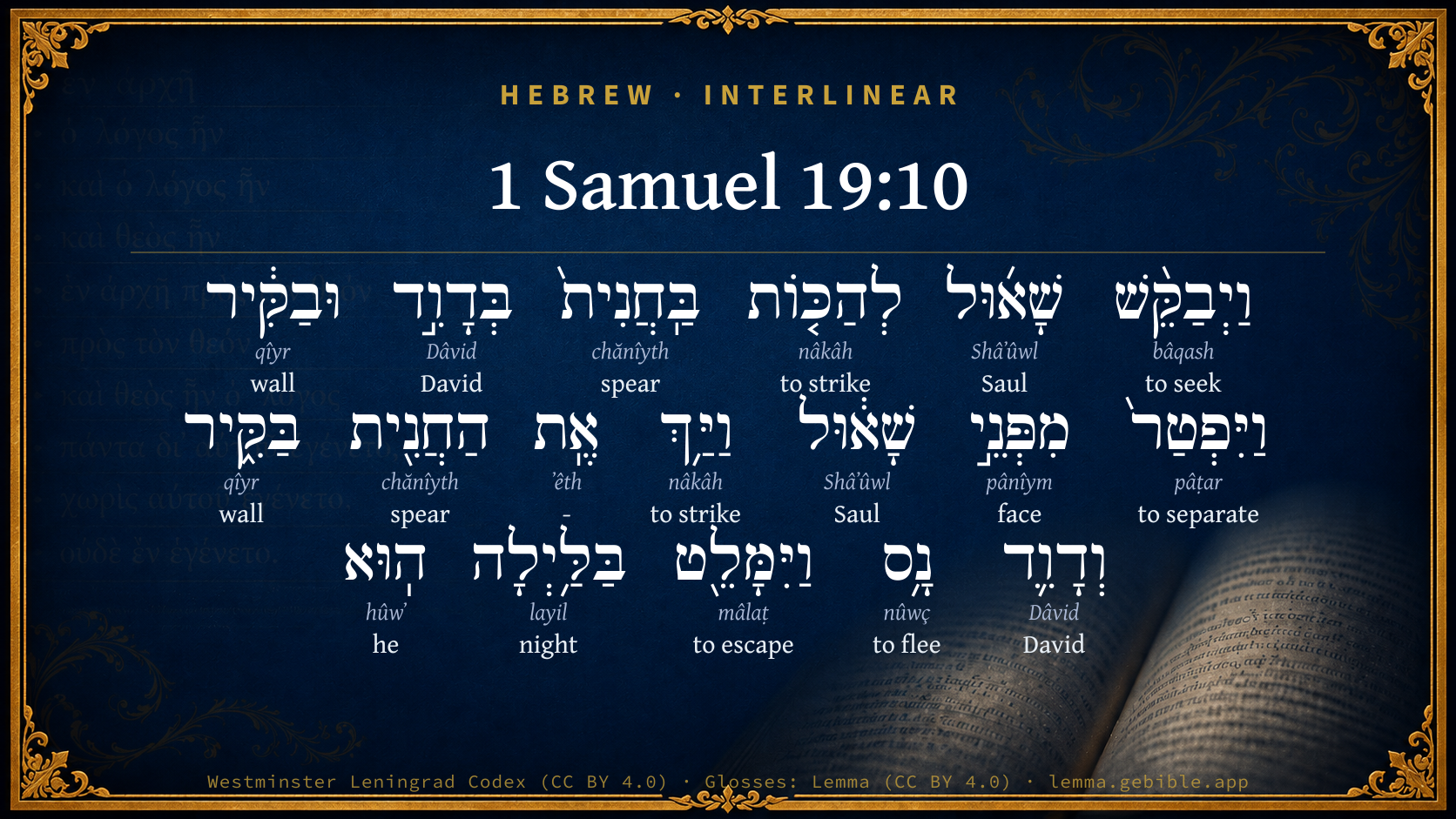
Hebrew (Westminster Leningrad Codex) 1 Samuel 19:10 appears in the Hebrew Old Testament. The text above is from the Westminster Leningrad Codex. Each word links to its Strong’s number, a concise gloss, and parsing drawn from the Open Scriptures Hebrew Bible morphology. Click any word for its full Brown-Driver-Briggs (BDB) entry.
Download image
Cite this verse

1 Samuel 19:10 (World English Bible). Public Domain. Lemma interlinear Bible study tool, https://lemma.gebible.app/v/1-samuel/19/10.

Show BibTeX & RIS
BibTeX
RIS
English Translation
Saul sought to strike David even to the wall with the spear; but he slipped away out of Saul's presence, and he struck the spear into the wall: and David fled, and escaped that night.
World English Bible · Public Domain
Highlights
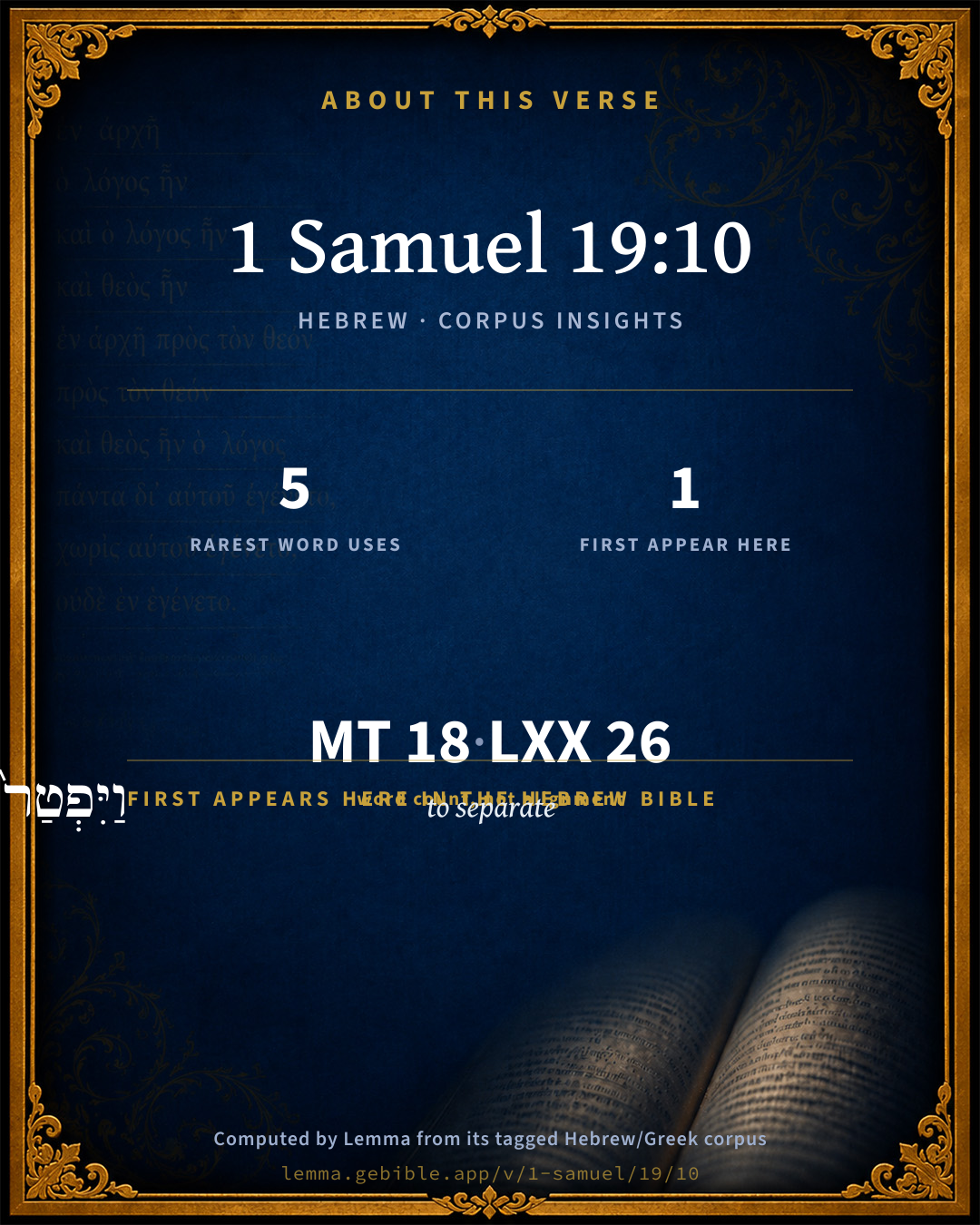
  • 1 first appearance in the Hebrew Bible
Full analysis ↓
Download a study sheet

One document with this verse’s original text, its word-by-word gloss line, the meaning frame, cross-references with their text, attributed commentary, and full source and license credits — printable, and it pastes into notes with its structure intact.

This verse Autodidact and up

Study sheet (.html) Plain text (.txt)

A passage Seminary Student

Up to 50 verses in one chapter. A passage sheet keeps up to 6 commentary sources and 12 cross-references per verse, in the order this page ranks them, and says so on the sheet whenever that leaves anything out. Ask for a single verse and you get the Autodidact verse sheet above.

Everything on this page stays free to read, with no account — the sheet is a download of what is already on screen, not access to it.

Want to remove ads? Support Godless Engineer
Compare translations 3

The same verse in 3 English versions, stacked beneath the original-language interlinear above. Click any original word for its lexicon entry.

Each is an independent rendering of the whole verse — the interlinear is not word-aligned to these translations.

Highlighted words mark where these versions differ — a whole-verse word diff, not a word-by-word alignment.

  • World English Bible Public Domain
    Saul sought to strike David even to the wall with the spear; but he slipped away out of Saul's presence, and he struck the spear into the wall: and David fled, and escaped that night.
  • King James Version Public Domain
    And Saul sought to smite David even to the wall with the javelin: but he slipped away out of Saul's presence, and he smote the javelin into the wall: and David fled, and escaped that night.
  • unfoldingWord Literal Text CC BY-SA 4.0
    And Saul sought to strike David with the spear, and into the wall, but he escaped from the face of Saul, and he struck the spear into the wall. And David fled and rescued himself on that night.

unfoldingWord Literal Text — © unfoldingWord, licensed CC BY-SA 4.0. Word-aligned USFM3 via Door43 (git.door43.org/unfoldingWord/en_ult).

Versions to compare (up to 4)

3 of 4 selected

Show all 18 translations

Every available English version of this verse, each an independent rendering of the whole verse.

  • World English Bible Public Domain
    Saul sought to strike David even to the wall with the spear; but he slipped away out of Saul's presence, and he struck the spear into the wall: and David fled, and escaped that night.
  • Berean Standard Bible Public Domain
    Saul tried to pin him to the wall with his spear. But the spear struck the wall and David eluded him, ran away, and escaped that night.
  • Majority Standard Bible Public Domain
    Saul tried to pin him to the wall with his spear. But David eluded him and the spear struck the wall. And David fled and escaped that night.
  • King James Version Public Domain
    And Saul sought to smite David even to the wall with the javelin: but he slipped away out of Saul's presence, and he smote the javelin into the wall: and David fled, and escaped that night.
  • American Standard Version (1901) Public Domain
    And Saul sought to smite David even to the wall with the spear; but he slipped away out of Saul's presence, and he smote the spear into the wall: and David fled, and escaped that night.
  • Revised Version (1885) Public Domain
    And Saul sought to smite David even to the wall with the spear; but he slipped away out of Saul’s presence, and he smote the spear into the wall: and David fled, and escaped that night.
  • Geneva Bible (1599) Public Domain
    And Saul intended to smite Dauid to the wall with the speare: but hee turned aside out of Sauls presence, and he smote the speare against the wall: but Dauid fled, and escaped the same night.
  • Douay-Rheims (1899) Public Domain
    And Saul endeavoured to nail David to the wall with his spear. And David slipt away out of the presence of Saul: and the spear missed him, and was fastened in the wall, and David fled and escaped that night.
  • Young's Literal Translation Public Domain
    and Saul seeketh to smite with the javelin through David, and through the wall, and he freeth himself from the presence of Saul, and he smiteth the javelin through the wall; and David hath fled and escapeth during that night.
  • Literal Standard Version CC BY-SA 4.0
    and Saul seeks to strike with the javelin through David, and through the wall, and he frees himself from the presence of Saul, and he strikes the javelin through the wall; and David has fled and escapes during that night.
  • Unlocked Literal Bible CC BY-SA 4.0
    Saul tried to pin David to the wall with the spear, but he slipped away from Saul's presence, so that Saul drove the spear into the wall. David fled and escaped that night.
  • unfoldingWord Literal Text CC BY-SA 4.0
    And Saul sought to strike David with the spear, and into the wall, but he escaped from the face of Saul, and he struck the spear into the wall. And David fled and rescued himself on that night.
  • Darby Bible Public Domain
    And Saul sought to smite David and the wall with the spear; but he slipped away out of Saul's presence, and he smote the spear into the wall. And David fled, and escaped that night.
  • World Messianic Bible Public Domain
    Saul sought to pin David to the wall with the spear, but he slipped away out of Saul’s presence; and he stuck the spear into the wall. David fled and escaped that night.
  • Webster's Bible Public Domain
    And Saul sought to smite David even to the wall with the javelin; but he slipped away from Saul's presence, and he smote the javelin into the wall: and David fled, and escaped that night.
  • Free Bible Version CC BY-SA 4.0
    Saul tried to pin David to the wall with the spear. David managed to dodge the spear which embedded itself in the wall. Then David escaped and ran away into the night.
  • Bible in Basic English Public Domain
    And Saul would have sent his spear through him, pinning him to the wall, but he got away and the spear went into the wall: and that night David went in flight and got away.
  • JPS Tanakh (1917) Public Domain
    And Saul sought to smite David even to the wall with the spear; but he slipped away out of Saul's presence, and he smote the spear into the wall; and David fled, and escaped that night.

Literal Standard Version (2020), Covenant Press — licensed CC BY-SA 4.0. Text via the HelloAO Bible API (eBible.org). Unlocked Literal Bible (unfoldingWord) — licensed CC BY-SA 4.0. Text via the HelloAO Bible API (eBible.org). unfoldingWord Literal Text — © unfoldingWord, licensed CC BY-SA 4.0. Word-aligned USFM3 via Door43 (git.door43.org/unfoldingWord/en_ult). Free Bible Version, Dr. Jonathan Gallagher — licensed CC BY-SA 4.0. Text via the HelloAO Bible API (eBible.org).

Word by word

More ways to search: Search by grammar → Find every occurrence → Compare this word →

Practice this passage: Drill this verse → Learn its vocabulary →

וַיִּפְטַר֙
pâṭar
H6362
“and · to separate”
Conjunction + Verb, Qal, Sequential Imperfect, 3rd Person, Masculine, Singular
Part of Speech
Conjunction + Verb
Stem
Qal
Form
Sequential Imperfect
Person
3rd Person
Gender
Masculine
Number
Singular
Full BDB Definition

Origin: a primitive root

TWOT: 1764

to separate, set free, remove, open, escape, burst through - (Qal) - to remove (oneself), escape - to set free, let out
  1. וַיְבַקֵּ֨שׁ bâqash H1245 “and · to seek” Conjunction + Verb, Piel, Sequential Imperfect, 3rd Person, Masculine, Singular
  2. שָׁא֜וּל Shâʼûwl H7586 “Saul” Noun, Proper
  3. לְהַכּ֤וֹת nâkâh H5221 “to strike” Preposition + Verb, Hiphil, Infinitive Construct
  4. בַּֽחֲנִית֙ chănîyth H2595 “in/at the · spear” Preposition, Determined + Noun, Common, Feminine, Singular, Absolute
  5. בְּדָוִ֣ד Dâvid H1732 “in/at · David” Preposition + Noun, Proper
  6. וּבַקִּ֔יר qîyr H7023 “and · in/at the · wall” Conjunction + Preposition, Determined + Noun, Common, Masculine, Singular, Absolute
  7. מִפְּנֵ֣י pânîym H6440 “from · face(s) of” Preposition + Noun, Common, Both, Plural, Construct
  8. שָׁא֔וּל Shâʼûwl H7586 “Saul” Noun, Proper
  9. וַיַּ֥ךְ nâkâh H5221 “and · to strike” Conjunction + Verb, Hiphil, Sequential Imperfect, 3rd Person, Masculine, Singular
  10. אֶֽת ʼêth H853 “-” Particle, Direct Object
  11. הַחֲנִ֖ית chănîyth H2595 “the · spear” Particle, Definite Article + Noun, Common, Feminine, Singular, Absolute
  12. בַּקִּ֑יר qîyr H7023 “in/at the · wall” Preposition, Determined + Noun, Common, Masculine, Singular, Absolute
  13. וְדָוִ֛ד Dâvid H1732 “and · David” Conjunction + Noun, Proper
  14. נָ֥ס nûwç H5127 “to flee” Verb, Qal, Perfect, 3rd Person, Masculine, Singular
  15. וַיִּמָּלֵ֖ט mâlaṭ H4422 “and · to escape” Conjunction + Verb, Niphal, Sequential Imperfect, 3rd Person, Masculine, Singular
  16. בַּלַּ֥יְלָה layil H3915 “in/at the · night” Preposition, Determined + Noun, Common, Masculine, Singular, Absolute
  17. הֽוּא hûwʼ H1931 “he” Pronoun, Personal, 3rd Person, Masculine, Singular

About this verse

These counts appear in no published source. They are computed here, from the morphology-tagged text and Lemma’s own curated glosses. What Lemma adds →

18
words
13
distinct lemmas
Historical
section

Notable vocabulary

The rarest word here is וַיִּפְטַר֙ to separate H6362 — appearing just 5 times in the whole Hebrew Bible.

First appearance in Scripture

This word makes its first canonical appearance in the Hebrew Bible here:

  • וַיִּפְטַר֙ to separate H6362

Shared distinctive vocabulary

וַיִּפְטַר֙ to separate H6362 occurs in 5 verses of the Hebrew Bible. Also found in:

Grammatical profile

  • 6 verbs
  • 10 nouns
  • 1 pronoun
  • 1 particle

Verb forms

  • וַיְבַקֵּ֨שׁ Piel · Sequential Imperfect
  • לְהַכּ֤וֹת Hiphil · Infinitive Construct
  • וַיִּפְטַר֙ Qal · Sequential Imperfect
  • וַיַּ֥ךְ Hiphil · Sequential Imperfect
  • נָ֥ס Qal · Perfect
  • וַיִּמָּלֵ֖ט Niphal · Sequential Imperfect

Repetition

Words recur within this verse — often emphatic in Hebrew:

  • שָׁא֜וּל Saul H7586 ×2
  • לְהַכּ֤וֹת to strike H5221 ×2
  • בַּֽחֲנִית֙ spear H2595 ×2
  • בְּדָוִ֣ד David H1732 ×2
  • וּבַקִּ֔יר wall H7023 ×2

Hebrew & Septuagint length

In English translation the verse runs 35 words from the Hebrew and 31 from the Septuagint (LXX English) — closely comparable.

A rough comparison of the two English renderings, which tokenize alike — not a word-level alignment.

Word counts can differ between the Hebrew and the Greek without any difference in meaning — e.g. the Hebrew direct-object marker אֵת has no separate Greek word, and Greek often adds the article ὁ.

In the original languages it is 18 Hebrew tokens and 26 Greek tokens — but the two are counted differently (Hebrew bundles its prefixes and suffixes into one token; the Greek is in lemma form), so that isn’t a like-for-like length.

Cross-references

16

Topical passages linked to 1 Samuel 19:10 in the Treasury of Scripture Knowledge — connected by theme and wording, ordered by reader-vote popularity; previews shown in the World English Bible.

  • 1 Samuel 18:11 and Saul cast the spear; for he said, I will strike David even to the wall. David avoided out of his presence twice.
  • 1 Samuel 20:33 Saul cast his spear at him to strike him. By this Jonathan knew that his father was determined to put David to death.
  • Proverbs 21:30 There is no wisdom nor understanding Nor counsel against Yahweh.
  • 1 Samuel 19:6 Saul listened to the voice of Jonathan: and Saul swore, As Yahweh lives, he shall not be put to death.
  • Job 5:14–15 They meet with darkness in the day-time, And grope at noonday as in the night.
  • Psalms 18:17 He delivered me from my strong enemy, From those who hated me; for they were too mighty for me.
  • Psalms 34:19 Many are the afflictions of the righteous, But Yahweh delivers him out of them all.
  • Psalms 124:7 Our soul has escaped like a bird out of the fowler's snare. The snare is broken, and we have escaped.
  • Isaiah 54:17 No weapon that is formed against you shall prosper; and every tongue that shall rise against you in judgment you shall condemn. This is the heritage of the servants of Yahweh, and their righteousness which is of me, says Yahweh.
  • Hosea 6:4 "Ephraim, what shall I do to you? Judah, what shall I do to you? For your love is like a morning cloud, And like the dew that disappears early.
  • Matthew 10:23 But when they persecute you in this city, flee into the next, for most assuredly I tell you, you will not have gone through the cities of Israel, until the Son of Man has come.
  • Matthew 12:43–45 But the unclean spirit, when he is gone out of the man, passes through waterless places, seeking rest, and doesn't find it.
  • Luke 4:30 But he, passing through the midst of them, went his way.
  • Luke 11:24–26 The unclean spirit, when he has gone out of the man, passes through dry places, seeking rest, and finding none, he says, 'I will turn back to my house from which I came out.'
  • John 10:39 They sought again to seize him, and he went out of their hand.
  • 2 Peter 2:20–22 For if, after they have escaped the defilement of the world through the knowledge of the Lord and Savior Jesus Christ, they are again entangled therein and overcome, the last state has become worse with them than the first.

Cross-references courtesy of OpenBible.info (CC BY 4.0).

Hebrew and Greek witnesses Masoretic Hebrew ↔ Greek Septuagint

The same verse in the two great witnesses to the Old Testament, shown verse-for-verse.

These are two independent witnesses, not word-aligned to each other, and the Septuagint is shown in lemma (dictionary) form.

Hebrew 1 Samuel 19:10 Masoretic · Westminster Leningrad Codex

וַיְבַקֵּ֨שׁ שָׁא֜וּל לְהַכּ֤וֹת בַּֽחֲנִית֙ בְּדָוִ֣ד וּבַקִּ֔יר וַיִּפְטַר֙ מִפְּנֵ֣י שָׁא֔וּל וַיַּ֥ךְ אֶֽת הַחֲנִ֖ית בַּקִּ֑יר וְדָוִ֛ד נָ֥ס וַיִּמָּלֵ֖ט בַּלַּ֥יְלָה הֽוּא

Saul sought to strike David even to the wall with the spear; but he slipped away out of Saul's presence, and he struck the spear into the wall: and David fled, and escaped that night.

World English Bible · Public Domain

Greek LXX 1 Samuel 19:10 Septuagint · lemma form

καί ζητέω σαούλ πατάσσω ὁ δόρυ εἰς δαυίδ καί ἀποἵστημι δαυίδ ἐκ πρόσωπον σαούλ καί πατάσσω ὁ δόρυ εἰς ὁ τοῖχος καί δαυίδ ἀναχωρέω καί διασώζω

And Saul sought to strike David with the spear; and David withdrew suddenly from the presence of Saul; and he drove the spear into the wall; and David retreated and escaped.

LXX2012 (modern English Septuagint) · Public Domain

Hebrew: Westminster Leningrad Codex (CC BY 4.0). Greek: Septuagint (public domain); English from LXX2012 (modern English Septuagint) (Public Domain). How the Septuagint differs from the Hebrew →

Targum (Aramaic paraphrase)

1

The Targum is the ancient Jewish Aramaic paraphrase of the Hebrew Scriptures — an interpretive translation, not the Hebrew text itself. Onkelos (literal) and Pseudo-Jonathan (expansive) render the Torah, and Jonathan the Prophets. Coverage is partial: where no permissively-licensed English translation exists for a verse, only the Aramaic is shown. This is verse-level text, not a word-by-word alignment to the Hebrew.

  1. Targum Jonathan Prophets (Joshua–Malachi)
    וּבְעָא שָׁאוּל לְמִימְחֵי בְּמוּרְנִיתָא בְּדָוִד וּלְמִבְרְזֵיהּ בְּכוֹתְלָא וְאִתְפַּטַר מִן קֳדָם שָׁאוּל וּקְבַע יַת מוּרְנִיתָא בְּכוֹתְלָא וְדָוִד עֲרַק וְאִשְׁתֵּיזֵיב בְּלֵילְיָא הַהוּא:

    (no public-domain English translation for this verse)

    Targum Jonathan — Aramaic: “Mikraot Gedolot” (public domain). English: “Sefaria Community Translation” (CC0 1.0 (public-domain dedication)); “London "Chaldee Paraphrase," 1871” (public domain). Text via Sefaria.

Commentary

Notes on 1 Samuel 19:10 from classic Christian and Jewish commentators (each source and its license shown beneath its notes). The classic Christian expositions comment on the surrounding passage and are grouped to its opening verse, so a note may address several verses; the Jewish commentaries on the Tanakh (Rashi and others) are per-verse, so they appear only where the commentator wrote on this verse.

Lemma curates 59 commentaries, every one of them public domain or Creative Commons licensed, each selected and text-cleaned for this edition rather than reprinted as found. About our sources →

Trapp's Complete Commentary

John Trapp

1Sa 19:10 And Saul sought to smite David even to the wall with the javelin; but he slipped away out of Saul’s presence, and he smote the javelin into the wall: and David fled, and escaped that night.

Ver. 10. And Saul sought to smite David.] Whom he now raged against more than ever before: contrary to his oath. So little trust or truth is there in the envious.

Even to the wall with the javelin.] See 1Sa 18:11, {See Trapp on "1Sa 18:11"} Envy was Saul’s master sin: as all hypocrites do customarily live in some known sin without sorrow or amendment: Judas in covetousness, Herod in voluptuousness, Diotrephes in ambition, &c.; and these devour them, as the moth in a garment, as a thief in a candle, as a worm in a tree: these put out the little good that was in them, as the sunlight putteth out the firelight.

John Trapp, A Commentary or Exposition upon All the Books of the Old and New Testament (1647–1656) — public domain. Text from a community e-Sword module.

Joseph Benson's Commentary

1Sa 19:10. Saul sought to smite David with the javelin — “How sad and shocking a scene was this! David labouring with all his study and skill to relieve Saul’s anguish; and Saul, in the same instant, meditating his destruction! sitting sullen and determined, with his javelin in his hand, watching his opportunity, and waiting, perhaps, until the power of music had so far calmed his spirits as to render his hand steady. He then darted his spear at David with all his might, and with such force, that, he happily declining it, it pierced and stuck into the wall; and David fled.” — Delaney. Saul’s wrath and fury, on this occasion, made him entirely forget his oath. So dangerous it is to be possessed with such passions! It seems likely, from Saul’s having a javelin in or near his hand, that it was usual for kings, in those days, to hold one in their hands, in the same manner as a sceptre in after-times, as a mark of royal authority.

Joseph Benson's Commentary on the Old and New Testaments (1811–1818) — public domain. Text from a community e-Sword module.

Tyndale Open Study Notes

Tyndale Open Resources

19:10 hurled his spear: See also 18:11; 20:33.

Tyndale Open Study Notes — © Tyndale Open Resources, licensed CC BY-SA 4.0. Text via the HelloAO Bible API.

Adam Clarke's Commentary

Verse 10. But he slipped away] He found he could not trust Saul; and therefore was continually on his watch. His agility of body was the means of his preservation at this time.

Adam Clarke's Commentary on the Bible (1810–1826) — public domain. Text from a community e-Sword/MySword module.

Ellicott's Commentary for English Readers

(10) The javelin.—This is the great spear, which in so many of the scenes in the First Book of Samuel is represented as in the hand of Saul or by his side.

A Bible Commentary for English Readers, edited by Charles John Ellicott (1878–1897) — public domain. Text from a community e-Sword module.

The Cambridge Bible for Schools and Colleges

gen. ed. J. J. S. Perowne

10. escaped that night] It is perhaps better to follow the Sept. in joining “that night” to the next sentence and reading, “and it came to pass that night that Saul, &c.”

The Cambridge Bible for Schools and Colleges (gen. ed. J. J. S. Perowne; Cambridge University Press, 1878–1918) — public domain. Text from a community e-Sword module.

John Gill's Exposition

And Saul sought to smite David even to the wall with his javelin,.... To strike it through him, and fasten him to the wall with it, as he had attempted before, Sa1 18:11,

but he slipped away out of Saul's presence: he perceived his design, and being of great agility of body, moved out of his place before him very nimbly:

and he smote the javelin into the wall; he threw it with suck force that it entered into the wall, and stuck there; so great was his resolution to destroy David, and such the rage and passion that he was in, and such his strength of body, and which, in person; in his circumstances, is strangely exerted at times:

and David fled, and escaped that night; it being towards night, or in the evening, very probably, when this affair happened; upon which he departed from Saul's court, and went to his own house, and so escaped the danger he was exposed to for the present.

John Gill's Exposition of the Whole Bible (1746–1763) — public domain (CC PDM 1.0). Text via the HelloAO Bible API.

Albert Barnes' Notes on the Bible

David fled - This was the beginning of David’s life as a fugitive and outcast, though for no “offence or fauIt” of his (Psa 59:3, Prayer Book Version).

Albert Barnes' Notes on the Bible (1834–1885) — public domain. Text from a community e-Sword/MySword module.

Whedon's Commentary on the Bible

Daniel D. Whedon

10. David fled, and escaped that night — Fled from the king’s presence and first sought refuge in his own house. To some it seems strange that David did not effect his escape altogether from Saul after his former attempt to smite him. 1Sa_18:11. But doubtless David regarded Saul’s former attack as an outburst of his madness, not flowing from any deep-seated design against his life. But now, after the startling revelations which Jonathan had made to him of Saul’s deadly purpose, he feels that his life is no longer safe in the royal court.

Daniel D. Whedon (gen. ed.), Commentary on the Old and New Testaments (1874–1909) — public domain. Text from a community e-Sword module.

The Pulpit Commentary

Vers. 10-12. Saul sought to smite David. The verb used here is not that rendered cast in 1Sa_18:11, where probably we had the record of a purpose threatened, but not carried out. Here Saul actually threw his javelin at David with such violence that it was fixed into the wall. But David, though playing some instrument of music at the time, was on his guard, and slipped away. And David fled, and escaped that night. As usual, the historian gives the ultimate results of Saul"s violence first, and then returns and gives the particulars; for plainly David first went home, and it was only when he found that the house was surrounded by Saul"s emissaries that he fled away to find refuge with Samuel. Saul also sent messengers. As is often the case, this outbreak of violence on Saul"s part broke down all the former restraints of upright feeling and conscience. He had lost his self-respect, was openly a murderer as regards everything but the success of his attempt, and he determined that.that should not be long wanting. He sends persons, therefore, to watch David"s house, with orders that when in the morning he came out, suspecting no danger, they should fall upon him and slay him. But Michal in some way or other became aware of her husband"s danger. Possibly she had been at her father"s house in the afternoon, and with quick observation had noticed that more than usual was going on, and seeing that her own house was the object of these preparations, had divined their intent; or possibly Jonathan may have given her information, and so she warned David of his danger. As the entrance was guarded, he was let down through a window, like St. Paul afterwards, and so began the weary life of wandering which lasted through so many troubled years.

The Pulpit Commentary (1880–1919), ed. H.D.M. Spence-Jones & Joseph S. Exell — public domain. Text from a community e-Sword module.

unfoldingWord translationNotes

Door43 World Missions Community

pin David to the wall with the spear

throw his spear so it would go through David and into the wall

he might kill him

"Saul might kill David"

Michal ... told him

Michal told David

If you do not save your life

Here "save your life" is an idiom that refers to escape. AT: "If you do not escape" (See: Idiom)

you will be killed

This can be stated in active form. AT: "someone will kill you" (See: Active or Passive)

translationWords

send

messenger

save

life

unfoldingWord translationNotes — © Distant Shores Media and the Door43 World Missions Community, licensed CC BY-SA 4.0. Source: git.door43.org/Door43/en_tn.

Lesson kit

Teaching starters — assembled from the data on this page, not authored interpretation. Every prompt links to the verse data it draws on. Edit before teaching.

1 Samuel, in the Historical, opens this verse with 18 words (13 distinct Hebrew lemmas). Its most distinctive word is pâṭar (“to separate”). A historical commentator’s framing appears above. Read the whole chapter for the surrounding context.

Discussion questions

  1. How does “to separate” (pâṭar) shape what this verse is saying?
  2. This is the first place “to separate” appears in Scripture (first appears here). What does its debut here establish?
  3. How does 1 Chronicles 9:33, which shares the word «to separate», read alongside this verse?
  4. What does the repetition of “Saul” (2× in this one verse) do in this verse?
  5. The translations on this page render this verse differently — a whole-verse word diff, not a word-by-word alignment. What might account for the different wordings?
  6. «וַיְבַקֵּ֨שׁ» is a Piel Sequential Imperfect verb. How does that grammatical form shape the action described?
  7. Compare how Trapp's Complete Commentary and Joseph Benson's Commentary read this verse. Where do they agree or differ?

Things to notice

Reading settings

Reading text

Shown beneath each verse's original-language words.

Old Testament
Old Testament edition

Read the OT as the Masoretic Hebrew (MT) or the Greek Septuagint (LXX).

English shown for the Greek Septuagint (in the Hebrew ↔ Greek comparison).

Comparing translations? Open the Compare panel on any verse page to stack up to four side by side.