
1 Chronicles 28:20

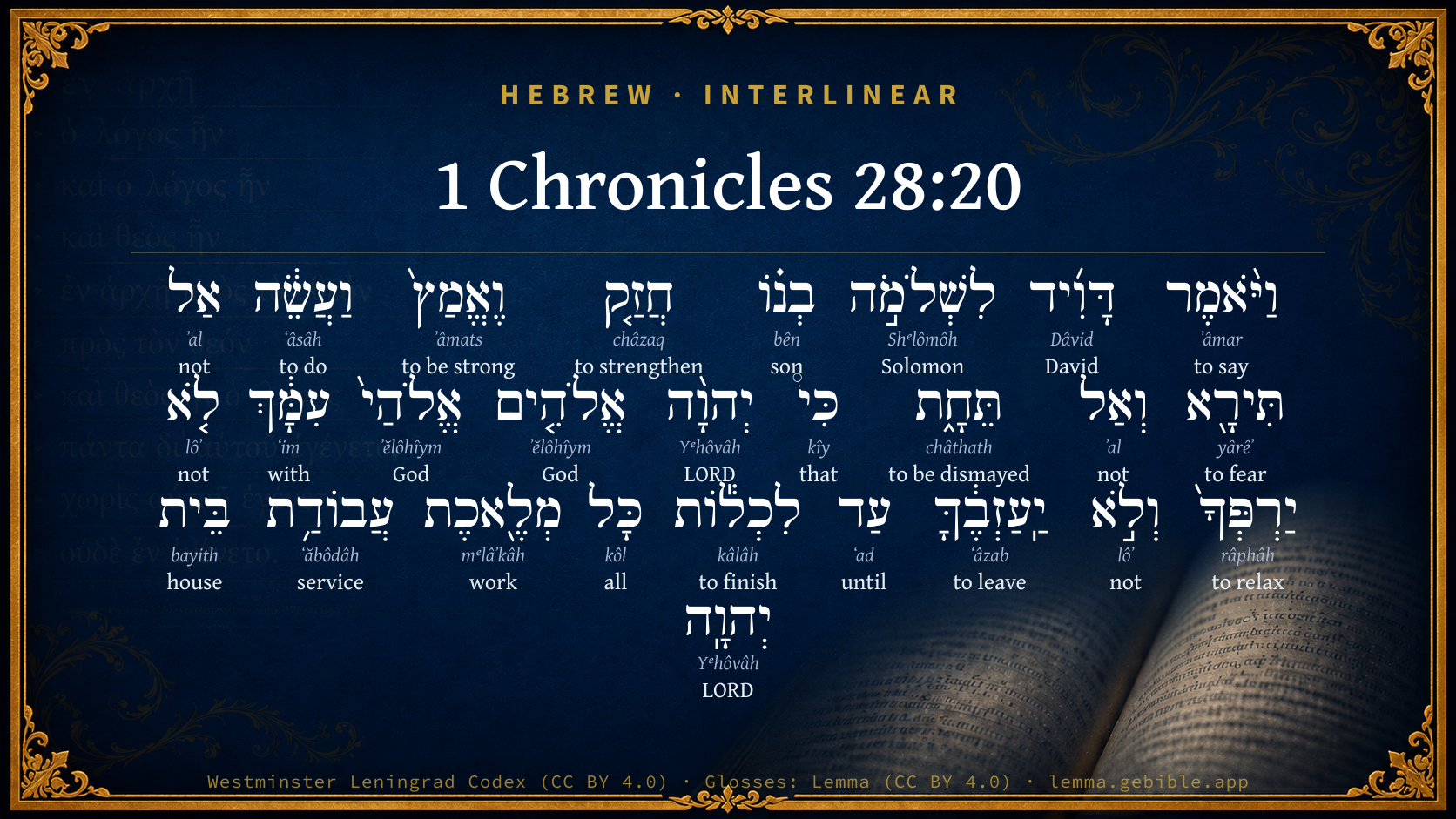
Hebrew (Westminster Leningrad Codex) 1 Chronicles 28:20 appears in the Hebrew Old Testament. The text above is from the Westminster Leningrad Codex. Each word links to its Strong’s number, a concise gloss, and parsing drawn from the Open Scriptures Hebrew Bible morphology. Click any word for its full Brown-Driver-Briggs (BDB) entry.
Download image
Cite this verse

1 Chronicles 28:20 (World English Bible). Public Domain. Lemma interlinear Bible study tool, https://lemma.gebible.app/v/1-chronicles/28/20.

Show BibTeX & RIS
BibTeX
RIS
English Translation
David said to Solomon his son, Be strong and of good courage, and do it: don't be afraid, nor be dismayed; for Yahweh God, even my God, is with you; he will not fail you, nor forsake you, until all the work for the service of the house of Yahweh is finished.
World English Bible · Public Domain
Download a study sheet

One document with this verse’s original text, its word-by-word gloss line, the meaning frame, cross-references with their text, attributed commentary, and full source and license credits — printable, and it pastes into notes with its structure intact.

This verse Autodidact and up

Study sheet (.html) Plain text (.txt)

A passage Seminary Student

Up to 50 verses in one chapter. A passage sheet keeps up to 6 commentary sources and 12 cross-references per verse, in the order this page ranks them, and says so on the sheet whenever that leaves anything out. Ask for a single verse and you get the Autodidact verse sheet above.

Everything on this page stays free to read, with no account — the sheet is a download of what is already on screen, not access to it.

Want to remove ads? Support Godless Engineer
Compare translations 3

The same verse in 3 English versions, stacked beneath the original-language interlinear above. Click any original word for its lexicon entry.

Each is an independent rendering of the whole verse — the interlinear is not word-aligned to these translations.

Highlighted words mark where these versions differ — a whole-verse word diff, not a word-by-word alignment.

  • World English Bible Public Domain
    David said to Solomon his son, Be strong and of good courage, and do it: don't be afraid, nor be dismayed; for Yahweh God, even my God, is with you; he will not fail you, nor forsake you, until all the work for the service of the house of Yahweh is finished.
  • King James Version Public Domain
    And David said to Solomon his son, Be strong and of good courage, and do it: fear not, nor be dismayed: for the LORD God, even my God, will be with thee; he will not fail thee, nor forsake thee, until thou hast finished all the work for the service of the house of the LORD.
  • unfoldingWord Literal Text CC BY-SA 4.0
    And David said to Solomon his son, “Be strong and be courageous and act. May you not fear, and may you not be dismayed, for Yahweh God, my God, with you. He will not leave you and he will not abandon you until all of the work of the service of the house of Yahweh finishes.

unfoldingWord Literal Text — © unfoldingWord, licensed CC BY-SA 4.0. Word-aligned USFM3 via Door43 (git.door43.org/unfoldingWord/en_ult).

Versions to compare (up to 4)

3 of 4 selected

Show all 18 translations

Every available English version of this verse, each an independent rendering of the whole verse.

  • World English Bible Public Domain
    David said to Solomon his son, Be strong and of good courage, and do it: don't be afraid, nor be dismayed; for Yahweh God, even my God, is with you; he will not fail you, nor forsake you, until all the work for the service of the house of Yahweh is finished.
  • Berean Standard Bible Public Domain
    David also said to Solomon his son, “Be strong and courageous, and do it. Do not be afraid or discouraged, for the LORD God, my God, is with you. He will neither fail you nor forsake you before all the work for the service of the house of the LORD is finished.
  • Majority Standard Bible Public Domain
    David also said to Solomon his son, “Be strong and courageous, and do it. Do not be afraid or discouraged, for the LORD God, my God, is with you. He will neither fail you nor forsake you before all the work for the service of the house of the LORD is finished.
  • King James Version Public Domain
    And David said to Solomon his son, Be strong and of good courage, and do it: fear not, nor be dismayed: for the LORD God, even my God, will be with thee; he will not fail thee, nor forsake thee, until thou hast finished all the work for the service of the house of the LORD.
  • American Standard Version (1901) Public Domain
    And David said to Solomon his son, Be strong and of good courage, and do it: fear not, nor be dismayed; for Jehovah God, even my God, is with thee; he will not fail thee, nor forsake thee, until all the work for the service of the house of Jehovah be finished.
  • Revised Version (1885) Public Domain
    And David said to Solomon his son, Be strong and of good courage, and do it: fear not, nor be dismayed: for the LORD God, even my God, is with thee; he will not fail thee, nor forsake thee, until all the work for the service of the house of the LORD be finished.
  • Geneva Bible (1599) Public Domain
    And Dauid said to Salomon his sonne, Be strong, and of a valiant courage and doe it: feare not, nor be afraide: for the Lord God, euen my God is with thee: he will not leaue thee nor forsake thee till thou hast finished all the worke for the seruice of the house of the Lord.
  • Douay-Rheims (1899) Public Domain
    And David said to Solomon his son: Act like a man, and take courage, and do: fear not, and be not dismayed: for the Lord my God will be with thee, and will not leave thee, nor forsake thee, till thou hast finished all the work for the service of the house of the Lord.
  • Young's Literal Translation Public Domain
    And David saith to Solomon his son, `Be strong, and courageous, and do; do not fear nor be affrighted, for Jehovah God, my God, `is' with thee; He doth not fail thee, nor forsake thee, unto the completion of all the work of the service of the house of Jehovah.
  • Literal Standard Version CC BY-SA 4.0
    And David says to his son Solomon, “Be strong and courageous, and do; do not fear nor be frightened, for YHWH God, my God, [is] with you; He does not fail you, nor forsake you, to the completion of all the work of the service of the house of YHWH.
  • Unlocked Literal Bible CC BY-SA 4.0
    David said to Solomon his son, “Be strong and brave. Do the work. Do not be afraid or anxious, for Yahweh God, my God, is with you. He will not leave you nor abandon you until all the work for the service of Yahweh's temple is finished.
  • unfoldingWord Literal Text CC BY-SA 4.0
    And David said to Solomon his son, “Be strong and be courageous and act. May you not fear, and may you not be dismayed, for Yahweh God, my God, with you. He will not leave you and he will not abandon you until all of the work of the service of the house of Yahweh finishes.
  • Darby Bible Public Domain
    And David said to Solomon his son, Be strong and courageous, and do it; fear not nor be dismayed: for Jehovah Elohim, my God, will be with thee; he will not leave thee, neither forsake thee, until all the work for the service of the house of Jehovah is finished.
  • World Messianic Bible Public Domain
    David said to Solomon his son, “Be strong and courageous, and do it. Don’t be afraid, nor be dismayed, for the LORD God, even my God, is with you. He will not fail you nor forsake you, until all the work for the service of the LORD’s house is finished.
  • Webster's Bible Public Domain
    And David said to Solomon his son, Be strong, and of good courage, and do it: fear not, nor be dismayed, for the LORD God, even my God, will be with thee; he will not fail thee, nor forsake thee, until thou hast finished all the work for the service of the house of the LORD.
  • Free Bible Version CC BY-SA 4.0
    Then David also told Solomon, “Be strong, be brave, and take action! Don't be afraid or discouraged, for the Lord God, my God, is with you! He will not let you down or leave you. He will make sure all the work for the service of the house of the Lord is finished.
  • Bible in Basic English Public Domain
    And David said to his son Solomon, Be strong and of a good heart and do your work; have no fear and do not be troubled, for the Lord God, my God, is with you; he will not give you up, and his face will not be turned away from you, till all the work necessary for the house of the Lord is complete.
  • JPS Tanakh (1917) Public Domain
    And David said to Solomon his son: 'Be strong and of good courage, and do it; fear not, nor be dismayed; for the LORD God, even my God, is with thee; He will not fail thee, nor forsake thee, until all the work for the service of the house of the LORD be finished.

Literal Standard Version (2020), Covenant Press — licensed CC BY-SA 4.0. Text via the HelloAO Bible API (eBible.org). Unlocked Literal Bible (unfoldingWord) — licensed CC BY-SA 4.0. Text via the HelloAO Bible API (eBible.org). unfoldingWord Literal Text — © unfoldingWord, licensed CC BY-SA 4.0. Word-aligned USFM3 via Door43 (git.door43.org/unfoldingWord/en_ult). Free Bible Version, Dr. Jonathan Gallagher — licensed CC BY-SA 4.0. Text via the HelloAO Bible API (eBible.org).

Word by word

More ways to search: Search by grammar → Find every occurrence → Compare this word →

Practice this passage: Drill this verse → Learn its vocabulary →

וֶאֱמַץ֙
ʼâmats
H553
“and · be strong”
Conjunction + Verb, Qal, Imperative, 2nd Person, Masculine, Singular
Part of Speech
Conjunction + Verb
Stem
Qal
Form
Imperative
Person
2nd Person
Gender
Masculine
Number
Singular
Full BDB Definition

Origin: a primitive root

TWOT: 117

to be strong, alert, courageous, brave, stout, bold, solid, hard - (Qal) to be strong, brave, bold - (Piel) to strengthen, secure (for oneself), harden (heart), make firm, make obstinate, assure - (Hithpael) to be determined, to make oneself alert, strengthen oneself, confirm oneself, persist in, prove superior to - (Hiphil) to exhibit strength, be strong, feel strong
  1. וַיֹּ֨אמֶר ʼâmar H559 “and · to say” Conjunction + Verb, Qal, Sequential Imperfect, 3rd Person, Masculine, Singular
  2. דָּוִ֜יד Dâvid H1732 “David” Noun, Proper
  3. לִשְׁלֹמֹ֣ה Shᵉlômôh H8010 “to/for · Solomon” Preposition + Noun, Proper
  4. בְנ֗וֹ bên H1121 “son · his” Noun, Common, Masculine, Singular, Construct + Suffix, Personal, 3rd Person, Masculine, Singular
  5. חֲזַ֤ק châzaq H2388 “strengthen” Verb, Qal, Imperative, 2nd Person, Masculine, Singular
  6. וַעֲשֵׂ֔ה ʻâsâh H6213 “and · do” Conjunction + Verb, Qal, Imperative, 2nd Person, Masculine, Singular
  7. אַל ʼal H408 “not” Particle, Negative
  8. תִּירָ֖א yârêʼ H3372 “to fear” Verb, Qal, Jussive, 2nd Person, Masculine, Singular
  9. וְאַל ʼal H408 “and · not” Conjunction + Particle, Negative
  10. תֵּחָ֑ת châthath H2865 “to be dismayed” Verb, Niphal, Jussive, 2nd Person, Masculine, Singular
  11. כִּי֩ kîy H3588 “that” Conjunction
  12. יְהוָ֨ה Yᵉhôvâh H3068 “LORD” Noun, Proper
  13. אֱלֹהִ֤ים ʼĕlôhîym H430 “God(s)” Noun, Common, Masculine, Plural, Absolute
  14. אֱלֹהַי֙ ʼĕlôhîym H430 “God(s) · my” Noun, Common, Masculine, Plural, Construct + Suffix, Personal, 1st Person, Common, Singular
  15. עִמָּ֔ךְ ʻim H5973 “with · you” Preposition + Suffix, Personal, 2nd Person, Masculine, Singular
  16. לֹ֤א lôʼ H3808 “not” Particle, Negative
  17. יַרְפְּךָ֙ râphâh H7503 “to relax · you” Verb, Hiphil, Imperfect, 3rd Person, Masculine, Singular + Suffix, Personal, 2nd Person, Masculine, Singular
  18. וְלֹ֣א lôʼ H3808 “and · not” Conjunction + Particle, Negative
  19. יַֽעַזְבֶ֔ךָּ ʻâzab H5800 “to leave · you” Verb, Qal, Imperfect, 3rd Person, Masculine, Singular + Suffix, Personal, 2nd Person, Masculine, Singular
  20. עַד ʻad H5704 “until” Preposition
  21. לִכְל֕וֹת kâlâh H3615 “to finish” Preposition + Verb, Qal, Infinitive Construct
  22. כָּל kôl H3605 “all of” Noun, Common, Masculine, Singular, Construct
  23. מְלֶ֖אכֶת mᵉlâʼkâh H4399 “work of” Noun, Common, Feminine, Singular, Construct
  24. עֲבוֹדַ֥ת ʻăbôdâh H5656 “service of” Noun, Common, Feminine, Singular, Construct
  25. בֵּית bayith H1004 “house of” Noun, Common, Masculine, Singular, Construct
  26. יְהוָֽה Yᵉhôvâh H3068 “LORD” Noun, Proper

About this verse

These counts appear in no published source. They are computed here, from the morphology-tagged text and Lemma’s own curated glosses. What Lemma adds →

27
words
23
distinct lemmas
Historical
section

Shared distinctive vocabulary

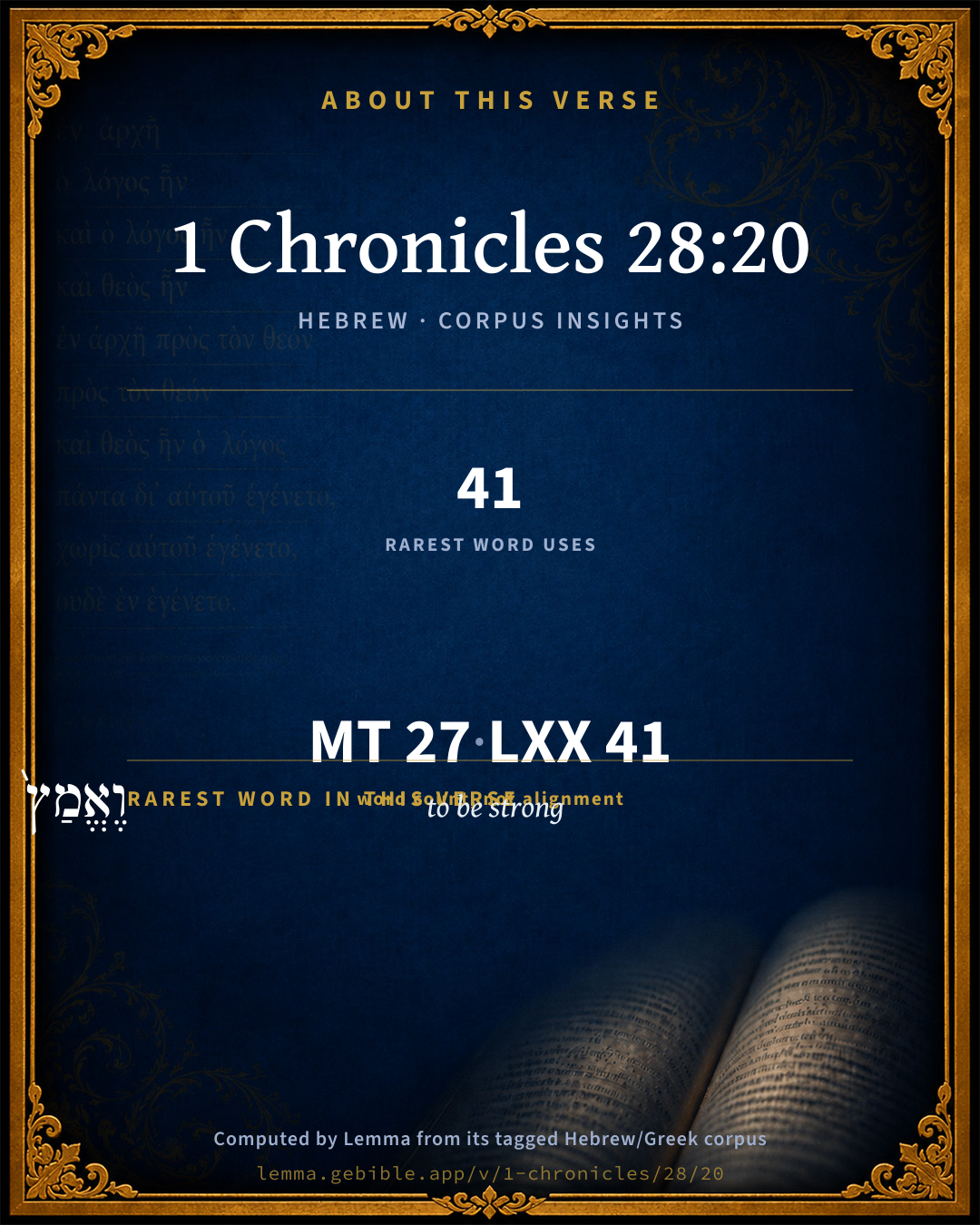
וֶאֱמַץ֙ to be strong H553 occurs in 41 verses of the Hebrew Bible. Also found in:

Grammatical profile

  • 9 verbs
  • 11 nouns
  • 2 prepositions
  • 1 conjunction
  • 4 particles

Verb forms

  • וַיֹּ֨אמֶר Qal · Sequential Imperfect
  • חֲזַ֤ק Qal · Imperative
  • וֶאֱמַץ֙ Qal · Imperative
  • וַעֲשֵׂ֔ה Qal · Imperative
  • תִּירָ֖א Qal · Jussive
  • תֵּחָ֑ת Niphal · Jussive
  • יַרְפְּךָ֙ Hiphil · Imperfect
  • יַֽעַזְבֶ֔ךָּ Qal · Imperfect
  • לִכְל֕וֹת Qal · Infinitive Construct

Repetition

Words recur within this verse — often emphatic in Hebrew:

  • יְהוָ֨ה LORD H3068 ×2
  • אֱלֹהִ֤ים God H430 ×2
  • אַל not H408 ×2
  • לֹ֤א not H3808 ×2

Hebrew & Septuagint length

In English translation the verse runs 52 words from the Hebrew and 89 from the Septuagint (LXX English) — the Septuagint runs noticeably longer here. See the side-by-side →

A rough comparison of the two English renderings, which tokenize alike — not a word-level alignment.

Word counts can differ between the Hebrew and the Greek without any difference in meaning — e.g. the Hebrew direct-object marker אֵת has no separate Greek word, and Greek often adds the article ὁ.

In the original languages it is 27 Hebrew tokens and 41 Greek tokens — but the two are counted differently (Hebrew bundles its prefixes and suffixes into one token; the Greek is in lemma form), so that isn’t a like-for-like length.

Cross-references

10

Topical passages linked to 1 Chronicles 28:20 in the Treasury of Scripture Knowledge — connected by theme and wording, ordered by reader-vote popularity; previews shown in the World English Bible.

  • 1 Chronicles 22:13 Then shall you prosper, if you observe to do the statutes and the ordinances which Yahweh gave Moses concerning Israel. Be strong, and of good courage. Don't be afraid, neither be dismayed.
  • Joshua 1:5–9 There shall not any man be able to stand before you all the days of your life. As I was with Moses, so I will be with you; I will not fail you, nor forsake you.
  • Isaiah 41:10 Don't you be afraid, for I am with you; don't be dismayed, for I am your God; I will strengthen you; yes, I will help you; yes, I will uphold you with the right hand of my righteousness.
  • Hebrews 13:5 Be free from the love of money, content with such things as you have, for he has said, "I will in no way leave you, neither will I in any way forsake you."
  • Deuteronomy 31:7–8 Moses called to Joshua, and said to him in the sight of all Israel, Be strong and of good courage: for you shall go with this people into the land which Yahweh has sworn to their fathers to give them; and you shall cause them to inherit it.
  • Psalms 27:1–2 Yahweh is my light and my salvation. Whom shall I fear? Yahweh is the strength of my life. Of whom shall I be afraid?
  • Isaiah 41:13 For I, Yahweh your God, will hold your right hand, saying to you, Don't be afraid; I will help you.
  • Romans 8:31 What then shall we say about these things? If God is for us, who can be against us?
  • 1 Corinthians 16:13 Watch! Stand firm in the faith! Be courageous! Be strong!
  • 1 Chronicles 28:10 Take heed now; for Yahweh has chosen you to build a house for the sanctuary: be strong, and do it.

Cross-references courtesy of OpenBible.info (CC BY 4.0).

Hebrew and Greek witnesses Masoretic Hebrew ↔ Greek Septuagint

The same verse in the two great witnesses to the Old Testament, shown verse-for-verse.

Here the Septuagint runs noticeably longer than the Hebrew — LXX2012 (modern English Septuagint) 89 words vs World English Bible 52. A rough length comparison of the two English translations, not a word-level alignment — read both below.

These are two independent witnesses, not word-aligned to each other, and the Septuagint is shown in lemma (dictionary) form.

Hebrew 1 Chronicles 28:20 Masoretic · Westminster Leningrad Codex

וַיֹּ֨אמֶר דָּוִ֜יד לִשְׁלֹמֹ֣ה בְנ֗וֹ חֲזַ֤ק וֶאֱמַץ֙ וַעֲשֵׂ֔ה אַל תִּירָ֖א וְאַל תֵּחָ֑ת כִּי֩ יְהוָ֨ה אֱלֹהִ֤ים אֱלֹהַי֙ עִמָּ֔ךְ לֹ֤א יַרְפְּךָ֙ וְלֹ֣א יַֽעַזְבֶ֔ךָּ עַד לִכְל֕וֹת כָּל מְלֶ֖אכֶת עֲבוֹדַ֥ת בֵּית יְהוָֽה

David said to Solomon his son, Be strong and of good courage, and do it: don't be afraid, nor be dismayed; for Yahweh God, even my God, is with you; he will not fail you, nor forsake you, until all the work for the service of the house of Yahweh is finished.

World English Bible · Public Domain

Greek LXX 1 Chronicles 28:20 Septuagint · lemma form

καί εἶπον δαυίδ σαλωμών ὁ υἱός αὐτός ἰσχύω καί ἀνδρίζομαι καί ποιέω μή φοβέω μηδέ πτοέω ὅτι κύριος ὁ θεός ἐγώ μετά σύ οὐ ἀναἵημι σύ καί οὐ μή σύ ἐν καταλείπω ἕως ὁ συντελέω σύ πᾶς ἐργασία λειτουργία οἶκος κύριος

And David said to Solomon his son, Be strong, and play the man, and do: fear not, neither be terrified; for the Lord my God is with you; he will not forsake you, and will not fail you, until you have finished all the work of the service of the house of the Lord. And behold the pattern of the temple, even his house, and its treasury, and the upper chambers, and the inner store-rooms, and the place of propitiation, and the plan of the house of the Lord.

LXX2012 (modern English Septuagint) · Public Domain

On this verse, Haydock's Catholic Bible Commentary discusses the Septuagint’s reading. Read the note in Commentary ↓

Hebrew: Westminster Leningrad Codex (CC BY 4.0). Greek: Septuagint (public domain); English from LXX2012 (modern English Septuagint) (Public Domain). How the Septuagint differs from the Hebrew →

Commentary

Notes on 1 Chronicles 28:20 from classic Christian and Jewish commentators (each source and its license shown beneath its notes). The classic Christian expositions comment on the surrounding passage and are grouped to its opening verse, so a note may address several verses; the Jewish commentaries on the Tanakh (Rashi and others) are per-verse, so they appear only where the commentator wrote on this verse.

Lemma curates 59 commentaries, every one of them public domain or Creative Commons licensed, each selected and text-cleaned for this edition rather than reprinted as found. About our sources →

Trapp's Complete Commentary

John Trapp

1Ch 28:20 And David said to Solomon his son, Be strong and of good courage, and do [it]: fear not, nor be dismayed: for the LORD God, [even] my God, [will be] with thee; he will not fail thee, nor forsake thee, until thou hast finished all the work for the service of the house of the LORD.

Ver. 20. He will not fail thee, &c.] See on Jos 1:5.

John Trapp, A Commentary or Exposition upon All the Books of the Old and New Testament (1647–1656) — public domain. Text from a community e-Sword module.

Joseph Benson's Commentary

1Ch 28:20. The Lord, even my God, will be with thee — He whom I have chosen and served, who has all along been with me, and prospered me. I recommend thee to him; he will be with thee, to strengthen, direct, and prosper thee. The God that owned our fathers, and carried them through the services of their day, will, in like manner, if we are faithful to him, go along with us in our day, and will never fail us. God never leaves any, unless they first leave him.

Joseph Benson's Commentary on the Old and New Testaments (1811–1818) — public domain. Text from a community e-Sword module.

Jamieson, Fausset & Brown

Robert Jamieson, A. R. Fausset & David Brown

Be strong and of good courage--The address begun in Ch1 28:9 is resumed and concluded in the same strain.

Jamieson, Fausset & Brown — Commentary Critical and Explanatory on the Whole Bible (1871) — public domain (CC PDM 1.0). Text via the HelloAO Bible API.

Adam Clarke's Commentary

Verse 20. The Lord God - my God, will be with thee] "The Word of the Lord my God will be thy assistant." - T.

Adam Clarke's Commentary on the Bible (1810–1826) — public domain. Text from a community e-Sword/MySword module.

Ellicott's Commentary for English Readers

(20) And David said to Solomon his son.—The conclusion of the speech begun in 1Ch_28:9-10, and interrupted by the transfer of the plans and designs (1Ch_28:11-19).

Be strong and of good courage.—So 1Ch_22:13. “And do” is added here, because the time for action is imminent.

Fear not . . . forsake thee.—From Deu_31:6; Deu_31:8. (See also Jos_1:5-6.)

My God.—Recalling, in a single word, all his own wonderful experience of the Divine Helper.

Fail.—Drop, let go, and so dismiss, desert.

Until.—The word implies nothing about the time beyond the expressed limit. (Comp. εws, Mat_1:25.)

A Bible Commentary for English Readers, edited by Charles John Ellicott (1878–1897) — public domain. Text from a community e-Sword module.

The Cambridge Bible for Schools and Colleges

gen. ed. J. J. S. Perowne

20. Be strong] God’s help in the planning is a pledge of God’s help in the accomplishment. Cp. 1Ch_28:10, 1Ch_22:13. The work was great, and Solomon young; 1Ch_22:5.

until thou hast finished all the work …] R.V. until all the work … be finished.

The Cambridge Bible for Schools and Colleges (gen. ed. J. J. S. Perowne; Cambridge University Press, 1878–1918) — public domain. Text from a community e-Sword module.

John Gill's Exposition

And, behold, all the courses of the priests and the Levites,.... Which David had lately fixed to take their turns in the temple, when built: even they shall be with thee

for all the service of the house of God; to advise and assist him in everything relating to the service of the sanctuary, which they might be supposed best to understand:

and there shall be with thee, for all manner of workmanship, every willing skilful man for any manner of service; men that were not only well skilled in all manner of curious work that was necessary for the service of the house, but were willing to employ their skill to the uttermost for it, and such David had provided, Ch1 22:15,

also the princes and all the people will be wholly at thy commandment: to do whatever he should order, whether to overlook the workmen, or to contribute to the expenses of the work.

Next: 1 Chronicles Chapter 29

John Gill's Exposition of the Whole Bible (1746–1763) — public domain (CC PDM 1.0). Text via the HelloAO Bible API.

Haydock's Catholic Bible Commentary

Lord. Septuagint add, "and I beheld, or behold, the pattern of the temple, and of the house and the Zakcho thereof, and the upper rooms and inner storehouses, and the house of propitiation, and the pattern of the house of the Lord: (21) and behold," ver. 11. (Haydock)

George Leo Haydock (1774–1849), Haydock's Catholic Family Bible and Commentary, 1859 edition — public domain. Excludes Psalms (Douay-Rheims chapter numbering differs from Protestant) and Deuterocanonical books (Catholic canon only).

Matthew Poole's English Annotations

Be strong and of good courage. See Poole "1Ch 27:10".

Matthew Poole's English Annotations on the Holy Bible (1683–1685) — public domain. Text from a community e-Sword/MySword module.

The Pulpit Commentary

Vers. 20, 21. These verses, as above seen, continue and close David"s urgent and last exhortation to Solomon. He has now done with admonition and urgent appeal, but he offers prayer for him. (1Ch_29:19)

David in this verse enlarges upon the certainty of God"s faithful steady presence with Solomon and support of his work to the end.

Vers. 20, 21.

The courage of age, and its grand adorn rages as grounded in experience.

Once more, then, the voice of the aged king and the aged father is heard. Its subject the same, its tones still more and more earnest, persuasive, imploring. Age calms, mellows, subdues, in almost all directions, but not literally in all.

I WE ARE ARRESTED BY OVERHEARING THE URGENT TONES OF OLD AGE. The voice is not weak, does not tremble, lisps not, nor hesitates. It is firm, full of vigour, and rings again more musical than even of old. There must be some significant reason for this.

II WE ARE ARRESTED BY SEEMING TO HEAR AGE URGE IMPETUOUSNESS AND DARING ON YOUTH. Surely the five times repeated exhortation," Be strong," "of good courage," "do it," "fear not," nor be dismayed," must betoken some very risky, presumptuous, and even daring enterprise. And yet it is the old man who is pressing on the young mall, appealing to him as though he would rouse him to an all but forlorn hope, instead of to a wise, prudent, and good work.

III WE ARE ARRESTED BY HEARING IN THE MIDST OF THESE URGENT AND IMPASSIONED TONES PROMISES OF THE HIGHEST INDUCEMENT, AND THAT BORROW THE NAME OF HEAVEN AND GOD. A father"s experience, encouragement, and entreaty may well weigh much with a son; a father"s savings, preparations, and enlistment through all the force of his influence, of much sure help from "princes and people," may well add inducement and confidence. But these are indefinitely exalted now by the challenge to believe that Heaven itself would work for and with Solomon. "The Lord God will be with thee; he will not fail thee, nor forsake thee, until thou hast finished.

IV ONE LITTLE FAMILIAR WORD, AMID ALL THE REST, ARRESTS OUR EAR AND WARMS THE WHOLE APPEAL WITH THE TONE OF PERSONAL INTEREST. That little word is the one which counts so often for so much the word "my." At the very crisis of invoking, in the great and terrible and reverend Name of "the Lord God," the very highest possible sanction, David does not forbear to link his own name with it: "The Lord God, my God, will be with thee?" This is the same David who in many a psalm could sing in the very lowliest strain and confession of the demerit of man and his poverty and his sinful nature and sinful practice. Yet the two things are not inconsistent, and David does not do wrong. The God of all, of nil worlds, the universal God, loves to be sought, to be clung to, to be appropriated by the individual. The poorer, the lowlier, the more solitary, so that his child"s trust corresponds in thoroughness and tenacity with his condition of want, so much the more welcome is that child, and not a word shall be said to him that he presumes. Note, then, that in the happy expression of David to his son," My God," we have:

1. The creatures rightful and blessed appropriation of the Creator; the only all-sufficient, the inexhaustible and ever-communicating, the one strong support of everything within the compass of his dominions.

2. The consecrated diminutive of affection. The thing or the person I believe I chiefly love, that thing or that person I restlessly, ceaselessly long to call mine, my own. Nor is there a simpler, grander, juster use of this little word, the consecrate word of affection the world all over, than when a creature, sinner, penitent, poor, and dependent, breathes out from all that is within him "My God.

3. The grateful outcome of tried experience. Age gives the opportunity of valuable experience in many a direction, but in none so much as in those relations which subsist direct between man and his God. There is nowhere such room for experience to have its way, to grow and to attain results of surpassing value. After the experience that David had accumulated of God, and of what a God, God had been to him, he rightly desires to make a point of this to his Son. It was not simply the sentiment of the father"s God, one to be held to by the son; it was no mere dictate of family pride, or of hereditary attachment to some lares et penates. No; the hard but telling facts of experience enable David to pledge and guarantee his" God, as the good God and the wonderful God, and the safe God for his son. So Paul said to the Philippians, "My God shall supply all your need," in that he, above any living Christian of that time, had suffered peril, need, persecution, (2Co_11:23-31) and had found God, the "very present Help and Refuge in time of trouble," whom the psalmist a thousand years before had tested. All distances of time, differences of dispensation, contrasts of character and of career, sometimes seem to meet in one place, one confession, and one adoration. Each utters, "My God," and all are found to have contributed the proof of a God unchangeable same yesterday, to-day, and for ever." Meantime the experience and testimony of each helps to influence and instruct and strengthen the faith and love of some nearest by nature or by friendship. And to many a son Solomon has come, with equal truth and effect, the aged father"s confession of what, through a long, a hard, a tried life, he has found his God to be. "The Lord God, my God, will be with thee." Happy the fathers who have such experience, and happy the children who hear their counsel in time. And happy for the long-favoured people of Israel, "blest beyond compare" already, if their new young king hear, and for ever heed, the advice of his aged and richly experienced father, and adopt his God for his own "even unto death.

Be strong.

Worship and work together make up the expression, the manifestation, of religion. Where the heart has true, living faith in Christ, both these will be. Worship is the soul, and work the body, of the religious life. And the Lord Jesus is the Mediator of worship, and the Inspiration of work. David"s closing admonitions to his son and successor naturally had respect to the high station he was about to occupy, and the great service he was about to render. Thus he set before Solomon a grand conception of the purpose of his future life, and glorious encouragement and assurances to induce him to go forward with courage and with zeal. In these words we have

I A VIEW OF LIFE AS PRACTICAL AND STRENUOUS SERVICE. There is work for all true and loyal hearts, for all willing, active hands. We are all, as Christians, builders in the house, the temple, of the most high God. The edifice of our life and happiness, our influence and usefulness, is not to rise by chance or magic; it is to be reared by our own labour and diligence, our own perseverance and prayers. What dignity, beauty, and interest are lent to our life by the conviction that we are building in the Lord"s house I Whether our life be public or private, whether our sphere of influence be home, or profession, or business; whether our relations to others be official or social, we may all be builders under God.

III ADMONITION AND ENCOURAGEMENT TO FULFIL LIFE"S WORK. As David spoke to his son in terms of fatherly sympathy and good cheer, so let the elder encourage the younger in the service of their God and Saviour.

1. Observe the disposition which is to be avoided. "Fear not, nor be dismayed." Some minds are naturally timorous. A nervous temperament, a diffident habit of mind, depressing circumstances, may account for this. Some are ever in dread of adversaries; others are more apprehensive of their own weakness and insufficiency. Accordingly, Scripture contains many dissuasives from timidity and faint-heartedness. "Fear not, for I am with thee; be not dismayed, for I am thy God?

1. Observe the disposition to be fostered. "Be strong and of good courage." To many of his servants, placed in critical positions, has the

2. supreme Lord addressed such admonitions. "Be strong and of a good courage," Jehovah had said to Joshua and to Israel, in the prospect of their entering upon Canaan as their inheritance. A courageous heart can do wonders; it can ever bear up a feeble body, contend with adverse circumstances, defy malignant opposition. We are not taught to place confidence in ourselves, but we are taught not to shrink from duty because of our felt inadequacy. Strength comes with a brave heart, a fixed resolution, a calm confidence in Divine grace and aid.

3. Observe the admonition to action. "Do it." David had prepared for the building of the temple; it was for his son to carry out the plans which had been made. It is for us all, as followers of Christ, not to dream or to purpose, but to act. We are gifted with active powers, and are called to an active life. "Whatsoever thy hand findeth to do, do it with thy might.

III PROMISE TO ANIMATE THE TRUE-HEARTED WORKER. Mere admonition and advice from fellow-men is insufficient. The question of practical moment for us, in our endeavours to serve, is this Is there help from above? We have the answer in the text.

1. Divine presence and aid are assured. "The Lord God will be with thee." How far better than the presence and counsel even of a faithful earthly friend, a judicious earthly father I "Vain is the help of man." But "if God be for us, who can be against us?

2. The same God who has been the dwelling-place of his people in allgenerations, is our God. It is very significant that David says, "Even my God." The memory of former interpositions, of the great works which God did in the days of our fathers, should hearten and cheer and comfort us. He is neither an unknown nor an untried God.

3. He will not fail or forsake his people until their work is finished. Otherhelpers may fail us, may be summoned from earth, or may prove unfaithful. We may fear lest God himself should depart from us. But he is faithful to all his promises. "The mountains may depart," etc. Solomon enjoyed the countenance, protection, and guidance of Cod until the temple was completed. God only knows what our life-work is to be; but we may all be assured that, if he has entrusted to us any service, he will not withdraw from us, he will not abandon our undertaking, until his purpose is fulfilled, until our work is done.

PRACTICAL LESSONS.

1. Let every hearer of the gospel obey the call, and enter without delayupon the Lord"s work.

2. Let God"s servants who are dismayed by difficulties and a sense ofinsufficiency betake themselves to the Word of God and to prayer. T.

Personal relations with God.

Lord God, even my God." It is possible for us to have thoughts of God that keep him wholly external to us, and altogether unrelated to us. And it may be feared that such are the thoughts of God usually cherished by men, Though they may have a certain influence on us, the full and saving power of God cannot be known until we have appropriated him, and come into direct and personal relations with him. A man finds God a living force upon thought, heart, life, and conduct when he calls him my God. The work of Christ is, in great part, the bringing about of this relation, and the persuasion of the man to recognize it fully. Man lost says, "I heard thy voice in the garden, and I was afraid, and hid myself. " Man redeemed, and standing right with God, says, "I flee unto thee to hide me. " "For thou art my God.

I How CAN GOD BE THUS PERSONALLY APPREHENDED?

1. By accepting the revelation of his fatherhood which he makes in Christthe Son, and entering into the privilege and duty which it involves.

2. By winning the trustful, thankful love of those who know they areforgiven and redeemed.

3. By maintaining those close and intimate communions with God whichbring freshly to us the joy of his care.

II WHAT IS INVOLVED IN SUCH PERSONAL RELATIONS?

1. On Gods part. Just what God loves, and what he is sure to meet with the fullest bestowments of his grace, is man"s love and trust expressed in the words my God.

2. On mans part. The relation becomes the most hallowing force exerted on the whole life. The man wants to be worthy of, wants to be like, his God.

III WHAT MAY IMPERIL SUCH RELATIONS AFTER THEY HAVE BEEN APPREHENDED? This may be treated in detail, or in the general principle. To say, "my God," involves maintaining the trustfulness of full and obedient submission; and, therefore, the peril lies in some returning form of wilfulness. This separates us at once, in feeling, from God, so that the words "my God" will not rise to our lips. R.T.

The Pulpit Commentary (1880–1919), ed. H.D.M. Spence-Jones & Joseph S. Exell — public domain. Text from a community e-Sword module.

John Wesley's Explanatory Notes

My God - Whom I have chosen and served, who has all along been with me and prospered me, I recommend thee to him; he will be with thee, to strengthen, direct and prosper thee. The God that owned our fathers, and carried them thro' the services of their day, will, in like manner, if we are faithful to him, go along with us in our day, and will never fail us. God never leaves any, unless they first leave him.

John Wesley, Explanatory Notes Upon the Whole Bible (1754–1765) — public domain. Text via the GEBible commentary corpus.

Keil & Delitzsch

C. F. Keil & F. Delitzsch

And, behold, all the courses of the priests and the Levites,.... Which David had lately fixed to take their turns in the temple, when built: even they shall be with thee

for all the service of the house of God; to advise and assist him in everything relating to the service of the sanctuary, which they might be supposed best to understand:

and there shall be with thee, for all manner of workmanship, every willing skilful man for any manner of service; men that were not only well skilled in all manner of curious work that was necessary for the service of the house, but were willing to employ their skill to the uttermost for it, and such David had provided, Ch1 22:15,

also the princes and all the people will be wholly at thy commandment: to do whatever he should order, whether to overlook the workmen, or to contribute to the expenses of the work.

Next: 1 Chronicles Chapter 29

Keil & Delitzsch — Biblical Commentary on the Old Testament (1861–1891) — public domain (CC PDM 1.0). Text via the HelloAO Bible API. (Old Testament only.)

unfoldingWord translationNotes

Door43 World Missions Community

strong and brave

These two words basically mean the same thing and emphasize that Solomon must be courageous. (See: Doublet)

Do not be afraid or anxious

The words "afraid" and "anxious" basically mean the same thing and emphasize that Solomon must never give up. Also, this can be written in positive form. AT: "Be courageous" or "Be confident" (See: Doublet)

is with you

This is an idiom. AT: "will help you" (See: Idiom)

He will not leave you nor abandon you

These two phrases mean the same thing and emphasize that Yahweh will always be with Solomon. Also, this can be stated in positive form. AT: "He will always be with you" (See: Parallelism)

See, here are the divisions

"Here are the divisions." David uses the word "see" here to refer back to the listings of the divisions of the Levites and their duties for the temple.

the divisions of the priests and Levites

See how you translated this in 1 Chronicles 28:13.

translationWords

Solomon

works

God

servant

temple

command

unfoldingWord translationNotes — © Distant Shores Media and the Door43 World Missions Community, licensed CC BY-SA 4.0. Source: git.door43.org/Door43/en_tn.

Rashi

Rabbi Shlomo Yitzchaki (Rashi)

Be strong and of good courage in order that your kingdom endure as the Holy One, blessed be He, has promised you, (verse 7): “... and I shall prepare his kingdom to eternity if he strengthens himself to perform My commandments, etc.”

Rashi on the Tanakh — English translations: “The Judaica Press complete Tanach with Rashi, translated by A. J. Rosenberg” (CC BY 4.0); “Pentateuch with Rashi's commentary by M. Rosenbaum and A.M. Silbermann, 1929-1934” (public domain); “The Metsudah Tanach series, Lakewood, N.J” (CC BY 4.0); and “The Book of Joshua, Metsudah Publications, 1997” (CC BY 4.0). Text via Sefaria.

Lesson kit

Teaching starters — assembled from the data on this page, not authored interpretation. Every prompt links to the verse data it draws on. Edit before teaching.

1 Chronicles, in the Historical, opens this verse with 27 words (23 distinct Hebrew lemmas). Its most distinctive word is ʼâmats (“to be strong”). The Greek Septuagint runs longer here. A historical commentator’s framing appears above. Read the whole chapter for the surrounding context.

Discussion questions

  1. The word ʼâmats carries the sense “to be strong.” How does it shape the verse?
  2. How does Genesis 25:23, which shares the word «to be strong», read alongside this verse?
  3. What does the repetition of “LORD” (2× in this one verse) do in this verse?
  4. The Septuagint runs longer here than the Hebrew. What might account for the difference?
  5. These translations render this verse differently; the difference is in the English rendering, not the original. What questions does that raise?
  6. «וַיֹּ֨אמֶר» is a Qal Sequential Imperfect verb. How does that grammatical form shape the action described?
  7. Compare how Trapp's Complete Commentary and Joseph Benson's Commentary read this verse. Where do they agree or differ?

Things to notice

Reading settings

Reading text

Shown beneath each verse's original-language words.

Old Testament
Old Testament edition

Read the OT as the Masoretic Hebrew (MT) or the Greek Septuagint (LXX).

English shown for the Greek Septuagint (in the Hebrew ↔ Greek comparison).

Comparing translations? Open the Compare panel on any verse page to stack up to four side by side.