
2 Chronicles 7:6

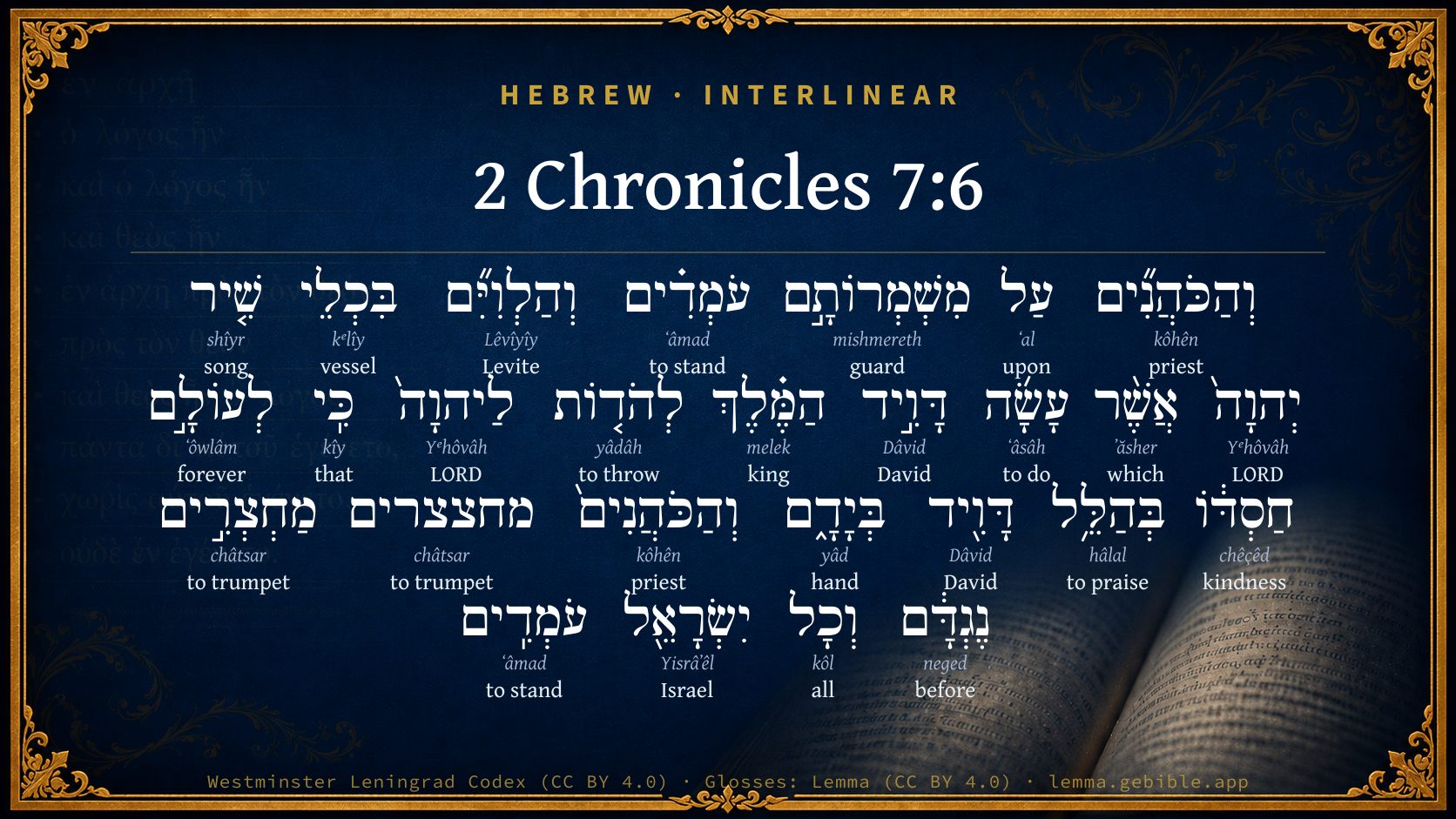
Hebrew (Westminster Leningrad Codex) 2 Chronicles 7:6 appears in the Hebrew Old Testament. The text above is from the Westminster Leningrad Codex. Each word links to its Strong’s number, a concise gloss, and parsing drawn from the Open Scriptures Hebrew Bible morphology. Click any word for its full Brown-Driver-Briggs (BDB) entry.
Download image
Cite this verse

2 Chronicles 7:6 (World English Bible). Public Domain. Lemma interlinear Bible study tool, https://lemma.gebible.app/v/2-chronicles/7/6.

Show BibTeX & RIS
BibTeX
RIS
English Translation
The priests stood, according to their offices; the Levites also with instruments of music of Yahweh, which David the king had made to give thanks to Yahweh, (for his loving kindness endures for ever), when David praised by their ministry: and the priests sounded trumpets before them; and all Israel stood.
World English Bible · Public Domain
Download a study sheet

One document with this verse’s original text, its word-by-word gloss line, the meaning frame, cross-references with their text, attributed commentary, and full source and license credits — printable, and it pastes into notes with its structure intact.

This verse Autodidact and up

Study sheet (.html) Plain text (.txt)

A passage Seminary Student

Up to 50 verses in one chapter. A passage sheet keeps up to 6 commentary sources and 12 cross-references per verse, in the order this page ranks them, and says so on the sheet whenever that leaves anything out. Ask for a single verse and you get the Autodidact verse sheet above.

Everything on this page stays free to read, with no account — the sheet is a download of what is already on screen, not access to it.

Want to remove ads? Support Godless Engineer
Compare translations 3

The same verse in 3 English versions, stacked beneath the original-language interlinear above. Click any original word for its lexicon entry.

Each is an independent rendering of the whole verse — the interlinear is not word-aligned to these translations.

Highlighted words mark where these versions differ — a whole-verse word diff, not a word-by-word alignment.

  • World English Bible Public Domain
    The priests stood, according to their offices; the Levites also with instruments of music of Yahweh, which David the king had made to give thanks to Yahweh, (for his loving kindness endures for ever), when David praised by their ministry: and the priests sounded trumpets before them; and all Israel stood.
  • King James Version Public Domain
    And the priests waited on their offices: the Levites also with instruments of music of the LORD, which David the king had made to praise the LORD, because his mercy endureth for ever, when David praised by their ministry; and the priests sounded trumpets before them, and all Israel stood.
  • unfoldingWord Literal Text CC BY-SA 4.0
    And the priests at their posts were standing; and the Levites with instruments of song of Yahweh which David the king had made to give thanks to Yahweh, “For his covenant faithfulness is forever,” when David praised by the hand of them. And the priests were trumpeting in front of them, and all Israel was standing.

unfoldingWord Literal Text — © unfoldingWord, licensed CC BY-SA 4.0. Word-aligned USFM3 via Door43 (git.door43.org/unfoldingWord/en_ult).

Versions to compare (up to 4)

3 of 4 selected

Show all 18 translations

Every available English version of this verse, each an independent rendering of the whole verse.

  • World English Bible Public Domain
    The priests stood, according to their offices; the Levites also with instruments of music of Yahweh, which David the king had made to give thanks to Yahweh, (for his loving kindness endures for ever), when David praised by their ministry: and the priests sounded trumpets before them; and all Israel stood.
  • Berean Standard Bible Public Domain
    The priests stood at their posts, as did the Levites with the musical instruments of the LORD, which King David had made for giving thanks to the LORD and with which David had offered praise, saying, “For His loving devotion endures forever.” Across from the Levites, the priests sounded trumpets, and all the Israelites were standing.
  • Majority Standard Bible Public Domain
    The priests stood at their posts, as did the Levites with the musical instruments of the LORD, which King David had made for giving thanks to the LORD and with which David had offered praise, saying, “For His loving devotion endures forever.” Across from the Levites, the priests sounded trumpets, and all the Israelites were standing.
  • King James Version Public Domain
    And the priests waited on their offices: the Levites also with instruments of music of the LORD, which David the king had made to praise the LORD, because his mercy endureth for ever, when David praised by their ministry; and the priests sounded trumpets before them, and all Israel stood.
  • American Standard Version (1901) Public Domain
    And the priests stood, according to their offices; the Levites also with instruments of music of Jehovah, which David the king had made to give thanks unto Jehovah, (for his lovingkindness `endureth' for ever,) when David praised by their ministry: and the priests sounded trumpets before them; and all Israel stood.
  • Revised Version (1885) Public Domain
    And the priests stood, according to their offices; the Levites also with instruments of music of the LORD, which David the king had made to give thanks unto the LORD, for his mercy endureth for ever, when David praised by their ministry: and the priests sounded trumpets before them; and all Israel stood.
  • Geneva Bible (1599) Public Domain
    And the Priests waited on their offices, and the Leuites with the instruments of musicke of the Lord, which King Dauid had made to praise the Lord, Because his mercy lasteth for euer: whe Dauid praysed God by them, the Priestes also blewe trumpets ouer against them: and all they of Israel stoode by.
  • Douay-Rheims (1899) Public Domain
    And the priests stood in their offices: and the Levites with the instruments of music of the Lord, which king David made to praise the Lord: because his mercy endureth for ever, singing the hymns of David by their ministry: and the priests sounded with trumpets before them, and all Israel stood.
  • Young's Literal Translation Public Domain
    And the priests over their charges are standing, and the Levites with instruments of the song of Jehovah -- that David the king made, to give thanks to Jehovah, for to the age `is' His kindness, in David's praising by their hand -- and the priests are blowing trumpets over-against them, and all Israel are standing.
  • Literal Standard Version CC BY-SA 4.0
    And the priests are standing over their charges, and the Levites with instruments of the song of YHWH that David the king made, to give thanks to YHWH, for His kindness [is] for all time, in David’s praising by their hand—and the priests are blowing trumpets opposite them, and all of Israel is standing.
  • Unlocked Literal Bible CC BY-SA 4.0
    The priests stood, each standing where they serve; the Levites also with instruments of music of Yahweh, which David the king had made to give thanks to Yahweh in the song, “For his covenant faithfulness endures for ever.” All the priests sounded trumpets before them, and all Israel stood.
  • unfoldingWord Literal Text CC BY-SA 4.0
    And the priests at their posts were standing; and the Levites with instruments of song of Yahweh which David the king had made to give thanks to Yahweh, “For his covenant faithfulness is forever,” when David praised by the hand of them. And the priests were trumpeting in front of them, and all Israel was standing.
  • Darby Bible Public Domain
    And the priests stood in their charges, and the Levites with Jehovah's instruments of music, which David the king had made to praise Jehovah, for his loving-kindness [endureth] for ever, when David praised by their means; and the priests sounded the trumpets opposite to them, and all Israel stood.
  • World Messianic Bible Public Domain
    The priests stood, according to their positions; the Levites also with instruments of music of the LORD, which David the king had made to give thanks to the LORD, when David praised by their ministry, saying “For his loving kindness endures forever.” The priests sounded shofars before them; and all Israel stood.
  • Webster's Bible Public Domain
    And the priests waited on their offices: the Levites also with instruments of music of the LORD, which David the king had made to praise the LORD, because his mercy endureth for ever, when David praised by their ministry; and the priests sounded trumpets before them, and all Israel stood.
  • Free Bible Version CC BY-SA 4.0
    The priests stood at their posts, and the Levites too, with the musical instruments that King David had made for giving praise, and which David had used for praise. They sang, “For his trustworthy love lasts forever!” Opposite them the priests blew trumpets, and all the Israelites stood up.
  • Bible in Basic English Public Domain
    And the priests were in their places, and the Levites with their instruments of music for the Lord's song, which David the king had made for the praise of the Lord whose mercy is unchanging for ever, when David gave praise by their hand; and the priests were sounding horns before them; and all Israel were on their feet.
  • JPS Tanakh (1917) Public Domain
    And the priests stood, according to their offices; the Levites also with instruments of music of the LORD, which David the king had made, to give thanks unto the LORD, for His mercy endureth for ever, with the praises of David by their hand; and the priests sounded trumpets over against them; and all Israel stood.

Literal Standard Version (2020), Covenant Press — licensed CC BY-SA 4.0. Text via the HelloAO Bible API (eBible.org). Unlocked Literal Bible (unfoldingWord) — licensed CC BY-SA 4.0. Text via the HelloAO Bible API (eBible.org). unfoldingWord Literal Text — © unfoldingWord, licensed CC BY-SA 4.0. Word-aligned USFM3 via Door43 (git.door43.org/unfoldingWord/en_ult). Free Bible Version, Dr. Jonathan Gallagher — licensed CC BY-SA 4.0. Text via the HelloAO Bible API (eBible.org).

Word by word

More ways to search: Search by grammar → Find every occurrence → Compare this word →

Practice this passage: Drill this verse → Learn its vocabulary →

מחצצרים
châtsar
H2690
“trumpeting”
Verb, Hiphil, Participle Active, Masculine, Plural, Absolute
Part of Speech
Verb
Stem
Hiphil
Form
Participle Active
Gender
Masculine
Number
Plural
State
Absolute
Full BDB Definition

Origin: a primitive root

TWOT: 726b

to sound a trumpet - (Piel) players on clarions (participle) - (Hiphil) sound with clarions (participle)
  1. וְהַכֹּהֲנִ֞ים kôhên H3548 “and · the · priests” Conjunction + Particle, Definite Article + Noun, Common, Masculine, Plural, Absolute
  2. עַל ʻal H5921 “upon” Preposition
  3. מִשְׁמְרוֹתָ֣ם mishmereth H4931 “guards · their” Noun, Common, Feminine, Plural, Construct + Suffix, Personal, 3rd Person, Masculine, Plural
  4. עֹמְדִ֗ים ʻâmad H5975 “standing” Verb, Qal, Participle Active, Masculine, Plural, Absolute
  5. וְהַלְוִיִּ֞ם Lêvîyîy H3881 “and · the · Levites” Conjunction + Particle, Definite Article + Noun, Gentilic, Masculine, Plural, Absolute
  6. בִּכְלֵי kᵉlîy H3627 “in/at · vessels of” Preposition + Noun, Common, Masculine, Plural, Construct
  7. שִׁ֤יר shîyr H7892 “song of” Noun, Common, Both, Singular, Construct
  8. יְהוָה֙ Yᵉhôvâh H3068 “LORD” Noun, Proper
  9. אֲשֶׁ֨ר ʼăsher H834 “which” Particle, Relative
  10. עָשָׂ֜ה ʻâsâh H6213 “to do” Verb, Qal, Perfect, 3rd Person, Masculine, Singular
  11. דָּוִ֣יד Dâvid H1732 “David” Noun, Proper
  12. הַמֶּ֗לֶךְ melek H4428 “the · king” Particle, Definite Article + Noun, Common, Masculine, Singular, Absolute
  13. לְהֹד֤וֹת yâdâh H3034 “to throw” Preposition + Verb, Hiphil, Infinitive Construct
  14. לַיהוָה֙ Yᵉhôvâh H3068 “to/for · LORD” Preposition + Noun, Proper
  15. כִּֽי kîy H3588 “that” Conjunction
  16. לְעוֹלָ֣ם ʻôwlâm H5769 “to/for · forever” Preposition + Noun, Common, Masculine, Singular, Absolute
  17. חַסְדּ֔וֹ chêçêd H2617 “kindness · his” Noun, Common, Masculine, Singular, Construct + Suffix, Personal, 3rd Person, Masculine, Singular
  18. בְּהַלֵּ֥ל hâlal H1984 “in/at · to praise” Preposition + Verb, Piel, Infinitive Construct
  19. דָּוִ֖יד Dâvid H1732 “David” Noun, Proper
  20. בְּיָדָ֑ם yâd H3027 “in/at · hand · their” Preposition + Noun, Common, Both, Singular, Construct + Suffix, Personal, 3rd Person, Masculine, Plural
  21. וְהַכֹּהֲנִים֙ kôhên H3548 “and · the · priests” Conjunction + Particle, Definite Article + Noun, Common, Masculine, Plural, Absolute
  22. מַחְצְרִ֣ים châtsar H2690 “trumpeting” Verb, Hiphil, Participle Active, Masculine, Plural, Absolute
  23. נֶגְדָּ֔ם neged H5048 “before · them” Preposition + Suffix, Personal, 3rd Person, Masculine, Plural
  24. וְכָל kôl H3605 “and · all of” Conjunction + Noun, Common, Masculine, Singular, Construct
  25. יִשְׂרָאֵ֖ל Yisrâʼêl H3478 “Israel” Noun, Proper
  26. עֹמְדִֽים ʻâmad H5975 “standing” Verb, Qal, Participle Active, Masculine, Plural, Absolute

About this verse

These counts appear in no published source. They are computed here, from the morphology-tagged text and Lemma’s own curated glosses. What Lemma adds →

27
words
22
distinct lemmas
Historical
section

Notable vocabulary

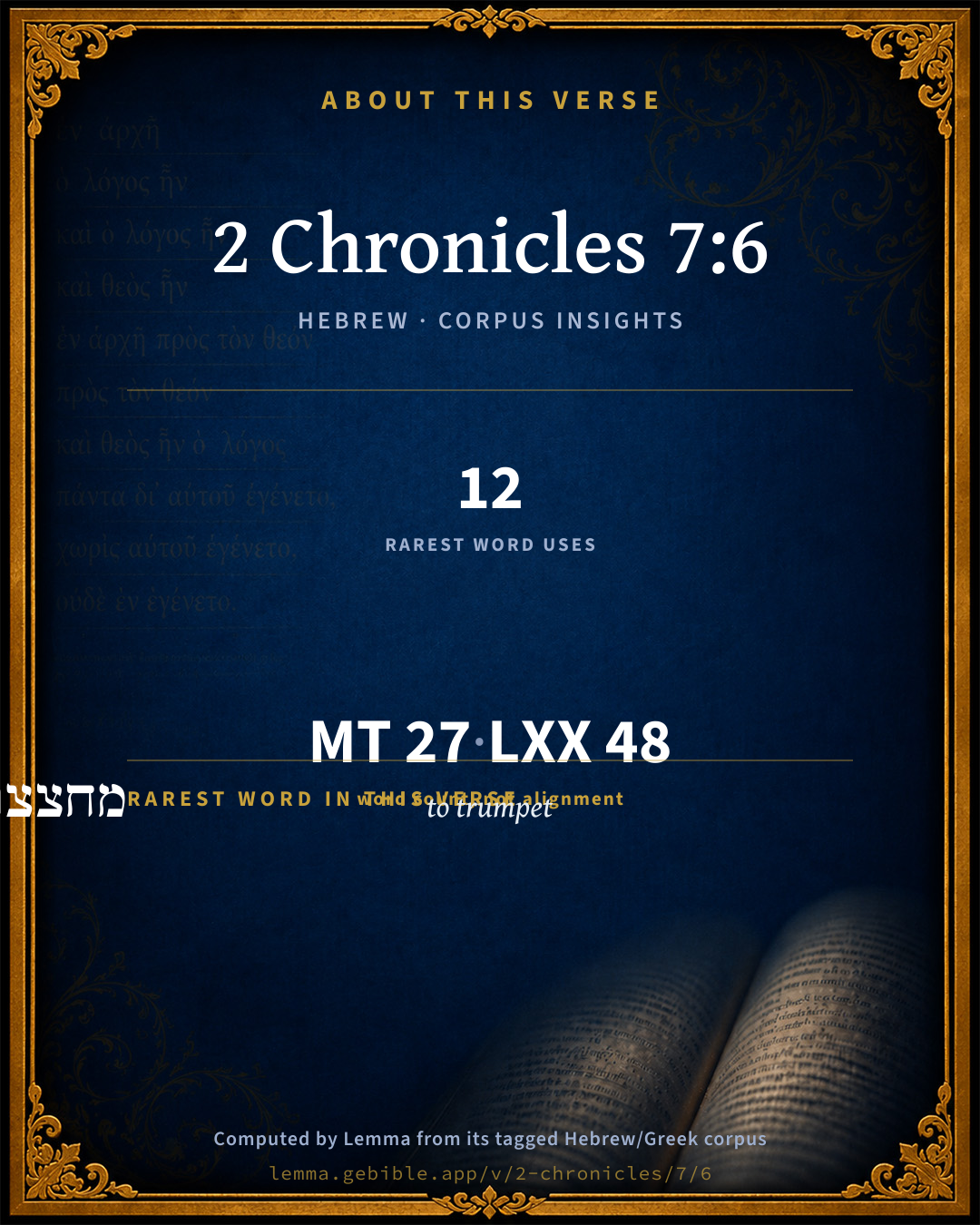
The rarest word here is מחצצרים to trumpet H2690 — appearing just 12 times in the whole Hebrew Bible.

Shared distinctive vocabulary

מחצצרים to trumpet H2690 occurs in 6 verses of the Hebrew Bible. Also found in:

Grammatical profile

  • 7 verbs
  • 16 nouns
  • 2 prepositions
  • 1 conjunction
  • 1 particle

Verb forms

  • עֹמְדִ֗ים Qal · Participle Active
  • עָשָׂ֜ה Qal · Perfect
  • לְהֹד֤וֹת Hiphil · Infinitive Construct
  • בְּהַלֵּ֥ל Piel · Infinitive Construct
  • מחצצרים Hiphil · Participle Active
  • מַחְצְרִ֣ים Hiphil · Participle Active
  • עֹמְדִֽים Qal · Participle Active

Repetition

Words recur within this verse — often emphatic in Hebrew:

  • וְהַכֹּהֲנִ֞ים priest H3548 ×2
  • עֹמְדִ֗ים to stand H5975 ×2
  • יְהוָה֙ LORD H3068 ×2
  • דָּוִ֣יד David H1732 ×2
  • מחצצרים to trumpet H2690 ×2

Hebrew & Septuagint length

In English translation the verse runs 51 words from the Hebrew and 55 from the Septuagint (LXX English) — closely comparable.

A rough comparison of the two English renderings, which tokenize alike — not a word-level alignment.

Word counts can differ between the Hebrew and the Greek without any difference in meaning — e.g. the Hebrew direct-object marker אֵת has no separate Greek word, and Greek often adds the article ὁ.

In the original languages it is 27 Hebrew tokens and 48 Greek tokens — but the two are counted differently (Hebrew bundles its prefixes and suffixes into one token; the Greek is in lemma form), so that isn’t a like-for-like length.

Cross-references

21

Topical passages linked to 2 Chronicles 7:6 in the Treasury of Scripture Knowledge — connected by theme and wording, ordered by reader-vote popularity; previews shown in the World English Bible.

  • 2 Chronicles 5:12 also the Levites who were the singers, all of them, even Asaph, Heman, Jeduthun, and their sons and their brothers, arrayed in fine linen, with cymbals and psalteries and harps, stood at the east end of the altar, and with them one hundred twenty priests sounding with trumpets;)
  • 1 Chronicles 15:16–21 David spoke to the chief of the Levites to appoint their brothers the singers, with instruments of music, psalteries and harps and cymbals, sounding aloud and lifting up the voice with joy.
  • 2 Chronicles 7:3 All the children of Israel looked on, when the fire came down, and the glory of Yahweh was on the house; and they bowed themselves with their faces to the ground on the pavement, and worshiped, and gave thanks to Yahweh, [saying], For he is good; for his loving kindness endures for ever.
  • Numbers 10:1–10 Yahweh spoke to Moses, saying,
  • Joshua 6:4 Seven priests shall bear seven trumpets of rams' horns before the ark: and the seventh day you shall compass the city seven times, and the priests shall blow the trumpets.
  • 1 Chronicles 6:31–32 These are they whom David set over the service of song in the house of Yahweh, after that the ark had rest.
  • 1 Chronicles 13:8 David and all Israel played before God with all their might, even with songs, and with harps, and with psalteries, and with tambourines, and with cymbals, and with trumpets.
  • 1 Chronicles 15:24 Shebaniah, and Joshaphat, and Nethanel, and Amasai, and Zechariah, and Benaiah, and Eliezer, the priests, did blow the trumpets before the ark of God: and Obed-edom and Jehiah were doorkeepers for the ark.
  • 1 Chronicles 16:4–6 He appointed certain of the Levites to minister before the ark of Yahweh, and to celebrate and to thank and praise Yahweh, the God of Israel:
  • 1 Chronicles 16:34 Oh give thanks to Yahweh; for he is good; For his loving kindness endures forever.
  • 1 Chronicles 16:39–42 and Zadok the priest, and his brothers the priests, before the tent of Yahweh in the high place that was at Gibeon,
  • 1 Chronicles 24:1–3 Thes were the divisions of the sons of Aaron. The sons of Aaron: Nadab and Abihu, Eleazar and Ithamar.
  • 1 Chronicles 25:1–7 Moreover, David and the captains of the host set apart for the service certain of the sons of Asaph, and of Heman, and of Jeduthun, who should prophesy with harps, with psalteries, and with cymbals: and the number of those who did the work according to their service was:
  • 2 Chronicles 29:25 He set the Levites in the house of Yahweh with cymbals, with psalteries, and with harps, according to the commandment of David, and of Gad the king's seer, and Nathan the prophet; for the commandment was of Yahweh by his prophets.
  • Psalms 87:7 Those who sing as well as those who dance say, "All my springs are in you."
  • Psalms 106:1 Praise Yahweh! Give thanks to Yahweh, for he is good, For his loving kindness endures forever.
  • Psalms 107:1 Give thanks to Yahweh, For he is good, For his loving kindness endures forever.
  • Psalms 118:1–4 Give thanks to Yahweh, for he is good, For his loving kindness endures forever.
  • Psalms 138:8 Yahweh will fulfill that which concerns me; Your loving kindness, Yahweh, endures forever. Don't forsake the works of your own hands.
  • Isaiah 52:6 Therefore my people shall know my name: therefore [they shall know] in that day that I am he who does speak; behold, it is I.
  • Amos 6:5 Who strum on the strings of a harp; Who invent for themselves instruments of music, like David;

Cross-references courtesy of OpenBible.info (CC BY 4.0).

Hebrew and Greek witnesses Masoretic Hebrew ↔ Greek Septuagint

The same verse in the two great witnesses to the Old Testament, shown verse-for-verse.

These are two independent witnesses, not word-aligned to each other, and the Septuagint is shown in lemma (dictionary) form.

Hebrew 2 Chronicles 7:6 Masoretic · Westminster Leningrad Codex

וְהַכֹּהֲנִ֞ים עַל מִשְׁמְרוֹתָ֣ם עֹמְדִ֗ים וְהַלְוִיִּ֞ם בִּכְלֵי שִׁ֤יר יְהוָה֙ אֲשֶׁ֨ר עָשָׂ֜ה דָּוִ֣יד הַמֶּ֗לֶךְ לְהֹד֤וֹת לַיהוָה֙ כִּֽי לְעוֹלָ֣ם חַסְדּ֔וֹ בְּהַלֵּ֥ל דָּוִ֖יד בְּיָדָ֑ם וְהַכֹּהֲנִים֙ מחצצרים מַחְצְרִ֣ים נֶגְדָּ֔ם וְכָל יִשְׂרָאֵ֖ל עֹמְדִֽים

The priests stood, according to their offices; the Levites also with instruments of music of Yahweh, which David the king had made to give thanks to Yahweh, (for his loving kindness endures for ever), when David praised by their ministry: and the priests sounded trumpets before them; and all Israel stood.

World English Bible · Public Domain

Greek LXX 2 Chronicles 7:6 Septuagint · lemma form

καί ὁ ἱερεύς ἐπί ὁ φυλακή αὐτός ἵστημι καί ὁ λευείτης ἐν ὄργανον ᾠδή κύριος ὁ δαυίδ ὁ βασιλεύς ὁ ἐκὁμολογέω ἔναντι κύριος ὅτι εἰς ὁ αἰών ὁ ἔλεος αὐτός ἐν ὕμνος δαυίδ διά χείρ αὐτός καί ὁ ἱερεύς σαλπίζω ὁ σάλπιγξ ἐναντίον αὐτός καί πᾶς ἰσραήλ ἵστημι

And the priests were standing at their watches, and the Levites with instruments of music of the Lord, belonging to king David, to give thanks before the Lord, for his mercy endures for ever, with the hymns of David, by their ministry: and the priests were blowing the trumpets before them, and all Israel standing.

LXX2012 (modern English Septuagint) · Public Domain

On this verse, Ellicott's Commentary for English Readers discusses the Septuagint’s reading. Read the note in Commentary ↓

Hebrew: Westminster Leningrad Codex (CC BY 4.0). Greek: Septuagint (public domain); English from LXX2012 (modern English Septuagint) (Public Domain). How the Septuagint differs from the Hebrew →

Commentary

Notes on 2 Chronicles 7:6 from classic Christian and Jewish commentators (each source and its license shown beneath its notes). The classic Christian expositions comment on the surrounding passage and are grouped to its opening verse, so a note may address several verses; the Jewish commentaries on the Tanakh (Rashi and others) are per-verse, so they appear only where the commentator wrote on this verse.

Lemma curates 59 commentaries, every one of them public domain or Creative Commons licensed, each selected and text-cleaned for this edition rather than reprinted as found. About our sources →

Trapp's Complete Commentary

John Trapp

2Ch 7:6 And the priests waited on their offices: the Levites also with instruments of musick of the LORD, which David the king had made to praise the LORD, because his mercy [endureth] for ever, when David praised by their ministry; and the priests sounded trumpets before them, and all Israel stood.

Ver. 6. To praise the Lord,] sc., With Psa 136:1-26 See 2Ch 5:13. The rest of the Israelites stood by the priests and Levites, praising God in their hearts.

John Trapp, A Commentary or Exposition upon All the Books of the Old and New Testament (1647–1656) — public domain. Text from a community e-Sword module.

Joseph Benson's Commentary

2Ch 7:6. Instruments of music of the Lord — So called, because David had made them to praise the Lord withal. See 1Ch 15:16. When David praised by their ministry — For David composed the psalms or hymns, and appointed them to be sung by the Levites, and instruments of music to be joined to their voices.

Joseph Benson's Commentary on the Old and New Testaments (1811–1818) — public domain. Text from a community e-Sword module.

Geneva Bible (1599)

Geneva Bible translators

Hebrew, by their hands.

Geneva Bible (1599) marginal notes — public domain. Text via Bolls.life.

Ellicott's Commentary for English Readers

(6) And the priests.—This verse is added by the chronicler, after his usual fashion of laying stress on the ritual, especially its choral and musical side. (Comp 2Ch_5:11-13.)

Waited on their offices.—Literally, And the priests upon their wards (watches) were standing, i.e., stood at their posts. Vulg., “sacerdotes autem stabant in officiis suis.”

Instruments of musick of the Lord—i.e., of sacred music, as we should say. (Comp. 1Ch_16:42.)

Which David . . . had made.—1Ch_23:5.

To praise.—Give thanks to. (Comp. 2Ch_7:3 supr.)

When David praised by their ministry.—See margin; and 1Ch_16:4-7. The LXX., ἐν ὕμνοις Δαυιδ διὰ τη̑ςχειρὸς αὐτῶν takes b’hallçl substantively, as if it meant “in David’s psalmody,” perhaps with special reference to the great hallel of the synagogue. The Authorised Version gives the true meaning, namely, that the Levites were David’s ministers of praise.

Sounded trumpets.—Were trumpeting.

Stood.—Were standing.

A Bible Commentary for English Readers, edited by Charles John Ellicott (1878–1897) — public domain. Text from a community e-Sword module.

The Cambridge Bible for Schools and Colleges

gen. ed. J. J. S. Perowne

6. the priests waited on their offices] R.V. the priests stood, according to their offices. This ver. does not appear in 1 Kings.

instruments of musick of the Lord] R.V. mg., instruments for the song of the LORD. Cp. 1Ch_23:5; Amo_6:5.

the priests sounded trumpets] Cp. 2Ch_5:12.

The Cambridge Bible for Schools and Colleges (gen. ed. J. J. S. Perowne; Cambridge University Press, 1878–1918) — public domain. Text from a community e-Sword module.

John Gill's Exposition

Moreover, Solomon hallowed the middle of the court,.... From hence, to the end of Ch2 7:10 is the same with Kg1 8:64. See Gill on Kg1 8:64, Kg1 8:65, Kg1 8:66, only mention is made in Ch2 7:9 of the dedication of the altar, as if distinct from the dedication of the house, and hallowing the middle of the court, see Num 7:10 in imitation of which the Heathens dedicated their altars, in which they used ashes and water, as Pausanias (y) relates, and had also feasts, as here, at the dedication of their temples (z), in which they have been imitated by Christians; and many of our country feasts, as they are called, were first kept at the dedication of churches to such and such a saint.

(y) Eliac, 1. sive, l. 5. p. 312. (z) Plin. Ep. l. 4. ep. 1.

John Gill's Exposition of the Whole Bible (1746–1763) — public domain (CC PDM 1.0). Text via the HelloAO Bible API.

Haydock's Catholic Bible Commentary

Which music, or Psalms, (carminum) David had composed. (Haydock) --- Because. This was the chorus of the 135th Psalm, which was sung on this occasion by some, while others played on their musical instruments. (Calmet) --- Literally, "singing by their hands." Protestants, "when David praised by their ministry." (Haydock) --- As the temple was chosen by God for the place of prayer, so special forms of blessing, &c., are more agreeable to him. (Worthington)

George Leo Haydock (1774–1849), Haydock's Catholic Family Bible and Commentary, 1859 edition — public domain. Excludes Psalms (Douay-Rheims chapter numbering differs from Protestant) and Deuterocanonical books (Catholic canon only).

Matthew Poole's English Annotations

When David praised by their ministry; for David composed the psalms or hymns, 1Ch 16:7, and appointed them to be sung by the Levites, and instrumental music to be joined to their voices.

Matthew Poole's English Annotations on the Holy Bible (1683–1685) — public domain. Text from a community e-Sword/MySword module.

The Pulpit Commentary

This verse is not found in the parallel (2Ch_5:12, 2Ch_5:13; 1Ch_15:16 1Ch_23:5)

The Pulpit Commentary (1880–1919), ed. H.D.M. Spence-Jones & Joseph S. Exell — public domain. Text from a community e-Sword module.

John Wesley's Explanatory Notes

David praised - For David composed the Psalms or hymns, and appointed them to be sung by the Levites, and instrumental music to be joined to their voices.

John Wesley, Explanatory Notes Upon the Whole Bible (1754–1765) — public domain. Text via the GEBible commentary corpus.

Rashi

Rabbi Shlomo Yitzchaki (Rashi)

And the priests...on their watches as David had divided them into twenty-four watches, for each watch to serve its week, and the Levites likewise on their twenty-four watches

to give thanks with musical instruments, for they recited (Ps. 136): “Give thanks to the Lord for He is good, for His loving kindness is eternal.”

with David’s praise The musical instruments with which they recited David’s praise and the thanksgivings were in the Levites’ hands.

and the priests were sounding the trumpets opposite them For it was incumbent upon them to play music with the trumpets, as it is said (Num. 10: 8): “And the sons of Aaron, the priests, shall blow [with the trumpets].”

Rashi on the Tanakh — English translations: “The Judaica Press complete Tanach with Rashi, translated by A. J. Rosenberg” (CC BY 4.0); “Pentateuch with Rashi's commentary by M. Rosenbaum and A.M. Silbermann, 1929-1934” (public domain); “The Metsudah Tanach series, Lakewood, N.J” (CC BY 4.0); and “The Book of Joshua, Metsudah Publications, 1997” (CC BY 4.0). Text via Sefaria.

Lesson kit

Teaching starters — assembled from the data on this page, not authored interpretation. Every prompt links to the verse data it draws on. Edit before teaching.

2 Chronicles, in the Historical, opens this verse with 27 words (22 distinct Hebrew lemmas). Its most distinctive word is châtsar (“to trumpet”). A historical commentator’s framing appears above. Read the whole chapter for the surrounding context.

Discussion questions

  1. How does “to trumpet” (châtsar) shape what this verse is saying?
  2. How does 1 Chronicles 15:24, which shares the word «to trumpet», read alongside this verse?
  3. What does the repetition of “priest” (2× in this one verse) do in this verse?
  4. These translations render this verse differently. What is at stake in choosing one wording over another?
  5. «עֹמְדִ֗ים» is a Qal Participle Active verb. How does that grammatical form shape the action described?
  6. Compare how Trapp's Complete Commentary and Joseph Benson's Commentary read this verse. Where do they agree or differ?

Things to notice

Reading settings

Reading text

Shown beneath each verse's original-language words.

Old Testament
Old Testament edition

Read the OT as the Masoretic Hebrew (MT) or the Greek Septuagint (LXX).

English shown for the Greek Septuagint (in the Hebrew ↔ Greek comparison).

Comparing translations? Open the Compare panel on any verse page to stack up to four side by side.