
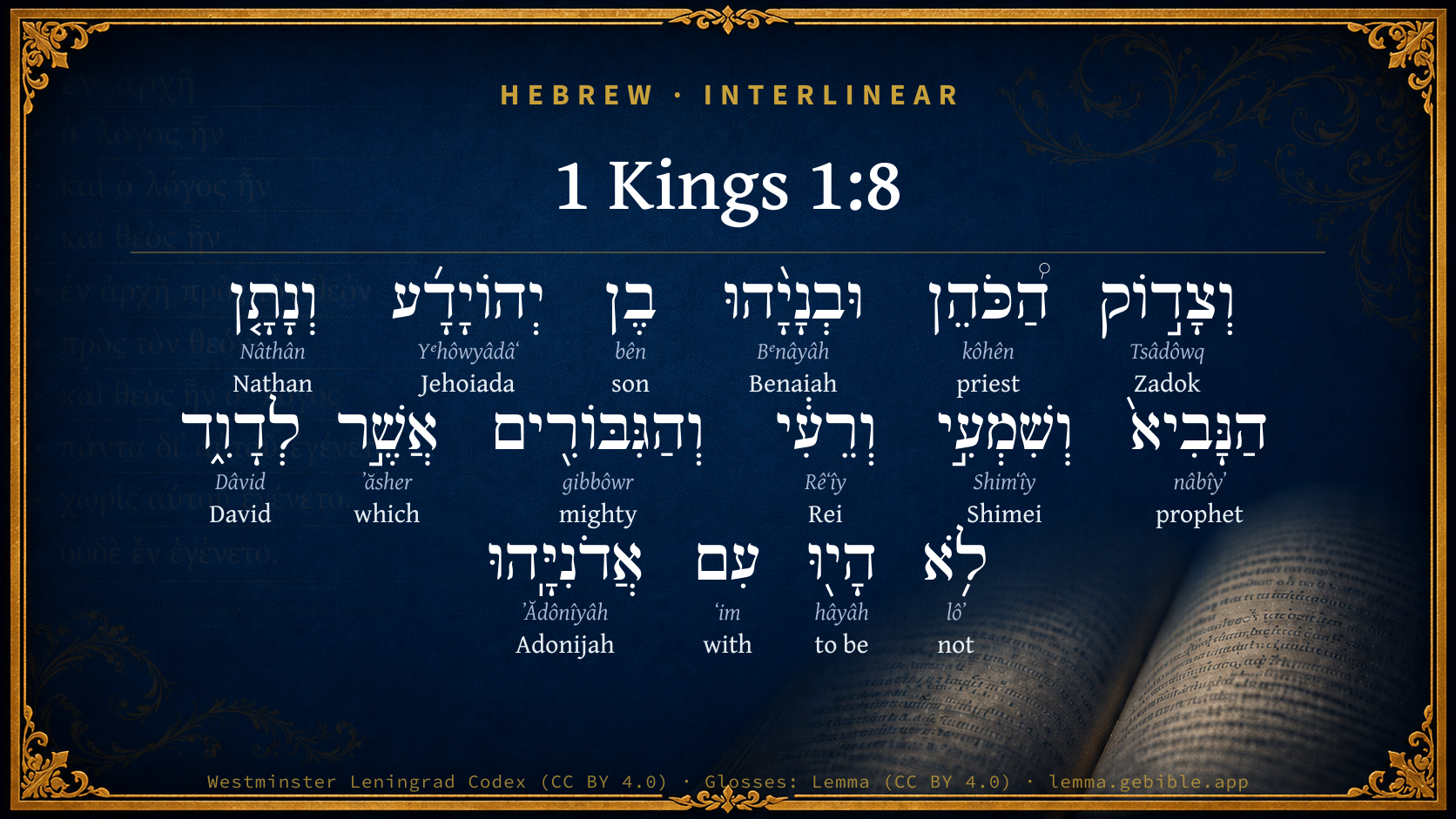
1 Kings 1:8

Hebrew (Westminster Leningrad Codex) 1 Kings 1:8 appears in the Hebrew Old Testament. The text above is from the Westminster Leningrad Codex. Each word links to its Strong’s number, a concise gloss, and parsing drawn from the Open Scriptures Hebrew Bible morphology. Click any word for its full Brown-Driver-Briggs (BDB) entry.
Download image
Cite this verse

1 Kings 1:8 (World English Bible). Public Domain. Lemma interlinear Bible study tool, https://lemma.gebible.app/v/1-kings/1/8.

Show BibTeX & RIS
BibTeX
RIS
English Translation
But Zadok the priest, and Benaiah the son of Jehoiada, and Nathan the prophet, and Shimei, and Rei, and the mighty men who belonged to David, were not with Adonijah.
World English Bible · Public Domain
Highlights
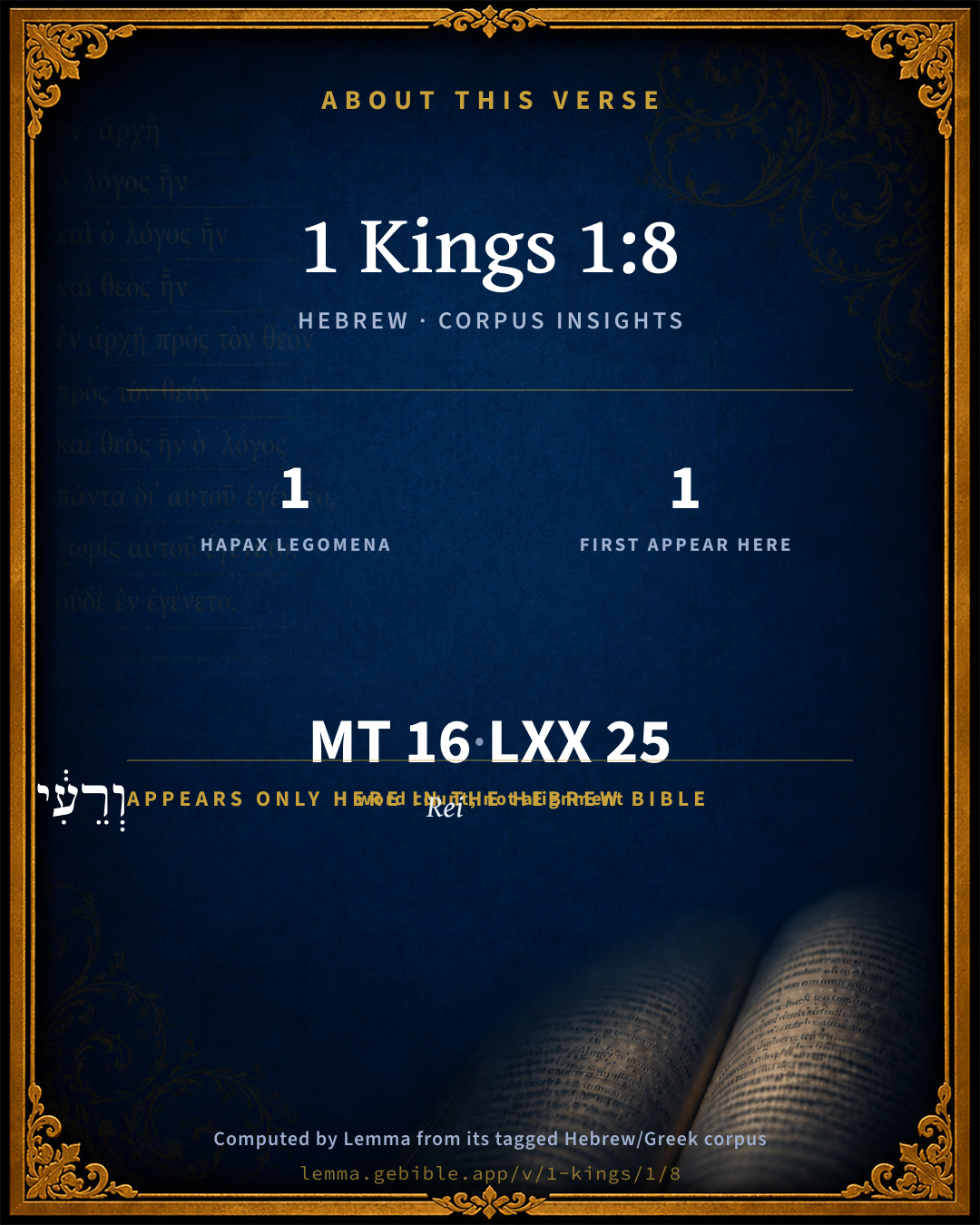
  • 1 hapax legomenon — only here in the Hebrew Bible
  • 1 first appearance in the Hebrew Bible
Full analysis ↓
Download a study sheet

One document with this verse’s original text, its word-by-word gloss line, the meaning frame, cross-references with their text, attributed commentary, and full source and license credits — printable, and it pastes into notes with its structure intact.

This verse Autodidact and up

Study sheet (.html) Plain text (.txt)

A passage Seminary Student

Up to 50 verses in one chapter. A passage sheet keeps up to 6 commentary sources and 12 cross-references per verse, in the order this page ranks them, and says so on the sheet whenever that leaves anything out. Ask for a single verse and you get the Autodidact verse sheet above.

Everything on this page stays free to read, with no account — the sheet is a download of what is already on screen, not access to it.

Want to remove ads? Support Godless Engineer
Compare translations 3

The same verse in 3 English versions, stacked beneath the original-language interlinear above. Click any original word for its lexicon entry.

Each is an independent rendering of the whole verse — the interlinear is not word-aligned to these translations.

Highlighted words mark where these versions differ — a whole-verse word diff, not a word-by-word alignment.

  • World English Bible Public Domain
    But Zadok the priest, and Benaiah the son of Jehoiada, and Nathan the prophet, and Shimei, and Rei, and the mighty men who belonged to David, were not with Adonijah.
  • King James Version Public Domain
    But Zadok the priest, and Benaiah the son of Jehoiada, and Nathan the prophet, and Shimei, and Rei, and the mighty men which belonged to David, were not with Adonijah.
  • unfoldingWord Literal Text CC BY-SA 4.0
    But Zadok the priest and Benaiah, the son of Jehoiada, and Nathan the prophet and Shimei and Rei and the warriors who to David were not with Adonijah.

unfoldingWord Literal Text — © unfoldingWord, licensed CC BY-SA 4.0. Word-aligned USFM3 via Door43 (git.door43.org/unfoldingWord/en_ult).

Versions to compare (up to 4)

3 of 4 selected

Show all 18 translations

Every available English version of this verse, each an independent rendering of the whole verse.

  • World English Bible Public Domain
    But Zadok the priest, and Benaiah the son of Jehoiada, and Nathan the prophet, and Shimei, and Rei, and the mighty men who belonged to David, were not with Adonijah.
  • Berean Standard Bible Public Domain
    But Zadok the priest, Benaiah son of Jehoiada, Nathan the prophet, Shimei, Rei, and David’s mighty men would not join Adonijah.
  • Majority Standard Bible Public Domain
    But Zadok the priest, Benaiah son of Jehoiada, Nathan the prophet, Shimei, Rei, and David’s mighty men would not join Adonijah.
  • King James Version Public Domain
    But Zadok the priest, and Benaiah the son of Jehoiada, and Nathan the prophet, and Shimei, and Rei, and the mighty men which belonged to David, were not with Adonijah.
  • American Standard Version (1901) Public Domain
    But Zadok the priest, and Benaiah the son of Jehoiada, and Nathan the prophet, and Shimei, and Rei, and the mighty men that belonged to David, were not with Adonijah.
  • Revised Version (1885) Public Domain
    But Zadok the priest, and Benaiah the son of Jehoiada, and Nathan the prophet, and Shimei, and Rei, and the mighty men which belonged to David, were not with Adonijah.
  • Geneva Bible (1599) Public Domain
    But Zadok the Priest, and Benaiah the sonne of Iehoiada, and Nathan the Prophet, and Shimei, and Rei, and the men of might, which were with Dauid, were not with Adoniiah.
  • Douay-Rheims (1899) Public Domain
    But Sadoc the priest, and Banaias the son of Joiada, and Nathan the prophet, and Semei, and Rei, and the strength of David's army was not with Adonias.
  • Young's Literal Translation Public Domain
    and Zadok the priest, and Benaiah son of Jehoiada, and Nathan the prophet, and Shimei, and Rei, and the mighty ones whom David hath, have not been with Adonijah.
  • Literal Standard Version CC BY-SA 4.0
    and Zadok the priest, and Benaiah son of Jehoiada, and Nathan the prophet, and Shimei, and Rei, and the mighty ones whom David has, have not been with Adonijah.
  • Unlocked Literal Bible CC BY-SA 4.0
    But Zadok the priest, Benaiah son of Jehoiada, Nathan the prophet, Shimei, Rei, and the mighty men who belonged to David did not follow Adonijah.
  • unfoldingWord Literal Text CC BY-SA 4.0
    But Zadok the priest and Benaiah, the son of Jehoiada, and Nathan the prophet and Shimei and Rei and the warriors who to David were not with Adonijah.
  • Darby Bible Public Domain
    But Zadok the priest, and Benaiah the son of Jehoiada, and Nathan the prophet, and Shimei, and Rei, and the mighty men whom David had, were not with Adonijah.
  • World Messianic Bible Public Domain
    But Zadok the priest, Benaiah the son of Jehoiada, Nathan the prophet, Shimei, Rei, and the mighty men who belonged to David, were not with Adonijah.
  • Webster's Bible Public Domain
    But Zadok the priest, and Benaiah the son of Jehoiada, and Nathan the prophet, and Shimei, and Rei, and the mighty men who belonged to David, were not with Adonijah.
  • Free Bible Version CC BY-SA 4.0
    But Zadok the priest, Benaiah, son of Jehoiada, Nathan the prophet, Shimei, Rei, and David's bodyguard were not on Adonijah's side.
  • Bible in Basic English Public Domain
    But Zadok the priest, and Benaiah, the son of Jehoiada, and Nathan the prophet and Shimei and Rei, and David's men of war did not take the side of Adonijah.
  • JPS Tanakh (1917) Public Domain
    But Zadok the priest, and Benaiah the son of Jehoiada, and Nathan the prophet, and Shimei, and Rei, and the mighty men that belonged to David, were not with Adonijah.

Literal Standard Version (2020), Covenant Press — licensed CC BY-SA 4.0. Text via the HelloAO Bible API (eBible.org). Unlocked Literal Bible (unfoldingWord) — licensed CC BY-SA 4.0. Text via the HelloAO Bible API (eBible.org). unfoldingWord Literal Text — © unfoldingWord, licensed CC BY-SA 4.0. Word-aligned USFM3 via Door43 (git.door43.org/unfoldingWord/en_ult). Free Bible Version, Dr. Jonathan Gallagher — licensed CC BY-SA 4.0. Text via the HelloAO Bible API (eBible.org).

Word by word

More ways to search: Search by grammar → Find every occurrence → Compare this word →

Practice this passage: Drill this verse → Learn its vocabulary →

וְרֵעִ֔י
Rêʻîy
H7472
“and · Rei”
Conjunction + Noun, Proper
Part of Speech
Conjunction + Noun
Type
Proper
Full BDB Definition

Origin: from H7453

TWOT: None

Rei = "friendly" - a person of David's court who remained loyal during Adonijah's rebellion
  1. וְצָד֣וֹק Tsâdôwq H6659 “and · Zadok” Conjunction + Noun, Proper
  2. הַ֠כֹּהֵן kôhên H3548 “the · priest” Particle, Definite Article + Noun, Common, Masculine, Singular, Absolute
  3. וּבְנָיָ֨הוּ Bᵉnâyâh H1141 “and · Benaiah” Conjunction + Noun, Proper
  4. בֶן bên H1121 “son of” Noun, Common, Masculine, Singular, Construct
  5. יְהוֹיָדָ֜ע Yᵉhôwyâdâʻ H3077 “Jehoiada” Noun, Proper
  6. וְנָתָ֤ן Nâthân H5416 “and · Nathan” Conjunction + Noun, Proper
  7. הַנָּבִיא֙ nâbîyʼ H5030 “the · prophet” Particle, Definite Article + Noun, Common, Masculine, Singular, Absolute
  8. וְשִׁמְעִ֣י Shimʻîy H8096 “and · Shimei” Conjunction + Noun, Proper
  9. וְהַגִּבּוֹרִ֖ים gibbôwr H1368 “and · the · mighty” Conjunction + Particle, Definite Article + Adjective, Adjective, Masculine, Plural, Absolute
  10. אֲשֶׁ֣ר ʼăsher H834 “which” Particle, Relative
  11. לְדָוִ֑ד Dâvid H1732 “to/for · David” Preposition + Noun, Proper
  12. לֹ֥א lôʼ H3808 “not” Particle, Negative
  13. הָי֖וּ hâyâh H1961 “to be” Verb, Qal, Perfect, 3rd Person, Common, Plural
  14. עִם ʻim H5973 “with” Preposition
  15. אֲדֹנִיָּֽהוּ ʼĂdônîyâh H138 “Adonijah” Noun, Proper

About this verse

These counts appear in no published source. They are computed here, from the morphology-tagged text and Lemma’s own curated glosses. What Lemma adds →

16
words
16
distinct lemmas
Historical
section

Notable vocabulary

1 hapax legomenon — a word that appears only here in the entire Hebrew Bible:

  • וְרֵעִ֔י Rei H7472

First appearance in Scripture

This word makes its first canonical appearance in the Hebrew Bible here:

  • וְרֵעִ֔י Rei H7472

Shared distinctive vocabulary

אֲדֹנִיָּֽהוּ Adonijah H138 occurs in 26 verses of the Hebrew Bible. Also found in:

Grammatical profile

  • 1 verb
  • 11 nouns
  • 1 adjective
  • 1 preposition
  • 2 particles

Verb forms

  • הָי֖וּ Qal · Perfect

Hebrew & Septuagint length

In English translation the verse runs 30 words from the Hebrew and 28 from the Septuagint (LXX English) — closely comparable.

A rough comparison of the two English renderings, which tokenize alike — not a word-level alignment.

Word counts can differ between the Hebrew and the Greek without any difference in meaning — e.g. the Hebrew direct-object marker אֵת has no separate Greek word, and Greek often adds the article ὁ.

In the original languages it is 16 Hebrew tokens and 25 Greek tokens — but the two are counted differently (Hebrew bundles its prefixes and suffixes into one token; the Greek is in lemma form), so that isn’t a like-for-like length.

Cross-references

11

Topical passages linked to 1 Kings 1:8 in the Treasury of Scripture Knowledge — connected by theme and wording, ordered by reader-vote popularity; previews shown in the World English Bible.

  • 1 Kings 4:18 Shimei the son of Ela, in Benjamin;
  • 2 Samuel 20:25 and Sheva was scribe; and Zadok and Abiathar were priests;
  • 2 Samuel 23:8–39 These are the names of the mighty men whom David had: Josheb Basshebeth a Tahchemonite, chief of the captains; the same was Adino the Eznite, against eight hundred slain at one time.
  • 2 Samuel 7:2–4 that the king said to Nathan the prophet, See now, I dwell in a house of cedar, but the ark of God dwells within curtains.
  • 2 Samuel 8:17–18 and Zadok the son of Ahitub, and Ahimelech the son of Abiathar, were priests; and Seraiah was scribe;
  • 2 Samuel 12:1–15 Yahweh sent Nathan to David. He came to him, and said to him, "There were two men in one city; the one rich, and the other poor.
  • 1 Kings 2:35 The king put Benaiah the son of Jehoiada in his room over the host; and Zadok the priest did the king put in the room of Abiathar.
  • 1 Chronicles 11:10–47 Now these are the chief of the mighty men whom David had, who shown themselves strong with him in his kingdom, together with all Israel, to make him king, according to the word of Yahweh concerning Israel.
  • 1 Chronicles 27:5–6 The third captain of the host for the third month was Benaiah, the son of Jehoiada the priest, chief: and in his division were twenty-four thousand.
  • Ezekiel 44:15 But the priests the Levites, the sons of Zadok, who kept the charge of my sanctuary when the children of Israel went astray from me, they shall come near to me to minister to me; and they shall stand before me to offer to me the fat and the blood, says the Lord Yahweh:
  • Zechariah 12:13 the family of the house of Levi apart, and their wives apart; the family of the Shimeites apart, and their wives apart;

Cross-references courtesy of OpenBible.info (CC BY 4.0).

Hebrew and Greek witnesses Masoretic Hebrew ↔ Greek Septuagint

The same verse in the two great witnesses to the Old Testament, shown verse-for-verse.

These are two independent witnesses, not word-aligned to each other, and the Septuagint is shown in lemma (dictionary) form.

Hebrew 1 Kings 1:8 Masoretic · Westminster Leningrad Codex

וְצָד֣וֹק הַ֠כֹּהֵן וּבְנָיָ֨הוּ בֶן יְהוֹיָדָ֜ע וְנָתָ֤ן הַנָּבִיא֙ וְשִׁמְעִ֣י וְרֵעִ֔י וְהַגִּבּוֹרִ֖ים אֲשֶׁ֣ר לְדָוִ֑ד לֹ֥א הָי֖וּ עִם אֲדֹנִיָּֽהוּ

But Zadok the priest, and Benaiah the son of Jehoiada, and Nathan the prophet, and Shimei, and Rei, and the mighty men who belonged to David, were not with Adonijah.

World English Bible · Public Domain

Greek LXX 1 Kings 1:8 Septuagint · lemma form

καί σαδωκ ὁ ἱερεύς καί βαναιας υἱός ιωδαε καί ναθαν ὁ προφήτης καί σεμεϊ καί ρηι καί ὁ δυνατός ὁ δαυίδ οὐ εἰμί ὀπίσω αδωνίας

But Sadoc the priest, and Banaeas the son of Jodae, and Nathan the prophet, and Semei, and Resi, and the mighty men of David, did not follow Adonias.

LXX2012 (modern English Septuagint) · Public Domain

On this verse, Haydock's Catholic Bible Commentary discusses the Septuagint’s reading. Read the note in Commentary ↓

Hebrew: Westminster Leningrad Codex (CC BY 4.0). Greek: Septuagint (public domain); English from LXX2012 (modern English Septuagint) (Public Domain). How the Septuagint differs from the Hebrew →

Targum (Aramaic paraphrase)

1

The Targum is the ancient Jewish Aramaic paraphrase of the Hebrew Scriptures — an interpretive translation, not the Hebrew text itself. Onkelos (literal) and Pseudo-Jonathan (expansive) render the Torah, and Jonathan the Prophets. Coverage is partial: where no permissively-licensed English translation exists for a verse, only the Aramaic is shown. This is verse-level text, not a word-by-word alignment to the Hebrew.

  1. Targum Jonathan Prophets (Joshua–Malachi)
    וְצָדוֹק כַּהֲנָא וּבְנָיָהוּ בַּר יְהוֹיָדָע וְנָתָן נְבִיָא וְשִׁמְעִי וְרֵעִי וְגִבָּרַיָא דִי לְדָוִד לָא הֲווֹ בַּעֲצַת אֲדוֹנִיָהוּ:

    (no public-domain English translation for this verse)

    Targum Jonathan — Aramaic: “Mikraot Gedolot” (public domain). English: “Sefaria Community Translation” (CC0 1.0 (public-domain dedication)); “London "Chaldee Paraphrase," 1871” (public domain). Text via Sefaria.

Commentary

Notes on 1 Kings 1:8 from classic Christian and Jewish commentators (each source and its license shown beneath its notes). The classic Christian expositions comment on the surrounding passage and are grouped to its opening verse, so a note may address several verses; the Jewish commentaries on the Tanakh (Rashi and others) are per-verse, so they appear only where the commentator wrote on this verse.

Lemma curates 59 commentaries, every one of them public domain or Creative Commons licensed, each selected and text-cleaned for this edition rather than reprinted as found. About our sources →

Trapp's Complete Commentary

John Trapp

1Ki 1:8 But Zadok the priest, and Benaiah the son of Jehoiada, and Nathan the prophet, and Shimei, and Rei, and the mighty men which [belonged] to David, were not with Adonijah.

Ver. 8. But Zadok the priest.] So Cranmer and Ridley, and some few other conscientious persons, afterwards ill rewarded by Queen Mary, refused to subscribe the letters patent for Lady Jane Gray’s succession to the crown, after the death of King Edward VI; which yet were subscribed by the most of the statesmen, who were guided with respect to their particular interest, for that they were possessed of various lands which once pertained to monasteries, chanteries, &c., which they foresaw they should lose, in case religion should change under Queen Mary.

John Trapp, A Commentary or Exposition upon All the Books of the Old and New Testament (1647–1656) — public domain. Text from a community e-Sword module.

The Biblical Illustrator

Joseph S. Exell

1Ki_1:8

But Zadok the priest . . . went not with Adonijah.

Steadfast when others falter

So Cranmer and Ridley, and some few other conscientious persons, afterwards ill rewarded by Queen Mary, refused to subscribe the letters patent for Lady Jane Greys succession to the crown, after the death of King Edward VI.; which yet were subscribed by the most of the statesmen, who were guided with respect to their particular interest, for that they were possessed of divers lands which once pertained to monasteries, chanteries, etc., which they foresaw they should lose, m case religion should change under Queen Mary. (J. Trapp.)

The Biblical Illustrator, edited by Joseph S. Exell (c. 1880s–1900s) — public domain. Text from a community e-Sword module.

Joseph Benson's Commentary

1Ki 1:8-10. The mighty men were not with Adonijah — That is, those named 2 Samuel 23., and the guards, who had served under David so long, and had done such mighty acts in his reign and under his conduct. Adonijah had no hope of drawing them to his party, and therefore did not confer with them as he did with Joab and Abiathar. And called all his brethren and all the men of Judah — Except those mentioned 1Ki 1:8, and again excepted, 1Ki 1:10. But all the rest of the family of David, and the principal persons of the tribe of Judah, with the high-priest and captain of the host, being present, there seemed to be nothing wanting to the making of him king, but only his anointing. For this appears to have been a federal feast, in which they swore allegiance to Adonijah. But Nathan the prophet, and Benaiah, &c., he called not — Because he knew they favoured Solomon.

Joseph Benson's Commentary on the Old and New Testaments (1811–1818) — public domain. Text from a community e-Sword module.

Tyndale Open Study Notes

Tyndale Open Resources

1:8 Solomon also had influential friends supporting his right to become king. Zadok was in the priestly line of Eleazar, Benaiah commanded David’s bodyguard and his thirty mighty men (2 Sam 23:20-23), Shimei was one of Solomon’s district governors (1 Kgs 4:18), and Nathan was David’s trusted prophet. Rei is unknown beyond this verse.

Tyndale Open Study Notes — © Tyndale Open Resources, licensed CC BY-SA 4.0. Text via the HelloAO Bible API.

Jamieson, Fausset & Brown

Robert Jamieson, A. R. Fausset & David Brown

But Zadok the priest--He had been high priest in the tabernacle at Gibeon under Saul (Ch1 16:39). David, on his accession, had conjoined him and Abiathar equal in the exercise of their high functions (Sa2 8:17; Sa2 15:24, Sa2 15:29, Sa2 15:35). But it is extremely probable that some cause of jealousy or discord between them had arisen, and hence each lent his countenance and support to opposite parties.

Benaiah--Distinguished for his bravery (Sa1 23:20), he had been appointed captain of the king's bodyguard (Sa2 8:18; Sa2 20:23; Ch1 18:17), and was regarded by Joab as a rival.

Nathan the prophet--He was held in high estimation by David, and stood on the most intimate relations with the royal family (Sa2 12:25).

Shimei--probably the person of this name who was afterwards enrolled among Solomon's great officers (Kg1 4:18).

Rei--supposed to be the same as Ira (Sa2 20:26).

and the mighty men--the select band of worthies.

Jamieson, Fausset & Brown — Commentary Critical and Explanatory on the Whole Bible (1871) — public domain (CC PDM 1.0). Text via the HelloAO Bible API.

Adam Clarke's Commentary

Verse 8. And Nathan] Some suppose that he was the preceptor of Solomon.

Adam Clarke's Commentary on the Bible (1810–1826) — public domain. Text from a community e-Sword/MySword module.

Ellicott's Commentary for English Readers

(8) Zadok the priest (son of Ahitub) was the representative of the family of Eleazar, elder son of Aaron, as Abiathar of the family of Ithamar, the younger son (1Ch_24:3). As a “young man of valour,” under “Jehoiada, leader of the Aaronites,” he joined David at Hebron with 3,700 men (1Ch_12:28), and had been left in charge of the Tabernacle at Gibeon (1Ch_16:39) after the removal of the Ark to Jerusalem. On his relation to Abiathar, see 1Ki_2:35.

Benaiah, the son of “Jehoiada, a chief priest,” and therefore of Levitical origin. (See 2Sa_8:18; 2Sa_23:20-23; 1Ch_27:5-6.) His rank is given in 2Sa_23:23, as intermediate between the “three mighty men” and “the thirty,” and in 1Ch_27:5, as “the third captain of the host for the third month”; but his command of the bodyguard gave him special importance, second only to that of Joab (2Sa_20:23), and perhaps of even greater importance for immediate action. (It is notable that there is no mention of Abishai, who is named as prior to Benaiah among “the mighty men” in 2Sa_23:18-22. It may be inferred that he was dead; otherwise he could hardly have been omitted here.)

Nathan the prophet.—See 2Sa_7:2; 2Sa_12:1; 2Sa_12:25. In the whole chapter he appears rather as a chief officer and counsellor of David, than in the loftier aspect of the prophetic character. He was also the royal chronicler of the reigns of David and Solomon (1Ch_29:29; 2Ch_9:29).

Shimei, and Rei.—Ewald conjectures that these were two brothers of David, called Shimma and Raddai in 1Ch_2:13-14. These, however, being older than David, would now be in extreme old age. Of Rei, we have no mention elsewhere; but there is a Shimei (in 1Ki_4:18), a high officer of Solomon; a “Shimea,” brother of Solomon (in 1Ch_3:5), and a “Shammah,” one of the “mighty men” (in 2Sa_23:11).

The mighty men.—See 2Sa_23:8-39. The name Gibbôrim is a technical name, and is thought to designate a picked body of troops, the standing nucleus of the armies of Israel. It is commonly inferred that they were the successors of the six hundred men of David’s band during his life of wandering and exile, and that “the three” and “the thirty” (2 Samuel 23) were their officers. They are mentioned as attached to the person of David in 2Sa_10:7; 2Sa_16:6; 2Sa_20:7.

A Bible Commentary for English Readers, edited by Charles John Ellicott (1878–1897) — public domain. Text from a community e-Sword module.

The Cambridge Bible for Schools and Colleges

gen. ed. J. J. S. Perowne

8. But Zadok the priest] He was the son of Ahitub, and descended from Eleazar, the son of Aaron. He joined David after the death of Saul, and there were thus two priests, perhaps one being highpriest and the other second priest, through the whole of David’s reign. Zadok’s duties appear (1Ch_16:39) to have been at the Tabernacle in Gibeon, and Abiathar had charge of the ark in Jerusalem. But in consequence of the events described in this chapter Abiathar was thrust out of his office and banished to Anathoth, and Zadok became the sole highpriest.

Benaiah the son of Jehoiada] This man, though of the tribe of Levi, became captain of David’s body-guard of Cherethites and Pelethites (see below on 1Ki_1:38), and was made, when Joab was dead, commander in chief of Solomon’s army.

Nathan the prophet] He was prominent in David’s reign, giving the king advice concerning the building of the Temple, bringing God’s rebuke after David’s adultery and the message of forgiveness when he had repented. He appears also in connexion with the birth of Solomon and now as the adviser and helper of Bath-sheba. After Solomon was proclaimed king we hear no more of Nathan.

and Shimei] There is a person so called mentioned afterwards as one of the twelve officers who provided victuals for king Solomon and his household. But whether that be the Shimei here mentioned there is no means of deciding. It was conjectured by Ewald that it was another way of writing the name of Shimeah, David’s brother.

and Rei] Rei is not mentioned elsewhere, and there is nothing to guide us to any opinion concerning his identity. Several conjectures have been made, but none that deserves much attention.

the mighty men which belonged to David] Of these champions a list is given 2Sa_23:8-39, with which may be compared 1Ch_11:10-47.

The Cambridge Bible for Schools and Colleges (gen. ed. J. J. S. Perowne; Cambridge University Press, 1878–1918) — public domain. Text from a community e-Sword module.

John Gill's Exposition

But Zadok the priest,.... Who bid fair to be the high priest on Solomon's coming to the throne as he was:

and Benaiah the son of Jehoiada; who was near David's person, and over his bodyguards, the Cherethites and Pelethites:

and Nathan the prophet; a very great intimate of David's, and his seer, whom he consulted on all occasions:

and Shimei; who, according to Abarbinel, was Shimei the son of Gera, who had cursed David, and was afraid of entering into the conspiracy, lest he should be involved in trouble again: though some think this may be that Shimei, one of Solomon's twelve officers, as after constituted, Kg1 4:18;

and Rei; whom the same writer takes to be Hushai the Archite, David's friend:

and the mighty men which belonged to David; that were about his person, his guards, the Cherethites and Pelethites:

were not with Adonijah; they did not join him, and indeed were not invited by him.

John Gill's Exposition of the Whole Bible (1746–1763) — public domain (CC PDM 1.0). Text via the HelloAO Bible API.

Albert Barnes' Notes on the Bible

There is some difficulty in understanding how Zadok and Abiathar came to be both “priests” at this time, and in what relation they stood to one another. The best explanation seems to be that Abiathar was the real high priest, and officiated at the sanctuary containing the ark of the covenant in Zion, while Zadok performed the offices of chief priest at the tabernacle of Witness at Gibeon 1Ch 16:39.

For Benaiah, see 2Sa 8:18; 2Sa 20:23; 2Sa 23:20-21. For Nathan, see 2Sa 7:2-3, 2Sa 7:17; 2Sa 12:1-15, 2Sa 12:25. As privy to all David’s plans 1Ki 1:24, he had no doubt fully approved the order of succession which the king was known to intend.

Shimei and Rei - Shimei and Rei are perhaps David’s two brothers, Shimma and Raddai 1Ch 2:13-14.

Mighty men - Probably the company of 600, originally formed during David’s early wanderings 1Sa 25:13; 1Sa 27:2, and afterward maintained as the most essential element of his standing army.

Albert Barnes' Notes on the Bible (1834–1885) — public domain. Text from a community e-Sword/MySword module.

Haydock's Catholic Bible Commentary

Sadoc, the rival of Abiathar, and a descendant of Eleazar. David had permitted both to perform the functions of the high priesthood; (Calmet) or one had acted as the delegate of the other. (Salien) --- Banaias was distinguished for his valour, 2 Kings xxiii. 20. He was the flower of his age, and, perhaps, aspired at the authority of Joab, whose credit began to decline; as he was grown old, and was known to be rather disagreeable to David, and had been guilty of such horrid murders. Both the contending princes sought to ingratiate themselves with the army and with the priests, as their influence was of the utmost consequence. Solomon was more fortunate, in having also Nathan the prophet on his side; but the throne was secured to him much more on account of the divine decree, 2 Kings vii. 12., and xii. 25. (Haydock) --- Nathan is commonly considered as the tutor of the young prince, (Menochius) and was styled his "father." (Calmet) --- Semei, or Nabath, father of Jeroboam; and Rei, or Ira, who is styled the priest of David, 2 Kings xx. 26. (St. Jerome, Tradit.) (Menochius) --- To confound Semei with Nabath is wrong. (Salien) --- Army; the king’s guard consisting chiefly of the Cerethi, &c., (Calmet) who were under Banaias. The whole army, over which Joab was general, was not always in arms. Septuagint, "Semei and Resi, other copies read (Haydock) his friends," (with Syriac; Arabic) "and Daia, heroes of David." Hebrew may be, "neither the hearers nor the seers, nor the brave men of David were with Adonias." The populace, or the disciples, as well as the prophets, may be thus denoted.

George Leo Haydock (1774–1849), Haydock's Catholic Family Bible and Commentary, 1859 edition — public domain. Excludes Psalms (Douay-Rheims chapter numbering differs from Protestant) and Deuterocanonical books (Catholic canon only).

Matthew Poole's English Annotations

His great and famous commanders, and the guards and soldiers under them.

Matthew Poole's English Annotations on the Holy Bible (1683–1685) — public domain. Text from a community e-Sword/MySword module.

Whedon's Commentary on the Bible

Daniel D. Whedon

8. Zadok — This priest probably still officiated at Gibeon. See note on 2Sa_6:17; 2Sa_8:17.

Shimei, and Rei — This Shimei is perhaps the same with the one mentioned 1Ki_4:18; but there is nothing sufficiently positive to identify either of these names with any person mentioned elsewhere.

Were not with Adonijah — This statement contains a tacit intimation that these mighty men of David had been approached by Adonijah, or by some of his abettors, and solicited to join the party, and help carry out the treasonable projects of that aspiring youth.

Daniel D. Whedon (gen. ed.), Commentary on the Old and New Testaments (1874–1909) — public domain. Text from a community e-Sword module.

The Pulpit Commentary

But Zadok the priest 2Sa_8:17. It is generally said to be difficult to explain "how Zadok and Abiathar came both to be "priests at this time." Rawlinson, who adds that "the best explanation is that Abiathar was the real high priest," officiating in Zion, while Zadok acted as chief priest at the tabernacle at Gibeon. (Bahr, by a strange oversight, assigns to Zadok the care of the ark on Mount Zion, whereas 1Ch_16:39, distinctly connects his ministry with the tabernacle of witness at Gibeon.) But the precedence (see on ver. 7) generally assigned to Zadok is hardly consistent with the idea that Abiathar was "the real high priest." The fact is that a duality of high priests, associated, apparently, on pretty equal terms, was not unknown in Jewish history. The cases of Eleazer and Ithamar, Hophni and Phinehas, Annas and Caiaphas, will occur to all. 2Ki_25:18, speaks of "the chief priest" and "the second priest;" 2Ch_31:10, of the "chief priest of the house of Zadok." And a dual priesthood would be the more necessary in David"s days, because of the two sanctuaries, Zion and Gibeon. We find, however, from 1Ch_15:11, that Zadok was already priest at the time of the bringing up of the ark. And the true explanation, no doubt, is that Zadok had succeeded some member of his family, in all probability Jehoiada, called in, 1Ch_12:27, "the leader of Aaron" (Hebrews) who had certainly been high priest in the time of Saul, (1Ch_27:5) and who would hardly be degraded when, with 3700 followers, he joined David at Hebron. On his decease, or cession of orifice, Zadok, who had joined at the same time with a large contingent,was associated with Abiathar in the priest"s office. This dual arrangement, consequently, was the result of David"s having taken over a high priest from Saul, together with the kingdom, when he had Abiathar as priest already, and Benaiah the son of Jehoiada, i.e., Jehoiada the high priest. (1Ch_27:5) Benaiah was consequently a Levite, and of the family of Aaron; set, however, by David, because of his prowess (2Sa_23:20, 2Sa_23:21; 1Ch_11:22) over the bodyguard. (2Sa_8:18; 1Ch_18:17) Probably he was a near relative of Zadok., and Nathan the prophet a Jewish tradition makes Nathan the eighth son of Jesse. He comes before us 2Sa_7:2, 2Sa_7:3, 17 12:1-12, 25 and Shimei by Ewald identified with Shammah, (1Sa_16:9) or Shimeah, David"s brother. (2Sa_13:3 2Sa_21:21) Others suppose him to be the Shimei 1Ki_4:18. But see note on chap. 2:8. Josephus calls Shimei (not Rei, as Bahr states) oJ Dauidou filov), and Rei this name occurs here only. Ewald would identify him with Raddai, (1Ch_2:14) another brother of David, but on very slender grounds, and the mighty men or heroes. Gesen. "chiefs." Not the 600 men who formed David"s band in his wanderings (1Sa_25:13 1Sa_27:2) (Rawlinson), but the 30 (or 37) to whom this name of Gibborim is expressly given, 2 Samuel 1Ch_11:15, 25 29:24. Comp. 2Ki_10:25, Hebrews which belonged to David same expression as in 2Sa_23:8 were not with Adonijah. And thy servant is in the midst of thy people which thou hast chosen see, Deu_7:6 a great people, that cannot be numbered nor counted for multitude. The promises of Gen_13:16 Gen_15:5, lived in the thoughts and language of the Jews, and were doubtless the original of this expression. Cf. also Num_23:10

The Pulpit Commentary (1880–1919), ed. H.D.M. Spence-Jones & Joseph S. Exell — public domain. Text from a community e-Sword module.

Rashi

Rabbi Shlomo Yitzchaki (Rashi)

And Noson the prophet. Who prophesied to Dovid that Shlomo would reign, as it is stated in Divrei Hayomim, “ his name will be Shlomo.”

Rashi on the Tanakh — English translations: “The Judaica Press complete Tanach with Rashi, translated by A. J. Rosenberg” (CC BY 4.0); “Pentateuch with Rashi's commentary by M. Rosenbaum and A.M. Silbermann, 1929-1934” (public domain); “The Metsudah Tanach series, Lakewood, N.J” (CC BY 4.0); and “The Book of Joshua, Metsudah Publications, 1997” (CC BY 4.0). Text via Sefaria.

Lesson kit

Teaching starters — assembled from the data on this page, not authored interpretation. Every prompt links to the verse data it draws on. Edit before teaching.

1 Kings, in the Historical, opens this verse with 16 words (16 distinct Hebrew lemmas). Its most distinctive word is Rêʻîy (“Rei”). A historical commentator’s framing appears above. Read the whole chapter for the surrounding context.

Discussion questions

  1. What does “Rei” (Rêʻîy) contribute to the verse as a whole?
  2. This verse holds 1 word here found nowhere else in the Hebrew Bible. What might the rare word draw attention to?
  3. The word “Rei” first appears here in Scripture. What is being introduced at this debut?
  4. 2 Samuel 3:4 shares the word «Adonijah» with this verse. How do the two illuminate each other?
  5. The translations on this page render this verse differently — a whole-verse word diff, not a word-by-word alignment. What might account for the different wordings?
  6. The verb «הָי֖וּ» is Qal Perfect. How does its form color the action?
  7. Reading how Trapp's Complete Commentary and The Biblical Illustrator read this verse, where do the two commentators agree and where do they part?

Things to notice

Reading settings

Reading text

Shown beneath each verse's original-language words.

Old Testament
Old Testament edition

Read the OT as the Masoretic Hebrew (MT) or the Greek Septuagint (LXX).

English shown for the Greek Septuagint (in the Hebrew ↔ Greek comparison).

Comparing translations? Open the Compare panel on any verse page to stack up to four side by side.