1 Chronicles 11:4

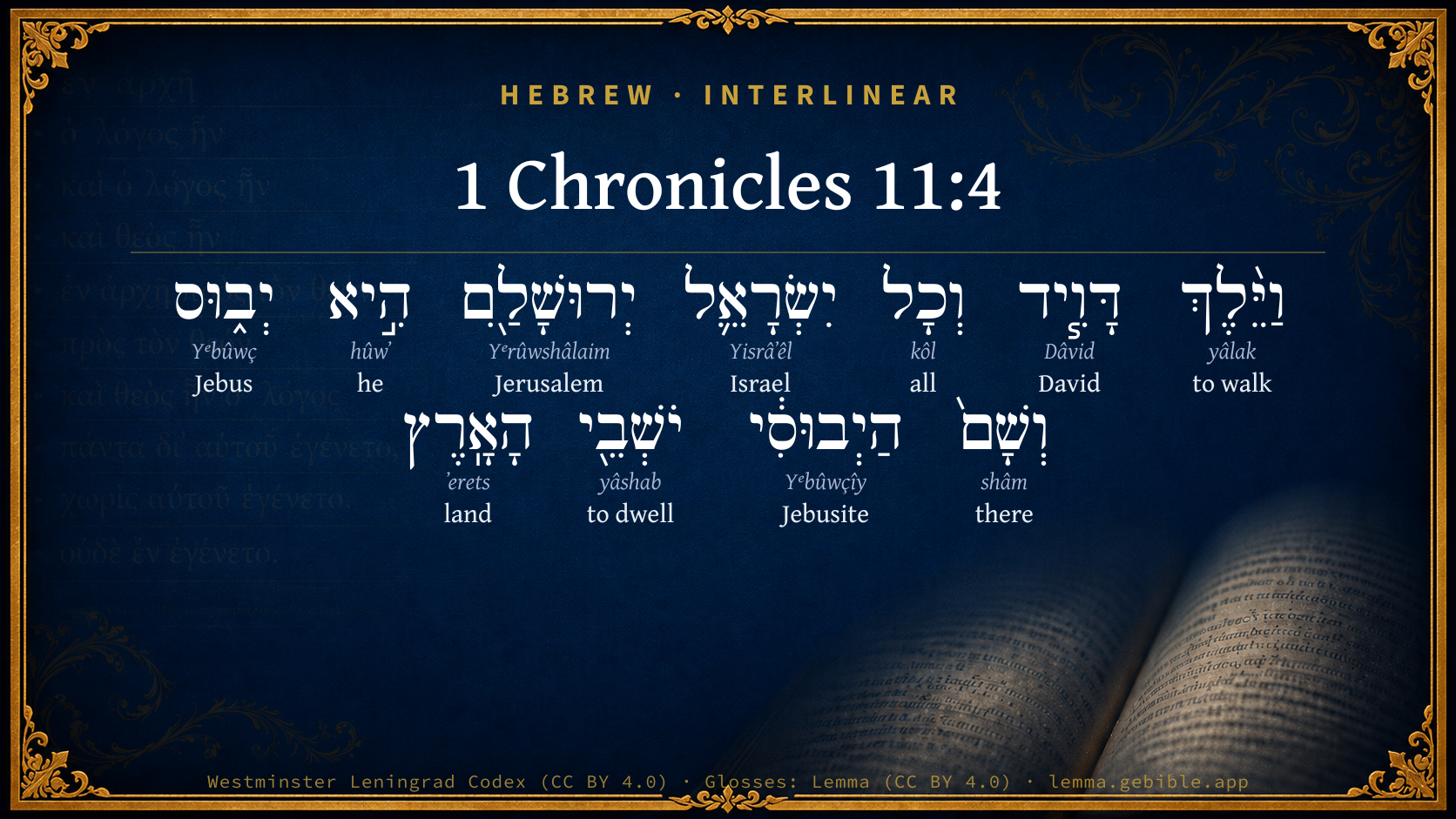
Hebrew (Westminster Leningrad Codex) 1 Chronicles 11:4 appears in the Hebrew Old Testament. The text above is from the Westminster Leningrad Codex. Each word links to its Strong’s number, a concise gloss, and parsing drawn from the Open Scriptures Hebrew Bible morphology. Click any word for its full Brown-Driver-Briggs (BDB) entry.
Download image
Cite this verse

1 Chronicles 11:4 (World English Bible). Public Domain. Lemma interlinear Bible study tool, https://lemma.gebible.app/v/1-chronicles/11/4.

Show BibTeX & RIS
BibTeX
RIS
English Translation
David and all Israel went to Jerusalem (the same is Jebus); and the Jebusites, the inhabitants of the land, were there.
World English Bible · Public Domain
Download a study sheet

One document with this verse’s original text, its word-by-word gloss line, the meaning frame, cross-references with their text, attributed commentary, and full source and license credits — printable, and it pastes into notes with its structure intact.

This verse Autodidact and up

Study sheet (.html) Plain text (.txt)

A passage Seminary Student

Up to 50 verses in one chapter. A passage sheet keeps up to 6 commentary sources and 12 cross-references per verse, in the order this page ranks them, and says so on the sheet whenever that leaves anything out. Ask for a single verse and you get the Autodidact verse sheet above.

Everything on this page stays free to read, with no account — the sheet is a download of what is already on screen, not access to it.

Want to remove ads? Support Godless Engineer
Compare translations 3

The same verse in 3 English versions, stacked beneath the original-language interlinear above. Click any original word for its lexicon entry.

Each is an independent rendering of the whole verse — the interlinear is not word-aligned to these translations.

Highlighted words mark where these versions differ — a whole-verse word diff, not a word-by-word alignment.

  • World English Bible Public Domain
    David and all Israel went to Jerusalem (the same is Jebus); and the Jebusites, the inhabitants of the land, were there.
  • King James Version Public Domain
    And David and all Israel went to Jerusalem, which is Jebus; where the Jebusites were, the inhabitants of the land.
  • unfoldingWord Literal Text CC BY-SA 4.0
    And David and all of Israel went Jerusalem, that Jebus. And the Jebusite, the dwellers of the land, there.

unfoldingWord Literal Text — © unfoldingWord, licensed CC BY-SA 4.0. Word-aligned USFM3 via Door43 (git.door43.org/unfoldingWord/en_ult).

Versions to compare (up to 4)

3 of 4 selected

Show all 18 translations

Every available English version of this verse, each an independent rendering of the whole verse.

  • World English Bible Public Domain
    David and all Israel went to Jerusalem (the same is Jebus); and the Jebusites, the inhabitants of the land, were there.
  • Berean Standard Bible Public Domain
    Then David and all the Israelites marched to Jerusalem (that is, Jebus), where the Jebusites inhabited the land.
  • Majority Standard Bible Public Domain
    Then David and all the Israelites marched to Jerusalem (that is, Jebus), where the Jebusites inhabited the land.
  • King James Version Public Domain
    And David and all Israel went to Jerusalem, which is Jebus; where the Jebusites were, the inhabitants of the land.
  • American Standard Version (1901) Public Domain
    And David and all Israel went to Jerusalem (the same is Jebus); and the Jebusites, the inhabitants of the land, were there.
  • Revised Version (1885) Public Domain
    And David and all Israel went to Jerusalem (the same is Jebus); and the Jebusites, the inhabitants of the land, were there.
  • Geneva Bible (1599) Public Domain
    And Dauid and all Israel went to Ierusalem, which is Iebus, where were the Iebusites, the inhabitants of the land.
  • Douay-Rheims (1899) Public Domain
    And David and all Israel went to Jerusalem, which is Jebus, where the Jebusites were the inhabitants of the land.
  • Young's Literal Translation Public Domain
    And David goeth, and all Israel, to Jerusalem -- it `is' Jebus -- and there the Jebusite, the inhabitants of the land.
  • Literal Standard Version CC BY-SA 4.0
    And David goes, and all Israel, to Jerusalem—it [is] Jebus—and the Jebusite [is] there, the inhabitants of the land.
  • Unlocked Literal Bible CC BY-SA 4.0
    David and all Israel went to Jerusalem (that is, Jebus). Now the Jebusites, the inhabitants of the land, were there.
  • unfoldingWord Literal Text CC BY-SA 4.0
    And David and all of Israel went Jerusalem, that Jebus. And the Jebusite, the dwellers of the land, there.
  • Darby Bible Public Domain
    And David and all Israel went to Jerusalem, which is Jebus; where the Jebusites were, the inhabitants of the land.
  • World Messianic Bible Public Domain
    David and all Israel went to Jerusalem (also called Jebus); and the Jebusites, the inhabitants of the land, were there.
  • Webster's Bible Public Domain
    And David and all Israel went to Jerusalem, which is Jebus; where the Jebusites were, the inhabitants of the land.
  • Free Bible Version CC BY-SA 4.0
    Then David and all the Israelites went to Jerusalem (formerly known as Jebus) where the Jebusites lived.
  • Bible in Basic English Public Domain
    Then David and all Israel went to Jerusalem (which is Jebus); and the Jebusites, the people of the land, were there.
  • JPS Tanakh (1917) Public Domain
    And David and all Israel went to Jerusalem — the same is Jebus — and the Jebusites, the inhabitants of the land, were there.

Literal Standard Version (2020), Covenant Press — licensed CC BY-SA 4.0. Text via the HelloAO Bible API (eBible.org). Unlocked Literal Bible (unfoldingWord) — licensed CC BY-SA 4.0. Text via the HelloAO Bible API (eBible.org). unfoldingWord Literal Text — © unfoldingWord, licensed CC BY-SA 4.0. Word-aligned USFM3 via Door43 (git.door43.org/unfoldingWord/en_ult). Free Bible Version, Dr. Jonathan Gallagher — licensed CC BY-SA 4.0. Text via the HelloAO Bible API (eBible.org).

Word by word

More ways to search: Search by grammar → Find every occurrence → Compare this word →

Practice this passage: Drill this verse → Learn its vocabulary →

About this verse

These counts appear in no published source. They are computed here, from the morphology-tagged text and Lemma’s own curated glosses. What Lemma adds →

11
words
11
distinct lemmas
Historical
section

Notable vocabulary

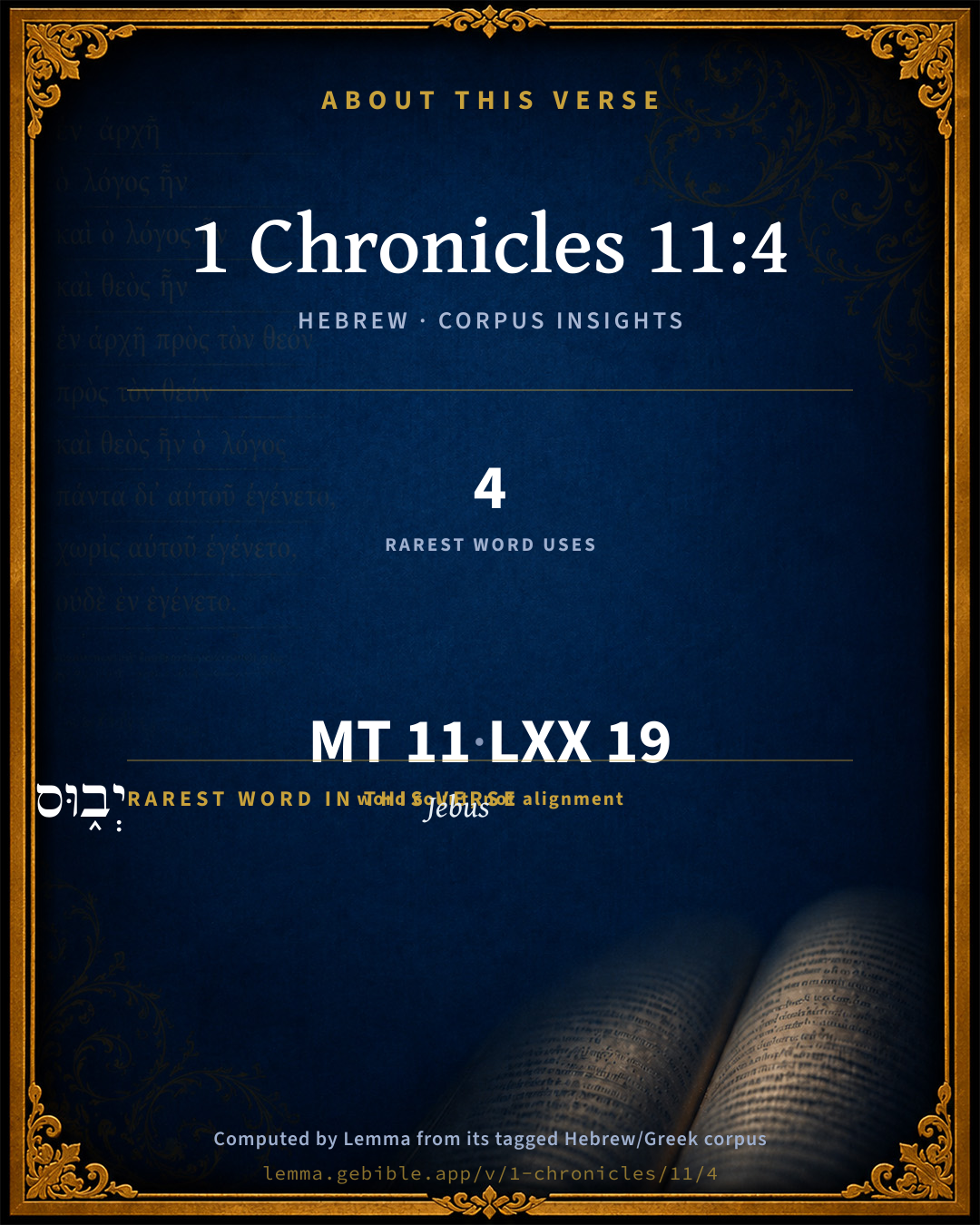
The rarest word here is יְב֑וּס Jebus H2982 — appearing just 4 times in the whole Hebrew Bible.

Shared distinctive vocabulary

יְב֑וּס Jebus H2982 occurs in 4 verses of the Hebrew Bible. Also found in:

Grammatical profile

  • 2 verbs
  • 7 nouns
  • 1 pronoun
  • 1 adverb

Verb forms

  • וַיֵּ֨לֶךְ Qal · Sequential Imperfect
  • יֹשְׁבֵ֖י Qal · Participle Active

Hebrew & Septuagint length

In English translation the verse runs 21 words from the Hebrew and 24 from the Septuagint (LXX English) — closely comparable.

A rough comparison of the two English renderings, which tokenize alike — not a word-level alignment.

Word counts can differ between the Hebrew and the Greek without any difference in meaning — e.g. the Hebrew direct-object marker אֵת has no separate Greek word, and Greek often adds the article ὁ.

In the original languages it is 11 Hebrew tokens and 19 Greek tokens — but the two are counted differently (Hebrew bundles its prefixes and suffixes into one token; the Greek is in lemma form), so that isn’t a like-for-like length.

Cross-references

10

Topical passages linked to 1 Chronicles 11:4 in the Treasury of Scripture Knowledge — connected by theme and wording, ordered by reader-vote popularity; previews shown in the World English Bible.

  • Judges 1:21 The children of Benjamin did not drive out the Jebusites who inhabited Jerusalem; but the Jebusites dwell with the children of Benjamin in Jerusalem to this day.
  • Joshua 15:8 and the border went up by the valley of the son of Hinnom to the side of the Jebusite southward (the same is Jerusalem); and the border went up to the top of the mountain that lies before the valley of Hinnom westward, which is at the uttermost part of the valley of Rephaim northward;
  • Joshua 15:63 As for the Jebusites, the inhabitants of Jerusalem, the children of Judah couldn't drive them out: but the Jebusites dwell with the children of Judah at Jerusalem to this day.
  • Genesis 15:21 the Amorites, the Canaanites, the Girgashites, and the Jebusites."
  • 1 Chronicles 11:5 The inhabitants of Jebus said to David, You shall not come in here. Nevertheless David took the stronghold of Zion; the same is the city of David.
  • Genesis 10:16 the Jebusite, the Amorite, the Girgashite,
  • Exodus 3:17 and I have said, I will bring you up out of the affliction of Egypt to the land of the Canaanite, the Hittite, the Amorite, the Perizzite, the Hivite, and the Jebusite, to a land flowing with milk and honey."'
  • Joshua 18:28 and Zelah, Eleph, and the Jebusite (the same is Jerusalem), Gibeath, [and] Kiriath; fourteen cities with their villages. This is the inheritance of the children of Benjamin according to their families.
  • Judges 19:10–12 But the man wouldn't stay that night, but he rose up and departed, and came over against Jebus (the same is Jerusalem): and there were with him a couple of donkeys saddled; his concubine also was with him.
  • 2 Samuel 5:6–10 The king and his men went to Jerusalem against the Jebusites, the inhabitants of the land, who spoke to David, saying, Except you take away the blind and the lame, you shall not come in here; thinking, David can't come in here.

Cross-references courtesy of OpenBible.info (CC BY 4.0).

Hebrew and Greek witnesses Masoretic Hebrew ↔ Greek Septuagint

The same verse in the two great witnesses to the Old Testament, shown verse-for-verse.

These are two independent witnesses, not word-aligned to each other, and the Septuagint is shown in lemma (dictionary) form.

Hebrew 1 Chronicles 11:4 Masoretic · Westminster Leningrad Codex

וַיֵּ֨לֶךְ דָּוִ֧יד וְכָל יִשְׂרָאֵ֛ל יְרוּשָׁלִַ֖ם הִ֣יא יְב֑וּס וְשָׁם֙ הַיְבוּסִ֔י יֹשְׁבֵ֖י הָאָֽרֶץ

David and all Israel went to Jerusalem (the same is Jebus); and the Jebusites, the inhabitants of the land, were there.

World English Bible · Public Domain

Greek LXX 1 Chronicles 11:4 Septuagint · lemma form

καί πορεύομαι ὁ βασιλεύς καί ἀνήρ ἰσραήλ εἰς ἰερουσαλήμ οὗτος ιεβους καί ἐκεῖ ὁ ιεβουσαῖος ὁ καταοἰκέω ὁ γῆ

And the king and his men went to Jerusalem, this is Jebus; and there the Jebusites the inhabitants of the land said to David,

LXX2012 (modern English Septuagint) · Public Domain

Hebrew: Westminster Leningrad Codex (CC BY 4.0). Greek: Septuagint (public domain); English from LXX2012 (modern English Septuagint) (Public Domain). How the Septuagint differs from the Hebrew →

Commentary

Notes on 1 Chronicles 11:4 from classic Christian and Jewish commentators (each source and its license shown beneath its notes). The classic Christian expositions comment on the surrounding passage and are grouped to its opening verse, so a note may address several verses; the Jewish commentaries on the Tanakh (Rashi and others) are per-verse, so they appear only where the commentator wrote on this verse.

Lemma curates 59 commentaries, every one of them public domain or Creative Commons licensed, each selected and text-cleaned for this edition rather than reprinted as found. About our sources →

Jamieson, Fausset & Brown

Robert Jamieson, A. R. Fausset & David Brown

HE WINS THE CASTLE OF ZION FROM THE JEBUSITES BY JOAB'S VALOR. (Ch1 11:4-9)

David and all Israel went to . . . Jebus--(See on Sa2 5:6).

Jamieson, Fausset & Brown — Commentary Critical and Explanatory on the Whole Bible (1871) — public domain (CC PDM 1.0). Text via the HelloAO Bible API.

Trapp's Complete Commentary

John Trapp

1Ch 11:4 And David and all Israel went to Jerusalem, which [is] Jebus; where the Jebusites [were], the inhabitants of the land.

Ver. 4. And David and all Israel went to Jerusalem.] He laid hold on so good an opportunity, having now all his forces about him, to set upon the Jebusites, and expelled them. We should watch and catch at opportunities of grace, and not procrastinate.

John Trapp, A Commentary or Exposition upon All the Books of the Old and New Testament (1647–1656) — public domain. Text from a community e-Sword module.

Joseph Benson's Commentary

1Ch 11:4. David and all Israel went to Jerusalem — Of this and the following verses, to 1Ch 11:9, see notes on 2Sa 5:6, &c.

Joseph Benson's Commentary on the Old and New Testaments (1811–1818) — public domain. Text from a community e-Sword module.

Tyndale Open Study Notes

Tyndale Open Resources

11:4-9 David’s conquest and rebuilding of Jerusalem established it as the capital city of his reign over all Israel.

Tyndale Open Study Notes — © Tyndale Open Resources, licensed CC BY-SA 4.0. Text via the HelloAO Bible API.

Ellicott's Commentary for English Readers

(4) And David . . . land.—Samuel is briefer: “And the king and his men went to Jerusalem, to the Jebusite, the inhabitant of the land.” The chronicler adds the explanatory “that is Jebus,” because of the after-mention of the Jebusite. He then further modifies the form of the original statement, continuing “and there (lived) the Jebusite (collect.), the inhabitants,” &c.

Jerusalem means city of Salem; Assyrian, Ursalimmê. But in Hebrew the name has been so modified as to suggest “vision of peace.” In Greek the name became Hierosolyma, “Sacred Solyma.”

Inhabitants of the land.—A standing name of the native Canaanites, and equivalent to indigenæ, or Ἀυτόχθονες.

(4-9) THE CAPTURE OF ZION BY JOAB’S VALOUR, AND DAVID’S SETTLEMENT THERE.

The accession of the new king is followed by a warlike enterprise, according to the precedent of Saul (1 Samuel 11). This agrees with the reason assigned for the election of a king (1Sa_8:20), as well as with what we know of Assyrian custom, and is a mark of historic truth.

A Bible Commentary for English Readers, edited by Charles John Ellicott (1878–1897) — public domain. Text from a community e-Sword module.

The Cambridge Bible for Schools and Colleges

gen. ed. J. J. S. Perowne

4–9 (= 2Sa_5:6-10). The “City of David” captured and made a royal residence

4. David and all Israel] In Samuel (more accurately) “The king and his men,” i.e. his household and body-guard; cp. 1Ch_10:6, note. A picked force, not a large one, was necessary.

which is Jebus] R.V. (the same is Jebus). Jerusalem (or Jebus) consisted, it seems (cp. 1Ch_11:8; Jdg_1:21), of a citadel inhabited by Jebusites and of a lower city inhabited by a mixed population of Jebusites and Benjamites. It was the citadel only which David stormed.

where the Jebusites were, the inhabitants of the land] R.V. and the Jebusites, the inhabitants of the land, were there. The Jebusites are called “inhabitants of the land,” because they were one of the “seven nations” dispossessed by Israel at the conquest (Deu_7:1).

The Cambridge Bible for Schools and Colleges (gen. ed. J. J. S. Perowne; Cambridge University Press, 1878–1918) — public domain. Text from a community e-Sword module.

Matthew Poole's English Annotations

Of this and the three following verses See Poole "2Sa 5:6", &c.

Matthew Poole's English Annotations on the Holy Bible (1683–1685) — public domain. Text from a community e-Sword/MySword module.

The Pulpit Commentary

Jerusalem, which is Jebus. This ancient name of Jerusalem, of Canaanitish date, is found only once beside, viz. in Jud_1:19:10, 11; the Gentile form of the noun, however, Jebusi, is of more frequent occurrence, and sometimes it is found even as the name of the city. (Jos_15:8, 63 18:16, 28) The derivation and meaning of the word are unascertained. Gesenius explains it to mean "a place dry or downtrodden like a threshing-floor.

Vers. 4-9.

Capture of Jerusalem.

David and all Israel with him went to Jerusalem, then called Jebus, and in the possession of the Jebusites. But they would have none of him. David, however, took the castle of Zion, and Joab subsequently captured the city, and was rewarded for his bravery by promotion to the chief military rank. We have seen the anointed king and his subjects, and now we are presented to the royal residence. In all this Christ is again shadowed forth. We have seen the anointed King Jesus and those who are his faithful ones. He has gone into "the far country to receive for himself a kingdom and to return;" and his people shall share in his glory when he shall return. "I go," he said, "to prepare a place for you: and if I go and.prepare a place for you, I will come again, and receive you unto myself; that where I am, there ye may be also." He has purchased Zion for his loved ones with his own precious blood, and they shall reign with him in his glory. W.

The Pulpit Commentary (1880–1919), ed. H.D.M. Spence-Jones & Joseph S. Exell — public domain. Text from a community e-Sword module.

unfoldingWord translationNotes

Door43 World Missions Community

David and all Israel

Here the phrase "all Israel" represents the entire Israelite army. AT: "David and all the Israelite army" (See: Metonymy)

Now the Jebusites ... were there

The word "now" is used to mark a break in the main story line. Here the narrator tells background information about Jerusalem. (See: Background Information)

David took the stronghold of Zion

Here the word "took" is an idiom that means "captured" or "conquered." Since David led the army, his name here is a synecdoche for the whole army who attacked the city. AT: "David captured the stronghold of Zion" or "David and the Israelite army captured the stronghold of Zion" (See: Idiom and Synecdoche)

the stronghold of Zion ... the city of David

Both of these names refer to Jerusalem.

so he was made the chief

This can be stated in active form. AT: "so David made Joab the chief" (See: Active or Passive)

translationWords

Jerusalem

Jebus

stronghold

Zion

city of David

commander

Joab

unfoldingWord translationNotes — © Distant Shores Media and the Door43 World Missions Community, licensed CC BY-SA 4.0. Source: git.door43.org/Door43/en_tn.

Rashi

Rabbi Shlomo Yitzchaki (Rashi)

And David... went, etc. He went immediately to war when all Israel crowned him, so that Israel should not say [that in] all the wars that David waged in the days of Saul and was victorious it was Saul’s luck, and that he was now afraid to fight. Therefore he immediately went to war.

Rashi on the Tanakh — English translations: “The Judaica Press complete Tanach with Rashi, translated by A. J. Rosenberg” (CC BY 4.0); “Pentateuch with Rashi's commentary by M. Rosenbaum and A.M. Silbermann, 1929-1934” (public domain); “The Metsudah Tanach series, Lakewood, N.J” (CC BY 4.0); and “The Book of Joshua, Metsudah Publications, 1997” (CC BY 4.0). Text via Sefaria.

Lesson kit

Teaching starters — assembled from the data on this page, not authored interpretation. Every prompt links to the verse data it draws on. Edit before teaching.

1 Chronicles, in the Historical, opens this verse with 11 words (11 distinct Hebrew lemmas). Its most distinctive word is Yᵉbûwç (“Jebus”). A historical commentator’s framing appears above. Read the whole chapter for the surrounding context.

Discussion questions

  1. How does “Jebus” (Yᵉbûwç) shape what this verse is saying?
  2. How does Judges 19:10, which shares the word «Jebus», read alongside this verse?
  3. The translations on this page render this verse differently — a whole-verse word diff, not a word-by-word alignment. What might account for the different wordings?
  4. «וַיֵּ֨לֶךְ» is a Qal Sequential Imperfect verb. How does that grammatical form shape the action described?
  5. Compare how Jamieson, Fausset & Brown and Trapp's Complete Commentary read this verse. Where do they agree or differ?

Things to notice

Reading settings

Reading text

Shown beneath each verse's original-language words.

Old Testament
Old Testament edition

Read the OT as the Masoretic Hebrew (MT) or the Greek Septuagint (LXX).

English shown for the Greek Septuagint (in the Hebrew ↔ Greek comparison).

Comparing translations? Open the Compare panel on any verse page to stack up to four side by side.