
1 Chronicles 29:20

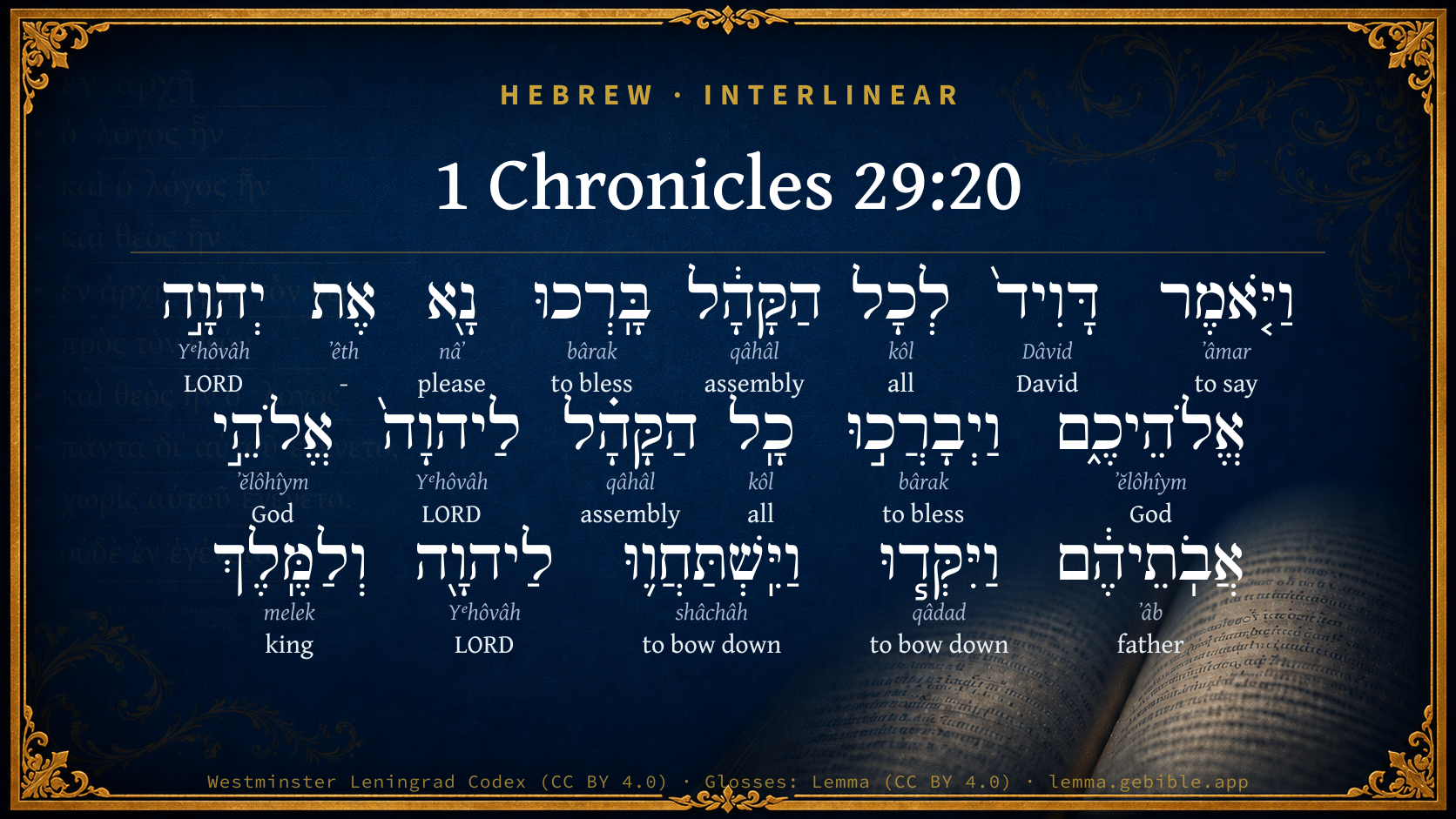
Hebrew (Westminster Leningrad Codex) 1 Chronicles 29:20 appears in the Hebrew Old Testament. The text above is from the Westminster Leningrad Codex. Each word links to its Strong’s number, a concise gloss, and parsing drawn from the Open Scriptures Hebrew Bible morphology. Click any word for its full Brown-Driver-Briggs (BDB) entry.
Download image
Cite this verse

1 Chronicles 29:20 (World English Bible). Public Domain. Lemma interlinear Bible study tool, https://lemma.gebible.app/v/1-chronicles/29/20.

Show BibTeX & RIS
BibTeX
RIS
English Translation
David said to all the assembly, Now bless Yahweh your God. All the assembly blessed Yahweh, the God of their fathers, and bowed down their heads, and worshiped Yahweh, and the king.
World English Bible · Public Domain
Download a study sheet

One document with this verse’s original text, its word-by-word gloss line, the meaning frame, cross-references with their text, attributed commentary, and full source and license credits — printable, and it pastes into notes with its structure intact.

This verse Autodidact and up

Study sheet (.html) Plain text (.txt)

A passage Seminary Student

Up to 50 verses in one chapter. A passage sheet keeps up to 6 commentary sources and 12 cross-references per verse, in the order this page ranks them, and says so on the sheet whenever that leaves anything out. Ask for a single verse and you get the Autodidact verse sheet above.

Everything on this page stays free to read, with no account — the sheet is a download of what is already on screen, not access to it.

Want to remove ads? Support Godless Engineer
Compare translations 3

The same verse in 3 English versions, stacked beneath the original-language interlinear above. Click any original word for its lexicon entry.

Each is an independent rendering of the whole verse — the interlinear is not word-aligned to these translations.

Highlighted words mark where these versions differ — a whole-verse word diff, not a word-by-word alignment.

  • World English Bible Public Domain
    David said to all the assembly, Now bless Yahweh your God. All the assembly blessed Yahweh, the God of their fathers, and bowed down their heads, and worshiped Yahweh, and the king.
  • King James Version Public Domain
    And David said to all the congregation, Now bless the LORD your God. And all the congregation blessed the LORD God of their fathers, and bowed down their heads, and worshipped the LORD, and the king.
  • unfoldingWord Literal Text CC BY-SA 4.0
    And David said to all of the assembly, “Now bless Yahweh your God.” And all of the assembly blessed Yahweh, the God of their fathers. And they bowed down and prostrated themselves to Yahweh and to the king.

unfoldingWord Literal Text — © unfoldingWord, licensed CC BY-SA 4.0. Word-aligned USFM3 via Door43 (git.door43.org/unfoldingWord/en_ult).

Versions to compare (up to 4)

3 of 4 selected

Show all 18 translations

Every available English version of this verse, each an independent rendering of the whole verse.

  • World English Bible Public Domain
    David said to all the assembly, Now bless Yahweh your God. All the assembly blessed Yahweh, the God of their fathers, and bowed down their heads, and worshiped Yahweh, and the king.
  • Berean Standard Bible Public Domain
    Then David said to the whole assembly, “Blessed be the LORD your God.” So the whole assembly blessed the LORD, the God of their fathers. They bowed down and paid homage to the LORD and to the king.
  • Majority Standard Bible Public Domain
    Then David said to the whole assembly, “Bless the LORD your God.” So the whole assembly blessed the LORD, the God of their fathers. They bowed down and paid homage to the LORD and to the king.
  • King James Version Public Domain
    And David said to all the congregation, Now bless the LORD your God. And all the congregation blessed the LORD God of their fathers, and bowed down their heads, and worshipped the LORD, and the king.
  • American Standard Version (1901) Public Domain
    And David said to all the assembly, Now bless Jehovah your God. And all the assembly blessed Jehovah, the God of their fathers, and bowed down their heads, and worshipped Jehovah, and the king.
  • Revised Version (1885) Public Domain
    And David said to all the congregation, Now bless the LORD your God. And all the congregation blessed the LORD, the God of their fathers, and bowed down their heads, and worshipped the LORD, and the king.
  • Geneva Bible (1599) Public Domain
    And Dauid said to all the Congregation, Now blesse the Lord your God. And all the Congregation blessed the Lord God of their fathers, and bowed downe their heads, and worshipped the Lord and the King.
  • Douay-Rheims (1899) Public Domain
    And David commanded all the assembly: Bless ye the Lord our God. And all the assembly blessed the Lord the God of their fathers: and they bowed themselves and worshipped God, and then the king.
  • Young's Literal Translation Public Domain
    And David saith to all the assembly, `Bless, I pray you, Jehovah your God;' and all the assembly bless Jehovah, God of their fathers, and bow and do obeisance to Jehovah, and to the king.
  • Literal Standard Version CC BY-SA 4.0
    And David says to all the assembly, “Now bless your God YHWH”; and all the assembly blesses YHWH, God of their fathers, and bows and pays respect to YHWH and to the king.
  • Unlocked Literal Bible CC BY-SA 4.0
    David said to all the assembly, “Now bless Yahweh your God.” All the assembly blessed Yahweh, the God of their ancestors, bowed their heads and worshiped Yahweh and prostrated themselves before the king.
  • unfoldingWord Literal Text CC BY-SA 4.0
    And David said to all of the assembly, “Now bless Yahweh your God.” And all of the assembly blessed Yahweh, the God of their fathers. And they bowed down and prostrated themselves to Yahweh and to the king.
  • Darby Bible Public Domain
    And David said to all the congregation, Bless now Jehovah your God. And all the congregation blessed Jehovah the God of their fathers, and bowed down their heads, and did homage to Jehovah and the king.
  • World Messianic Bible Public Domain
    Then David said to all the assembly, “Now bless the LORD your God!” All the assembly blessed the LORD, the God of their fathers, and bowed down their heads and prostrated themselves before the LORD and the king.
  • Webster's Bible Public Domain
    And David said to all the congregation, Now bless the LORD your God. And all the congregation blessed the LORD God of their fathers, and bowed their heads, and worshiped the LORD, and the king.
  • Free Bible Version CC BY-SA 4.0
    Then David said to everyone there, “Praise the Lord your God!” So everyone praised the Lord, the God of their fathers. They bowed down in reverence to the Lord and to the king.
  • Bible in Basic English Public Domain
    And David said to all the people, Now give praise to the Lord your God. And all the people gave praise to the Lord, the God of their fathers, with bent heads worshipping the Lord and the king.
  • JPS Tanakh (1917) Public Domain
    And David said to all the congregation: 'Now bless the LORD your God.' And all the congregation blessed the LORD, the God of their fathers, and bowed down their heads, and prostrated themselves before the LORD, and before the king.

Literal Standard Version (2020), Covenant Press — licensed CC BY-SA 4.0. Text via the HelloAO Bible API (eBible.org). Unlocked Literal Bible (unfoldingWord) — licensed CC BY-SA 4.0. Text via the HelloAO Bible API (eBible.org). unfoldingWord Literal Text — © unfoldingWord, licensed CC BY-SA 4.0. Word-aligned USFM3 via Door43 (git.door43.org/unfoldingWord/en_ult). Free Bible Version, Dr. Jonathan Gallagher — licensed CC BY-SA 4.0. Text via the HelloAO Bible API (eBible.org).

Word by word

More ways to search: Search by grammar → Find every occurrence → Compare this word →

Practice this passage: Drill this verse → Learn its vocabulary →

וַיִּקְּד֧וּ
qâdad
H6915
“and · to bow down”
Conjunction + Verb, Qal, Sequential Imperfect, 3rd Person, Masculine, Plural
Part of Speech
Conjunction + Verb
Stem
Qal
Form
Sequential Imperfect
Person
3rd Person
Gender
Masculine
Number
Plural
Full BDB Definition

Origin: a primitive root

TWOT: 1985

(Qal) to bow down
  1. וַיֹּ֤אמֶר ʼâmar H559 “and · to say” Conjunction + Verb, Qal, Sequential Imperfect, 3rd Person, Masculine, Singular
  2. דָּוִיד֙ Dâvid H1732 “David” Noun, Proper
  3. לְכָל kôl H3605 “to/for · all of” Preposition + Noun, Common, Masculine, Singular, Construct
  4. הַקָּהָ֔ל qâhâl H6951 “the · assembly” Particle, Definite Article + Noun, Common, Masculine, Singular, Absolute
  5. בָּֽרְכוּ bârak H1288 “bless” Verb, Piel, Imperative, 2nd Person, Masculine, Plural
  6. נָ֖א nâʼ H4994 “please” Particle, Exhortation
  7. אֶת ʼêth H853 “-” Particle, Direct Object
  8. יְהוָ֣ה Yᵉhôvâh H3068 “LORD” Noun, Proper
  9. אֱלֹהֵיכֶ֑ם ʼĕlôhîym H430 “God(s) · your” Noun, Common, Masculine, Plural, Construct + Suffix, Personal, 2nd Person, Masculine, Plural
  10. וַיְבָרֲכ֣וּ bârak H1288 “and · to bless” Conjunction + Verb, Piel, Sequential Imperfect, 3rd Person, Masculine, Plural
  11. כָֽל kôl H3605 “all of” Noun, Common, Masculine, Singular, Construct
  12. הַקָּהָ֗ל qâhâl H6951 “the · assembly” Particle, Definite Article + Noun, Common, Masculine, Singular, Absolute
  13. לַיהוָה֙ Yᵉhôvâh H3068 “to/for · LORD” Preposition + Noun, Proper
  14. אֱלֹהֵ֣י ʼĕlôhîym H430 “God(s) of” Noun, Common, Masculine, Plural, Construct
  15. אֲבֹֽתֵיהֶ֔ם ʼâb H1 “fathers · their” Noun, Common, Masculine, Plural, Construct + Suffix, Personal, 3rd Person, Masculine, Plural
  16. וַיִּֽשְׁתַּחֲו֛וּ shâchâh H7812 “and · to bow down” Conjunction + Verb, Hithpael, Sequential Imperfect, 3rd Person, Masculine, Plural
  17. לַיהוָ֖ה Yᵉhôvâh H3068 “to/for · LORD” Preposition + Noun, Proper
  18. וְלַמֶּֽלֶךְ melek H4428 “and · to/for the · king” Conjunction + Preposition, Determined + Noun, Common, Masculine, Singular, Absolute

About this verse

These counts appear in no published source. They are computed here, from the morphology-tagged text and Lemma’s own curated glosses. What Lemma adds →

19
words
13
distinct lemmas
Historical
section

Notable vocabulary

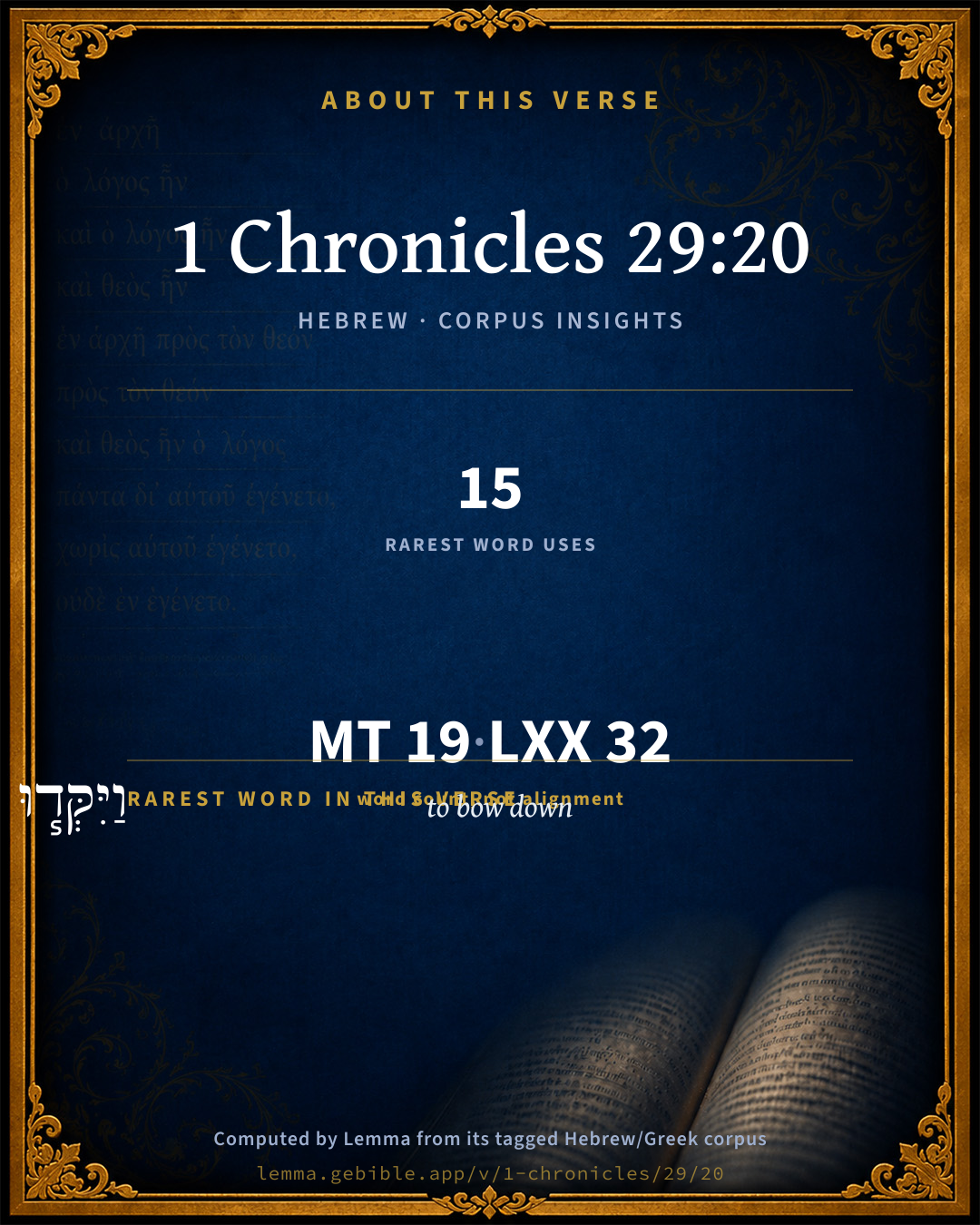
The rarest word here is וַיִּקְּד֧וּ to bow down H6915 — appearing just 15 times in the whole Hebrew Bible.

Shared distinctive vocabulary

וַיִּקְּד֧וּ to bow down H6915 occurs in 15 verses of the Hebrew Bible. Also found in:

Grammatical profile

  • 5 verbs
  • 12 nouns
  • 2 particles

Verb forms

  • וַיֹּ֤אמֶר Qal · Sequential Imperfect
  • בָּֽרְכוּ Piel · Imperative
  • וַיְבָרֲכ֣וּ Piel · Sequential Imperfect
  • וַיִּקְּד֧וּ Qal · Sequential Imperfect
  • וַיִּֽשְׁתַּחֲו֛וּ Hithpael · Sequential Imperfect

Repetition

Words recur within this verse — often emphatic in Hebrew:

  • יְהוָ֣ה LORD H3068 ×3
  • לְכָל all H3605 ×2
  • הַקָּהָ֔ל assembly H6951 ×2
  • בָּֽרְכוּ to bless H1288 ×2
  • אֱלֹהֵיכֶ֑ם God H430 ×2

Hebrew & Septuagint length

In English translation the verse runs 32 words from the Hebrew and 39 from the Septuagint (LXX English) — closely comparable.

A rough comparison of the two English renderings, which tokenize alike — not a word-level alignment.

Word counts can differ between the Hebrew and the Greek without any difference in meaning — e.g. the Hebrew direct-object marker אֵת has no separate Greek word, and Greek often adds the article ὁ.

In the original languages it is 19 Hebrew tokens and 32 Greek tokens — but the two are counted differently (Hebrew bundles its prefixes and suffixes into one token; the Greek is in lemma form), so that isn’t a like-for-like length.

Cross-references

16

Topical passages linked to 1 Chronicles 29:20 in the Treasury of Scripture Knowledge — connected by theme and wording, ordered by reader-vote popularity; previews shown in the World English Bible.

  • Exodus 4:31 The people believed, and when they heard that Yahweh had visited the children of Israel, and that he had seen their affliction, then they bowed their heads and worshiped.
  • Psalms 95:6 Oh come, let's worship and bow down. Let's kneel before Yahweh, our Maker,
  • Genesis 24:26 The man bowed his head, and worshiped Yahweh.
  • Genesis 24:48 I bowed my head, and worshiped Yahweh, and blessed Yahweh, the God of my master Abraham, who had led me in the right way to take my master's brother's daughter for his son.
  • 1 Samuel 12:18 So Samuel called to Yahweh; and Yahweh sent thunder and rain that day: and all the people greatly feared Yahweh and Samuel.
  • 1 Chronicles 16:36 Blessed be Yahweh, the God of Israel, From everlasting even to everlasting. All the people said, Amen, and praised Yahweh.
  • 2 Chronicles 20:21 When he had taken counsel with the people, he appointed those who should sing to Yahweh, and give praise in holy array, as they went out before the army, and say, Give thanks to Yahweh; for his loving kindness endures forever.
  • Psalms 134:2 Lift up your hands in the sanctuary. Praise Yahweh!
  • Psalms 135:19–21 House of Israel, praise Yahweh! House of Aaron, praise Yahweh!
  • Psalms 145:1–21 I will exalt you, my God, the King. I will praise your name forever and ever.
  • Psalms 148:13–14 Let them praise the name of Yahweh, For his name alone is exalted. His glory is above the earth and the heavens.
  • Proverbs 24:21 My son, fear Yahweh and the king. Don't join those who are rebellious:
  • 1 Peter 2:17 Honor all men. Love the brotherhood. Fear God. Honor the king.
  • Exodus 14:31 Israel saw the great work which Yahweh did to the Egyptians, and the people feared Yahweh; and they believed in Yahweh, and in his servant Moses.
  • Joshua 22:33 The thing pleased the children of Israel; and the children of Israel blessed God, and spoke no more of going up against them to war, to destroy the land in which the children of Reuben and the children of Gad lived.
  • Psalms 29:1–2 Ascribe to Yahweh, you sons of the mighty, Ascribe to Yahweh glory and strength.

Cross-references courtesy of OpenBible.info (CC BY 4.0).

Hebrew and Greek witnesses Masoretic Hebrew ↔ Greek Septuagint

The same verse in the two great witnesses to the Old Testament, shown verse-for-verse.

These are two independent witnesses, not word-aligned to each other, and the Septuagint is shown in lemma (dictionary) form.

Hebrew 1 Chronicles 29:20 Masoretic · Westminster Leningrad Codex

וַיֹּ֤אמֶר דָּוִיד֙ לְכָל הַקָּהָ֔ל בָּֽרְכוּ נָ֖א אֶת יְהוָ֣ה אֱלֹהֵיכֶ֑ם וַיְבָרֲכ֣וּ כָֽל הַקָּהָ֗ל לַיהוָה֙ אֱלֹהֵ֣י אֲבֹֽתֵיהֶ֔ם וַיִּקְּד֧וּ וַיִּֽשְׁתַּחֲו֛וּ לַיהוָ֖ה וְלַמֶּֽלֶךְ

David said to all the assembly, Now bless Yahweh your God. All the assembly blessed Yahweh, the God of their fathers, and bowed down their heads, and worshiped Yahweh, and the king.

World English Bible · Public Domain

Greek LXX 1 Chronicles 29:20 Septuagint · lemma form

καί εἶπον δαυίδ πᾶς ὁ ἐκκλησία εὐλογέω κύριος ὁ θεός σύ καί εὐλογέω πᾶς ὁ ἐκκλησία κύριος ὁ θεός ὁ πατήρ αὐτός καί κάμπτω ὁ γόνυ προςκυνέω ὁ κύριος καί ὁ βασιλεύς

And David said to the whole congregation, Bless you⌃ the Lord our God. And all the congregation blessed the Lord God of their fathers, and they bowed the knee and worshipped the Lord, and did obeisance to the king.

LXX2012 (modern English Septuagint) · Public Domain

On this verse, Ellicott's Commentary for English Readers discusses the Septuagint’s reading. Read the note in Commentary ↓

Hebrew: Westminster Leningrad Codex (CC BY 4.0). Greek: Septuagint (public domain); English from LXX2012 (modern English Septuagint) (Public Domain). How the Septuagint differs from the Hebrew →

Commentary

Notes on 1 Chronicles 29:20 from classic Christian and Jewish commentators (each source and its license shown beneath its notes). The classic Christian expositions comment on the surrounding passage and are grouped to its opening verse, so a note may address several verses; the Jewish commentaries on the Tanakh (Rashi and others) are per-verse, so they appear only where the commentator wrote on this verse.

Lemma curates 59 commentaries, every one of them public domain or Creative Commons licensed, each selected and text-cleaned for this edition rather than reprinted as found. About our sources →

Trapp's Complete Commentary

John Trapp

1Ch 29:20 And David said to all the congregation, Now bless the LORD your God. And all the congregation blessed the LORD God of their fathers, and bowed down their heads, and worshipped the LORD, and the king.

Ver. 20. Now bless the Lord your God.] David was excellent at this, viz., stirring up others to join with him in praising God. See on Psa 34:3; Psa 103:20.

And worshipped the Lord.] With a religious worship.

And the king.] With a civil reverence.

John Trapp, A Commentary or Exposition upon All the Books of the Old and New Testament (1647–1656) — public domain. Text from a community e-Sword module.

The Biblical Illustrator

Joseph S. Exell

1Ch_29:20

Now bless the Lord your God.

National and individual thanksgiving

I. The abundant encouragement to praise God afforded us in the scriptures.

II. The most appropriate themes of thanksgiving.

III. The Best means of showing Gods praise. (Richard Jones, B. A.)

The duty of praise

I. Why we should praise God.

1. It is acceptable to God Himself.

2. It confers a blessing on him who renders it.

3. It is the joyous occupation of the saints before the throne.

II. What should be the subjects of our praise? His mercies.

1. Creation.

2. Preservation.

3. Redemption.

4. The means of grace.

5. The hope of glory.

III. In what way Gods people are to praise and bless Him.

1. With our lips.

2. In the life and conversation. (A. Roberts, M. A.)

The Biblical Illustrator, edited by Joseph S. Exell (c. 1880s–1900s) — public domain. Text from a community e-Sword module.

Joseph Benson's Commentary

1Ch 29:20. David said to all the congregation, Now bless the Lord your God — Adore his divine majesty, and give him thanks for all his benefits, hereby testifying your concurrence with me in what I have done and spoken. And all the congregation blessed the Lord, &c. — They did as David desired, bowing down their heads in a gesture of adoration. Whoever is the mouth of the congregation to God, only those have the benefit of his ministrations who join with him, not so much by bowing down the head, as by lifting up the heart. And worshipped the Lord, and the king — The Lord with religious, and the king with civil worship.

Joseph Benson's Commentary on the Old and New Testaments (1811–1818) — public domain. Text from a community e-Sword module.

Geneva Bible (1599)

Geneva Bible translators

That is, did reverence the king.

Geneva Bible (1599) marginal notes — public domain. Text via Bolls.life.

Jamieson, Fausset & Brown

Robert Jamieson, A. R. Fausset & David Brown

all the congregation . . . worshipped the Lord, and the king--Though the external attitude might be the same, the sentiments of which it was expressive were very different in the two cases--of divine worship in the one, of civil homage in the other.

Jamieson, Fausset & Brown — Commentary Critical and Explanatory on the Whole Bible (1871) — public domain (CC PDM 1.0). Text via the HelloAO Bible API.

Adam Clarke's Commentary

Verse 20. Worshipped the Lord, and the king.] They did reverence to God as the supreme Ruler, and to the king as his deputy.

Adam Clarke's Commentary on the Bible (1810–1826) — public domain. Text from a community e-Sword/MySword module.

Ellicott's Commentary for English Readers

(20) Now bless.—Bless ye, I pray. The “now” is not a note of time, but of entreaty.

Blessed the Lord God of their fathers.—Probably using a liturgical formula, like the doxologies which close the books of the Psalter (Psa_41:13; Psa_72:18-19; Psa_89:52, &c).

And bowed down their heads.—Or, and bowed. Vulg., inclinaverunt se; LXX. here, κάμψαντες τὰ γόνατα, bending the knees; but usually κνψαντες, stooping, bowing.

Worshipped.—Prostrated themselves. LXX., προσεκύνησαν. The two expressions “bowed and worshipped” are always united, as here (save in 2Ch_20:18. Comp. Gen_24:26; Exo_12:27). The Syriac renders, “fell down and worshipped.”

And the king.—As God’s earthly representative, David receives the same tokens of reverence and homage. (Comp. 1Ki_1:31.)

(20-25) The sacrificial feast and anointing of Solomon.

A Bible Commentary for English Readers, edited by Charles John Ellicott (1878–1897) — public domain. Text from a community e-Sword module.

The Cambridge Bible for Schools and Colleges

gen. ed. J. J. S. Perowne

20–22. The Great Rejoicing

20. worshipped] i.e. prostrated themselves.

The Cambridge Bible for Schools and Colleges (gen. ed. J. J. S. Perowne; Cambridge University Press, 1878–1918) — public domain. Text from a community e-Sword module.

John Gill's Exposition

And they sacrificed sacrifices unto the Lord,.... David and the congregation:

and offered burnt offerings unto the Lord on the morrow after that day; not having time enough on that day to perform, at least not all of them; and these they offered on the altar David had erected in the threshingfloor of Araunah, by the order of God, where afterwards the temple was built:

even a thousand bullocks, a thousand rams, and a thousand lambs, with their burnt offerings; and meat offerings also, both which always went along with them:

and sacrifices in abundance for all Israel; whom they represented; these last were peace offerings, part of which the offerers had for themselves and friends to feast on, as these did, as follows.

John Gill's Exposition of the Whole Bible (1746–1763) — public domain (CC PDM 1.0). Text via the HelloAO Bible API.

Albert Barnes' Notes on the Bible

Worshipped the Lord, and the king - The same outward signs of reverence were accorded by the customs of the Jews (as of the Oriental nations generally) to God and to their monarchs (see 1Ki 1:31). But the application of the terms to both in the same passage, which occurs nowhere in Scripture but here, is thought to indicate a time when a long servitude under despotic lords had orientalized men’s mode of speech.

Albert Barnes' Notes on the Bible (1834–1885) — public domain. Text from a community e-Sword/MySword module.

Haydock's Catholic Bible Commentary

Then is not in Hebrew or Septuagint. (Haydock) --- The same term is used, to express the outward adoration which they shewed to God, and the civil respect which was due to the king: pari gestu, says Grotius, animo diverso. (Calmet) --- How then will Protestants prove that we are guilty of idolatry, when we bow down before the cross, &c., unless they pretend to know the secrets of hearts? Protestants, they "bowed down their heads, (Septuagint, knees) and worshipped the Lord and the king." (Haydock) --- The exterior set was the same, but the intention determined the application. See Exodus xx. (Worthington)

George Leo Haydock (1774–1849), Haydock's Catholic Family Bible and Commentary, 1859 edition — public domain. Excludes Psalms (Douay-Rheims chapter numbering differs from Protestant) and Deuterocanonical books (Catholic canon only).

Matthew Poole's English Annotations

The Lord with religious, and the king with civil worship, as it is evident.

Matthew Poole's English Annotations on the Holy Bible (1683–1685) — public domain. Text from a community e-Sword/MySword module.

The Pulpit Commentary

Worship.

David was a true leader; for he not only directed, he preceded his subjects in the path of duty. If he called upon his soldiers to fight, he led them to the field; if he desired the princes to offer gifts, he first himself gave munificently; and if he would have his people worship, he himself set them the example. Thus, upon the occasion of presenting offerings towards the building of the temple, the king summoned the inhabitants of Jerusalem together, and in their presence and hearing addressed to Heaven the adorations and petitions recorded in this chapter. Only after this did he use the language of the text, "Now bless the Lord your God.

I THE NATURE OF WORSHIP: in what worship consists. Worship of some sort has been general among all nations. Revealed religion directs and consecrates what seems a natural tendency; and both the Old Testament and the New contain many admonitions to, many examples of, true and acceptable worship.

1. True worship is spiritual. "God is a Spirit: and they that worship him must worship him in spirit and in truth." It consists in the recognition of the Divine attributes, the acknowledgment of the Divine reign, and gratitude

2. for Divine mercies gifts, forbearance, loving-kindness. Nothing is more hateful to God than the language and posture of worship from which spiritual devotion is absent. Of the insincere he speaks with indignation, "This people draweth near unto me with their lips, but their heart is far from me." Silence is compatible with true worship; insincerity is not.

3. A devout heart will find expression for its sentiments. "The people bowed down their heads, and worshipped." Language is an assistance to the intelligent worshipper, though an unuttered aspiration or affection is heard and accepted by God. And attitudes of kneeling, standing, bowing the head, stretching forth the hands, are all appropriate as expressive of the feelings of the devout worshipper. It is only when they are substituted for spiritual worship that they are bad and displeasing to him who searches the hearts and tries the reins of the children of men.

II THE OBJECT OF WORSHIP: to whom worship is due. The congregation of Israel "worshipped the Lord, and the king." Yet the homage offered to David was civil, not religions; and there could have been no danger of confusing the one with the other. Whilst the heathen worship gods many and lords many, to us there is but one God, and one Mediator between God and men, the Man Christ Jesus. The Christian adores and blesses God in Christ. Notice that he is:

1. Your God. The Israelites were reminded of this; and we all are summoned to regard him as ours; for he has made us and redeemed us, and by his own Spirit renewed us, so that we are his and he is ours.

2. And he is also your fathers" God. The Hebrews knew him as "the Godof Abraham, of Isaac, and of Jacob." And we can exclaim, when we approach him, "Doubtless thou art our Father, though Abraham be ignorant of us, and Israel acknowledge us not." The fact that God made himself known unto the fathers of mankind, that our parents or ancestors knew and acknowledged him, adds a pathos and a power to our prayers.

III THE WORSHIPPERS. David summoned "all the congregation" to worship, bless, and praise the Lord.

1. All men have abundant reason to bless the Lord. He is "good unto all" His bounty, care, watchfulness, and long-suffering, have been experienced by all. No wonder that the psalmist in so many passages calls upon all people all nations to praise the Lord; summons young men and maidens, old men and children, to praise the Name of the Lord.

2. All men are in the gospel encouraged to present acceptable worship to God through Jesus Christ. The Saviour reveals the Father as the Object of worship, and himself provides the new and living way of access, and offers the intercession which secures Divine acceptance and approval for the believing worshipper. "I will," says the Apostle Paul, "that men pray everywhere, lifting up holy hands, without wrath and doubting.

QUESTIONS.

1. Do you worship God yourselves?

2. Do you admonish and encourage others, especially the young, tobless and praise the Lord? T.

The Pulpit Commentary (1880–1919), ed. H.D.M. Spence-Jones & Joseph S. Exell — public domain. Text from a community e-Sword module.

John Wesley's Explanatory Notes

Worshipped - The Lord with religious, and the king with civil worship.

John Wesley, Explanatory Notes Upon the Whole Bible (1754–1765) — public domain. Text via the GEBible commentary corpus.

Keil & Delitzsch

C. F. Keil & F. Delitzsch

And they sacrificed sacrifices unto the Lord,.... David and the congregation:

and offered burnt offerings unto the Lord on the morrow after that day; not having time enough on that day to perform, at least not all of them; and these they offered on the altar David had erected in the threshingfloor of Araunah, by the order of God, where afterwards the temple was built:

even a thousand bullocks, a thousand rams, and a thousand lambs, with their burnt offerings; and meat offerings also, both which always went along with them:

and sacrifices in abundance for all Israel; whom they represented; these last were peace offerings, part of which the offerers had for themselves and friends to feast on, as these did, as follows.

Keil & Delitzsch — Biblical Commentary on the Old Testament (1861–1891) — public domain (CC PDM 1.0). Text via the HelloAO Bible API. (Old Testament only.)

unfoldingWord translationNotes

Door43 World Missions Community

Now bless Yahweh

"Now praise Yahweh"

prostrated themselves before the king

This refers to laying down on the ground before someone to show great respect. AT: "prostrated themselves on the ground to show respect to Yahweh and the king" (See: Symbolic Action)

they made sacrifices to Yahweh and offered burnt offerings to him

The people offered animals to be sacrificed to Yahweh by the priests. Most of the people did not actually kill and sacrifice the animals themselves. (See: Metonymy)

a thousand bulls, a thousand rams, and a thousand lambs

"1,000 bulls, 1,000 rams, and 1,000 lambs" (See: Numbers)

translationWords

assembly

bless

bow

head

worship

king

sacrifice

burnt offering

drink offering

Israel

unfoldingWord translationNotes — © Distant Shores Media and the Door43 World Missions Community, licensed CC BY-SA 4.0. Source: git.door43.org/Door43/en_tn.

Rashi

Rabbi Shlomo Yitzchaki (Rashi)

And David said to the entire assembly This refers back to (above 28:1): “And David assembled all the leaders of, etc.”

Now bless the Lord your God It does not say, “The God of your fathers,” but “your God,” which implies: but not the God of your fathers. Therefore, it says, “Now bless the Lord your God,” but they said, “Our God and the God of our fathers,” and therefore, [it says:] “... and the assembly blessed the Lord, the God of their fathers,” out of appeasement to God and because of His holiness.

Rashi on the Tanakh — English translations: “The Judaica Press complete Tanach with Rashi, translated by A. J. Rosenberg” (CC BY 4.0); “Pentateuch with Rashi's commentary by M. Rosenbaum and A.M. Silbermann, 1929-1934” (public domain); “The Metsudah Tanach series, Lakewood, N.J” (CC BY 4.0); and “The Book of Joshua, Metsudah Publications, 1997” (CC BY 4.0). Text via Sefaria.

Lesson kit

Teaching starters — assembled from the data on this page, not authored interpretation. Every prompt links to the verse data it draws on. Edit before teaching.

1 Chronicles, in the Historical, opens this verse with 19 words (13 distinct Hebrew lemmas). Its most distinctive word is qâdad (“to bow down”). A historical commentator’s framing appears above. Read the whole chapter for the surrounding context.

Discussion questions

  1. The word qâdad carries the sense “to bow down.” How does it shape the verse?
  2. Genesis 24:26 shares the word «to bow down» with this verse. How do the two illuminate each other?
  3. “LORD” occurs 3× in this one verse. What is the effect of the repetition?
  4. These translations render this verse differently. What is at stake in choosing one wording over another?
  5. The verb «וַיֹּ֤אמֶר» is Qal Sequential Imperfect. How does its form color the action?
  6. Reading how Trapp's Complete Commentary and The Biblical Illustrator read this verse, where do the two commentators agree and where do they part?

Things to notice

Reading settings

Reading text

Shown beneath each verse's original-language words.

Old Testament
Old Testament edition

Read the OT as the Masoretic Hebrew (MT) or the Greek Septuagint (LXX).

English shown for the Greek Septuagint (in the Hebrew ↔ Greek comparison).

Comparing translations? Open the Compare panel on any verse page to stack up to four side by side.