Ruth 4:17

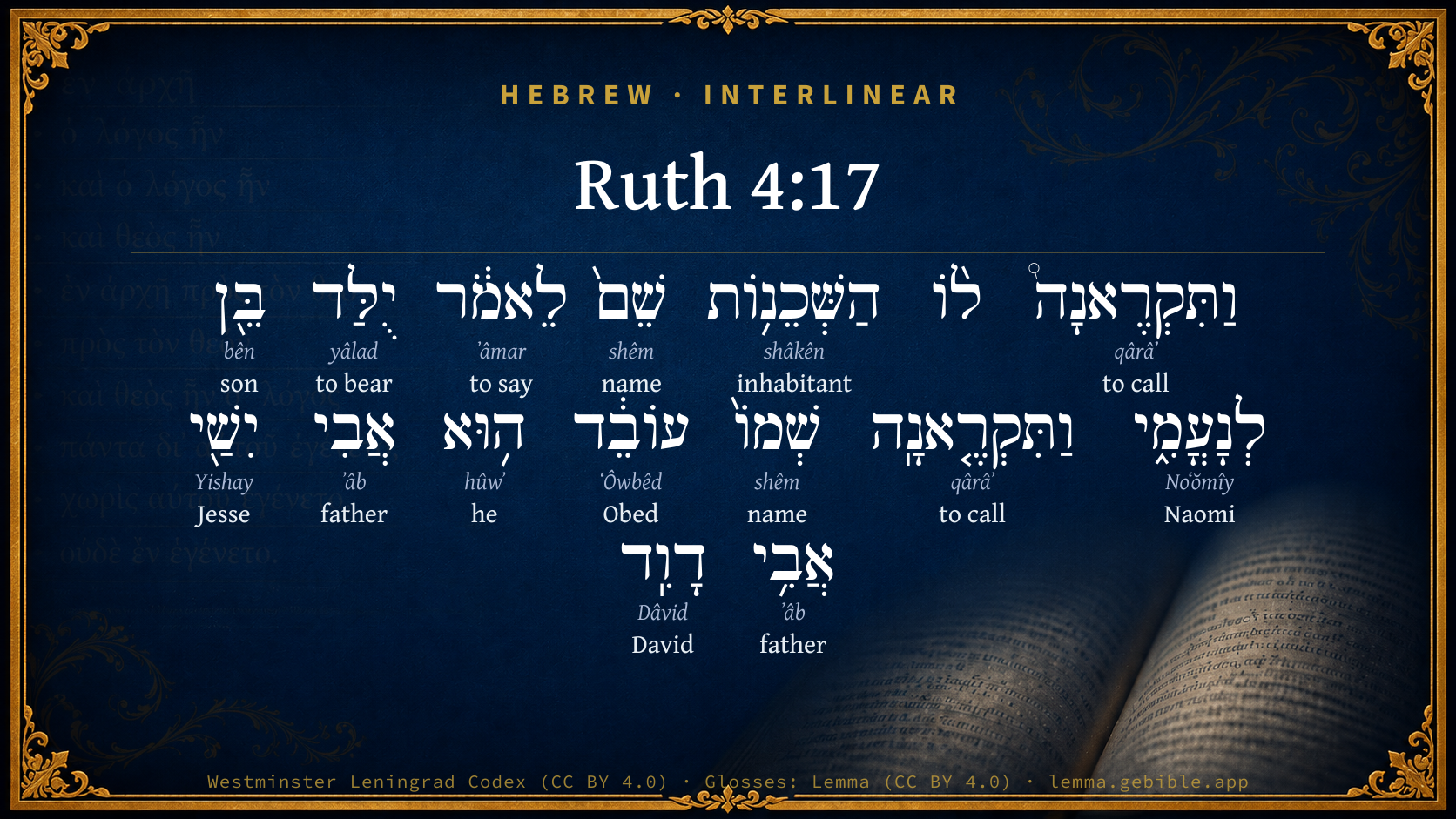
Hebrew (Westminster Leningrad Codex) Ruth 4:17 appears in the Hebrew Old Testament. The text above is from the Westminster Leningrad Codex. Each word links to its Strong’s number, a concise gloss, and parsing drawn from the Open Scriptures Hebrew Bible morphology. Click any word for its full Brown-Driver-Briggs (BDB) entry.
Download image
Cite this verse

Ruth 4:17 (World English Bible). Public Domain. Lemma interlinear Bible study tool, https://lemma.gebible.app/v/ruth/4/17.

Show BibTeX & RIS
BibTeX
RIS
English Translation
The women her neighbors gave it a name, saying, There is a son born to Naomi; and they named him Obed: he is the father of Jesse, the father of David.
World English Bible · Public Domain
Highlights
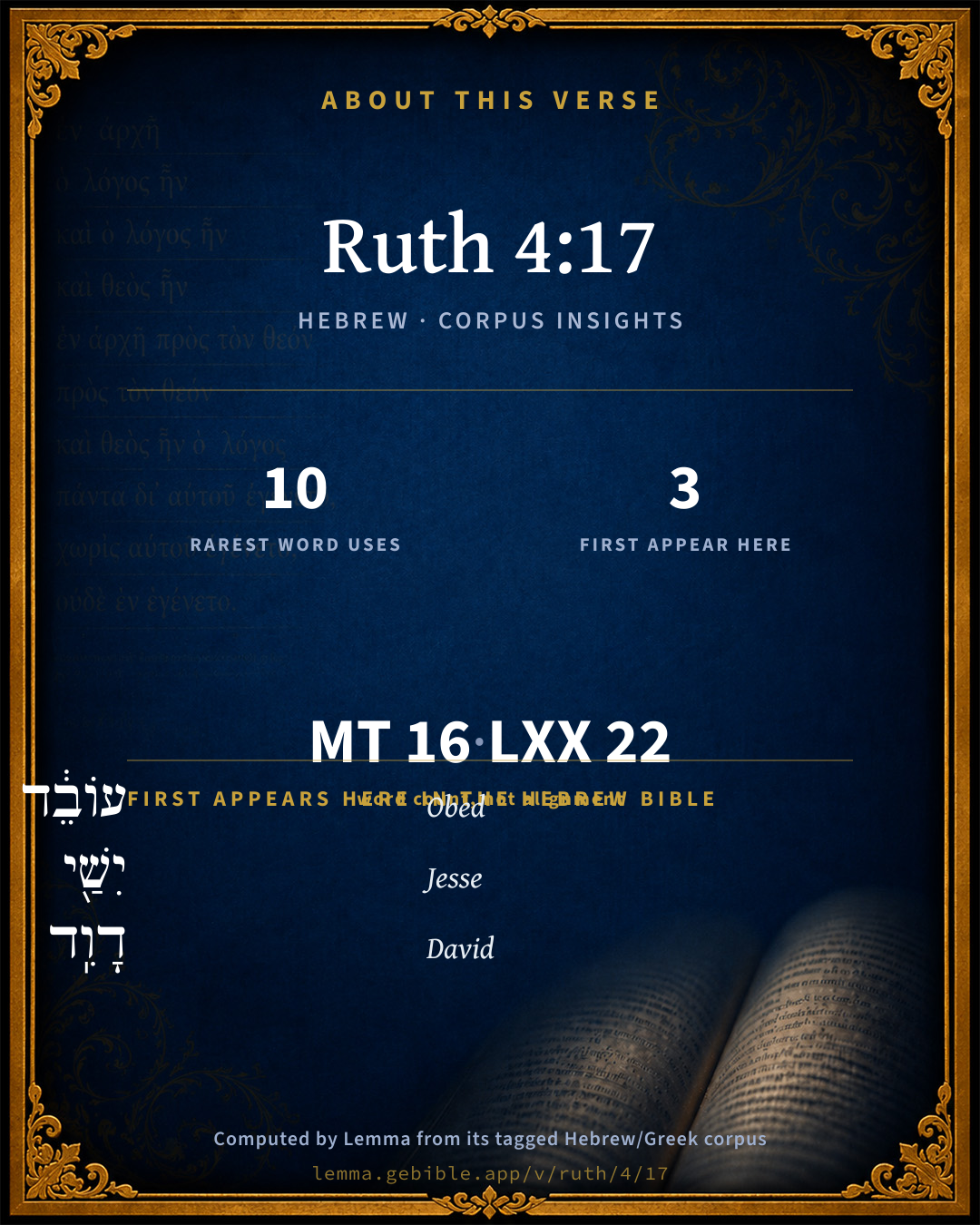
  • 3 first appearances in the Hebrew Bible
Full analysis ↓
Download a study sheet

One document with this verse’s original text, its word-by-word gloss line, the meaning frame, cross-references with their text, attributed commentary, and full source and license credits — printable, and it pastes into notes with its structure intact.

This verse Autodidact and up

Study sheet (.html) Plain text (.txt)

A passage Seminary Student

Up to 50 verses in one chapter. A passage sheet keeps up to 6 commentary sources and 12 cross-references per verse, in the order this page ranks them, and says so on the sheet whenever that leaves anything out. Ask for a single verse and you get the Autodidact verse sheet above.

Everything on this page stays free to read, with no account — the sheet is a download of what is already on screen, not access to it.

Want to remove ads? Support Godless Engineer
Compare translations 3

The same verse in 3 English versions, stacked beneath the original-language interlinear above. Click any original word for its lexicon entry.

Each is an independent rendering of the whole verse — the interlinear is not word-aligned to these translations.

Highlighted words mark where these versions differ — a whole-verse word diff, not a word-by-word alignment.

  • World English Bible Public Domain
    The women her neighbors gave it a name, saying, There is a son born to Naomi; and they named him Obed: he is the father of Jesse, the father of David.
  • King James Version Public Domain
    And the women her neighbors gave it a name, saying, There is a son born to Naomi; and they called his name Obed: he is the father of Jesse, the father of David.
  • unfoldingWord Literal Text CC BY-SA 4.0
    So the neighbor women called out a name for him, saying, “A son has been born to Naomi.” And they called his name Obed. He was the father of Jesse, the father of David.

unfoldingWord Literal Text — © unfoldingWord, licensed CC BY-SA 4.0. Word-aligned USFM3 via Door43 (git.door43.org/unfoldingWord/en_ult).

Versions to compare (up to 4)

3 of 4 selected

Show all 18 translations

Every available English version of this verse, each an independent rendering of the whole verse.

  • World English Bible Public Domain
    The women her neighbors gave it a name, saying, There is a son born to Naomi; and they named him Obed: he is the father of Jesse, the father of David.
  • Berean Standard Bible Public Domain
    The neighbor women said, “A son has been born to Naomi,” and they named him Obed. He became the father of Jesse, the father of David.
  • Majority Standard Bible Public Domain
    The neighbor women said, “A son has been born to Naomi,” and they named him Obed. He became the father of Jesse, the father of David.
  • King James Version Public Domain
    And the women her neighbors gave it a name, saying, There is a son born to Naomi; and they called his name Obed: he is the father of Jesse, the father of David.
  • American Standard Version (1901) Public Domain
    And the women her neighbors gave it a name, saying, There is a son born to Naomi; and they called his name Obed: he is the father of Jesse, the father of David.
  • Revised Version (1885) Public Domain
    And the women her neighbours gave it a name, saying, There is a son born to Naomi; and they called his name Obed: he is the father of Jesse, the father of David.
  • Geneva Bible (1599) Public Domain
    And the women her neighbours gaue it a name, saying, There is a childe borne to Naomi, and called the name thereof Obed: the same was the father of Ishai, the father of Dauid.
  • Douay-Rheims (1899) Public Domain
    And the women her neighbours, congratulating with her and saying: There is a son born to Noemi: called his name Obed: he is the father of Isai, the father of David.
  • Young's Literal Translation Public Domain
    and the neighbouring women give to him a name, saying, `There hath been a son born to Naomi,' and they call his name Obed; he `is' father of Jesse, father of David.
  • Literal Standard Version CC BY-SA 4.0
    and the neighboring women give a name to him, saying, “There has been a son born to Naomi,” and they call his name Obed; he [is] father of Jesse, father of David.
  • Unlocked Literal Bible CC BY-SA 4.0
    The women of the neighborhood gave him a name, saying, “A son has been born to Naomi.” They named him Obed. He became the father of Jesse, who became the father of David.
  • unfoldingWord Literal Text CC BY-SA 4.0
    So the neighbor women called out a name for him, saying, “A son has been born to Naomi.” And they called his name Obed. He was the father of Jesse, the father of David.
  • Darby Bible Public Domain
    And the women [her] neighbours gave it a name, saying, There is a son born to Naomi. And they called his name Obed. He is the father of Jesse, the father of David.
  • World Messianic Bible Public Domain
    The women, her neighbors, gave him a name, saying, “A son is born to Naomi”. They named him Obed. He is the father of Jesse, the father of David.
  • Webster's Bible Public Domain
    And the women, her neighbors, gave it a name, saying, There is a son born to Naomi; and they called his name Obed: he is the father of Jesse, the father of David.
  • Free Bible Version CC BY-SA 4.0
    The neighbor women named him Obed, saying “Naomi now has a son!” He was the father of Jesse who was the father of David.
  • Bible in Basic English Public Domain
    And the women who were her neighbours gave it a name, saying, Naomi has a child; and they gave him the name of Obed: he is the father of Jesse, the father of David.
  • JPS Tanakh (1917) Public Domain
    And the women her neighbours gave it a name, saying: 'There is a son born to Naomi'; and they called his name Obed; he is the father of Jesse, the father of David.

Literal Standard Version (2020), Covenant Press — licensed CC BY-SA 4.0. Text via the HelloAO Bible API (eBible.org). Unlocked Literal Bible (unfoldingWord) — licensed CC BY-SA 4.0. Text via the HelloAO Bible API (eBible.org). unfoldingWord Literal Text — © unfoldingWord, licensed CC BY-SA 4.0. Word-aligned USFM3 via Door43 (git.door43.org/unfoldingWord/en_ult). Free Bible Version, Dr. Jonathan Gallagher — licensed CC BY-SA 4.0. Text via the HelloAO Bible API (eBible.org).

Word by word

More ways to search: Search by grammar → Find every occurrence → Compare this word →

Practice this passage: Drill this verse → Learn its vocabulary →

עוֹבֵ֔ד
ʻÔwbêd
H5744
“Obed”
Noun, Proper
Part of Speech
Noun
Type
Proper
Full BDB Definition

Origin: act part of H5647

TWOT: None

Obed = "serving" - son of Boaz by Ruth and the grandfather of David - a Judaite, a descendant of Jarha, the Egyptian slave of Sheshan, in the line of Jerahmeel - a Judaite, father of Azariah, one of the captains of hundreds who joined with Jehoiada in the revolution by which Athaliah fell - one of David's mighty warriors - son of Shemaiah and a gatekeeper of the temple
  1. וַתִּקְרֶאנָה֩ qârâʼ H7121 “and · to call” Conjunction + Verb, Qal, Sequential Imperfect, 3rd Person, Feminine, Plural
  2. הַשְּׁכֵנ֥וֹת shâkên H7934 “the · inhabitant” Particle, Definite Article + Adjective, Adjective, Feminine, Plural, Absolute
  3. שֵׁם֙ shêm H8034 “name” Noun, Common, Masculine, Singular, Absolute
  4. לֵאמֹ֔ר ʼâmar H559 “to say” Preposition + Verb, Qal, Infinitive Construct
  5. יֻלַּד yâlad H3205 “to bear” Verb, Pual, Perfect, 3rd Person, Masculine, Singular
  6. בֵּ֖ן bên H1121 “son” Noun, Common, Masculine, Singular, Absolute
  7. לְנָעֳמִ֑י Noʻŏmîy H5281 “to/for · Naomi” Preposition + Noun, Proper
  8. וַתִּקְרֶ֤אנָֽה qârâʼ H7121 “and · to call” Conjunction + Verb, Qal, Sequential Imperfect, 3rd Person, Feminine, Plural
  9. שְׁמוֹ֙ shêm H8034 “name · his” Noun, Common, Masculine, Singular, Construct + Suffix, Personal, 3rd Person, Masculine, Singular
  10. ה֥וּא hûwʼ H1931 “he” Pronoun, Personal, 3rd Person, Masculine, Singular
  11. אֲבִי ʼâb H1 “father of” Noun, Common, Masculine, Singular, Construct
  12. יִשַׁ֖י Yishay H3448 “Jesse” Noun, Proper
  13. אֲבִ֥י ʼâb H1 “father of” Noun, Common, Masculine, Singular, Construct
  14. דָוִֽד Dâvid H1732 “David” Noun, Proper

About this verse

These counts appear in no published source. They are computed here, from the morphology-tagged text and Lemma’s own curated glosses. What Lemma adds →

16
words
12
distinct lemmas
Historical
section

Notable vocabulary

The rarest word here is עוֹבֵ֔ד Obed H5744 — appearing just 10 times in the whole Hebrew Bible.

First appearance in Scripture

These words make their first canonical appearance in the Hebrew Bible here:

  • עוֹבֵ֔ד Obed H5744
  • יִשַׁ֖י Jesse H3448
  • דָוִֽד David H1732

Shared distinctive vocabulary

עוֹבֵ֔ד Obed H5744 occurs in 9 verses of the Hebrew Bible. Also found in:

Grammatical profile

  • 4 verbs
  • 9 nouns
  • 1 adjective
  • 1 pronoun
  • 1 preposition

Verb forms

  • וַתִּקְרֶאנָה֩ Qal · Sequential Imperfect
  • לֵאמֹ֔ר Qal · Infinitive Construct
  • יֻלַּד Pual · Perfect
  • וַתִּקְרֶ֤אנָֽה Qal · Sequential Imperfect

Repetition

Words recur within this verse — often emphatic in Hebrew:

  • וַתִּקְרֶאנָה֩ to call H7121 ×2
  • שֵׁם֙ name H8034 ×2
  • אֲבִי father H1 ×2

Hebrew & Septuagint length

In English translation the verse runs 31 words from the Hebrew and 31 from the Septuagint (LXX English) — the same length.

A rough comparison of the two English renderings, which tokenize alike — not a word-level alignment.

Word counts can differ between the Hebrew and the Greek without any difference in meaning — e.g. the Hebrew direct-object marker אֵת has no separate Greek word, and Greek often adds the article ὁ.

In the original languages it is 16 Hebrew tokens and 22 Greek tokens — but the two are counted differently (Hebrew bundles its prefixes and suffixes into one token; the Greek is in lemma form), so that isn’t a like-for-like length.

Cross-references

1

Topical passages linked to Ruth 4:17 in the Treasury of Scripture Knowledge — connected by theme and wording, ordered by reader-vote popularity; previews shown in the World English Bible.

  • Luke 1:58–63 Her neighbors and her relatives heard that the Lord had magnified his mercy towards her, and they rejoiced with her.

Cross-references courtesy of OpenBible.info (CC BY 4.0).

Hebrew and Greek witnesses Masoretic Hebrew ↔ Greek Septuagint

The same verse in the two great witnesses to the Old Testament, shown verse-for-verse.

These are two independent witnesses, not word-aligned to each other, and the Septuagint is shown in lemma (dictionary) form.

Hebrew Ruth 4:17 Masoretic · Westminster Leningrad Codex

וַתִּקְרֶאנָה֩ ל֨וֹ הַשְּׁכֵנ֥וֹת שֵׁם֙ לֵאמֹ֔ר יֻלַּד בֵּ֖ן לְנָעֳמִ֑י וַתִּקְרֶ֤אנָֽה שְׁמוֹ֙ עוֹבֵ֔ד ה֥וּא אֲבִי יִשַׁ֖י אֲבִ֥י דָוִֽד

The women her neighbors gave it a name, saying, There is a son born to Naomi; and they named him Obed: he is the father of Jesse, the father of David.

World English Bible · Public Domain

Greek LXX Ruth 4:17 Septuagint · lemma form

καί καλέω αὐτός ὁ γείτων ὄνομα λέγω τίκτω υἱός ὁ νωεμιν καί καλέω ὁ ὄνομα αὐτός ωβηδ οὗτος πατήρ ιεσσαι πατήρ δαυίδ

And the neighbors gave it a name, saying, A son has been born to Noemin; and they called his name Obed; this is the father of Jessae the father of David.

LXX2012 (modern English Septuagint) · Public Domain

Hebrew: Westminster Leningrad Codex (CC BY 4.0). Greek: Septuagint (public domain); English from LXX2012 (modern English Septuagint) (Public Domain). How the Septuagint differs from the Hebrew →

Commentary

Notes on Ruth 4:17 from classic Christian and Jewish commentators (each source and its license shown beneath its notes). The classic Christian expositions comment on the surrounding passage and are grouped to its opening verse, so a note may address several verses; the Jewish commentaries on the Tanakh (Rashi and others) are per-verse, so they appear only where the commentator wrote on this verse.

Lemma curates 59 commentaries, every one of them public domain or Creative Commons licensed, each selected and text-cleaned for this edition rather than reprinted as found. About our sources →

Trapp's Complete Commentary

John Trapp

Rth 4:17 And the women her neighbours gave it a name, saying, There is a son born to Naomi; and they called his name Obed: he [is] the father of Jesse, the father of David.

Ver. 17. And the women her neighbours gave it a name.] Those good women, spoken of before, {Rth 4:14} persuaded the parents to give the child that name, either when it was born or when it came to be circumcised, which was the usual time.

There is a son born to Naomi.] Now no longer Marah, but a joyful mother; for grandmothers also are so called; and this child was born for her good and comfort. See a like phrase in Isa 9:6, "Unto us a child is born, unto us a son is given."

And they called his name Obed,] i.e., A servitor, a servant of God, - a Theodulus, as Lavater gives the reason, - who hath promised to spare his people, as a man spareth his own son that serveth him. {Mal 3:17} Others say he was so called because he should serve as a comforter to old Naomi, as the the women said. {Rth 4:15}

He is the father of Jesse.] Who was Vir bonus et honestus, saith one, minus tamen clarus {2Sa 17:27} He is also called Nahash; and that for his serpentine prudence, saith the Chaldee Paraphrast.

The father of David.] God’s darling, as his name signifieth, a notable type of Christ, and his most famous progenitor.

John Trapp, A Commentary or Exposition upon All the Books of the Old and New Testament (1647–1656) — public domain. Text from a community e-Sword module.

The Biblical Illustrator

Joseph S. Exell

Rth_4:17-22

And they called his name Obed.

Little Obed

No doubt there were circumstances connected with the birth of this child which surrounded it with a special interest. But take the birth of any child, and while few events are more common, few can occur on the earth which in sober reality are more momentous. What a mystery hangs over its wondrous constitution of thought and matter, of soul and body! What a capacity is there of sin and suffering, of holy service and blessedness l What will be its future and final destiny? The hopes of friends at such a moment are naturally sanguine, woven far more of sunbeams than of shadows. And there were circumstances which made the congratulations of Ruths friends peculiarly glad and hopeful; for this little smiling boy folded in his young mothers arms was not only the heir of Boaz but of Mahlon. He was to unite the family inheritances; he was to save the name of an old and honoured family in Bethlehem from being extinguished in Israel, and to give to Naomi and to Ruth that position of honour and consequence in Jewish society which grew out of the maternal relation. There was now hope concerning this tree, that it would yet bud and flourish. This will account to us for the warmth of the language in which the birth of Obed was hailed. To some it may appear strange that the congratulations of the friendly women were addressed to Naomi rather than to Ruth, the childs own mother. The explanation has in part been suggested already, in the fact that the birth of this child exercised so peculiar and propitious an influence over Naomis social position and family fortunes. It secured to her the position of a tribe-mother. It may be, too, that those kindly women had known Naomi and been her comforters in the days of her deep affliction, when she appeared in the streets of Bethlehem claiming to be called Mara--the woman with the sorrowful spirit; and as they beheld her on this day of revived hopes and vanished clouds the same true sympathy that had formerly made them weep with her when she wept now made them rejoice with her when she rejoiced. That we are correct in this explanation is evident from the words of the women, in which, with such glad anticipations for the future, there is also a looking back upon the sorrowful past. There shall be unto thee in this child a restorer of thy life and a nourisher of thine old age. How beautifully descriptive are these words of what children should aim to be to aged parents and relatives, and of what there is every reason to believe this child eventually became to Naomi. The former clause brings before us the picture of a tree in whose roots there remains a kind of lingering life, but which, assailed by storms and smitten by other unkindly influences, stands almost without leaf or blossom, with no birds making music in its branches, a blighted and forsaken thing. But there comes at length a genial influence of shower, and sunshine, and breeze, which quickens within it the vegetative life, and covers it with the leaves and blossoms of its earlier springs. Now, Naomis life had been to her for many years like a long winter. But this little child would bring back to her the recollections and the joys of her happier days; the blank in her heart would be filled up; she would find something to love and cherish without restraint, and this itself would be to her a well of happiness; she would remember Mahlon and Chilion in little Obeds childish sports and expanding mind; her thoughts, which had been too much turned inward upon her sorrows, would hence forth go outward upon him, and the future would not so much be a prolongation of the present as a return to her sunnier days--He shall be unto thee a restorer of thy life, and he shall be unto thee a nourisher of thine old age. The meaning of this is not exhausted by supposing that Naomi would never want the means of support while Obad lived, but that his affluence would be her riches. It includes in it, besides, those thousand varied acts of respect and tenderness which we are accustomed to describe by the name of kindness. In the case of persons in advanced years many sources of enjoyment are dried up, many frailties are induced, the senses are dulled, the power of motion is diminished, not a few of their companions have been removed into the other world, and they are apt to feel, in their infirmity and inaction, as if they had become useless to their generation. It is the duty of the young, and especially of the children and descendants of the aged, to endeavour to cheer them in the autumn of their life, to anticipate their wishes, to study their feelings, to make growing frailties only another reason for growing attentions, and, by kind words and kinder acts, to shed a calm sunshine on the path by which they are travelling to the tomb. Religion, and even the instincts of our human nature, command us to stand up before the old man, and to put honour on the hoary head. And never do children appear more lovely than when they are thus seen nourishing the old age of a father or a mother. (A. Thomson, D. D.)

Lessons from the Book of Ruth

I. In the first place it seems to me that the Book of Ruth exhibits to us an eternal law of Gods kingdom; that in the worst and darkest times of the Church God has had his own people. Ever since God had a Church on earth true spiritual religion has never been utterly extinguished. Faith can always say with the apostle that there is a remnant according to the election of grace. When Gods holy dove is driven from cities and the abodes of men, that bird of sweetest note can be heard singing in remote places, even in dens and in the clefts of the rocks.

II. We may learn a lesson on the law of social life. There is throughout the book a constant reference to the Levitical law. There is the goal, the redeeming kinsman. But I wish you specially to observe the beneficence of the law. I wish that some who speak of the barbarous character of the old law would take their Bibles and read the eighteenth chapter of Leviticus. You will there see that God ordained that a portion should be reserved for the poor and the stranger. The law gave a measure of wealth to the indigent. It solved in this way one of the most terrible problems of our modern society. While it did this there was an ample margin left for the exercise of private charity. The corner of the field was defined to mean a portion that in modern language would have been a poor-rate of fourpence in the pound. It was not a system of outdoor relief, for the Book of Ruth shows us that there was great delicacy to be observed in giving. Depend upon it, as the spirit of the Old Testament works, the bitter taunt will become less and less true that England is a paradise for the rich and a purgatory for the poor.

III. There is an evangelical law connecting this book of the Old Testament with Christ Jesus our Lord.

IV. Lastly, we learn the law which pervades the life of every true believer. We may learn that our lives are not random things, and that there is no such thing as chance about the Christians life. This story of Ruth, like every story of the highest sort, would lead us to perfect trust in Him who wants His own dear children to lift up their hands to Him when in darkness. They must wrestle in the darkness before they can face the sunrise. God seems to keep silence when we pray. We ask, and God seems not to give us the things for which we pray. Ah! but He gives us far better. (Abp. William Alexander.)

The Biblical Illustrator, edited by Joseph S. Exell (c. 1880s–1900s) — public domain. Text from a community e-Sword module.

Joseph Benson's Commentary

Rth 4:17. Her neighbours gave it a name — That is, gave her advice about his name; for it did not belong to them, but to the father or mother, to name the child. They called his name Obed — That is, a servant, meaning to express their hopes that he would nourish, comfort, and assist her, duties which children owe to their progenitors. He is the father of Jesse, the father of David — For whose sake chiefly this whole book seems to have been written, that it might be certainly known from whom he was descended, the Messiah being to spring from him; which is the reason why the following genealogy is annexed for the conclusion of this book.

Joseph Benson's Commentary on the Old and New Testaments (1811–1818) — public domain. Text from a community e-Sword module.

Jamieson, Fausset & Brown

Robert Jamieson, A. R. Fausset & David Brown

SHE BEARS OBED. (Rut 4:13-18)

Obed--means "servant."

Jamieson, Fausset & Brown — Commentary Critical and Explanatory on the Whole Bible (1871) — public domain (CC PDM 1.0). Text via the HelloAO Bible API.

Adam Clarke's Commentary

Verse 17. The neighbours gave it a name] That is, they recommended a name suitable to the circumstances of the case; and the parents and grandmother adopted it.

They called his name Obed] עובד obed, serving, from עבד abad, he served. Why was this name given? Because he was to be the nourisher of her old age, Ru 4:15. And so he must be by lying in her bosom, even if services in future life were wholly left out of the question. These neighbours of Naomi were skilful people. See on Ru 4:16. Other meanings, of which I am not ignorant, have been derived from these words; those who prefer them have my consent.

He is the father of Jesse, the father of David.] And for the sake of this conclusion, to ascertain the line of David, and in the counsel of God to fix and ascertain the line of the Messiah was this instructive little book written.

Adam Clarke's Commentary on the Bible (1810–1826) — public domain. Text from a community e-Sword/MySword module.

Ellicott's Commentary for English Readers

(17) Obed.—i.e., a serving one.

(18–22). This short genealogy, abruptly added, may be due to a later hand, it being thought necessary to connect David’s line fully with Judah.

A Bible Commentary for English Readers, edited by Charles John Ellicott (1878–1897) — public domain. Text from a community e-Sword module.

The Cambridge Bible for Schools and Colleges

gen. ed. J. J. S. Perowne

17. the women her neighbours]. Cf. Rth_4:14 and Rth_1:19. In St Luk_1:58 f., the neighbours and kinsfolk propose to name the child.

There is a son born to Naomi] The child is popularly considered to belong to Naomi’s family. Cf. Gen_30:3, where the son of Bilhah, born on the knees of Rachel, is regarded as Rachel’s child.

Obed] An abbreviated form of Obad-iah ‘servant of Jah,’ or of Abdi-el ‘servant of El.’

the father of Jesse, the father of David] The ancestry of Jesse is not given in 1 Sam. The name (Ishai) is perhaps a shortened form of Abishai. The story of Ruth thus shews how a Moabite women obtained an honourable place in the annals of Hebrew history; the rule laid down in Deu_23:3 [Hebrews 4] had at least one noteworthy exception1[7]. From 1Sa_22:3-4 we learn that friendly relations existed between David and the Moabites: it may not be fanciful to suppose that he would be all the move ready to entrust his parents to the care of the Moabite king because his father’s grandmother was a Moabite.

[7] The Rabbis get over the difficulty by supposing that the law of Deu_23:3 applies only to men: Talm. Jebamoth 76 b: Sifre on Deut. l.c.

With this account of the memorable issue of Ruth’s marriage the Book is brought to a suitable close. The genealogy which follows may be regarded as a later addition.

The Cambridge Bible for Schools and Colleges (gen. ed. J. J. S. Perowne; Cambridge University Press, 1878–1918) — public domain. Text from a community e-Sword module.

John Gill's Exposition

And the women her neighbours gave it a name,.... Josephus says (q) Naomi gave it, by the advice of her neighbours; very probably on the eighth day when he was circumcised, and the neighbours were invited on that occasion, at which time it seems it was usual to give names to children, see Luk 1:59. The Romans gave names to females on the eighth day, to the males on the ninth; hence the goddess Nundina had her name (r); the Greeks generally on the tenth, sometimes on the seventh (s): it was commonly the province of the father to give the name, and sometimes his neighbours and nearest friends were called, and in their presence the name was given, and by any of them he should choose in his stead (t):

saying, there is a son born to Naomi; to her family, and even to herself, being born of her who had been wife to her eldest son; and this was to her as instead of him, and was as he to her; so Aben Ezra compares this with Exo 2:10 and moreover, this child was born, as the neighbours presaged, for the great comfort and advantage of Naomi, to be her supporter and nourisher in her old age, Rut 4:15.

and they called his name Obed; which signifies "serving", as Josephus (u) rightly observes, though he does not always give the true sense of Hebrew words: this name was given, not in remembrance of the service his mother was obliged to, before marriage with Boaz; but rather on the account of the service that he would be of to Naomi, as they hoped and believed; though the reason of it, as given by the Targum, is not to be overlooked, which interprets it,"who served the Lord of the world with a perfect heart;''and so they might have some respect to his being hereafter a servant of the Lord:

he is the father of Jesse, and the father of David: so Jesse is called the Bethlehemite, Sa1 16:1, being of the city of Bethlehem, of which city Boaz was when his son Obed was born, who was the father of Jesse; of whom was David king of Israel, and from whom sprung the Messiah, for whose sake this book was written, that his genealogy might clearly appear; and of which use it is made by the Evangelists Matthew; and Luke.

(q) Ut supra. (Antiqu. l. 5. c. 9. sect. 4.) (r) Alex. ab Alex. Genial. Dier. l. 2. c. 25. (s) Harpocration & Suidas in voce Scholiast. in Aristoph. Aves, p. 565. & Euripid. & Aristot. in ib. (t) Vid. Sperling. de Baptism. Ethnic. c. 14. & 15. (u) Ibid.

John Gill's Exposition of the Whole Bible (1746–1763) — public domain (CC PDM 1.0). Text via the HelloAO Bible API.

Albert Barnes' Notes on the Bible

Obed - i. e. serving, with allusion to the service of love and duty which he would render to his grandmother Naomi.

Albert Barnes' Notes on the Bible (1834–1885) — public domain. Text from a community e-Sword/MySword module.

Haydock's Catholic Bible Commentary

Obed; "serving," to comfort the old age of Noemi, (ver. 15,) who gave him this’ name. (Serarius, q. 14,) at the suggestion of her neighbours. (Menochius)

George Leo Haydock (1774–1849), Haydock's Catholic Family Bible and Commentary, 1859 edition — public domain. Excludes Psalms (Douay-Rheims chapter numbering differs from Protestant) and Deuterocanonical books (Catholic canon only).

Matthew Poole's English Annotations

Gave it a name, i.e. they gave her advice about the name; for otherwise they had no power or right to do so.

Obed; a servant, to wit, to thee, to nourish, and comfort, and assist thee; which duty children owe to their progenitors.

Matthew Poole's English Annotations on the Holy Bible (1683–1685) — public domain. Text from a community e-Sword/MySword module.

Whedon's Commentary on the Bible

Daniel D. Whedon

17. There is a son born to Naomi — The son of Ruth was called Naomi’s, and that aged and childless widow herself rejoiced over the birth just as Rachel and Leah, who built the house of Israel, (Rth_4:11,) rejoiced over the children borne them by Bilhah and Zilpah. their maid-servants. Gen_30:1-13. By the birth of this child she was assured that the name of her precious dead would not be cut off from among their brethren. Rth_4:10.

They called his name Obed — The name means, literally, one who serves; and, as the context seems to suggest, was given to the child of Ruth and Boaz because he served to gladden Naomi’s old age. From this it appears that the law of Deu_25:6, was not understood to mean that the firstborn child of the levirate marriage must be called after the very name of the dead. See note on Rth_4:10.

He is the father of Jesse, the father of David — Thus at last is brought out fully and significantly the author’s manifest object in writing this brief but deeply interesting history of Ruth. It throws a calm and peaceful light upon the ancestry of the greatest personage of Israelitish history.

Daniel D. Whedon (gen. ed.), Commentary on the Old and New Testaments (1874–1909) — public domain. Text from a community e-Sword module.

The Pulpit Commentary

And the women, her neigh-bouts, named the child, saying, A son has been born to Naomi; and they called his name Obed. He was the father of Jesse, the father of David. "Obed," if a participle of the Hebrew verb db, naturally means serving, or servant. No other derivation, apparently, can at present be assumed (but see Raabe"s "Glossar."). Josephus gives the participial interpretation as a matter of course, and Jerome too. If the objective correlate of the servitude referred to were Yahveh, then the word might be equivalent to worshipper. If the name, however, as seems to be the case, was imposed first of all by the matronly neighbors who had come to mingle their joys with those of the mother, and of the grandmother in particular, then it is not likely that there would be an overshadowing reference, either on the one hand to servitude in relation to Yahveh, or on the other to servitude in the abstract. Something simpler would be in harmony with their unsophisticated, impressible, and purely matronly minds. It is not at all unlikely that, in fondling the welcome New-come," and congratulating the overjoyed grandmother, they would, with Oriental luxuriance of speech and Oriental overflow of demonstrativeness, speak of the "lad" as come home to be a faithful little servant to his most excellent grandmother. The infirmities of advancing age, aggravated by anxieties many, griefs many, bereavements many, toils many, privations many, disappointments many, had been one after another accumulating on the dear old lady." But now a sealed fountain of reviving waters had been opened in the wilderness. Might it for many years overflow! Might the oasis around it widen and still widen, till the whole solitary place should be blossoming as the rose! Might the lively little child be spared to minister, with bright activity and devotedness, to the aged pilgrim for the little remainder of her journey! The word which the sympathetic neighbors, with not the least intention to propose a real name, had been affectionately bandying about, while fondling the child, was accepted by Boaz and Ruth. They would say to one another, "Yes, just let him be little Obed to his loving grandmother." Naomi, soothed in all her motherly and grandmotherly longings and aspirations, would seem to have yielded, resolving, we may suppose, to train the child up to be a servant of Yahveh.

The Pulpit Commentary (1880–1919), ed. H.D.M. Spence-Jones & Joseph S. Exell — public domain. Text from a community e-Sword module.

John Wesley's Explanatory Notes

A name - That is, they gave her advice about his name; for otherwise they had no power or right to do so. Obed - A servant, to thee, to nourish, and comfort, and assist thee; which duty children owe to their progenitors.

John Wesley, Explanatory Notes Upon the Whole Bible (1754–1765) — public domain. Text via the GEBible commentary corpus.

Ibn Ezra

Rabbi Abraham ibn Ezra

"A son has been born to Naomi." Similar to "And she had a son."

"Father of David." It's possible that the lineage goes through both Oved and Yishai, akin to "God of my father Abraham and God of my father Isaac," reasoning that Nachshon died in the desert before Israel's entry, for he couldn't have been a youth leading the tribe while Israel journeyed initially. Moreover, the text mentions him entering the land, implying he'd be the tribe's leader. Hence, between his entering the land and David's birth, only six years passed, as it's written, "In the four hundred and eightieth year after the Israelites had come out of Egypt, in the fourth year of Solomon's reign." David lived for seventy years. Forty years the Israelites journeyed in the desert. If we say Salmon entered the land at one year old, then Salmon, Boaz, Oved, and Yishai each fathered a child at ninety-one years old. If we assume Nachshon was less than twenty when leaving Egypt, he'd be eighteen years old, accounting for the years in the desert. So, the sum would be five, and each would father a child at eighty-four. This seems plausible, as Boaz was already elderly, which Ruth knew, as he told her not to go after the young men. Yishai was also old when he fathered David, as he was the eighth son. Perhaps Oved was named because he was fathered by an elderly man, and the woman only accepted him for the sake of God's honor. Additionally, his mother left her religion and homeland, taking refuge under God's wings. Therefore, the child would be named Oved Hashem (a servant of God), as most children resemble their parents, as they are the roots.

Ibn Ezra on the Tanakh — English translations: “Sefaria Community Translation” (CC0 1.0 (public-domain dedication)); “Yalkut, Sifsei Chachomim Chumash, Metsudah Publications, 2009” (CC BY 4.0); and “Commentary of Ibn Ezra on Isaiah - trans. by M. Friedlander, 1873” (public domain). Text via Sefaria.

Lesson kit

Teaching starters — assembled from the data on this page, not authored interpretation. Every prompt links to the verse data it draws on. Edit before teaching.

Ruth, in the Historical, opens this verse with 16 words (12 distinct Hebrew lemmas). Its most distinctive word is ʻÔwbêd (“Obed”). A historical commentator’s framing appears above. Read the whole chapter for the surrounding context.

Discussion questions

  1. What does “Obed” (ʻÔwbêd) contribute to the verse as a whole?
  2. 3 words make their first appearance in Scripture here. What does this debut establish?
  3. How does Ruth 4:21, which shares the word «Obed», read alongside this verse?
  4. What does the repetition of “to call” (2× in this one verse) do in this verse?
  5. These translations render this verse differently; the difference is in the English rendering, not the original. What questions does that raise?
  6. «וַתִּקְרֶאנָה֩» is a Qal Sequential Imperfect verb. How does that grammatical form shape the action described?
  7. Compare how Trapp's Complete Commentary and The Biblical Illustrator read this verse. Where do they agree or differ?

Things to notice

Reading settings

Reading text

Shown beneath each verse's original-language words.

Old Testament
Old Testament edition

Read the OT as the Masoretic Hebrew (MT) or the Greek Septuagint (LXX).

English shown for the Greek Septuagint (in the Hebrew ↔ Greek comparison).

Comparing translations? Open the Compare panel on any verse page to stack up to four side by side.