
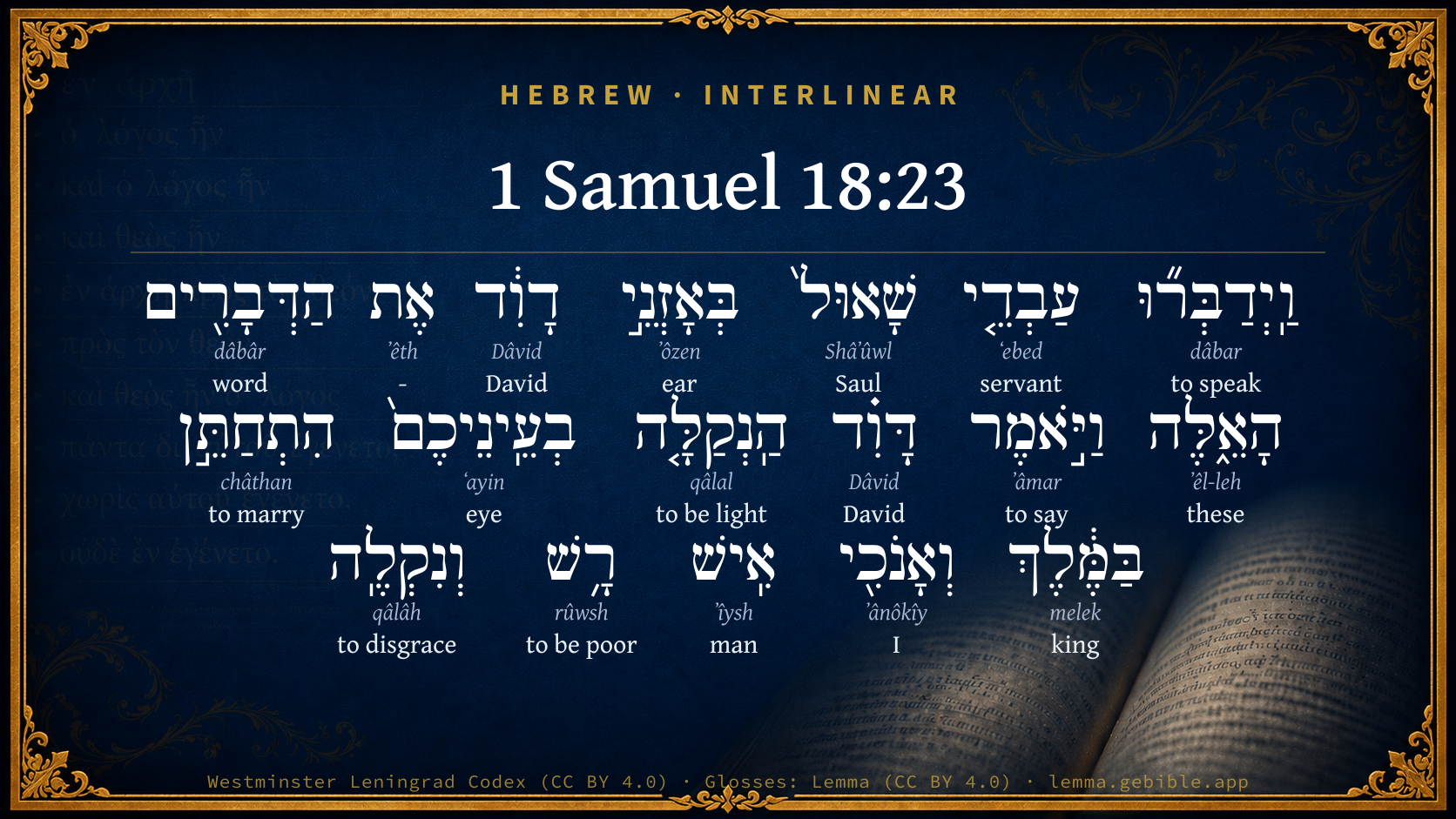
1 Samuel 18:23

Hebrew (Westminster Leningrad Codex) 1 Samuel 18:23 appears in the Hebrew Old Testament. The text above is from the Westminster Leningrad Codex. Each word links to its Strong’s number, a concise gloss, and parsing drawn from the Open Scriptures Hebrew Bible morphology. Click any word for its full Brown-Driver-Briggs (BDB) entry.
Download image
Cite this verse

1 Samuel 18:23 (World English Bible). Public Domain. Lemma interlinear Bible study tool, https://lemma.gebible.app/v/1-samuel/18/23.

Show BibTeX & RIS
BibTeX
RIS
English Translation
Saul's servants spoke those words in the ears of David. David said, Seems it to you a light thing to be the king's son-in-law, seeing that I am a poor man, and lightly esteemed?
World English Bible · Public Domain
Highlights
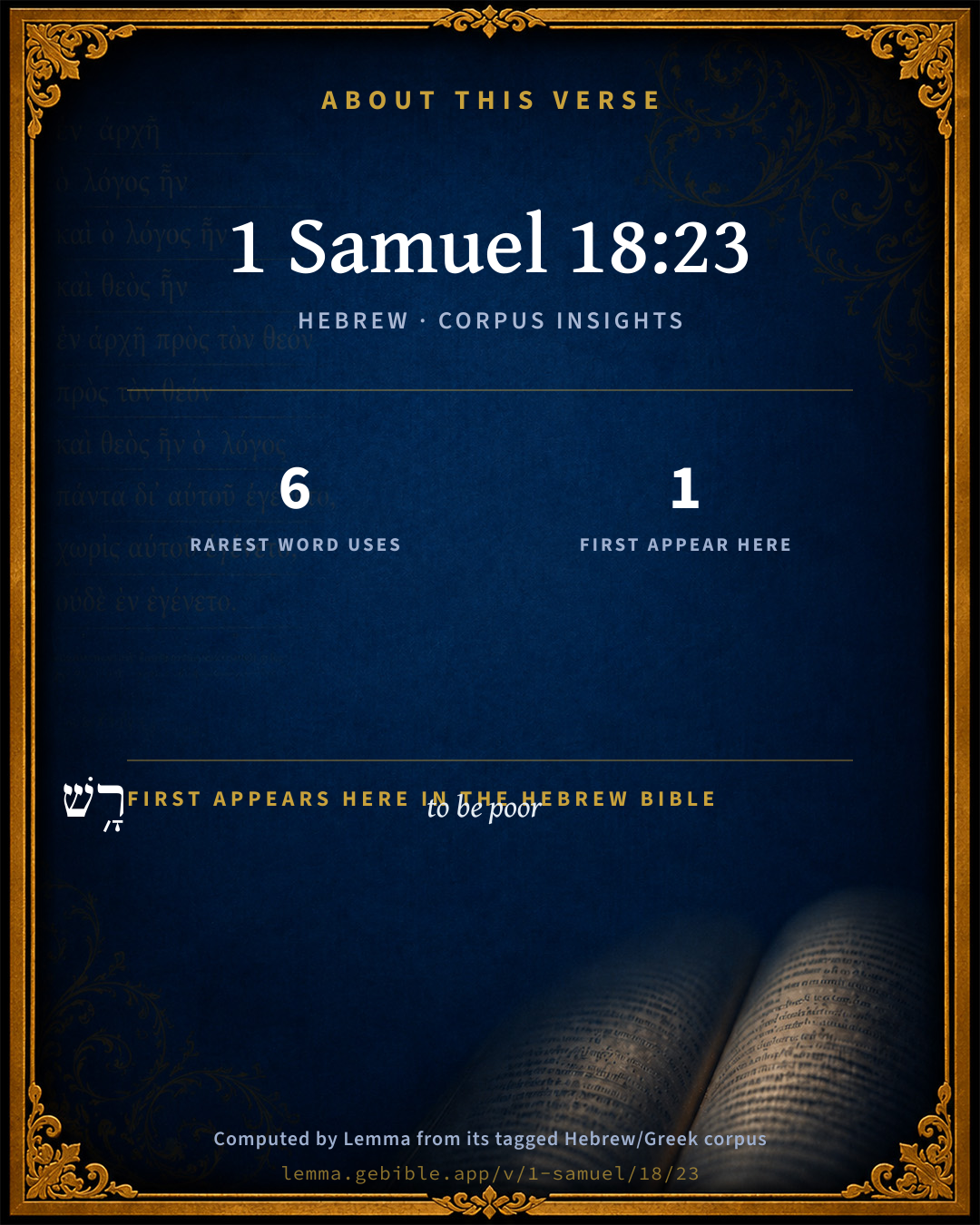
  • 1 first appearance in the Hebrew Bible
Full analysis ↓
Download a study sheet

One document with this verse’s original text, its word-by-word gloss line, the meaning frame, cross-references with their text, attributed commentary, and full source and license credits — printable, and it pastes into notes with its structure intact.

This verse Autodidact and up

Study sheet (.html) Plain text (.txt)

A passage Seminary Student

Up to 50 verses in one chapter. A passage sheet keeps up to 6 commentary sources and 12 cross-references per verse, in the order this page ranks them, and says so on the sheet whenever that leaves anything out. Ask for a single verse and you get the Autodidact verse sheet above.

Everything on this page stays free to read, with no account — the sheet is a download of what is already on screen, not access to it.

Want to remove ads? Support Godless Engineer
Compare translations 3

The same verse in 3 English versions, stacked beneath the original-language interlinear above. Click any original word for its lexicon entry.

Each is an independent rendering of the whole verse — the interlinear is not word-aligned to these translations.

Highlighted words mark where these versions differ — a whole-verse word diff, not a word-by-word alignment.

  • World English Bible Public Domain
    Saul's servants spoke those words in the ears of David. David said, Seems it to you a light thing to be the king's son-in-law, seeing that I am a poor man, and lightly esteemed?
  • King James Version Public Domain
    And Saul's servants spake those words in the ears of David. And David said, Seemeth it to you a light thing to be a king's son in law, seeing that I am a poor man, and lightly esteemed?
  • unfoldingWord Literal Text CC BY-SA 4.0
    And the servants of Saul spoke these words in the ears of David. And David said, “Does it seem light in your eyes to make oneself a son-in-law of the king? And I a poor man, and I am lightly esteemed.”

unfoldingWord Literal Text — © unfoldingWord, licensed CC BY-SA 4.0. Word-aligned USFM3 via Door43 (git.door43.org/unfoldingWord/en_ult).

Versions to compare (up to 4)

3 of 4 selected

Show all 18 translations

Every available English version of this verse, each an independent rendering of the whole verse.

  • World English Bible Public Domain
    Saul's servants spoke those words in the ears of David. David said, Seems it to you a light thing to be the king's son-in-law, seeing that I am a poor man, and lightly esteemed?
  • Berean Standard Bible Public Domain
    But when Saul’s servants relayed these words to David, he replied, “Does it seem trivial in your sight to be the son-in-law of the king? I am a poor man and lightly esteemed.”
  • Majority Standard Bible Public Domain
    But when Saul’s servants relayed these words to David, he replied, “Does it seem trivial in your sight to be the son-in-law of the king? I am a poor man and lightly esteemed.”
  • King James Version Public Domain
    And Saul's servants spake those words in the ears of David. And David said, Seemeth it to you a light thing to be a king's son in law, seeing that I am a poor man, and lightly esteemed?
  • American Standard Version (1901) Public Domain
    And Saul's servants spake those words in the ears of David. And David said, Seemeth it to you a light thing to be the king's son-in-law, seeing that I am a poor man, and lightly esteemed?
  • Revised Version (1885) Public Domain
    And Saul’s servants spake those words in the ears of David. And David said, Seemeth it to you a light thing to be the king’s son in law, seeing that I am a poor man, and lightly esteemed?
  • Geneva Bible (1599) Public Domain
    And Sauls seruantes spake these wordes in the eares of Dauid. And Dauid sayd, Seemeth it to you a light thing to be a Kings sonne in lawe, seeing that I am a poore man and of small reputation?
  • Douay-Rheims (1899) Public Domain
    And the servants of Saul spoke all these words in the ears of David. And David said: Doth it seem to you a small matter to be the king's son in law? But I am a poor man, and of small ability.
  • Young's Literal Translation Public Domain
    And the servants of Saul speak in the ears of David these words, and David saith, `Is it a light thing in your eyes to be son-in-law to the king -- and I a poor man, and lightly esteemed?'
  • Literal Standard Version CC BY-SA 4.0
    And the servants of Saul speak these words in the ears of David, and David says, “Is it a light thing in your eyes to be son-in-law of the king—and I a poor man, and lightly esteemed?”
  • Unlocked Literal Bible CC BY-SA 4.0
    So Saul's servants spoke these words to David. Then David said, “Is it a small matter to you to be the king's son-in-law, since I am a poor man, and lightly esteemed?”
  • unfoldingWord Literal Text CC BY-SA 4.0
    And the servants of Saul spoke these words in the ears of David. And David said, “Does it seem light in your eyes to make oneself a son-in-law of the king? And I a poor man, and I am lightly esteemed.”
  • Darby Bible Public Domain
    And Saul's servants spoke those words in the ears of David. And David said, Is it a light thing in your eyes to be the king's son-in-law, seeing that I am a poor man, and lightly esteemed?
  • World Messianic Bible Public Domain
    Saul’s servants spoke those words in the ears of David. David said, “Does it seem to you a light thing to be the king’s son-in-law, since I am a poor man and little known?”
  • Webster's Bible Public Domain
    And Saul's servants spoke those words in the ears of David. And David said, Seemeth it to you a light thing to be a king's son-in-law, seeing that I am a poor man, and lightly esteemed?
  • Free Bible Version CC BY-SA 4.0
    Saul's servants spoke privately to David, but he replied, “Do you think it's nothing to become the king's son-in-law? I'm a poor man, and I'm not important.”
  • Bible in Basic English Public Domain
    And Saul's servants said these things to David. And David said, Does it seem to you a small thing to be the king's son-in-law, seeing that I am a poor man, of no great name?
  • JPS Tanakh (1917) Public Domain
    And Saul's servants spoke those words in the ears of David. And David said: 'Seemeth it to you a light thing to be the king's son-in-law, seeing that I am a poor man, and lightly esteemed?'

Literal Standard Version (2020), Covenant Press — licensed CC BY-SA 4.0. Text via the HelloAO Bible API (eBible.org). Unlocked Literal Bible (unfoldingWord) — licensed CC BY-SA 4.0. Text via the HelloAO Bible API (eBible.org). unfoldingWord Literal Text — © unfoldingWord, licensed CC BY-SA 4.0. Word-aligned USFM3 via Door43 (git.door43.org/unfoldingWord/en_ult). Free Bible Version, Dr. Jonathan Gallagher — licensed CC BY-SA 4.0. Text via the HelloAO Bible API (eBible.org).

Word by word

More ways to search: Search by grammar → Find every occurrence → Compare this word →

Practice this passage: Drill this verse → Learn its vocabulary →

וְנִקְלֶֽה
qâlâh
H7034
“and · disgracing”
Conjunction + Verb, Niphal, Participle Active, Masculine, Singular, Absolute
Part of Speech
Conjunction + Verb
Stem
Niphal
Form
Participle Active
Gender
Masculine
Number
Singular
State
Absolute
Full BDB Definition

Origin: a primitive root

TWOT: 2024

to disgrace, dishonour, be lightly esteemed, be dishonoured, be despised - (Niphal) to be dishonoured, be despised, be lightly esteemed - (Hiphil) to treat with contempt, dishonour, treat shamefully
  1. וַֽיְדַבְּר֞וּ dâbar H1696 “and · to speak” Conjunction + Verb, Piel, Sequential Imperfect, 3rd Person, Masculine, Plural
  2. עַבְדֵ֤י ʻebed H5650 “servants of” Noun, Common, Masculine, Plural, Construct
  3. שָׁאוּל֙ Shâʼûwl H7586 “Saul” Noun, Proper
  4. בְּאָזְנֵ֣י ʼôzen H241 “in/at · ears of” Preposition + Noun, Common, Feminine, Dual, Construct
  5. דָוִ֔ד Dâvid H1732 “David” Noun, Proper
  6. אֶת ʼêth H853 “-” Particle, Direct Object
  7. הַדְּבָרִ֖ים dâbâr H1697 “the · words” Particle, Definite Article + Noun, Common, Masculine, Plural, Absolute
  8. הָאֵ֑לֶּה ʼêl-leh H428 “the · these” Particle, Definite Article + Pronoun, Demonstrative, Common, Plural
  9. וַיֹּ֣אמֶר ʼâmar H559 “and · to say” Conjunction + Verb, Qal, Sequential Imperfect, 3rd Person, Masculine, Singular
  10. דָּוִ֗ד Dâvid H1732 “David” Noun, Proper
  11. הַֽנְקַלָּ֤ה qâlal H7043 “being light” Particle, Interrogative + Verb, Niphal, Participle Active, Feminine, Singular, Absolute
  12. בְעֵֽינֵיכֶם֙ ʻayin H5869 “in/at · eyes · your” Preposition + Noun, Common, Both, Dual, Construct + Suffix, Personal, 2nd Person, Masculine, Plural
  13. הִתְחַתֵּ֣ן châthan H2859 “to marry” Verb, Hithpael, Infinitive Construct
  14. בַּמֶּ֔לֶךְ melek H4428 “in/at the · king” Preposition, Determined + Noun, Common, Masculine, Singular, Absolute
  15. וְאָנֹכִ֖י ʼânôkîy H595 “and · I” Conjunction + Pronoun, Personal, 1st Person, Common, Singular
  16. אִֽישׁ ʼîysh H376 “man” Noun, Common, Masculine, Singular, Absolute
  17. רָ֥שׁ rûwsh H7326 “being poor” Verb, Qal, Participle Active, Masculine, Singular, Absolute

About this verse

These counts appear in no published source. They are computed here, from the morphology-tagged text and Lemma’s own curated glosses. What Lemma adds →

18
words
17
distinct lemmas
Historical
section

Notable vocabulary

The rarest word here is וְנִקְלֶֽה to disgrace H7034 — appearing just 6 times in the whole Hebrew Bible.

First appearance in Scripture

This word makes its first canonical appearance in the Hebrew Bible here:

  • רָ֥שׁ to be poor H7326

Shared distinctive vocabulary

וְנִקְלֶֽה to disgrace H7034 occurs in 6 verses of the Hebrew Bible. Also found in:

Grammatical profile

  • 6 verbs
  • 9 nouns
  • 2 pronouns
  • 1 particle

Verb forms

  • וַֽיְדַבְּר֞וּ Piel · Sequential Imperfect
  • וַיֹּ֣אמֶר Qal · Sequential Imperfect
  • הַֽנְקַלָּ֤ה Niphal · Participle Active
  • הִתְחַתֵּ֣ן Hithpael · Infinitive Construct
  • רָ֥שׁ Qal · Participle Active
  • וְנִקְלֶֽה Niphal · Participle Active

Repetition

A word recurs within this verse — often emphatic in Hebrew:

  • דָוִ֔ד David H1732 ×2

Hebrew & Septuagint length

In English translation the verse runs 34 words from the Hebrew and 39 from the Septuagint (LXX English) — closely comparable.

A rough comparison of the two English renderings, which tokenize alike — not a word-level alignment.

Word counts can differ between the Hebrew and the Greek without any difference in meaning — e.g. the Hebrew direct-object marker אֵת has no separate Greek word, and Greek often adds the article ὁ.

Cross-references

6

Topical passages linked to 1 Samuel 18:23 in the Treasury of Scripture Knowledge — connected by theme and wording, ordered by reader-vote popularity; previews shown in the World English Bible.

  • 1 Samuel 9:21 Saul answered, Am I not a Benjamite, of the smallest of the tribes of Israel? and my family the least of all the families of the tribe of Benjamin? why then speak you to me after this manner?
  • Psalms 119:141 I am small and despised. I don't forget your precepts.
  • Proverbs 14:20 The poor person is shunned even by his own neighbor, But the rich person has many friends.
  • Proverbs 19:6–7 Many will entreat the favor of a ruler, And everyone is a friend to a man who gives gifts.
  • Ecclesiastes 9:15–16 Now a poor wise man was found in it, and he by his wisdom delivered the city; yet no man remembered that same poor man.
  • 1 John 3:1 Behold, how great a love the Father has bestowed on us, that we should be called children of God! For this cause the world doesn't know us, because it didn't know him.

Cross-references courtesy of OpenBible.info (CC BY 4.0).

Hebrew and Greek witnesses Masoretic Hebrew ↔ Greek Septuagint

The same verse in the two great witnesses to the Old Testament, shown verse-for-verse.

These are two independent witnesses, not word-aligned to each other, and the Septuagint is shown in lemma (dictionary) form.

Hebrew 1 Samuel 18:23 Masoretic · Westminster Leningrad Codex

וַֽיְדַבְּר֞וּ עַבְדֵ֤י שָׁאוּל֙ בְּאָזְנֵ֣י דָוִ֔ד אֶת הַדְּבָרִ֖ים הָאֵ֑לֶּה וַיֹּ֣אמֶר דָּוִ֗ד הַֽנְקַלָּ֤ה בְעֵֽינֵיכֶם֙ הִתְחַתֵּ֣ן בַּמֶּ֔לֶךְ וְאָנֹכִ֖י אִֽישׁ רָ֥שׁ וְנִקְלֶֽה

Saul's servants spoke those words in the ears of David. David said, Seems it to you a light thing to be the king's son-in-law, seeing that I am a poor man, and lightly esteemed?

World English Bible · Public Domain

Greek LXX 1 Samuel 18:23 Septuagint · lemma form
And the servants of Saul spoke these words in the ears of David; and David said, Is it a light thing in your eyes to become son-in-law to the king? Whereas I am an humble man, and not honorable?

LXX2012 (modern English Septuagint) · Public Domain

On this verse, Haydock's Catholic Bible Commentary discusses the Septuagint’s reading. Read the note in Commentary ↓

Hebrew: Westminster Leningrad Codex (CC BY 4.0). Greek: Septuagint (public domain); English from LXX2012 (modern English Septuagint) (Public Domain). How the Septuagint differs from the Hebrew →

Targum (Aramaic paraphrase)

1

The Targum is the ancient Jewish Aramaic paraphrase of the Hebrew Scriptures — an interpretive translation, not the Hebrew text itself. Onkelos (literal) and Pseudo-Jonathan (expansive) render the Torah, and Jonathan the Prophets. Coverage is partial: where no permissively-licensed English translation exists for a verse, only the Aramaic is shown. This is verse-level text, not a word-by-word alignment to the Hebrew.

  1. Targum Jonathan Prophets (Joshua–Malachi)
    וּמַלִילוּ עַבְדֵי שָׁאוּל קֳדָם דָוִד יַת פִּתְגָמַיָא הָאִלֵין וַאֲמַר דָוִד הַזְעֵירָא בְּעֵינֵיכוֹן לְאִתְחַתָּנָא בְּמַלְכָּא וַאֲנָא גְבַר מִסְכֵּן וְהֶדְיוֹט:

    (no public-domain English translation for this verse)

    Targum Jonathan — Aramaic: “Mikraot Gedolot” (public domain). English: “Sefaria Community Translation” (CC0 1.0 (public-domain dedication)); “London "Chaldee Paraphrase," 1871” (public domain). Text via Sefaria.

Commentary

Notes on 1 Samuel 18:23 from classic Christian and Jewish commentators (each source and its license shown beneath its notes). The classic Christian expositions comment on the surrounding passage and are grouped to its opening verse, so a note may address several verses; the Jewish commentaries on the Tanakh (Rashi and others) are per-verse, so they appear only where the commentator wrote on this verse.

Lemma curates 59 commentaries, every one of them public domain or Creative Commons licensed, each selected and text-cleaned for this edition rather than reprinted as found. About our sources →

Trapp's Complete Commentary

John Trapp

1Sa 18:23 And Saul’s servants spake those words in the ears of David. And David said, Seemeth it to you [a] light [thing] to be a king’s son in law, seeing that I [am] a poor man, and lightly esteemed?

Ver. 23. Seeing that I am a poor man, and lightly esteemed.] Poverty is vilified and slighted: Pauper ubique iacet. Arrian hath observed that in a tragedy there is no place for a poor man, but only to dance. {a}

{a} In Epictet.

John Trapp, A Commentary or Exposition upon All the Books of the Old and New Testament (1647–1656) — public domain. Text from a community e-Sword module.

Tyndale Open Study Notes

Tyndale Open Resources

18:23 The future son-in-law would give the bride price as a gift to his bride’s father (see Gen 34:12; Exod 22:16-17).

Tyndale Open Study Notes — © Tyndale Open Resources, licensed CC BY-SA 4.0. Text via the HelloAO Bible API.

Geneva Bible (1599)

Geneva Bible translators

Meaning, that he was not able to endow his wife with riches.

Geneva Bible (1599) marginal notes — public domain. Text via Bolls.life.

Ellicott's Commentary for English Readers

(23) I am a poor man.—David dwells upon this fact of his utter inability to give the expected costly offering for the princess. He evidently attributes to his poverty and his successful rival’s wealth his former disappointment in the case of Merab.

And lightly esteemed.—David looked upon himself as a mere successful soldier of fortune among the wealthy chiefs who surrounded Saul. His father—though, no doubt, “head man” or sheik in tiny Bethlehem—was, compared with the elders of Israel who formed the Court of Saul, a poor man.

A Bible Commentary for English Readers, edited by Charles John Ellicott (1878–1897) — public domain. Text from a community e-Sword module.

The Cambridge Bible for Schools and Colleges

gen. ed. J. J. S. Perowne

23. a poor man] And therefore unable to offer the “dowry,” or price such as it was usual for the suitor to pay to the father of the bride, either in money (Gen_34:12) or in service (Gen_29:20). The same custom prevailed among the ancient Greeks (Hom. Il. XVI. 178; Od. VIII. 318), Babylonians, and Assyrians, and still survives in the East. Tacitus notices it as a peculiarity of the Germans, that “it is not the wife who offers a dowry to her husband, but the husband to his wife” (Germ. c. 18).

The Cambridge Bible for Schools and Colleges (gen. ed. J. J. S. Perowne; Cambridge University Press, 1878–1918) — public domain. Text from a community e-Sword module.

John Gill's Exposition

And the servants of Saul told him, saying, on this manner spake David. Such and such words were spoken by him, to this purpose; the sum and substance of them were expressive of his unworthiness to be a king's son-in-law, and of his inability to bring a dowry suitable to her quality.

And the servants of Saul told him, saying, on this manner spake David. Such and such words were spoken by him, to this purpose; the sum and substance of them were expressive of his unworthiness to be a king's son-in-law, and of his inability to bring a dowry suitable to her quality.

1 Samuel 18:25

sa1 18:25

sa1 18:25

sa1 18:25And Saul said, thus shall ye say to David,.... In answer to his objections, and in order to remove them, and especially what concerned the dowry:

the king desireth not any dowry, but an hundred foreskins of the Philistines, to be avenged of the king's enemies; that is, he required or desired no other dowry of David, but that he would slay an hundred Philistines, and bring their foreskins to him; by which he would be able to know that they were Philistines he slew, not Israelites who were circumcised; though it cannot well be thought that Saul should have any suspicion of that, or take such a method to prevent it; but as those were almost, if not altogether, the only uncircumcised persons that were their neighbours, since the Arabians, Edomites, Midianites, &c. received circumcision from their ancestors, it would be a clear case to him that these were the men he slew; and whom he the rather pitched upon, because they were his enemies, and the enemies of Israel, and abhorred of the Lord; which carried in it a show of zeal for the glory of God, and the good of his people, and because he hoped David would fall by them in the enterprise, or however render himself very odious to them, and they would bear him ill will, and seek his ruin. Strabo (y) reports of the people in Carmania, that no man among them marries a wife before he cuts off the head of an enemy, and brings it to the king; and the king lays up the skulls in a treasury, and he is the most famous that has the most heads brought unto him. Saul chose not heads, but foreskins, for the reasons before given:

but Saul thought to make David fall by the hand of the Philistines; he hoped in the enterprise the Philistines would be too powerful for him, and kill him.

(y) Geograph. l. 15. p. 500. Vid. Alex. ab Alex. Genial. l. 1. c. 24.

John Gill's Exposition of the Whole Bible (1746–1763) — public domain (CC PDM 1.0). Text via the HelloAO Bible API.

Albert Barnes' Notes on the Bible

A poor man and lightly esteemed - Compare Psa 119:141. Poor, and therefore unable to pay a sufficient dowry. See 1Sa 18:25.

Albert Barnes' Notes on the Bible (1834–1885) — public domain. Text from a community e-Sword/MySword module.

Haydock's Catholic Bible Commentary

Ability, or riches. Septuagint, "without glory." (Haydock) See ver. 18.

George Leo Haydock (1774–1849), Haydock's Catholic Family Bible and Commentary, 1859 edition — public domain. Excludes Psalms (Douay-Rheims chapter numbering differs from Protestant) and Deuterocanonical books (Catholic canon only).

Matthew Poole's English Annotations

And therefore neither have estate nor credit to give (according to the manner, Gen 34:12; Exo 22:16,17) a dowry suitable to her quality.

Matthew Poole's English Annotations on the Holy Bible (1683–1685) — public domain. Text from a community e-Sword/MySword module.

Whedon's Commentary on the Bible

Daniel D. Whedon

23. I am a poor man — And therefore unable to pay such a dowry as the daughter of the king deserves. In the East the dowry paid to the father of a bride was proportioned to her rank.

Daniel D. Whedon (gen. ed.), Commentary on the Old and New Testaments (1874–1909) — public domain. Text from a community e-Sword module.

unfoldingWord translationNotes

Door43 World Missions Community

Is it a small matter to you to be the king's son-in-law, since I am a poor man, and lightly esteemed?

David asks this rhetorical question to emphasize that he is not worthy to be the king's son-in-law. AT: "It is a great matter to be the king's son-in-law, and I am too poor and unimportant for that." (See: Rhetorical Question)

translationWords

Saul (OT)

word

David

report

unfoldingWord translationNotes — © Distant Shores Media and the Door43 World Missions Community, licensed CC BY-SA 4.0. Source: git.door43.org/Door43/en_tn.

Lesson kit

Teaching starters — assembled from the data on this page, not authored interpretation. Every prompt links to the verse data it draws on. Edit before teaching.

1 Samuel, in the Historical, opens this verse with 18 words (17 distinct Hebrew lemmas). Its most distinctive word is qâlâh (“to disgrace”). A historical commentator’s framing appears above. Read the whole chapter for the surrounding context.

Discussion questions

  1. What does “to disgrace” (qâlâh) contribute to the verse as a whole?
  2. The word “to be poor” first appears here in Scripture. What is being introduced at this debut?
  3. Deuteronomy 25:3 shares the word «to disgrace» with this verse. How do the two illuminate each other?
  4. “David” occurs 2× in this one verse. What is the effect of the repetition?
  5. These translations render this verse differently; the difference is in the English rendering, not the original. What questions does that raise?
  6. The verb «וַֽיְדַבְּר֞וּ» is Piel Sequential Imperfect. How does its form color the action?
  7. Reading how Trapp's Complete Commentary and Tyndale Open Study Notes read this verse, where do the two commentators agree and where do they part?

Things to notice

  • 1 word makes its first canonical appearance in Scripture here.
  • These translations choose different wording for 19 words in this verse.
  • “David” occurs 2× in this single verse.
  • 17 distinct Hebrew lemmas span 18 words in this verse.

Reading settings

Reading text

Shown beneath each verse's original-language words.

Old Testament
Old Testament edition

Read the OT as the Masoretic Hebrew (MT) or the Greek Septuagint (LXX).

English shown for the Greek Septuagint (in the Hebrew ↔ Greek comparison).

Comparing translations? Open the Compare panel on any verse page to stack up to four side by side.