
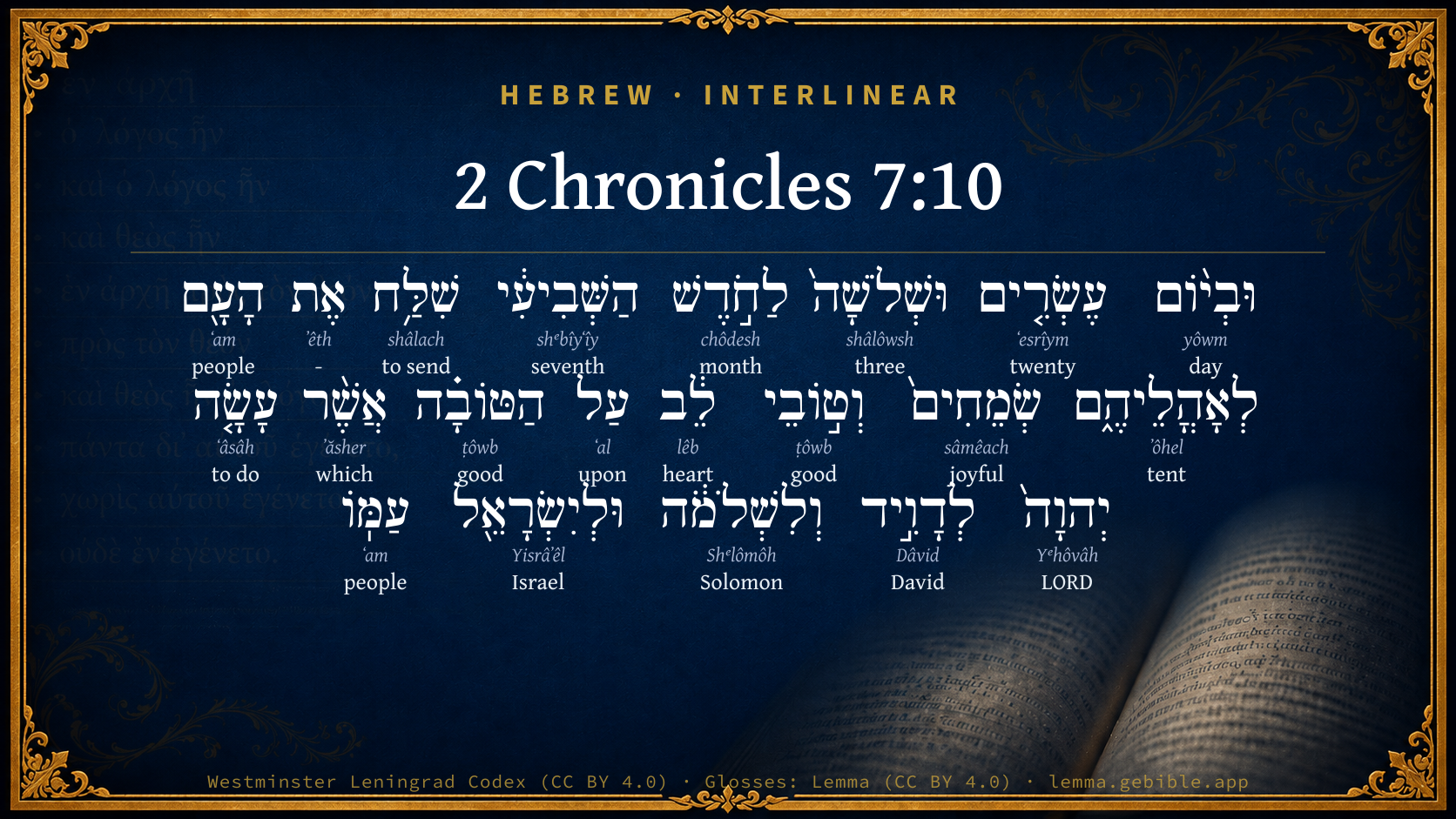
2 Chronicles 7:10

Hebrew (Westminster Leningrad Codex) 2 Chronicles 7:10 appears in the Hebrew Old Testament. The text above is from the Westminster Leningrad Codex. Each word links to its Strong’s number, a concise gloss, and parsing drawn from the Open Scriptures Hebrew Bible morphology. Click any word for its full Brown-Driver-Briggs (BDB) entry.
Download image
Cite this verse

2 Chronicles 7:10 (World English Bible). Public Domain. Lemma interlinear Bible study tool, https://lemma.gebible.app/v/2-chronicles/7/10.

Show BibTeX & RIS
BibTeX
RIS
English Translation
On the three and twentieth day of the seventh month he sent the people away to their tents, joyful and glad of heart for the goodness that Yahweh had shown to David, and to Solomon, and to Israel his people.
World English Bible · Public Domain
Download a study sheet

One document with this verse’s original text, its word-by-word gloss line, the meaning frame, cross-references with their text, attributed commentary, and full source and license credits — printable, and it pastes into notes with its structure intact.

This verse Autodidact and up

Study sheet (.html) Plain text (.txt)

A passage Seminary Student

Up to 50 verses in one chapter. A passage sheet keeps up to 6 commentary sources and 12 cross-references per verse, in the order this page ranks them, and says so on the sheet whenever that leaves anything out. Ask for a single verse and you get the Autodidact verse sheet above.

Everything on this page stays free to read, with no account — the sheet is a download of what is already on screen, not access to it.

Want to remove ads? Support Godless Engineer
Compare translations 3

The same verse in 3 English versions, stacked beneath the original-language interlinear above. Click any original word for its lexicon entry.

Each is an independent rendering of the whole verse — the interlinear is not word-aligned to these translations.

Highlighted words mark where these versions differ — a whole-verse word diff, not a word-by-word alignment.

  • World English Bible Public Domain
    On the three and twentieth day of the seventh month he sent the people away to their tents, joyful and glad of heart for the goodness that Yahweh had shown to David, and to Solomon, and to Israel his people.
  • King James Version Public Domain
    And on the three and twentieth day of the seventh month he sent the people away into their tents, glad and merry in heart for the goodness that the LORD had showed unto David, and to Solomon, and to Israel his people.
  • unfoldingWord Literal Text CC BY-SA 4.0
    And on the 23rd day of the seventh month, he sent away the people to their tents joyful and good of heart on account of the goodness which Yahweh did for David, and for Solomon, and for Israel his people.

unfoldingWord Literal Text — © unfoldingWord, licensed CC BY-SA 4.0. Word-aligned USFM3 via Door43 (git.door43.org/unfoldingWord/en_ult).

Versions to compare (up to 4)

3 of 4 selected

Show all 18 translations

Every available English version of this verse, each an independent rendering of the whole verse.

  • World English Bible Public Domain
    On the three and twentieth day of the seventh month he sent the people away to their tents, joyful and glad of heart for the goodness that Yahweh had shown to David, and to Solomon, and to Israel his people.
  • Berean Standard Bible Public Domain
    On the twenty-third day of the seventh month, Solomon sent the people away to their homes, joyful and glad of heart for the good things that the LORD had done for David, for Solomon, and for His people Israel.
  • Majority Standard Bible Public Domain
    On the twenty-third day of the seventh month, Solomon sent the people away to their homes, joyful and glad of heart for the good things that the LORD had done for David, for Solomon, and for His people Israel.
  • King James Version Public Domain
    And on the three and twentieth day of the seventh month he sent the people away into their tents, glad and merry in heart for the goodness that the LORD had showed unto David, and to Solomon, and to Israel his people.
  • American Standard Version (1901) Public Domain
    And on the three and twentieth day of the seventh month he sent the people away unto their tents, joyful and glad of heart for the goodness that Jehovah had showed unto David, and to Solomon, and to Israel his people.
  • Revised Version (1885) Public Domain
    And on the three and twentieth day of the seventh mouth he sent the people away unto their tents, joyful and glad of heart for the goodness that the LORD had shewed unto David, and to Solomon, and to Israel his people.
  • Geneva Bible (1599) Public Domain
    And the three and twentieth day of the seuenth moneth, he sent the people away into their tentes, ioyous and with glad heart, because of the goodnesse that the Lord had done for Dauid and for Salomon, and for Israel his people.
  • Douay-Rheims (1899) Public Domain
    So on the three and twentieth day of the seventh month he sent away the people to their dwellings, joyful and glad for the good that the Lord had done to David, and to Solomon, and to all Israel his people.
  • Young's Literal Translation Public Domain
    And on the twenty and third day of the seventh month he hath sent the people to their tents, rejoicing, and glad in heart, for the goodness that Jehovah hath done to David, and to Solomon, and to Israel His people.
  • Literal Standard Version CC BY-SA 4.0
    And on the twenty-third day of the seventh month he has sent the people to their tents, rejoicing, and glad in heart, for the goodness that YHWH has done to David, and to Solomon, and to His people Israel.
  • Unlocked Literal Bible CC BY-SA 4.0
    On the twenty-third day of the seventh month, Solomon sent the people away to their homes with glad and joyful hearts because of the goodness that Yahweh had shown to David, Solomon, and Israel, his people.
  • unfoldingWord Literal Text CC BY-SA 4.0
    And on the 23rd day of the seventh month, he sent away the people to their tents joyful and good of heart on account of the goodness which Yahweh did for David, and for Solomon, and for Israel his people.
  • Darby Bible Public Domain
    And on the three and twentieth day of the seventh month he sent the people away to their tents, joyful and glad of heart for the goodness that Jehovah had done to David and to Solomon, and to Israel his people.
  • World Messianic Bible Public Domain
    On the twenty-third day of the seventh month, he sent the people away to their tents, joyful and glad of heart for the goodness that the LORD had shown to David, to Solomon, and to Israel his people.
  • Webster's Bible Public Domain
    And on the three and twentieth day of the seventh month he sent the people away to their tents, glad and merry in heart for the goodness that the LORD had shown to David, and to Solomon, and to Israel his people.
  • Free Bible Version CC BY-SA 4.0
    On the twenty-third day of the seventh month, Solomon sent the people home. They were still celebrating and really happy for the goodness that the Lord had shown to David, to Solomon, and to his people Israel.
  • Bible in Basic English Public Domain
    And on the twenty-third day of the seventh month, he sent the people away to their tents, full of joy and glad in their hearts, because of all the good which the Lord had done to David and to Solomon and to Israel his people.
  • JPS Tanakh (1917) Public Domain
    And on the three and twentieth day of the seventh month he sent the people away unto their tents, joyful and glad of heart for the goodness that the LORD had shown unto David, and to Solomon, and to Israel His people.

Literal Standard Version (2020), Covenant Press — licensed CC BY-SA 4.0. Text via the HelloAO Bible API (eBible.org). Unlocked Literal Bible (unfoldingWord) — licensed CC BY-SA 4.0. Text via the HelloAO Bible API (eBible.org). unfoldingWord Literal Text — © unfoldingWord, licensed CC BY-SA 4.0. Word-aligned USFM3 via Door43 (git.door43.org/unfoldingWord/en_ult). Free Bible Version, Dr. Jonathan Gallagher — licensed CC BY-SA 4.0. Text via the HelloAO Bible API (eBible.org).

Word by word

More ways to search: Search by grammar → Find every occurrence → Compare this word →

Practice this passage: Drill this verse → Learn its vocabulary →

שְׂמֵחִים֙
sâmêach
H8056
“joyful”
Adjective, Adjective, Masculine, Plural, Absolute
Part of Speech
Adjective
Type
Adjective
Gender
Masculine
Number
Plural
State
Absolute
Full BDB Definition

Origin: from H8055

TWOT: 2268a

joyful, merry, glad - joyful, showing joy - you who rejoice (substantive)
  1. וּבְי֨וֹם yôwm H3117 “and · in/at · day of” Conjunction + Preposition + Noun, Common, Masculine, Singular, Construct
  2. עֶשְׂרִ֤ים ʻesrîym H6242 “twenty” Adjective, Cardinal number, Both, Plural, Absolute
  3. וּשְׁלֹשָׁה֙ shâlôwsh H7969 “and · three” Conjunction + Adjective, Cardinal number, Masculine, Singular, Absolute
  4. לַחֹ֣דֶשׁ chôdesh H2320 “to/for the · month” Preposition, Determined + Noun, Common, Masculine, Singular, Absolute
  5. הַשְּׁבִיעִ֔י shᵉbîyʻîy H7637 “the · seventh” Particle, Definite Article + Adjective, Ordinal number, Masculine, Singular, Absolute
  6. שִׁלַּ֥ח shâlach H7971 “to send” Verb, Piel, Perfect, 3rd Person, Masculine, Singular
  7. אֶת ʼêth H853 “-” Particle, Direct Object
  8. הָעָ֖ם ʻam H5971 “the · people” Particle, Definite Article + Noun, Common, Masculine, Singular, Absolute
  9. לְאָהֳלֵיהֶ֑ם ʼôhel H168 “to/for · tents · their” Preposition + Noun, Common, Masculine, Plural, Construct + Suffix, Personal, 3rd Person, Masculine, Plural
  10. וְט֣וֹבֵי ṭôwb H2896 “and · good of” Conjunction + Adjective, Adjective, Masculine, Plural, Construct
  11. לֵ֔ב lêb H3820 “heart” Noun, Common, Masculine, Singular, Absolute
  12. עַל ʻal H5921 “upon” Preposition
  13. הַטּוֹבָ֗ה ṭôwb H2896 “the · good” Particle, Definite Article + Adjective, Adjective, Feminine, Singular, Absolute
  14. אֲשֶׁ֨ר ʼăsher H834 “which” Particle, Relative
  15. עָשָׂ֤ה ʻâsâh H6213 “to do” Verb, Qal, Perfect, 3rd Person, Masculine, Singular
  16. יְהוָה֙ Yᵉhôvâh H3068 “LORD” Noun, Proper
  17. לְדָוִ֣יד Dâvid H1732 “to/for · David” Preposition + Noun, Proper
  18. וְלִשְׁלֹמֹ֔ה Shᵉlômôh H8010 “and · to/for · Solomon” Conjunction + Preposition + Noun, Proper
  19. וּלְיִשְׂרָאֵ֖ל Yisrâʼêl H3478 “and · to/for · Israel” Conjunction + Preposition + Noun, Proper
  20. עַמּֽוֹ ʻam H5971 “people · his” Noun, Common, Masculine, Singular, Construct + Suffix, Personal, 3rd Person, Masculine, Singular

About this verse

These counts appear in no published source. They are computed here, from the morphology-tagged text and Lemma’s own curated glosses. What Lemma adds →

21
words
19
distinct lemmas
Historical
section

Notable vocabulary

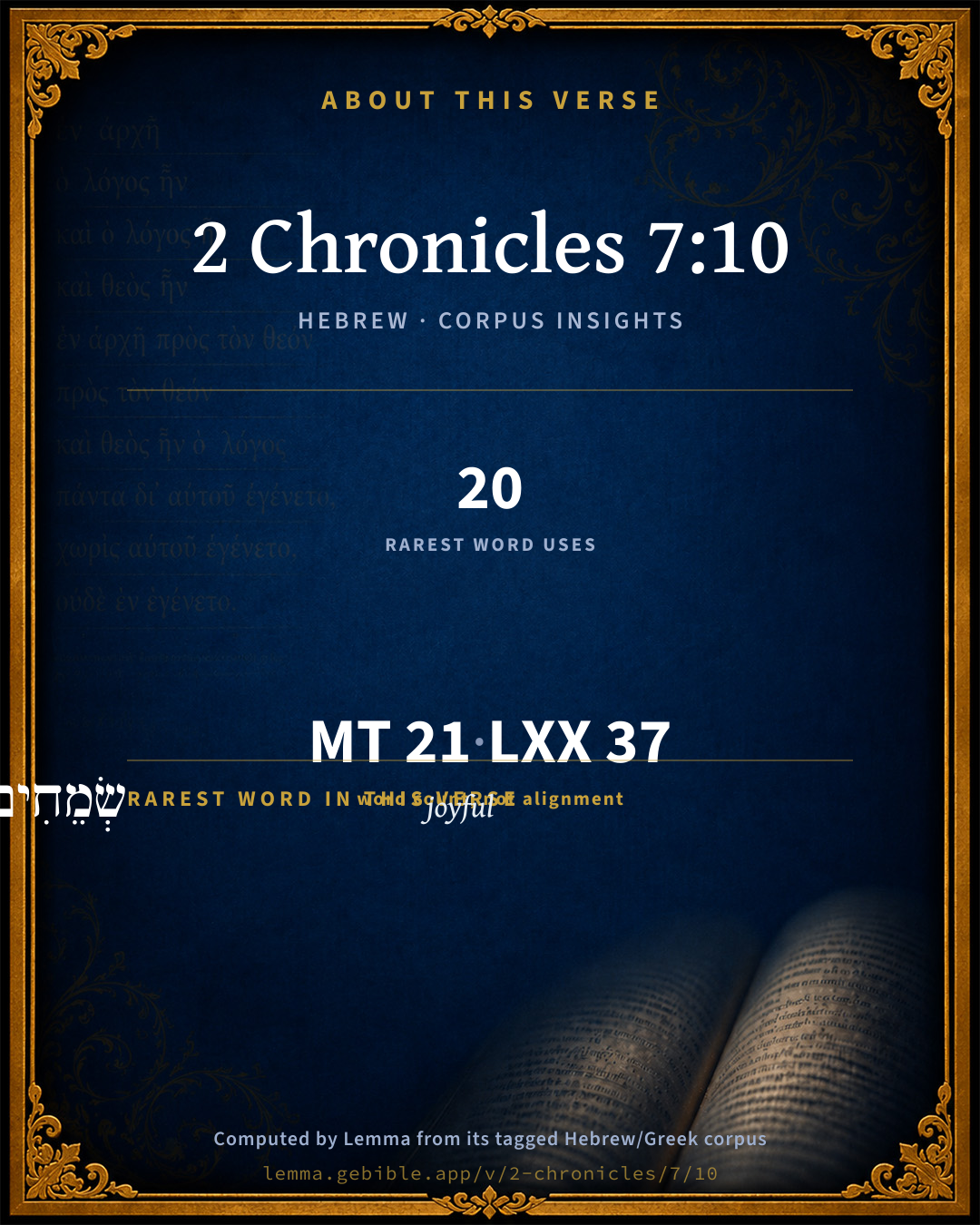
The rarest word here is שְׂמֵחִים֙ joyful H8056 — appearing just 20 times in the whole Hebrew Bible.

Shared distinctive vocabulary

שְׂמֵחִים֙ joyful H8056 occurs in 20 verses of the Hebrew Bible. Also found in:

Grammatical profile

  • 2 verbs
  • 10 nouns
  • 6 adjectives
  • 1 preposition
  • 2 particles

Verb forms

  • שִׁלַּ֥ח Piel · Perfect
  • עָשָׂ֤ה Qal · Perfect

Repetition

Words recur within this verse — often emphatic in Hebrew:

  • הָעָ֖ם people H5971 ×2
  • וְט֣וֹבֵי good H2896 ×2

Hebrew & Septuagint length

In English translation the verse runs 40 words from the Hebrew and 42 from the Septuagint (LXX English) — closely comparable.

A rough comparison of the two English renderings, which tokenize alike — not a word-level alignment.

Word counts can differ between the Hebrew and the Greek without any difference in meaning — e.g. the Hebrew direct-object marker אֵת has no separate Greek word, and Greek often adds the article ὁ.

In the original languages it is 21 Hebrew tokens and 37 Greek tokens — but the two are counted differently (Hebrew bundles its prefixes and suffixes into one token; the Greek is in lemma form), so that isn’t a like-for-like length.

Cross-references

19

Topical passages linked to 2 Chronicles 7:10 in the Treasury of Scripture Knowledge — connected by theme and wording, ordered by reader-vote popularity; previews shown in the World English Bible.

  • 1 Kings 8:66 On the eighth day he sent the people away; and they blessed the king, and went to their tents joyful and glad of heart for all the goodness that Yahweh had shown to David his servant, and to Israel his people.
  • Psalms 100:2 Serve Yahweh with gladness. Come before his presence with singing.
  • Exodus 18:1 Now Jethro, the priest of Midian, Moses' father-in-law, heard of all that God had done for Moses, and for Israel his people, how that Yahweh had brought Israel out of Egypt.
  • Deuteronomy 12:7 and there you shall eat before Yahweh your God, and you shall rejoice in all that you put your hand to, you and your households, in which Yahweh your God has blessed you.
  • Deuteronomy 12:12 You shall rejoice before Yahweh your God, you, and your sons, and your daughters, and your men-servants, and your maid-servants, and the Levite who is within your gates, because he has no portion nor inheritance with you.
  • Deuteronomy 12:18 but you shall eat them before Yahweh your God in the place which Yahweh your God shall choose, you, and your son, and your daughter, and your man-servant, and your maid-servant, and the Levite who is within your gates: and you shall rejoice before Yahweh your God in all that you put your hand to.
  • Deuteronomy 16:11 and you shall rejoice before Yahweh your God, you, and your son, and your daughter, and your man-servant, and your maid-servant, and the Levite who is within your gates, and the foreigner, and the fatherless, and the widow, who are in the midst of you, in the place which Yahweh your God shall choose, to cause his name to dwell there.
  • Deuteronomy 16:14 and you shall rejoice in your feast, you, and your son, and your daughter, and your man-servant, and your maid-servant, and the Levite, and the foreigner, and the fatherless, and the widow, who are within your gates.
  • 2 Chronicles 6:41 Now therefore arise, Yahweh God, into your resting-place, you, and the ark of your strength: let your priests, Yahweh God, be clothed with salvation, and let your saints rejoice in goodness.
  • 2 Chronicles 29:36 Hezekiah rejoiced, and all the people, because of that which God had prepared for the people: for the thing was done suddenly.
  • 2 Chronicles 30:26 So there was great joy in Jerusalem; for since the time of Solomon the son of David king of Israel there was not the like in Jerusalem.
  • Nehemiah 8:10 Then he said to them, Go your way, eat the fat, and drink the sweet, and send portions to him for whom nothing is prepared; for this day is holy to our Lord: neither be you grieved; for the joy of Yahweh is your strength.
  • Psalms 32:11–33:1 Be glad in Yahweh, and rejoice, you righteous! Shout for joy, all you who are upright in heart!
  • Psalms 92:4 For you, Yahweh, have made me glad through your work. I will triumph in the works of your hands.
  • Psalms 105:3 Glory in his holy name. Let the heart of those who seek Yahweh rejoice.
  • Acts 2:46 Day by day, continuing steadfastly with one accord in the temple, and breaking bread at home, they took their food with gladness and singleness of heart,
  • Acts 16:34 He brought them up into his house, and set food before them, and rejoiced greatly, with all his household, having believed in God.
  • Philippians 4:4 Rejoice in the Lord always! Again I will say, Rejoice!
  • Psalms 106:5 That I may see the prosperity of your chosen, That I may rejoice in the gladness of your nation, That I may glory with your inheritance.

Cross-references courtesy of OpenBible.info (CC BY 4.0).

Hebrew and Greek witnesses Masoretic Hebrew ↔ Greek Septuagint

The same verse in the two great witnesses to the Old Testament, shown verse-for-verse.

These are two independent witnesses, not word-aligned to each other, and the Septuagint is shown in lemma (dictionary) form.

Hebrew 2 Chronicles 7:10 Masoretic · Westminster Leningrad Codex

וּבְי֨וֹם עֶשְׂרִ֤ים וּשְׁלֹשָׁה֙ לַחֹ֣דֶשׁ הַשְּׁבִיעִ֔י שִׁלַּ֥ח אֶת הָעָ֖ם לְאָהֳלֵיהֶ֑ם שְׂמֵחִים֙ וְט֣וֹבֵי לֵ֔ב עַל הַטּוֹבָ֗ה אֲשֶׁ֨ר עָשָׂ֤ה יְהוָה֙ לְדָוִ֣יד וְלִשְׁלֹמֹ֔ה וּלְיִשְׂרָאֵ֖ל עַמּֽוֹ

On the three and twentieth day of the seventh month he sent the people away to their tents, joyful and glad of heart for the goodness that Yahweh had shown to David, and to Solomon, and to Israel his people.

World English Bible · Public Domain

Greek LXX 2 Chronicles 7:10 Septuagint · lemma form

καί ἐν ὁ τρίτος καί εἰκοστός ὁ μήν ὁ ἕβδομος ἀποστέλλω ὁ λαός εἰς ὁ σκήνωμα αὐτός εὐφραίνω καί ἀγαθός καρδία ἐπί ὁ ἀγαθός ὅς ποιέω κύριος ὁ δαυίδ καί ὁ σαλωμών καί ὁ ἰσραήλ λαός αὐτός

And on the twenty-third day of the seventh month he dismissed the people to their tents, rejoicing, and with a glad heart because of the good deeds which the Lord had done to David, and to Solomon, and to Israel his people.

LXX2012 (modern English Septuagint) · Public Domain

Hebrew: Westminster Leningrad Codex (CC BY 4.0). Greek: Septuagint (public domain); English from LXX2012 (modern English Septuagint) (Public Domain). How the Septuagint differs from the Hebrew →

Commentary

Notes on 2 Chronicles 7:10 from classic Christian and Jewish commentators (each source and its license shown beneath its notes). The classic Christian expositions comment on the surrounding passage and are grouped to its opening verse, so a note may address several verses; the Jewish commentaries on the Tanakh (Rashi and others) are per-verse, so they appear only where the commentator wrote on this verse.

Lemma curates 59 commentaries, every one of them public domain or Creative Commons licensed, each selected and text-cleaned for this edition rather than reprinted as found. About our sources →

Trapp's Complete Commentary

John Trapp

2Ch 7:10 And on the three and twentieth day of the seventh month he sent the people away into their tents, glad and merry in heart for the goodness that the LORD had shewed unto David, and to Solomon, and to Israel his people.

Ver. 10. And on the three and twentieth day.] On the two and twentieth he dismissed those that dwelt within a Sabbath day’s journey. {1Ki 8:66}

John Trapp, A Commentary or Exposition upon All the Books of the Old and New Testament (1647–1656) — public domain. Text from a community e-Sword module.

Joseph Benson's Commentary

2Ch 7:10. On the three and twentieth day of the seventh month, he sent the people away — They kept the feast of the dedication of the altar seven days, from the second to the ninth; the tenth day was the day of atonement, when they were to afflict their souls for sin, and that was not unseasonable in the midst of their rejoicings: then on the fifteenth began the feast of tabernacles, which continued to the twenty-second, and thus they continued to be employed in sacred services, and did not part till the twenty-third. We ought never to grudge the time that we spend in the worship of God, and in communion with him, nor think it long, or grow weary of it. Glad and merry in heart for the goodness, &c. — That is, according to the Targum, “for the goodness of the Lord shown unto David, in opening the doors of the sanctuary; and unto Solomon, whose prayer God had accepted, and had honoured with his presence in the house which he had built; and unto his people Israel, in his acceptance of their sacrifices, and sending down fire from heaven to consume them.”

Joseph Benson's Commentary on the Old and New Testaments (1811–1818) — public domain. Text from a community e-Sword module.

Geneva Bible (1599)

Geneva Bible translators

They had leave to depart the two and twentieth day, 1 Kings 8:66, but they went not away till the next day.

Geneva Bible (1599) marginal notes — public domain. Text via Bolls.life.

Jamieson, Fausset & Brown

Robert Jamieson, A. R. Fausset & David Brown

on the three and twentieth day of the seventh month--This was the last day of the feast of tabernacles.

Jamieson, Fausset & Brown — Commentary Critical and Explanatory on the Whole Bible (1871) — public domain (CC PDM 1.0). Text via the HelloAO Bible API.

Adam Clarke's Commentary

Verse 10. On the three and twentieth day] This was the ninth day of the dedication of the temple; but in 1Kg 8:66 it is called the eighth day. "The meaning is this," says Jarchi: "he gave them liberty to return on the eighth day, and many of them did then return: and he dismissed the remainder on the ninth, what is called here the twenty-third, reckoning the fourteen days for the duration of the two feasts; in all, twenty-three."

The Targum paraphrases this verse thus: "The people departed with a glad heart, for all the good which God had done to David his servant, on whose account the doors of the sanctuary were open and for Solomon his son, because God had heard his prayer, and the majesty of the Lord had rested on the house of the sanctuary and for Israel, his people, because God had favourably accepted their oblations, and the heavenly fire had descended, and, burning on the altar, had devoured their sacrifices."

Adam Clarke's Commentary on the Bible (1810–1826) — public domain. Text from a community e-Sword/MySword module.

Ellicott's Commentary for English Readers

(10) And on the three and twentieth day of the seventh month.—Beginning with the evening of the twenty-second.

For the goodness.—Some MSS., Syriac, and Arabic, “for all the goodness,” as in 1Ki_8:66.

David, and to Solomon.—Kings, “David his servant.” The mention of Solomon was added by the chronicler. (Comp. 2Ch_6:4; 2Ch_6:8; 2Ch_6:15-17; 2Ch_6:42, where all Solomon’s success is connected with the premise to David.)

A Bible Commentary for English Readers, edited by Charles John Ellicott (1878–1897) — public domain. Text from a community e-Sword module.

The Cambridge Bible for Schools and Colleges

gen. ed. J. J. S. Perowne

10. into their tents] R.V. unto their tents (as 1Ki_8:66). The Hebrew word (ohel) here approaches in meaning the corresponding Arabic word (ahl), which denotes household or one’s own people, e.g. in the phrase ahlu ’linjil, “the household of the Gospel,” i.e. “the Christians” a phrase found in the Koran. Cp. 2Ch_10:16; 2Ch_25:22.

glad and merry in heart] R.V. joyful and glad of heart (as in 1Ki_8:66).

The Cambridge Bible for Schools and Colleges (gen. ed. J. J. S. Perowne; Cambridge University Press, 1878–1918) — public domain. Text from a community e-Sword module.

Haydock's Catholic Bible Commentary

Day. He had given them leave to depart, the day before, 3 Kings viii. 66.

George Leo Haydock (1774–1849), Haydock's Catholic Family Bible and Commentary, 1859 edition — public domain. Excludes Psalms (Douay-Rheims chapter numbering differs from Protestant) and Deuterocanonical books (Catholic canon only).

Scofield Reference Notes

C. I. Scofield

seventh month

i.e. October.

The Scofield Reference Bible (1917 edition), notes by C. I. Scofield — public domain. Text from a community e-Sword module.

Rashi

Rabbi Shlomo Yitzchaki (Rashi)

And on the twenty-third day of the seventh month, he dismissed the people which was the ninth [day] of the inauguration of the Temple, but in I Kings (8:66) it is written: “On the eighth day,” which was the twenty-second of the month. The meaning is: On the eighth day he gave them permission to leave after the Feast, and on the morrow, when the Feast was over, they all went [home] together. Another meaning: On the eighth day he gave them permission and dismissed those who lived within the Sabbath limits and whoever wished to travel and go on that day in that limit, and on the following day, he dismissed the entire populace. In Genesis Rabbah (35:3) it is explained that they took his leave but waited there one more day and then they repeated [this procedure] and took leave again a second time; therefore it is said: “on the twenty-third day of the month.”

rejoicing and delighted of heart, etc. for David, for Solomon For that which He spoke with His mouth above (I Chron 28:6): “Your son Solomon - he shall build My House,” He fulfilled with His hand, for He gave him a son sitting on his throne, who built a House in the name of the Lord. And in Genesis Rabbah it is explained: Said Rabbi Levi: It is written: “for the inauguration of, etc.” “Rejoicing” refers to “that the Lord had wrought for David,” viz. that He fulfilled that which He had vowed to Solomon, that He chose him from all his brothers because he was wise.

and for Israel His people it is written in I Kings (8:56): “there has not failed one word, etc.” Another explanation: “and for Israel His people” - they had a ruler, so that they dwelt safely and tranquilly, as it is written (ibid. 5:5): “And Judah and Israel dwelt, etc.”

Rashi on the Tanakh — English translations: “The Judaica Press complete Tanach with Rashi, translated by A. J. Rosenberg” (CC BY 4.0); “Pentateuch with Rashi's commentary by M. Rosenbaum and A.M. Silbermann, 1929-1934” (public domain); “The Metsudah Tanach series, Lakewood, N.J” (CC BY 4.0); and “The Book of Joshua, Metsudah Publications, 1997” (CC BY 4.0). Text via Sefaria.

Lesson kit

Teaching starters — assembled from the data on this page, not authored interpretation. Every prompt links to the verse data it draws on. Edit before teaching.

2 Chronicles, in the Historical, opens this verse with 21 words (19 distinct Hebrew lemmas). Its most distinctive word is sâmêach (“joyful”). A historical commentator’s framing appears above. Read the whole chapter for the surrounding context.

Discussion questions

  1. What does “joyful” (sâmêach) contribute to the verse as a whole?
  2. Deuteronomy 16:15 shares the word «joyful» with this verse. How do the two illuminate each other?
  3. “people” occurs 2× in this one verse. What is the effect of the repetition?
  4. The translations on this page render this verse differently — a whole-verse word diff, not a word-by-word alignment. What might account for the different wordings?
  5. The verb «שִׁלַּ֥ח» is Piel Perfect. How does its form color the action?
  6. Reading how Trapp's Complete Commentary and Joseph Benson's Commentary read this verse, where do the two commentators agree and where do they part?

Things to notice

Reading settings

Reading text

Shown beneath each verse's original-language words.

Old Testament
Old Testament edition

Read the OT as the Masoretic Hebrew (MT) or the Greek Septuagint (LXX).

English shown for the Greek Septuagint (in the Hebrew ↔ Greek comparison).

Comparing translations? Open the Compare panel on any verse page to stack up to four side by side.