
2 Chronicles 16:14

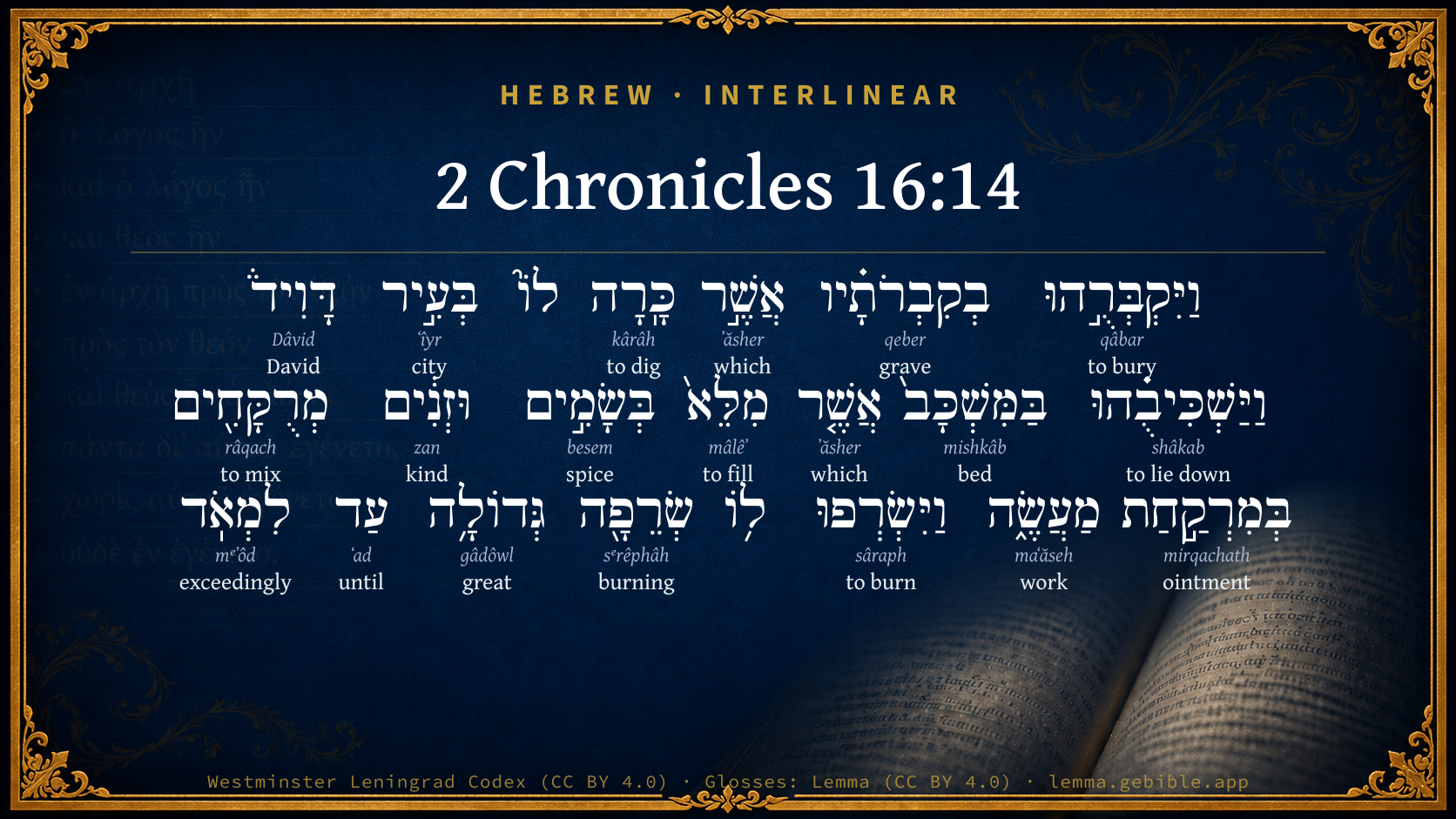
Hebrew (Westminster Leningrad Codex) 2 Chronicles 16:14 appears in the Hebrew Old Testament. The text above is from the Westminster Leningrad Codex. Each word links to its Strong’s number, a concise gloss, and parsing drawn from the Open Scriptures Hebrew Bible morphology. Click any word for its full Brown-Driver-Briggs (BDB) entry.
Download image
Cite this verse

2 Chronicles 16:14 (World English Bible). Public Domain. Lemma interlinear Bible study tool, https://lemma.gebible.app/v/2-chronicles/16/14.

Show BibTeX & RIS
BibTeX
RIS
English Translation
They buried him in his own tombs, which he had hewn out for himself in the city of David, and laid him in the bed which was filled with sweet odors and various kinds [of spices] prepared by the perfumers' are: and they made a very great burning for him.
World English Bible · Public Domain
Highlights
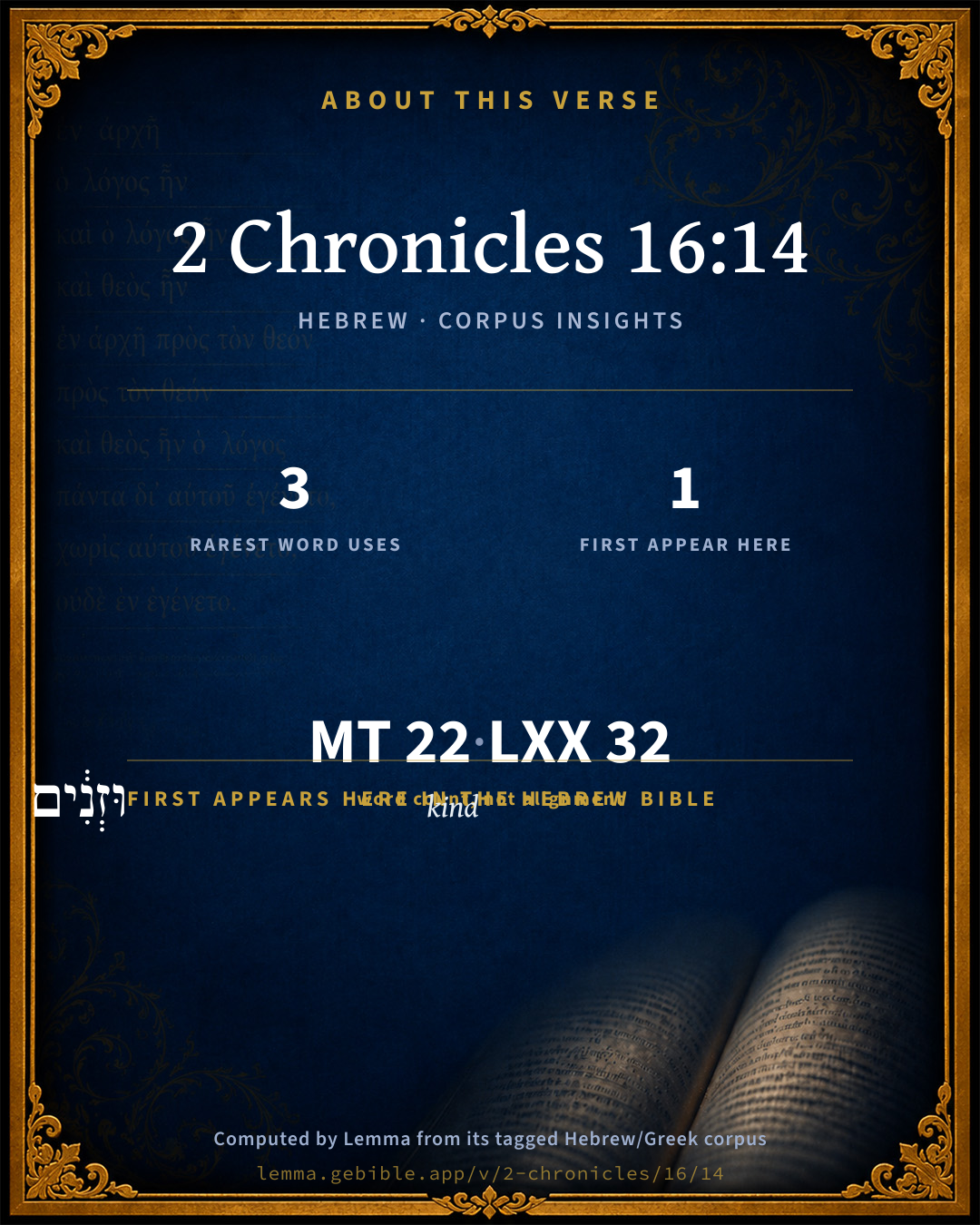
  • 1 first appearance in the Hebrew Bible
Full analysis ↓
Download a study sheet

One document with this verse’s original text, its word-by-word gloss line, the meaning frame, cross-references with their text, attributed commentary, and full source and license credits — printable, and it pastes into notes with its structure intact.

This verse Autodidact and up

Study sheet (.html) Plain text (.txt)

A passage Seminary Student

Up to 50 verses in one chapter. A passage sheet keeps up to 6 commentary sources and 12 cross-references per verse, in the order this page ranks them, and says so on the sheet whenever that leaves anything out. Ask for a single verse and you get the Autodidact verse sheet above.

Everything on this page stays free to read, with no account — the sheet is a download of what is already on screen, not access to it.

Want to remove ads? Support Godless Engineer
Compare translations 3

The same verse in 3 English versions, stacked beneath the original-language interlinear above. Click any original word for its lexicon entry.

Each is an independent rendering of the whole verse — the interlinear is not word-aligned to these translations.

Highlighted words mark where these versions differ — a whole-verse word diff, not a word-by-word alignment.

  • World English Bible Public Domain
    They buried him in his own tombs, which he had hewn out for himself in the city of David, and laid him in the bed which was filled with sweet odors and various kinds [of spices] prepared by the perfumers' are: and they made a very great burning for him.
  • King James Version Public Domain
    And they buried him in his own sepulchres, which he had made for himself in the city of David, and laid him in the bed which was filled with sweet odorous and divers kinds of spices prepared by the apothecaries' art: and they made a very great burning for him.
  • unfoldingWord Literal Text CC BY-SA 4.0
    And they buried him in his graves, which he hollowed out for himself in the city of David. And they laid him on a bed which he filled with spices and kinds of mixtures with an ointment mixture of a work. And they burned for him a great burning until abundance.

unfoldingWord Literal Text — © unfoldingWord, licensed CC BY-SA 4.0. Word-aligned USFM3 via Door43 (git.door43.org/unfoldingWord/en_ult).

Versions to compare (up to 4)

3 of 4 selected

Show all 18 translations

Every available English version of this verse, each an independent rendering of the whole verse.

  • World English Bible Public Domain
    They buried him in his own tombs, which he had hewn out for himself in the city of David, and laid him in the bed which was filled with sweet odors and various kinds [of spices] prepared by the perfumers' are: and they made a very great burning for him.
  • Berean Standard Bible Public Domain
    And he was buried in the tomb that he had cut out for himself in the City of David. They laid him on a bier that was full of spices and various blended perfumes; then they made a great fire in his honor.
  • Majority Standard Bible Public Domain
    And he was buried in the tomb that he had cut out for himself in the City of David. They laid him on a bier that was full of spices and various blended perfumes; then they made a great fire in his honor.
  • King James Version Public Domain
    And they buried him in his own sepulchres, which he had made for himself in the city of David, and laid him in the bed which was filled with sweet odorous and divers kinds of spices prepared by the apothecaries' art: and they made a very great burning for him.
  • American Standard Version (1901) Public Domain
    And they buried him in his own sepulchres, which he had hewn out for himself in the city of David, and laid him in the bed which was filled with sweet odors and divers kinds `of spices' prepared by the perfumers' art: and they made a very great burning for him.
  • Revised Version (1885) Public Domain
    And they buried him in his own sepulchres, which he had hewn out for himself in the city of David, and laid him in the bed which was filled with sweet odours and divers kinds of spices prepared by the apothecaries’ art: and they made a very great burning for him.
  • Geneva Bible (1599) Public Domain
    And they buryed him in one of his sepulchres, which he had made for him selfe in the citie of Dauid, and layed him in the bed, which they had filled with sweete odours and diuers kindes of spices made by the arte of the apoticarie: and they burnt odours for him with an exceeding great fire.
  • Douay-Rheims (1899) Public Domain
    And they buried him in his own sepulchre, which he had made for himself in the city of David: and they laid him on his bed full of spices and odoriferous ointments, which were made by the art of the perfumers, and they burnt them over him with very great pomp.
  • Young's Literal Translation Public Domain
    and they bury him in `one of' his graves, that he had prepared for himself in the city of David, and they cause him to lie on a bed that `one' hath filled `with' spices, and divers kinds of mixtures, with perfumed work; and they burn for him a burning -- very great.
  • Literal Standard Version CC BY-SA 4.0
    and they bury him in [one of] his graves that he had prepared for himself in the City of David, and they cause him to lie on a bed that [one] has filled [with] spices, and various kinds of mixtures, with perfumed work; and they burn a very great burning for him.
  • Unlocked Literal Bible CC BY-SA 4.0
    They buried him in his own tomb, which he had dug out for himself in the city of David. They laid him on a bier that was filled with sweet odors and various kinds of spices prepared by skilled perfumers. Then they made a very great fire in his honor.
  • unfoldingWord Literal Text CC BY-SA 4.0
    And they buried him in his graves, which he hollowed out for himself in the city of David. And they laid him on a bed which he filled with spices and kinds of mixtures with an ointment mixture of a work. And they burned for him a great burning until abundance.
  • Darby Bible Public Domain
    And they buried him in his own sepulchre, which he had excavated for himself in the city of David, and laid him in a bed filled with spices, a mixture of divers kinds prepared by the perfumer's art; and they made a very great burning for him.
  • World Messianic Bible Public Domain
    They buried him in his own tomb, which he had dug out for himself in David’s city, and laid him in the bed which was filled with sweet odors and various kinds of spices prepared by the perfumers’ art; and they made a very great fire for him.
  • Webster's Bible Public Domain
    And they buried him in his own sepulchers which he had made for himself in the city of David, and laid him in the bed which was filled with sweet odors and divers kinds of spices prepared by the apothecaries' art: and they made a very great burning for him.
  • Free Bible Version CC BY-SA 4.0
    He was buried in the tomb that he had prepared for himself in the City of David. They placed him on a bed full of spices, perfumed oils, and fragrances. Then they made a great fire to honor him.
  • Bible in Basic English Public Domain
    And they put him into the resting-place which he had made for himself in the town of David, in a bed full of sweet perfumes of all sorts of spices, made by the perfumer's art, and they made a great burning for him.
  • JPS Tanakh (1917) Public Domain
    And they buried him in his own sepulchres, which he had hewn out for himself in the city of David, and laid him in the bed which was filled with sweet odours and divers kinds of spices prepared by the perfumers' art; and they made a very great burning for him.

Literal Standard Version (2020), Covenant Press — licensed CC BY-SA 4.0. Text via the HelloAO Bible API (eBible.org). Unlocked Literal Bible (unfoldingWord) — licensed CC BY-SA 4.0. Text via the HelloAO Bible API (eBible.org). unfoldingWord Literal Text — © unfoldingWord, licensed CC BY-SA 4.0. Word-aligned USFM3 via Door43 (git.door43.org/unfoldingWord/en_ult). Free Bible Version, Dr. Jonathan Gallagher — licensed CC BY-SA 4.0. Text via the HelloAO Bible API (eBible.org).

Word by word

More ways to search: Search by grammar → Find every occurrence → Compare this word →

Practice this passage: Drill this verse → Learn its vocabulary →

וּזְנִ֔ים
zan
H2177
“and · kinds”
Conjunction + Noun, Common, Masculine, Plural, Absolute
Part of Speech
Conjunction + Noun
Type
Common
Gender
Masculine
Number
Plural
State
Absolute
Full BDB Definition

Origin: from H2109

TWOT: 561

kind, sort
  1. וַיִּקְבְּרֻ֣הוּ qâbar H6912 “and · to bury · him” Conjunction + Verb, Qal, Sequential Imperfect, 3rd Person, Masculine, Plural + Suffix, Personal, 3rd Person, Masculine, Singular
  2. בְקִבְרֹתָ֗יו qeber H6913 “in/at · graves · his” Preposition + Noun, Common, Masculine, Plural, Construct + Suffix, Personal, 3rd Person, Masculine, Singular
  3. אֲשֶׁ֣ר ʼăsher H834 “which” Particle, Relative
  4. כָּֽרָה kârâh H3738 “to dig” Verb, Qal, Perfect, 3rd Person, Masculine, Singular
  5. בְּעִ֣יר ʻîyr H5892 “in/at · city of” Preposition + Noun, Common, Feminine, Singular, Construct
  6. דָּוִיד֒ Dâvid H1732 “David” Noun, Proper
  7. וַיַּשְׁכִּיבֻ֗הוּ shâkab H7901 “and · to lie down · him” Conjunction + Verb, Hiphil, Sequential Imperfect, 3rd Person, Masculine, Plural + Suffix, Personal, 3rd Person, Masculine, Singular
  8. בַּמִּשְׁכָּב֙ mishkâb H4904 “in/at the · bed” Preposition, Determined + Noun, Common, Masculine, Singular, Absolute
  9. אֲשֶׁ֤ר ʼăsher H834 “which” Particle, Relative
  10. מִלֵּא֙ mâlêʼ H4390 “to fill” Verb, Piel, Perfect, 3rd Person, Masculine, Singular
  11. בְּשָׂמִ֣ים besem H1314 “spices” Noun, Common, Masculine, Plural, Absolute
  12. מְרֻקָּחִ֖ים râqach H7543 “mixed” Verb, Pual, Participle Passive, Masculine, Plural, Absolute
  13. בְּמִרְקַ֣חַת mirqachath H4842 “in/at · ointment of” Preposition + Noun, Common, Feminine, Singular, Construct
  14. מַעֲשֶׂ֑ה maʻăseh H4639 “work” Noun, Common, Masculine, Singular, Absolute
  15. וַיִּשְׂרְפוּ sâraph H8313 “and · to burn” Conjunction + Verb, Qal, Sequential Imperfect, 3rd Person, Masculine, Plural
  16. שְׂרֵפָ֖ה sᵉrêphâh H8316 “burning” Noun, Common, Feminine, Singular, Absolute
  17. גְּדוֹלָ֥ה gâdôwl H1419 “great” Adjective, Adjective, Feminine, Singular, Absolute
  18. עַד ʻad H5704 “until” Preposition
  19. לִמְאֹֽד mᵉʼôd H3966 “to/for · exceedingly” Preposition + Noun, Common, Masculine, Singular, Absolute

About this verse

These counts appear in no published source. They are computed here, from the morphology-tagged text and Lemma’s own curated glosses. What Lemma adds →

22
words
19
distinct lemmas
Historical
section

Notable vocabulary

The rarest word here is וּזְנִ֔ים kind H2177 — appearing just 3 times in the whole Hebrew Bible.

First appearance in Scripture

This word makes its first canonical appearance in the Hebrew Bible here:

  • וּזְנִ֔ים kind H2177

Shared distinctive vocabulary

וּזְנִ֔ים kind H2177 occurs in 2 verses of the Hebrew Bible. Also found in:

Grammatical profile

  • 6 verbs
  • 10 nouns
  • 1 adjective
  • 3 prepositions
  • 2 particles

Verb forms

  • וַיִּקְבְּרֻ֣הוּ Qal · Sequential Imperfect
  • כָּֽרָה Qal · Perfect
  • וַיַּשְׁכִּיבֻ֗הוּ Hiphil · Sequential Imperfect
  • מִלֵּא֙ Piel · Perfect
  • מְרֻקָּחִ֖ים Pual · Participle Passive
  • וַיִּשְׂרְפוּ Qal · Sequential Imperfect

Repetition

A word recurs within this verse — often emphatic in Hebrew:

  • אֲשֶׁ֣ר which H834 ×2

Hebrew & Septuagint length

In English translation the verse runs 50 words from the Hebrew and 47 from the Septuagint (LXX English) — closely comparable.

A rough comparison of the two English renderings, which tokenize alike — not a word-level alignment.

Word counts can differ between the Hebrew and the Greek without any difference in meaning — e.g. the Hebrew direct-object marker אֵת has no separate Greek word, and Greek often adds the article ὁ.

In the original languages it is 22 Hebrew tokens and 32 Greek tokens — but the two are counted differently (Hebrew bundles its prefixes and suffixes into one token; the Greek is in lemma form), so that isn’t a like-for-like length.

Cross-references

9

Topical passages linked to 2 Chronicles 16:14 in the Treasury of Scripture Knowledge — connected by theme and wording, ordered by reader-vote popularity; previews shown in the World English Bible.

  • Genesis 50:2 Joseph commanded his servants, the physicians, to embalm his father; and the physicians embalmed Israel.
  • 2 Chronicles 21:19 It happened, in process of time, at the end of two years, that his bowels fell out by reason of his sickness, and he died of sore diseases. His people made no burning for him, like the burning of his fathers.
  • Jeremiah 34:5 you shall die in peace; and with the burnings of your fathers, the former kings who were before you, so shall they make a burning for you; and they shall lament you, [saying], Ah Lord! for I have spoken the word, says Yahweh.
  • Mark 16:1 When the Sabbath was past, Mary Magdalene, and Mary the mother of James, and Salome, bought spices, that they might come and anoint him.
  • Exodus 30:25–37 You shall make it a holy anointing oil, a perfume compounded after the art of the perfumer: it shall be a holy anointing oil.
  • 2 Chronicles 35:24 So his servants took him out of the chariot, and put him in the second chariot that he had, and brought him to Jerusalem; and he died, and was buried in the tombs of his fathers. All Judah and Jerusalem mourned for Josiah.
  • Ecclesiastes 10:1 Dead flies cause the oil of the perfumer to send forth an evil odor; so does a little folly outweigh wisdom and honor.
  • Isaiah 22:16 "What are you doing here? and who has you here, that you have hewed out a tomb here? Cutting him out a tomb on high, chiseling a habitation for himself in the rock!"
  • John 19:39–42 Nicodemus, who at first came to Jesus by night, also came bringing a mixture of myrrh and aloes, about a hundred pounds.

Cross-references courtesy of OpenBible.info (CC BY 4.0).

Hebrew and Greek witnesses Masoretic Hebrew ↔ Greek Septuagint

The same verse in the two great witnesses to the Old Testament, shown verse-for-verse.

These are two independent witnesses, not word-aligned to each other, and the Septuagint is shown in lemma (dictionary) form.

Hebrew 2 Chronicles 16:14 Masoretic · Westminster Leningrad Codex

וַיִּקְבְּרֻ֣הוּ בְקִבְרֹתָ֗יו אֲשֶׁ֣ר כָּֽרָה לוֹ֮ בְּעִ֣יר דָּוִיד֒ וַיַּשְׁכִּיבֻ֗הוּ בַּמִּשְׁכָּב֙ אֲשֶׁ֤ר מִלֵּא֙ בְּשָׂמִ֣ים וּזְנִ֔ים מְרֻקָּחִ֖ים בְּמִרְקַ֣חַת מַעֲשֶׂ֑ה וַיִּשְׂרְפוּ ל֥וֹ שְׂרֵפָ֖ה גְּדוֹלָ֥ה עַד לִמְאֹֽד

They buried him in his own tombs, which he had hewn out for himself in the city of David, and laid him in the bed which was filled with sweet odors and various kinds [of spices] prepared by the perfumers' are: and they made a very great burning for him.

World English Bible · Public Domain

Greek LXX 2 Chronicles 16:14 Septuagint · lemma form

καί θάπτω αὐτός ἐν ὁ μνῆμα ὅς ὀρύσσω ἑαυτοῦ ἐν πόλις δαυίδ καί κοιμίζω αὐτός ἐπί ὁ κλίνη καί πίμπλημι ἄρωμα καί γένος μύρον μυρεψός καί ποιέω αὐτός ἐκφορά μέγας ἕως σφόδρα

And they buried him in the sepulchre which he had dug for himself in the city of David, and they laid him on a bed, and filled it with spices and all kinds of perfumes of the apothecaries; and they made for him a very great funeral.

LXX2012 (modern English Septuagint) · Public Domain

Hebrew: Westminster Leningrad Codex (CC BY 4.0). Greek: Septuagint (public domain); English from LXX2012 (modern English Septuagint) (Public Domain). How the Septuagint differs from the Hebrew →

Commentary

Notes on 2 Chronicles 16:14 from classic Christian and Jewish commentators (each source and its license shown beneath its notes). The classic Christian expositions comment on the surrounding passage and are grouped to its opening verse, so a note may address several verses; the Jewish commentaries on the Tanakh (Rashi and others) are per-verse, so they appear only where the commentator wrote on this verse.

Lemma curates 59 commentaries, every one of them public domain or Creative Commons licensed, each selected and text-cleaned for this edition rather than reprinted as found. About our sources →

Trapp's Complete Commentary

John Trapp

2Ch 16:14 And they buried him in his own sepulchres, which he had made for himself in the city of David, and laid him in the bed which was filled with sweet odours and divers kinds [of spices] prepared by the apothecaries’ art: and they made a very great burning for him.

Ver. 14. And they buried him in his own sepulchre.]. Heb., Sepulchres; haply because large and capacious.

Which he had made.] Heb., Digged. This was well done. But that he filled it so full of sweet odours, Pellican blameth him for; whether justly or not, aliorum esto iudicium.

And laid him in the bed which was filled.] Or, Which he had filled. See the preceding note. What would Pellican have said if he had been in France, when after the death of Charles IX, his image was laid in a rich bed in triumphant attire, with the crown upon his head, and the collar of the order about his neck, and forty days at ordinary hours, dinner and supper was served in with all accustomed ceremonies, as sewing, water, grace, carving, &c., all the cardinals, prelates, lords, gentlemen, and officers attending in far greater solemnity than if he had been alive! {a}

With sweet odours.] Congesta cremantur thurea dona. {b} A good name is better than all these. {Ecc 7:1}

And they made a very great burning for him.] Not of his body, but of sweet odours only, at and in his sepulchre. See 2Ch 21:19 Jer 34:5.

{a} Dr Hakew., Apolog.

{b} Virg.

John Trapp, A Commentary or Exposition upon All the Books of the Old and New Testament (1647–1656) — public domain. Text from a community e-Sword module.

Joseph Benson's Commentary

2Ch 16:14. They buried him in his sepulchre which he had made for himself — As one mindful of his grave. And laid him in the bed with sweet odours, and divers kinds of spices — After the manner of those nations, Gen 50:2; 2Ch 21:19. And made a very great burning — Of precious spices; thereby testifying their respect to him, notwithstanding his miscarriages. The eminent piety and usefulness of good men ought to be remembered to their praise, though they have had their blemishes. Let their faults be buried in their graves, while their services are remembered over their graves.

Joseph Benson's Commentary on the Old and New Testaments (1811–1818) — public domain. Text from a community e-Sword module.

Tyndale Open Study Notes

Tyndale Open Resources

16:14 Asa had an honorable burial despite his sins. He had made extravagant preparations for his burial during his lifetime, including a tomb he had carved out for himself. Asa might have been imitating the pharaohs of Egypt in making these preparations. • The custom of a huge funeral fire is unknown outside of Chronicles and Jeremiah (cp. Jer 34:5).

Tyndale Open Study Notes — © Tyndale Open Resources, licensed CC BY-SA 4.0. Text via the HelloAO Bible API.

Jamieson, Fausset & Brown

Robert Jamieson, A. R. Fausset & David Brown

they buried him in his own sepulchres--The tombs in the neighborhood of Jerusalem were excavated in the side of a rock. One cave contained several tombs or sepulchres.

laid him in the bed . . . filled with sweet odours and divers kinds of spices--It is evident that a sumptuous public funeral was given him as a tribute of respect and gratitude for his pious character and patriotic government. But whether "the bed" means a state couch on which he lay exposed to public view, the odoriferous perfumes being designed to neutralize the offensive smell of the corpse, or whether it refers to an embalmment, in which aromatic spices were always used in great profusion, it is impossible to say.

they made a very great burning for him--according to some, for consuming the spices. According to others, it was a magnificent pile for the cremation of the corpse--a usage which was at that time, and long after, prevalent among the Hebrews, and the omission of which in the case of royal personages was reckoned a great indignity (Ch2 21:19; Sa1 31:12; Jer 34:5; Amo 6:10).

Next: 2 Chronicles Chapter 17

Jamieson, Fausset & Brown — Commentary Critical and Explanatory on the Whole Bible (1871) — public domain (CC PDM 1.0). Text via the HelloAO Bible API.

Adam Clarke's Commentary

Verse 14. And laid him in the bed] It is very likely that the body of Asa was burnt; that the bed spoken of here was a funeral pyre, on which much spices and odoriferous woods had been placed; and then they set fire to the whole and consumed the body with the aromatics. Some think the body was not burned, but the aromatics only, in honour of the king.

How the ancients treated the bodies of the illustrious dead we learn from Virgil, in the funeral rites paid to Misenus.

Nec minus interea Misenum in littore Teucri

Flebant, et cineri ingrato suprema ferebant.

Principio pinguem taedis et robore secto

Ingentem struxere pyram: cui frondibus atris

Intexunt latera, et ferales ante cupressas

Constituunt, decorantque super fulgentibus armis, c.

AEN. vi. 214.

"Meanwhile the Trojan troops, with weeping eyes,

To dead Misenus pay their obsequies.

First from the ground a lofty pile they rear

Of pitch trees, oaks, and pines, and unctuous fir.

The fabric's front with cypress twigs they strew,

And stick the sides with boughs of baleful yew.

The topmost part his glittering arms adorn:

Warm waters, then, in brazen caldrons borne

Are poured to wash his body joint by joint,

And fragrant oils the stiffen'd limbs anoint.

With groans and cries Misenus they deplore:

Then on a bier, with purple cover'd o'er,

The breathless body thus bewail'd they lay,

And fire the pile (their faces turn'd away.)

Such reverend rites their fathers used to pay.

Pure oil and incense on the fire they throw,

And fat of victims which their friends bestow.

These gifts the greedy flames to dust devour,

Then on the living coals red wine they pour.

And last the relics by themselves dispose,

Which in a brazen urn the priests enclose.

Old Corineus compass'd thrice the crew,

And dipp'd an olive branch in holy dew

Which thrice he sprinkled round, and thrice aloud

Invoked the dead, and then dismiss'd the crowd."

DRYDEN.

All these rites are of Asiatic extraction. Virgil borrows almost every circumstance from Homer; (see Iliad, xxiii., ver. 164, c.) and we well know that Homer ever describes Asiatic manners. Sometimes, especially in war, several captives were sacrificed to the manes of the departed hero. So, in the place above, the mean-souled, ferocious demon, ACHILLES, is represented sacrificing twelve Trojan captives to the ghost of his friend Patroclus. Urns containing the ashes and half-calcined bones of the dead occur frequently in barrows or tumuli in this country; most of them, no doubt, the work of the Romans. But all ancient nations, in funeral matters, have nearly the same rites.

Adam Clarke's Commentary on the Bible (1810–1826) — public domain. Text from a community e-Sword/MySword module.

Ellicott's Commentary for English Readers

(14) And they buried him.—The particulars of this verse are also added by the chronicler.

In his own sepulchres.—Not therefore in the ordinary tombs of the Kings. The plural sepulchres indicates a family tomb containing many cells.

Which he had made.—Digged, or hewn out of the rock. (Comp. Job_3:14; Isa_22:16.) Like the Pharaohs, Asa, who was a great and powerful sovereign, prepared his own last resting-place.

Which was filled.—Literally, which one had filled.

Sweet odours.—Bĕsamîm, “spices” (2Ch_9:1; 2Ch_9:9). Kinds. Heb., zènim, an Aramaic word common in the Targums, but in Old Testament Hebrew only found here and in Psa_144:13.

Prepared by the apothecaries’ art.—Literally, Compounded in a compound of work (art). The participle mĕruqqah only occurs here. The word rendered compound means an ointment or compost of various spices (1Ch_9:30). The full phrase “compound of the work of the compounder” occurs Exo_30:25; Exo_30:35.

And they made.—Literally, And they burned.

Very.—‘Ad limeôd. Only here, a later equivalent of ‘ad mcud (Gen_27:33). The burning of aromatic woods and spices was usual at the obsequies of kings (see 2Ch_21:19; Jer_34:5, and Note on 1Ch_10:12). Asa’s distinction as a wealthy and powerful monarch, and the high esteem with which his subjects regarded him, are indicated by the extraordinary amount of spices burnt in his honour. There is no ground for supposing that the chronicler blames “the exaggerated splendour and lavish excess with which this custom was observed at the burial of Asa, as if it were the burial of an Egyptian Pharaoh” (Zöckler). His account of the splendour of Solomon proves that he delighted to dwell on the glory of the ancient kings of his people.

A Bible Commentary for English Readers, edited by Charles John Ellicott (1878–1897) — public domain. Text from a community e-Sword module.

The Cambridge Bible for Schools and Colleges

gen. ed. J. J. S. Perowne

14. in his own sepulchres] In 1 Kin. with his fathers.

which he had made for himself] R.V. which he had hewn out for himself. This clause is absent from 1 Kin.

divers kinds of spices] Mar_16:1; Joh_12:3; Joh_12:7; Joh_19:39-40.

a very great burning] Cp. 2Ch_21:19. What is here meant is not cremation of the body, but only a burning of spices; Jer_34:5.

The Cambridge Bible for Schools and Colleges (gen. ed. J. J. S. Perowne; Cambridge University Press, 1878–1918) — public domain. Text from a community e-Sword module.

Albert Barnes' Notes on the Bible

The explanation of the plural - “sepulchres” - will be seen in 1Ki 13:30 note.

The burning of spices in honor of a king at his funeral was customary (compare the marginal references).

Albert Barnes' Notes on the Bible (1834–1885) — public domain. Text from a community e-Sword/MySword module.

Haydock's Catholic Bible Commentary

Sepulchre. Heb. "sepulchres," as there were many separate apartments in the same cavern. C. --- Asa had prepared one cell, as David and Solomon had done. M. T. --- Odoriferous (mertriciis.) Such as harlots delight in, (Proverbs vii. 16,) to entice the sensual. D. --- Heb. zenim, may be derived from zana, fornicari. It denotes a mixture of perfumes. M. --- But here the Vulgate read zunim. D. --- Heb. and Sept. "they laid him on a bed, and filled it with aromatical spices, and with various sorts of perfumers’ ointments, and they made him a very great funeral, or (H.) burning." Protestants --- It is not clear whether the body was placed on a bed of state, and these perfumes were used to remove every disagreeable smell, or the body itself was rather consumed along with them, a practice which seems to have become more common since the days of Asa, Jeremias xxxiv. 5., 1 K. xxxi. 12., and Amos vi. 10. Joram was deprived of this honour, C. xxi. 19. C. --- Sanctius adduces many examples, to prove that the spices were burnt only near the body; (T.) and the Hebrews generally preferred to inter the corpse. Corpora condere quam cremare e more Ægyptio. Tacitus, Hist. v.

George Leo Haydock (1774–1849), Haydock's Catholic Family Bible and Commentary, 1859 edition — public domain. Excludes Psalms (Douay-Rheims chapter numbering differs from Protestant) and Deuterocanonical books (Catholic canon only).

Matthew Poole's English Annotations

Laid him in the bed which was filled with sweet odours, as the manner of those nations was. See Gen 50:2; 2Ch 21:19.

They made a very great burning, to wit, of precious spices; thereby testifying their thankfulness for many benefits which they enjoyed under his government, and their respect to him notwithstanding his miscarriages.

Matthew Poole's English Annotations on the Holy Bible (1683–1685) — public domain. Text from a community e-Sword/MySword module.

Whedon's Commentary on the Bible

Daniel D. Whedon

14. Buried him in his own sepulchres — He for some reason had had private tombs excavated in Jerusalem for himself and family, so that, apparently by his own desire, he was not buried in the tombs of the kings of Judah.

Laid him in the bed — The niche or grave-chamber of the tomb which had been prepared for the king.

Sweet odours and divers kinds of spices — The use of large quantities of perfumes and spices, especially at the burial of distinguished persons, was common among the ancient Israelites, as well as among other nations. Eighty pounds of spices are said to have been used at the funeral of Rabbi Gamaliel. At the funeral of Herod the Great five hundred servants attended as spice bearers. Joseph of Arimathea and Nicodemus gave a hundred pounds of myrrh and aloes for the burial of Jesus. See Joh_19:39, note.

A very great burning — Not the burning of the dead body, for that practice was very rare in Israel, but a burning of fragrant spices, which was customary at the funerals of kings. Asa’s funeral was distinguished by the unusually large quantity of spices burned on the occasion.

Daniel D. Whedon (gen. ed.), Commentary on the Old and New Testaments (1874–1909) — public domain. Text from a community e-Sword module.

The Pulpit Commentary

In his own sepulchres; Hebrew, ytrobqi fem. plur. of rbq. The plural designates, of course, the range of burial compartments that formed the tomb of one person or family. So Job_17:1, where the masc. plur. is used, yli In the city of David. (see note on 2Ch_12:16) In the bed; Hebrew, bK; vmi. The use or associations of this word (found about fifty times) are almost entirely, if not entirely, those of the bed of nightly rest, even when not at the time speaking of nightly rest; and this is the first and only occasion that it is employed to link the grave in kindly analogy with the couch of bodily repose during lifetime. The fact might have suggested Bishop Ken"s lines in the evening hymn

Teach me to live, that I may dread The grave as little as my bed.

In the present instance, however, the writer, whoever he was (query, was he the compiler of our Chronicles, or his original?), is doubt-leas led to the analogy by considerations mere earthly than those enshrined in Ken"s hymn, viz. by the somewhat "vain show" of attractiveness and fragrance (probably designed partly for preservative purposes) with which the place was filled, and which were among even patriarchal indications of faith in a future state. Sweet odours; Hebrew, Of the twenty-nine times that this word occurs in Exodus, Kings, and Chronicles, Esther, Canticles, Isaiah, and Ezekiel, it is rendered in the Authorized Vermon "spices" twenty-four times, "sweet cinnamon" once, "sweet calamus" once, and "sweet odours" or "sweet smell" three times. The chief and determining references are those inW; Exo_25:6 Exo_30:23 Exo_35:8, Exo_35:28. And divers kinds; Hebrew, plur. of z; from the root, nz unused, but probably one with an Amble root, meaning "to shape;" hence our noun, meaning a kind or species, used here and, Psa_144:13 (where the margin renders literally, "from kind to kind") and in the Chaldee of Dan_3:5, Dan_3:7, Dan_3:10, Dan_3:15. Prepared; Hebrew, syjiQ; rum; solitary occurrence of pual conjugation of the root jqr "to spice," i.e. , to spice, season, or prepare oil for ointment purposes. This root occurs in kal future once; (Exo_30:33) in kal part. poel five times (Exo_30:25, 35 37:29; Ecc_10:1) and in hiph. infin. once. (Eze_24:10) By the apothecaries" art; Hebrew, hc tjqrmib. Translate the clause, and divers kinds compounded by the compounding of art, which means to say spices skilfully treated and wrought into ointments by professional hands. A very great burning; literally, and they burned for him a burning great even to an exceeding extent. The burn ing is not the burning of 1Sa_31:12, 1Sa_31:13. (comp. 2Sa_21:10-12; 1Ch_10:12) but the burning of spices, indicated by the language of 2Ch_21:19 and Jer_34:5.

The Pulpit Commentary (1880–1919), ed. H.D.M. Spence-Jones & Joseph S. Exell — public domain. Text from a community e-Sword module.

John Wesley's Explanatory Notes

Burning - Of precious spices; thereby testifying their respect to him notwithstanding his miscarriages.

John Wesley, Explanatory Notes Upon the Whole Bible (1754–1765) — public domain. Text via the GEBible commentary corpus.

Rashi

Rabbi Shlomo Yitzchaki (Rashi)

and divers kinds These are kinds of spices, and the spices were prepared with the perfumer’s art, a mixture. The meaning is: prepared with the perfumer’s art.

and they kindled an exceedingly great fire They burned good spices for him into ashes, and they scattered those ashes on him. Others explain this like (Abodah Zarah 11a): “We may burn for the kings.” Now what did they burn? Their biers and the utensils they used.

Rashi on the Tanakh — English translations: “The Judaica Press complete Tanach with Rashi, translated by A. J. Rosenberg” (CC BY 4.0); “Pentateuch with Rashi's commentary by M. Rosenbaum and A.M. Silbermann, 1929-1934” (public domain); “The Metsudah Tanach series, Lakewood, N.J” (CC BY 4.0); and “The Book of Joshua, Metsudah Publications, 1997” (CC BY 4.0). Text via Sefaria.

Lesson kit

Teaching starters — assembled from the data on this page, not authored interpretation. Every prompt links to the verse data it draws on. Edit before teaching.

2 Chronicles, in the Historical, opens this verse with 22 words (19 distinct Hebrew lemmas). Its most distinctive word is zan (“kind”). A historical commentator’s framing appears above. Read the whole chapter for the surrounding context.

Discussion questions

  1. How does “kind” (zan) shape what this verse is saying?
  2. The word “kind” first appears here in Scripture. What is being introduced at this debut?
  3. Psalms 144:13 shares the word «kind» with this verse. How do the two illuminate each other?
  4. “which” occurs 2× in this one verse. What is the effect of the repetition?
  5. These translations render this verse differently. What is at stake in choosing one wording over another?
  6. The verb «וַיִּקְבְּרֻ֣הוּ» is Qal Sequential Imperfect. How does its form color the action?
  7. Reading how Trapp's Complete Commentary and Joseph Benson's Commentary read this verse, where do the two commentators agree and where do they part?

Things to notice

Reading settings

Reading text

Shown beneath each verse's original-language words.

Old Testament
Old Testament edition

Read the OT as the Masoretic Hebrew (MT) or the Greek Septuagint (LXX).

English shown for the Greek Septuagint (in the Hebrew ↔ Greek comparison).

Comparing translations? Open the Compare panel on any verse page to stack up to four side by side.