
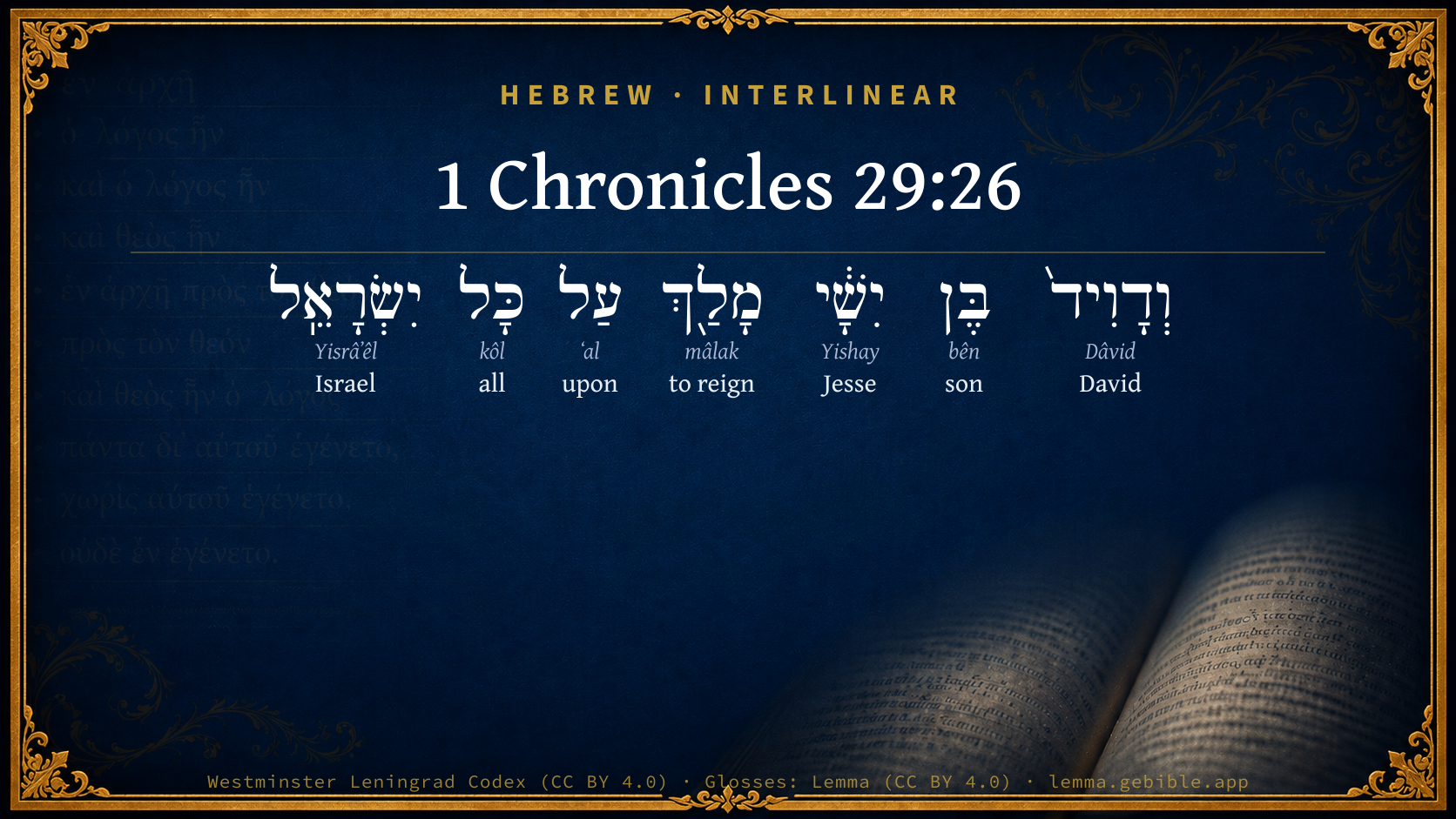
1 Chronicles 29:26

Hebrew (Westminster Leningrad Codex) 1 Chronicles 29:26 appears in the Hebrew Old Testament. The text above is from the Westminster Leningrad Codex. Each word links to its Strong’s number, a concise gloss, and parsing drawn from the Open Scriptures Hebrew Bible morphology. Click any word for its full Brown-Driver-Briggs (BDB) entry.
Download image
Cite this verse

1 Chronicles 29:26 (World English Bible). Public Domain. Lemma interlinear Bible study tool, https://lemma.gebible.app/v/1-chronicles/29/26.

Show BibTeX & RIS
BibTeX
RIS
English Translation
Now David the son of Jesse reigned over all Israel.
World English Bible · Public Domain
Download a study sheet

One document with this verse’s original text, its word-by-word gloss line, the meaning frame, cross-references with their text, attributed commentary, and full source and license credits — printable, and it pastes into notes with its structure intact.

This verse Autodidact and up

Study sheet (.html) Plain text (.txt)

A passage Seminary Student

Up to 50 verses in one chapter. A passage sheet keeps up to 6 commentary sources and 12 cross-references per verse, in the order this page ranks them, and says so on the sheet whenever that leaves anything out. Ask for a single verse and you get the Autodidact verse sheet above.

Everything on this page stays free to read, with no account — the sheet is a download of what is already on screen, not access to it.

Want to remove ads? Support Godless Engineer
Compare translations 3

The same verse in 3 English versions, stacked beneath the original-language interlinear above. Click any original word for its lexicon entry.

Each is an independent rendering of the whole verse — the interlinear is not word-aligned to these translations.

Highlighted words mark where these versions differ — a whole-verse word diff, not a word-by-word alignment.

  • World English Bible Public Domain
    Now David the son of Jesse reigned over all Israel.
  • King James Version Public Domain
    Thus David the son of Jesse reigned over all Israel.
  • unfoldingWord Literal Text CC BY-SA 4.0
    Now David, the son of Jesse, had reigned over all of Israel.

unfoldingWord Literal Text — © unfoldingWord, licensed CC BY-SA 4.0. Word-aligned USFM3 via Door43 (git.door43.org/unfoldingWord/en_ult).

Versions to compare (up to 4)

3 of 4 selected

Show all 18 translations

Every available English version of this verse, each an independent rendering of the whole verse.

  • World English Bible Public Domain
    Now David the son of Jesse reigned over all Israel.
  • Berean Standard Bible Public Domain
    David son of Jesse was king over all Israel.
  • Majority Standard Bible Public Domain
    David son of Jesse was king over all Israel.
  • King James Version Public Domain
    Thus David the son of Jesse reigned over all Israel.
  • American Standard Version (1901) Public Domain
    Now David the son of Jesse reigned over all Israel.
  • Revised Version (1885) Public Domain
    Now David the son of Jesse reigned over all Israel.
  • Geneva Bible (1599) Public Domain
    Thus Dauid the sonne of Ishai reigned ouer all Israel.
  • Douay-Rheims (1899) Public Domain
    So David the son of Isai reigned over all Israel.
  • Young's Literal Translation Public Domain
    And David son of Jesse hath reigned over all Israel,
  • Literal Standard Version CC BY-SA 4.0
    And David son of Jesse has reigned over all Israel,
  • Unlocked Literal Bible CC BY-SA 4.0
    David son of Jesse reigned over all Israel.
  • unfoldingWord Literal Text CC BY-SA 4.0
    Now David, the son of Jesse, had reigned over all of Israel.
  • Darby Bible Public Domain
    Now David the son of Jesse reigned over all Israel.
  • World Messianic Bible Public Domain
    Now David the son of Jesse reigned over all Israel.
  • Webster's Bible Public Domain
    Thus David the son of Jesse reigned over all Israel.
  • Free Bible Version CC BY-SA 4.0
    So David, son of Jesse, ruled over all of Israel.
  • Bible in Basic English Public Domain
    Now David, the son of Jesse, was king over all Israel.
  • JPS Tanakh (1917) Public Domain
    Now David the son of Jesse reigned over all Israel.

Literal Standard Version (2020), Covenant Press — licensed CC BY-SA 4.0. Text via the HelloAO Bible API (eBible.org). Unlocked Literal Bible (unfoldingWord) — licensed CC BY-SA 4.0. Text via the HelloAO Bible API (eBible.org). unfoldingWord Literal Text — © unfoldingWord, licensed CC BY-SA 4.0. Word-aligned USFM3 via Door43 (git.door43.org/unfoldingWord/en_ult). Free Bible Version, Dr. Jonathan Gallagher — licensed CC BY-SA 4.0. Text via the HelloAO Bible API (eBible.org).

Word by word

More ways to search: Search by grammar → Find every occurrence → Compare this word →

Practice this passage: Drill this verse → Learn its vocabulary →

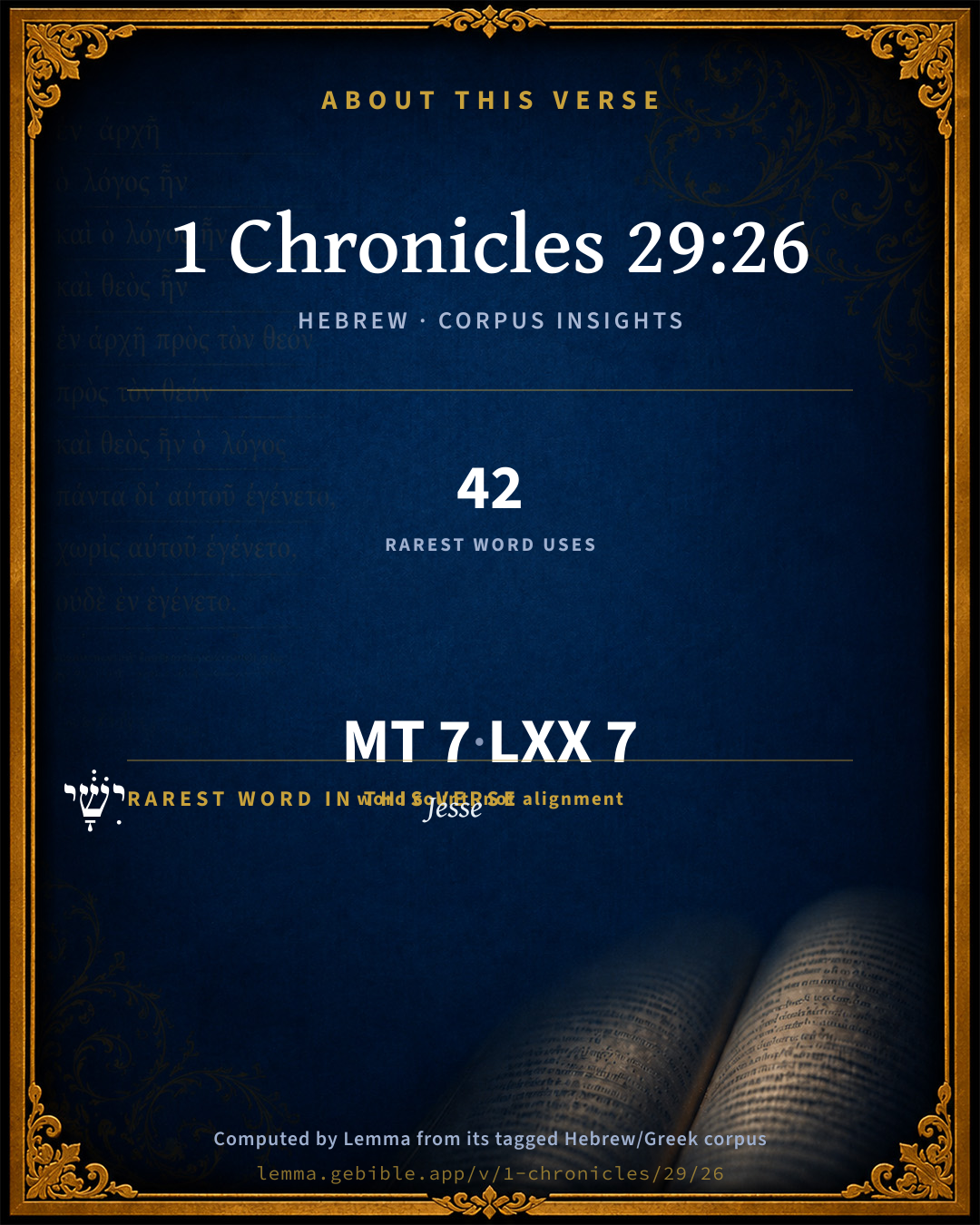
About this verse

These counts appear in no published source. They are computed here, from the morphology-tagged text and Lemma’s own curated glosses. What Lemma adds →

7
words
7
distinct lemmas
Historical
section

Shared distinctive vocabulary

יִשָׁ֔י Jesse H3448 occurs in 39 verses of the Hebrew Bible. Also found in:

Grammatical profile

  • 1 verb
  • 5 nouns
  • 1 preposition

Verb forms

  • מָלַ֖ךְ Qal · Perfect

Hebrew & Septuagint length

In English translation the verse runs 10 words from the Hebrew and 11 from the Septuagint (LXX English) — closely comparable.

A rough comparison of the two English renderings, which tokenize alike — not a word-level alignment.

Word counts can differ between the Hebrew and the Greek without any difference in meaning — e.g. the Hebrew direct-object marker אֵת has no separate Greek word, and Greek often adds the article ὁ.

In the original languages it is 7 Hebrew tokens and 7 Greek tokens — but the two are counted differently (Hebrew bundles its prefixes and suffixes into one token; the Greek is in lemma form), so that isn’t a like-for-like length.

Cross-references

2

Topical passages linked to 1 Chronicles 29:26 in the Treasury of Scripture Knowledge — connected by theme and wording, ordered by reader-vote popularity; previews shown in the World English Bible.

  • 1 Chronicles 18:14 David reigned over all Israel; and he executed justice and righteousness to all his people.
  • Psalms 78:71–72 From following the ewes that have their young, He brought him to be the shepherd of Jacob, his people, And Israel, his inheritance.

Cross-references courtesy of OpenBible.info (CC BY 4.0).

Hebrew and Greek witnesses Masoretic Hebrew ↔ Greek Septuagint

The same verse in the two great witnesses to the Old Testament, shown verse-for-verse.

These are two independent witnesses, not word-aligned to each other, and the Septuagint is shown in lemma (dictionary) form.

Hebrew 1 Chronicles 29:26 Masoretic · Westminster Leningrad Codex

וְדָוִיד֙ בֶּן יִשָׁ֔י מָלַ֖ךְ עַל כָּל יִשְׂרָאֵֽל

Now David the son of Jesse reigned over all Israel.

World English Bible · Public Domain

Greek LXX 1 Chronicles 29:26 Septuagint · lemma form

καί δαυίδ υἱός ιεσσαι βασιλεύω ἐπί ἰσραήλ

And David the son of Jessae reigned over Israel forty years;

LXX2012 (modern English Septuagint) · Public Domain

Hebrew: Westminster Leningrad Codex (CC BY 4.0). Greek: Septuagint (public domain); English from LXX2012 (modern English Septuagint) (Public Domain). How the Septuagint differs from the Hebrew →

Commentary

Notes on 1 Chronicles 29:26 from classic Christian and Jewish commentators (each source and its license shown beneath its notes). The classic Christian expositions comment on the surrounding passage and are grouped to its opening verse, so a note may address several verses; the Jewish commentaries on the Tanakh (Rashi and others) are per-verse, so they appear only where the commentator wrote on this verse.

Lemma curates 59 commentaries, every one of them public domain or Creative Commons licensed, each selected and text-cleaned for this edition rather than reprinted as found. About our sources →

Jamieson, Fausset & Brown

Robert Jamieson, A. R. Fausset & David Brown

HIS REIGN AND DEATH. (Ch1 29:26-30)

Thus David . . . reigned--(See Kg1 2:11).

Next: 2 Chronicles Introduction

Jamieson, Fausset & Brown — Commentary Critical and Explanatory on the Whole Bible (1871) — public domain (CC PDM 1.0). Text via the HelloAO Bible API.

Ellicott's Commentary for English Readers

(26) Thus David . . . reigned.—Rather, Now David . . . had reigned.

1Ch_29:26-30.—Concluding remarks upon David’s history.

Over all Israel.—This alludes to the antecedent reign over Judah only. (See 2Sa_5:1-5; 1Ch_11:1; 1Ch_12:38.)

A Bible Commentary for English Readers, edited by Charles John Ellicott (1878–1897) — public domain. Text from a community e-Sword module.

Trapp's Complete Commentary

John Trapp

1Ch 29:26 Thus David the son of Jesse reigned over all Israel.

Ver. 26. Thus David the son of Jesse reigned.] Albeit he swam to the throne through a sea of sorrows; and so must all saints to the kingdom of heaven, which is such as all the sufferings of this life present are in no comparison worthy of. {Rom 8:18}

John Trapp, A Commentary or Exposition upon All the Books of the Old and New Testament (1647–1656) — public domain. Text from a community e-Sword module.

Joseph Benson's Commentary

1Ch 29:26. Thus David reigned, &c. — This sacred writer, having mentioned the anointing of Solomon, and, upon that occasion, proceeded to give a further account of Solomon’s actual settlement in his kingdom, returns to his main business, to give an account of the close of David’s reign and life. He here brings him to the end of his day, leaves him asleep, and draws the curtains about him.

Joseph Benson's Commentary on the Old and New Testaments (1811–1818) — public domain. Text from a community e-Sword module.

Tyndale Open Study Notes

Tyndale Open Resources

29:26-30 The Chronicler concludes his account of David’s reign with a stylized summary, similar in form to those used for all the kings of Israel and Judah (e.g., 1 Kgs 22:41-50). Like Abraham (Gen 25:8) and Isaac (Gen 35:29), David . . . died at a ripe old age with wealth and honor.

Tyndale Open Study Notes — © Tyndale Open Resources, licensed CC BY-SA 4.0. Text via the HelloAO Bible API.

The Cambridge Bible for Schools and Colleges

gen. ed. J. J. S. Perowne

26–30. A Summary of David’s Reign

26. Thus David] R.V. Now David.

The Cambridge Bible for Schools and Colleges (gen. ed. J. J. S. Perowne; Cambridge University Press, 1878–1918) — public domain. Text from a community e-Sword module.

John Gill's Exposition

And he died in a good old age,.... Being seventy years of age:

full of days, riches, and honour; had as much of either of them as he could wish for; and having enough, he sought after, and was taken to the possession of, eternal life, durable riches, and honours, and glory, that fade not away:

and Solomon his son reigned in his stead; in full power and authority.

John Gill's Exposition of the Whole Bible (1746–1763) — public domain (CC PDM 1.0). Text via the HelloAO Bible API.

Matthew Poole's English Annotations

This sacred writer having mentioned the anointing of Solomon to be king, 1Ch 29:22, and upon that occasion proceeded to give a further account of Solomon’s actual settlement in his kingdom, and of his prosperous and glorious management of it, 1Ch 29:23-25, he now returns to his main and proper business, to give an account of the close of David’s reign and life. Thus, i.e. in manner hitherto expressed,

David—reigned, & c.

Matthew Poole's English Annotations on the Holy Bible (1683–1685) — public domain. Text from a community e-Sword/MySword module.

The Pulpit Commentary

Vers. 26-30. These verses contain last words respecting David"s reign, its extent and its length; respecting his death and age, and the succession of Solomon; and respecting the sources of the history of himself, his reign, his people, and other countries.

The words of this verse, not indeed hard to follow here, but marking the close instead of the commencement or career of David"s reign over all Israel, are paralleled by the earlier passage, 1 Chronicles 2Sa_8:15.

Vers. 26-30.

David"s death.

Our book ends with David"s death. He had reigned forty years, viz. seven years and a half in Hebron, (1Ki_2:11) and thirty-three in Jerusalem. And the Spirit of God writes his obituary: "He died in a good old age." Many an age is "old," but not good. " But David had set God before him through life, and God sets the crown upon it in these words. The Bible obituaries of good men are short. There is no parade, no lengthened record on marble monument or polished stone. They need none. Their record is in heaven. In this they form a striking contrast to the fulsome epitaphs of this world. The greatest of men in Bible history have short records. "So Moses died, and the Lord buried him." Is that all, and of such a man! Yes; for it is the life that should speak and not the death; and that life is the character of the man, whatever the world may say of his death. "Full of days, riches, and honour," all worthy of a record because consecrated to God. Our days are only "full" when thus used. What empty days fill up the lives of most around us days of which an unseen hand has written "vanity," but for which the soul must give an account to God! It is said here that a record is given of" the times that went over him." There were "times" of sorrow and "times" of joy, times of trouble and times of rest, times of weakness and times of strength; but when God is in them there are no empty days. They were full because God was in them. In the midst of all the changes and chances of this mortal life may such be our days! W.

The Pulpit Commentary (1880–1919), ed. H.D.M. Spence-Jones & Joseph S. Exell — public domain. Text from a community e-Sword module.

John Wesley's Explanatory Notes

Thus, &c. - This sacred writer having mentioned the anointing of Solomon and upon that occasion proceeded to give a farther account of Solomon's actual settlement in his kingdom, returns to his main business, to give an account of the close of David's reign and life. He here brings him to the end of his day, leaves him asleep, and draws the curtains about him.

John Wesley, Explanatory Notes Upon the Whole Bible (1754–1765) — public domain. Text via the GEBible commentary corpus.

Keil & Delitzsch

C. F. Keil & F. Delitzsch

And he died in a good old age,.... Being seventy years of age:

full of days, riches, and honour; had as much of either of them as he could wish for; and having enough, he sought after, and was taken to the possession of, eternal life, durable riches, and honours, and glory, that fade not away:

and Solomon his son reigned in his stead; in full power and authority.

Keil & Delitzsch — Biblical Commentary on the Old Testament (1861–1891) — public domain (CC PDM 1.0). Text via the HelloAO Bible API. (Old Testament only.)

unfoldingWord translationNotes

Door43 World Missions Community

forty years ... thirty-three years

"40 years ... 33 years" (See: Numbers)

at a good old age

"as an old man"

translationWords

David

Jesse

reign

Israel

rule

Hebron

Jerusalem

die

good

age

life

honor

unfoldingWord translationNotes — © Distant Shores Media and the Door43 World Missions Community, licensed CC BY-SA 4.0. Source: git.door43.org/Door43/en_tn.

Lesson kit

Teaching starters — assembled from the data on this page, not authored interpretation. Every prompt links to the verse data it draws on. Edit before teaching.

1 Chronicles, in the Historical, opens this verse with 7 words (7 distinct Hebrew lemmas). Its most distinctive word is Yishay (“Jesse”). A historical commentator’s framing appears above. Read the whole chapter for the surrounding context.

Discussion questions

  1. How does “Jesse” (Yishay) shape what this verse is saying?
  2. Ruth 4:17 shares the word «Jesse» with this verse. How do the two illuminate each other?
  3. These translations render this verse differently; the difference is in the English rendering, not the original. What questions does that raise?
  4. The verb «מָלַ֖ךְ» is Qal Perfect. How does its form color the action?
  5. Reading how Jamieson, Fausset & Brown and Ellicott's Commentary for English Readers read this verse, where do the two commentators agree and where do they part?

Things to notice

Reading settings

Reading text

Shown beneath each verse's original-language words.

Old Testament
Old Testament edition

Read the OT as the Masoretic Hebrew (MT) or the Greek Septuagint (LXX).

English shown for the Greek Septuagint (in the Hebrew ↔ Greek comparison).

Comparing translations? Open the Compare panel on any verse page to stack up to four side by side.