
1 Chronicles 20:3

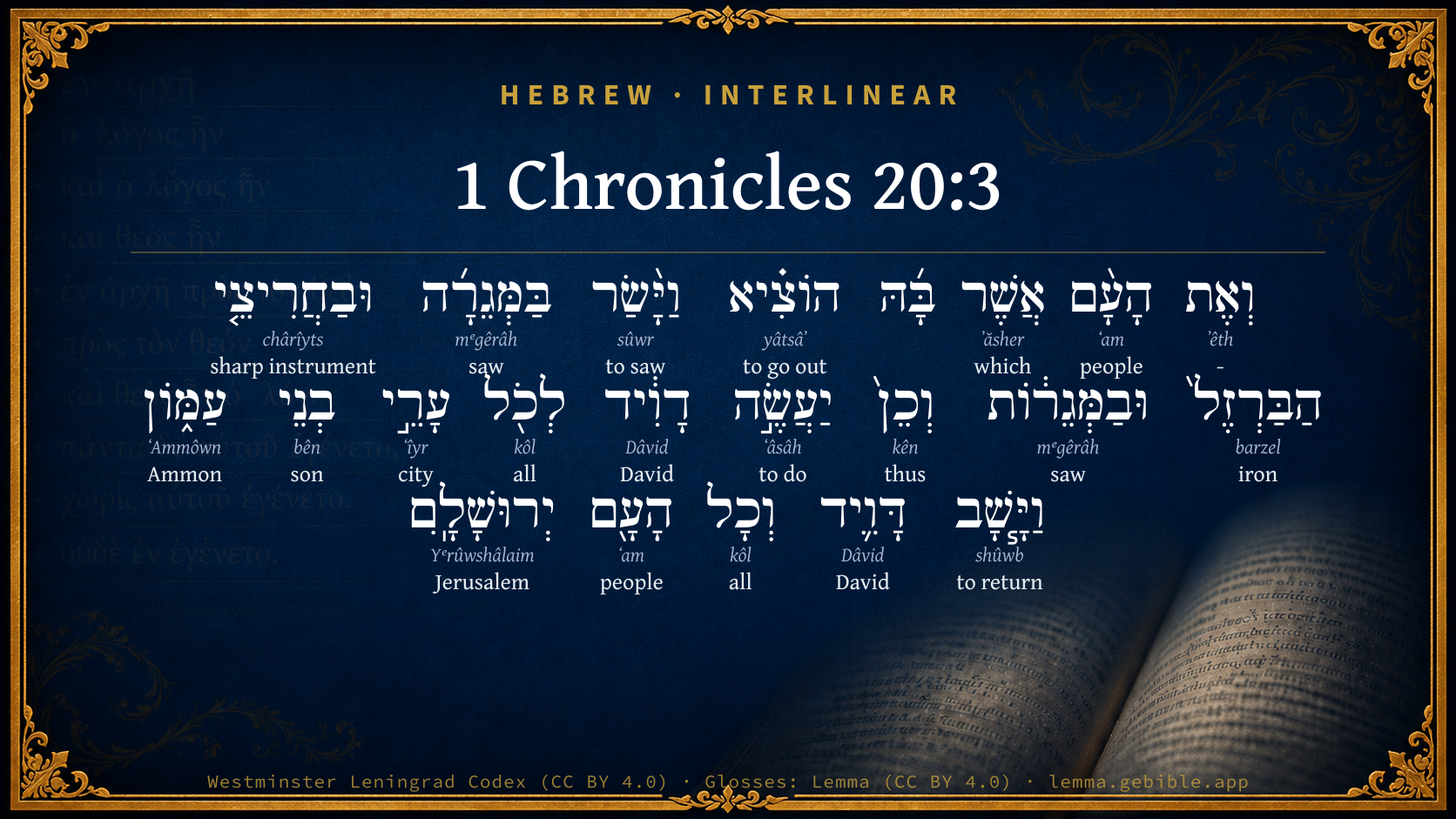
Hebrew (Westminster Leningrad Codex) 1 Chronicles 20:3 appears in the Hebrew Old Testament. The text above is from the Westminster Leningrad Codex. Each word links to its Strong’s number, a concise gloss, and parsing drawn from the Open Scriptures Hebrew Bible morphology. Click any word for its full Brown-Driver-Briggs (BDB) entry.
Download image
Cite this verse

1 Chronicles 20:3 (World English Bible). Public Domain. Lemma interlinear Bible study tool, https://lemma.gebible.app/v/1-chronicles/20/3.

Show BibTeX & RIS
BibTeX
RIS
English Translation
He brought forth the people who were therein, and cut [them] with saws, and with harrows of iron, and with axes. Thus did David to all the cities of the children of Ammon. David and all the people returned to Jerusalem.
World English Bible · Public Domain
Highlights
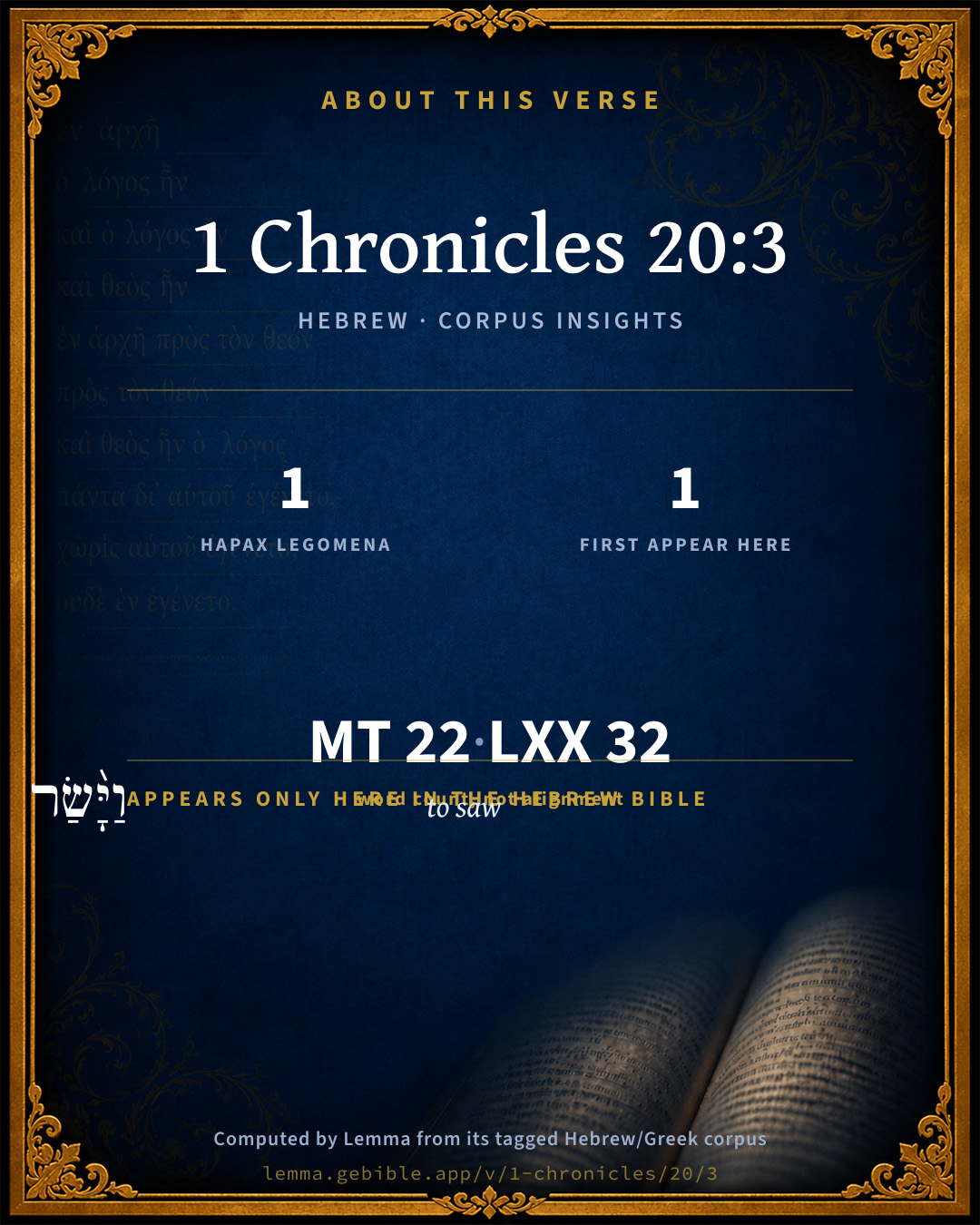
  • 1 hapax legomenon — only here in the Hebrew Bible
  • 1 first appearance in the Hebrew Bible
Full analysis ↓
Download a study sheet

One document with this verse’s original text, its word-by-word gloss line, the meaning frame, cross-references with their text, attributed commentary, and full source and license credits — printable, and it pastes into notes with its structure intact.

This verse Autodidact and up

Study sheet (.html) Plain text (.txt)

A passage Seminary Student

Up to 50 verses in one chapter. A passage sheet keeps up to 6 commentary sources and 12 cross-references per verse, in the order this page ranks them, and says so on the sheet whenever that leaves anything out. Ask for a single verse and you get the Autodidact verse sheet above.

Everything on this page stays free to read, with no account — the sheet is a download of what is already on screen, not access to it.

Want to remove ads? Support Godless Engineer
Compare translations 3

The same verse in 3 English versions, stacked beneath the original-language interlinear above. Click any original word for its lexicon entry.

Each is an independent rendering of the whole verse — the interlinear is not word-aligned to these translations.

Highlighted words mark where these versions differ — a whole-verse word diff, not a word-by-word alignment.

  • World English Bible Public Domain
    He brought forth the people who were therein, and cut [them] with saws, and with harrows of iron, and with axes. Thus did David to all the cities of the children of Ammon. David and all the people returned to Jerusalem.
  • King James Version Public Domain
    And he brought out the people that were in it, and cut them with saws, and with harrows of iron, and with axes. Even so dealt David with all the cities of the children of Ammon. And David and all the people returned to Jerusalem.
  • unfoldingWord Literal Text CC BY-SA 4.0
    And he brought out the people who in it, and one sawed with the saw and with picks of iron and with saws. And thus David did to all of the cities of the sons of Ammon. And David and all of the people returned Jerusalem.

unfoldingWord Literal Text — © unfoldingWord, licensed CC BY-SA 4.0. Word-aligned USFM3 via Door43 (git.door43.org/unfoldingWord/en_ult).

Versions to compare (up to 4)

3 of 4 selected

Show all 18 translations

Every available English version of this verse, each an independent rendering of the whole verse.

  • World English Bible Public Domain
    He brought forth the people who were therein, and cut [them] with saws, and with harrows of iron, and with axes. Thus did David to all the cities of the children of Ammon. David and all the people returned to Jerusalem.
  • Berean Standard Bible Public Domain
    David brought out the people who were there and put them to work with saws, iron picks, and axes. And he did the same to all the Ammonite cities. Then David and all his troops returned to Jerusalem.
  • Majority Standard Bible Public Domain
    David brought out the people who were there and put them to work with saws, iron picks, and axes. And he did the same to all the Ammonite cities. Then David and all his troops returned to Jerusalem.
  • King James Version Public Domain
    And he brought out the people that were in it, and cut them with saws, and with harrows of iron, and with axes. Even so dealt David with all the cities of the children of Ammon. And David and all the people returned to Jerusalem.
  • American Standard Version (1901) Public Domain
    And he brought forth the people that were therein, and cut `them' with saws, and with harrows of iron, and with axes. And thus did David unto all the cities of the children of Ammon. And David and all the people returned to Jerusalem.
  • Revised Version (1885) Public Domain
    And he brought forth the people that were therein, and cut them with saws, and with harrows of iron, and with axes. And thus did David unto all the cities of the children of Ammon. And David and all the people returned to Jerusalem.
  • Geneva Bible (1599) Public Domain
    And he caryed away the people that were in it, and cut them with sawes, and with harowes of yron, and with axes: euen thus did Dauid with all the cities of the children of Ammon. Then Dauid and all the people came againe to Ierusalem.
  • Douay-Rheims (1899) Public Domain
    And the people that were therein he brought out: and made harrows, and sleds, and chariots of iron to go over them, so that they were cut and bruised to pieces: in this manner David dealt with all the cities of the children of Ammon: and he returned with alibis people to Jerusalem.
  • Young's Literal Translation Public Domain
    and the people who `are' in it he hath brought out, and setteth to the saw, and to cutting instruments of iron, and to axes; and thus doth David to all cities of the sons of Ammon, and David turneth back, and all the people, to Jerusalem.
  • Literal Standard Version CC BY-SA 4.0
    and he has brought out the people who [are] in it, and sets [them] to the saw, and to cutting instruments of iron, and to axes; and thus David does to all cities of the sons of Ammon, and David turns back—and all the people—to Jerusalem.
  • Unlocked Literal Bible CC BY-SA 4.0
    He brought out the people who were in the city and forced them to work with saws and iron picks and axes. David required all the cities of the people of Ammon to do this labor. Then David and all the army returned to Jerusalem.
  • unfoldingWord Literal Text CC BY-SA 4.0
    And he brought out the people who in it, and one sawed with the saw and with picks of iron and with saws. And thus David did to all of the cities of the sons of Ammon. And David and all of the people returned Jerusalem.
  • Darby Bible Public Domain
    And he brought out the people that were in it, and cut them with the saw, and with harrows of iron, and with saws. And so David did to all the cities of the children of Ammon. And David and all the people returned to Jerusalem.
  • World Messianic Bible Public Domain
    He brought out the people who were in it, and had them cut with saws, with iron picks, and with axes. David did so to all the cities of the children of Ammon. Then David and all the people returned to Jerusalem.
  • Webster's Bible Public Domain
    And he brought out the people that were in it, and cut them with saws, and with harrows of iron, and with axes. Even so David dealt with all the cities of the children of Ammon. And David and all the people returned to Jerusalem.
  • Free Bible Version CC BY-SA 4.0
    David made the people there work with saws, iron picks, and axes. He also did the same to all the Ammonite towns. Then David and all his army returned to Jerusalem.
  • Bible in Basic English Public Domain
    And he took the people out of the town and put them to work with wood-cutting instruments, and iron grain-crushers, and axes. And this he did to all the towns of the children of Ammon. Then David and all the people went back to Jerusalem.
  • JPS Tanakh (1917) Public Domain
    And he brought forth the people that were therein, and cut them with saws, and with harrows of iron, and with axes. And thus did David unto all the cities of the children of Ammon. And David and all the people returned to Jerusalem.

Literal Standard Version (2020), Covenant Press — licensed CC BY-SA 4.0. Text via the HelloAO Bible API (eBible.org). Unlocked Literal Bible (unfoldingWord) — licensed CC BY-SA 4.0. Text via the HelloAO Bible API (eBible.org). unfoldingWord Literal Text — © unfoldingWord, licensed CC BY-SA 4.0. Word-aligned USFM3 via Door43 (git.door43.org/unfoldingWord/en_ult). Free Bible Version, Dr. Jonathan Gallagher — licensed CC BY-SA 4.0. Text via the HelloAO Bible API (eBible.org).

Word by word

More ways to search: Search by grammar → Find every occurrence → Compare this word →

Practice this passage: Drill this verse → Learn its vocabulary →

וַיָּ֨שַׂר
sûwr
H7787
“and · to saw”
Conjunction + Verb, Qal, Sequential Imperfect, 3rd Person, Masculine, Singular
Part of Speech
Conjunction + Verb
Stem
Qal
Form
Sequential Imperfect
Person
3rd Person
Gender
Masculine
Number
Singular
Full BDB Definition

Origin: a primitive root [identical with H7786 through the idea of reducing to pieces

TWOT: 2245

(Qal) to saw - (TWOT) meaning uncertain
  1. וְאֶת ʼêth H853 “and · -” Conjunction + Particle, Direct Object
  2. הָעָ֨ם ʻam H5971 “the · people” Particle, Definite Article + Noun, Common, Masculine, Singular, Absolute
  3. אֲשֶׁר ʼăsher H834 “which” Particle, Relative
  4. הוֹצִ֗יא yâtsâʼ H3318 “to go out” Verb, Hiphil, Perfect, 3rd Person, Masculine, Singular
  5. בַּמְּגֵרָ֜ה mᵉgêrâh H4050 “in/at the · saw” Preposition, Determined + Noun, Common, Feminine, Singular, Absolute
  6. וּבַחֲרִיצֵ֤י chârîyts H2757 “and · in/at · sharp instruments of” Conjunction + Preposition + Noun, Common, Masculine, Plural, Construct
  7. הַבַּרְזֶל֙ barzel H1270 “the · iron” Particle, Definite Article + Noun, Common, Masculine, Singular, Absolute
  8. וּבַמְּגֵר֔וֹת mᵉgêrâh H4050 “and · in/at the · saws” Conjunction + Preposition, Determined + Noun, Common, Feminine, Plural, Absolute
  9. וְכֵן֙ kên H3651 “and · thus” Conjunction + Particle, Demonstrative
  10. יַעֲשֶׂ֣ה ʻâsâh H6213 “to do” Verb, Qal, Imperfect, 3rd Person, Masculine, Singular
  11. דָוִ֔יד Dâvid H1732 “David” Noun, Proper
  12. לְכֹ֖ל kôl H3605 “to/for · all of” Preposition + Noun, Common, Masculine, Singular, Construct
  13. עָרֵ֣י ʻîyr H5892 “cities of” Noun, Common, Feminine, Plural, Construct
  14. בְנֵי bên H1121 “sons of” Noun, Common, Masculine, Plural, Construct
  15. עַמּ֑וֹן ʻAmmôwn H5983 “Ammon” Noun, Proper
  16. וַיָּ֧שָׁב shûwb H7725 “and · to return” Conjunction + Verb, Qal, Sequential Imperfect, 3rd Person, Masculine, Singular
  17. דָּוִ֛יד Dâvid H1732 “David” Noun, Proper
  18. וְכָל kôl H3605 “and · all of” Conjunction + Noun, Common, Masculine, Singular, Construct
  19. הָעָ֖ם ʻam H5971 “the · people” Particle, Definite Article + Noun, Common, Masculine, Singular, Absolute
  20. יְרוּשָׁלִָֽם Yᵉrûwshâlaim H3389 “Jerusalem” Noun, Proper

About this verse

These counts appear in no published source. They are computed here, from the morphology-tagged text and Lemma’s own curated glosses. What Lemma adds →

22
words
17
distinct lemmas
Historical
section

Notable vocabulary

1 hapax legomenon — a word that appears only here in the entire Hebrew Bible:

  • וַיָּ֨שַׂר to saw H7787

First appearance in Scripture

This word makes its first canonical appearance in the Hebrew Bible here:

  • וַיָּ֨שַׂר to saw H7787

Shared distinctive vocabulary

וּבַחֲרִיצֵ֤י sharp instrument H2757 occurs in 3 verses of the Hebrew Bible. Also found in:

Grammatical profile

  • 4 verbs
  • 14 nouns
  • 1 preposition
  • 3 particles

Verb forms

  • הוֹצִ֗יא Hiphil · Perfect
  • וַיָּ֨שַׂר Qal · Sequential Imperfect
  • יַעֲשֶׂ֣ה Qal · Imperfect
  • וַיָּ֧שָׁב Qal · Sequential Imperfect

Repetition

Words recur within this verse — often emphatic in Hebrew:

  • הָעָ֨ם people H5971 ×2
  • בַּמְּגֵרָ֜ה saw H4050 ×2
  • דָוִ֔יד David H1732 ×2
  • לְכֹ֖ל all H3605 ×2

Hebrew & Septuagint length

In English translation the verse runs 41 words from the Hebrew and 44 from the Septuagint (LXX English) — closely comparable.

A rough comparison of the two English renderings, which tokenize alike — not a word-level alignment.

Word counts can differ between the Hebrew and the Greek without any difference in meaning — e.g. the Hebrew direct-object marker אֵת has no separate Greek word, and Greek often adds the article ὁ.

In the original languages it is 22 Hebrew tokens and 32 Greek tokens — but the two are counted differently (Hebrew bundles its prefixes and suffixes into one token; the Greek is in lemma form), so that isn’t a like-for-like length.

Cross-references

8

Topical passages linked to 1 Chronicles 20:3 in the Treasury of Scripture Knowledge — connected by theme and wording, ordered by reader-vote popularity; previews shown in the World English Bible.

  • 1 Chronicles 19:2–5 David said, I will show kindness to Hanun the son of Nahash, because his father shown kindness to me. So David sent messengers to comfort him concerning his father. David's servants came into the land of the children of Ammon to Hanun, to comfort him.
  • Exodus 1:14 and they made their lives bitter with hard service, in mortar and in brick, and in all manner of service in the field, all their service, in which they ruthlessly made them serve.
  • Joshua 9:23 Now therefore you are cursed, and there shall never fail to be of you bondservants, both wood cutters and drawers of water for the house of my God.
  • Judges 8:6–7 The princes of Succoth said, Are the hands of Zebah and Zalmunna now in your hand, that we should give bread to your army?
  • Judges 8:16–17 He took the elders of the city, and thorns of the wilderness and briers, and with them he taught the men of Succoth.
  • 2 Samuel 12:31 He brought forth the people who were therein, and put them under saws, and under harrows of iron, and under axes of iron, and made them pass through the brick kiln: and thus did he to all the cities of the children of Ammon. David and all the people returned to Jerusalem.
  • 1 Kings 9:21 their children who were left after them in the land, whom the children of Israel were not able utterly to destroy, of them did Solomon raise a levy of bondservants to this day.
  • Psalms 21:8–9 Your hand will find out all of your enemies. Your right hand will find out those who hate you.

Cross-references courtesy of OpenBible.info (CC BY 4.0).

Hebrew and Greek witnesses Masoretic Hebrew ↔ Greek Septuagint

The same verse in the two great witnesses to the Old Testament, shown verse-for-verse.

These are two independent witnesses, not word-aligned to each other, and the Septuagint is shown in lemma (dictionary) form.

Hebrew 1 Chronicles 20:3 Masoretic · Westminster Leningrad Codex

וְאֶת הָעָ֨ם אֲשֶׁר בָּ֜הּ הוֹצִ֗יא וַיָּ֨שַׂר בַּמְּגֵרָ֜ה וּבַחֲרִיצֵ֤י הַבַּרְזֶל֙ וּבַמְּגֵר֔וֹת וְכֵן֙ יַעֲשֶׂ֣ה דָוִ֔יד לְכֹ֖ל עָרֵ֣י בְנֵי עַמּ֑וֹן וַיָּ֧שָׁב דָּוִ֛יד וְכָל הָעָ֖ם יְרוּשָׁלִָֽם

He brought forth the people who were therein, and cut [them] with saws, and with harrows of iron, and with axes. Thus did David to all the cities of the children of Ammon. David and all the people returned to Jerusalem.

World English Bible · Public Domain

Greek LXX 1 Chronicles 20:3 Septuagint · lemma form

καί ὁ λαός ὁ ἐν αὐτός ἐκἄγω καί διαπρίζω πρίων καί ἐν σκεπάρνον σιδηροῦς καί οὕτως ποιέω δαυίδ ὁ πᾶς υἱός αμμων καί ἀναστρέφω δαυίδ καί πᾶς ὁ λαός αὐτός εἰς ἰερουσαλήμ

And he brought out the people that were in it, and sawed them asunder with saws, and cut them with iron axes, and with harrows: and thus David did to all the children of Ammon. And David and all his people returned to Jerusalem.

LXX2012 (modern English Septuagint) · Public Domain

Hebrew: Westminster Leningrad Codex (CC BY 4.0). Greek: Septuagint (public domain); English from LXX2012 (modern English Septuagint) (Public Domain). How the Septuagint differs from the Hebrew →

Commentary

Notes on 1 Chronicles 20:3 from classic Christian and Jewish commentators (each source and its license shown beneath its notes). The classic Christian expositions comment on the surrounding passage and are grouped to its opening verse, so a note may address several verses; the Jewish commentaries on the Tanakh (Rashi and others) are per-verse, so they appear only where the commentator wrote on this verse.

Lemma curates 59 commentaries, every one of them public domain or Creative Commons licensed, each selected and text-cleaned for this edition rather than reprinted as found. About our sources →

Jamieson, Fausset & Brown

Robert Jamieson, A. R. Fausset & David Brown

cut them with saws, &c.--The Hebrew word, "cut them," is, with the difference of the final letter, the same as that rendered "put them," in the parallel passage of Samuel [Sa2 12:31]; and many consider that putting them to saws, axes, and so forth, means nothing more than that David condemned the inhabitants of Rabbah to hard and penal servitude.

Jamieson, Fausset & Brown — Commentary Critical and Explanatory on the Whole Bible (1871) — public domain (CC PDM 1.0). Text via the HelloAO Bible API.

Adam Clarke's Commentary

Verse 3. He brought out the people] See this transaction particularly explained in the notes on the parallel places, 2Sa 12:30-31.

Adam Clarke's Commentary on the Bible (1810–1826) — public domain. Text from a community e-Sword/MySword module.

Ellicott's Commentary for English Readers

(3) And he brought.—Better, “And the people that were in it he brought out, and sawed with the saw, and with the iron threshing-drags (Isa_41:15), and with the axes.”

Sawed.—The Hebrew is an old word, only found here. Samuel reads, by change of one letter, “set them in,” or “among,” the saws, &c.

With the axes.—So Samuel. Our Hebrew text repeats the word “saw” in the plural, owing to a scribe’s error. The two words differ by a single letter. Samuel adds, “and made them pass through the brick-kiln,” or “Moloch’s fire” (2Ki_23:10).

Even so dealt David.—Literally, And so David used to do. These cruelties were enacted again at the taking of every Ammonite city. There needs no attempt to palliate such revolting savagery; but according to the ideas of that age it was only a glorious revenge. As David treated Ammon, so would the Ammonites have treated Israel, had the victory been theirs. (Comp. their behaviour to the Gileadites, Amo_1:13; comp. also the atrocities of Assyrian conquerors, Hos_10:14; and of the Babylonians Psa_137:7-9.)

A Bible Commentary for English Readers, edited by Charles John Ellicott (1878–1897) — public domain. Text from a community e-Sword module.

The Cambridge Bible for Schools and Colleges

gen. ed. J. J. S. Perowne

3. and cut them with saws] Read (cp. 2Sa_12:31, R.V. mg.) and put them with saws, i.e. put them to work with saws, etc. Cp. 2Ch_2:17-18; Jos_9:21-23. The implements mentioned here and in the parallel passage of 2 Sam. suggest task-work, not massacre. The Ammonites were reduced to bondage like that of Israel in Egypt. The exceptionally harsh treatment of the Ammonites was doubtless due to the exceptional insults which David’s ambassadors had received from them. A very different spirit towards Ammon is shewn in Deu_2:19.

4–8 (= 2Sa_21:18-22). Philistine champions slain

This section is the last in which the Chronicler notices David’s wars. It is taken from 2 Samuel 21, where, however, it is preceded by an account (2Sa_21:15-17) of David’s narrow escape in an encounter with a Philistine.

Between the two sections of this chapter the Chronicler omits the account of the rebellions of Absalom and of Sheba, and the story of the Gibeonite vengeance on the house of Saul (2Sa_13:1 to 2Sa_21:14).

The Cambridge Bible for Schools and Colleges (gen. ed. J. J. S. Perowne; Cambridge University Press, 1878–1918) — public domain. Text from a community e-Sword module.

Haydock's Catholic Bible Commentary

Harrows. Hebrew, "cut them with saws, and with harrows; (Haydock) or, rollers of iron, and with saws." But some other term was probably used, as we find saws before. (Calmet) --- Protestants have "axes." This exemplary punishment was in consequence of the violation of the law of nations. Abulensis pronounced it lawful. Tirinus accuses David of a grievous sin of cruelty; observing that he was at this time involved in the sin of adultery: and people easily fall from one abyss into another. Cruelty and lust often go together. Yet it seems best to suspend our judgment. (Haydock) --- David might only treat the most guilty in this manner. (Du Hamel)

George Leo Haydock (1774–1849), Haydock's Catholic Family Bible and Commentary, 1859 edition — public domain. Excludes Psalms (Douay-Rheims chapter numbering differs from Protestant) and Deuterocanonical books (Catholic canon only).

The Pulpit Commentary

Cut them with saws. (so Heb_11:37) We have here the very doubtful (so far as regards its real signification) Hebrew word Rc"y; w" (and he cut) instead of w" (he put). Probably it is nowhere else used in the sense of "cutting," if it is here. Its ordinary sense is to rule or put into subjection. The parallel place (2Sa_12:31) corrects, in the word (Authorized Version) axes, our Hebrew text, which repeats the word for saw, though putting it in the plural, and which thereby shows twOrgeM]b"w, instead of twOrz]g]m"b]w. This last word means "Axes" or "scythes," and is from the root r"z"g; to cut. (2Ki_6:4) It is found only in 2Sa_12:31, though it should appear here also. There is a fourth severity of punishment mentioned in the parallel place, that the people were "made to pass through the brick-kilns," a form of torture possibly suggested by the own familiar cruelty of the Ammonites in "making their children to pass through the fire to Moloch." However, in harmony with what is above said respecting the doubtfulness of the just signification of the verb Rc"y; w," much uncertainty hangs over the interpretation of this verse. Instead of severity and needless cruelty on the part of David, it may rather set forth that he subjected them to hard tasks in connection with the cultivation of the soil and with the making of bricks. The saws and harrows and axes (or scythes) were awkward and unlikely weapons to be employed for the purpose of inflicting torture, when the ordinary weapons of battle and warfare were close at hand. This view, however, is contrary to the verdict, so far as the above Hebrew verb is concerned, of Gesenius"s "Thesaurus," p. 1326, and of Thenins, on this and the parallel passage. When such punishments were of the nature of torture, the cruelty was in some cases extreme. "The criminal was sometimes sawn asunder lengthwise; this was more especially the practice in Persia. Isaiah, according to the Talmud-isis, was put to death in this wise by King Manasseh, "Sanhedrin," p. 103, c. 2; comp. Justin"s dialogue with Trypho" (Jahn"s "Sacred Antiquities," p. 132, 260, 7.). With saws. The word in the original is not in the plural. It occurs again only in the parallel place (2Sa_12:31) and in 1Ki_7:9, both times in the singular. The teeth of Eastern saws then and now usually incline to the handle instead of from it. With harrows of iron. The only harrow known to have been used at this time consisted of a thick block of wood borne down by a weight, or on which a man sat, drawn over the ploughed land by oxen (Isa_28:24, Isa_28:25; Job_39:10; Hos_10:11) and the root of the Hebrew word expresses the idea of crushing or levelling the land. But our present word is very different, and is found only here and in the parallel place, with the word "iron" accompanying it, so as to be equivalent to a compound word, and appears to mean "sharp instruments of iron," or sharp threshing instruments. The use of the former part of this phrase (1Sa_17:18) for cheeses is the only other instance of its occurrence. Saws should be "axes," or "scythes," as stated above, though it is not any of the three more ordinary words for "axe" (see Smith"s "Bible Dictionary," 1:142).

HOMILIES BY J.R. THOMSON Ver. 3.

The barbarity of man to man.

There are signal inconsistencies in the character of David. He was capable of kindness, self-denial, and generosity, but he was capable also of cruelty amounting to inhumanity and savagery. Perhaps no act more disgraceful and inexcusable is related to have been performed by him than that recorded in the text. The people of Rabbah had long resisted his arms; and when the city fell David seems to have given the reins to his passions, and to have treated the captive population with what seems to us all but incredible cruelty. But allowance must be made for the manners and morals of the age. Humanity towards enemies is comparatively a modern virtue. Though history records a few striking exceptions to the general rule, that rule was undoubtedly one of utter insensibility to the miseries of a vanquished foe. The chronicler here relates, evidently as a matter calling for no surprise or indignation, that David in cold blood cut the people with saws, broke their limbs with threshing-instruments, and flung them, whilst still alive, into the red-hot brick-kilns!

I CRUELTY IS AN OUTCOME AND A FORM OF SIN. From the time, and in consequence of, man"s original departure from God, human society has been cursed with all the horrors which result from the violation of Divine law, the defiance of Divine authority. Hatred, envy, and strife have run riot, and their manifestations have been the main factors in what is called human history. Hence the barbarities heartlessly and ruthlessly practised among all rude nations. Modern war is nothing but a disgraceful survival of the savage barbarism of the sinful and inhuman past. Even now the practices common in war are enough to sadden and to sicken every sensitive mind. "Whence come wars and fightings? Come they not hence of your lusts?

II RESTRAINTS AND CHECKS UPON CRUELTY HAVE BEEN COMPARATIVELY FEEBLE AND INEFFECTIVE. David was a very religious man, but his religion did not preserve him from adultery and murder; nor did it restrain him from cold-blooded cruelty. The ancient civilizations, the ancient religions, failed to check the prevalent insensibility to suffering, the prevalent habit of revenge. Even the religion of the Old Testament had very partial power to secure these ends. Mitigations of the horrors of war have doubtless been introduced by Christianity and by chivalry. Yet the professed servants of the meek and holy Jesus have too often sanctioned and applauded the barbarities of war, the infamies of slavery, the tortures of the Inquisition.

III VITAL AND SCRIPTURAL CHRISTIANITY ALONE CAN COPE WITH AND VANQUISH THIS EVIL. Rules and maxims are of little avail to contend with the fierce passions of our fallen nature. The new heart, with its changed dispositions, is alone sufficient. The example and the spirit of our Divine Saviour are incompatible with cruelty. In proportion as Christ himself lives in the hearts and governs the lives of men, will inhumanity diminish until it disappear, and until such deeds as those described in the text become impossible. The prophecies and promises of God"s Word point forward to a day when the "new commandment" shall be everywhere observed, and when cruelty shall be no more. T.

HOMILIES BY R. TUCK Ver. 3.

The horrors of war.

All actions, both of nations and of individuals, should be judged in the light of the prevailing standards and sentiments of the age in which they are done. This is a most important principle, but it is a difficult one to apply wisely; and it is one that may be easily misrepresented. Right can never be other than right, and wrong can never be other than wrong. But custom and sentiment give a temporary character to many actions which tend to confuse our apprehension of their essential rightness or wrongness. Limited knowledge also leads to the permission of things which advancing civilization shows to be unworthy and even wrong. These points may be illustrated from slavery, truthfulness, sense of the value of life, ideas of property, and war. Another important consideration, which greatly helps to explain Old Testament narratives, is that national judgments must of necessity take national character. An old divine well says, "God can punish individuals both in this life and in the next; but he can only punish nations in this." There are distinctly personal and individual sins, and there are as distinctly national sins; wrong done by the rulers in the name of the people; or a wrong spirit pervading the people; or times when vice is permitted to run an unrestrained and ruinous course. And such national sin Jehovah ever regards, using such agencies as famine, plague, or war, for its due punishment. In this light the Old Testament ever regards war; the aggressive force is always treated as the executioner who carries out the Divine judgments. And it may be urged that this is still the deeper view to take of war, and that it is quite consistent with a clear recognition of the fact that such an aggressive force may act in mere wilfulness, or in furtherance of wicked schemes of self-aggrandizement. God makes the very "wrath of man" praise him. In treating the incidents of this chapter, it may be well to point out the distinction between what usually happens under the excitements of a siege, and the deliberate judgment that may be pronounced upon a conquered people. As may be painfully illustrated from the conduct of the British soldiers in India and in Spain, when a city is taken by storm, a scene of wild and awful rioting usually follows. Illustrate also from the Roman siege of Jerusalem. For Rabbah, the city here referred to, see the Expository portion of this Commentary, and 2Sa_11:1.

I ANCIENT HORRORS OF WAR. Illustrate from different kinds of war wars of races, the young and strong pushing out the old and weak; hardy mountain races occupying the cultured plains of the over-civilized and effeminate; dynastic wars, occasioned by the rivalries of different royal houses; sacred wars, such as the Crusades, to recover possession of the Lord"s tomb; and wars of revenge, undertaken to clear off supposed or real insults. Of this latter kind was the war with Ammon (see ch. 19.). Modern ideas concerning war make it impossible for us to approve of the treatment to which the conquered Ammonites were subjected. Some writers have urged that David merely condemned the captives to severe bodily labours, to hewing and sawing wood, to burning of bricks, and to working in iron-mines; but probably the more terrible translation of the language must be accepted, in view of the common war-law of that stern age. And, with its best mitigations, war must still be regarded as a dreadful thing. The whole world sighs for the day when "the nations shall learn war no more.

II CHRISTIAN MITIGATIONS OF THE HORRORS OF WAR. Illustrate from modem treatment of the dead, the wounded, the prisoner, and the conquered. Show how a prolonged period of comparative peace has influenced national sentiment concerning war. Explain, illustrate, and impress that the Christian law of the universal human brotherhood seeks to destroy all forms of war; and the day of its full triumph is surely coming.

R.T.

The Pulpit Commentary (1880–1919), ed. H.D.M. Spence-Jones & Joseph S. Exell — public domain. Text from a community e-Sword module.

Lesson kit

Teaching starters — assembled from the data on this page, not authored interpretation. Every prompt links to the verse data it draws on. Edit before teaching.

1 Chronicles, in the Historical, opens this verse with 22 words (17 distinct Hebrew lemmas). Its most distinctive word is sûwr (“to saw”). A historical commentator’s framing appears above. Read the whole chapter for the surrounding context.

Discussion questions

  1. What does “to saw” (sûwr) contribute to the verse as a whole?
  2. This verse holds 1 word here found nowhere else in the Hebrew Bible. What might the rare word draw attention to?
  3. The word “to saw” first appears here in Scripture. What is being introduced at this debut?
  4. 1 Samuel 17:18 shares the word «sharp instrument» with this verse. How do the two illuminate each other?
  5. “people” occurs 2× in this one verse. What is the effect of the repetition?
  6. These translations render this verse differently. What is at stake in choosing one wording over another?
  7. The verb «הוֹצִ֗יא» is Hiphil Perfect. How does its form color the action?
  8. Reading how Jamieson, Fausset & Brown and Adam Clarke's Commentary read this verse, where do the two commentators agree and where do they part?

Things to notice

  • 1 word in this verse appears nowhere else in the Hebrew Bible.
  • 1 word makes its first canonical appearance in Scripture here.
  • This verse counts 22 Hebrew ↔ 32 Greek words.
  • These translations choose different wording for 17 words in this verse.
  • “people” occurs 2× in this single verse.

Reading settings

Reading text

Shown beneath each verse's original-language words.

Old Testament
Old Testament edition

Read the OT as the Masoretic Hebrew (MT) or the Greek Septuagint (LXX).

English shown for the Greek Septuagint (in the Hebrew ↔ Greek comparison).

Comparing translations? Open the Compare panel on any verse page to stack up to four side by side.