
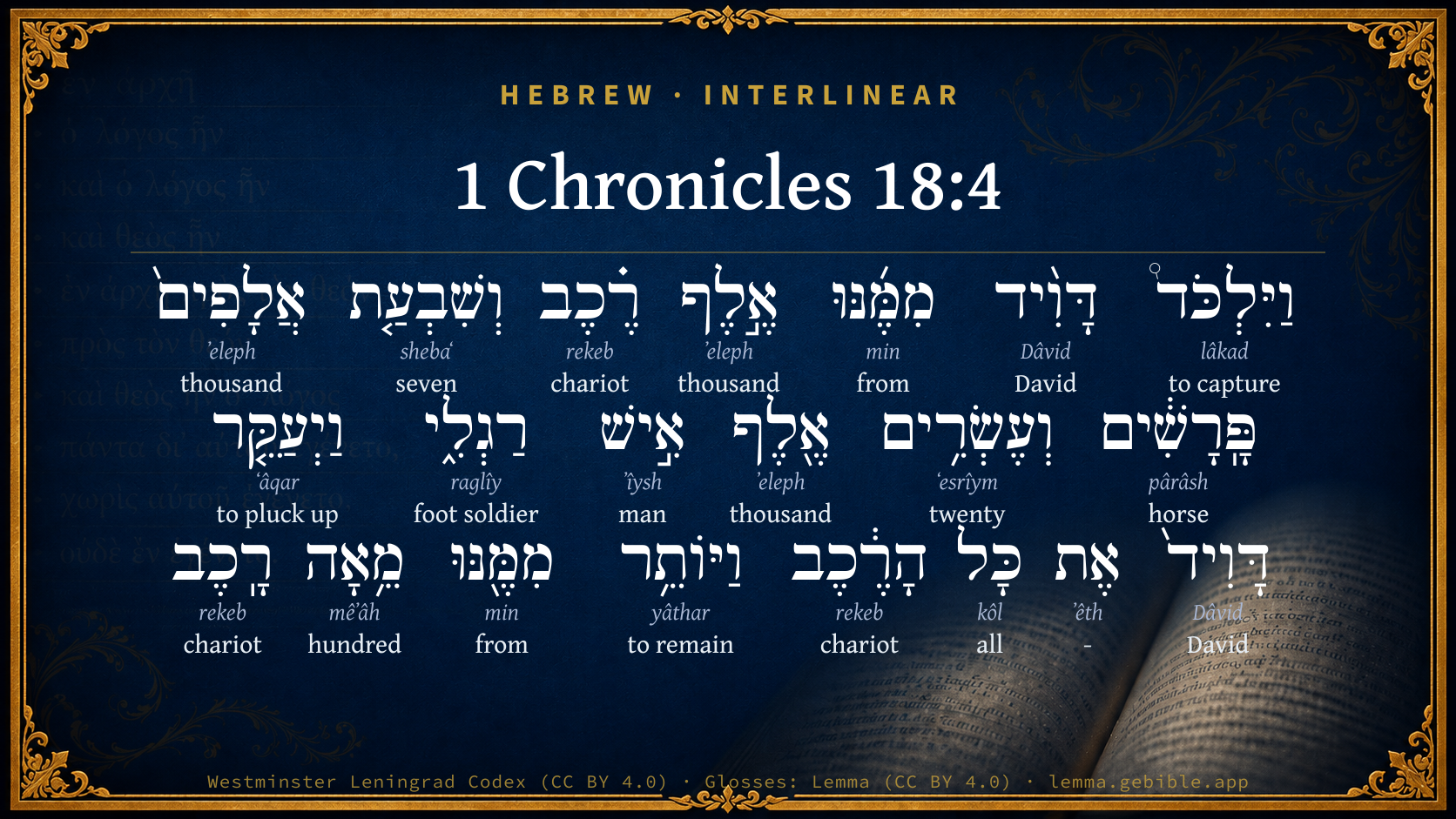
1 Chronicles 18:4

Hebrew (Westminster Leningrad Codex) 1 Chronicles 18:4 appears in the Hebrew Old Testament. The text above is from the Westminster Leningrad Codex. Each word links to its Strong’s number, a concise gloss, and parsing drawn from the Open Scriptures Hebrew Bible morphology. Click any word for its full Brown-Driver-Briggs (BDB) entry.
Download image
Cite this verse

1 Chronicles 18:4 (World English Bible). Public Domain. Lemma interlinear Bible study tool, https://lemma.gebible.app/v/1-chronicles/18/4.

Show BibTeX & RIS
BibTeX
RIS
English Translation
David took from him one thousand chariots, and seven thousand horsemen, and twenty thousand footmen; and David hamstrung all the chariot horses, but reserved of them for one hundred chariots.
World English Bible · Public Domain
Download a study sheet

One document with this verse’s original text, its word-by-word gloss line, the meaning frame, cross-references with their text, attributed commentary, and full source and license credits — printable, and it pastes into notes with its structure intact.

This verse Autodidact and up

Study sheet (.html) Plain text (.txt)

A passage Seminary Student

Up to 50 verses in one chapter. A passage sheet keeps up to 6 commentary sources and 12 cross-references per verse, in the order this page ranks them, and says so on the sheet whenever that leaves anything out. Ask for a single verse and you get the Autodidact verse sheet above.

Everything on this page stays free to read, with no account — the sheet is a download of what is already on screen, not access to it.

Want to remove ads? Support Godless Engineer
Compare translations 3

The same verse in 3 English versions, stacked beneath the original-language interlinear above. Click any original word for its lexicon entry.

Each is an independent rendering of the whole verse — the interlinear is not word-aligned to these translations.

Highlighted words mark where these versions differ — a whole-verse word diff, not a word-by-word alignment.

  • World English Bible Public Domain
    David took from him one thousand chariots, and seven thousand horsemen, and twenty thousand footmen; and David hamstrung all the chariot horses, but reserved of them for one hundred chariots.
  • King James Version Public Domain
    And David took from him a thousand chariots, and seven thousand horsemen, and twenty thousand footmen: David also houghed all the chariot horses, but reserved of them an hundred chariots.
  • unfoldingWord Literal Text CC BY-SA 4.0
    And David captured from him 1,000 chariots, and 7,000 horsemen and 20,000 men on foot. And David hamstrung all of the chariots, but he left from him 100 chariots.

unfoldingWord Literal Text — © unfoldingWord, licensed CC BY-SA 4.0. Word-aligned USFM3 via Door43 (git.door43.org/unfoldingWord/en_ult).

Versions to compare (up to 4)

3 of 4 selected

Show all 18 translations

Every available English version of this verse, each an independent rendering of the whole verse.

  • World English Bible Public Domain
    David took from him one thousand chariots, and seven thousand horsemen, and twenty thousand footmen; and David hamstrung all the chariot horses, but reserved of them for one hundred chariots.
  • Berean Standard Bible Public Domain
    David captured from him a thousand chariots, seven thousand charioteers, and twenty thousand foot soldiers, and he hamstrung all the horses except a hundred he kept for the chariots.
  • Majority Standard Bible Public Domain
    David captured from him a thousand chariots, seven thousand charioteers, and twenty thousand foot soldiers, and he hamstrung all the horses except a hundred he kept for the chariots.
  • King James Version Public Domain
    And David took from him a thousand chariots, and seven thousand horsemen, and twenty thousand footmen: David also houghed all the chariot horses, but reserved of them an hundred chariots.
  • American Standard Version (1901) Public Domain
    And David took from him a thousand chariots, and seven thousand horsemen, and twenty thousand footmen; and David hocked all the chariot horses, but reserved of them for a hundred chariots.
  • Revised Version (1885) Public Domain
    And David took from him a thousand chariots, and seven thousand horsemen, and twenty thousand footmen: and David houghed all the chariot horses, but reserved of them for an hundred chariots.
  • Geneva Bible (1599) Public Domain
    And Dauid tooke from him a thousand charets, and seuen thousand horsemen, and twentie thousand footemen, and destroyed all the charets, but he reserued of them an hundreth charets.
  • Douay-Rheims (1899) Public Domain
    And David took from him a thousand chariots, and seven thousand horsemen, and twenty thousand footmen, and he houghed all the chariot horses, only a hundred chariots, which he reserved for himself.
  • Young's Literal Translation Public Domain
    and David captureth from him a thousand chariots, and seven thousand horsemen, and twenty thousand footmen, and David destroyeth utterly all the chariots, and leaveth of them a hundred chariots `only'.
  • Literal Standard Version CC BY-SA 4.0
    and David captures from him one thousand chariots, and seven thousand horsemen, and twenty thousand footmen, and David utterly destroys all the chariots, and leaves of them [only] one hundred chariots.
  • Unlocked Literal Bible CC BY-SA 4.0
    David captured from him a thousand chariots, seven thousand horsemen, and twenty thousand footmen. David hamstrung all the chariot horses, but reserved enough of them for a hundred chariots.
  • unfoldingWord Literal Text CC BY-SA 4.0
    And David captured from him 1,000 chariots, and 7,000 horsemen and 20,000 men on foot. And David hamstrung all of the chariots, but he left from him 100 chariots.
  • Darby Bible Public Domain
    And David took from him a thousand chariots, and seven thousand horsemen, and twenty thousand footmen; and David houghed all the chariot [horses], but reserved of them [for] a hundred chariots.
  • World Messianic Bible Public Domain
    David took from him one thousand chariots, seven thousand horsemen, and twenty thousand footmen; and David hamstrung all the chariot horses, but reserved of them enough for one hundred chariots.
  • Webster's Bible Public Domain
    And David took from him a thousand chariots, and seven thousand horsemen, and twenty thousand footmen: David also houghed all the chariot-horses, but reserved of them a hundred chariots.
  • Free Bible Version CC BY-SA 4.0
    David captured from him 1,000 chariots, 7,000 charioteers, and 20,000 foot soldiers. David hamstrung all the chariot horses—except he saved enough for 100 chariots.
  • Bible in Basic English Public Domain
    And David took from him a thousand war-carriages and seven thousand horsemen and twenty thousand footmen: and he had the leg-muscles of all the horses cut, keeping only enough of them for a hundred war-carriages.
  • JPS Tanakh (1917) Public Domain
    And David took from him a thousand chariots, and seven thousand horsemen, and twenty thousand footmen; and David houghed all the chariot horses, but reserved of them for a hundred chariots.

Literal Standard Version (2020), Covenant Press — licensed CC BY-SA 4.0. Text via the HelloAO Bible API (eBible.org). Unlocked Literal Bible (unfoldingWord) — licensed CC BY-SA 4.0. Text via the HelloAO Bible API (eBible.org). unfoldingWord Literal Text — © unfoldingWord, licensed CC BY-SA 4.0. Word-aligned USFM3 via Door43 (git.door43.org/unfoldingWord/en_ult). Free Bible Version, Dr. Jonathan Gallagher — licensed CC BY-SA 4.0. Text via the HelloAO Bible API (eBible.org).

Word by word

More ways to search: Search by grammar → Find every occurrence → Compare this word →

Practice this passage: Drill this verse → Learn its vocabulary →

וַיְעַקֵּ֤ר
ʻâqar
H6131
“and · to pluck up”
Conjunction + Verb, Piel, Sequential Imperfect, 3rd Person, Masculine, Singular
Part of Speech
Conjunction + Verb
Stem
Piel
Form
Sequential Imperfect
Person
3rd Person
Gender
Masculine
Number
Singular
Full BDB Definition

Origin: a primitive root

TWOT: 1681 , 1682

to pluck up, root up - (Qal) to pluck up, root up - (Niphal) to be plucked up - to cut, hamstring - (Piel) to cut, hamstring
  1. וַיִּלְכֹּד֩ lâkad H3920 “and · to capture” Conjunction + Verb, Qal, Sequential Imperfect, 3rd Person, Masculine, Singular
  2. דָּוִ֨יד Dâvid H1732 “David” Noun, Proper
  3. מִמֶּ֜נּוּ min H4480 “from · us” Preposition + Suffix, Personal, 1st Person, Common, Plural
  4. אֶ֣לֶף ʼeleph H505 “thousand” Adjective, Cardinal number, Both, Singular, Absolute
  5. רֶ֗כֶב rekeb H7393 “chariot” Noun, Common, Masculine, Singular, Absolute
  6. וְשִׁבְעַ֤ת shebaʻ H7651 “and · seven” Conjunction + Adjective, Cardinal number, Masculine, Singular, Construct
  7. אֲלָפִים֙ ʼeleph H505 “thousand” Adjective, Cardinal number, Both, Plural, Absolute
  8. פָּֽרָשִׁ֔ים pârâsh H6571 “horses” Noun, Common, Masculine, Plural, Absolute
  9. וְעֶשְׂרִ֥ים ʻesrîym H6242 “and · twenty” Conjunction + Adjective, Cardinal number, Both, Plural, Absolute
  10. אֶ֖לֶף ʼeleph H505 “thousand” Adjective, Cardinal number, Both, Singular, Absolute
  11. אִ֣ישׁ ʼîysh H376 “man” Noun, Common, Masculine, Singular, Absolute
  12. רַגְלִ֑י raglîy H7273 “foot soldier” Adjective, Adjective, Masculine, Singular, Absolute
  13. דָּוִיד֙ Dâvid H1732 “David” Noun, Proper
  14. אֶת ʼêth H853 “-” Particle, Direct Object
  15. כָּל kôl H3605 “all of” Noun, Common, Masculine, Singular, Construct
  16. הָרֶ֔כֶב rekeb H7393 “the · chariot” Particle, Definite Article + Noun, Common, Masculine, Singular, Absolute
  17. וַיּוֹתֵ֥ר yâthar H3498 “and · to remain” Conjunction + Verb, Hiphil, Sequential Imperfect, 3rd Person, Masculine, Singular
  18. מִמֶּ֖נּוּ min H4480 “from · us” Preposition + Suffix, Personal, 1st Person, Common, Plural
  19. מֵ֥אָה mêʼâh H3967 “hundred” Adjective, Cardinal number, Both, Singular, Absolute
  20. רָֽכֶב rekeb H7393 “chariot” Noun, Common, Masculine, Singular, Absolute

About this verse

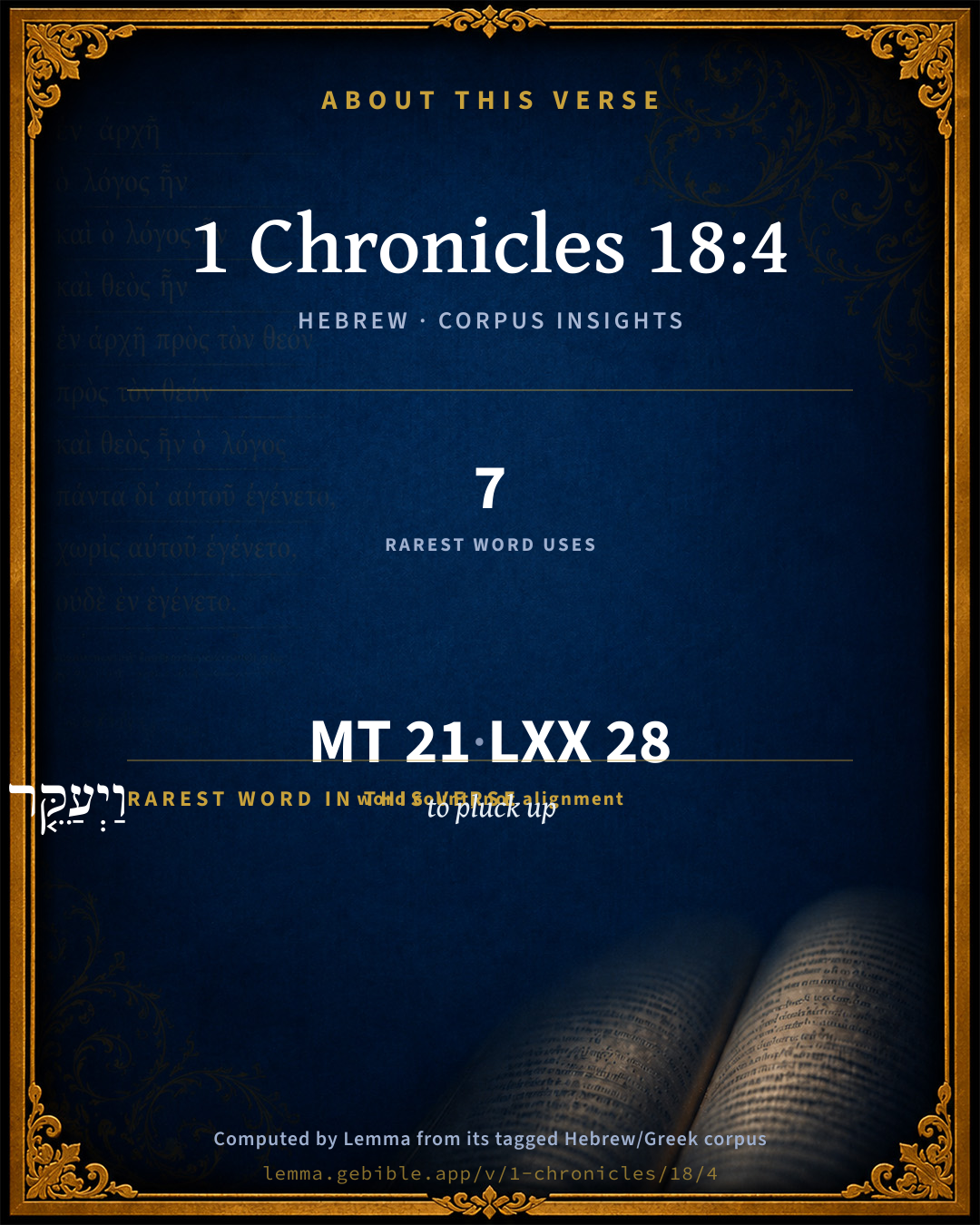
These counts appear in no published source. They are computed here, from the morphology-tagged text and Lemma’s own curated glosses. What Lemma adds →

21
words
15
distinct lemmas
Historical
section

Notable vocabulary

The rarest word here is וַיְעַקֵּ֤ר to pluck up H6131 — appearing just 7 times in the whole Hebrew Bible.

Shared distinctive vocabulary

וַיְעַקֵּ֤ר to pluck up H6131 occurs in 7 verses of the Hebrew Bible. Also found in:

Grammatical profile

  • 3 verbs
  • 8 nouns
  • 7 adjectives
  • 2 prepositions
  • 1 particle

Verb forms

  • וַיִּלְכֹּד֩ Qal · Sequential Imperfect
  • וַיְעַקֵּ֤ר Piel · Sequential Imperfect
  • וַיּוֹתֵ֥ר Hiphil · Sequential Imperfect

Repetition

Words recur within this verse — often emphatic in Hebrew:

  • אֶ֣לֶף thousand H505 ×3
  • רֶ֗כֶב chariot H7393 ×3
  • דָּוִ֨יד David H1732 ×2
  • מִמֶּ֜נּוּ from H4480 ×2

Hebrew & Septuagint length

In English translation the verse runs 30 words from the Hebrew and 32 from the Septuagint (LXX English) — closely comparable.

A rough comparison of the two English renderings, which tokenize alike — not a word-level alignment.

Word counts can differ between the Hebrew and the Greek without any difference in meaning — e.g. the Hebrew direct-object marker אֵת has no separate Greek word, and Greek often adds the article ὁ.

In the original languages it is 21 Hebrew tokens and 28 Greek tokens — but the two are counted differently (Hebrew bundles its prefixes and suffixes into one token; the Greek is in lemma form), so that isn’t a like-for-like length.

Cross-references

8

Topical passages linked to 1 Chronicles 18:4 in the Treasury of Scripture Knowledge — connected by theme and wording, ordered by reader-vote popularity; previews shown in the World English Bible.

  • 2 Samuel 8:4 David took from him one thousand seven hundred horsemen, and twenty thousand footmen: and David hamstrung all the chariot horses, but reserved of them for one hundred chariots.
  • Psalms 20:7 Some trust in chariots, and some in horses, But we trust the name of Yahweh our God.
  • Psalms 33:16–17 There is no king saved by the multitude of a host. A mighty man is not delivered by great strength.
  • Deuteronomy 17:16 Only he shall not multiply horses to himself, nor cause the people to return to Egypt, to the end that he may multiply horses; because Yahweh has said to you, You shall henceforth return no more that way.
  • Joshua 11:6 Yahweh said to Joshua, Don't be afraid because of them; for tomorrow at this time will I deliver them up all slain before Israel: you shall hamstring their horses, and burn their chariots with fire.
  • Joshua 11:9 Joshua did to them as Yahweh bade him: he hamstrung their horses, and burnt their chariots with fire.
  • 1 Kings 4:2 These were the princes whom he had: Azariah the son of Zadok, the priest;
  • 1 Kings 10:26 Solomon gathered together chariots and horsemen: and he had a thousand and four hundred chariots, and twelve thousand horsemen, that he bestowed in the chariot cities, and with the king at Jerusalem.

Cross-references courtesy of OpenBible.info (CC BY 4.0).

Hebrew and Greek witnesses Masoretic Hebrew ↔ Greek Septuagint

The same verse in the two great witnesses to the Old Testament, shown verse-for-verse.

These are two independent witnesses, not word-aligned to each other, and the Septuagint is shown in lemma (dictionary) form.

Hebrew 1 Chronicles 18:4 Masoretic · Westminster Leningrad Codex

וַיִּלְכֹּד֩ דָּוִ֨יד מִמֶּ֜נּוּ אֶ֣לֶף רֶ֗כֶב וְשִׁבְעַ֤ת אֲלָפִים֙ פָּֽרָשִׁ֔ים וְעֶשְׂרִ֥ים אֶ֖לֶף אִ֣ישׁ רַגְלִ֑י וַיְעַקֵּ֤ר דָּוִיד֙ אֶת כָּל הָרֶ֔כֶב וַיּוֹתֵ֥ר מִמֶּ֖נּוּ מֵ֥אָה רָֽכֶב

David took from him one thousand chariots, and seven thousand horsemen, and twenty thousand footmen; and David hamstrung all the chariot horses, but reserved of them for one hundred chariots.

World English Bible · Public Domain

Greek LXX 1 Chronicles 18:4 Septuagint · lemma form

καί προ καταλαμβάνω δαυίδ αὐτός χίλιοι ἅρμα καί ἑπτά χιλιάς ἵππος καί εἴκοσι χιλιάς ἀνήρ πεζός καί παραλύω δαυίδ πᾶς ὁ ἅρμα καί ὑπολείπω ἐκ αὐτός ἑκατόν ἅρμα

And David took of them a thousand chariots, and seven thousand horsemen, and twenty thousand infantry: and David houghed all the chariot horses, but there were reserved of them one hundred chariots.

LXX2012 (modern English Septuagint) · Public Domain

On this verse, The Cambridge Bible for Schools and Colleges discusses the Septuagint’s reading. Read the note in Commentary ↓

Hebrew: Westminster Leningrad Codex (CC BY 4.0). Greek: Septuagint (public domain); English from LXX2012 (modern English Septuagint) (Public Domain). How the Septuagint differs from the Hebrew →

Commentary

Notes on 1 Chronicles 18:4 from classic Christian and Jewish commentators (each source and its license shown beneath its notes). The classic Christian expositions comment on the surrounding passage and are grouped to its opening verse, so a note may address several verses; the Jewish commentaries on the Tanakh (Rashi and others) are per-verse, so they appear only where the commentator wrote on this verse.

Lemma curates 59 commentaries, every one of them public domain or Creative Commons licensed, each selected and text-cleaned for this edition rather than reprinted as found. About our sources →

Jamieson, Fausset & Brown

Robert Jamieson, A. R. Fausset & David Brown

And David took from him a thousand chariots--(See on Sa2 8:3-14). In Sa2 8:4 David is said to have taken seven hundred horsemen, whereas here it is said that he took seven thousand. This great discrepancy in the text of the two narratives seems to have originated with a transcriber in confounding the two Hebrew letters which indicate the numbers, and in neglecting to mark or obscure the points over one of them. We have no means of ascertaining whether seven hundred or seven thousand be the more correct. Probably the former should be adopted [DAVIDSON'S HERMENUTICS].

but reserved of them an hundred chariots--probably to grace a triumphal procession on his return to Jerusalem, and after using them in that way, destroy them like the rest.

Jamieson, Fausset & Brown — Commentary Critical and Explanatory on the Whole Bible (1871) — public domain (CC PDM 1.0). Text via the HelloAO Bible API.

Ellicott's Commentary for English Readers

(4) A thousand chariots, and seven thousand horsemen.—Hebrew text of Samuel, “a thousand and seven hundred horsemen.” The territory of Zobah lay somewhere in the great plain of Aram. Hadadezer would, therefore, be strong in chariots and horses, and our reading is probably correct. (Comp. 1Ch_19:18.)

Houghed.—Hamstrung—i.e., cut the sinews of the hind legs, so as to disable them.

Chariot horses.—The same Hebrew term has just been rendered chariots. It means also chariot soldiers.

David reserved a hundred chariots, with their horses, probably for his own use. Horses were always a luxury in Israel. (Comp. Isa_2:7.) Solomon recruited his stud from Egypt. (Comp. the prohibition, Deu_17:16.)

A Bible Commentary for English Readers, edited by Charles John Ellicott (1878–1897) — public domain. Text from a community e-Sword module.

The Cambridge Bible for Schools and Colleges

gen. ed. J. J. S. Perowne

4. a thousand chariots, and seven thousand horsemen] Sam. a thousand and seven hundred horsemen (so Heb. but LXX. of Sam. agrees with Chron.). Houghed = “hamstrung.”

The Cambridge Bible for Schools and Colleges (gen. ed. J. J. S. Perowne; Cambridge University Press, 1878–1918) — public domain. Text from a community e-Sword module.

Haydock's Catholic Bible Commentary

Footmen. Hebrew may well signify, "1000 chariot-horses and 7000 men who mounted the chariots and the horses." We only find 1700 horsemen, 2 Kings viii. 4. But soon after it is added, David houghed all the chariot-horses. (Calmet) --- They were thus rendered useless. The king was forbidden to keep many horses. (Du Hamel)

George Leo Haydock (1774–1849), Haydock's Catholic Family Bible and Commentary, 1859 edition — public domain. Excludes Psalms (Douay-Rheims chapter numbering differs from Protestant) and Deuterocanonical books (Catholic canon only).

The Pulpit Commentary

The parallel place (2Sa_8:4) omits, probably by error merely, the word "chariots," and reads for our seven thousand, "seven hundred." As the form of expression in the last two clauses of our present verse is the same in both cases, it is more natural to render, David houghed all the chariot horses, but reserved a hundred, i.e. a hundred horses unhoughed; he houghed all but a hundred. Our Authorized Version, in the parallel, gets over the difficulty by inserting "for," i.e. enough for, "a hundred chariots.

Vers. 4, 9-11.

David, Hadarezer, and Tou.

The Spirit of God is a faithful Biographer. If he records the good features of character in God"s children, he is no less faithful in describing the dark side of their character. In this the Word of God is a striking contrast to all human biography. David"s cruel conduct in "houghing the chariot-horses" is in keeping with the imperfect light of that dispensation, and is not recorded for our imitation any more than the records of crime in our daily press. It teaches us that there is only One perfect. There is a blot on every escutcheon except that of the Lord Jesus; and they are recorded by the Spirit of God in order that the eye of the soul should be ever turning from the best of earth"s heroes to him who is the "chief of ten thousand, and the altogether lovely." Let us be warned by the cruelties of David"s time and mark his graces, and follow him so far as he followed Christ. Hadarezer"s spoils and every other are consecrated to God. Not a trophy falls into David"s hands but is laid there. Hadarezer"s spoils and Tou"s gifts are all alike the Lord"s. May we follow him here, and cast every crown at the feet of Jesus! W.

The Pulpit Commentary (1880–1919), ed. H.D.M. Spence-Jones & Joseph S. Exell — public domain. Text from a community e-Sword module.

Rashi

Rabbi Shlomo Yitzchaki (Rashi)

and David hamstrung because it is written (Deut. 17:16) “Only he must not get himself many horses,” (Josh. 11:6): “... you shall cripple their horses.”

and left over of them a hundred chariots He must not get himself many horses, but enough for his chariots is permissible.

Rashi on the Tanakh — English translations: “The Judaica Press complete Tanach with Rashi, translated by A. J. Rosenberg” (CC BY 4.0); “Pentateuch with Rashi's commentary by M. Rosenbaum and A.M. Silbermann, 1929-1934” (public domain); “The Metsudah Tanach series, Lakewood, N.J” (CC BY 4.0); and “The Book of Joshua, Metsudah Publications, 1997” (CC BY 4.0). Text via Sefaria.

Lesson kit

Teaching starters — assembled from the data on this page, not authored interpretation. Every prompt links to the verse data it draws on. Edit before teaching.

1 Chronicles, in the Historical, opens this verse with 21 words (15 distinct Hebrew lemmas). Its most distinctive word is ʻâqar (“to pluck up”). A historical commentator’s framing appears above. Read the whole chapter for the surrounding context.

Discussion questions

  1. The word ʻâqar carries the sense “to pluck up.” How does it shape the verse?
  2. Genesis 49:6 shares the word «to pluck up» with this verse. How do the two illuminate each other?
  3. “thousand” occurs 3× in this one verse. What is the effect of the repetition?
  4. These translations render this verse differently; the difference is in the English rendering, not the original. What questions does that raise?
  5. The verb «וַיִּלְכֹּד֩» is Qal Sequential Imperfect. How does its form color the action?
  6. Reading how Jamieson, Fausset & Brown and Ellicott's Commentary for English Readers read this verse, where do the two commentators agree and where do they part?

Things to notice

Reading settings

Reading text

Shown beneath each verse's original-language words.

Old Testament
Old Testament edition

Read the OT as the Masoretic Hebrew (MT) or the Greek Septuagint (LXX).

English shown for the Greek Septuagint (in the Hebrew ↔ Greek comparison).

Comparing translations? Open the Compare panel on any verse page to stack up to four side by side.