
1 Chronicles 19:6

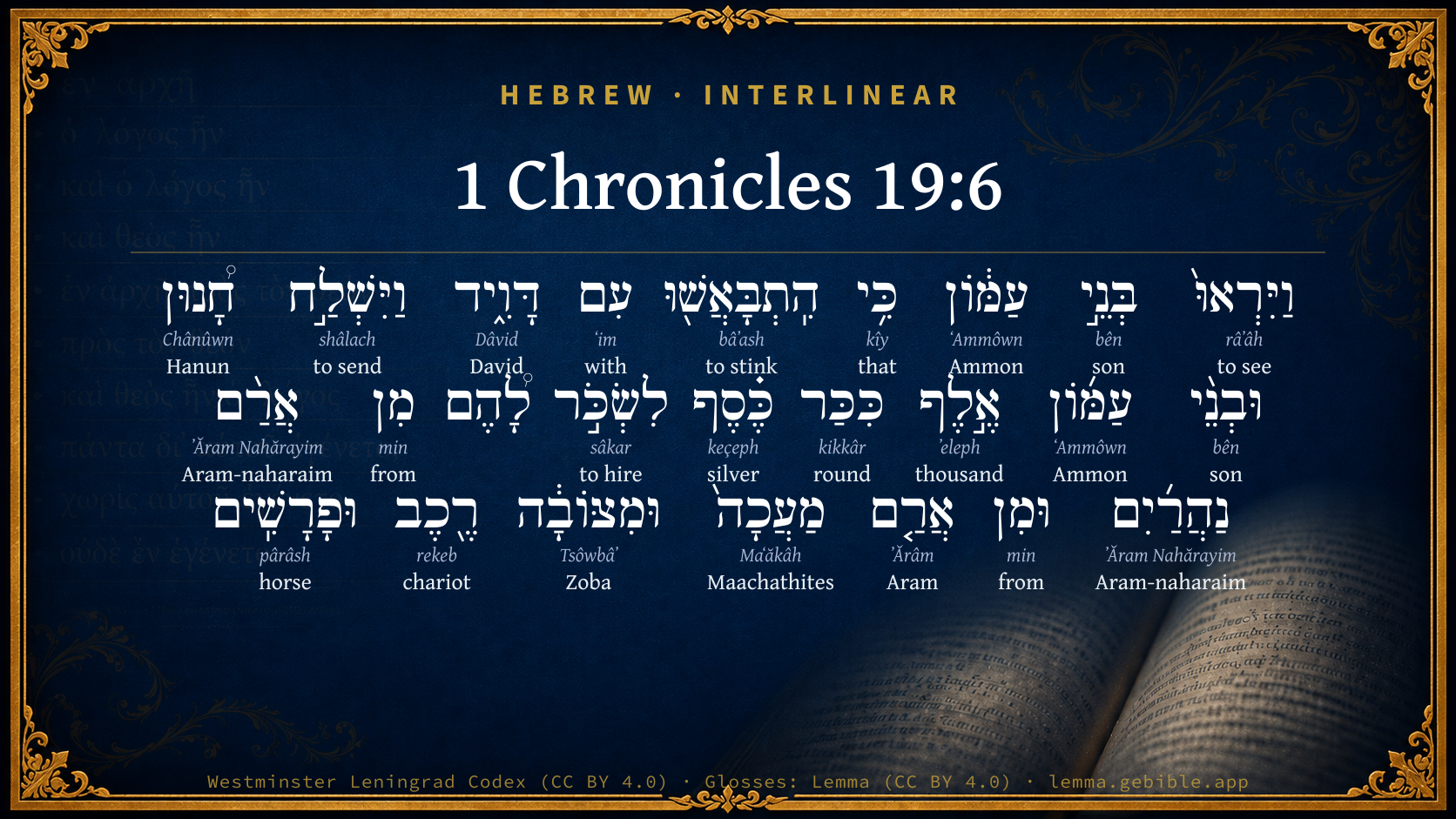
Hebrew (Westminster Leningrad Codex) 1 Chronicles 19:6 appears in the Hebrew Old Testament. The text above is from the Westminster Leningrad Codex. Each word links to its Strong’s number, a concise gloss, and parsing drawn from the Open Scriptures Hebrew Bible morphology. Click any word for its full Brown-Driver-Briggs (BDB) entry.
Download image
Cite this verse

1 Chronicles 19:6 (World English Bible). Public Domain. Lemma interlinear Bible study tool, https://lemma.gebible.app/v/1-chronicles/19/6.

Show BibTeX & RIS
BibTeX
RIS
English Translation
When the children of Ammon saw that they had made themselves odious to David, Hanun and the children of Ammon sent one thousand talents of silver to hire them chariots and horsemen out of Mesopotamia, and out of Arammaacah, and out of Zobah.
World English Bible · Public Domain
Download a study sheet

One document with this verse’s original text, its word-by-word gloss line, the meaning frame, cross-references with their text, attributed commentary, and full source and license credits — printable, and it pastes into notes with its structure intact.

This verse Autodidact and up

Study sheet (.html) Plain text (.txt)

A passage Seminary Student

Up to 50 verses in one chapter. A passage sheet keeps up to 6 commentary sources and 12 cross-references per verse, in the order this page ranks them, and says so on the sheet whenever that leaves anything out. Ask for a single verse and you get the Autodidact verse sheet above.

Everything on this page stays free to read, with no account — the sheet is a download of what is already on screen, not access to it.

Want to remove ads? Support Godless Engineer
Compare translations 3

The same verse in 3 English versions, stacked beneath the original-language interlinear above. Click any original word for its lexicon entry.

Each is an independent rendering of the whole verse — the interlinear is not word-aligned to these translations.

Highlighted words mark where these versions differ — a whole-verse word diff, not a word-by-word alignment.

  • World English Bible Public Domain
    When the children of Ammon saw that they had made themselves odious to David, Hanun and the children of Ammon sent one thousand talents of silver to hire them chariots and horsemen out of Mesopotamia, and out of Arammaacah, and out of Zobah.
  • King James Version Public Domain
    And when the children of Ammon saw that they had made themselves odious to David, Hanun and the children of Ammon sent a thousand talents of silver to hire them chariots and horsemen out of Mesopotamia, and out of Syriamaachah, and out of Zobah.
  • unfoldingWord Literal Text CC BY-SA 4.0
    And the sons of Ammon saw that they had made themselves stink with David. So Hanun and the sons of Ammon sent 1,000 kikkars of silver to hire chariots and horsemen for themselves from Aram Naharaim and from Aram Maacah and from Zobah.

unfoldingWord Literal Text — © unfoldingWord, licensed CC BY-SA 4.0. Word-aligned USFM3 via Door43 (git.door43.org/unfoldingWord/en_ult).

Versions to compare (up to 4)

3 of 4 selected

Show all 18 translations

Every available English version of this verse, each an independent rendering of the whole verse.

  • World English Bible Public Domain
    When the children of Ammon saw that they had made themselves odious to David, Hanun and the children of Ammon sent one thousand talents of silver to hire them chariots and horsemen out of Mesopotamia, and out of Arammaacah, and out of Zobah.
  • Berean Standard Bible Public Domain
    When the Ammonites realized that they had become a stench to David, Hanun and the Ammonites sent a thousand talents of silver to hire for themselves chariots and horsemen from Aram-naharaim, Aram-maacah, and Zobah.
  • Majority Standard Bible Public Domain
    When the Ammonites realized that they had become a stench to David, Hanun and the Ammonites sent a thousand talents of silver to hire for themselves chariots and horsemen from Aram-naharaim, Aram-maacah, and Zobah.
  • King James Version Public Domain
    And when the children of Ammon saw that they had made themselves odious to David, Hanun and the children of Ammon sent a thousand talents of silver to hire them chariots and horsemen out of Mesopotamia, and out of Syriamaachah, and out of Zobah.
  • American Standard Version (1901) Public Domain
    And when the children of Ammon saw that they had made themselves odious to David, Hanun and the children of Ammon sent a thousand talents of silver to hire them chariots and horsemen out of Mesopotamia, and out of Arammaacah, and out of Zobah.
  • Revised Version (1885) Public Domain
    And when the children of Ammon saw that they had made themselves odious to David, Hanun and the children of Ammon sent a thousand talents of silver to hire them chariots and horsemen out of Mesopotamia, and out of Aram-maacah, and out of Zobah.
  • Geneva Bible (1599) Public Domain
    When the children of Ammon saw that they stanke in the sight of Dauid, then sent Hanun and the children of Ammon a thousande talents of siluer to hire them charets and horsemen out of Aram Naharaim and out of Aram Maachah, and out of Zobah.
  • Douay-Rheims (1899) Public Domain
    And when the children of Ammon saw that they had done an injury to David, Hanon and the rest of the people sent a thousand talents of silver, to hire them chariots and horsemen out of Mesopotamia, and out of Syria Maacha, and out of Soba.
  • Young's Literal Translation Public Domain
    And the sons of Ammon see that they have made themselves abhorred by David, and Hanun and the sons of Ammon send a thousand talents of silver, to hire to them, from Aram-Naharaim, and from Aram-Maachah, and from Zobah, chariots and horsemen;
  • Literal Standard Version CC BY-SA 4.0
    And the sons of Ammon see that they have made themselves abhorred by David, and Hanun and the sons of Ammon send one thousand talents of silver, to hire for themselves, from Aram-Naharaim, and from Aram-Maachah, and from Zobah, chariots and horsemen;
  • Unlocked Literal Bible CC BY-SA 4.0
    When the Ammonites saw that they had become a stench to David, Hanun and the Ammonites sent a thousand talents of silver to hire Aramean chariots and horsemen from Naharaim, Maacah, and Zobah.
  • unfoldingWord Literal Text CC BY-SA 4.0
    And the sons of Ammon saw that they had made themselves stink with David. So Hanun and the sons of Ammon sent 1,000 kikkars of silver to hire chariots and horsemen for themselves from Aram Naharaim and from Aram Maacah and from Zobah.
  • Darby Bible Public Domain
    And the children of Ammon saw that they had made themselves odious to David; and Hanun and the children of Ammon sent a thousand talents of silver to hire them chariots and horsemen out of Mesopotamia, and from the Syrians of Maacah, and from Zobah.
  • World Messianic Bible Public Domain
    When the children of Ammon saw that they had made themselves odious to David, Hanun and the children of Ammon sent one thousand talents of silver to hire chariots and horsemen out of Mesopotamia, out of Aram-maacah, and out of Zobah.
  • Webster's Bible Public Domain
    And when the children of Ammon saw that they had made themselves odious to David, Hanun and the children of Ammon sent a thousand talents of silver to hire them chariots and horsemen out of Mesopotamia, and out of Syria-maachah, and out of Zobah.
  • Free Bible Version CC BY-SA 4.0
    Then the Ammonites realized that they had really been offensive to David. So Hanun and the Ammonites sent a thousand talents of silver to hire chariots and charioteers from Aram-naharaim, Aram-maacah, and Zobah.
  • Bible in Basic English Public Domain
    And when the children of Ammon saw that they had made themselves hated by David, Hanun and the children of Ammon sent a thousand talents of silver as payment for war-carriages and horsemen from Mesopotamia and Aram-maacah and Zobah.
  • JPS Tanakh (1917) Public Domain
    And when the children of Ammon saw that they had made themselves odious to David, Hanun and the children of Ammon sent a thousand talents of silver to hire them chariots and horsemen out of Aram-naharaim, and out of Aram-maacah, and out of Zobah.

Literal Standard Version (2020), Covenant Press — licensed CC BY-SA 4.0. Text via the HelloAO Bible API (eBible.org). Unlocked Literal Bible (unfoldingWord) — licensed CC BY-SA 4.0. Text via the HelloAO Bible API (eBible.org). unfoldingWord Literal Text — © unfoldingWord, licensed CC BY-SA 4.0. Word-aligned USFM3 via Door43 (git.door43.org/unfoldingWord/en_ult). Free Bible Version, Dr. Jonathan Gallagher — licensed CC BY-SA 4.0. Text via the HelloAO Bible API (eBible.org).

Word by word

More ways to search: Search by grammar → Find every occurrence → Compare this word →

Practice this passage: Drill this verse → Learn its vocabulary →

אֲרַ֨ם
ʼĂram Nahărayim
H763
“Aram-naharaim”
Noun, Proper
Part of Speech
Noun
Type
Proper
Full BDB Definition

Origin: from H758 and the dual of H5104

TWOT: None

Aram-naharaim = "Aram of the two rivers" - Mesopotamia
  1. וַיִּרְאוּ֙ râʼâh H7200 “and · to see” Conjunction + Verb, Qal, Sequential Imperfect, 3rd Person, Masculine, Plural
  2. בְּנֵ֣י bên H1121 “sons of” Noun, Common, Masculine, Plural, Construct
  3. עַמּ֔וֹן ʻAmmôwn H5983 “Ammon” Noun, Proper
  4. כִּ֥י kîy H3588 “that” Conjunction
  5. הִֽתְבָּאֲשׁ֖וּ bâʼash H887 “to stink” Verb, Hithpael, Perfect, 3rd Person, Common, Plural
  6. עִם ʻim H5973 “with” Preposition
  7. דָּוִ֑יד Dâvid H1732 “David” Noun, Proper
  8. וַיִּשְׁלַ֣ח shâlach H7971 “and · to send” Conjunction + Verb, Qal, Sequential Imperfect, 3rd Person, Masculine, Singular
  9. חָ֠נוּן Chânûwn H2586 “Hanun” Noun, Proper
  10. וּבְנֵ֨י bên H1121 “and · sons of” Conjunction + Noun, Common, Masculine, Plural, Construct
  11. עַמּ֜וֹן ʻAmmôwn H5983 “Ammon” Noun, Proper
  12. אֶ֣לֶף ʼeleph H505 “thousand” Adjective, Cardinal number, Both, Singular, Absolute
  13. כִּכַּר kikkâr H3603 “round of” Noun, Common, Both, Singular, Construct
  14. כֶּ֗סֶף keçeph H3701 “silver” Noun, Common, Masculine, Singular, Absolute
  15. לִשְׂכֹּ֣ר sâkar H7936 “to hire” Preposition + Verb, Qal, Infinitive Construct
  16. מִן min H4480 “from” Preposition
  17. נַהֲרַ֜יִם ʼĂram Nahărayim H763 “Aram-naharaim” Noun, Proper
  18. וּמִן min H4480 “and · from” Conjunction + Preposition
  19. אֲרַ֤ם ʼĂrâm H758 “Aram” Noun, Proper
  20. מַעֲכָה֙ Maʻăkâh H4601 “Maachathites” Noun, Proper
  21. וּמִצּוֹבָ֔ה Tsôwbâʼ H6678 “and · from · Zoba” Conjunction + Preposition + Noun, Proper
  22. רֶ֖כֶב rekeb H7393 “chariot” Noun, Common, Masculine, Singular, Absolute
  23. וּפָרָשִֽׁים pârâsh H6571 “and · horses” Conjunction + Noun, Common, Masculine, Plural, Absolute

About this verse

These counts appear in no published source. They are computed here, from the morphology-tagged text and Lemma’s own curated glosses. What Lemma adds →

25
words
20
distinct lemmas
Historical
section

Notable vocabulary

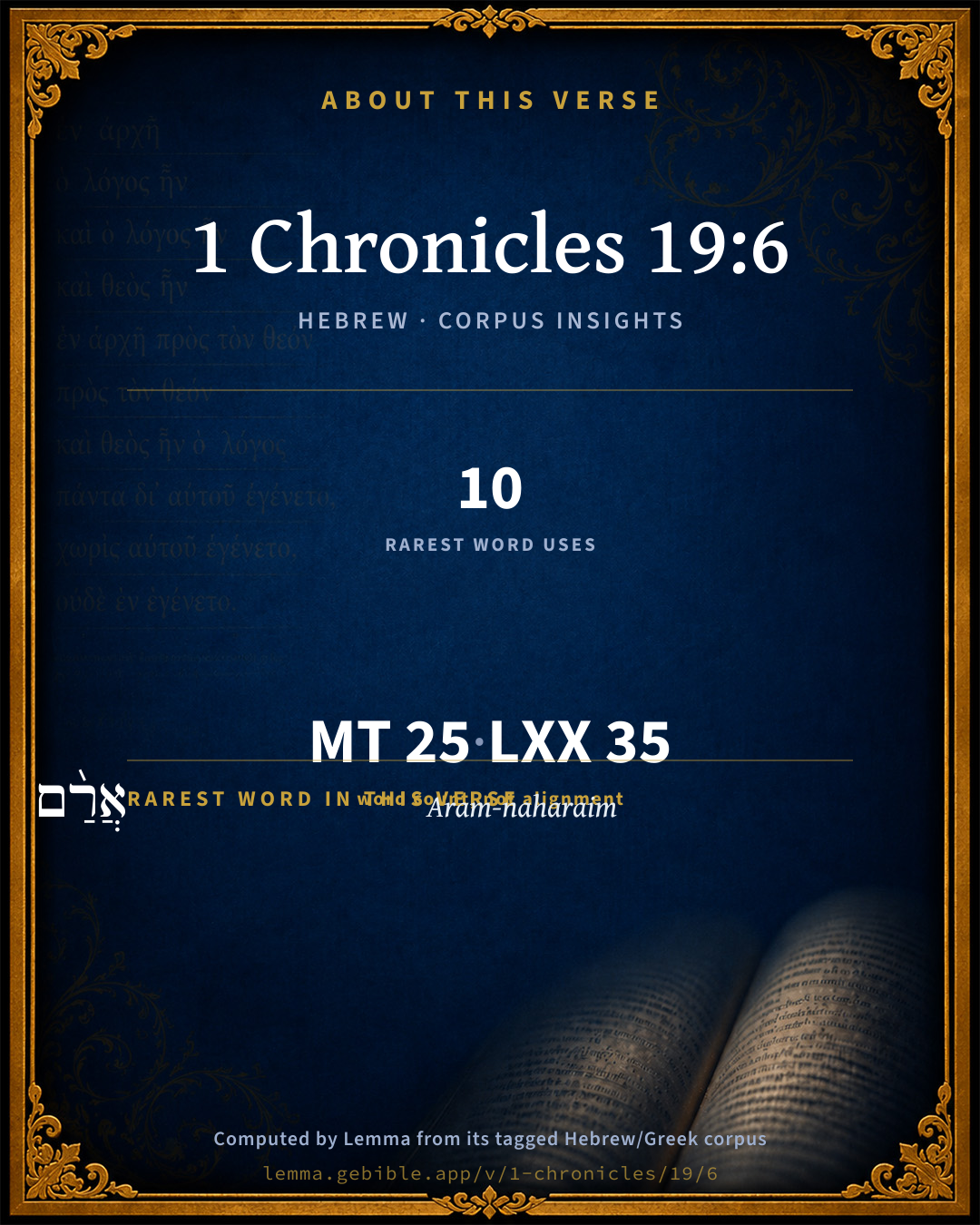
The rarest word here is אֲרַ֨ם Aram-naharaim H763 — appearing just 10 times in the whole Hebrew Bible.

Shared distinctive vocabulary

אֲרַ֨ם Aram-naharaim H763 occurs in 5 verses of the Hebrew Bible. Also found in:

Grammatical profile

  • 4 verbs
  • 15 nouns
  • 1 adjective
  • 4 prepositions
  • 1 conjunction

Verb forms

  • וַיִּרְאוּ֙ Qal · Sequential Imperfect
  • הִֽתְבָּאֲשׁ֖וּ Hithpael · Perfect
  • וַיִּשְׁלַ֣ח Qal · Sequential Imperfect
  • לִשְׂכֹּ֣ר Qal · Infinitive Construct

Repetition

Words recur within this verse — often emphatic in Hebrew:

  • בְּנֵ֣י son H1121 ×2
  • עַמּ֔וֹן Ammon H5983 ×2
  • אֲרַ֨ם Aram-naharaim H763 ×2
  • מִן from H4480 ×2

Hebrew & Septuagint length

In English translation the verse runs 43 words from the Hebrew and 46 from the Septuagint (LXX English) — closely comparable.

A rough comparison of the two English renderings, which tokenize alike — not a word-level alignment.

Word counts can differ between the Hebrew and the Greek without any difference in meaning — e.g. the Hebrew direct-object marker אֵת has no separate Greek word, and Greek often adds the article ὁ.

In the original languages it is 25 Hebrew tokens and 35 Greek tokens — but the two are counted differently (Hebrew bundles its prefixes and suffixes into one token; the Greek is in lemma form), so that isn’t a like-for-like length.

Cross-references

20

Topical passages linked to 1 Chronicles 19:6 in the Treasury of Scripture Knowledge — connected by theme and wording, ordered by reader-vote popularity; previews shown in the World English Bible.

  • Genesis 34:30 Jacob said to Simeon and Levi, "You have troubled me, to make me odious to the inhabitants of the land, among the Canaanites and the Perizzites. I am few in number. They will gather themselves together against me and strike me, and I will be destroyed, I and my house."
  • 2 Samuel 10:6 When the children of Ammon saw that they were become odious to David, the children of Ammon sent and hired the Syrians of Beth Rehob, and the Syrians of Zobah, twenty thousand footmen, and the king of Maacah with one thousand men, and the men of Tob twelve thousand men.
  • 1 Chronicles 18:5 When the Syrians of Damascus came to help Hadarezer king of Zobah, David struck of the Syrians twenty-two thousand men.
  • 1 Chronicles 18:9 When Tou king of Hamath heard that David had struck all the host of Hadarezer king of Zobah,
  • Exodus 5:21 and they said to them, "May Yahweh look at you, and judge, because you have made us a stench to be abhorred in the eyes of Pharaoh, and in the eyes of his servants, to put a sword in their hand to kill us."
  • 1 Samuel 13:4 All Israel heard say that Saul had struck the garrison of the Philistines, and also that Israel was had in abomination with the Philistines. The people were gathered together after Saul to Gilgal.
  • 1 Samuel 14:47 Now when Saul had taken the kingdom over Israel, he fought against all his enemies on every side, against Moab, and against the children of Ammon, and against Edom, and against the kings of Zobah, and against the Philistines: and wherever he turned himself, he put [them] to the worse.
  • 1 Samuel 27:12 Achish believed David, saying, He has made his people Israel utterly to abhor him; therefore he shall be my servant forever.
  • 2 Samuel 8:3 David struck also Hadadezer the son of Rehob, king of Zobah, as he went to recover his dominion at the River.
  • 1 Kings 11:23–24 God raised up [another] adversary to him, Rezon the son of Eliada, who had fled from his lord Hadadezer king of Zobah.
  • 2 Chronicles 16:2–3 Then Asa brought out silver and gold out of the treasures of the house of Yahweh and of the king's house, and sent to Ben Hadad king of Syria, who lived at Damascus, saying,
  • 2 Chronicles 18:3 Ahab king of Israel said to Jehoshaphat king of Judah, Will you go with me to Ramoth-gilead? He answered him, I am as you are, and my people as your people; and [we will be] with you in the war.
  • 2 Chronicles 18:5 Then the king of Israel gathered the prophets together, four hundred men, and said to them, Shall we go to Ramoth-gilead to battle, or shall I forbear? They said, Go up; for God will deliver it into the hand of the king.
  • 2 Chronicles 18:9 Now the king of Israel and Jehoshaphat the king of Judah sat each on his throne, arrayed in their robes, and they were sitting in an open place at the entrance of the gate of Samaria; and all the prophets were prophesying before them.
  • 2 Chronicles 25:6 He hired also one hundred thousand mighty men of valor out of Israel for one hundred talents of silver.
  • 2 Chronicles 27:5 He fought also with the king of the children of Ammon, and prevailed against them. The children of Ammon gave him the same year one hundred talents of silver, and ten thousand measures of wheat, and ten thousand of barley. So much did the children of Ammon render to him, in the second year also, and in the third.
  • Psalms 14:3 They have all gone aside. They have together become corrupt. There is none who does good, no, not one.
  • Psalms 46:9 He makes wars cease to the end of the earth. He breaks the bow, and shatters the spear. He burns the chariots in the fire.
  • Luke 10:16 Whoever listens to you listens to me, and whoever rejects you rejects me. Whoever rejects me rejects him who sent me."
  • 1 Thessalonians 4:8 Therefore he who rejects doesn't reject man, but God, who has also given his Holy Spirit to you.

Cross-references courtesy of OpenBible.info (CC BY 4.0).

Hebrew and Greek witnesses Masoretic Hebrew ↔ Greek Septuagint

The same verse in the two great witnesses to the Old Testament, shown verse-for-verse.

These are two independent witnesses, not word-aligned to each other, and the Septuagint is shown in lemma (dictionary) form.

Hebrew 1 Chronicles 19:6 Masoretic · Westminster Leningrad Codex

וַיִּרְאוּ֙ בְּנֵ֣י עַמּ֔וֹן כִּ֥י הִֽתְבָּאֲשׁ֖וּ עִם דָּוִ֑יד וַיִּשְׁלַ֣ח חָ֠נוּן וּבְנֵ֨י עַמּ֜וֹן אֶ֣לֶף כִּכַּר כֶּ֗סֶף לִשְׂכֹּ֣ר לָ֠הֶם מִן אֲרַ֨ם נַהֲרַ֜יִם וּמִן אֲרַ֤ם מַעֲכָה֙ וּמִצּוֹבָ֔ה רֶ֖כֶב וּפָרָשִֽׁים

When the children of Ammon saw that they had made themselves odious to David, Hanun and the children of Ammon sent one thousand talents of silver to hire them chariots and horsemen out of Mesopotamia, and out of Arammaacah, and out of Zobah.

World English Bible · Public Domain

Greek LXX 1 Chronicles 19:6 Septuagint · lemma form

καί ὁράω ὁ υἱός αμμων ὅτι αἰσχύνω λαός δαυίδ καί ἀποστέλλω αναν καί ὁ υἱός αμμων χίλιοι τάλαντον ἀργύριον ὁ μισθόω ἑαυτοῦ ἐκ συρία μεσοποταμία καί ἐκ συρία μοοχα καί ἐκ σωβα ἅρμα καί ἱππεύς

And the children of Ammon saw that the people of David were ashamed, and Anan and the children of Ammon sent a thousand talents of silver to hire for themselves chariots and horsemen out of Syria of Mesopotamia, and out of Syria Maacha, and from Sobal.

LXX2012 (modern English Septuagint) · Public Domain

On this verse, Haydock's Catholic Bible Commentary discusses the Septuagint’s reading. Read the note in Commentary ↓

Hebrew: Westminster Leningrad Codex (CC BY 4.0). Greek: Septuagint (public domain); English from LXX2012 (modern English Septuagint) (Public Domain). How the Septuagint differs from the Hebrew →

Commentary

Notes on 1 Chronicles 19:6 from classic Christian and Jewish commentators (each source and its license shown beneath its notes). The classic Christian expositions comment on the surrounding passage and are grouped to its opening verse, so a note may address several verses; the Jewish commentaries on the Tanakh (Rashi and others) are per-verse, so they appear only where the commentator wrote on this verse.

Lemma curates 59 commentaries, every one of them public domain or Creative Commons licensed, each selected and text-cleaned for this edition rather than reprinted as found. About our sources →

Matthew Henry's Commentary

We may see here, 1. How the hearts of sinners that are marked for ruin are hardened to their destruction. The children of Ammon saw that they had made themselves odious to David (Ch1 19:6), and then it would have been their wisdom to desire conditions of peace, to humble themselves and offer any satisfaction for the injury they had done him, the rather because they had made themselves not only odious to David, but obnoxious to the justice of God, who is King of nations, and will assert the injured rights and maintain the violated laws of nations. But, instead of this, they prepared for war, and so brought upon themselves, by David's hand, those desolations which he never intended them. 2. How the courage of brave men is heightened and invigorated by difficulties. When Joab saw that the battle was set against him before and behind (Ch1 19:10), instead of meditating a retreat, he doubled his resolution; and, though he could not double, he divided his army, and not only spoke, but acted, like a gallant man, that had great presence of mind when he saw himself surrounded. He engaged with his brother for mutual assistance (Ch1 19:12), excited himself and the rest of the officers to act vigorously in their respective posts, with an eye to God's glory and their country's good, not to any honour and advantage of their own, and then left the issue to God: Let the Lord do that which is right in his sight. 3. How vain the greatest art and strength are against justice and equity. The Ammonites did their utmost to make the best of their position: they brought as good a force into the field, and disposed it with as much policy as possible; yet, having a bad cause, and acting in defence of wrong, it would not do; they were put to the worst. Right will prevail and triumph at last. 4. To how little purpose it is for those to rally again, and reinforce themselves, that have not God on their side. The Syrians, though in no way concerned in the merits of the cause, but serving only as mercenaries to the Ammonites, when they were beaten, thought themselves concerned to retrieve their honour, and therefore called in the assistance of the Syrians on the other side Euphrates; but to no purpose, for still they fled before Israel (Ch1 19:18); they lost 7000 men, who are said to be the men of 700 chariots, Sa2 10:18. For, as now in a man of war for sea-service they allot ten men to a gun, so then, in land-service, ten men to a chariot. 5. those who have meddled with strife that belongs not to them, and have found that they meddled to their own heart, do well to learn wit at length and meddle no further. The Syrians, finding that Israel was the conquering side, not only broke off their alliance with the Ammonites and would help them no more (Ch1 19:19), but made peace with David and became his servants. Let those who have in vain stood it out against God be thus wise for themselves, and agree with him quickly, while they are in the way. Let them become his servants; for they cannot but see themselves undone if they be his enemies.

Matthew Henry's Commentary on the Whole Bible (1708–1710) — public domain (CC PDM 1.0). Text via the HelloAO Bible API.

Jamieson, Fausset & Brown

Robert Jamieson, A. R. Fausset & David Brown

JOAB AND ABISHAI OVERCOME THE AMMONITES. (Ch1 19:6-15)

when the children of Ammon saw that they had made themselves odious to David--One universal feeling of indignation was roused throughout Israel, and all classes supported the king in his determination to avenge this unprovoked insult on the Hebrew nation.

Hanun . . . sent a thousand talents of silver--a sum equal to £342,100, to procure the services of foreign mercenaries.

chariots and horsemen out of Mesopotamia . . . Syria-maachah, and . . . Zobah--The Mesopotamian troops did not arrive during this campaign (Ch1 19:16). Syria-maachah lay on the north of the possessions of the trans-jordanic Israelites, near Gilead.

Zobah--(see on Ch1 18:3).

Jamieson, Fausset & Brown — Commentary Critical and Explanatory on the Whole Bible (1871) — public domain (CC PDM 1.0). Text via the HelloAO Bible API.

The Biblical Illustrator

Joseph S. Exell

1Ch_19:6-9

And when the children of Ammon.

Avenging an insult

I. Insult springing from slight provocation.

1. From a suspicious mind.

2. From advice of jealous princes.

II. Insult leading to unjust war. This War might have been avoided by an honourable apology or better understanding. One evil leads to smother.

III. War terminating in disgraceful overthrow. (J. Wolfendale.)

The Biblical Illustrator, edited by Joseph S. Exell (c. 1880s–1900s) — public domain. Text from a community e-Sword module.

Geneva Bible (1599)

Geneva Bible translators

Which were five in all.

Or, had made themselves to be abhorred of David.

Geneva Bible (1599) marginal notes — public domain. Text via Bolls.life.

Adam Clarke's Commentary

Verse 6. Chariots and horsemen out of Mesopotamia] These are not mentioned in the parallel place in Samuel; probably they did not arrive till the Ammonites and their other allies were defeated by the Israelites in the first battle.

Adam Clarke's Commentary on the Bible (1810–1826) — public domain. Text from a community e-Sword/MySword module.

Ellicott's Commentary for English Readers

(6) And when the children of Ammon.—Up to this point the narrative has substantially coincided with 2 Samuel 10, and might have been derived immediately from it; but this and the following verses differ considerably from the older account, and add one or two material facts, which suggest another source.

Made themselves odious.—“Had become in bad odonr.” A unique (Aramaized) form of the same verb as is used in Samuel (hithbâ’γshϋ for nib’γshϋ).

A thousand talents of silver.—The talent was a weight, not a coin, coined money being unknown at that epoch. The sum specified amounts to £400,000. estimating the silver talent at £400. This detail is peculiar to the Chronicles.

Out of Mesopotamia, and out of Syria-maachah, and out of Zobah.—Out of Aram-naharaïm, and out of Aram-maachah, &c Samuel has, “And they hired Aram-beth-rehob and Aram-zobah, 20,000 foot, and the king of Maachah, 1,000 men, and the men (or chieftain) of Tôb, 12,000men.”Aram-naharaïm, i.e., Aram of the two rivers, was the country between the Tigris and Euphrates (see Jdg_3:8); Aram-beth-rehob may have been one of its political divisions, and is perhaps to be identified with Rehoboth-hannahar (1Ch_1:48), on the Euphrates. Another Rehoboth (“Rehoboth-ir,” Gen_10:11) lay on the Tigris, north-east of Nineveh, and was a suburb of that great city. Aram-maachah imply the dominions of “the king of Maachah,” who is mentioned in 1Ch_19:7; and Zobah, the Aram-zobah of Samuel. The chronicler makes no separate mention of the “men of Tòb” (Jdg_11:3), perhaps because they were subject to Hadadezer, and as such, included in his forces. The Syriac and Arabic here have “from Aram-naharaïm, Haran, Nisibis, and Edom.”

A Bible Commentary for English Readers, edited by Charles John Ellicott (1878–1897) — public domain. Text from a community e-Sword module.

The Cambridge Bible for Schools and Colleges

gen. ed. J. J. S. Perowne

6. a thousand talents of silver] A very large sum; for a hundred talents Amaziah hired a hundred thousand men (2Ch_25:6).

chariots and horsemen] The Israelite armies on the contrary consisted chiefly of infantry, the country being for the most part unsuitable for horses.

Mesopotamia] Heb. “Aram (Syria) of the two rivers” (cp. Gen_24:10, R.V. mg.) i.e. probably the land between the Euphrates and the Chaboras. The Greeks used the term Mesopotamia of a wider district, i.e. of the country between the Euphrates and the Tigris. This mention of Mesopotamia is probably premature, for in 1Ch_19:16 the summons of Syrians from beyond the Euphrates is spoken of as a new thing. The corresponding expression in 2Sa_10:6 is Beth-rehob, a district which has not yet been identified.

Syria-maachah] R.V. Aram-maacah. Cp. 1Ch_7:15, note; Deu_3:14; Jos_12:5; Jos_13:11.

Zobah] Cp. 1Ch_18:3 note.

The Cambridge Bible for Schools and Colleges (gen. ed. J. J. S. Perowne; Cambridge University Press, 1878–1918) — public domain. Text from a community e-Sword module.

Albert Barnes' Notes on the Bible

A thousand talents of silver - The price is not given in Samuel. On the practice of hiring troops about this time in western Asia, see 1Ki 15:18; 2Ki 7:6; 2Ch 25:6.

Albert Barnes' Notes on the Bible (1834–1885) — public domain. Text from a community e-Sword/MySword module.

Haydock's Catholic Bible Commentary

Done. Hebrew, "made themselves stinking." Septuagint, "that the people of David were covered with confusion." The insult fell on all Israel. --- Mesopotamia is not mentioned [in] 2 Kings, as the troops perhaps did not arrive soon enough for the first battle, ver. 16.

George Leo Haydock (1774–1849), Haydock's Catholic Family Bible and Commentary, 1859 edition — public domain. Excludes Psalms (Douay-Rheims chapter numbering differs from Protestant) and Deuterocanonical books (Catholic canon only).

The Pulpit Commentary

Made themselves odious. The Hebrew root of very strong force, vaB is here employed, and which our Authorized Version translates, both in the parallel place and elsewhere, far more uncompromisingly than here. A thousand talents . Not stated in Samuel. This talent was of three thousand shekels, believed to be equivalent to f342. Mesopotamia. The parallel place has Aram-beth-rehob, instead of our Aram-naharaim ("Syria of the Two Rivers," i.e. Tigris and Euphrates; Authorized Version, Mesopotamia"). From comparing this verso with ver. 16, it may seem probable that those strictly called of Mesopotamia" lent either no aid at first or but very partial. It is observable that the numbers of men supplied by Beth-rehob, Zobah, and Ishtob in the parallel place (viz. thirty-two thousand) agree with the numbers of this verse, from which we may conclude that, whatever Aram-beth-rehob (probably either Reho-both on the Euphrates, or Rehob last of Lebanon) and Aramnaharaim may strictly stand for respectively, they here substantially mean the same. It is possible that the difference is that of a corrupt text or careless copying. The Aram-naharaim ( Mesopotamia), which comes before us first in Gen_24:10, passes out of Scripture language after the defeats of this chapter the tract of country which it designated (some seven hundred miles by twenty to two hundred and fifty) being absorbed, first by Assyria, and afterwards by Babylon. The Assyrian Inscriptions reveal the fact that Mesopotamia was the prey of a largo number of small separate tribes at the period of the judges and the early Jewish monarchy, which is quite consistent with the glimpses we hero get of it and its people. Aram-maachah probably designates the tract of country north of East Manasseh, bordering on Palestine, and bounded by the Jordan, Mount Hermon, and on its east, Salcah. Zobah; (see 1Ch_18:3, note 1Sa_14:47) The parallel place adds also "the men of Ishtob.

Vers. 6-19.

Joab and Abishai, and the battle between the Israelites and the allied armies of the Ammonites and Syrians.

One sin always leads to another, and the insult of Hanun"s princes led on to a bloody war. No doubt the inconsiderate act of Hanun to David"s messengers was regretted shortly after it was committed. But it was too late. It is a law of God"s moral government that though the sin of our acts may be forgiven, the consequences of them must be reaped. "Whatsoever a man soweth, that shall he also reap." A little time sufficed to make the princes of Hanun aware that sooner or later there would be a terrible reprisal. David felt the indignity keenly. Yet the retribution did not proceed from him, but from those who had so grossly insulted him. This is invariably the case. A dread of retribution and a guilty conscience go together. The inconsiderate act of a moment, it is foreseen, will lead to consequences which must be averted; and so another is resolved on, and then follows a collapse or utter ruin. Thus it was here. The consequence of a momentary impulse are the destruction and ruin of a kingdom and nation. But notice, when the armies stood face to face with each other, Joab"s conduct. The Ammonites and the Syrians beset Israel behind and before. Joab was in straits. He evidently saw his danger. In the emergency he does his best, and then casts himself and his cause upon God. He asks not for victory. He does better. He makes the battle not a matter between the Ammonites and Israel, but between the Ammonites and God. He asks not for victory, but simply says, "Let the Lord do that which is good in his sight." This is faith of a high order. Herein he is an example for all believers. In every perplexity, difficulty, danger, or whatever the emergency may be, let us, as Joab did, devise the very best plans, use all means, and, having done all, leave the result calmly and confidently with God, feeling sure that whatever may be the result "all must be well." Such confidence will always sooner or later meet with its reward. And so it was here. Joab"s faith and trust in God. was crowned with a great victory.

W.

The Pulpit Commentary (1880–1919), ed. H.D.M. Spence-Jones & Joseph S. Exell — public domain. Text from a community e-Sword module.

Kretzmann's Popular Commentary

Paul E. Kretzmann

Defeat of the Ammonites

v. 6. And when the children of Ammon saw that they had made themselves odious to David, that they were a stench in his nostrils on account of their unprovoked treatment of his ambassadors, Hanun and the children of Ammon sent a thousand talents of silver (almost $2,000,000) to hire them chariots and horsemen out of Mesopotamia, beyond the Euphrates, and out of Syria-maachah, north of Gilead and Bozrah, in the country east of Jordan, and out of Zobah, north or northeast of Damascus.

v. 7. So they, the representatives of the Ammonites, hired thirty and two thousand chariots, and the king of Maachah and his people, who came and pitched before Medeba, a city of the tribe of Reuben, about nine miles southeast of Heshbon. The mercenary troops were such as could fight on horseback as well as in chariots, experienced in both forms of battle. And the children of Ammon, whose territory was somewhat farther to the east, gathered themselves together from their cities and came to battle, ready either for defensive or offensive work.

v. 8. And when David heard of it, he sent Joab and all the host of the mighty men, the entire army of Israel’s military forces.

v. 9. And the children of Ammon came out, and put the battle in array before the gate of the city: before their capital, Rabbah, the forts of the city thus serving to cover their rear. And the kings that were come were by themselves in the field; the mercenaries did not effect a union with the army of the Ammonites, but prepared to attack the forces of Israel from the north, from the flank or the rear.

v. 10. Now, when Joab saw that the battle was set against him before and behind, the Ammonites facing him, and the Syrians threatening him from the rear, he chose out of all the choice of Israel, from the number of the most valiant veterans, and put them in array against the Syrians, the more numerous and formidable enemies.

v. 11. And the rest of the people, the remainder of his army, he delivered unto the hand of Abishai, his brother, and they set themselves in array, they arranged themselves in battle order, against the children of Ammon, the weaker foe.

v. 12. And he said, If the Syrians be too strong for me, then thou shalt help me; but if the children of Ammon be too strong for thee, then I will help thee, thus arranging for mutual assistance.

v. 13. Be of good courage, and let us behave ourselves valiantly for our people, for very much depends upon the attitude of the leader in all great crises, and for the cities of our God, which would have been in danger of capture and destruction in case the enemies had gained the victory; and let the Lord do that which is good in His sight. This is the trust which should characterize all Christians. After they have done all that is in their power, and if they are straining all their strength, they may leave the success of their efforts to the Lord in prayerful confidence.

v. 14. So Joab and the people that were with him drew nigh before the Syrians unto the battle; and they fled before him.

v. 15. And when the children of Ammon saw that the Syrians were fled, they likewise fled before Abishai, his brother, and entered into the city, they took refuge behind the strong walls of their capital, Rabbah. Then Joab came to Jerusalem, reserving the capture of the Ammonite capital for a later season. It is an easy matter for the Lord to grant the victory to the weaker side if thereby His plans are promoted.

Paul E. Kretzmann, Popular Commentary of the Bible (1921–1924) — public domain. Text from a community e-Sword module.

unfoldingWord translationNotes

Door43 World Missions Community

saw that they had become a stench to David

The word "stench" refers to a bad smell. This describes the Ammonites as something unpleasant and unwanted. AT: "realized that they had become repulsive to David" or "realized that they had angered David" (See: Metaphor)

a thousand talents ... thirty-two thousand chariots

"1,000 talents ... 32,000 talents" (See: Numbers)

talents

approximately 33 kilograms (See: Biblical Money)

Naharaim ... Maacah ... Zobah ... Medeba

These are the names of cities. (See: How to Translate Names)

thirty-two thousand chariots

It is not clear if the Ammonites paid the entire thousand talents to the king of Maacah, or if they paid him only a portion of that amount and gave the rest to the other cities that sent additional chariots and horsemen.

translationWords

Ammon

Aram

chariot

horseman

unfoldingWord translationNotes — © Distant Shores Media and the Door43 World Missions Community, licensed CC BY-SA 4.0. Source: git.door43.org/Door43/en_tn.

Rashi

Rabbi Shlomo Yitzchaki (Rashi)

from Aram Naharaim and from Aram-Maacah There were many Arameans, and that is the meaning of Aram-Maacah - the Arameans dwelling in Maacah. Some Arameans dwelt by the Euphrates River, and [likewise] Aram-Zobah; but Aram, without a surname, is the main part of the nation. Similarly, the Ammonites dwelling in Ammon are called Ammonites, but the main part of the nation was in other places, and so, the children of Esau in the land of Seir, but the main part [of the nation] dwelt in Edom.

Rashi on the Tanakh — English translations: “The Judaica Press complete Tanach with Rashi, translated by A. J. Rosenberg” (CC BY 4.0); “Pentateuch with Rashi's commentary by M. Rosenbaum and A.M. Silbermann, 1929-1934” (public domain); “The Metsudah Tanach series, Lakewood, N.J” (CC BY 4.0); and “The Book of Joshua, Metsudah Publications, 1997” (CC BY 4.0). Text via Sefaria.

Lesson kit

Teaching starters — assembled from the data on this page, not authored interpretation. Every prompt links to the verse data it draws on. Edit before teaching.

1 Chronicles, in the Historical, opens this verse with 25 words (20 distinct Hebrew lemmas). Its most distinctive word is ʼĂram Nahărayim (“Aram-naharaim”). A historical commentator’s framing appears above. Read the whole chapter for the surrounding context.

Discussion questions

  1. The word ʼĂram Nahărayim carries the sense “Aram-naharaim.” How does it shape the verse?
  2. How does Genesis 24:10, which shares the word «Aram-naharaim», read alongside this verse?
  3. What does the repetition of “son” (2× in this one verse) do in this verse?
  4. These translations render this verse differently. What is at stake in choosing one wording over another?
  5. «וַיִּרְאוּ֙» is a Qal Sequential Imperfect verb. How does that grammatical form shape the action described?
  6. Compare how Matthew Henry's Commentary and Jamieson, Fausset & Brown read this verse. Where do they agree or differ?

Things to notice

Reading settings

Reading text

Shown beneath each verse's original-language words.

Old Testament
Old Testament edition

Read the OT as the Masoretic Hebrew (MT) or the Greek Septuagint (LXX).

English shown for the Greek Septuagint (in the Hebrew ↔ Greek comparison).

Comparing translations? Open the Compare panel on any verse page to stack up to four side by side.