
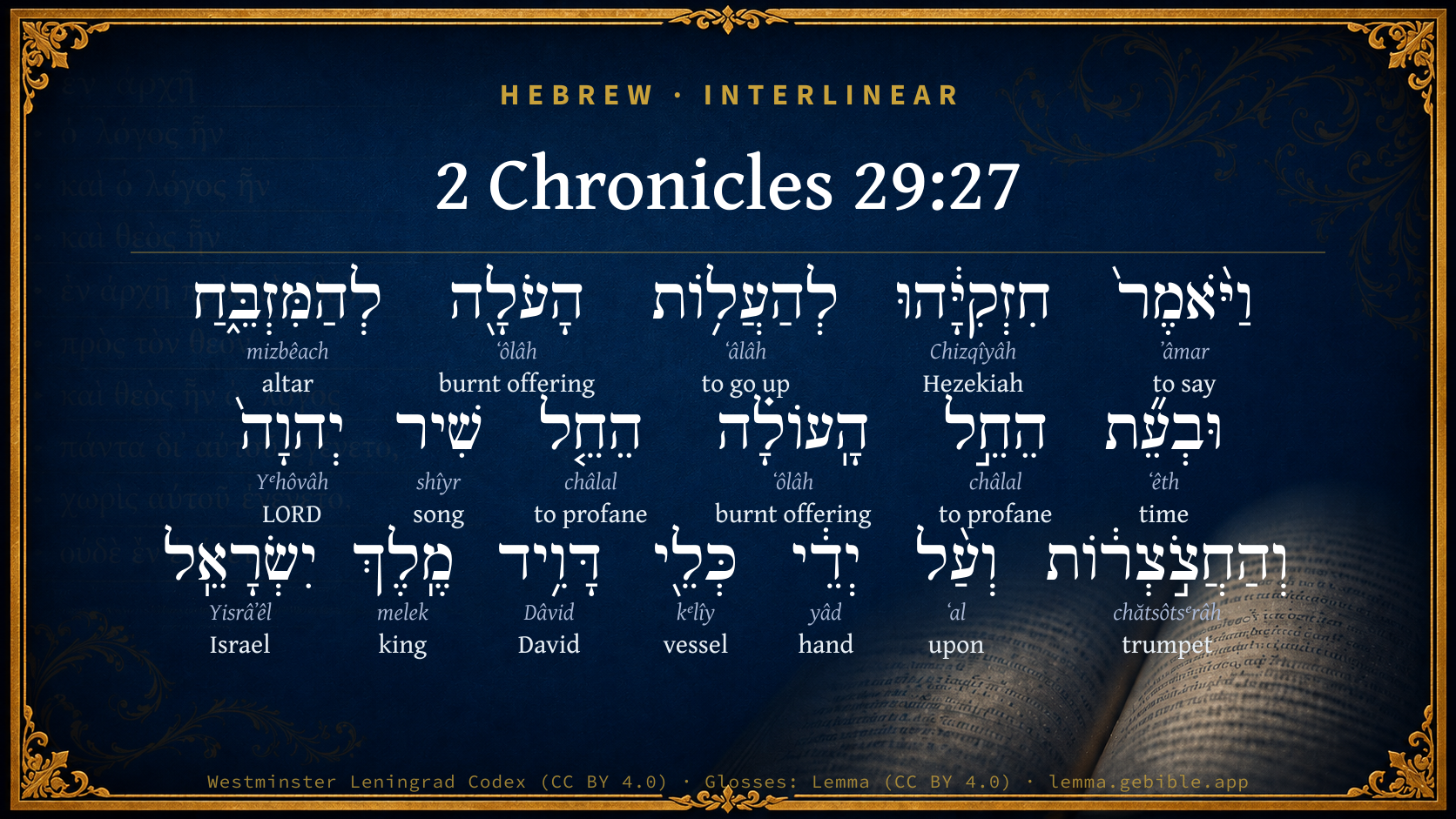
2 Chronicles 29:27

Hebrew (Westminster Leningrad Codex) 2 Chronicles 29:27 appears in the Hebrew Old Testament. The text above is from the Westminster Leningrad Codex. Each word links to its Strong’s number, a concise gloss, and parsing drawn from the Open Scriptures Hebrew Bible morphology. Click any word for its full Brown-Driver-Briggs (BDB) entry.
Download image
Cite this verse

2 Chronicles 29:27 (World English Bible). Public Domain. Lemma interlinear Bible study tool, https://lemma.gebible.app/v/2-chronicles/29/27.

Show BibTeX & RIS
BibTeX
RIS
English Translation
Hezekiah commanded to offer the burnt offering on the altar. When the burnt offering began, the song of Yahweh began also, and the trumpets, together with the instruments of David king of Israel.
World English Bible · Public Domain
Download a study sheet

One document with this verse’s original text, its word-by-word gloss line, the meaning frame, cross-references with their text, attributed commentary, and full source and license credits — printable, and it pastes into notes with its structure intact.

This verse Autodidact and up

Study sheet (.html) Plain text (.txt)

A passage Seminary Student

Up to 50 verses in one chapter. A passage sheet keeps up to 6 commentary sources and 12 cross-references per verse, in the order this page ranks them, and says so on the sheet whenever that leaves anything out. Ask for a single verse and you get the Autodidact verse sheet above.

Everything on this page stays free to read, with no account — the sheet is a download of what is already on screen, not access to it.

Want to remove ads? Support Godless Engineer
Compare translations 3

The same verse in 3 English versions, stacked beneath the original-language interlinear above. Click any original word for its lexicon entry.

Each is an independent rendering of the whole verse — the interlinear is not word-aligned to these translations.

Highlighted words mark where these versions differ — a whole-verse word diff, not a word-by-word alignment.

  • World English Bible Public Domain
    Hezekiah commanded to offer the burnt offering on the altar. When the burnt offering began, the song of Yahweh began also, and the trumpets, together with the instruments of David king of Israel.
  • King James Version Public Domain
    And Hezekiah commanded to offer the burnt offering upon the altar. And when the burnt offering began, the song of the LORD began also with the trumpets, and with the instruments ordained by David king of Israel.
  • unfoldingWord Literal Text CC BY-SA 4.0
    And Hezekiah said to offer the burnt offering on the altar. And at the time the burnt offering began, the song of Yahweh began and the trumpets, and by the hands of the instruments of David, the king of Israel.

unfoldingWord Literal Text — © unfoldingWord, licensed CC BY-SA 4.0. Word-aligned USFM3 via Door43 (git.door43.org/unfoldingWord/en_ult).

Versions to compare (up to 4)

3 of 4 selected

Show all 18 translations

Every available English version of this verse, each an independent rendering of the whole verse.

  • World English Bible Public Domain
    Hezekiah commanded to offer the burnt offering on the altar. When the burnt offering began, the song of Yahweh began also, and the trumpets, together with the instruments of David king of Israel.
  • Berean Standard Bible Public Domain
    And Hezekiah ordered that the burnt offering be sacrificed on the altar. When the burnt offering began, the song of the LORD and the trumpets began as well, accompanied by the instruments of David king of Israel.
  • Majority Standard Bible Public Domain
    And Hezekiah ordered that the burnt offering be sacrificed on the altar. When the burnt offering began, the song of the LORD and the trumpets began as well, accompanied by the instruments of David king of Israel.
  • King James Version Public Domain
    And Hezekiah commanded to offer the burnt offering upon the altar. And when the burnt offering began, the song of the LORD began also with the trumpets, and with the instruments ordained by David king of Israel.
  • American Standard Version (1901) Public Domain
    And Hezekiah commanded to offer the burnt-offering upon the altar. And when the burnt-offering began, the song of Jehovah began also, and the trumpets, together with the instruments of David king of Israel.
  • Revised Version (1885) Public Domain
    And Hezekiah commanded to offer the burnt offering upon the altar, And when the burnt offering began, the song of the LORD began also, and the trumpets, together with the instruments of David king of Israel.
  • Geneva Bible (1599) Public Domain
    And Hezekiah commanded to offer the burnt offring vpon the altar: and when the burnt offring began, the song of the Lord beganne with the trumpets, and the instruments of Dauid King of Israel.
  • Douay-Rheims (1899) Public Domain
    And Ezechias commanded that they should offer holocausts upon the altar: and when the holocausts were offered, they began to sing praises to the Lord, and to sound with trumpets, and divers instruments which David the king of Israel had prepared.
  • Young's Literal Translation Public Domain
    And Hezekiah saith to cause the burnt-offering to ascend on the altar; and at the time the burnt-offering began -- began the song of Jehovah, and the trumpets, even by the hands of the instruments of David king of Israel.
  • Literal Standard Version CC BY-SA 4.0
    And Hezekiah commands to cause the burnt-offering to ascend on the altar; and at the time the burnt-offering began, the song of YHWH began, and the trumpets, and with [the] hands of [the] instruments of David king of Israel.
  • Unlocked Literal Bible CC BY-SA 4.0
    Hezekiah commanded them to offer the burnt offering on the altar. When the burnt offering began, the song of Yahweh began also, with the trumpets, together with the instruments of David, king of Israel.
  • unfoldingWord Literal Text CC BY-SA 4.0
    And Hezekiah said to offer the burnt offering on the altar. And at the time the burnt offering began, the song of Yahweh began and the trumpets, and by the hands of the instruments of David, the king of Israel.
  • Darby Bible Public Domain
    And Hezekiah commanded to offer up the burnt-offering on the altar. And at the moment the burnt-offering began, the song of Jehovah began, and the trumpets, accompanied by the instruments of David king of Israel.
  • World Messianic Bible Public Domain
    Hezekiah commanded them to offer the burnt offering on the altar. When the burnt offering began, the LORD’s song also began, along with the shofars and instruments of David king of Israel.
  • Webster's Bible Public Domain
    And Hezekiah commanded to offer the burnt-offering upon the altar. And when the burnt-offering began, the song of the LORD began also with the trumpets, and with the instruments ordained by David king of Israel.
  • Free Bible Version CC BY-SA 4.0
    Then Hezekiah gave the order for the burnt offering to be offered on the altar. As the burnt offering began, the song of the Lord began at the same time, the trumpets sounded, and music was played on the instruments of David, once king of Israel.
  • Bible in Basic English Public Domain
    And Hezekiah gave the word for the burned offering to be offered on the altar. And when the burned offering was started, then the song of the Lord was started, with the blowing of horns and with all the instruments of David, king of Israel.
  • JPS Tanakh (1917) Public Domain
    And Hezekiah commanded to offer the burnt-offering upon the altar. And when the burnt-offering began, the song of the LORD began also, and the trumpets, together with the instruments of David king of Israel.

Literal Standard Version (2020), Covenant Press — licensed CC BY-SA 4.0. Text via the HelloAO Bible API (eBible.org). Unlocked Literal Bible (unfoldingWord) — licensed CC BY-SA 4.0. Text via the HelloAO Bible API (eBible.org). unfoldingWord Literal Text — © unfoldingWord, licensed CC BY-SA 4.0. Word-aligned USFM3 via Door43 (git.door43.org/unfoldingWord/en_ult). Free Bible Version, Dr. Jonathan Gallagher — licensed CC BY-SA 4.0. Text via the HelloAO Bible API (eBible.org).

Word by word

More ways to search: Search by grammar → Find every occurrence → Compare this word →

Practice this passage: Drill this verse → Learn its vocabulary →

וְהַחֲצֹ֣צְר֔וֹת
chătsôtsᵉrâh
H2689
“and · the · trumpets”
Conjunction + Particle, Definite Article + Noun, Common, Feminine, Plural, Absolute
Part of Speech
Conjunction + Particle + Noun
Type
Common
Gender
Feminine
Number
Plural
State
Absolute
Full BDB Definition

Origin: by reduplication from H2690

TWOT: 726a

trumpet, clarion
  1. וַיֹּ֨אמֶר֙ ʼâmar H559 “and · to say” Conjunction + Verb, Qal, Sequential Imperfect, 3rd Person, Masculine, Singular
  2. חִזְקִיָּ֔הוּ Chizqîyâh H2396 “Hezekiah” Noun, Proper
  3. לְהַעֲל֥וֹת ʻâlâh H5927 “to go up” Preposition + Verb, Hiphil, Infinitive Construct
  4. הָעֹלָ֖ה ʻôlâh H5930 “the · burnt offering” Particle, Definite Article + Noun, Common, Feminine, Singular, Absolute
  5. לְהַמִּזְבֵּ֑חַ mizbêach H4196 “to/for · the · altar” Preposition + Particle, Definite Article + Noun, Common, Masculine, Singular, Absolute
  6. וּבְעֵ֞ת ʻêth H6256 “and · in/at · time” Conjunction + Preposition + Noun, Common, Both, Singular, Absolute
  7. הֵחֵ֣ל châlal H2490 “to profane” Verb, Hiphil, Perfect, 3rd Person, Masculine, Singular
  8. הָֽעוֹלָ֗ה ʻôlâh H5930 “the · burnt offering” Particle, Definite Article + Noun, Common, Feminine, Singular, Absolute
  9. הֵחֵ֤ל châlal H2490 “to profane” Verb, Hiphil, Perfect, 3rd Person, Masculine, Singular
  10. שִׁיר shîyr H7892 “song of” Noun, Common, Both, Singular, Construct
  11. יְהוָה֙ Yᵉhôvâh H3068 “LORD” Noun, Proper
  12. וְעַ֨ל ʻal H5921 “and · upon” Conjunction + Preposition
  13. יְדֵ֔י yâd H3027 “hands of” Noun, Common, Both, Dual, Construct
  14. כְּלֵ֖י kᵉlîy H3627 “vessels of” Noun, Common, Masculine, Plural, Construct
  15. דָּוִ֥יד Dâvid H1732 “David” Noun, Proper
  16. מֶֽלֶךְ melek H4428 “king of” Noun, Common, Masculine, Singular, Construct
  17. יִשְׂרָאֵֽל Yisrâʼêl H3478 “Israel” Noun, Proper

About this verse

These counts appear in no published source. They are computed here, from the morphology-tagged text and Lemma’s own curated glosses. What Lemma adds →

18
words
16
distinct lemmas
Historical
section

Shared distinctive vocabulary

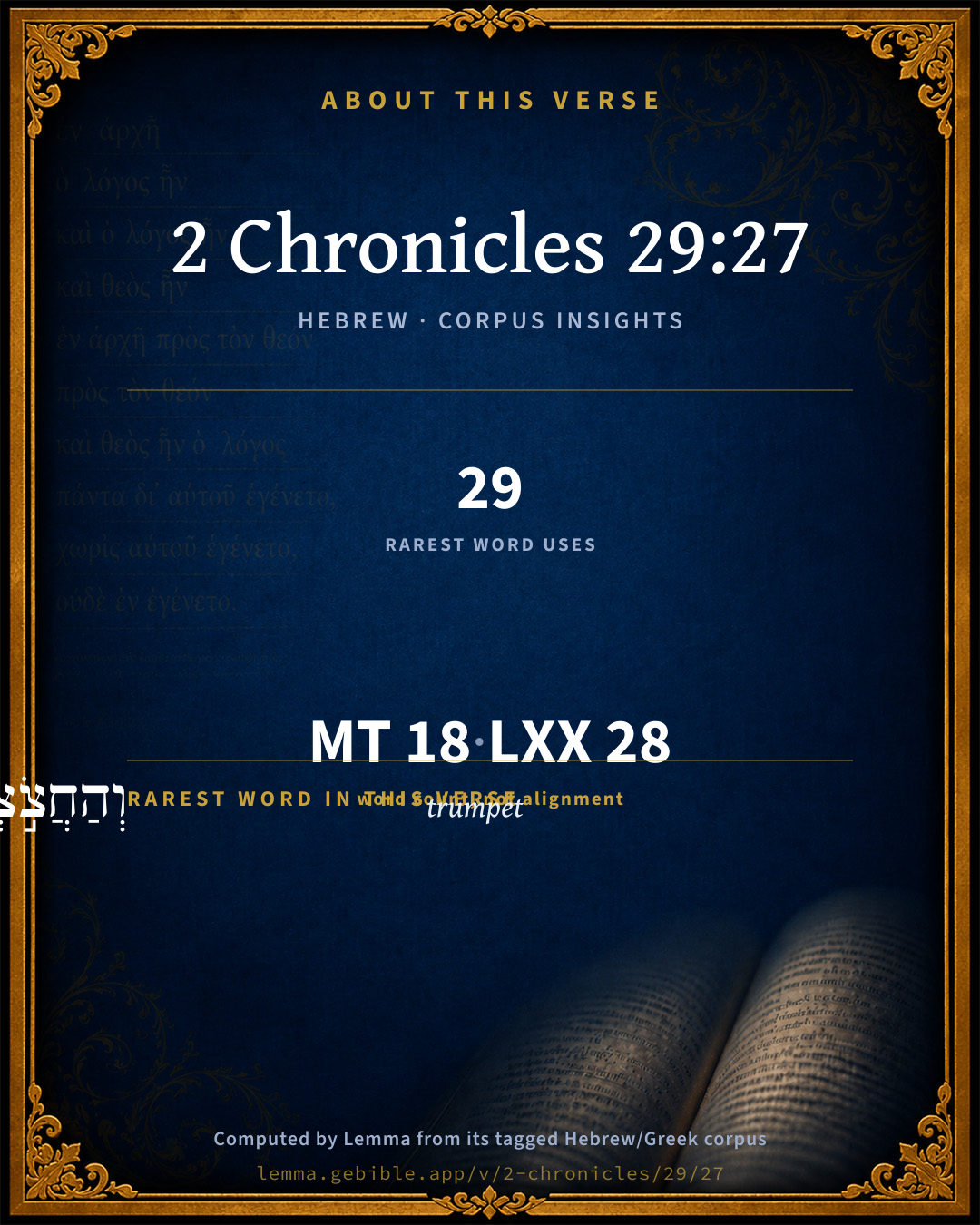
וְהַחֲצֹ֣צְר֔וֹת trumpet H2689 occurs in 27 verses of the Hebrew Bible. Also found in:

Grammatical profile

  • 4 verbs
  • 13 nouns
  • 1 preposition

Verb forms

  • וַיֹּ֨אמֶר֙ Qal · Sequential Imperfect
  • לְהַעֲל֥וֹת Hiphil · Infinitive Construct
  • הֵחֵ֣ל Hiphil · Perfect
  • הֵחֵ֤ל Hiphil · Perfect

Repetition

Words recur within this verse — often emphatic in Hebrew:

  • הָעֹלָ֖ה burnt offering H5930 ×2
  • הֵחֵ֣ל to profane H2490 ×2

Hebrew & Septuagint length

In English translation the verse runs 33 words from the Hebrew and 42 from the Septuagint (LXX English) — closely comparable.

A rough comparison of the two English renderings, which tokenize alike — not a word-level alignment.

Word counts can differ between the Hebrew and the Greek without any difference in meaning — e.g. the Hebrew direct-object marker אֵת has no separate Greek word, and Greek often adds the article ὁ.

In the original languages it is 18 Hebrew tokens and 28 Greek tokens — but the two are counted differently (Hebrew bundles its prefixes and suffixes into one token; the Greek is in lemma form), so that isn’t a like-for-like length.

Cross-references

5

Topical passages linked to 2 Chronicles 29:27 in the Treasury of Scripture Knowledge — connected by theme and wording, ordered by reader-vote popularity; previews shown in the World English Bible.

  • 2 Chronicles 23:18 Jehoiada appointed the officers of the house of Yahweh under the hand of the priests the Levites, whom David had distributed in the house of Yahweh, to offer the burnt offerings of Yahweh, as it is written in the law of Moses, with rejoicing and with singing, according to the order of David.
  • 2 Chronicles 7:3 All the children of Israel looked on, when the fire came down, and the glory of Yahweh was on the house; and they bowed themselves with their faces to the ground on the pavement, and worshiped, and gave thanks to Yahweh, [saying], For he is good; for his loving kindness endures for ever.
  • 2 Chronicles 20:21 When he had taken counsel with the people, he appointed those who should sing to Yahweh, and give praise in holy array, as they went out before the army, and say, Give thanks to Yahweh; for his loving kindness endures forever.
  • Psalms 136:1 Give thanks to Yahweh, for he is good; For his loving kindness endures forever.
  • Psalms 137:3–4 For there, those who led us captive asked us for songs. Those who tormented us demanded songs of joy: "Sing us one of the songs of Zion!"

Cross-references courtesy of OpenBible.info (CC BY 4.0).

Hebrew and Greek witnesses Masoretic Hebrew ↔ Greek Septuagint

The same verse in the two great witnesses to the Old Testament, shown verse-for-verse.

These are two independent witnesses, not word-aligned to each other, and the Septuagint is shown in lemma (dictionary) form.

Hebrew 2 Chronicles 29:27 Masoretic · Westminster Leningrad Codex

וַיֹּ֨אמֶר֙ חִזְקִיָּ֔הוּ לְהַעֲל֥וֹת הָעֹלָ֖ה לְהַמִּזְבֵּ֑חַ וּבְעֵ֞ת הֵחֵ֣ל הָֽעוֹלָ֗ה הֵחֵ֤ל שִׁיר יְהוָה֙ וְהַחֲצֹ֣צְר֔וֹת וְעַ֨ל יְדֵ֔י כְּלֵ֖י דָּוִ֥יד מֶֽלֶךְ יִשְׂרָאֵֽל

Hezekiah commanded to offer the burnt offering on the altar. When the burnt offering began, the song of Yahweh began also, and the trumpets, together with the instruments of David king of Israel.

World English Bible · Public Domain

Greek LXX 2 Chronicles 29:27 Septuagint · lemma form

καί εἶπον εζεκιας ἀναφέρω ὁ ὁλοκαύτωσις ἐπί ὁ θυσιαστήριον καί ἐν ὁ ἄρχω ἀναφέρω ὁ ὁλοκαύτωσις ἄρχω ᾄδω κύριος καί ὁ σάλπιγξ πρός ὁ ὄργανον δαυίδ βασιλεύς ἰσραήλ

And Ezekias told them to offer up the whole burnt offering on the altar: and when they began to offer the whole burnt offering, they began to sing to the Lord, and the trumpets accompanied the instruments of David king of Israel.

LXX2012 (modern English Septuagint) · Public Domain

On this verse, Ellicott's Commentary for English Readers discusses the Septuagint’s reading. Read the note in Commentary ↓

Hebrew: Westminster Leningrad Codex (CC BY 4.0). Greek: Septuagint (public domain); English from LXX2012 (modern English Septuagint) (Public Domain). How the Septuagint differs from the Hebrew →

Commentary

Notes on 2 Chronicles 29:27 from classic Christian and Jewish commentators (each source and its license shown beneath its notes). The classic Christian expositions comment on the surrounding passage and are grouped to its opening verse, so a note may address several verses; the Jewish commentaries on the Tanakh (Rashi and others) are per-verse, so they appear only where the commentator wrote on this verse.

Lemma curates 59 commentaries, every one of them public domain or Creative Commons licensed, each selected and text-cleaned for this edition rather than reprinted as found. About our sources →

Trapp's Complete Commentary

John Trapp

2Ch 29:27 And Hezekiah commanded to offer the burnt offering upon the altar. And when the burnt offering began, the song of the LORD began [also] with the trumpets, and with the instruments [ordained] by David king of Israel.

Ver. 27. The song of the Lord began also.] Holy and divine songs, {Psa 136:1-26} especially, which is here, by an excellency, called the song of the Lord, as some think.

John Trapp, A Commentary or Exposition upon All the Books of the Old and New Testament (1647–1656) — public domain. Text from a community e-Sword module.

The Biblical Illustrator

Joseph S. Exell

2Ch_29:27

When the burnt offering began, then the song of the Lord began also.

Sacrifice and song

This chapter contains a brief, graphic account of the great reformation which Hezekiah wrought in the beginning of his reign. The text is part of that account.

I. How often these two things--sacrifice and song--self-denial and joy--are associated. We see the union every, where.

1. In the home. When is the husband or wife so supremely happy as when by some deed of self-sacrifice he or she has made the other glad? When does the fathers heart sing for joy? Not when he has bent the stubborn will of the child, but when, by the sacrifice of some luxury he has made the little soul glad on its birthday.

2. In the best works of fiction, i.e., those which are most true to human nature who does not remember the half-sovereign which Tom Pinch, the poor half-starved clerk, concealed in a piece of paper and put into the hand of Martin Chuzzlewit at their parting? And who has not envied the feeling of happiness with which he returned to his bare home and grinding lot?

3. In the lives of Gods servants. The memorials of Robert and Mary Moffat, show what sacrifices they had to make in carrying on their work in Africa. They leave no doubt that they found a joy in them that the selfish and luxurious are seeking in vain.

4. In our own lives we have all experienced it.

II. They are indissolubly associated--joined together in the nature of things. Man cannot have the one without the other. Let there be no sacrifice and there will be no song, no self-denial and there will ere long be no joy. That is a law written broadly over human nature, attested by the widest experience, and recognised by Pro_11:24-25. It explains some of what seem to be the hardest sayings and most difficult demands of our Lord, as, e.g., Mat_16:24-25; Joh_12:24; and His question put to the two ambitious disciples (Mar_10:37-38). The lesson is clear. We all want happiness--that our joy may be full. But we cannot have it by aiming at it directly. Begin to sacrifice, to give to God what you really value; say, I will not offer unto the Lord my God that which doth cost me nothing. Give your money, interest, time, effort. Copy the example of Him who went about doing good, and pleased not Himself. Try to make lives brighter, homes happier, business more pure. Take up the cross. Then this bit of old-world history shall record your experience: When the burnt offering began, then the song of the Lord began also--a song which grew louder and mightier as the sacrifice went on, and never ended until the sacrifice itself came to an end. (J. Ogle.)

The Biblical Illustrator, edited by Joseph S. Exell (c. 1880s–1900s) — public domain. Text from a community e-Sword module.

Joseph Benson's Commentary

2Ch 29:27. When the burnt-offering began, the song of the Lord began also — The psalms composed by David and Asaph, (2Ch 29:30,) with the musical instruments which God, by his prophets, had commanded to be used,

(2Ch 29:25,) and which had been long neglected. Even sorrow for sin must not put us out of tune for praising God. By faith we must even then rejoice in the Lord our righteousness, and our prayers and praises must ascend with his offering, to be accepted only in the virtue of it.

Joseph Benson's Commentary on the Old and New Testaments (1811–1818) — public domain. Text from a community e-Sword module.

Geneva Bible (1599)

Geneva Bible translators

Which David had appointed to praise the Lord with.

The Psalm which David had appointed to be sung for thanksgiving.

Geneva Bible (1599) marginal notes — public domain. Text via Bolls.life.

Ellicott's Commentary for English Readers

(27) Commanded to offer the burnt offering . . . altar.—These words are repeated from 2Ch_29:21, because all that comes between is descriptive of the preparations made for the due performance of the sacrifice. When the victims had been slain, flayed, and cut up, and the altar had been sprinkled with their blood, and when the Levitical musicians had taken their places, instruments in hand, everything was ready, and the sacrifice was ordered to begin. “And at the time when the burnt offering began, the song of Jehovah” (i.e., the chant of the Levites with its musical accompaniment) “began, and the clarions; and that under the lead of the instruments of David king of Israel,” i.e., the harps and lyres were dominant throughout, and the clarions subordinate to their music. Or we may render: “And that at the side of (i.e., along with) the instruments of David king of Israel.” The phrase is ‘al-yĕdê, “upon the hands.” (Comp. 1Ch_25:2-3; 1Ch_25:6.) The LXX. omits the needless “and that” (wĕ); the Syriac renders: “And when the burnt offerings began to be offered, Hezekiah began to chant the praises of the Lord, as from the mouth of David king of Israel.” The Vulgate also is very free.

A Bible Commentary for English Readers, edited by Charles John Ellicott (1878–1897) — public domain. Text from a community e-Sword module.

The Cambridge Bible for Schools and Colleges

gen. ed. J. J. S. Perowne

27. with the trumpets] R.V. and the trumpets. Cp. 1Ch_15:24 (note).

and with the instruments ordained by David] Render, even according to the guidance of the instruments of David, i.e. led (or “accompanied”) by them.

The Cambridge Bible for Schools and Colleges (gen. ed. J. J. S. Perowne; Cambridge University Press, 1878–1918) — public domain. Text from a community e-Sword module.

John Gill's Exposition

And when they had made an end of offering,.... Both the sin offering and the burnt offering:

the king and all that were with him bowed themselves and worshipped; towards the place where the ark was, giving thanks for the purging of the temple, and restoring the worship of it.

John Gill's Exposition of the Whole Bible (1746–1763) — public domain (CC PDM 1.0). Text via the HelloAO Bible API.

Albert Barnes' Notes on the Bible

All had hitherto been preparatory. Now Hezekiah gave orders that “the burnt offering” - i. e. the daily morning sacrifice - should be offered upon the brass altar in front of the porch, thus restoring and reinstituting the regular temple-service. A burst of music gave notice to the people of the moment when the old worship recommenced.

Albert Barnes' Notes on the Bible (1834–1885) — public domain. Text from a community e-Sword/MySword module.

Haydock's Catholic Bible Commentary

CHAPTER XXIX.

Prepared, or ordained. M. --- Heb. "with the instruments, by David."

George Leo Haydock (1774–1849), Haydock's Catholic Family Bible and Commentary, 1859 edition — public domain. Excludes Psalms (Douay-Rheims chapter numbering differs from Protestant) and Deuterocanonical books (Catholic canon only).

The Pulpit Commentary

Hezekiah commanded to offer the burnt offering. This verse and the following, with graphic brevity, purport to describe the actual consummating of the preparations rehearsed before, and, as seems most probable, in the significance of the last clause of Ezr_8:35, already referred to. The whole of the burnt offering was burnt on the altar, but of the sin offering the "fat" alone. (Lev_4:19)

The Pulpit Commentary (1880–1919), ed. H.D.M. Spence-Jones & Joseph S. Exell — public domain. Text from a community e-Sword module.

John Wesley's Explanatory Notes

The song - The psalms composed by David and Asaph. Even sorrow for sin must not put us out of tune for praising God. By faith we must even then rejoice in the Lord our righteousness, and our prayers and praises must attend with his offering, to be accepted only in the virtue of it.

John Wesley, Explanatory Notes Upon the Whole Bible (1754–1765) — public domain. Text via the GEBible commentary corpus.

unfoldingWord translationNotes

Door43 World Missions Community

the song of Yahweh began also

The phrase "the song of Yahweh" refers to people singing a song to Yahweh. AT: "the people began to sing a song to Yahweh also"

until the burnt offering was finished

This can be stated in active form. AT: "until the priests finished offering the burnt offering" (See: Active or Passive)

translationWords

Israel

worship

unfoldingWord translationNotes — © Distant Shores Media and the Door43 World Missions Community, licensed CC BY-SA 4.0. Source: git.door43.org/Door43/en_tn.

Lesson kit

Teaching starters — assembled from the data on this page, not authored interpretation. Every prompt links to the verse data it draws on. Edit before teaching.

2 Chronicles, in the Historical, opens this verse with 18 words (16 distinct Hebrew lemmas). Its most distinctive word is chătsôtsᵉrâh (“trumpet”). A historical commentator’s framing appears above. Read the whole chapter for the surrounding context.

Discussion questions

  1. How does “trumpet” (chătsôtsᵉrâh) shape what this verse is saying?
  2. Numbers 10:2 shares the word «trumpet» with this verse. How do the two illuminate each other?
  3. “burnt offering” occurs 2× in this one verse. What is the effect of the repetition?
  4. These translations render this verse differently. What is at stake in choosing one wording over another?
  5. The verb «וַיֹּ֨אמֶר֙» is Qal Sequential Imperfect. How does its form color the action?
  6. Reading how Trapp's Complete Commentary and The Biblical Illustrator read this verse, where do the two commentators agree and where do they part?

Things to notice

Reading settings

Reading text

Shown beneath each verse's original-language words.

Old Testament
Old Testament edition

Read the OT as the Masoretic Hebrew (MT) or the Greek Septuagint (LXX).

English shown for the Greek Septuagint (in the Hebrew ↔ Greek comparison).

Comparing translations? Open the Compare panel on any verse page to stack up to four side by side.