
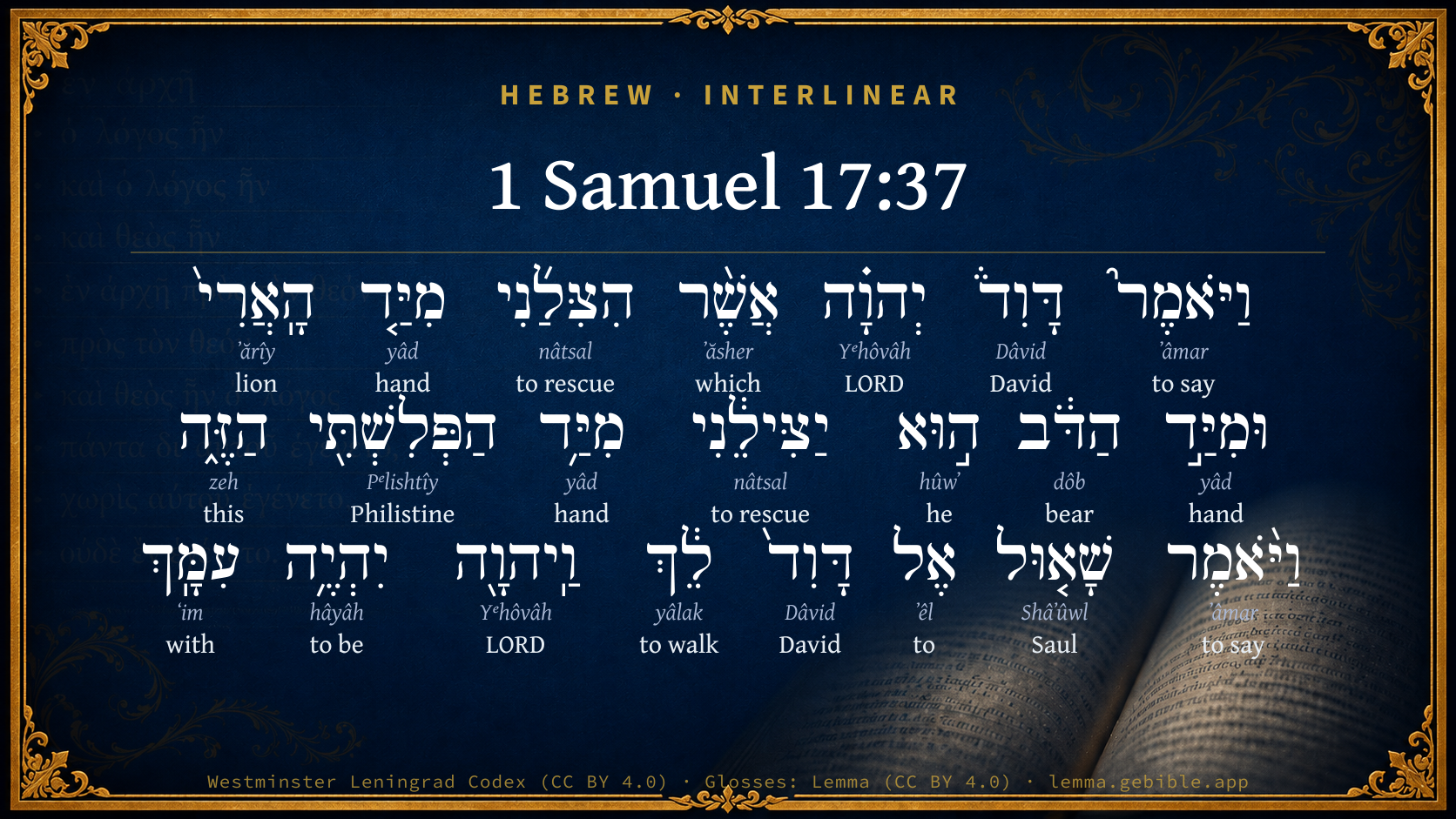
1 Samuel 17:37

Hebrew (Westminster Leningrad Codex) 1 Samuel 17:37 appears in the Hebrew Old Testament. The text above is from the Westminster Leningrad Codex. Each word links to its Strong’s number, a concise gloss, and parsing drawn from the Open Scriptures Hebrew Bible morphology. Click any word for its full Brown-Driver-Briggs (BDB) entry.
Download image
Cite this verse

1 Samuel 17:37 (World English Bible). Public Domain. Lemma interlinear Bible study tool, https://lemma.gebible.app/v/1-samuel/17/37.

Show BibTeX & RIS
BibTeX
RIS
English Translation
David said, Yahweh who delivered me out of the paw of the lion, and out of the paw of the bear, he will deliver me out of the hand of this Philistine. Saul said to David, Go, and Yahweh shall be with you.
World English Bible · Public Domain
Download a study sheet

One document with this verse’s original text, its word-by-word gloss line, the meaning frame, cross-references with their text, attributed commentary, and full source and license credits — printable, and it pastes into notes with its structure intact.

This verse Autodidact and up

Study sheet (.html) Plain text (.txt)

A passage Seminary Student

Up to 50 verses in one chapter. A passage sheet keeps up to 6 commentary sources and 12 cross-references per verse, in the order this page ranks them, and says so on the sheet whenever that leaves anything out. Ask for a single verse and you get the Autodidact verse sheet above.

Everything on this page stays free to read, with no account — the sheet is a download of what is already on screen, not access to it.

Want to remove ads? Support Godless Engineer
Compare translations 3

The same verse in 3 English versions, stacked beneath the original-language interlinear above. Click any original word for its lexicon entry.

Each is an independent rendering of the whole verse — the interlinear is not word-aligned to these translations.

Highlighted words mark where these versions differ — a whole-verse word diff, not a word-by-word alignment.

  • World English Bible Public Domain
    David said, Yahweh who delivered me out of the paw of the lion, and out of the paw of the bear, he will deliver me out of the hand of this Philistine. Saul said to David, Go, and Yahweh shall be with you.
  • King James Version Public Domain
    David said moreover, The LORD that delivered me out of the paw of the lion, and out of the paw of the bear, he will deliver me out of the hand of this Philistine. And Saul said unto David, Go, and the LORD be with thee.
  • unfoldingWord Literal Text CC BY-SA 4.0
    And David said, “Yahweh who delivered me from the hand of the lion and from the hand of the bear, he will deliver me from the hand of this Philistine.” And Saul said to David, “Go, and may Yahweh be with you.”

unfoldingWord Literal Text — © unfoldingWord, licensed CC BY-SA 4.0. Word-aligned USFM3 via Door43 (git.door43.org/unfoldingWord/en_ult).

Versions to compare (up to 4)

3 of 4 selected

Show all 18 translations

Every available English version of this verse, each an independent rendering of the whole verse.

  • World English Bible Public Domain
    David said, Yahweh who delivered me out of the paw of the lion, and out of the paw of the bear, he will deliver me out of the hand of this Philistine. Saul said to David, Go, and Yahweh shall be with you.
  • Berean Standard Bible Public Domain
    David added, “The LORD, who delivered me from the claws of the lion and the bear, will deliver me from the hand of this Philistine.” “Go,” said Saul, “and may the LORD be with you.”
  • Majority Standard Bible Public Domain
    David added, “The LORD, who delivered me from the claws of the lion and the bear, will deliver me from the hand of this Philistine.” “Go,” said Saul, “and may the LORD be with you.”
  • King James Version Public Domain
    David said moreover, The LORD that delivered me out of the paw of the lion, and out of the paw of the bear, he will deliver me out of the hand of this Philistine. And Saul said unto David, Go, and the LORD be with thee.
  • American Standard Version (1901) Public Domain
    And David said, Jehovah that delivered me out of the paw of the lion, and out of the paw of the bear, he will deliver me out of the hand of this Philistine. And Saul said unto David, Go, and Jehovah shall be with thee.
  • Revised Version (1885) Public Domain
    And David said, The LORD that delivered me out of the paw of the lion, and out of the paw of the bear, he will deliver me out of the hand of this Philistine. And Saul said unto David, Go, and the LORD shall be with thee.
  • Geneva Bible (1599) Public Domain
    Moreouer Dauid sayd, The Lord that deliuered me out of the pawe of the lyon, and out of the paw of the beare, he wil deliuer me out of the hand of this Philistim. Then Saul sayd vnto Dauid, Go, and the Lord be with thee.
  • Douay-Rheims (1899) Public Domain
    And David said: The Lord who delivered me out of the paw of the lion, and out of the paw of the bear, he will deliver me out of the hand of this Philistine. And Saul said to David: Go, and the Lord be with thee.
  • Young's Literal Translation Public Domain
    And David saith, `Jehovah, who delivered me out of the paw of the lion, and out of the paw of the bear, He doth deliver me from the hand of this Philistine.' And Saul saith unto David, `Go, and Jehovah is with thee.'
  • Literal Standard Version CC BY-SA 4.0
    And David says, “YHWH, who delivered me out of the paw of the lion, and out of the paw of the bear, He delivers me from the hand of this Philistine.” And Saul says to David, “Go, and YHWH is with you.”
  • Unlocked Literal Bible CC BY-SA 4.0
    David said, “Yahweh rescued me from the paw of the lion and from the paw of the bear. He will rescue me from the hand of this Philistine.” Then Saul said to David, “Go, and may Yahweh be with you.”
  • unfoldingWord Literal Text CC BY-SA 4.0
    And David said, “Yahweh who delivered me from the hand of the lion and from the hand of the bear, he will deliver me from the hand of this Philistine.” And Saul said to David, “Go, and may Yahweh be with you.”
  • Darby Bible Public Domain
    And David said, Jehovah who delivered me out of the paw of the lion and out of the paw of the bear, he will deliver me out of the hand of this Philistine. And Saul said to David, Go, and Jehovah be with thee.
  • World Messianic Bible Public Domain
    David said, “The LORD, who delivered me out of the paw of the lion and out of the paw of the bear, will deliver me out of the hand of this Philistine.” Saul said to David, “Go! The LORD will be with you.”
  • Webster's Bible Public Domain
    David said moreover, The LORD that delivered me out of the paw of the lion, and out of the paw of the bear, he will deliver me out of the hand of this Philistine. And Saul said to David, Go, and the LORD be with thee.
  • Free Bible Version CC BY-SA 4.0
    David concluded, “The Lord who saved me from the claws of the lion and the bear will save me from this Philistine.” “Go, and may the Lord be with you,” Saul responded.
  • Bible in Basic English Public Domain
    And David said, The Lord, who kept me safe from the grip of the lion and the bear, will be my saviour from the hands of this Philistine. And Saul said to David, Go! and may the Lord be with you.
  • JPS Tanakh (1917) Public Domain
    And David said: 'The LORD that delivered me out of the paw of the lion, and out of the paw of the bear, He will deliver me out of the hand of this Philistine.' And Saul said unto David: 'Go, and the LORD shall be with thee.'

Literal Standard Version (2020), Covenant Press — licensed CC BY-SA 4.0. Text via the HelloAO Bible API (eBible.org). Unlocked Literal Bible (unfoldingWord) — licensed CC BY-SA 4.0. Text via the HelloAO Bible API (eBible.org). unfoldingWord Literal Text — © unfoldingWord, licensed CC BY-SA 4.0. Word-aligned USFM3 via Door43 (git.door43.org/unfoldingWord/en_ult). Free Bible Version, Dr. Jonathan Gallagher — licensed CC BY-SA 4.0. Text via the HelloAO Bible API (eBible.org).

Word by word

More ways to search: Search by grammar → Find every occurrence → Compare this word →

Practice this passage: Drill this verse → Learn its vocabulary →

הַדֹּ֔ב
dôb
H1677
“the · bear”
Particle, Definite Article + Noun, Common, Masculine, Singular, Absolute
Part of Speech
Particle + Noun
Type
Common
Gender
Masculine
Number
Singular
State
Absolute
Full BDB Definition

Origin: from H1680

TWOT: 396a

bear
  1. וַיֹּאמֶר֮ ʼâmar H559 “and · to say” Conjunction + Verb, Qal, Sequential Imperfect, 3rd Person, Masculine, Singular
  2. דָּוִד֒ Dâvid H1732 “David” Noun, Proper
  3. יְהוָ֗ה Yᵉhôvâh H3068 “LORD” Noun, Proper
  4. אֲשֶׁ֨ר ʼăsher H834 “which” Particle, Relative
  5. הִצִּלַ֜נִי nâtsal H5337 “to rescue · me” Verb, Hiphil, Perfect, 3rd Person, Masculine, Singular + Suffix, Personal, 1st Person, Common, Singular
  6. מִיַּ֤ד yâd H3027 “from · hand of” Preposition + Noun, Common, Both, Singular, Construct
  7. הָֽאֲרִי֙ ʼărîy H738 “the · lion” Particle, Definite Article + Noun, Common, Masculine, Singular, Absolute
  8. וּמִיַּ֣ד yâd H3027 “and · from · hand of” Conjunction + Preposition + Noun, Common, Both, Singular, Construct
  9. ה֣וּא hûwʼ H1931 “he” Pronoun, Personal, 3rd Person, Masculine, Singular
  10. יַצִּילֵ֔נִי nâtsal H5337 “to rescue · me” Verb, Hiphil, Imperfect, 3rd Person, Masculine, Singular + Suffix, Personal, 1st Person, Common, Singular
  11. מִיַּ֥ד yâd H3027 “from · hand of” Preposition + Noun, Common, Both, Singular, Construct
  12. הַפְּלִשְׁתִּ֖י Pᵉlishtîy H6430 “the · Philistine” Particle, Definite Article + Noun, Gentilic, Masculine, Singular, Absolute
  13. הַזֶּ֑ה zeh H2088 “the · this” Particle, Definite Article + Pronoun, Demonstrative, Masculine, Singular
  14. וַיֹּ֨אמֶר ʼâmar H559 “and · to say” Conjunction + Verb, Qal, Sequential Imperfect, 3rd Person, Masculine, Singular
  15. שָׁא֤וּל Shâʼûwl H7586 “Saul” Noun, Proper
  16. אֶל ʼêl H413 “to” Preposition
  17. דָּוִד֙ Dâvid H1732 “David” Noun, Proper
  18. לֵ֔ךְ yâlak H3212 “walk” Verb, Qal, Imperative, 2nd Person, Masculine, Singular
  19. וַֽיהוָ֖ה Yᵉhôvâh H3068 “and · LORD” Conjunction + Noun, Proper
  20. יִהְיֶ֥ה hâyâh H1961 “to be” Verb, Qal, Imperfect, 3rd Person, Masculine, Singular
  21. עִמָּֽךְ ʻim H5973 “with · you” Preposition + Suffix, Personal, 2nd Person, Feminine, Singular

About this verse

These counts appear in no published source. They are computed here, from the morphology-tagged text and Lemma’s own curated glosses. What Lemma adds →

22
words
16
distinct lemmas
Historical
section

Notable vocabulary

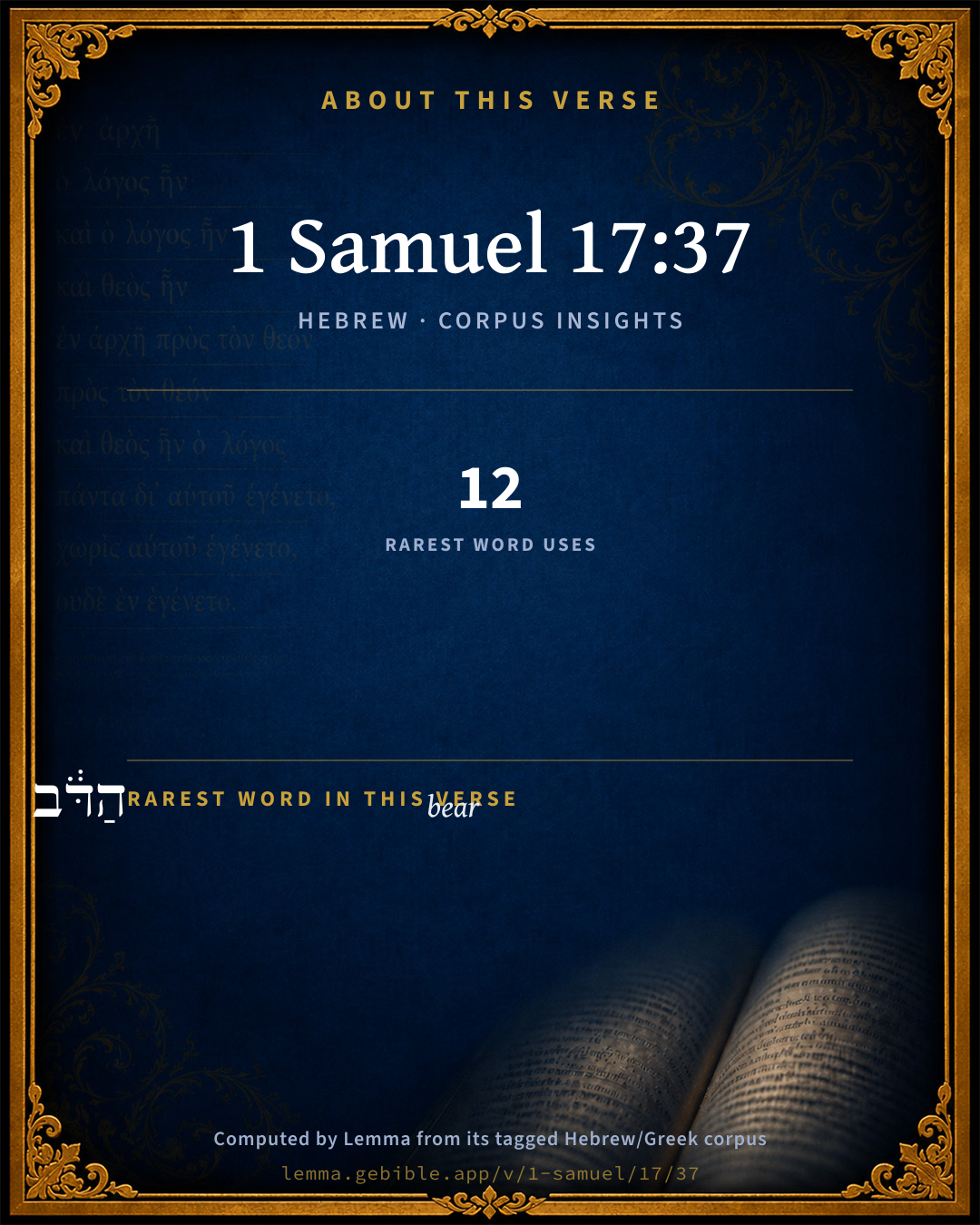
The rarest word here is הַדֹּ֔ב bear H1677 — appearing just 12 times in the whole Hebrew Bible.

Shared distinctive vocabulary

הַדֹּ֔ב bear H1677 occurs in 12 verses of the Hebrew Bible. Also found in:

Grammatical profile

  • 6 verbs
  • 11 nouns
  • 2 pronouns
  • 2 prepositions
  • 1 particle

Verb forms

  • וַיֹּאמֶר֮ Qal · Sequential Imperfect
  • הִצִּלַ֜נִי Hiphil · Perfect
  • יַצִּילֵ֔נִי Hiphil · Imperfect
  • וַיֹּ֨אמֶר Qal · Sequential Imperfect
  • לֵ֔ךְ Qal · Imperative
  • יִהְיֶ֥ה Qal · Imperfect

Repetition

Words recur within this verse — often emphatic in Hebrew:

  • מִיַּ֤ד hand H3027 ×3
  • וַיֹּאמֶר֮ to say H559 ×2
  • דָּוִד֒ David H1732 ×2
  • יְהוָ֗ה LORD H3068 ×2
  • הִצִּלַ֜נִי to rescue H5337 ×2

Hebrew & Septuagint length

In English translation the verse runs 43 words from the Hebrew and 45 from the Septuagint (LXX English) — closely comparable.

A rough comparison of the two English renderings, which tokenize alike — not a word-level alignment.

Word counts can differ between the Hebrew and the Greek without any difference in meaning — e.g. the Hebrew direct-object marker אֵת has no separate Greek word, and Greek often adds the article ὁ.

Cross-references

14

Topical passages linked to 1 Samuel 17:37 in the Treasury of Scripture Knowledge — connected by theme and wording, ordered by reader-vote popularity; previews shown in the World English Bible.

  • 2 Timothy 4:17–18 But the Lord stood by me, and strengthened me, that through me the message might be fully proclaimed, and that all the Gentiles might hear; and I was delivered out of the mouth of the lion.
  • Psalms 138:7–8 Though I walk in the midst of trouble, you will revive me. You will stretch forth your hand against the wrath of my enemies. Your right hand will save me.
  • 2 Corinthians 1:9–10 Yes, we ourselves have had the sentence of death within ourselves, that we should not trust in ourselves, but in God who raises the dead,
  • Psalms 18:16–17 He sent from on high. He took me. He drew me out of many waters.
  • Psalms 63:7 For you have been my help. I will rejoice in the shadow of your wings.
  • 1 Samuel 7:12 Then Samuel took a stone, and set it between Mizpah and Shen, and called the name of it Ebenezer, saying, Hitherto has Yahweh helped us.
  • 1 Samuel 20:13 Yahweh do so to Jonathan, and more also, should it please my father to do you evil, if I don't disclose it to you, and send you away, that you may go in peace: and Yahweh be with you, as he has been with my father.
  • 1 Chronicles 22:11 Now, my son, Yahweh be with you; and prosper you, and build the house of Yahweh your God, as he has spoken concerning you.
  • 2 Samuel 10:12 Be of good courage, and let us play the man for our people, and for the cities of our God: and Yahweh do that which seems him good.
  • 1 Chronicles 22:16 of the gold, the silver, and the brass, and the iron, there is no number. Arise and be doing, and Yahweh be with you.
  • Psalms 138:3 In the day that I called, you answered me. You encouraged me with strength in my soul.
  • Psalms 77:11 I will remember Yah's deeds; For I will remember your wonders of old.
  • 1 Samuel 24:19 For if a man finds his enemy, will he let him go away unharmed? Therefore may Yahweh reward you good for that which you have done to me this day.
  • 1 Samuel 26:25 Then Saul said to David, Blessed be you, my son David: you shall both do mightily, and shall surely prevail. So David went his way, and Saul returned to his place.

Cross-references courtesy of OpenBible.info (CC BY 4.0).

Hebrew and Greek witnesses Masoretic Hebrew ↔ Greek Septuagint

The same verse in the two great witnesses to the Old Testament, shown verse-for-verse.

These are two independent witnesses, not word-aligned to each other, and the Septuagint is shown in lemma (dictionary) form.

Hebrew 1 Samuel 17:37 Masoretic · Westminster Leningrad Codex

וַיֹּאמֶר֮ דָּוִד֒ יְהוָ֗ה אֲשֶׁ֨ר הִצִּלַ֜נִי מִיַּ֤ד הָֽאֲרִי֙ וּמִיַּ֣ד הַדֹּ֔ב ה֣וּא יַצִּילֵ֔נִי מִיַּ֥ד הַפְּלִשְׁתִּ֖י הַזֶּ֑ה וַיֹּ֨אמֶר שָׁא֤וּל אֶל דָּוִד֙ לֵ֔ךְ וַֽיהוָ֖ה יִהְיֶ֥ה עִמָּֽךְ

David said, Yahweh who delivered me out of the paw of the lion, and out of the paw of the bear, he will deliver me out of the hand of this Philistine. Saul said to David, Go, and Yahweh shall be with you.

World English Bible · Public Domain

Greek LXX 1 Samuel 17:37 Septuagint · lemma form
The Lord who delivered me out of the paw of the lion and out of the paw of the bear, he will deliver me out of the hand of this uncircumcised Philistine. And Saul said to David, Go, and the Lord shall be with you.

LXX2012 (modern English Septuagint) · Public Domain

Hebrew: Westminster Leningrad Codex (CC BY 4.0). Greek: Septuagint (public domain); English from LXX2012 (modern English Septuagint) (Public Domain). How the Septuagint differs from the Hebrew →

Targum (Aramaic paraphrase)

1

The Targum is the ancient Jewish Aramaic paraphrase of the Hebrew Scriptures — an interpretive translation, not the Hebrew text itself. Onkelos (literal) and Pseudo-Jonathan (expansive) render the Torah, and Jonathan the Prophets. Coverage is partial: where no permissively-licensed English translation exists for a verse, only the Aramaic is shown. This is verse-level text, not a word-by-word alignment to the Hebrew.

  1. Targum Jonathan Prophets (Joshua–Malachi)
    וַאֲמַר דָוִד יְיָ דְשֵׁיזְבַנִי מִידָא דְאַרְיָא וּמִידָא דְדוּבָּא הוּא יְשֵׁיזְבִינַנִי מִידָא דִפְלִשְׁתָּאָה הָדֵין וַאֲמַר שָׁאוּל לְדָוִד אֱזֵיל וּמֵימְרָא דַייָ יְהֵי בְסַעֲדָךְ:

    (no public-domain English translation for this verse)

    Targum Jonathan — Aramaic: “Mikraot Gedolot” (public domain). English: “Sefaria Community Translation” (CC0 1.0 (public-domain dedication)); “London "Chaldee Paraphrase," 1871” (public domain). Text via Sefaria.

Commentary

Notes on 1 Samuel 17:37 from classic Christian and Jewish commentators (each source and its license shown beneath its notes). The classic Christian expositions comment on the surrounding passage and are grouped to its opening verse, so a note may address several verses; the Jewish commentaries on the Tanakh (Rashi and others) are per-verse, so they appear only where the commentator wrote on this verse.

Lemma curates 59 commentaries, every one of them public domain or Creative Commons licensed, each selected and text-cleaned for this edition rather than reprinted as found. About our sources →

Trapp's Complete Commentary

John Trapp

1Sa 17:37 David said moreover, The LORD that delivered me out of the paw of the lion, and out of the paw of the bear, he will deliver me out of the hand of this Philistine. And Saul said unto David, Go, and the LORD be with thee.

Ver. 37. The Lord that delivered me, &c.] He who hath found God present in one extremity, may trust him in the next. Every sensible favour of the Almighty inviteth both his gifts and our trust.

John Trapp, A Commentary or Exposition upon All the Books of the Old and New Testament (1647–1656) — public domain. Text from a community e-Sword module.

The Biblical Illustrator

Joseph S. Exell

1Sa_17:37

Go, and the Lord be with thee.

The conscious presence of God with us in our personal life

The Philistines originally formed part of the great Shemitic family. They wandered from Palestine to Crete, and afterwards, returning to their former homes, reestablished themselves, and built their five great cities, Gaza, Ashdod, Askalon, Gath, and Ekron. This representation respecting their early history is in harmony with their name, Philistine, a wanderer. It accounts for the fact that the Philistines and the Israelites used a common language. It accords with the evidence given by the classic writers of Greece as to the wide diffusion of the Shemitic race over the islands of the Mediterranean Sea; and it agrees with the practice referred to by them as having prevailed so extensively in warfare, of the enemy challenging the foe to a duel as the test of the power of either side arrayed for conflict. These Philistines had become very influential in Palestine. Occupying the coast, they were in possession of the trade carried on with Europe and Asia. In this chapter the Israelites are represented as engaged in hostilities with the Philistines, and as furnishing in this time of national difficulty a striking illustration of the extinction of faith. God has wrought wondrous deliverances on their behalf. We should have thought that, from the army of Israel encamped upon that chain of hills, there would have risen the voice of praise, and that, adapting the song of Moses to their present circumstances, they would have chanted right heartily, The Lord is a man of war: the Lord is His name. Thy right hand, O Lord, is glorious in power: Thy right hand, O Lord, will dash in pieces the enemy; and in the greatness of Thine excellency Thou wilt overthrow them that rise up against Thee. But instead of this, the very opposite was the case. They were filled with terror and alarm. They were dismayed and greatly afraid. Nor let us be too ready to censure them, for we are very prone to act in the same way. Whatever may have been the emergencies through which God may have brought us in the past, we are too ready to overlook these deliverances when new difficulties arise in our path. It is said that when old Rome was in all her glory, and the Caesars were exercising their mighty sway, one who was in trouble was communicating his sorrow to a certain philosopher, who, knowing that the mourner before him was a favourite with the Emperor, said to him, Why mourn thus? Caesar is your friend! The thought of the friendship of the greatest earthly potentate, the philosopher considered, should assuage the mourners grief, and inspire confidence and hope. And, even so, if we enjoy the friendship of the Sovereign Ruler of the Universe, what need have we to feel dismayed and fearful? What a contrast is presented between these hosts of Israel on the one hand, and David, the stripling the shepherd-youth, on the other! How beautiful he appears, clothed with true humility! Clothe yourselves, said Tertullian, with the silk of piety, with the satin of sanctity, and with the purple of modesty and humility; so shall you have God Himself to be your suitor. Saul, without much heart and hope, and almost despairing of his cause, said, Go, and the Lord be with thee. I would adopt his words, and, not in his spirit, but would say to each of you, with reference to the year so soon to commence, Go, and the Lord be with thee. Go, and in all the duties which will devolve upon you in the new year, the Lord be with thee, strengthening thee for their efficient and faithful discharge. Go, and in all the perplexities which will arise, the Lord be with thee to guide and to direct thy way. Go, and amidst the increasing responsibilities of thy life, the Lord be with thee, giving thee increasing wisdom, and imparting to thee more grace, and fulfilling to thee His ancient promise, And as thy days, so shall thy strength be. Go, and in all the darker experiences of life through which thou mayest have to pass, the Lord be with thee, to comfort and to cheer thine heart, and to render thee victorious over the tribulations of the world! The Lord be with thee. No, Gods care for us is a care for us individually. He says, I know thee by name. Our name distinguishes us from all others; it stands out for our separate individuality as apart from all others. And even so, as distinctly we are regarded by God. He does not merely look broadly over the race, but He sets each member of it apart; each single life stands out, distinct and clear, in the light of His presence. Then, Go, and the Lord be with thee! With thee, lad or lassie, entering, with the new year, upon a new situation, going into fresh surroundings, and having to lay the foundations of that calling which is to be your occupation through life. With thee, young man or maiden, just leaving the harbour of home. With thee, man of business, who must, in the future, as in the past, be oft overborne with anxious care. With thee, suffering one, with weakened and shattered frame. With thee, aged pilgrim, leaning on thy staff, and gradually descending the hill of life--the Lord be with thee. (S. D. Hillman.)

The Biblical Illustrator, edited by Joseph S. Exell (c. 1880s–1900s) — public domain. Text from a community e-Sword module.

Geneva Bible (1599)

Geneva Bible translators

For by these examples he saw that the power of God was with him.

Geneva Bible (1599) marginal notes — public domain. Text via Bolls.life.

Jamieson, Fausset & Brown

Robert Jamieson, A. R. Fausset & David Brown

The Lord that delivered me--It would have been natural for a youth, and especially an Oriental youth, to make a parade of his gallantry. But David's piety sank all consideration of his own prowess and ascribed the success of those achievements to the divine aid, which he felt assured would not be withheld from him in a cause which so intimately concerned the safety and honor of His people.

Saul said unto David, Go, and the Lord be with thee--The pious language of the modest but valiant youth impressed the monarch's heart. He felt that it indicated the true military confidence for Israel, and, therefore, made up his mind, without any demur, to sanction a combat on which the fate of his kingdom depended, and with a champion supporting his interests apparently so unequal to the task.

Jamieson, Fausset & Brown — Commentary Critical and Explanatory on the Whole Bible (1871) — public domain (CC PDM 1.0). Text via the HelloAO Bible API.

Adam Clarke's Commentary

Verse 37. Go, and the Lord be with thee.] Saul saw that these were reasonable grounds of confidence, and therefore wished him success.

Adam Clarke's Commentary on the Bible (1810–1826) — public domain. Text from a community e-Sword/MySword module.

Ellicott's Commentary for English Readers

(37) Go, and the Lord be with thee.—This permission and blessing of King Saul recalls the Saul of old days, before the covenant between him and the Mighty One of Israel was broken, before the Spirit of the Lord had departed from him. It was a great act of courageous trust in the Glorious Arm which had, Saul knew, so often fought for Israel. We must bear in mind that it was no mere duel between two fighting men, an Israelite and a Philistine, but that the fortunes of the nation for an indefinite period were to be staked on this momentous single combat between a tried warrior of gigantic strength and a boy quite unaccustomed to martial exercises, and, as we shall presently see, a stranger even to a soldier’s dress and martial equipment.

A Bible Commentary for English Readers, edited by Charles John Ellicott (1878–1897) — public domain. Text from a community e-Sword module.

The Cambridge Bible for Schools and Colleges

gen. ed. J. J. S. Perowne

37. the paw] Lit. “the hand,” i.e. the power: the very same word as he uses in reference to the Philistine.

the Lord be with thee] Jehovah shall be with thee: an assurance, not a prayer.

The Cambridge Bible for Schools and Colleges (gen. ed. J. J. S. Perowne; Cambridge University Press, 1878–1918) — public domain. Text from a community e-Sword module.

John Gill's Exposition

And David said moreover,.... For the further confirmation of it, and as more strongly expressing his faith of it; not as owing to any natural strength or skill of his, but to the power of God, of whose assistance he made no question:

the Lord that delivered me out of the paw of the lion, and out of the paw of the bear; for to him he ascribes his deliverance from those savage creatures, and his victory over them, and on him he relied for help and salvation in the present case:

he will deliver me out of the hand of this Philistine; David did not go forth in his own name and strength, but in the name and strength of the Lord of hosts:

and Saul; seeing him so positive, and fully assured of victory:

said unto David, go, and the Lord be with thee; to help and assist him, to deliver him out of the hand of the Philistine, and give him victory over him; the Targum is,"the Word of the Lord be for thy help.''

John Gill's Exposition of the Whole Bible (1746–1763) — public domain (CC PDM 1.0). Text via the HelloAO Bible API.

Matthew Poole's English Annotations

He will deliver me; his good will is the same to me that it then was, and his power is not diminished. It is not strange that Saul consents to the combat, considering David’s pious and convincing discourse, grounded upon sensible experience; and withal, the dangerous condition of the Israelitish affairs, and the absolute refusal of all other persons.

Matthew Poole's English Annotations on the Holy Bible (1683–1685) — public domain. Text from a community e-Sword/MySword module.

The Pulpit Commentary

Saul said unto David, Go. The king"s consent was necessary before David could act as the champion of the Israelites. It was a courageous act in Saul to give his permission, considering the conditions of the combat (see ver. 9), but the two arguments here given persuaded him: the first, David"s strong confidence in Jehovah, insuring his courage; and, secondly, the coolness and bravery he had shown in these dangerous encounters with savage animals.

The Pulpit Commentary (1880–1919), ed. H.D.M. Spence-Jones & Joseph S. Exell — public domain. Text from a community e-Sword module.

John Wesley's Explanatory Notes

The Lord, &c. - The lion and the bear were only enemies to me and my sheep, and it was in defense of them I attacked them. But this Philistine is an enemy to my God and his people, and it is for their honour that I attack him.

John Wesley, Explanatory Notes Upon the Whole Bible (1754–1765) — public domain. Text via the GEBible commentary corpus.

unfoldingWord translationNotes

Door43 World Missions Community

from the paw of the lion and from the paw of the bear

Bears and lions use their paws when they attack, so the word "paw" represents the attack. AT: "from the attack of the lion and from the attack of the bear" or "from the lion and the bear" (See: Metonymy)

the hand of this Philistine

The Philistine's hand represents his power in fighting. AT: "the power of this Philistine" or "the Philistine" (See: Metonymy)

coat of chainmail

a flexible piece of body armor covered with protective scales or small plates

translationWords

David

Yahweh

lions

Philistines

Saul (OT)

armor

bronze

unfoldingWord translationNotes — © Distant Shores Media and the Door43 World Missions Community, licensed CC BY-SA 4.0. Source: git.door43.org/Door43/en_tn.

Rashi

Rabbi Shlomo Yitzchaki (Rashi)

Adonoy Who saved me from the claws of the lion. I know that this incident did not occur to me for naught, but as an indication that in the future, I would be confronted with similar circumstances, as a salvation for Yisroel. I will therefore rely on this, and go out. And he was one of two righteous men, to whom [God] gave a hint, and they understood the matter, Dovid and Mordechai, as it is stated: "And every day Mordechai would walk before the courtyard…" He said [to himself], 'It is not for naught that this righteous woman [Esther] has been taken into the bed of this uncircumcised one [Achashveirosh]. It can only mean that she is destined to stand up on behalf of Yisroel at a time of distress.'

Rashi on the Tanakh — English translations: “The Judaica Press complete Tanach with Rashi, translated by A. J. Rosenberg” (CC BY 4.0); “Pentateuch with Rashi's commentary by M. Rosenbaum and A.M. Silbermann, 1929-1934” (public domain); “The Metsudah Tanach series, Lakewood, N.J” (CC BY 4.0); and “The Book of Joshua, Metsudah Publications, 1997” (CC BY 4.0). Text via Sefaria.

Lesson kit

Teaching starters — assembled from the data on this page, not authored interpretation. Every prompt links to the verse data it draws on. Edit before teaching.

1 Samuel, in the Historical, opens this verse with 22 words (16 distinct Hebrew lemmas). Its most distinctive word is dôb (“bear”). A historical commentator’s framing appears above. Read the whole chapter for the surrounding context.

Discussion questions

  1. The word dôb carries the sense “bear.” How does it shape the verse?
  2. 1 Samuel 17:34 shares the word «bear» with this verse. How do the two illuminate each other?
  3. “hand” occurs 3× in this one verse. What is the effect of the repetition?
  4. The translations on this page render this verse differently — a whole-verse word diff, not a word-by-word alignment. What might account for the different wordings?
  5. The verb «וַיֹּאמֶר֮» is Qal Sequential Imperfect. How does its form color the action?
  6. Reading how Trapp's Complete Commentary and The Biblical Illustrator read this verse, where do the two commentators agree and where do they part?

Things to notice

Reading settings

Reading text

Shown beneath each verse's original-language words.

Old Testament
Old Testament edition

Read the OT as the Masoretic Hebrew (MT) or the Greek Septuagint (LXX).

English shown for the Greek Septuagint (in the Hebrew ↔ Greek comparison).

Comparing translations? Open the Compare panel on any verse page to stack up to four side by side.