
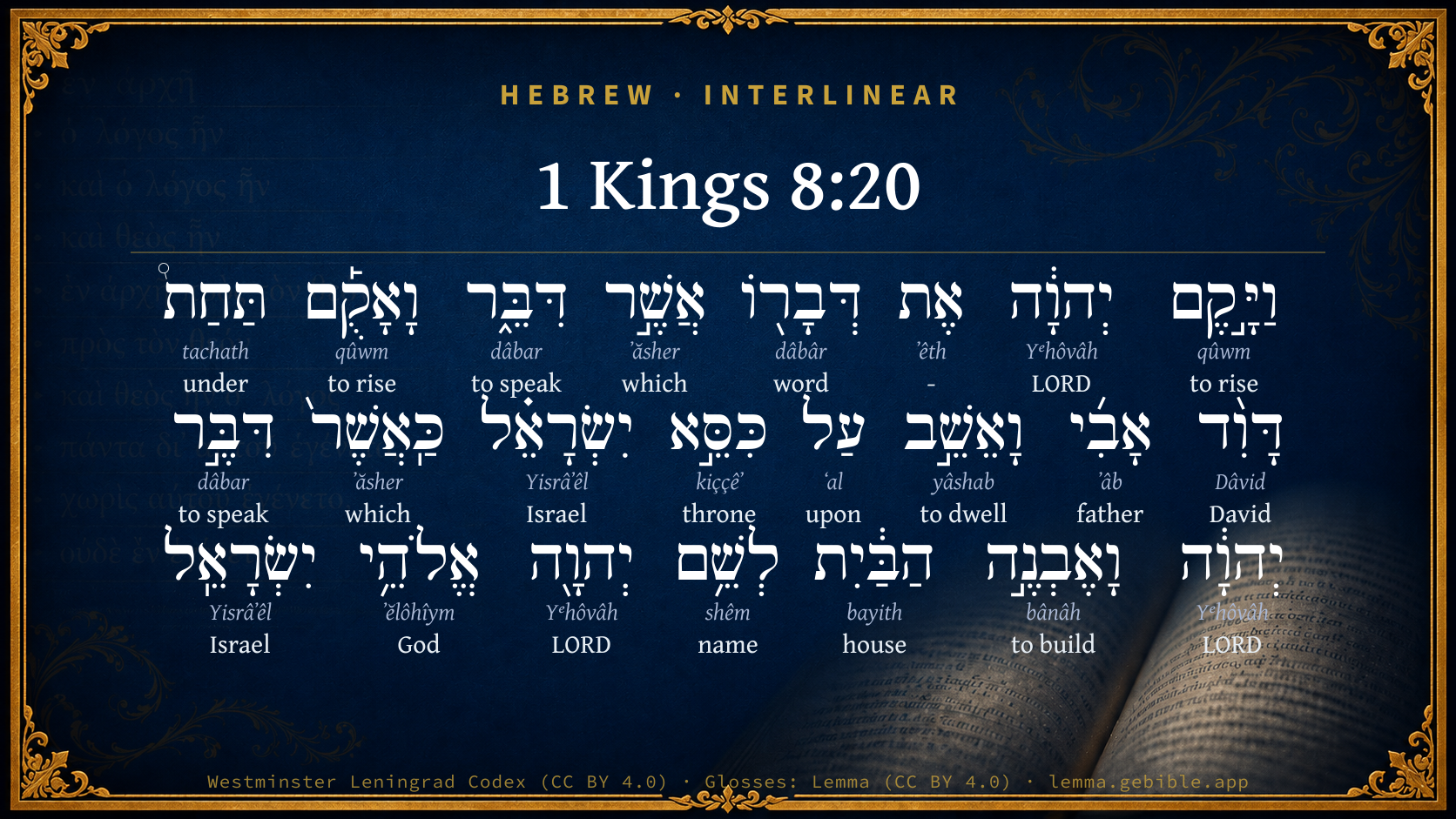
1 Kings 8:20

Hebrew (Westminster Leningrad Codex) 1 Kings 8:20 appears in the Hebrew Old Testament. The text above is from the Westminster Leningrad Codex. Each word links to its Strong’s number, a concise gloss, and parsing drawn from the Open Scriptures Hebrew Bible morphology. Click any word for its full Brown-Driver-Briggs (BDB) entry.
Download image
Cite this verse

1 Kings 8:20 (World English Bible). Public Domain. Lemma interlinear Bible study tool, https://lemma.gebible.app/v/1-kings/8/20.

Show BibTeX & RIS
BibTeX
RIS
English Translation
Yahweh has established his word that he spoke; for I am risen up in the room of David my father, and sit on the throne of Israel, as Yahweh promised, and have built the house for the name of Yahweh, the God of Israel.
World English Bible · Public Domain
Download a study sheet

One document with this verse’s original text, its word-by-word gloss line, the meaning frame, cross-references with their text, attributed commentary, and full source and license credits — printable, and it pastes into notes with its structure intact.

This verse Autodidact and up

Study sheet (.html) Plain text (.txt)

A passage Seminary Student

Up to 50 verses in one chapter. A passage sheet keeps up to 6 commentary sources and 12 cross-references per verse, in the order this page ranks them, and says so on the sheet whenever that leaves anything out. Ask for a single verse and you get the Autodidact verse sheet above.

Everything on this page stays free to read, with no account — the sheet is a download of what is already on screen, not access to it.

Want to remove ads? Support Godless Engineer
Compare translations 3

The same verse in 3 English versions, stacked beneath the original-language interlinear above. Click any original word for its lexicon entry.

Each is an independent rendering of the whole verse — the interlinear is not word-aligned to these translations.

Highlighted words mark where these versions differ — a whole-verse word diff, not a word-by-word alignment.

  • World English Bible Public Domain
    Yahweh has established his word that he spoke; for I am risen up in the room of David my father, and sit on the throne of Israel, as Yahweh promised, and have built the house for the name of Yahweh, the God of Israel.
  • King James Version Public Domain
    And the LORD hath performed his word that he spake, and I am risen up in the room of David my father, and sit on the throne of Israel, as the LORD promised, and have built an house for the name of the LORD God of Israel.
  • unfoldingWord Literal Text CC BY-SA 4.0
    And Yahweh has raised up his word that he spoke. And I have arisen in place of David my father, and I sit on the throne of Israel, just as Yahweh spoke. And I have built the house for the name of Yahweh, the God of Israel.

unfoldingWord Literal Text — © unfoldingWord, licensed CC BY-SA 4.0. Word-aligned USFM3 via Door43 (git.door43.org/unfoldingWord/en_ult).

Versions to compare (up to 4)

3 of 4 selected

Show all 18 translations

Every available English version of this verse, each an independent rendering of the whole verse.

  • World English Bible Public Domain
    Yahweh has established his word that he spoke; for I am risen up in the room of David my father, and sit on the throne of Israel, as Yahweh promised, and have built the house for the name of Yahweh, the God of Israel.
  • Berean Standard Bible Public Domain
    Now the LORD has fulfilled the word that He spoke. I have succeeded my father David, and I sit on the throne of Israel, as the LORD promised. I have built the house for the Name of the LORD, the God of Israel.
  • Majority Standard Bible Public Domain
    Now the LORD has fulfilled the word that He spoke. I have succeeded my father David, and I sit on the throne of Israel, as the LORD promised. I have built the house for the Name of the LORD, the God of Israel.
  • King James Version Public Domain
    And the LORD hath performed his word that he spake, and I am risen up in the room of David my father, and sit on the throne of Israel, as the LORD promised, and have built an house for the name of the LORD God of Israel.
  • American Standard Version (1901) Public Domain
    And Jehovah hath established his word that he spake; for I am risen up in the room of David my father, and sit on the throne of Israel, as Jehovah promised, and have built the house for the name of Jehovah, the God of Israel.
  • Revised Version (1885) Public Domain
    And the LORD hath established his word that he spake; for I am risen up in the room of David my father, and sit on the throne of Israel, as the LORD promised, and have built the house for the name of the LORD, the God of Israel.
  • Geneva Bible (1599) Public Domain
    And the Lord hath made good his worde that he spake: and I am risen vp in the roume of Dauid my father, and sit on the throne of Israel, as the Lord promised, and haue built the house for the Name of the Lord God of Israel.
  • Douay-Rheims (1899) Public Domain
    The Lord hath performed his word which he spoke: and I stand in the room of David my father, and sit upon the throne of Israel, as the Lord promised: and have built a house to the name of the Lord the God of Israel.
  • Young's Literal Translation Public Domain
    `And Jehovah doth establish His word which He spake, and I am risen up instead of David my father, and sit on the throne of Israel, as Jehovah spake, and build the house for the name of Jehovah, God of Israel,
  • Literal Standard Version CC BY-SA 4.0
    And YHWH establishes His word which He spoke, and I am risen up instead of my father David, and I sit on the throne of Israel, as YHWH spoke, and build the house for the Name of YHWH, God of Israel,
  • Unlocked Literal Bible CC BY-SA 4.0
    Yahweh has carried out the word that he had said, for I have arisen in the place of David my father, and I sit on the throne of Israel, as Yahweh promised. I have built the house for the name of Yahweh, the God of Israel.
  • unfoldingWord Literal Text CC BY-SA 4.0
    And Yahweh has raised up his word that he spoke. And I have arisen in place of David my father, and I sit on the throne of Israel, just as Yahweh spoke. And I have built the house for the name of Yahweh, the God of Israel.
  • Darby Bible Public Domain
    And Jehovah has performed his word which he spoke; and I am risen up in the room of David my father, and sit on the throne of Israel, as Jehovah promised, and I have built the house unto the name of Jehovah the God of Israel.
  • World Messianic Bible Public Domain
    The LORD has established his word that he spoke; for I have risen up in the place of David my father, and I sit on the throne of Israel, as the LORD promised, and have built the house for the name of the LORD, the God of Israel.
  • Webster's Bible Public Domain
    And the LORD hath performed his word that he spoke, and I have risen in the room of David my father, and sit on the throne of Israel, as the LORD promised, and have built a house for the name of the LORD God of Israel.
  • Free Bible Version CC BY-SA 4.0
    Now the Lord has kept his promise that he made. I have succeeded my father David, and I sit on the throne of Israel, just as the Lord promised. I have built the Temple to honor the Lord, the God of Israel.
  • Bible in Basic English Public Domain
    And the Lord has made his word come true; for I have taken my father David's place on the seat of the kingdom of Israel, as the Lord gave his word; and I have made a house for the name of the Lord, the God of Israel.
  • JPS Tanakh (1917) Public Domain
    And the LORD hath established His word that He spoke; for I am risen up in the room of David my father, and sit on the throne of Israel, as the LORD promised, and have built the house for the name of the LORD, the God of Israel.

Literal Standard Version (2020), Covenant Press — licensed CC BY-SA 4.0. Text via the HelloAO Bible API (eBible.org). Unlocked Literal Bible (unfoldingWord) — licensed CC BY-SA 4.0. Text via the HelloAO Bible API (eBible.org). unfoldingWord Literal Text — © unfoldingWord, licensed CC BY-SA 4.0. Word-aligned USFM3 via Door43 (git.door43.org/unfoldingWord/en_ult). Free Bible Version, Dr. Jonathan Gallagher — licensed CC BY-SA 4.0. Text via the HelloAO Bible API (eBible.org).

Word by word

More ways to search: Search by grammar → Find every occurrence → Compare this word →

Practice this passage: Drill this verse → Learn its vocabulary →

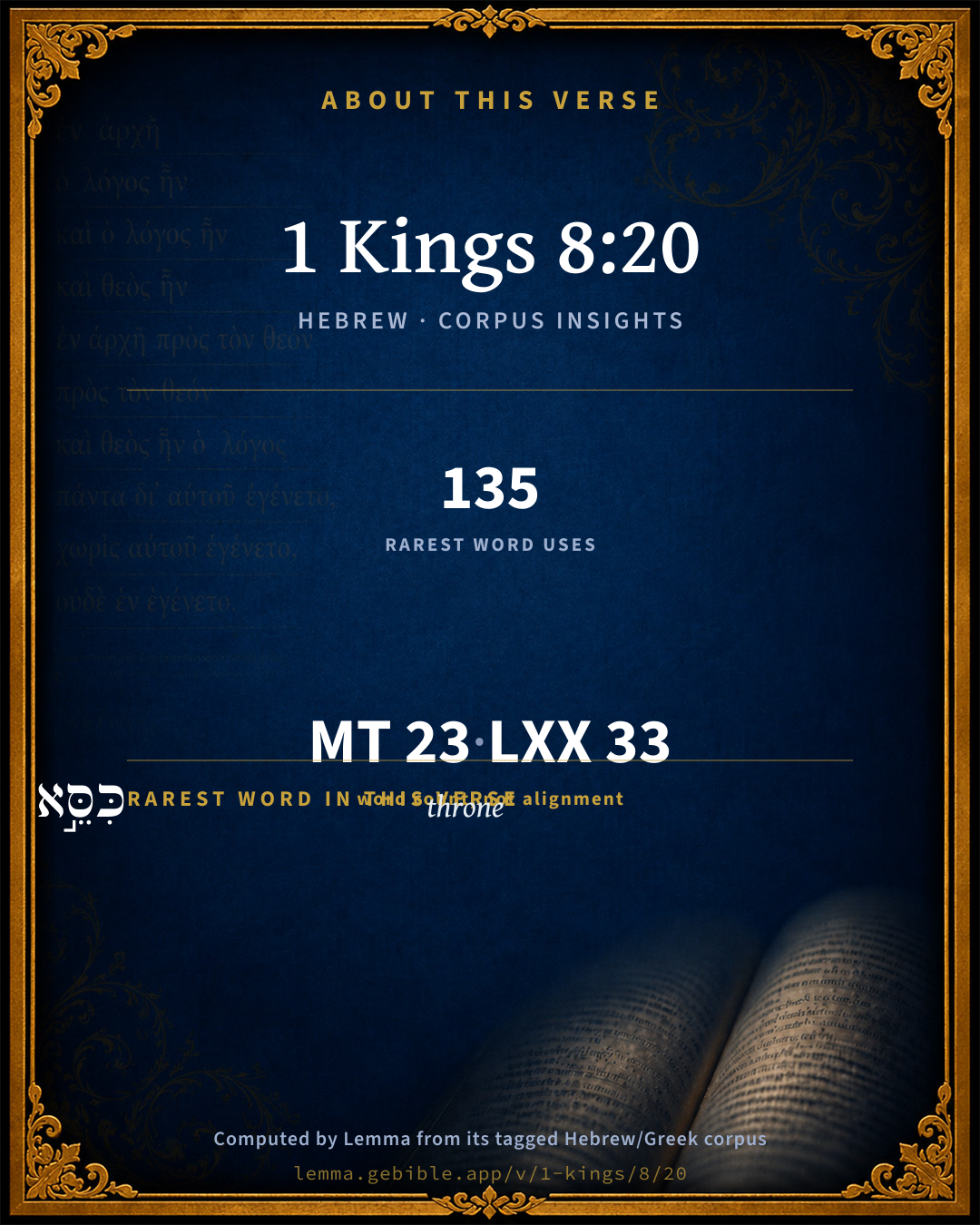
כִּסֵּ֣א
kiççêʼ
H3678
“throne of”
Noun, Common, Masculine, Singular, Construct
Part of Speech
Noun
Type
Common
Gender
Masculine
Number
Singular
State
Construct
Full BDB Definition

Origin: from H3680

TWOT: 1007

seat (of honour), throne, seat, stool - seat (of honour), throne - royal dignity, authority, power (figuratively)
  1. וַיָּ֣קֶם qûwm H6965 “and · to rise” Conjunction + Verb, Hiphil, Sequential Imperfect, 3rd Person, Masculine, Singular
  2. יְהוָ֔ה Yᵉhôvâh H3068 “LORD” Noun, Proper
  3. אֶת ʼêth H853 “-” Particle, Direct Object
  4. דְּבָר֖וֹ dâbâr H1697 “word · his” Noun, Common, Masculine, Singular, Construct + Suffix, Personal, 3rd Person, Masculine, Singular
  5. אֲשֶׁ֣ר ʼăsher H834 “which” Particle, Relative
  6. דִּבֵּ֑ר dâbar H1696 “to speak” Verb, Piel, Perfect, 3rd Person, Masculine, Singular
  7. וָאָקֻ֡ם qûwm H6965 “and · to rise” Conjunction + Verb, Qal, Sequential Imperfect, 1st Person, Common, Singular
  8. תַּחַת֩ tachath H8478 “under” Preposition
  9. דָּוִ֨ד Dâvid H1732 “David” Noun, Proper
  10. אָבִ֜י ʼâb H1 “father · my” Noun, Common, Masculine, Singular, Construct + Suffix, Personal, 1st Person, Common, Singular
  11. וָאֵשֵׁ֣ב yâshab H3427 “and · to dwell” Conjunction + Verb, Qal, Sequential Imperfect, 1st Person, Common, Singular
  12. עַל ʻal H5921 “upon” Preposition
  13. יִשְׂרָאֵ֗ל Yisrâʼêl H3478 “Israel” Noun, Proper
  14. כַּֽאֲשֶׁר֙ ʼăsher H834 “like/as · which” Preposition + Particle, Relative
  15. דִּבֶּ֣ר dâbar H1696 “to speak” Verb, Piel, Perfect, 3rd Person, Masculine, Singular
  16. יְהוָ֔ה Yᵉhôvâh H3068 “LORD” Noun, Proper
  17. וָאֶבְנֶ֣ה bânâh H1129 “and · to build” Conjunction + Verb, Qal, Sequential Imperfect, 1st Person, Common, Singular
  18. הַבַּ֔יִת bayith H1004 “the · house” Particle, Definite Article + Noun, Common, Masculine, Singular, Absolute
  19. לְשֵׁ֥ם shêm H8034 “to/for · name of” Preposition + Noun, Common, Masculine, Singular, Construct
  20. יְהוָ֖ה Yᵉhôvâh H3068 “LORD” Noun, Proper
  21. אֱלֹהֵ֥י ʼĕlôhîym H430 “God(s) of” Noun, Common, Masculine, Plural, Construct
  22. יִשְׂרָאֵֽל Yisrâʼêl H3478 “Israel” Noun, Proper

About this verse

These counts appear in no published source. They are computed here, from the morphology-tagged text and Lemma’s own curated glosses. What Lemma adds →

23
words
17
distinct lemmas
Historical
section

Grammatical profile

  • 6 verbs
  • 12 nouns
  • 2 prepositions
  • 3 particles

Verb forms

  • וַיָּ֣קֶם Hiphil · Sequential Imperfect
  • דִּבֵּ֑ר Piel · Perfect
  • וָאָקֻ֡ם Qal · Sequential Imperfect
  • וָאֵשֵׁ֣ב Qal · Sequential Imperfect
  • דִּבֶּ֣ר Piel · Perfect
  • וָאֶבְנֶ֣ה Qal · Sequential Imperfect

Repetition

Words recur within this verse — often emphatic in Hebrew:

  • יְהוָ֔ה LORD H3068 ×3
  • וַיָּ֣קֶם to rise H6965 ×2
  • דִּבֵּ֑ר to speak H1696 ×2
  • יִשְׂרָאֵ֗ל Israel H3478 ×2
  • אֲשֶׁ֣ר which H834 ×2

Hebrew & Septuagint length

In English translation the verse runs 44 words from the Hebrew and 51 from the Septuagint (LXX English) — closely comparable.

A rough comparison of the two English renderings, which tokenize alike — not a word-level alignment.

Word counts can differ between the Hebrew and the Greek without any difference in meaning — e.g. the Hebrew direct-object marker אֵת has no separate Greek word, and Greek often adds the article ὁ.

In the original languages it is 23 Hebrew tokens and 33 Greek tokens — but the two are counted differently (Hebrew bundles its prefixes and suffixes into one token; the Greek is in lemma form), so that isn’t a like-for-like length.

Cross-references

10

Topical passages linked to 1 Kings 8:20 in the Treasury of Scripture Knowledge — connected by theme and wording, ordered by reader-vote popularity; previews shown in the World English Bible.

  • 1 Chronicles 28:5–6 Of all my sons (for Yahweh has given me many sons), he has chosen Solomon my son to sit on the throne of the kingdom of Yahweh over Israel.
  • 1 Kings 8:15 He said, Blessed be Yahweh, the God of Israel, who spoke with his mouth to David your father, and has with his hand fulfilled it, saying,
  • Nehemiah 9:8 and found his heart faithful before you, and made a covenant with him to give the land of the Canaanite, the Hittite, the Amorite, and the Perizzite, and the Jebusite, and the Girgashite, to give it to his seed, and have performed your words; for you are righteous.
  • Isaiah 9:7 Of the increase of his government and of peace there shall be no end, on the throne of David, and on his kingdom, to establish it, and to uphold it with justice and with righteousness from henceforth even forever. The zeal of Yahweh of Hosts will perform this.
  • Jeremiah 29:10–11 For thus says Yahweh, After seventy years are accomplished for Babylon, I will visit you, and perform my good word toward you, in causing you to return to this place.
  • Ezekiel 12:25 For I am Yahweh; I will speak, and the word that I shall speak shall be performed; it shall be no more deferred: for in your days, rebellious house, will I speak the word, and will perform it, says the Lord Yahweh.
  • Ezekiel 37:14 I will put my Spirit in you, and you shall live, and I will place you in your own land: and you shall know that I, Yahweh, have spoken it and performed it, says Yahweh.
  • Micah 7:20 You will give truth to Jacob, and mercy to Abraham, As you have sworn to our fathers from the days of old.
  • Romans 4:21 and being fully assured that what he had promised, he was able also to perform.
  • Philippians 1:6 being confident of this very thing, that he who began a good work in you will complete it until the day of Jesus Christ.

Cross-references courtesy of OpenBible.info (CC BY 4.0).

Hebrew and Greek witnesses Masoretic Hebrew ↔ Greek Septuagint

The same verse in the two great witnesses to the Old Testament, shown verse-for-verse.

These are two independent witnesses, not word-aligned to each other, and the Septuagint is shown in lemma (dictionary) form.

Hebrew 1 Kings 8:20 Masoretic · Westminster Leningrad Codex

וַיָּ֣קֶם יְהוָ֔ה אֶת דְּבָר֖וֹ אֲשֶׁ֣ר דִּבֵּ֑ר וָאָקֻ֡ם תַּחַת֩ דָּוִ֨ד אָבִ֜י וָאֵשֵׁ֣ב עַל כִּסֵּ֣א יִשְׂרָאֵ֗ל כַּֽאֲשֶׁר֙ דִּבֶּ֣ר יְהוָ֔ה וָאֶבְנֶ֣ה הַבַּ֔יִת לְשֵׁ֥ם יְהוָ֖ה אֱלֹהֵ֥י יִשְׂרָאֵֽל

Yahweh has established his word that he spoke; for I am risen up in the room of David my father, and sit on the throne of Israel, as Yahweh promised, and have built the house for the name of Yahweh, the God of Israel.

World English Bible · Public Domain

Greek LXX 1 Kings 8:20 Septuagint · lemma form

καί ἀναἵστημι κύριος ὁ ῥῆμα αὐτός ὅς λαλέω καί ἀναἵστημι ἀντί δαυίδ ὁ πατήρ ἐγώ καί καταἵζω ἐπί ὁ θρόνος ἰσραήλ καθώς λαλέω κύριος καί οἰκοδομέω ὁ οἶκος ὁ ὄνομα κύριος θεός ἰσραήλ

And the Lord has confirmed the word that he spoke, and I am risen up in the place of my father David, and I have sat down on the throne of Israel, as the Lord spoke, and I have built the house to the name of the Lord God of Israel.

LXX2012 (modern English Septuagint) · Public Domain

On this verse, The Pulpit Commentary discusses the Septuagint’s reading. Read the note in Commentary ↓

Hebrew: Westminster Leningrad Codex (CC BY 4.0). Greek: Septuagint (public domain); English from LXX2012 (modern English Septuagint) (Public Domain). How the Septuagint differs from the Hebrew →

Targum (Aramaic paraphrase)

1

The Targum is the ancient Jewish Aramaic paraphrase of the Hebrew Scriptures — an interpretive translation, not the Hebrew text itself. Onkelos (literal) and Pseudo-Jonathan (expansive) render the Torah, and Jonathan the Prophets. Coverage is partial: where no permissively-licensed English translation exists for a verse, only the Aramaic is shown. This is verse-level text, not a word-by-word alignment to the Hebrew.

  1. Targum Jonathan Prophets (Joshua–Malachi)
    וְקַיָים יְיָ יַת פִּתְגָמֵיהּ דְמַלֵיל וְקָמִית תְּחוֹת דָוִד אַבָּא וִיתֵיבִית עַל כּוּרְסֵי מַלְכוּתָא דְיִשְׂרָאֵל כְּמָא דְמַלֵיל יְיָ וּבְנֵיתִי בֵיתָא לִשְׁמָא דַייָ אֱלָהָא דְיִשְׂרָאֵל:

    (no public-domain English translation for this verse)

    Targum Jonathan — Aramaic: “Mikraot Gedolot” (public domain). English: “Sefaria Community Translation” (CC0 1.0 (public-domain dedication)); “London "Chaldee Paraphrase," 1871” (public domain). Text via Sefaria.

Commentary

Notes on 1 Kings 8:20 from classic Christian and Jewish commentators (each source and its license shown beneath its notes). The classic Christian expositions comment on the surrounding passage and are grouped to its opening verse, so a note may address several verses; the Jewish commentaries on the Tanakh (Rashi and others) are per-verse, so they appear only where the commentator wrote on this verse.

Lemma curates 59 commentaries, every one of them public domain or Creative Commons licensed, each selected and text-cleaned for this edition rather than reprinted as found. About our sources →

Trapp's Complete Commentary

John Trapp

1Ki 8:20 And the LORD hath performed his word that he spake, and I am risen up in the room of David my father, and sit on the throne of Israel, as the LORD promised, and have built an house for the name of the LORD God of Israel.

Ver. 20. And the Lord hath performed his word.] He never yet "suffered his faithfulness to fail, nor altered the thing that went out of his mouth." {Psa 89:33} Witness the constant and concurrent experience of saints in all ages; not one instance to the contrary.

John Trapp, A Commentary or Exposition upon All the Books of the Old and New Testament (1647–1656) — public domain. Text from a community e-Sword module.

Geneva Bible (1599)

Geneva Bible translators

Hebrew, confirmed.

Geneva Bible (1599) marginal notes — public domain. Text via Bolls.life.

John Gill's Exposition

And the Lord hath performed his word that he spake,.... To David, concerning his son's building the temple:

and I am risen up in the room of David my father, and sit on the throne of Israel, as the Lord promised; succeeded him in the kingdom:

and have built an house for the name of the Lord God of Israel; the temple he had now finished; and thus the promise to David was punctually fulfilled, that he should have a son that should succeed him in the throne, and build the house of the Lord.

John Gill's Exposition of the Whole Bible (1746–1763) — public domain (CC PDM 1.0). Text via the HelloAO Bible API.

The Pulpit Commentary

And the Lord hath performed. Same word as in 1Ki_2:4. Lit., "hath raised up" (LXX ajnesthse). Also same word as "risen up" (LXX ajnesthn) below, and as "set up" in 2Sa_7:12. We might translate "established" throughout his word that he spake, and I am risen up in the room of David my father, and sit on the throne of Israel, (1Ki_1:48) as the Lord promised, (2Sa_7:12) and have built a house for the name of the Lord God of Israel (ib. ver. 13) .

The Pulpit Commentary (1880–1919), ed. H.D.M. Spence-Jones & Joseph S. Exell — public domain. Text from a community e-Sword module.

unfoldingWord translationNotes

Door43 World Missions Community

has carried out the word that he had said

This is an idiom. AT: "has done exactly what he said he would do" (See: Idiom)

I have arisen in the place of David my father

Height is a metaphor for power. AT: "I have gained the power that David my father had" (See: Metaphor)

I sit on the throne of Israel

The throne is a metonym for the activity of the one who sits on the throne. AT: "I rule over Israel" (See: Metonymy)

for the name of Yahweh

The word "name" is a metonym for the person, and "for ... name" refers to worshiping the person. See how you translated this in 1 Kings 3:2. AT: "in which people will worship Yahweh" (See: Metonymy)

is Yahweh's covenant, which

The stone tablets on which Yahweh had written the terms of the covenant are spoken of as if they were the covenant itself. AT: "are the tablets on which Yahweh wrote the terms of the covenant that" (See: Metonymy)

translationWords

Yahweh

word

raise

David

ancestor

throne

Israel

promise

house

ark of the covenant

covenant

Egypt

unfoldingWord translationNotes — © Distant Shores Media and the Door43 World Missions Community, licensed CC BY-SA 4.0. Source: git.door43.org/Door43/en_tn.

Lesson kit

Teaching starters — assembled from the data on this page, not authored interpretation. Every prompt links to the verse data it draws on. Edit before teaching.

1 Kings, in the Historical, opens this verse with 23 words (17 distinct Hebrew lemmas). Its most distinctive word is kiççêʼ (“throne”). A historical commentator’s framing appears above. Read the whole chapter for the surrounding context.

Discussion questions

  1. How does “throne” (kiççêʼ) shape what this verse is saying?
  2. How does 1 Chronicles 28:5–6, which shares this passage’s theme, read alongside this verse?
  3. What does the repetition of “LORD” (3× in this one verse) do in this verse?
  4. These translations render this verse differently; the difference is in the English rendering, not the original. What questions does that raise?
  5. «וַיָּ֣קֶם» is a Hiphil Sequential Imperfect verb. How does that grammatical form shape the action described?
  6. Compare how Trapp's Complete Commentary and Geneva Bible (1599) read this verse. Where do they agree or differ?

Things to notice

Reading settings

Reading text

Shown beneath each verse's original-language words.

Old Testament
Old Testament edition

Read the OT as the Masoretic Hebrew (MT) or the Greek Septuagint (LXX).

English shown for the Greek Septuagint (in the Hebrew ↔ Greek comparison).

Comparing translations? Open the Compare panel on any verse page to stack up to four side by side.