1 Chronicles 18:5

Hebrew (Westminster Leningrad Codex) 1 Chronicles 18:5 appears in the Hebrew Old Testament. The text above is from the Westminster Leningrad Codex. Each word links to its Strong’s number, a concise gloss, and parsing drawn from the Open Scriptures Hebrew Bible morphology. Click any word for its full Brown-Driver-Briggs (BDB) entry.
Download image
Cite this verse

1 Chronicles 18:5 (World English Bible). Public Domain. Lemma interlinear Bible study tool, https://lemma.gebible.app/v/1-chronicles/18/5.

Show BibTeX & RIS
BibTeX
RIS
English Translation
When the Syrians of Damascus came to help Hadarezer king of Zobah, David struck of the Syrians twenty-two thousand men.
World English Bible · Public Domain
Download a study sheet

One document with this verse’s original text, its word-by-word gloss line, the meaning frame, cross-references with their text, attributed commentary, and full source and license credits — printable, and it pastes into notes with its structure intact.

This verse Autodidact and up

Study sheet (.html) Plain text (.txt)

A passage Seminary Student

Up to 50 verses in one chapter. A passage sheet keeps up to 6 commentary sources and 12 cross-references per verse, in the order this page ranks them, and says so on the sheet whenever that leaves anything out. Ask for a single verse and you get the Autodidact verse sheet above.

Everything on this page stays free to read, with no account — the sheet is a download of what is already on screen, not access to it.

Want to remove ads? Support Godless Engineer
Compare translations 3

The same verse in 3 English versions, stacked beneath the original-language interlinear above. Click any original word for its lexicon entry.

Each is an independent rendering of the whole verse — the interlinear is not word-aligned to these translations.

Highlighted words mark where these versions differ — a whole-verse word diff, not a word-by-word alignment.

  • World English Bible Public Domain
    When the Syrians of Damascus came to help Hadarezer king of Zobah, David struck of the Syrians twenty-two thousand men.
  • King James Version Public Domain
    And when the Syrians of Damascus came to help Hadarezer king of Zobah, David slew of the Syrians two and twenty thousand men.
  • unfoldingWord Literal Text CC BY-SA 4.0
    And Aram of Damascus came to help Hadadezer the king of Zobah. And David struck 22,000 men among Aram.

unfoldingWord Literal Text — © unfoldingWord, licensed CC BY-SA 4.0. Word-aligned USFM3 via Door43 (git.door43.org/unfoldingWord/en_ult).

Versions to compare (up to 4)

3 of 4 selected

Show all 18 translations

Every available English version of this verse, each an independent rendering of the whole verse.

  • World English Bible Public Domain
    When the Syrians of Damascus came to help Hadarezer king of Zobah, David struck of the Syrians twenty-two thousand men.
  • Berean Standard Bible Public Domain
    When the Arameans of Damascus came to help King Hadadezer of Zobah, David struck down twenty-two thousand men.
  • Majority Standard Bible Public Domain
    When the Arameans of Damascus came to help King Hadadezer of Zobah, David struck down twenty-two thousand of their men.
  • King James Version Public Domain
    And when the Syrians of Damascus came to help Hadarezer king of Zobah, David slew of the Syrians two and twenty thousand men.
  • American Standard Version (1901) Public Domain
    And when the Syrians of Damascus came to succor Hadarezer king of Zobah, David smote of the Syrians two and twenty thousand men.
  • Revised Version (1885) Public Domain
    And when the Syrians of Damascus came to succour Hadarezer king of Zobah, David smote of the Syrians two and twenty thousand men.
  • Geneva Bible (1599) Public Domain
    Then came the Aramites of Damascus to succour Hadarezer King of Zobah, but Dauid slewe of the Aramites two and twentie thousand.
  • Douay-Rheims (1899) Public Domain
    And the Syrians of Damascus came also to help Adarezer king of Soba: and David slew of them likewise two and twenty thousand men.
  • Young's Literal Translation Public Domain
    And Aram of Damascus cometh in to give help to Hadarezer king of Zobah, and David smiteth in Aram twenty and two thousand men,
  • Literal Standard Version CC BY-SA 4.0
    And Aram of Damascus comes to give help to Hadarezer king of Zobah, and David strikes twenty-two thousand men in Aram,
  • Unlocked Literal Bible CC BY-SA 4.0
    When the Arameans of Damascus came to help Hadadezer king of Zobah, David killed twenty-two thousand Aramean men.
  • unfoldingWord Literal Text CC BY-SA 4.0
    And Aram of Damascus came to help Hadadezer the king of Zobah. And David struck 22,000 men among Aram.
  • Darby Bible Public Domain
    And the Syrians of Damascus came to help Hadarezer king of Zobah, and David smote of the Syrians twenty-two thousand men.
  • World Messianic Bible Public Domain
    When the Syrians of Damascus came to help Hadadezer king of Zobah, David struck twenty-two thousand men of the Syrians.
  • Webster's Bible Public Domain
    And when the Syrians of Damascus came to help Hadarezer king of Zobah, David slew of the Syrians two and twenty thousand men.
  • Free Bible Version CC BY-SA 4.0
    When the Arameans from Damascus came to help Hadadezer king of Zobah, David killed 22,000 of them.
  • Bible in Basic English Public Domain
    And when the Aramaeans of Damascus came to the help of Hadadezer, king of Zobah, David put to the sword twenty-two thousand Aramaeans.
  • JPS Tanakh (1917) Public Domain
    And when the Arameans of Damascus came to succour Hadarezer king of Zobah, David smote of the Arameans two and twenty thousand men.

Literal Standard Version (2020), Covenant Press — licensed CC BY-SA 4.0. Text via the HelloAO Bible API (eBible.org). Unlocked Literal Bible (unfoldingWord) — licensed CC BY-SA 4.0. Text via the HelloAO Bible API (eBible.org). unfoldingWord Literal Text — © unfoldingWord, licensed CC BY-SA 4.0. Word-aligned USFM3 via Door43 (git.door43.org/unfoldingWord/en_ult). Free Bible Version, Dr. Jonathan Gallagher — licensed CC BY-SA 4.0. Text via the HelloAO Bible API (eBible.org).

Word by word

More ways to search: Search by grammar → Find every occurrence → Compare this word →

Practice this passage: Drill this verse → Learn its vocabulary →

צוֹבָ֑ה
Tsôwbâʼ
H6678
“Zoba”
Noun, Proper
Part of Speech
Noun
Type
Proper
Full BDB Definition

Origin: from an unused root meaning to station

TWOT: None

Zoba or Zobah = "station" - the name of a portion of Syria which formed a separate kingdom in the times of Saul, David, and Solomon; located northeast of Damascus
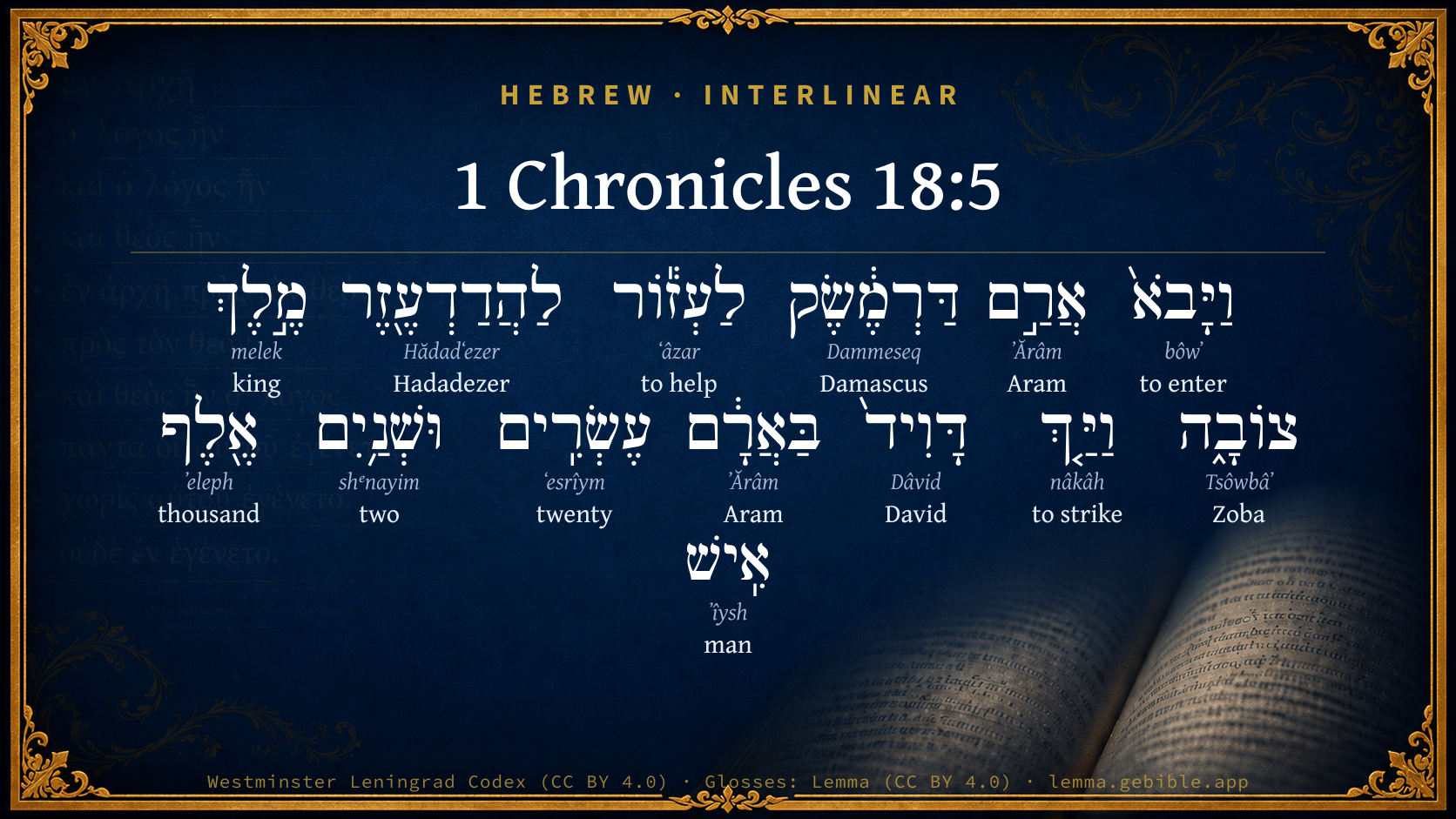
  1. וַיָּבֹא֙ bôwʼ H935 “and · to enter” Conjunction + Verb, Qal, Sequential Imperfect, 3rd Person, Masculine, Singular
  2. אֲרַ֣ם ʼĂrâm H758 “Aram” Noun, Proper
  3. דַּרְמֶ֔שֶׂק Dammeseq H1834 “Damascus” Noun, Proper
  4. לַעְז֕וֹר ʻâzar H5826 “to help” Preposition + Verb, Qal, Infinitive Construct
  5. לַהֲדַדְעֶ֖זֶר Hădadʻezer H1909 “to/for · Hadadezer” Preposition + Noun, Proper
  6. מֶ֣לֶךְ melek H4428 “king of” Noun, Common, Masculine, Singular, Construct
  7. וַיַּ֤ךְ nâkâh H5221 “and · to strike” Conjunction + Verb, Hiphil, Sequential Imperfect, 3rd Person, Masculine, Singular
  8. דָּוִיד֙ Dâvid H1732 “David” Noun, Proper
  9. בַּאֲרָ֔ם ʼĂrâm H758 “in/at · Aram” Preposition + Noun, Proper
  10. עֶשְׂרִֽים ʻesrîym H6242 “twenty” Adjective, Cardinal number, Both, Plural, Absolute
  11. וּשְׁנַ֥יִם shᵉnayim H8147 “and · two” Conjunction + Adjective, Cardinal number, Masculine, Dual, Absolute
  12. אֶ֖לֶף ʼeleph H505 “thousand” Adjective, Cardinal number, Both, Singular, Absolute
  13. אִֽישׁ ʼîysh H376 “man” Noun, Common, Masculine, Singular, Absolute

About this verse

These counts appear in no published source. They are computed here, from the morphology-tagged text and Lemma’s own curated glosses. What Lemma adds →

14
words
13
distinct lemmas
Historical
section

Notable vocabulary

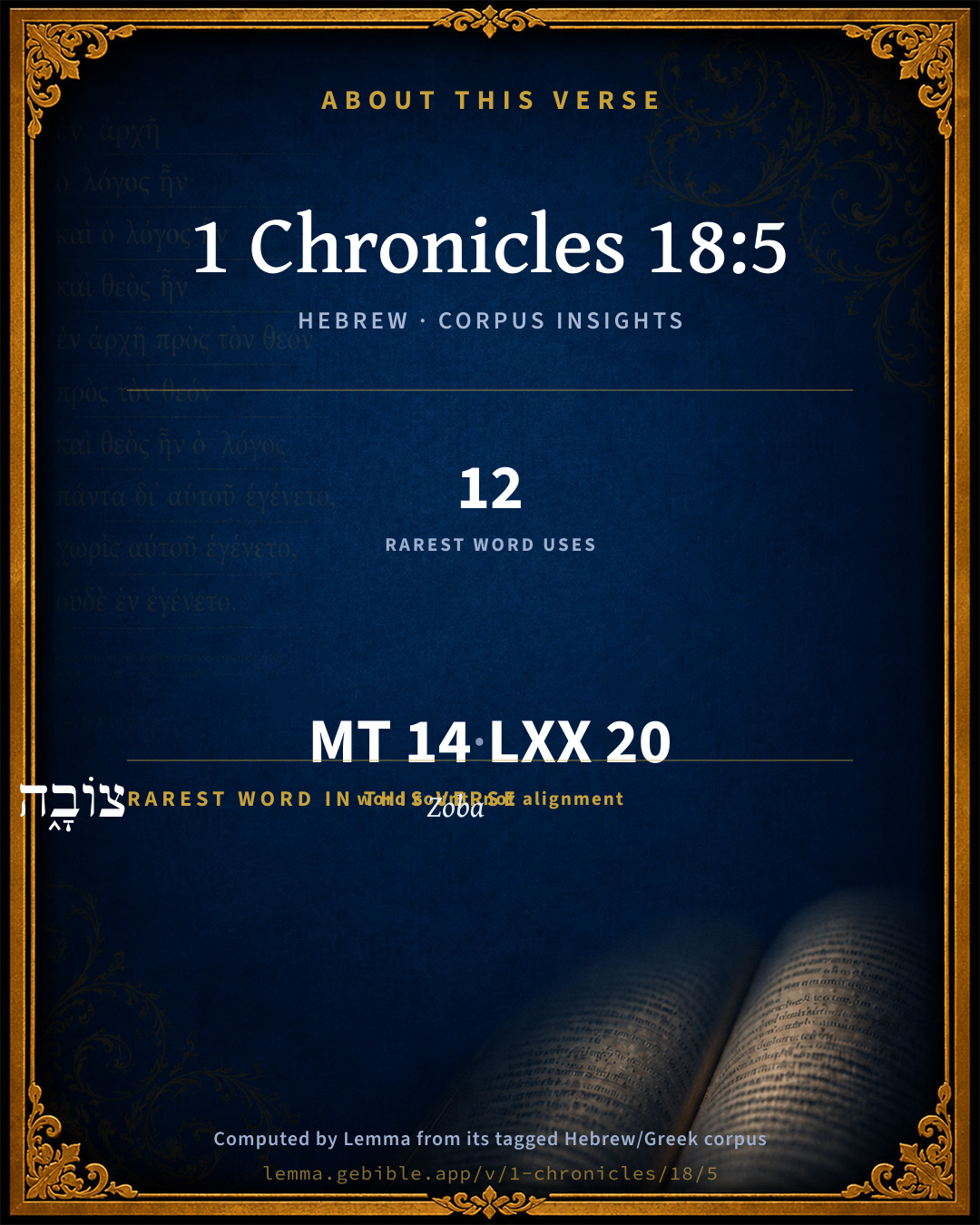
The rarest word here is צוֹבָ֑ה Zoba H6678 — appearing just 12 times in the whole Hebrew Bible.

Shared distinctive vocabulary

צוֹבָ֑ה Zoba H6678 occurs in 12 verses of the Hebrew Bible. Also found in:

Grammatical profile

  • 3 verbs
  • 8 nouns
  • 3 adjectives

Verb forms

  • וַיָּבֹא֙ Qal · Sequential Imperfect
  • לַעְז֕וֹר Qal · Infinitive Construct
  • וַיַּ֤ךְ Hiphil · Sequential Imperfect

Repetition

A word recurs within this verse — often emphatic in Hebrew:

  • אֲרַ֣ם Aram H758 ×2

Hebrew & Septuagint length

In English translation the verse runs 20 words from the Hebrew and 24 from the Septuagint (LXX English) — closely comparable.

A rough comparison of the two English renderings, which tokenize alike — not a word-level alignment.

Word counts can differ between the Hebrew and the Greek without any difference in meaning — e.g. the Hebrew direct-object marker אֵת has no separate Greek word, and Greek often adds the article ὁ.

In the original languages it is 14 Hebrew tokens and 20 Greek tokens — but the two are counted differently (Hebrew bundles its prefixes and suffixes into one token; the Greek is in lemma form), so that isn’t a like-for-like length.

Cross-references

6

Topical passages linked to 1 Chronicles 18:5 in the Treasury of Scripture Knowledge — connected by theme and wording, ordered by reader-vote popularity; previews shown in the World English Bible.

  • 2 Samuel 8:5–6 When the Syrians of Damascus came to help Hadadezer king of Zobah, David struck of the Syrians two and twenty thousand men.
  • 1 Chronicles 19:6 When the children of Ammon saw that they had made themselves odious to David, Hanun and the children of Ammon sent one thousand talents of silver to hire them chariots and horsemen out of Mesopotamia, and out of Arammaacah, and out of Zobah.
  • Isaiah 8:9–10 Make an uproar, O you peoples, and be broken in pieces! And give ear, all you of far countries: gird yourselves, and be broken in pieces! Gird yourselves, and be broken in pieces!
  • 1 Samuel 14:47 Now when Saul had taken the kingdom over Israel, he fought against all his enemies on every side, against Moab, and against the children of Ammon, and against Edom, and against the kings of Zobah, and against the Philistines: and wherever he turned himself, he put [them] to the worse.
  • 1 Kings 11:23–24 God raised up [another] adversary to him, Rezon the son of Eliada, who had fled from his lord Hadadezer king of Zobah.
  • 1 Chronicles 18:3 David struck Hadarezer king of Zobah to Hamath, as he went to establish his dominion by the river Euphrates.

Cross-references courtesy of OpenBible.info (CC BY 4.0).

Hebrew and Greek witnesses Masoretic Hebrew ↔ Greek Septuagint

The same verse in the two great witnesses to the Old Testament, shown verse-for-verse.

These are two independent witnesses, not word-aligned to each other, and the Septuagint is shown in lemma (dictionary) form.

Hebrew 1 Chronicles 18:5 Masoretic · Westminster Leningrad Codex

וַיָּבֹא֙ אֲרַ֣ם דַּרְמֶ֔שֶׂק לַעְז֕וֹר לַהֲדַדְעֶ֖זֶר מֶ֣לֶךְ צוֹבָ֑ה וַיַּ֤ךְ דָּוִיד֙ בַּאֲרָ֔ם עֶשְׂרִֽים וּשְׁנַ֥יִם אֶ֖לֶף אִֽישׁ

When the Syrians of Damascus came to help Hadarezer king of Zobah, David struck of the Syrians twenty-two thousand men.

World English Bible · Public Domain

Greek LXX 1 Chronicles 18:5 Septuagint · lemma form

καί ἔρχομαι σύρος ἐκ δαμασκός βοηθέω αδρααζαρ βασιλεύς σουβα καί πατάσσω δαυίδ ἐν ὁ σύρος εἴκοσι καί δύο χιλιάς ἀνήρ

And the Syrian came from Damascus to help Adraazar king of Suba; and David struck of the Syrian army twenty and two thousand men.

LXX2012 (modern English Septuagint) · Public Domain

Hebrew: Westminster Leningrad Codex (CC BY 4.0). Greek: Septuagint (public domain); English from LXX2012 (modern English Septuagint) (Public Domain). How the Septuagint differs from the Hebrew →

Commentary

Notes on 1 Chronicles 18:5 from classic Christian and Jewish commentators (each source and its license shown beneath its notes). The classic Christian expositions comment on the surrounding passage and are grouped to its opening verse, so a note may address several verses; the Jewish commentaries on the Tanakh (Rashi and others) are per-verse, so they appear only where the commentator wrote on this verse.

Lemma curates 59 commentaries, every one of them public domain or Creative Commons licensed, each selected and text-cleaned for this edition rather than reprinted as found. About our sources →

Joseph Benson's Commentary

1Ch 18:5-6. When the Syrians came to help Hadarezer, David slew of the Syrians, &c. — Thus the enemies of God’s church are often made to ruin themselves by helping one another. The Syrians became David’s servants, and brought gifts — For the wealth of the sinner often proves to have been laid up for the just. The Syrians’ shields of gold, and their brass, were brought to Jerusalem, 1Ch 18:7-8. As the tabernacle was built of the spoils of the Egyptians, so the temple of the spoils of other Gentile nations: a happy presage of the interest the Gentiles should have in the gospel church.

Joseph Benson's Commentary on the Old and New Testaments (1811–1818) — public domain. Text from a community e-Sword module.

Ellicott's Commentary for English Readers

(5) And when the Syrians of Damascus came.—Literally, And Aram of Damascus came. The verb is masculine here, feminine in Samuel. (Comp. 1Ch_18:2.)

Damascus.—Heb., Darmèseq, a late form, occurring again in 2Ch_28:5; 2Ch_28:23 (= ancient Dammèseq). In Syriac the name is similar: Darmĕsûq. The Arabic is Dimashqu, the cuneiform Dimashqa or Dimmasqa.

David slew of the Syrians.—Literally, smote in Aram. The preposition is partitive.

A Bible Commentary for English Readers, edited by Charles John Ellicott (1878–1897) — public domain. Text from a community e-Sword module.

The Cambridge Bible for Schools and Colleges

gen. ed. J. J. S. Perowne

5. Damascus] The name is variously written in Heb., Darmesek (Chron.), Dammesek (Gen., 1 Kin.), Dummesek (2Ki_16:10). In Arabic it is Dimishk. See Bädeker, p. 306 ff. and Kirkpatrick on 2Sa_8:5.

came to help] By interposing between David and his own land and threatening his rear.

The Cambridge Bible for Schools and Colleges (gen. ed. J. J. S. Perowne; Cambridge University Press, 1878–1918) — public domain. Text from a community e-Sword module.

Haydock's Catholic Bible Commentary

Damascus. Hebrew, "Aram of Darmesek." Elsewhere the r is omitted.

George Leo Haydock (1774–1849), Haydock's Catholic Family Bible and Commentary, 1859 edition — public domain. Excludes Psalms (Douay-Rheims chapter numbering differs from Protestant) and Deuterocanonical books (Catholic canon only).

The Pulpit Commentary

The Hebrew text of Damascus, here, next verse, and also 2Ch_28:5, spells the word with a resh, omitting the dagesh forte in the mere following, which Gesenius instances (see his "Lexicon as the Syriac orthography.

The Pulpit Commentary (1880–1919), ed. H.D.M. Spence-Jones & Joseph S. Exell — public domain. Text from a community e-Sword module.

unfoldingWord translationNotes

Door43 World Missions Community

killed twenty-two thousand

"killed 22,000" (See: Numbers)

garrisons

groups of soldiers assigned to particular areas

Yahweh gave victory to David

"Yahweh caused David to be victorious"

translationWords

Aram

Damascus

servant

tribute

Yahweh

unfoldingWord translationNotes — © Distant Shores Media and the Door43 World Missions Community, licensed CC BY-SA 4.0. Source: git.door43.org/Door43/en_tn.

Rashi

Rabbi Shlomo Yitzchaki (Rashi)

And Aram of Damascus came - Heb. דַרְמֶשֶׂק, and in II Samuel (8:6), it is written: דַמֶּשֶׂק. It is customary for Scripture to speak in this manner, like from שַׁרְבִיט:שֵׁבֶט, for (cf. I Kings 12:14): “I shall flog you with whips בַּשּׁוֹטִים (Sic),” is translated שַׁרְבִיטִים. (Rabbi Isaac said this also.)

Rashi on the Tanakh — English translations: “The Judaica Press complete Tanach with Rashi, translated by A. J. Rosenberg” (CC BY 4.0); “Pentateuch with Rashi's commentary by M. Rosenbaum and A.M. Silbermann, 1929-1934” (public domain); “The Metsudah Tanach series, Lakewood, N.J” (CC BY 4.0); and “The Book of Joshua, Metsudah Publications, 1997” (CC BY 4.0). Text via Sefaria.

Lesson kit

Teaching starters — assembled from the data on this page, not authored interpretation. Every prompt links to the verse data it draws on. Edit before teaching.

1 Chronicles, in the Historical, opens this verse with 14 words (13 distinct Hebrew lemmas). Its most distinctive word is Tsôwbâʼ (“Zoba”). A historical commentator’s framing appears above. Read the whole chapter for the surrounding context.

Discussion questions

  1. How does “Zoba” (Tsôwbâʼ) shape what this verse is saying?
  2. How does 1 Samuel 14:47, which shares the word «Zoba», read alongside this verse?
  3. What does the repetition of “Aram” (2× in this one verse) do in this verse?
  4. The translations on this page render this verse differently — a whole-verse word diff, not a word-by-word alignment. What might account for the different wordings?
  5. «וַיָּבֹא֙» is a Qal Sequential Imperfect verb. How does that grammatical form shape the action described?
  6. Compare how Joseph Benson's Commentary and Ellicott's Commentary for English Readers read this verse. Where do they agree or differ?

Things to notice

Reading settings

Reading text

Shown beneath each verse's original-language words.

Old Testament
Old Testament edition

Read the OT as the Masoretic Hebrew (MT) or the Greek Septuagint (LXX).

English shown for the Greek Septuagint (in the Hebrew ↔ Greek comparison).

Comparing translations? Open the Compare panel on any verse page to stack up to four side by side.