
1 Chronicles 22:5

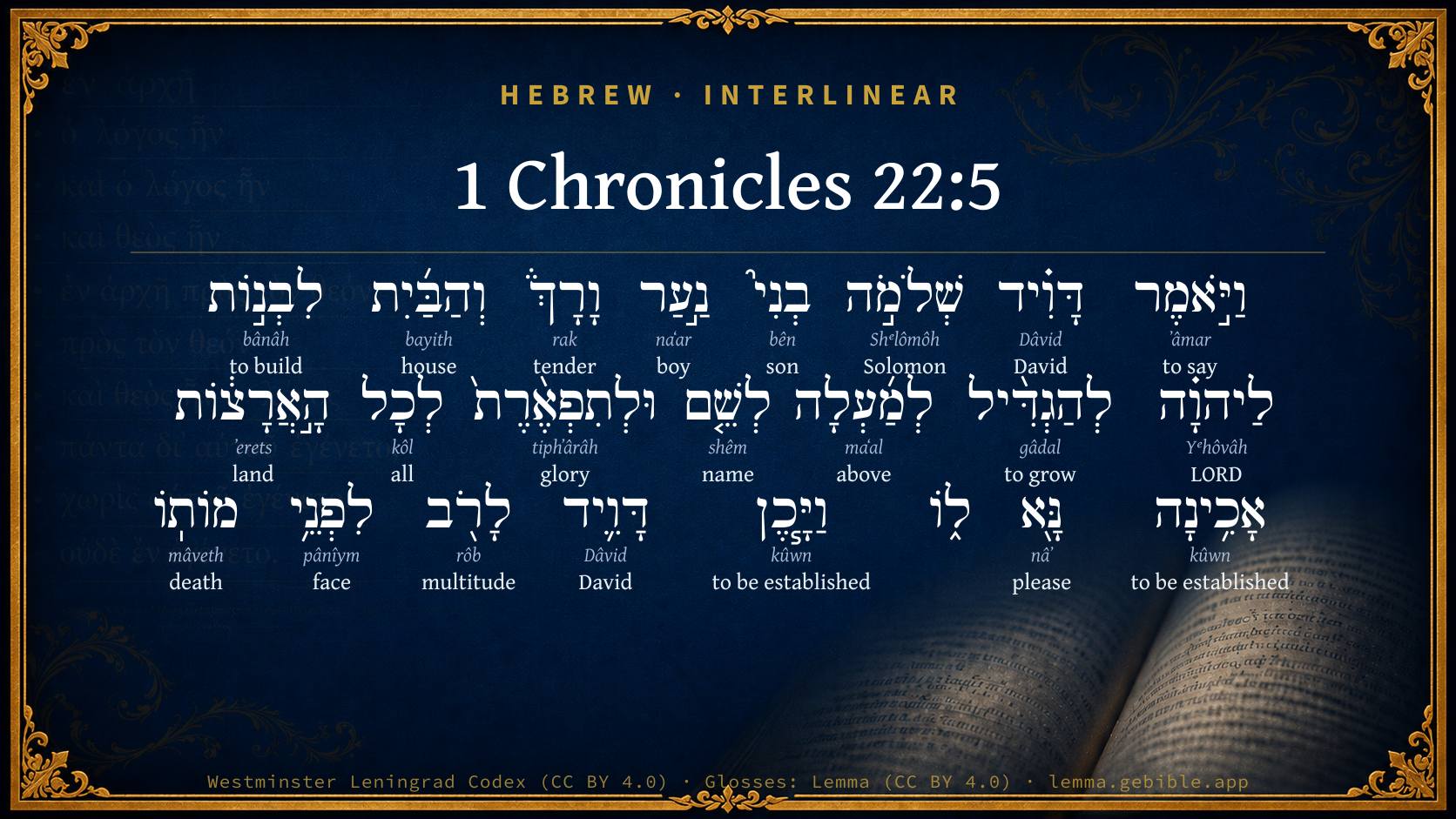
Hebrew (Westminster Leningrad Codex) 1 Chronicles 22:5 appears in the Hebrew Old Testament. The text above is from the Westminster Leningrad Codex. Each word links to its Strong’s number, a concise gloss, and parsing drawn from the Open Scriptures Hebrew Bible morphology. Click any word for its full Brown-Driver-Briggs (BDB) entry.
Download image
Cite this verse

1 Chronicles 22:5 (World English Bible). Public Domain. Lemma interlinear Bible study tool, https://lemma.gebible.app/v/1-chronicles/22/5.

Show BibTeX & RIS
BibTeX
RIS
English Translation
David said, Solomon my son is young and tender, and the house that is to be built for Yahweh must be exceedingly magnificent, of fame and of glory throughout all countries: I will therefore make preparation for it. So David prepared abundantly before his death.
World English Bible · Public Domain
Download a study sheet

One document with this verse’s original text, its word-by-word gloss line, the meaning frame, cross-references with their text, attributed commentary, and full source and license credits — printable, and it pastes into notes with its structure intact.

This verse Autodidact and up

Study sheet (.html) Plain text (.txt)

A passage Seminary Student

Up to 50 verses in one chapter. A passage sheet keeps up to 6 commentary sources and 12 cross-references per verse, in the order this page ranks them, and says so on the sheet whenever that leaves anything out. Ask for a single verse and you get the Autodidact verse sheet above.

Everything on this page stays free to read, with no account — the sheet is a download of what is already on screen, not access to it.

Want to remove ads? Support Godless Engineer
Compare translations 3

The same verse in 3 English versions, stacked beneath the original-language interlinear above. Click any original word for its lexicon entry.

Each is an independent rendering of the whole verse — the interlinear is not word-aligned to these translations.

Highlighted words mark where these versions differ — a whole-verse word diff, not a word-by-word alignment.

  • World English Bible Public Domain
    David said, Solomon my son is young and tender, and the house that is to be built for Yahweh must be exceedingly magnificent, of fame and of glory throughout all countries: I will therefore make preparation for it. So David prepared abundantly before his death.
  • King James Version Public Domain
    And David said, Solomon my son is young and tender, and the house that is to be builded for the LORD must be exceeding magnificent, of fame and of glory throughout all countries: I will therefore now make preparation for it. So David prepared abundantly before his death.
  • unfoldingWord Literal Text CC BY-SA 4.0
    And David said, “Solomon my son is a young man and tender, and the house to build for Yahweh is to make great for the sake of the name and for beauty in all of the lands. Let me now prepare for it.” And David prepared to abundance to the face of his death.

unfoldingWord Literal Text — © unfoldingWord, licensed CC BY-SA 4.0. Word-aligned USFM3 via Door43 (git.door43.org/unfoldingWord/en_ult).

Versions to compare (up to 4)

3 of 4 selected

Show all 18 translations

Every available English version of this verse, each an independent rendering of the whole verse.

  • World English Bible Public Domain
    David said, Solomon my son is young and tender, and the house that is to be built for Yahweh must be exceedingly magnificent, of fame and of glory throughout all countries: I will therefore make preparation for it. So David prepared abundantly before his death.
  • Berean Standard Bible Public Domain
    And David said, “My son Solomon is young and inexperienced, and the house to be built for the LORD must be exceedingly magnificent—famous and glorious throughout all lands. Therefore I must make preparations for it.” So David made lavish preparations before his death.
  • Majority Standard Bible Public Domain
    And David said, “My son Solomon is young and inexperienced, and the house to be built for the LORD must be exceedingly magnificent—famous and glorious throughout all lands. Therefore I must make preparations for it.” So David made lavish preparations before his death.
  • King James Version Public Domain
    And David said, Solomon my son is young and tender, and the house that is to be builded for the LORD must be exceeding magnificent, of fame and of glory throughout all countries: I will therefore now make preparation for it. So David prepared abundantly before his death.
  • American Standard Version (1901) Public Domain
    And David said, Solomon my son is young and tender, and the house that is to be builded for Jehovah must be exceeding magnificent, of fame and of glory throughout all countries: I will therefore make preparation for it. So David prepared abundantly before his death.
  • Revised Version (1885) Public Domain
    And David said, Solomon my son is young and tender, and the house that is to be builded for the LORD must be exceeding magnifical, of fame and of glory throughout all countries: I will therefore make preparation for it. So David prepared abundantly before his death.
  • Geneva Bible (1599) Public Domain
    And Dauid saide, Salomon my sonne is yong and tender, and we must builde an house for the Lord, magnificall, excellent and of great fame and dignitie throughout all countreyes. I will therefore nowe prepare for him. So Dauid prepared very much before his death.
  • Douay-Rheims (1899) Public Domain
    And David said: Solomon my son is very young and tender, and the house which I would have to be built to the Lord, must be such as to be renowned in all countries: therefore I will prepare him necessaries. And therefore before his death he prepared all the charges.
  • Young's Literal Translation Public Domain
    And David saith, `Solomon my son `is' a youth and tender, and the house to be built to Jehovah `is' to be made exceedingly great, for name and for beauty to all the lands; let me prepare, I pray Thee, for it;' and David prepareth in abundance before his death.
  • Literal Standard Version CC BY-SA 4.0
    And David says, “My son Solomon [is] a youth and tender, and the house to be built for YHWH [is] to be made exceedingly great, for renown and for beauty to all the lands; now let me prepare for it”; and David prepares in abundance before his death.
  • Unlocked Literal Bible CC BY-SA 4.0
    David said, “My son Solomon is young and inexperienced, and the house that is to be built for Yahweh must be especially magnificent, so that it will be famous and glorious in all other lands. So I will prepare for its building.” So David made extensive preparations before his death.
  • unfoldingWord Literal Text CC BY-SA 4.0
    And David said, “Solomon my son is a young man and tender, and the house to build for Yahweh is to make great for the sake of the name and for beauty in all of the lands. Let me now prepare for it.” And David prepared to abundance to the face of his death.
  • Darby Bible Public Domain
    For David said, Solomon my son is young and tender, and the house that is to be built for Jehovah must be exceeding great in fame and in beauty in all lands: I will therefore make preparation for it. And David prepared abundantly before his death.
  • World Messianic Bible Public Domain
    David said, “Solomon my son is young and tender, and the house that is to be built for the LORD must be exceedingly magnificent, of fame and of glory throughout all countries. I will therefore make preparation for it.” So David prepared abundantly before his death.
  • Webster's Bible Public Domain
    And David said, Solomon my son is young and tender, and the house that is to be built for the LORD must be very magnificent, of fame and of glory throughout all countries: I will therefore now make preparation for it. So David made abundant preparation before his death.
  • Free Bible Version CC BY-SA 4.0
    David said to himself, “My son Solomon is still young and inexperienced, and the house that is to be built for the Lord must be truly magnificent, famous and glorious around the world. I need to start preparing for it.” So David made sure plenty of building materials were ready before he died.
  • Bible in Basic English Public Domain
    And David said, Solomon my son is young and untested, and the house which is to be put up for the Lord is to be very great, a thing of wonder and glory through all countries; so I will make ready what is needed for it. So David got ready a great store of material before his death.
  • JPS Tanakh (1917) Public Domain
    And David said: 'Solomon my son is young and tender, and the house that is to be builded for the LORD must be exceeding magnificent, of fame and of glory throughout all countries; I will therefore make preparation for him.' So David prepared abundantly before his death.

Literal Standard Version (2020), Covenant Press — licensed CC BY-SA 4.0. Text via the HelloAO Bible API (eBible.org). Unlocked Literal Bible (unfoldingWord) — licensed CC BY-SA 4.0. Text via the HelloAO Bible API (eBible.org). unfoldingWord Literal Text — © unfoldingWord, licensed CC BY-SA 4.0. Word-aligned USFM3 via Door43 (git.door43.org/unfoldingWord/en_ult). Free Bible Version, Dr. Jonathan Gallagher — licensed CC BY-SA 4.0. Text via the HelloAO Bible API (eBible.org).

Word by word

More ways to search: Search by grammar → Find every occurrence → Compare this word →

Practice this passage: Drill this verse → Learn its vocabulary →

וָרָךְ֒
rak
H7390
“and · tender”
Conjunction + Adjective, Adjective, Masculine, Singular, Absolute
Part of Speech
Conjunction + Adjective
Type
Adjective
Gender
Masculine
Number
Singular
State
Absolute
Full BDB Definition

Origin: from H7401

TWOT: 2164a

tender, soft, delicate, weak - tender, delicate (of flesh) - weak of heart, timid - soft (of words) - gentle words (substantive)
  1. וַיֹּ֣אמֶר ʼâmar H559 “and · to say” Conjunction + Verb, Qal, Sequential Imperfect, 3rd Person, Masculine, Singular
  2. דָּוִ֗יד Dâvid H1732 “David” Noun, Proper
  3. שְׁלֹמֹ֣ה Shᵉlômôh H8010 “Solomon” Noun, Proper
  4. בְנִי֮ bên H1121 “son · my” Noun, Common, Masculine, Singular, Construct + Suffix, Personal, 1st Person, Common, Singular
  5. נַ֣עַר naʻar H5288 “boy” Noun, Common, Masculine, Singular, Absolute
  6. וְהַבַּ֜יִת bayith H1004 “and · the · house” Conjunction + Particle, Definite Article + Noun, Common, Masculine, Singular, Absolute
  7. לִבְנ֣וֹת bânâh H1129 “to build” Preposition + Verb, Qal, Infinitive Construct
  8. לַיהוָ֗ה Yᵉhôvâh H3068 “to/for · LORD” Preposition + Noun, Proper
  9. לְהַגְדִּ֨יל gâdal H1431 “to grow” Preposition + Verb, Hiphil, Infinitive Construct
  10. לְמַ֜עְלָה maʻal H4605 “to/for · above · toward” Preposition + Adverb + Suffix, Demonstrative
  11. לְשֵׁ֤ם shêm H8034 “to/for · name” Preposition + Noun, Common, Masculine, Singular, Absolute
  12. וּלְתִפְאֶ֨רֶת֙ tiphʼârâh H8597 “and · to/for · glory” Conjunction + Preposition + Noun, Common, Feminine, Singular, Absolute
  13. לְכָל kôl H3605 “to/for · all of” Preposition + Noun, Common, Masculine, Singular, Construct
  14. הָ֣אֲרָצ֔וֹת ʼerets H776 “the · lands” Particle, Definite Article + Noun, Common, Both, Plural, Absolute
  15. אָכִ֥ינָה kûwn H3559 “to be established” Verb, Hiphil, Cohortative, 1st Person, Common, Singular
  16. נָּ֖א nâʼ H4994 “please” Particle, Interjection
  17. וַיָּ֧כֶן kûwn H3559 “and · to be established” Conjunction + Verb, Hiphil, Sequential Imperfect, 3rd Person, Masculine, Singular
  18. דָּוִ֛יד Dâvid H1732 “David” Noun, Proper
  19. לָרֹ֖ב rôb H7230 “to/for · multitude” Preposition + Noun, Common, Both, Singular, Absolute
  20. לִפְנֵ֥י pânîym H6440 “to/for · face(s) of” Preposition + Noun, Common, Both, Plural, Construct
  21. מוֹתֽוֹ mâveth H4194 “death · his” Noun, Common, Masculine, Singular, Construct + Suffix, Personal, 3rd Person, Masculine, Singular

About this verse

These counts appear in no published source. They are computed here, from the morphology-tagged text and Lemma’s own curated glosses. What Lemma adds →

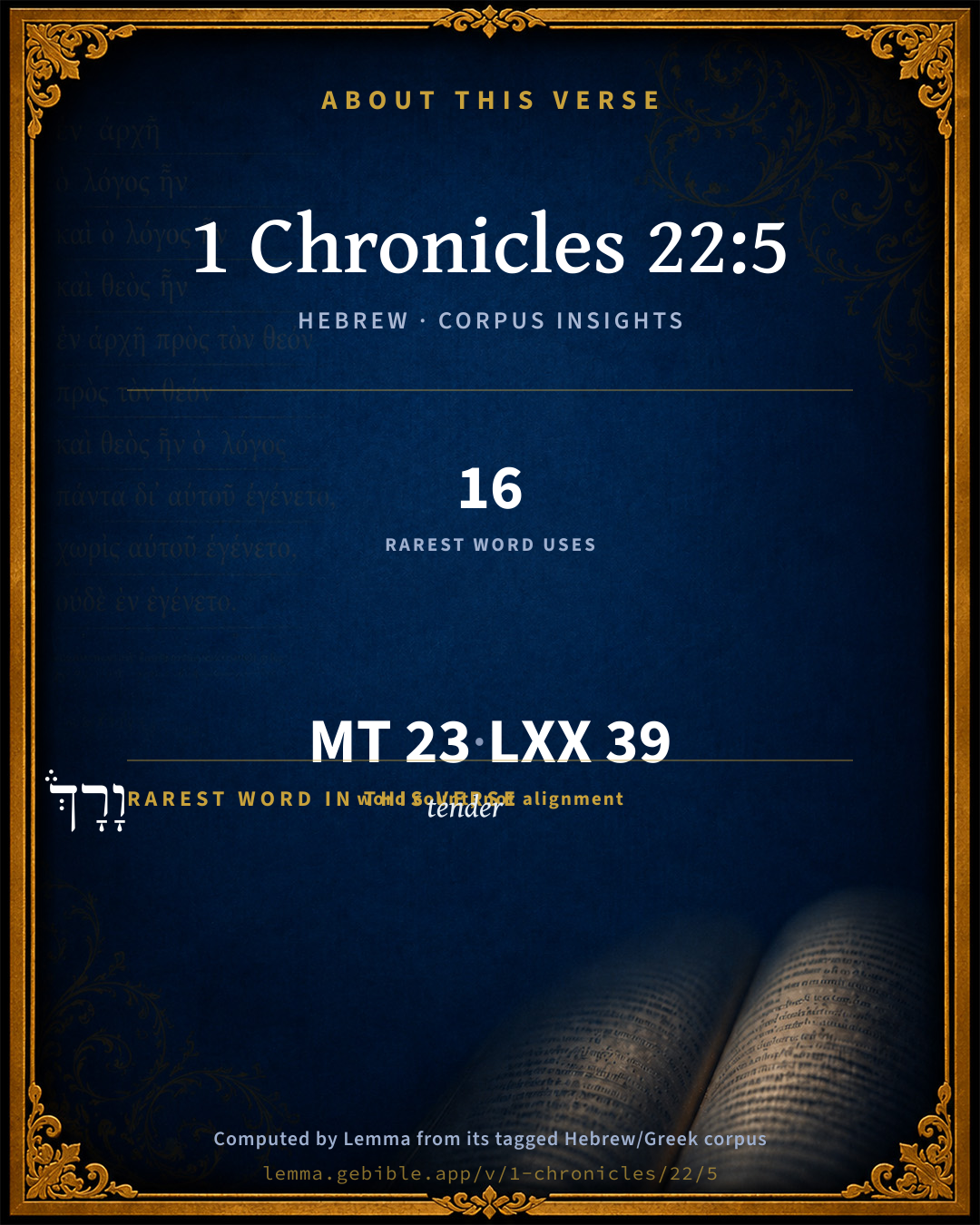
23
words
20
distinct lemmas
Historical
section

Notable vocabulary

The rarest word here is וָרָךְ֒ tender H7390 — appearing just 16 times in the whole Hebrew Bible.

Shared distinctive vocabulary

וָרָךְ֒ tender H7390 occurs in 16 verses of the Hebrew Bible. Also found in:

Grammatical profile

  • 5 verbs
  • 14 nouns
  • 1 adjective
  • 1 preposition
  • 1 adverb
  • 1 particle

Verb forms

  • וַיֹּ֣אמֶר Qal · Sequential Imperfect
  • לִבְנ֣וֹת Qal · Infinitive Construct
  • לְהַגְדִּ֨יל Hiphil · Infinitive Construct
  • אָכִ֥ינָה Hiphil · Cohortative
  • וַיָּ֧כֶן Hiphil · Sequential Imperfect

Repetition

Words recur within this verse — often emphatic in Hebrew:

  • דָּוִ֗יד David H1732 ×2
  • אָכִ֥ינָה to be established H3559 ×2

Hebrew & Septuagint length

In English translation the verse runs 45 words from the Hebrew and 48 from the Septuagint (LXX English) — closely comparable.

A rough comparison of the two English renderings, which tokenize alike — not a word-level alignment.

Word counts can differ between the Hebrew and the Greek without any difference in meaning — e.g. the Hebrew direct-object marker אֵת has no separate Greek word, and Greek often adds the article ὁ.

In the original languages it is 23 Hebrew tokens and 39 Greek tokens — but the two are counted differently (Hebrew bundles its prefixes and suffixes into one token; the Greek is in lemma form), so that isn’t a like-for-like length.

Cross-references

19

Topical passages linked to 1 Chronicles 22:5 in the Treasury of Scripture Knowledge — connected by theme and wording, ordered by reader-vote popularity; previews shown in the World English Bible.

  • 1 Kings 3:7 Now, Yahweh my God, you have made your servant king instead of David my father: and I am but a little child; I don't know how to go out or come in.
  • 1 Chronicles 29:1 David the king said to all the assembly, Solomon my son, whom alone God has chosen, is yet young and tender, and the work is great; for the palace is not for man, but for Yahweh God.
  • John 3:30 He must increase, but I must decrease.
  • John 13:1 Now before the feast of the Passover, Jesus knowing that his time had come that he would depart from this world to the Father, having loved his own who were in the world, he loved them to the end.
  • Deuteronomy 31:2–7 He said to them, I am one hundred twenty years old this day; I can no more go out and come in: and Yahweh has said to me, You shall not go over this Jordan.
  • 1 Kings 9:8 Though this house is so high, yet shall everyone who passes by it be astonished, and shall hiss; and they shall say, Why has Yahweh done thus to this land, and to this house?
  • 2 Chronicles 2:5 The house which I build is great; for great is our God above all gods.
  • 2 Chronicles 7:21 This house, which is so high, everyone who passes by it shall be astonished, and shall say, Why has Yahweh done thus to this land, and to this house?
  • 2 Chronicles 13:7 There were gathered to him worthless men, base fellows, who strengthened themselves against Rehoboam the son of Solomon, when Rehoboam was young and tender-hearted, and could not withstand them.
  • Ezra 3:12 But many of the priests and Levites and heads of fathers' [houses], the old men who had seen the first house, when the foundation of this house was laid before their eyes, wept with a loud voice; and many shouted aloud for joy:
  • Ecclesiastes 9:10 Whatever your hand finds to do, do it with your might; for there is no work, nor device, nor knowledge, nor wisdom, in Sheol, where you are going.
  • Isaiah 64:11 Our holy and our beautiful house, where our fathers praised you, is burned with fire; and all our pleasant places are laid waste.
  • Ezekiel 7:20 As for the beauty of his ornament, he set it in majesty; but they made the images of their abominations [and] their detestable things therein: therefore have I made it to them as an unclean thing.
  • Haggai 2:3 'Who is left among you who saw this house in its former glory? How do you see it now? Isn't it in your eyes as nothing?
  • Haggai 2:9 'The latter glory of this house will be greater than the former,' says Yahweh of Hosts; 'and in this place will I give peace,' says Yahweh of Hosts."
  • Luke 21:5 As some were talking about the temple and how it was decorated with beautiful stones and gifts, he said,
  • John 4:37–38 For in this the saying is true, 'One sows, and another reaps.'
  • John 9:4 I must work the works of him who sent me, while it is day. The night is coming, when no one can work.
  • 2 Peter 1:13–15 I think it right, as long as I am in this tent, to stir you up by reminding you;

Cross-references courtesy of OpenBible.info (CC BY 4.0).

Hebrew and Greek witnesses Masoretic Hebrew ↔ Greek Septuagint

The same verse in the two great witnesses to the Old Testament, shown verse-for-verse.

These are two independent witnesses, not word-aligned to each other, and the Septuagint is shown in lemma (dictionary) form.

Hebrew 1 Chronicles 22:5 Masoretic · Westminster Leningrad Codex

וַיֹּ֣אמֶר דָּוִ֗יד שְׁלֹמֹ֣ה בְנִי֮ נַ֣עַר וָרָךְ֒ וְהַבַּ֜יִת לִבְנ֣וֹת לַיהוָ֗ה לְהַגְדִּ֨יל לְמַ֜עְלָה לְשֵׁ֤ם וּלְתִפְאֶ֨רֶת֙ לְכָל הָ֣אֲרָצ֔וֹת אָכִ֥ינָה נָּ֖א ל֑וֹ וַיָּ֧כֶן דָּוִ֛יד לָרֹ֖ב לִפְנֵ֥י מוֹתֽוֹ

David said, Solomon my son is young and tender, and the house that is to be built for Yahweh must be exceedingly magnificent, of fame and of glory throughout all countries: I will therefore make preparation for it. So David prepared abundantly before his death.

World English Bible · Public Domain

Greek LXX 1 Chronicles 22:5 Septuagint · lemma form

καί εἶπον δαυίδ σαλωμών ὁ υἱός ἐγώ παιδάριον ἁπαλός καί ὁ οἶκος ὁ οἰκοδομέω ὁ κύριος εἰς μεγαλωσύνη ἄνω εἰς ὄνομα καί εἰς δόξα εἰς πᾶς ὁ γῆ ἑτοιμάζω αὐτός καί ἑτοιμάζω δαυίδ εἰς πλῆθος ἔμπροσθεν ὁ τελευτή αὐτός

And David said, My son Solomon is a tender child, and the house for me to build to the Lord is for superior magnificence for a name and for a glory through all the earth: I will make preparation for it. And David prepared abundantly before his death.

LXX2012 (modern English Septuagint) · Public Domain

Hebrew: Westminster Leningrad Codex (CC BY 4.0). Greek: Septuagint (public domain); English from LXX2012 (modern English Septuagint) (Public Domain). How the Septuagint differs from the Hebrew →

Commentary

Notes on 1 Chronicles 22:5 from classic Christian and Jewish commentators (each source and its license shown beneath its notes). The classic Christian expositions comment on the surrounding passage and are grouped to its opening verse, so a note may address several verses; the Jewish commentaries on the Tanakh (Rashi and others) are per-verse, so they appear only where the commentator wrote on this verse.

Lemma curates 59 commentaries, every one of them public domain or Creative Commons licensed, each selected and text-cleaned for this edition rather than reprinted as found. About our sources →

Trapp's Complete Commentary

John Trapp

1Ch 22:5 And David said, Solomon my son [is] young and tender, and the house [that is] to be builded for the LORD [must be] exceeding magnifical, of fame and of glory throughout all countries: I will [therefore] now make preparation for it. So David prepared abundantly before his death.

Ver. 5. Must be exceeding magniflcal.] Heb., To make great; to be above: Magnificentissimum, et excellentissimum, et nominatissimum, Vat. The second temple was nothing like it, though the glory of it was far greater, {Hag 2:3; Hag 2:9} by the presence and preaching of Jesus Christ in it.

John Trapp, A Commentary or Exposition upon All the Books of the Old and New Testament (1647–1656) — public domain. Text from a community e-Sword module.

The Biblical Illustrator

Joseph S. Exell

1Ch_22:5

And David said, Solomon my son is young.

The ideal temple

I. The motive which set David to work in preparing for building the temple. This motive was thankfulness for a great mercy--Gods mercy in arresting the pestilence. God sends us deliverances from earthly calamities, not merely, not chiefly, that we may be delivered, but that our hearts may rise in thankfulness to Him. The soul gains more by the effort of thankfulness than the body has gained by deliverance from the physical mischief. The deliverance without the thankfulness is a sheer failure, baulking the providential purposes of God. Life would be brighter and stronger if each mercy were the occasion of a resolution to do some piece of good work for God.

II. The high estimate david had formed of what he had set himself to do: Exceeding magnifical, etc. He felt that a great effort was due, first of all to God Himself, as being what He is, and next, for the sake of those who did not know Him--the surrounding heathen peoples, who must not think meanly of what Gods servants thought to be due to His service. If anything is fatal to greatness in human endeavour, in act, in work, in character, it is a stunted estimate of what we have to do. The artist who has no ideal before him, or only a poor and meagre ideal, cannot hope to succeed. It is so with all forms of external enterprise. It is so with the formation of character. If we set out by saying that it is impossible to attain to anything great or noble, most certainly we never shall attain to it. We must make up our minds that the house of the Lord, whether it be material or spiritual, must be exceeding magnifical. No honest student of Davids Psalms can maintain that he was ignorant of the true meaning of spiritual worship; or that he thought more of the things of sense than of the action of the soul in its approach to the Holy One; but his spirituality was not of that unwise kind which imperils the very existence of religion among men by doing away with all the outward symbols of its presence. Worship will not be the less spiritual when man has done his very uttermost in his poor way to express in outward and material structure his sense of the unapproachable magnificence of God.

III. The great distinction of Davids work of preparation for the temple is its unselfishness. One of the sternest lessons a man learns with advancing life is the disabling power of sin. Long after we have sincerely repented of sin it haunts us with its double legacy of a dimmed moral eyesight and of an enfeebled will; and even where these effects do not follow, as in Davids case they did not follow, sin remains with us as a memory which tells us when we would attempt something beyond the work of other men, something heroic, something sublime, something that belongs to the career of the saints, that, other matters apart, we are not the men to do it. The discovery that he would not be allowed to express his devotion in one supreme effort must have caused David a shock which we may not easily take measure of. But David did not think of the temple as having to be built either for his own glory or for Solomons glory, but for the glory of God. And so David prepared for it with all his heart.

IV. Davids preparation points to a great truth--the preciousness of work unrecognised by man. David does the work, Solomon is decorated with the reputation. Almost every discovery in science has been led up to by forgotten workers. The discoverer, who, after all, has only taken the last step in a long process, lives in history. A minister rises in his place in Parliament to make a statement which astonishes us by its familiarity with the details of a vast and intricate subject; but while the country is ringing with his praises the fact is that the knowledge which so astonishes England has been brought together by the patient toil of the permanent staff of the department, the toil of clerks whose names are, perhaps, unknown beyond their own families. Much more is this the case with the best work in the Church of Jesus Christ. (Canon Liddon.)

The inspiration of a lofty ideal

We expend our strength according to the ideals which it is our purpose to realise. The man who has not a high ideal of his work will be content with indifference, and with doing as little as possible. How profitable it would be if every young life could say at the beginning of its career, My life is to be exceeding magnifical: it is to be a life of intelligence, purity, beneficence, holy activity in all blessed service: I will now make preparation for it. What school-going we should then have! What attentive reading of initial books! What an eager sympathy with the purpose of every tutor! How little we should then make of difficulties! The work of preparation would be done under the consciousness that the temple was already built. (J. Parker, D. D.)

David and the temple

A fine and delicate sense of the becoming hindered David from building the temple. A voice within him had whispered, No: however right and praiseworthy the idea, you are hardly the man to carry it out. Your hands are too stained with blood. When the Divine word came, simply interdicting, it awoke in him at once a Divine perception of the reason and reasonableness of it; and the God-taught, God-chastened spirit within him made him see at once why the work of enshrining the ark, the ark of the holy and awful presence, must not he his.

I. Consider the remarkable self-restraint displayed by david. He who had lived much in camps and on the battlefield, whose will was law through the length and breadth of the land--he could stay himself from prosecuting his daring scheme with the thought of incongruity.

II. The self-restraint of David reveals the intense reality which god was to him, as well as the impression which he had of the character of God. How pure and lofty would be his conception of the almighty Ruler when it struck him as altogether inappropriate and inconsistent that a shrine should be built for Him by one who had been engaged, however patriotically and for the interests of his country, in shedding much human blood.

1. The picture indicates that, although a man of war from his youth, David had never been proud of fighting. He had had dreams perhaps in his fathers fields of quite another sort of career for himself, and could see something far more attractive and desirable; it was not his ideal life; but it was what his lot had rendered inevitable for him and incumbent on him; it was what he had to do, and he did it.

2. Then, ones more, observe revealed here the remarkable preservation of Davids higher sensibilities. Neither the tumult and strife of years of warfare, nor the elation of successes gained by bow and spear, had prevailed to coarsen him, to render him gross and dull of soul. He emerges from it all, on the contrary, sensitive enough to answer readily to the whispered suggestions of seemliness, to be restrained and turned back upon the threshold of a coveted enterprise by a sense of the becoming.

3. Although precluded from doing what he had purposed and wished to do, he did not, as is the case with many, make that an excuse for doing nothing; did not, therefore, sulkily fold his hands, and decline to see what there was that he might do.

4. Then see how his true thought and noble aim survived him, and survived him to be ultimately realised. The temple grew and rose at last in all its wonderful splendour, though he was not there to behold it. (S. A. Tipple.)

Working up to death

We should work up to the very moment of our death. Our last breath should, if possible, help some other man to pray better, or to work more, or suffer with a firmer constancy. Let no man suppose that the world stands still because he dies. God has always a temple to build, and He will always raise up the builders of it, and yet it pleases Him in His condescension to receive our assistance in preparation. (J. Parker, D. D.)

The Biblical Illustrator, edited by Joseph S. Exell (c. 1880s–1900s) — public domain. Text from a community e-Sword module.

Joseph Benson's Commentary

1Ch 22:5. So David prepared abundantly — And with good reason, because it was intended for the honour of the great God, and was to be a type of Christ, in whom all fulness dwells, and in whom are hid all treasures.

Joseph Benson's Commentary on the Old and New Testaments (1811–1818) — public domain. Text from a community e-Sword module.

Tyndale Open Study Notes

Tyndale Open Resources

22:5 While Solomon was young and inexperienced (see also 29:1; cp. 1 Kgs 3:7; 2 Chr 13:7), David had the wisdom and skill to make preparations for building the Temple; David also designed the Temple (1 Chr 28:11-12). Later, God provided Solomon with the wisdom he needed to build the Temple and to govern well (see 2 Chr 1:7-12).

Tyndale Open Study Notes — © Tyndale Open Resources, licensed CC BY-SA 4.0. Text via the HelloAO Bible API.

Ellicott's Commentary for English Readers

(5) Solomon my son is young and tender—i.e., an inexperienced young man. David repeats the expression (1Ch_29:1); and it is applied to Rehoboam (2Ch_13:7) at the age of forty-one. The word here rendered “young,” literally, “youth” (na’ar), is even more vague than the Latin adolescens. It may mean a new-born babe (Exo_2:6), a young child (Isa_7:16; Isa_8:4), a youth (Isa_3:5; 1Sa_17:55), or a man in the prime of life (1Sa_30:17; Exo_33:11). Solomon calls himself “a young child” (na‘ar qâtôn) even after his accession to the throne (1Ki_3:7), though he was born soon after the time of the Syro-Ammonite war (2Sa_12:24).

Tender.—Timid (Deu_20:8).

The house that is to be builded . . . exceeding magnifical.—Literally, the house to build . . . (one is) to make great exceedingly. For the infinitival construction, comp. 1Ch_5:1; 1Ch_13:4; 1Ch_9:25; 1Ch_15:2.

Exceeding.—Literally, unto height, upwards; an adverbial expression, which frequently occurs in the Chronicles. (See 1Ch_14:2 : “On high.”)

Of fame and of glory throughout all countries.—Literally, for a name and for a glory (tiph’ereth) for all the lands. (Comp. Isa_2:3; Isa_60:3, et seq., Isa_62:2-3.) In similar terms the famous Assyrian Sennacherib (Sin-ahi-irba) speaks of his palace as built “for the lodging (taprati) of multitudes of men.” And of his temple of Nergal he says: “The house of Nergal, within the city of Tarbiçu, I caused to be made, and like day I caused it to shine” (usnammir).

I will therefore now make preparation for it.—Literally, Let me now prepare for him—the expression of an earnest desire, and self-encouragement to an arduous task, rather than of mere resolve.

We need not suppose that the verse relates to any actual utterance of David’s. It is not said when nor to whom he spoke. The historian is merely representing the king’s motive for these preparations. “To say” in Hebrew often means to think, by an elliptic construction. (Comp. Exo_2:14 with Gen_17:17.)

So David prepared.—It is strange, but instructive, to remember that there have been critics so destitute of the historical faculty as to allege that “the whole episode about David’s preparations is a fiction of the chronist’s” (Gramberg), because the Books of Samuel and Kings are silent on the subject.

A Bible Commentary for English Readers, edited by Charles John Ellicott (1878–1897) — public domain. Text from a community e-Sword module.

The Cambridge Bible for Schools and Colleges

gen. ed. J. J. S. Perowne

5. exceeding magnifical] The Temple took seven years in building, and it was richly overlaid with gold, but its proportions were small, viz., about 90 ft. × 45 ft. × 30 ft. Some have regarded it as merely the king’s private chapel, but its small proportions do not of themselves prove this view to be correct. In any case the “House” was not intended to contain the congregation; the courts must be large to accommodate those who came up for the three great feasts, but the Temple itself need only be large enough to hold its furniture.

The Cambridge Bible for Schools and Colleges (gen. ed. J. J. S. Perowne; Cambridge University Press, 1878–1918) — public domain. Text from a community e-Sword module.

John Gill's Exposition

And David said, Solomon my son is young and tender,.... Jarchi supposes he was about twelve years of age, though he observes that the same word is used of Joshua when forty two years of age; it is probable Solomon might be now about twenty:

and the house that is to be builded for the Lord must be exceeding magnificent, of fame and of glory throughout all countries: and such was the temple built by Solomon; it was renowned throughout the whole earth; never was there a temple equal to it, no, not the famous temple of Diana at Ephesus, built by the assistance of many kings, and at the expense of all Asia, and was two hundred years in building:

I will therefore now, make preparation for it; seeing his son was so young, and this building to be so magnificent, though he himself was not admitted to build it:

so David prepared abundantly before his death; of which we have an after account in this chapter, and more largely in Ch1 28:1.

John Gill's Exposition of the Whole Bible (1746–1763) — public domain (CC PDM 1.0). Text via the HelloAO Bible API.

Albert Barnes' Notes on the Bible

Young and tender - The exact age of Solomon at this time is uncertain; but it cannot have been more than 24 or 25. It may have been as little as 14 or 15. Compare the 1Ki 2:2 note.

Albert Barnes' Notes on the Bible (1834–1885) — public domain. Text from a community e-Sword/MySword module.

Matthew Poole's English Annotations

David said within himself, or in his own thoughts.

Solomon is young and tender; and therefore, through youthful vanity, and folly, and unsettledness, may not use that care, and consideration, and diligence in making such provisions as this great work requires. Of Solomon’s age, see 1Ki 3:7.

Matthew Poole's English Annotations on the Holy Bible (1683–1685) — public domain. Text from a community e-Sword/MySword module.

Whedon's Commentary on the Bible

Daniel D. Whedon

5. Young and tender — A youth of probably less than twenty years. See on 1Ki_3:7.

Exceeding magnifical, of fame and of glory — Literally, the house to be builded to Jehovah is to be made great to an exceeding extent, for a name and for an ornament to all the lands. David had a most exalted and worthy conception of the grandeur and importance of the temple to be builded. Not only was it to be a most magnificent structure, but it was to magnify Jehovah’s name and praise among the nations. Thus the monarch of Israel breathed the spirit of later prophecies, which foreshadowed the spiritual glory of the Christian temple, and according to which “the mountain of the Lord’s house should be established in the top of the mountains, and exalted above the hills; and all nations flow unto it.” Isa_2:2; Mic_4:1.

Daniel D. Whedon (gen. ed.), Commentary on the Old and New Testaments (1874–1909) — public domain. Text from a community e-Sword module.

The Pulpit Commentary

Solomon is young and tender. It is impossible to fix the exact age of Solomon as marked by these words. In a "fragment" of Eupolemus (see Cory"s "Ancient Fragments of the Phoenician," etc., Writers," edit. London, 1832) he is put down at twelve years of age. Josephus ("Ant. Jud:," 8:7, as vaguely supposes he was fourteen at the time that he took the throne. He was the second son of Bathsheba, and can scarcely have exceeded the last-men-tioned age by mere than three or four years. (yet comp 1Ki_2:2 1Ki_3:1, 1Ki_3:7) This same language, "young and tender," is repeated in 1Ch_29:1. The reign of Solomon lasted forty years (1Ki_11:42; 2Ch_9:30) He is called old (1Ki_11:4) when his strange wives "turned away his heart after other gods." We are not told his age at the time of his death. There are, in fact, no sufficient data for fixing to the year, or indeed within the liberal margin of several years, the age now designated as young and tender.

HOMILIES BY J.R. THOMSON Ver. 5.

Preparation for the temple.

A site having been secured for the house of the Lord, the next thing to be done was to make what preparations were possible in view of the great undertaking. David"s forethought and liberality, as described in this passage, are deserving of our admiration. Not permitted to do the work himself, he was allowed to commence and carry forward preparations for the construction of the temple. The considerations which led to this course of action were

I THE GREATNESS AND GLORY OF THE WORK TO BE EXECUTED. A house for the Lord, the Eternal, whom "the heaven and the heaven of heavens cannot contain," a house which should be "exceeding magnifical," obviously needed vast and prolonged and costly preparation. Masonry, metals, cedar-wood, joinery, all were made ready beforehand by the provident generosity of the king. Thus, when the time came to build, it was found that much was already prepared for the workmen"s hands.

II THE YOUTH AND INEXPERIENCE OF THE PRINCE WHO WAS TO CARRY OUT THE PROJECT. As this was David"s own son, it was natural that a kind consideration of the difficulties of the enterprise committed to him should govern David"s conduct. Great interest gathers round a young monarch, especially if he comes to the throne at a time when great things are expected of him, or when his position is encompassed with difficulties. Solomon was "young and tender," and it was natural and right that his experienced father should take measures to lighten the burden which Providence designed to fall upon the youthful and inexperienced.

III HIS OWN INTEREST IN THE WORK. David would fain have undertaken the great enterprise himself. His mind conceived the purpose which his son was appointed to execute. He sacrificed self, and sank his personal ambition in the great project. Reverence and gratitude to the God to whom he owed so much induced him to acquiesce in the appointment of Divine wisdom, and to further the undertaking, if not in his own way, yet in God"s.

PRACTICAL APPLICATION.

1. The construction of the Lords spiritual temple is a work in which it behoves all Christians to take a deep interest. There groweth "a holy temple unto the Lord." In this temple Christ"s people are not only living stones, they are active builders. They wrong themselves and their Saviour, if they are absorbed in their own petty plans and negligent of this great cause which should excite the attention and sympathy of all.

2. Even though our part in this work be subordinate and unnoticeable, we should not slight the privilege granted us. Our work may be underground work which no one sees, or preparatory work which no one values at its true worth. But if God has assigned it to us, let us count it an honour to work for him.

3. In the service of God we may be fellow-helpers one of another. As David and Solomon wrought in harmony, so should all the builders in the spiritual temple. Sympathy and co-operation distinguish the sanctified activities of the Lord"s servants.

4. Our time for work is short. Death will soon call upon us to lay down the implements of toil. Let us therefore work while it is day, "for the night cometh when no man can work. T.

Right ideas concerning God"s earthly sanctuaries.

David"s language in this verse is striking and suggestive, and it expresses a right feeling in relation to God"s worship, and the places in which his worship is offered. He says, "The house that is to be builded for the Lord must be exceeding magnifical, of fame and of glory throughout all countries." David did not desire a merely grand building, but rather one whose magnificence should be of such a character that it would draw universal attention to Jehovah and magnify his Name. "The temple was to have, as it were, a missionary character and office in proclaiming the Name of the Lord to all nations." The principles illustrated in this sentiment of David"s may be thus dealt with.

I THE DUTY OF CONSERVING SPIRITUAL CONCEPTIONS OF GOD. "God is a Spirit: and they who worship him must worship him in spirit and in truth." The unity and spirituality of God are foundation and essential truths of religion. How jealously they were regarded is indicated by the strong expressions of the two first commandments. We must as anxiously guard them from doctrines or sentiments that imperil them, as Israel must guard them from idolatrous customs. No earthly thing adequately represents God. No earthly figure or image properly fits him. And no earthly dwelling may be thought of as containing him. The omnipresence of Jehovah is beyond our power of apprehension; yet we may conceive of him as coming under no kind of human limitations. Material figures and forms of thought greatly help us, but none can know the Almighty to perfection. In our day of pronounced atheism, it is the. more incumbent on us to witness fully concerning the immaterial and spiritual nature of God. Men may resist our representations and descriptions of God, and find these stumbling-blocks in the way of their conceiving God himself; and therefore we should ever cherish high, mystical, and spiritual thoughts of the great Source of all being.

II THOUGH WE MAY NOT REPRESENT GOD HIMSELF, WE MAY REPRESENT THE SPHERE AROUND HIM. Moses and the elders did not represent the being or person of God himself; only the glory of the "sapphire" round about him. Isaiah did not see him who sat on the throne; only the splendour of the throne, and the attitudes of the attendant courtiers. Heaven is so fully described in the New Testament as the sphere where God dwells, in order to relieve us of distress on account of the impossibility of picturing to us God himself. We see the cloud that shrouds him, and the fire that is an emblem of him; and we are taught to see in the vast blue dome of the sky the abode where he dwells. And being thus fittingly impressed, we are encouraged to argue out the question What must he be, whose "robe is the light, whose canopy space"?

III OUR REPRESENTATIONS SHOULD WORTHILY EXPRESS OUR CONCEPTIONS OF THE DIVINE SURROUNDINGS. This is the ground on which we consecrate architectural genius and artistic skill to the building and the decoration of our sanctuaries. If we may represent the surroundings of God, we must try to represent them worthily. The palace of the great King of kings ought to be "exceeding magnifical." God"s own representation of his surroundings is sublime creation: the blue, star-studded dome of sky; the many-sounding, vast sea; the everlasting mountains; the harvest-laden plains; the million-flowered earth. Our representation in our temples and churches should be the ideal beauty of each age; classic, Gothic, or otherwise, as fits the sentiment of each age. Illustrate what proper moral impressions are produced by our cathedrals, abbeys, and churches towering above the houses of our cities, and made our architectural models. It is a right and true feeling which leads us to build magnificent temples and churches, and to arrange beautiful and artistic services. Yet we must jealously keep the feeling that these are, at best, but suggestions of the "surroundings" of God, and they leave the infinite mystery of God himself wholly unrevealed. R.T.

The Pulpit Commentary (1880–1919), ed. H.D.M. Spence-Jones & Joseph S. Exell — public domain. Text from a community e-Sword module.

John Wesley's Explanatory Notes

Prepared, &c. - And good reason, because it was intended for the honour of the great God, and was to be a type of Christ, in whom all fulness dwells, and in whom are hid all treasures.

John Wesley, Explanatory Notes Upon the Whole Bible (1754–1765) — public domain. Text via the GEBible commentary corpus.

Keil & Delitzsch

C. F. Keil & F. Delitzsch

And David said, Solomon my son is young and tender,.... Jarchi supposes he was about twelve years of age, though he observes that the same word is used of Joshua when forty two years of age; it is probable Solomon might be now about twenty:

and the house that is to be builded for the Lord must be exceeding magnificent, of fame and of glory throughout all countries: and such was the temple built by Solomon; it was renowned throughout the whole earth; never was there a temple equal to it, no, not the famous temple of Diana at Ephesus, built by the assistance of many kings, and at the expense of all Asia, and was two hundred years in building:

I will therefore now, make preparation for it; seeing his son was so young, and this building to be so magnificent, though he himself was not admitted to build it:

so David prepared abundantly before his death; of which we have an after account in this chapter, and more largely in Ch1 28:1.

Keil & Delitzsch — Biblical Commentary on the Old Testament (1861–1891) — public domain (CC PDM 1.0). Text via the HelloAO Bible API. (Old Testament only.)

Rashi

Rabbi Shlomo Yitzchaki (Rashi)

is young and tender נַעַר, because even one [who is] forty-two years old is called נַעַר, for it is written: (Exod. 33:11): “... and his young (נַעַר) servant, Joshua the son of Nun, did not depart, etc.,” for Joshua reigned after Moses only twenty-eight years, and he lived one hundred and ten years. We find (in the first year that the Israelites were in the desert) that Scripture testifies about him: “and Joshua the son of Nun, his young [servant],” and at that time he was forty-two years old. Therefore, it was necessary to write, “tender,” because he [Solomon] was only twelve years old when he reigned.

magnified on high It was very tall, for Solomon raised it up to one hundred and twenty cubits, as it is written: (I Kings 6:3): “And the porch before the Temple of the House, etc.”

Rashi on the Tanakh — English translations: “The Judaica Press complete Tanach with Rashi, translated by A. J. Rosenberg” (CC BY 4.0); “Pentateuch with Rashi's commentary by M. Rosenbaum and A.M. Silbermann, 1929-1934” (public domain); “The Metsudah Tanach series, Lakewood, N.J” (CC BY 4.0); and “The Book of Joshua, Metsudah Publications, 1997” (CC BY 4.0). Text via Sefaria.

Lesson kit

Teaching starters — assembled from the data on this page, not authored interpretation. Every prompt links to the verse data it draws on. Edit before teaching.

1 Chronicles, in the Historical, opens this verse with 23 words (20 distinct Hebrew lemmas). Its most distinctive word is rak (“tender”). A historical commentator’s framing appears above. Read the whole chapter for the surrounding context.

Discussion questions

  1. How does “tender” (rak) shape what this verse is saying?
  2. Genesis 18:7 shares the word «tender» with this verse. How do the two illuminate each other?
  3. “David” occurs 2× in this one verse. What is the effect of the repetition?
  4. The translations on this page render this verse differently — a whole-verse word diff, not a word-by-word alignment. What might account for the different wordings?
  5. The verb «וַיֹּ֣אמֶר» is Qal Sequential Imperfect. How does its form color the action?
  6. Reading how Trapp's Complete Commentary and The Biblical Illustrator read this verse, where do the two commentators agree and where do they part?

Things to notice

Reading settings

Reading text

Shown beneath each verse's original-language words.

Old Testament
Old Testament edition

Read the OT as the Masoretic Hebrew (MT) or the Greek Septuagint (LXX).

English shown for the Greek Septuagint (in the Hebrew ↔ Greek comparison).

Comparing translations? Open the Compare panel on any verse page to stack up to four side by side.