1 Chronicles 22:7

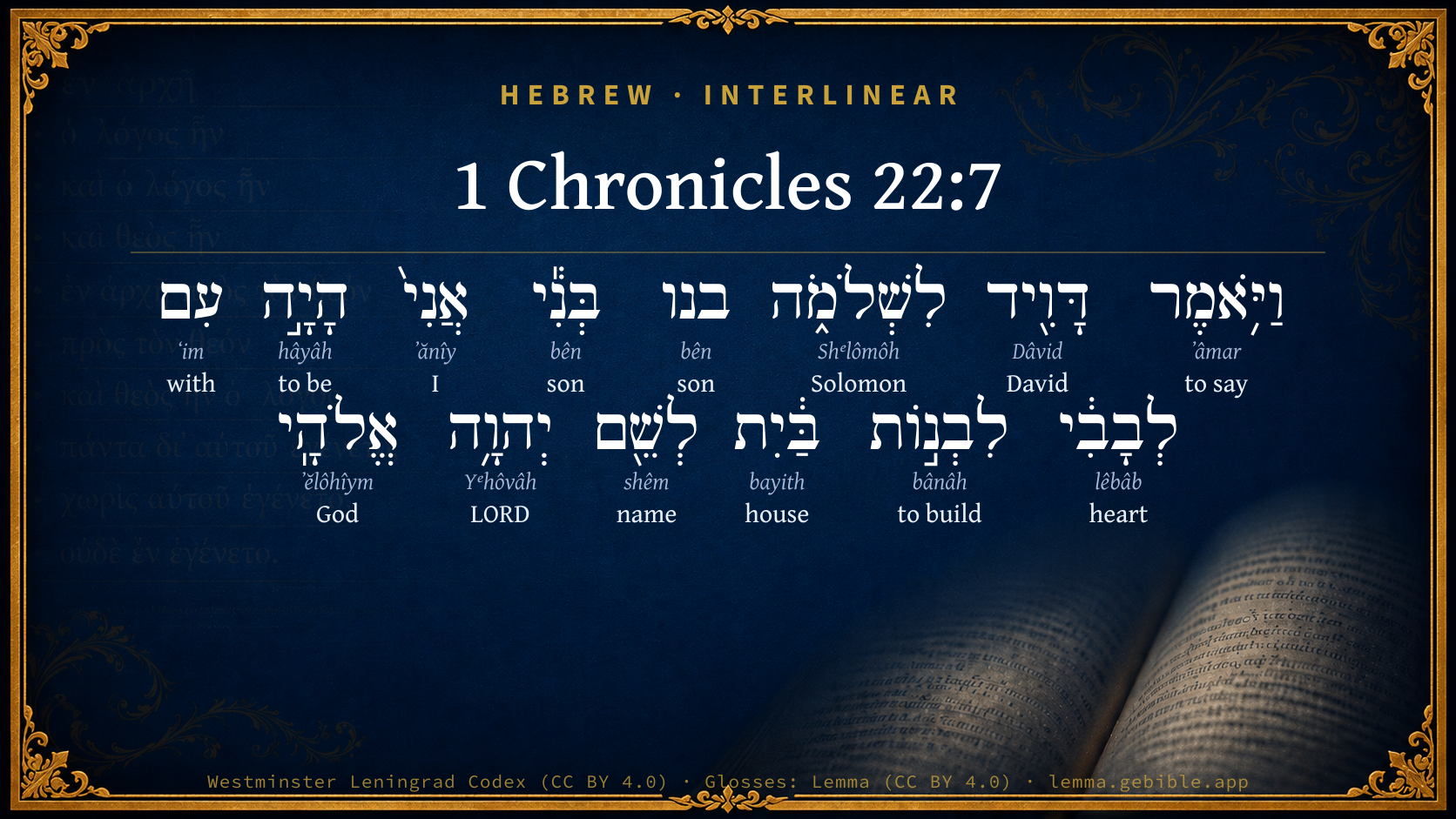
Hebrew (Westminster Leningrad Codex) 1 Chronicles 22:7 appears in the Hebrew Old Testament. The text above is from the Westminster Leningrad Codex. Each word links to its Strong’s number, a concise gloss, and parsing drawn from the Open Scriptures Hebrew Bible morphology. Click any word for its full Brown-Driver-Briggs (BDB) entry.
Download image
Cite this verse

1 Chronicles 22:7 (World English Bible). Public Domain. Lemma interlinear Bible study tool, https://lemma.gebible.app/v/1-chronicles/22/7.

Show BibTeX & RIS
BibTeX
RIS
English Translation
David said to Solomon his son, As for me, it was in my heart to build a house to the name of Yahweh my God.
World English Bible · Public Domain
Download a study sheet

One document with this verse’s original text, its word-by-word gloss line, the meaning frame, cross-references with their text, attributed commentary, and full source and license credits — printable, and it pastes into notes with its structure intact.

This verse Autodidact and up

Study sheet (.html) Plain text (.txt)

A passage Seminary Student

Up to 50 verses in one chapter. A passage sheet keeps up to 6 commentary sources and 12 cross-references per verse, in the order this page ranks them, and says so on the sheet whenever that leaves anything out. Ask for a single verse and you get the Autodidact verse sheet above.

Everything on this page stays free to read, with no account — the sheet is a download of what is already on screen, not access to it.

Want to remove ads? Support Godless Engineer
Compare translations 3

The same verse in 3 English versions, stacked beneath the original-language interlinear above. Click any original word for its lexicon entry.

Each is an independent rendering of the whole verse — the interlinear is not word-aligned to these translations.

Highlighted words mark where these versions differ — a whole-verse word diff, not a word-by-word alignment.

  • World English Bible Public Domain
    David said to Solomon his son, As for me, it was in my heart to build a house to the name of Yahweh my God.
  • King James Version Public Domain
    And David said to Solomon, My son, as for me, it was in my mind to build an house unto the name of the LORD my God:
  • unfoldingWord Literal Text CC BY-SA 4.0
    And David said to Solomon, “My son, I, it was with my heart to build a house for the name of Yahweh my God.

unfoldingWord Literal Text — © unfoldingWord, licensed CC BY-SA 4.0. Word-aligned USFM3 via Door43 (git.door43.org/unfoldingWord/en_ult).

Versions to compare (up to 4)

3 of 4 selected

Show all 18 translations

Every available English version of this verse, each an independent rendering of the whole verse.

  • World English Bible Public Domain
    David said to Solomon his son, As for me, it was in my heart to build a house to the name of Yahweh my God.
  • Berean Standard Bible Public Domain
    “My son,” said David to Solomon, “it was in my heart to build a house for the Name of the LORD my God,
  • Majority Standard Bible Public Domain
    “My son,” said David to Solomon, “it was in my heart to build a house for the Name of the LORD my God,
  • King James Version Public Domain
    And David said to Solomon, My son, as for me, it was in my mind to build an house unto the name of the LORD my God:
  • American Standard Version (1901) Public Domain
    And David said to Solomon his son, As for me, it was in my heart to build a house unto the name of Jehovah my God.
  • Revised Version (1885) Public Domain
    And David said to Solomon his son, As for me, it was in my heart to build an house unto the name of the LORD my God.
  • Geneva Bible (1599) Public Domain
    And Dauid said to Salomon, My sonne, I purposed with my selfe to builde an house to the Name of the Lord my God,
  • Douay-Rheims (1899) Public Domain
    And David said to Solomon: My son, it was my desire to have built a house to the name of the Lord my God.
  • Young's Literal Translation Public Domain
    and David saith to Solomon his son, `As for me, it hath been with my heart to build a house to the name of Jehovah my God,
  • Literal Standard Version CC BY-SA 4.0
    and David says to his son Solomon, “As for me, it has been with my heart to build a house for the Name of my God YHWH,
  • Unlocked Literal Bible CC BY-SA 4.0
    David said to Solomon, “My son, it was my intention to build a house myself, for the name of Yahweh my God.
  • unfoldingWord Literal Text CC BY-SA 4.0
    And David said to Solomon, “My son, I, it was with my heart to build a house for the name of Yahweh my God.
  • Darby Bible Public Domain
    And David said to Solomon, As for me, my son, I was minded to build a house unto the name of Jehovah my God.
  • World Messianic Bible Public Domain
    David said to Solomon his son, “As for me, it was in my heart to build a house to the name of the LORD my God.
  • Webster's Bible Public Domain
    And David said to Solomon, My son, as for me, it was in my mind to build a house to the name of the LORD my God:
  • Free Bible Version CC BY-SA 4.0
    David told Solomon, “My son, I had always wanted to build a house to honor the Lord my God.
  • Bible in Basic English Public Domain
    And David said to Solomon, My son, it was my desire to put up a house for the name of the Lord my God.
  • JPS Tanakh (1917) Public Domain
    And David said to Solomon: 'My son, as for me, it was in my heart to build a house unto the name of the LORD my God.

Literal Standard Version (2020), Covenant Press — licensed CC BY-SA 4.0. Text via the HelloAO Bible API (eBible.org). Unlocked Literal Bible (unfoldingWord) — licensed CC BY-SA 4.0. Text via the HelloAO Bible API (eBible.org). unfoldingWord Literal Text — © unfoldingWord, licensed CC BY-SA 4.0. Word-aligned USFM3 via Door43 (git.door43.org/unfoldingWord/en_ult). Free Bible Version, Dr. Jonathan Gallagher — licensed CC BY-SA 4.0. Text via the HelloAO Bible API (eBible.org).

Word by word

More ways to search: Search by grammar → Find every occurrence → Compare this word →

Practice this passage: Drill this verse → Learn its vocabulary →

לְבָבִ֔י
lêbâb
H3824
“heart · my”
Noun, Common, Masculine, Singular, Construct + Suffix, Personal, 1st Person, Common, Singular
Part of Speech
Noun
Type
Common
Gender
Masculine
Number
Singular
State
Construct
Full BDB Definition

Origin: from H3823

TWOT: 1071a

inner man, mind, will, heart, soul, understanding - inner part, midst - midst (of things) - heart (of man) - soul, heart (of man) - mind, knowledge, thinking, reflection, memory - inclination, resolution, determination (of will) - conscience - heart (of moral character) - as seat of appetites - as seat of emotions and passions - as seat of courage
  1. וַיֹּ֥אמֶר ʼâmar H559 “and · to say” Conjunction + Verb, Qal, Sequential Imperfect, 3rd Person, Masculine, Singular
  2. דָּוִ֖יד Dâvid H1732 “David” Noun, Proper
  3. לִשְׁלֹמֹ֑ה Shᵉlômôh H8010 “to/for · Solomon” Preposition + Noun, Proper
  4. בנו bên H1121 “son · his” Noun, Common, Masculine, Singular, Construct + Suffix, Personal, 3rd Person, Masculine, Singular
  5. בְּנִ֕י bên H1121 “son · my” Noun, Common, Masculine, Singular, Construct + Suffix, Personal, 1st Person, Common, Singular
  6. אֲנִי֙ ʼănîy H589 “I” Pronoun, Personal, 1st Person, Common, Singular
  7. הָיָ֣ה hâyâh H1961 “to be” Verb, Qal, Perfect, 3rd Person, Masculine, Singular
  8. עִם ʻim H5973 “with” Preposition
  9. לִבְנ֣וֹת bânâh H1129 “to build” Preposition + Verb, Qal, Infinitive Construct
  10. בַּ֔יִת bayith H1004 “house” Noun, Common, Masculine, Singular, Absolute
  11. לְשֵׁ֖ם shêm H8034 “to/for · name of” Preposition + Noun, Common, Masculine, Singular, Construct
  12. יְהוָ֥ה Yᵉhôvâh H3068 “LORD” Noun, Proper
  13. אֱלֹהָֽי ʼĕlôhîym H430 “God(s) · my” Noun, Common, Masculine, Plural, Construct + Suffix, Personal, 1st Person, Common, Singular

About this verse

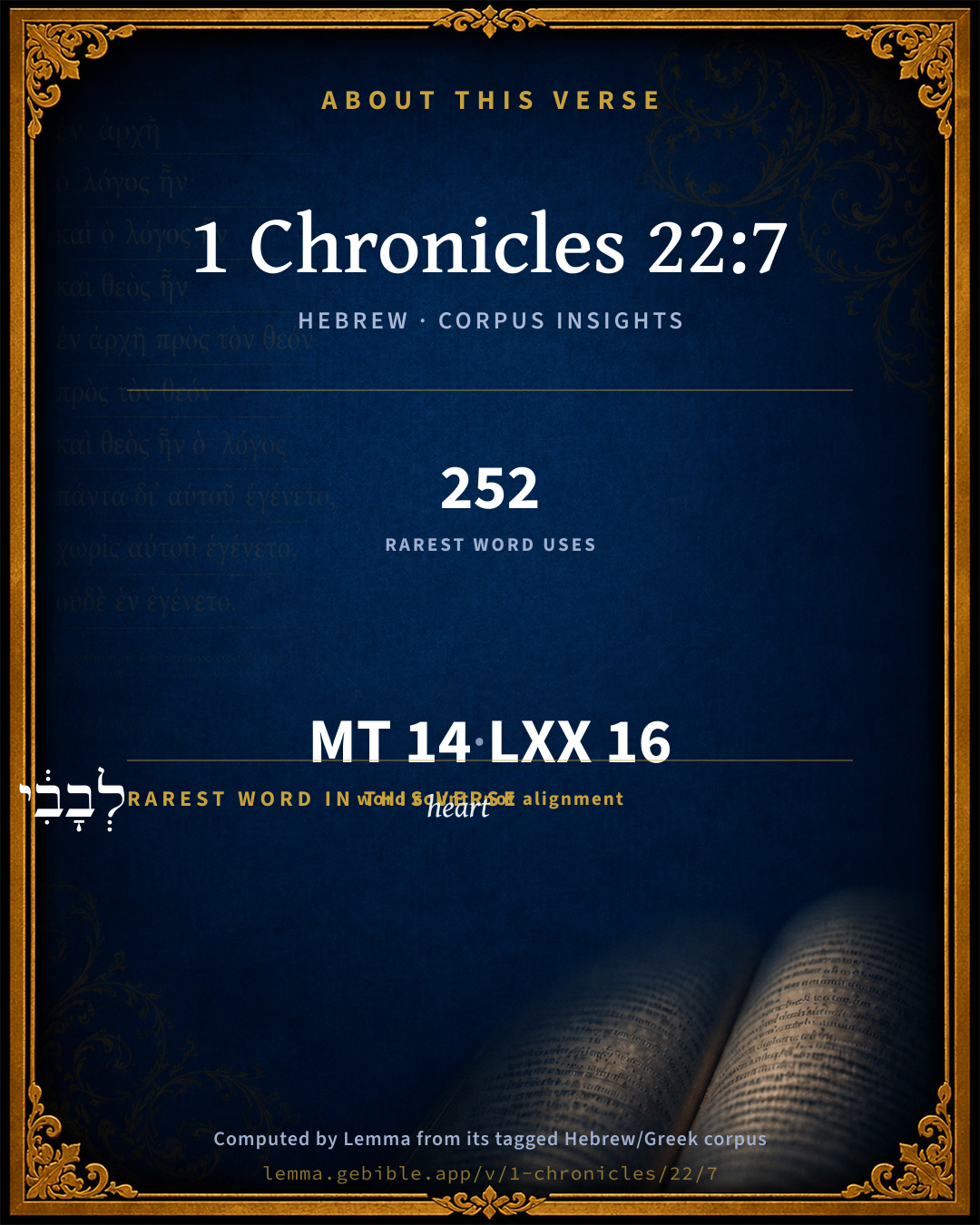
These counts appear in no published source. They are computed here, from the morphology-tagged text and Lemma’s own curated glosses. What Lemma adds →

14
words
13
distinct lemmas
Historical
section

Grammatical profile

  • 3 verbs
  • 9 nouns
  • 1 pronoun
  • 1 preposition

Verb forms

  • וַיֹּ֥אמֶר Qal · Sequential Imperfect
  • הָיָ֣ה Qal · Perfect
  • לִבְנ֣וֹת Qal · Infinitive Construct

Repetition

A word recurs within this verse — often emphatic in Hebrew:

Hebrew & Septuagint length

In English translation the verse runs 25 words from the Hebrew and 23 from the Septuagint (LXX English) — closely comparable.

A rough comparison of the two English renderings, which tokenize alike — not a word-level alignment.

Word counts can differ between the Hebrew and the Greek without any difference in meaning — e.g. the Hebrew direct-object marker אֵת has no separate Greek word, and Greek often adds the article ὁ.

In the original languages it is 14 Hebrew tokens and 16 Greek tokens — but the two are counted differently (Hebrew bundles its prefixes and suffixes into one token; the Greek is in lemma form), so that isn’t a like-for-like length.

Cross-references

14

Topical passages linked to 1 Chronicles 22:7 in the Treasury of Scripture Knowledge — connected by theme and wording, ordered by reader-vote popularity; previews shown in the World English Bible.

  • Psalms 132:5 Until I find out a place for Yahweh, A dwelling for the Mighty One of Jacob."
  • Deuteronomy 12:5 But to the place which Yahweh your God shall choose out of all your tribes, to put his name there, even to his habitation shall you seek, and there you shall come;
  • Deuteronomy 12:11 then it shall happen that to the place which Yahweh your God shall choose, to cause his name to dwell there, there shall you bring all that I command you: your burnt offerings, and your sacrifices, your tithes, and the heave-offering of your hand, and all your choice vows which you vow to Yahweh.
  • 1 Kings 8:16–20 Since the day that I brought forth my people Israel out of Egypt, I chose no city out of all the tribes of Israel to build a house, that my name might be there; but I chose David to be over my people Israel.
  • 2 Chronicles 6:7–9 Now it was in the heart of David my father to build a house for the name of Yahweh, the God of Israel.
  • Deuteronomy 12:21 If the place which Yahweh your God shall choose, to put his name there, be too far from you, then you shall kill of your herd and of your flock, which Yahweh has given you, as I have commanded you; and you may eat within your gates, after all the desire of your soul.
  • 2 Samuel 7:2–3 that the king said to Nathan the prophet, See now, I dwell in a house of cedar, but the ark of God dwells within curtains.
  • 1 Kings 8:29 that your eyes may be open toward this house night and day, even toward the place of which you have said, My name shall be there; to listen to the prayer which your servant shall pray toward this place.
  • 1 Kings 9:3 Yahweh said to him, I have heard your prayer and your supplication, that you have made before me: I have made this house holy, which you have built, to put my name there forever; and my eyes and my heart shall be there perpetually.
  • 1 Chronicles 17:1–15 It happened, when David lived in his house, that David said to Nathan the prophet, Behold, I dwell in a house of cedar, but the ark of the covenant of Yahweh [dwells] under curtains.
  • 1 Chronicles 28:2–21 Then David the king stood up on his feet, and said, Hear me, my brothers, and my people: as for me, it was in my heart to build a house of rest for the ark of the covenant of Yahweh, and for the footstool of our God; and I had made ready for the building.
  • 1 Chronicles 29:3 In addition, because I have set my affection on the house of my God, seeing that I have a treasure of my own of gold and silver, I give it to the house of my God, over and above all that I have prepared for the holy house,
  • 2 Chronicles 2:4 Behold, I am about to build a house for the name of Yahweh my God, to dedicate it to him, and to burn before him incense of sweet spices, and for the continual show bread, and for the burnt offerings morning and evening, on the Sabbaths, and on the new moons, and on the set feasts of Yahweh our God. This is [an ordinance] forever to Israel.
  • Ezra 6:12 and the God who has caused his name to dwell there overthrow all kings and peoples who shall put forth their hand to alter [the same], to destroy this house of God which is at Jerusalem. I Darius have made a decree; let it be done with all diligence.

Cross-references courtesy of OpenBible.info (CC BY 4.0).

Hebrew and Greek witnesses Masoretic Hebrew ↔ Greek Septuagint

The same verse in the two great witnesses to the Old Testament, shown verse-for-verse.

These are two independent witnesses, not word-aligned to each other, and the Septuagint is shown in lemma (dictionary) form.

Hebrew 1 Chronicles 22:7 Masoretic · Westminster Leningrad Codex

וַיֹּ֥אמֶר דָּוִ֖יד לִשְׁלֹמֹ֑ה בנו בְּנִ֕י אֲנִי֙ הָיָ֣ה עִם לְבָבִ֔י לִבְנ֣וֹת בַּ֔יִת לְשֵׁ֖ם יְהוָ֥ה אֱלֹהָֽי

David said to Solomon his son, As for me, it was in my heart to build a house to the name of Yahweh my God.

World English Bible · Public Domain

Greek LXX 1 Chronicles 22:7 Septuagint · lemma form

καί εἶπον δαυίδ σαλωμών τέκνον ἐγώ γίγνομαι ἐπί ψυχή ὁ οἰκοδομέω οἶκος ὁ ὄνομα κύριος θεός

And David said to Solomon, My child, it was in my heart to build a house to the name of the Lord God.

LXX2012 (modern English Septuagint) · Public Domain

On this verse, Ellicott's Commentary for English Readers discusses the Septuagint’s reading. Read the note in Commentary ↓

Hebrew: Westminster Leningrad Codex (CC BY 4.0). Greek: Septuagint (public domain); English from LXX2012 (modern English Septuagint) (Public Domain). How the Septuagint differs from the Hebrew →

Commentary

Notes on 1 Chronicles 22:7 from classic Christian and Jewish commentators (each source and its license shown beneath its notes). The classic Christian expositions comment on the surrounding passage and are grouped to its opening verse, so a note may address several verses; the Jewish commentaries on the Tanakh (Rashi and others) are per-verse, so they appear only where the commentator wrote on this verse.

Lemma curates 59 commentaries, every one of them public domain or Creative Commons licensed, each selected and text-cleaned for this edition rather than reprinted as found. About our sources →

Ellicott's Commentary for English Readers

(7) My son.—So some MSS., the Hebrew margin, and LXX., Vulg., Targ. rightly. The Hebrew text reads, “His son,” which is probably an oversight, due to “Solomon his son” in 1Ch_22:6.

As for me, it was in my mind.—Literally, I—it became with (near or in) my heart, i.e., it came into my mind, was my intention. The phrase is common in 2 Chronicles, but rare in the older books. (Comp. 1Ki_8:17; 1Ki_10:2; and also Jos_14:7.) It recurs in 1Ch_28:2 exactly as here.

Unto the name of the Lord.—Comp. 1Ki_8:29 : “My name shall be there,” i.e., My real presence. The statement of this and the following verses refers to what is told in 1Ch_17:1-14.

A Bible Commentary for English Readers, edited by Charles John Ellicott (1878–1897) — public domain. Text from a community e-Sword module.

The Cambridge Bible for Schools and Colleges

gen. ed. J. J. S. Perowne

6–16. David’s Charge to Solomon

7. said to Solomon, My son] R.V. said to Solomon his son (so C’thîb); A.V. follows the K’rî.

unto the name] Cp. Deu_12:5; 2Sa_7:13.

The Cambridge Bible for Schools and Colleges (gen. ed. J. J. S. Perowne; Cambridge University Press, 1878–1918) — public domain. Text from a community e-Sword module.

John Gill's Exposition

And David said to Solomon,.... When brought into his presence:

my son, as for me, it was in my mind to build an house unto the name of the Lord my God; he was disposed and inclined to it, and was once determined upon it, see Sa2 7:2.

John Gill's Exposition of the Whole Bible (1746–1763) — public domain (CC PDM 1.0). Text via the HelloAO Bible API.

Whedon's Commentary on the Bible

Daniel D. Whedon

7. It was in my mind to build — See at 1 Chronicles Samuel 1Ch_7:1-17, and 1Ch_17:1-15.

Daniel D. Whedon (gen. ed.), Commentary on the Old and New Testaments (1874–1909) — public domain. Text from a community e-Sword module.

The Pulpit Commentary

Ver. 7. (Comp. 1Ch_17:1, 1Ch_17:2; 2Sa_7:2, 2Sa_7:3) For my son, the Chethiv shows "his son," the Keri substituting "my.

Vers. 7, 8.

The grounds of Divine refusals.

God would not permit David to build his temple, and he was graciously pleased to signify to him the grounds on which this refusal was made: "Because thou hast shed much blood upon the earth in my sight." For illustrations of the bloody character of David"s wars, see 2Sa_8:2, 5 10:18 12:31; 1Ki_11:16. David"s mission did not appear to consort with David"s wishes. He did not, however, see an unfitness which God recognized. A man must let God tell him what he may do and what he may not; and full willingness thus to receive Divine direction is a high sign of the true submission. No man ever finds it easy to give up his long-cherished wishes.

I A MAN MAY WILL MORE THAN HE MAY PERFORM. Distinguish carefully between willing, or seriously purposing, and mere wishing. A man"s sentimental wishes mean nothing, and cannot stand in place of right deeds; but a man"s definite plans and purposes may be as true expressions of character and righteousness as actual deeds could be; and so God may say, "Thou didst well that it was in thine heart." One of the gravest troubles to the earnest man is the impossibility of carrying into effect one-half of what he can purpose and desire to do. The artist has his visions of more and better pictures than he can ever paint. The author plans more and better books than he will ever write. The Christian resolves upon nobler works than he will ever accomplish, and a nobler life than he will ever live. From this common fact an important argument for man"s immortality may be drawn. There must be the larger sphere in which man may find the room which he vainly seeks here.

II A MAN"S PROVIDENTIAL PLACE MAY PUT HIM IN LIMITATIONS. David was where God had lint him, and in his wars he had been doing the work which God required him to do; and yet he found his very life-work limited him; and his very faithfulness to God hindered his accomplishment of his own cherished desires. So it often is still. A man"s providential place is one he never would have chosen. A man"s life-work is one that prevents his following out his own wishes. At this men often fret, fancying themselves fit for far higher work than is given to their charge. But the true-hearted man accepts the Divine overruling and the painful limitations, learning to say calmly, "My times are in thine hand," and thankful that in some sphere he may carry out the Divine purposes of grace.

III THE DIVINE REFUSAL OF A MAN"S PERSONAL WISH IS ALWAYS WISELY BASED. God sees influences and consequences which the man himself may fail to discern. God works ever for the larger good of the whole, and his sphere takes in wider considerations than any individual can reach. God"s estimate of what a man is, and is fit for, may well differ from a man"s own estimate of himself. And God"s sensitiveness to what is befitting we may be sure is keener and altogether more refined and subtle than any man"s. Enough that we are sure all God"s decisions are based on the judgments of infinite wisdom, and never on mere eccentricities of feeling.

IV YET THE PURPOSE WHICH A MAN MAY NOT EXECUTE MAY WIN THE DIVINE ACCEPTANCE. David"s intention was acknowledged graciously, and the next best thing was given him. His son should do what. he might not do; and that son should do it as soon as David had passed away. And even more than this: the preparation work David was himself permitted to arrange, and the plan he might devise; so that, after all, the temple that was ultimately built was more David"s than Solomon"s.

Plead that a man does well who has great things in his heart; but he must be sure that Divine providences and leadings and nothing else keep him for carrying them out and giving them practical effect. R.T.

The Pulpit Commentary (1880–1919), ed. H.D.M. Spence-Jones & Joseph S. Exell — public domain. Text from a community e-Sword module.

Keil & Delitzsch

C. F. Keil & F. Delitzsch

And David said to Solomon,.... When brought into his presence:

my son, as for me, it was in my mind to build an house unto the name of the Lord my God; he was disposed and inclined to it, and was once determined upon it, see Sa2 7:2.

Keil & Delitzsch — Biblical Commentary on the Old Testament (1861–1891) — public domain (CC PDM 1.0). Text via the HelloAO Bible API. (Old Testament only.)

Lesson kit

Teaching starters — assembled from the data on this page, not authored interpretation. Every prompt links to the verse data it draws on. Edit before teaching.

1 Chronicles, in the Historical, opens this verse with 14 words (13 distinct Hebrew lemmas). Its most distinctive word is lêbâb (“heart”). A historical commentator’s framing appears above. Read the whole chapter for the surrounding context.

Discussion questions

  1. The word lêbâb carries the sense “heart.” How does it shape the verse?
  2. Psalms 132:5 shares this passage’s theme. How do the two illuminate each other?
  3. “son” occurs 2× in this one verse. What is the effect of the repetition?
  4. The translations on this page render this verse differently — a whole-verse word diff, not a word-by-word alignment. What might account for the different wordings?
  5. The verb «וַיֹּ֥אמֶר» is Qal Sequential Imperfect. How does its form color the action?
  6. Reading how Ellicott's Commentary for English Readers and The Cambridge Bible for Schools and Colleges read this verse, where do the two commentators agree and where do they part?

Things to notice

Reading settings

Reading text

Shown beneath each verse's original-language words.

Old Testament
Old Testament edition

Read the OT as the Masoretic Hebrew (MT) or the Greek Septuagint (LXX).

English shown for the Greek Septuagint (in the Hebrew ↔ Greek comparison).

Comparing translations? Open the Compare panel on any verse page to stack up to four side by side.