1 Chronicles 14:1

Hebrew (Westminster Leningrad Codex) 1 Chronicles 14:1 appears in the Hebrew Old Testament. The text above is from the Westminster Leningrad Codex. Each word links to its Strong’s number, a concise gloss, and parsing drawn from the Open Scriptures Hebrew Bible morphology. Click any word for its full Brown-Driver-Briggs (BDB) entry.
Download image
Cite this verse

1 Chronicles 14:1 (World English Bible). Public Domain. Lemma interlinear Bible study tool, https://lemma.gebible.app/v/1-chronicles/14/1.

Show BibTeX & RIS
BibTeX
RIS
English Translation
Hiram king of Tyre sent messengers to David, and cedar trees, and masons, and carpenters, to build him a house.
World English Bible · Public Domain
Download a study sheet

One document with this verse’s original text, its word-by-word gloss line, the meaning frame, cross-references with their text, attributed commentary, and full source and license credits — printable, and it pastes into notes with its structure intact.

This verse Autodidact and up

Study sheet (.html) Plain text (.txt)

A passage Seminary Student

Up to 50 verses in one chapter. A passage sheet keeps up to 6 commentary sources and 12 cross-references per verse, in the order this page ranks them, and says so on the sheet whenever that leaves anything out. Ask for a single verse and you get the Autodidact verse sheet above.

Everything on this page stays free to read, with no account — the sheet is a download of what is already on screen, not access to it.

Want to remove ads? Support Godless Engineer
Compare translations 3

The same verse in 3 English versions, stacked beneath the original-language interlinear above. Click any original word for its lexicon entry.

Each is an independent rendering of the whole verse — the interlinear is not word-aligned to these translations.

Highlighted words mark where these versions differ — a whole-verse word diff, not a word-by-word alignment.

  • World English Bible Public Domain
    Hiram king of Tyre sent messengers to David, and cedar trees, and masons, and carpenters, to build him a house.
  • King James Version Public Domain
    Now Hiram king of Tyre sent messengers to David, and timber of cedars, with masons and carpenters, to build him an house.
  • unfoldingWord Literal Text CC BY-SA 4.0
    And Hiram, the king of Tyre, sent messengers to David, and trees of cedar and craftsmen of a wall and craftsmen of wood to build a house for him.

unfoldingWord Literal Text — © unfoldingWord, licensed CC BY-SA 4.0. Word-aligned USFM3 via Door43 (git.door43.org/unfoldingWord/en_ult).

Versions to compare (up to 4)

3 of 4 selected

Show all 18 translations

Every available English version of this verse, each an independent rendering of the whole verse.

  • World English Bible Public Domain
    Hiram king of Tyre sent messengers to David, and cedar trees, and masons, and carpenters, to build him a house.
  • Berean Standard Bible Public Domain
    Now Hiram king of Tyre sent envoys to David, along with cedar logs, stonemasons, and carpenters, to build a palace for him.
  • Majority Standard Bible Public Domain
    Now Hiram king of Tyre sent envoys to David, along with cedar logs, stonemasons, and carpenters, to build a palace for him.
  • King James Version Public Domain
    Now Hiram king of Tyre sent messengers to David, and timber of cedars, with masons and carpenters, to build him an house.
  • American Standard Version (1901) Public Domain
    And Hiram king of Tyre sent messengers to David, and cedar-trees, and masons, and carpenters, to build him a house.
  • Revised Version (1885) Public Domain
    And Hiram king of Tyre sent messengers to David, and cedar trees, and masons, and carpenters, to build him an house.
  • Geneva Bible (1599) Public Domain
    Then sent Hiram the King of Tyrus messengers to Dauid, and cedar trees, with masons and carpenters to builde him an house.
  • Douay-Rheims (1899) Public Domain
    And Hiram king of Tyre sent messengers to David, and cedar trees, and masons, and carpenters, to build him a house.
  • Young's Literal Translation Public Domain
    And Huram king of Tyre sendeth messengers unto David, and cedar-wood, and artificers of walls, and artificers of wood, to build to him a house.
  • Literal Standard Version CC BY-SA 4.0
    And Huram king of Tyre sends messengers to David, and cedar-wood, and craftsmen of walls, and craftsmen of wood, to build a house for him.
  • Unlocked Literal Bible CC BY-SA 4.0
    Then Hiram king of Tyre sent messengers to David, and cedar trees, carpenters, and masons. They built a house for him.
  • unfoldingWord Literal Text CC BY-SA 4.0
    And Hiram, the king of Tyre, sent messengers to David, and trees of cedar and craftsmen of a wall and craftsmen of wood to build a house for him.
  • Darby Bible Public Domain
    And Hiram king of Tyre sent messengers to David, and timber of cedars, with masons and carpenters, to build him a house.
  • World Messianic Bible Public Domain
    Hiram king of Tyre sent messengers to David with cedar trees, masons, and carpenters, to build him a house.
  • Webster's Bible Public Domain
    Now Hiram king of Tyre sent messengers to David, and timber of cedars, with masons and carpenters, to build him a house.
  • Free Bible Version CC BY-SA 4.0
    Then Hiram, king of Tyre, sent messengers to David along with cedar timber, stonemasons, and carpenters to build him a palace.
  • Bible in Basic English Public Domain
    And Hiram, king of Tyre, sent men to David with cedar-trees, and stoneworkers and woodworkers for the building of his house.
  • JPS Tanakh (1917) Public Domain
    And Huram king of Tyre sent messengers to David, and cedar-trees, and masons, and carpenters, to build him a house.

Literal Standard Version (2020), Covenant Press — licensed CC BY-SA 4.0. Text via the HelloAO Bible API (eBible.org). Unlocked Literal Bible (unfoldingWord) — licensed CC BY-SA 4.0. Text via the HelloAO Bible API (eBible.org). unfoldingWord Literal Text — © unfoldingWord, licensed CC BY-SA 4.0. Word-aligned USFM3 via Door43 (git.door43.org/unfoldingWord/en_ult). Free Bible Version, Dr. Jonathan Gallagher — licensed CC BY-SA 4.0. Text via the HelloAO Bible API (eBible.org).

Word by word

More ways to search: Search by grammar → Find every occurrence → Compare this word →

Practice this passage: Drill this verse → Learn its vocabulary →

חירם
Chîyrâm
H2438
“Hiram”
Noun, Proper
Part of Speech
Noun
Type
Proper
Full BDB Definition

Origin: another form of H2361

TWOT: None

Hiram, Huram = "noble" - the king of Tyre who sent workmen and materials to Jerusalem to build both the palace for David and the temple for Solomon - the chief architect and engineer of Solomon's temple sent by King Hiram to Solomon
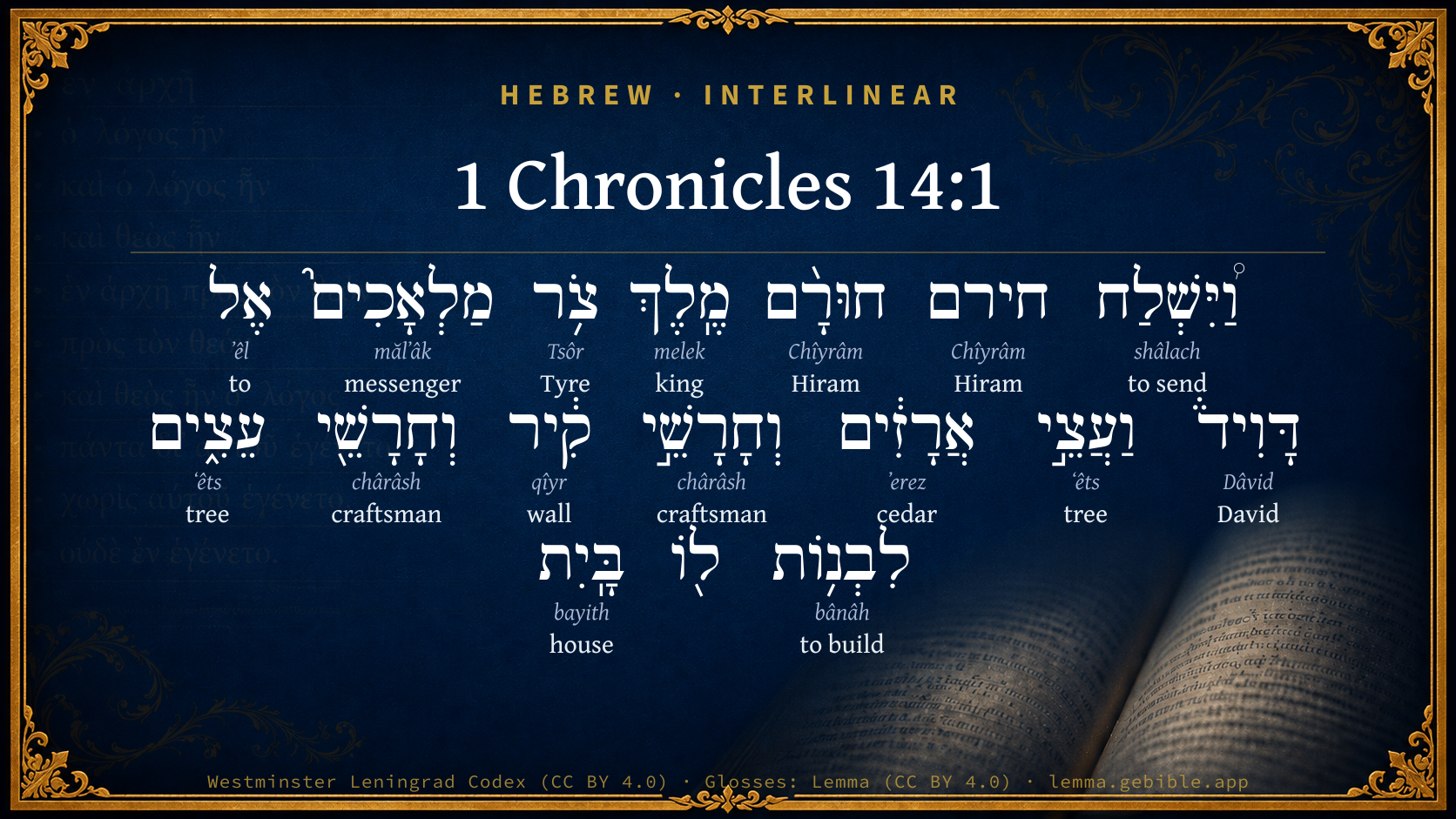
  1. וַ֠יִּשְׁלַח shâlach H7971 “and · to send” Conjunction + Verb, Qal, Sequential Imperfect, 3rd Person, Masculine, Singular
  2. חוּרָ֨ם Chîyrâm H2438 “Hiram” Noun, Proper
  3. מֶֽלֶךְ melek H4428 “king of” Noun, Common, Masculine, Singular, Construct
  4. צֹ֥ר Tsôr H6865 “Tyre” Noun, Proper
  5. מַלְאָכִים֮ mălʼâk H4397 “messengers” Noun, Common, Masculine, Plural, Absolute
  6. אֶל ʼêl H413 “to” Preposition
  7. דָּוִיד֒ Dâvid H1732 “David” Noun, Proper
  8. וַעֲצֵ֣י ʻêts H6086 “and · trees of” Conjunction + Noun, Common, Masculine, Plural, Construct
  9. אֲרָזִ֔ים ʼerez H730 “cedars” Noun, Common, Masculine, Plural, Absolute
  10. וְחָרָשֵׁ֣י chârâsh H2796 “and · craftsmen of” Conjunction + Noun, Common, Masculine, Plural, Construct
  11. קִ֔יר qîyr H7023 “wall” Noun, Common, Masculine, Singular, Absolute
  12. וְחָרָשֵׁ֖י chârâsh H2796 “and · craftsmen of” Conjunction + Noun, Common, Masculine, Plural, Construct
  13. עֵצִ֑ים ʻêts H6086 “trees” Noun, Common, Masculine, Plural, Absolute
  14. לִבְנ֥וֹת bânâh H1129 “to build” Preposition + Verb, Qal, Infinitive Construct
  15. בָּֽיִת bayith H1004 “house” Noun, Common, Masculine, Singular, Absolute

About this verse

These counts appear in no published source. They are computed here, from the morphology-tagged text and Lemma’s own curated glosses. What Lemma adds →

17
words
13
distinct lemmas
Historical
section

Shared distinctive vocabulary

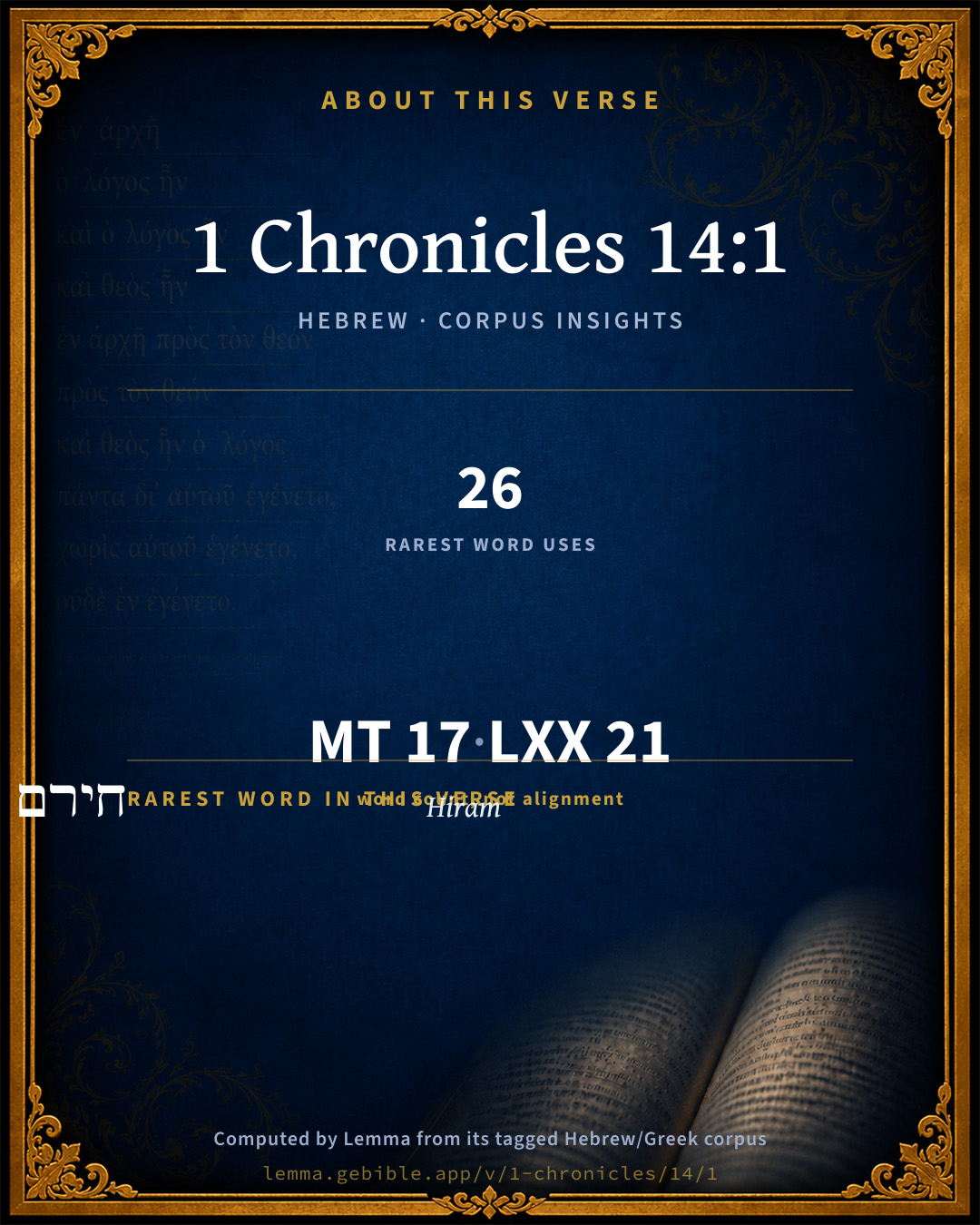
חירם Hiram H2438 occurs in 21 verses of the Hebrew Bible. Also found in:

Grammatical profile

  • 2 verbs
  • 13 nouns
  • 2 prepositions

Verb forms

  • וַ֠יִּשְׁלַח Qal · Sequential Imperfect
  • לִבְנ֥וֹת Qal · Infinitive Construct

Repetition

Words recur within this verse — often emphatic in Hebrew:

  • חירם Hiram H2438 ×2
  • וַעֲצֵ֣י tree H6086 ×2
  • וְחָרָשֵׁ֣י craftsman H2796 ×2

Hebrew & Septuagint length

In English translation the verse runs 20 words from the Hebrew and 22 from the Septuagint (LXX English) — closely comparable.

A rough comparison of the two English renderings, which tokenize alike — not a word-level alignment.

Word counts can differ between the Hebrew and the Greek without any difference in meaning — e.g. the Hebrew direct-object marker אֵת has no separate Greek word, and Greek often adds the article ὁ.

In the original languages it is 17 Hebrew tokens and 21 Greek tokens — but the two are counted differently (Hebrew bundles its prefixes and suffixes into one token; the Greek is in lemma form), so that isn’t a like-for-like length.

Cross-references

13

Topical passages linked to 1 Chronicles 14:1 in the Treasury of Scripture Knowledge — connected by theme and wording, ordered by reader-vote popularity; previews shown in the World English Bible.

  • 2 Samuel 5:11–16 Hiram king of Tyre sent messengers to David, and cedar trees, and carpenters, and masons; and they built David a house.
  • 2 Chronicles 2:3 Solomon sent to Huram the king of Tyre, saying, As you dealt with David my father, and sent him cedars to build him a house in which to dwell, [even so deal with me].
  • Ezra 3:7 They gave money also to the masons, and to the carpenters; and food, and drink, and oil, to them of Sidon, and to them of Tyre, to bring cedar trees from Lebanon to the sea, to Joppa, according to the grant that they had of Cyrus king of Persia.
  • 2 Samuel 7:2 that the king said to Nathan the prophet, See now, I dwell in a house of cedar, but the ark of God dwells within curtains.
  • 1 Kings 5:1 Hiram king of Tyre sent his servants to Solomon; for he had heard that they had anointed him king in the room of his father: for Hiram was ever a lover of David.
  • 1 Kings 5:6 Now therefore command you that they cut me cedar trees out of Lebanon; and my servants shall be with your servants; and I will give you hire for your servants according to all that you shall say: for you know that there is not among us any who knows how to cut timber like the Sidonians.
  • 1 Kings 5:8–12 Hiram sent to Solomon, saying, I have heard [the message] which you have sent to me: I will do all your desire concerning timber of cedar, and concerning timber of fir.
  • 1 Kings 5:18 Solomon's builders and Hiram's builders and the Gebalites did fashion them, and prepared the timber and the stones to build the house.
  • 1 Kings 7:1–12 Solomon was building his own house thirteen years, and he finished all his house.
  • 1 Chronicles 17:1 It happened, when David lived in his house, that David said to Nathan the prophet, Behold, I dwell in a house of cedar, but the ark of the covenant of Yahweh [dwells] under curtains.
  • 1 Chronicles 22:2 David commanded to gather together the foreigners who were in the land of Israel; and he set masons to hew worked stones to build the house of God.
  • 2 Chronicles 2:8–12 Send me also cedar trees, fir trees, and algum trees, out of Lebanon; for I know that your servants know how to cut timber in Lebanon: and, behold, my servants shall be with your servants,
  • Jeremiah 22:13–15 Woe to him who builds his house by unrighteousness, and his chambers by injustice; who uses his neighbor's service without wages, and doesn't give him his hire;

Cross-references courtesy of OpenBible.info (CC BY 4.0).

Hebrew and Greek witnesses Masoretic Hebrew ↔ Greek Septuagint

The same verse in the two great witnesses to the Old Testament, shown verse-for-verse.

These are two independent witnesses, not word-aligned to each other, and the Septuagint is shown in lemma (dictionary) form.

Hebrew 1 Chronicles 14:1 Masoretic · Westminster Leningrad Codex

וַ֠יִּשְׁלַח חירם חוּרָ֨ם מֶֽלֶךְ צֹ֥ר מַלְאָכִים֮ אֶל דָּוִיד֒ וַעֲצֵ֣י אֲרָזִ֔ים וְחָרָשֵׁ֣י קִ֔יר וְחָרָשֵׁ֖י עֵצִ֑ים לִבְנ֥וֹת ל֖וֹ בָּֽיִת

Hiram king of Tyre sent messengers to David, and cedar trees, and masons, and carpenters, to build him a house.

World English Bible · Public Domain

Greek LXX 1 Chronicles 14:1 Septuagint · lemma form

καί ἀποστέλλω χιραμ βασιλεύς τύρος ἄγγελος πρός δαυίδ καί ξύλον κέδρινος καί οἰκοδόμος τοῖχος καί τέκτων ξύλον ὁ οἰκοδομέω αὐτός οἶκος

And Chiram king of Tyre sent messengers to David, and cedar timbers, and masons, and carpenters, to build a house for him.

LXX2012 (modern English Septuagint) · Public Domain

On this verse, Ellicott's Commentary for English Readers discusses the Septuagint’s reading. Read the note in Commentary ↓

Hebrew: Westminster Leningrad Codex (CC BY 4.0). Greek: Septuagint (public domain); English from LXX2012 (modern English Septuagint) (Public Domain). How the Septuagint differs from the Hebrew →

Commentary

Notes on 1 Chronicles 14:1 from classic Christian and Jewish commentators (each source and its license shown beneath its notes). The classic Christian expositions comment on the surrounding passage and are grouped to its opening verse, so a note may address several verses; the Jewish commentaries on the Tanakh (Rashi and others) are per-verse, so they appear only where the commentator wrote on this verse.

Lemma curates 59 commentaries, every one of them public domain or Creative Commons licensed, each selected and text-cleaned for this edition rather than reprinted as found. About our sources →

Matthew Henry's Commentary

We may observe here, 1. There is no man that has such a sufficiency in himself but he has need of his neighbours and has reason to be thankful for their help: David had a very large kingdom, Hiram a very little one; yet David could not build himself a house to his mind unless Hiram furnished him with both workmen and materials, Ch1 14:1. This is a reason why we should despise none, but, as we have opportunity, be obliging to all. 2. It is a great satisfaction to a wise man to be settled, and to a good man to see the special providences of God in his settlement. The people had made David king; but he could not be easy, nor think himself happy, till he perceived that the Lord had confirmed him king over Israel, Ch1 14:2. "Who shall unfix me if God hath fixed me?" 3. We must look upon all our advancements as designed for our usefulness. David's kingdom was lifted up on high, not for his own sake, that he might look great, but because of his people Israel, that he might be a guide and protector to them. We are blessed in order that we may be blessings. See Gen 12:2. We are not born, nor do we live, for ourselves. 4. It is difficult to thrive without growing secure and indulgent to the flesh. It was David's infirmity that when he settled in his kingdom he took more wives (Ch1 14:3), yet the numerous issue he had added to his honour and strength. Lo, children are a heritage of the Lord. We had an account of David's children, not only in Samuel, but in this book (Ch1 3:1, etc.) and now here again; for it was their honour to have such a father.

Matthew Henry's Commentary on the Whole Bible (1708–1710) — public domain (CC PDM 1.0). Text via the HelloAO Bible API.

Trapp's Complete Commentary

John Trapp

1Ch 14:1 Now Hiram king of Tyre sent messengers to David, and timber of cedars, with masons and carpenters, to build him an house.

Ver. 1. Now Hiram king of Tyre.] {See Trapp on "2Sa 5:11"} {See Trapp on "2Sa 5:12"}

John Trapp, A Commentary or Exposition upon All the Books of the Old and New Testament (1647–1656) — public domain. Text from a community e-Sword module.

The Biblical Illustrator

Joseph S. Exell

1Ch_14:1-2

Now Hiram king of Tyre sent messengers to David.

The building of the royal house

In Hirams conduct notice--

I. An instance of true friendship.

1. Genuine.

2. Lasting.

II. An illustration of human agency in the service of God.

III. A proof of Gods providence.

1. In Hirams conduct.

2. In Davids accession to the throne.

3. In the honour and extension of Davids kingdom. (J. Wolfendale.)

Hiram and David

The treaty between these two kings illustrates--

I. The providence of God in the exaltation of a good man.

II. The influence of a good man upon others when thus exalted. Men pay homage to moral worth and holy life. This power every Christian may possess and wield.

III. The design for which God exalts a good man (2Sa_5:12). Not for themselves, but for others are men enriched and honoured. (J. Wolfendale.)

Lifted up

Man throws down. God lifts up:

1. Persons.

2. Societies.

3. Nations.

Lifts up above:

1. Distress.

2. Opposition.

3. Danger. (J. P. Lange.)

The Biblical Illustrator, edited by Joseph S. Exell (c. 1880s–1900s) — public domain. Text from a community e-Sword module.

Joseph Benson's Commentary

A.M. 2961. — B.C. 1043.

David is confirmed in his kingdom, 1Ch 14:1, 1Ch 14:2. His wives and children, 1Ch 14:3-7. His victories over the Philistines, 1Ch 14:8-17.

NOTES ON CHAPTER 14.

1Ch 14:2. David perceived that the Lord had confirmed him king over Israel — By the remembrance of God’s promise, and his providence conspiring with it. For his kingdom was lifted up on high, because of his people Israel — But of this and the following verses of this chapter, see notes on 2Sa 5:12-25, where the same history is related.

Joseph Benson's Commentary on the Old and New Testaments (1811–1818) — public domain. Text from a community e-Sword module.

The Preacher's Complete Homiletical Commentary

Joseph S. Exell (gen. ed.)

CRITICAL NOTES.] This chapter runs parallel with 2Sa_5:11-25, and presents a general verbal identity, which is insufficiently represented by the Authorised Version. The only important variations from 2 Samuel 5 are in 1Ch_14:4-7; 1Ch_14:12, in the former of which passages the sons of David are given somewhat differently, while in the latter the fact is added that the idols taken from the Philistines were burned [Speak. Com.].

1Ch_14:1-2.—David’s house. H. elsewhere Huram (2Ch_2:3; 2Ch_8:18; 2Ch_9:10; cf. 2Sa_5:11). A Phœnician, a Canaanite, speaking the language of David, and sovereign of a city trading in cedars and abounding with craftsmen in stone and wood [cf. Murphy]. 1Ch_14:2. Confirmed in contrast to his former state and the fate of Saul’s kingdom.

1Ch_14:3-7.—David’s family (cf. 2Sa_3:5). Concubines in ch. 1Ch_3:9; a list of children 1Ch_14:5-8; those born in Jerusalem, 2Sa_5:14-16. But names of Eliphalet and Nogah not found, and Beeliada appears the same as Eliada.

1Ch_14:8-17.—David’s victories. Seek to ruin him before consolidated in kingdom. 1Ch_14:9. Rephaim (1Ch_11:15) south east of Jerusalem, near capital of David. 1Ch_14:10. Enquired for high priest to give tone to his reign. 1Ch_14:11. Smote in the engagement at Mount Perazim (Isa_38:21), in valley of Rephaim. This first victory. 1Ch_14:12. God’s images carried into battlefields (1Sa_4:4-11; 2Sa_5:21).

1Ch_14:13-17.—Second victory. Again in next season campaign renewed. 1Ch_14:14. Not up to meet them directly; come upon them by stratagem in the rear. 1Ch_14:15. Sound, the rustling of leaves by strong breeze, the appointed sign and moment for attack. 1Ch_14:16. Gibeon, now Yefa, in Judah. 1Ch_14:17. Fane in all the surrounding nations. This verse an appropriate conclusion, not found in Samuel.

HOMILETICS

THE BUILDING OF THE ROYAL HOUSE.—1Ch_14:1-2

David had conquered Jebusites; made Zion capital; had now wisely made a treaty with a neighbouring prince. Magnanimous and godfearing. In Hiram’s conduct notice—

I. An instance of true friendship. History gives noble examples of love and friendship.

1. This was genuine. Real and excellent. David need of artisans. War and disorder had depopulated. “A friend in need is a friend indeed.”

“Ill fares the land, to hastening ills a prey,

Where wealth accumulates and men decay.”

2. This was lasting. Friends often change with change of principles and circumstances; vary with temperature and desert in meanness. Hiram did to the son what he had done to the father (2Ch_2:3); “for Hiram was ever a lover of David” (1Ki_5:1).

II. An illustration of human agency in the service of God. None independent. All require friends and help. Rich to give to poor; wise to teach the ignorant, and kings to rule subjects. All may communicate, interchange stores of thought, knowledge, and substance.

1. Agency in men. Tyrian workmen renowned and skilful; helped David to build a city, so splendid in cedar structures that Jeremiah exclaimed, “Thou dwellest on Lebanon and makest thy nest in the cedars” (Jer_22:23).

2. Agency in materials. Israel agricultural, furnished corn and oil; Tyre commercial, gave its manufactures and foreign produce. Thus mutually helpful. All the treasures of art and materials of nature subserve man’s highest interests and God’s work.

III. A proof of God’s providence. David more than “fortunate in having a friend in Hiram at this time.”

1. Providence in Hiram’s conduct. God disposed him to render help. The God of infinite wisdom has a purpose in the rise and fall of empires, in all events of life, obscure or illustrious. As a gardener directs rills of water through different parts of his ground, so “the king’s heart is in the hand of the Lord, as the rivers of water: he turneth it whithersoever he will” (Pro_21:1).

2. Providence in David’s accession to the throne. “David perceived that the Lord had established him king over Israel.” By internal unity, external peace, and friendly connection with Hiram.

3. Providence in the honour and extension of David’s kingdom. “And that his kingdom was exalted on high.” Respected at home and abroad among nations; elevated as the people of God above others in knowledge, privilege, and destiny. In building characters, churches, and societies rely upon God, not too much upon human friendship and human instrumentality, wealth, eloquent preachers and active evangelists. Recognition, consciousness of God, gives strength and success. “David perceived,” &c.

HIRAM AND DAVID

The treaty between these two kings illustrates—

I. The providence of God in the exaltation of a good man. “Confirmed him king.” Scholars, ministers, statesmen, fitted and exalted from obscurity to honour. Joseph from prison to prime minister; Garfield from log cabin to White House; Livingstone from Blantyre to Westminster Abbey. “The Most High ruleth in the kingdom of men, and giveth it to whomsoever he will.”

II. The influence of a good man upon others when thus exalted. David’s influence far and near. Men pay homage to moral worth and holy life. This power every Christian may possess and wield. The secret is, “The Lord was with him.”

III. The design for which God exalts a good man. “For his people Israel’s sake” (2Sa_5:12). Not for themselves, but for others are men enriched and honoured. Great interests often sacrificed for selfish ends. Kings, popes, and emperors forget that others are as dear to God as they. Elevation should never separate. Kings created for the people, not the people for kings.

HOMILETIC HINTS AND SUGGESTIONS

1Ch_14:1; 1Ch_2:1. David’s house built. Fit for his court and homage. Workmen of a wealthy prince helped to rear it. “The sons of strangers shall build up” the walls of the spiritual house, “and their kings shall minister unto thee” (Isa_60:10).

2. David’s kingdom established. Saul not established. Nothing to shake or disturb possession. Exalted before friend and foe. “Higher than the kings of the earth.”

3. God’s hand recognised in this. Many blessed and honoured do not perceive this, will not acknowledge God, talk about their “fortune,” “star,” and “chance.” “David perceived,” &c. “By this I know that thou favourest me” (Psa_41:1).

1Ch_14:2. Lifted up. Man throws down. God lifts up persons, societies, and nations; lifts up above distress, opposition, and danger. “A good man in great prosperity.

1. He ascribes it all to the Lord.

2. He regards it as given him for the benefit of his fellow-men” [Lange].

HOMILETICS

THE EXTENSION OF THE ROYAL FAMILY.—1Ch_14:3-7

When the palace was built and the kingdom established, David’s family multiplied and increased. Of his sons, see 1Ch_3:1-9; and his concubines, 2Sa_15:16; 2Sa_16:22; 2Sa_19:5. This—

I. In worldly policy. Always thought to be politic to have many children; marry them into powerful families, and thus strengthen interest and gain support. The custom of Oriental monarchs to gather a numerous harem. This an essential part of court-state, and a symbol of royal power. But David overstepped the mark and went astray. “Men who have once broken the fence will wander carelessly.”

II. In disobedience to God’s command. Multiplication of wives expressly forbidden to the kings of Israel. “Neither shall he multiply wives to himself, that his heart turn not away” (Deu_17:17). Worldly policy often contradictory to God’s design. Expediency never safe. Divine wisdom the only preservative and redemptive force in life. “When wisdom entereth into thine heart and knowledge is pleasant unto thy soul, discretion shall preserve thee, understanding shall keep thee.”

“To know

That which before us lies in daily life

Is the prime wisdom” [Milton].

FAMOUS BATTLES.—1Ch_14:8-17

Philistines afraid of David’s growing power—that he would wipe away the national dishonour of Gilboa, and that his knowledge of the country would give superior advantage in war—resolve to attack, surprise, and ruin him. Went up to seek, with intention to crush him before consolidated in his kingdom (cf. 1Sa_23:15; 1Sa_24:2), but were overcome in two famous battles.

I. The counsel by which they were undertaken. “David enquired of God” (1Ch_14:10); “David enquired again of God” (1Ch_14:13). In all affairs look to God for direction. Have his will and word for your guide. Means always at hand to discover his will. Submit thoughts, plans, and ways to God’s approval—to check if wrong, to perfect if right. If depressed by their weight, “commit” (literally, roll as a burden which you cannot bear) “thy way unto the Lord” (Psa_27:5). “Roll thy works” (thy undertakings) “upon the Lord” (Pro_16:3).

II. The help by which they were fought. This from above.

1. In divine direction. “The Lord said unto him, go up.” Never stir without this.

2. In hearty co-operation. David did not entrench himself in Zion, nor act merely on the defensive, but made the attack and conquered. “To serve the gods was to reign,” said a heathen writer.

III. The victories which they gained. Brilliant and complete.

1. The enemy overcome. “David smote them”—like rising waters, overflowing their banks and sweeping everything before them.

2. Their false confidence destroyed. Philistines carried their gods into battle, with the belief, common in ancient nations, that they would grant success. Their owners left them helpless on the field; the victors carried them as trophies to the capital, and consumed them in the flames. “They were burned with fire.”

3. David became, famous. “The fame of David went out unto all lands” (1Ch_14:17). As a great warrior, a powerful monarch, and a good man.

4. God was honoured. Acknowledged as the source of victory—“God hath broken in” (1Ch_14:11)—praised for his gift and presence, and feared above all the gods of the earth. Give to him the glory due to his name.

SIGNALS FOR DUTY.—1Ch_14:15-16

In the responses to David’s inquiries we not simply have commands in words, and symbols in sound, but signals for duty or action.

I. God’s answer to man’s prayer. Given twice, in terms direct and explicit.

1. Prayer for knowledge of duty. “Shall I go?”

2. Prayer for assurance of success. “Wilt thou deliver them into my hand?” David often defeated. For his own encouragement and that of his army, he desires grounds of confidence. True prayer will give knowledge, hope, and strength.

II. God’s help in man’s circumstances. These often strange and apparently against us; render powerless and insufficient. God’s help adequate to feeble men and scanty resources. In his service never left without indications of his presence. “God is gone forth before thee.”

III. God’s signal for man’s action. We need not only to know and strength to obey God’s will, but the call to duty—the signal to “go” at the exact time. A detachment on one occasion waited for orders, longed to join their comrades in battle, instead of standing in silence, exposed to danger. At length Wellington gave the command, and the attack was successful. “They serve who stand and wait.” A time to “stand still” and to “go forward,” but God must give the signal. Wait for his salvation. “The vision shall come and not tarry.”

THE BATTLE OF BAAL-PERAZIM.—1Ch_14:8-12

Here the Philistines marched from Rephaim, pitched their tent, and offered battle (2Sa_5:18-20).

I. The spirit in which it was fought. Most commendable and advantageous.

1. A spirit of reliance upon God. “Shall I go?” An attitude of conscious danger and helplessness.

2. A spirit of humility. David talks of his “hand,” not his sword. God is the giver, he only receives with the hand. None fit to be great but those who can stoop lowest. “Before honour is humility.”

3. A spirit of obedience. “They came up.” Wise to listen to and obey law—to be convinced of its divine authority and justice. Men ever ready to order, to modify and repeal, in danger and doubt. But “the wise in heart will receive commandments.”

4. A spirit of courage. Victory promised by God, hence bravery and enthusiasm. “A good cause makes a stout heart.”

“He holds no parley with unmanly fears,

Where duty bids, he confidently steers,

Faces a thousand dangers at her call,

And trusting in his God, surmounts them all” [Cowper].

II. The scenes by which it was characterised. Battlefields never pleasant to inspect. Great soldiers have often wept on them.

1. Shameful defeat. “David smote them,” and like an impetuous flood carried all before him. The defeat terrible, and perpetuated in name of place. “Baal-perazim water-breach” (cf. Isa_28:21).

2. National disgrace. The gods were forsaken, lost, and destroyed. The disgrace of the Philistine’s capture of the ark was wiped away, and the idolatrous people dishonoured. God makes men weary of things they love, and compels them to desert what they worship. “In that day a man shall cast his idols of silver, and his idols of gold, which they made each one for himself to worship, to the moles and to the bats” (Isa_2:20).

THE BATTLE OF GIBEON.—1Ch_14:14-17

Again the enemy renewed hostile attempt with greater force. God interposes in a peculiar way, caused a sound to be heard, and David suddenly attacked from behind the mulberry-trees. Notice—

I. A special change in tactics. Much depends upon methods in war. David not permitted to act as in first battle, though successful. This would have been natural. But God alone must be followed; not rules of earthly warfare, not past experience, nor past success must guide. God does “a new thing.” “Thou shalt not go up; fetch a compass behind them.”

II. A special sign by which these tactics are carried out. “When thou shalt hear a sound of going, &c.”

1. A supernatural sign. “Sound of going”—viz., of God. Soldiers must look to the commander for orders. This, many think, was a noise made by angels, who came to help (cf. 2Ki_7:6).

2. A disciplinary sign. Requiring an upward look, an open eye to see, an attentive ear to hear. Duty of soldiers to wait and watch in readiness and order.

3. A typical sign. In the setting up of Christ’s kingdom, disciples waited to be equipped for work. The Spirit “came with a sound from heaven as of a rushing mighty wind.” When they heard and felt that, they bestirred themselves, and went forth to conquer.

HOMILETIC HINTS AND SUGGESTIONS

1Ch_14:8.

1. A vigilant foe. “Philistines heard.”

2. An army on guard. “David heard.”

3. An army prepared to meet the foe. “Went out against them.” A Christian’s duty like that of a soldier. He does not attempt to meet temptation, to fight the enemy in his own strength. His watchfulness lies in observing its approach, telling God of it in prayer, and being prepared in God’s strength.

1Ch_14:10.

1. The thing to ascertain. Is it God’s will?

2. The power required to perform it when known. Many wish for God’s favour and help without doing God’s will. The order can never be reversed; first God’s will, then God’s help. No answer and no power, if not in right attitude and relation to him.

1Ch_14:11. God hath broken asunder or through mine enemies as a breach of waters, i.e., as a violent torrent makes a rift or breach. Philistines scattered suddenly, unexpectedly and violently. God’s terrors awful. “Thy fierce anger goeth over me (as waves of the sea); thy terrors have cut me off. They came round about me daily like water; they compassed me about together” (Psa_88:16-17).

1Ch_14:9 to 1Ch_11:1. An instance of self-conquest. David conquered self, and then consulted God.

2. A lesson of dependence upon God. Pray, look up, and expect.

3. An instance of success through obedience.

“God fights the battles of a will resigned.”

1Ch_14:15. Sound of going applies figuratively to us also in our spiritual conflict with the children of unbelief in the world. There, too, it comes to nothing that one should make war with his own prowess and merely in the human equipment of reason and science. Success can only be reckoned on when the conflict is waged amid the blowing of the Holy Spirit’s breath and with the immediate presence of the Lord and of the truth of his word [Krummacher]. God before thee.

1. In the pledge of success.

2. By confounding the enemy. Sound something amazing, like the noise of a mighty host. Hence panic and flight.

1Ch_14:15. Before thee.

1. A word of consolation in sore distress.

2. A word of encouragement amid inward conflict.

3. A word of exhortation to unconditional obedience of faith.

4. A word of assurance of the victory which the Lord gives [Lange]. The rustling of the Lord’s approaching help in the tops of the trees.

1. Dost thou wait for it at his bidding?

2. Dost thou hear it with the right heed?

3. Dost thou understand it in the right sense?

4. Dost thou follow it without delay? [Idem]. Victory comes from the Lord.

1. When it is beforehand humbly asked for according to the Lord’s will and word.

2. When the battle is undertaken in the Lord’s name and for His cause.

3. When it is fought with obedient observation of the Lord’s directions and guidance [Idem].

ILLUSTRATIONS TO CHAPTER 14

1Ch_14:1-2. Hiram and David.

“A generous friendship no cold medium knows,

Burns with one love, with one resentment glows” [Pope’s Homer].

It was reckoned a crime among the Romans to be without a friend. “Friends,” says one, “are to be inventoried as well as goods.”

1Ch_14:8. David heard of it. “Set double guard on that point to-night,” was an officer’s command when an attack was expected.

1Ch_14:10. Shall I go up? The English Ambassador to the Court of Prussia sat at a table of Frederick the Great, then meditating a war whose sinews were to be mainly formed of English subsidies. Round the table sat infidel French wits, and they and the king made merry over decadent superstitions, the follies of the ancient faith. Suddenly the talk changed to war. Said the Ambassador, “England would, by the help of God, stand by Prussia.” “Ah!” said the infidel Frederick, “I did not know you had an ally of that name,” and the infidel wits smirked applause. “So, please your Majesty,” was the swift retort, “He is the only ally to whom we do not send subsidies” [Baxendale].

1Ch_14:14-16. Luther’s strength lay in the way in which he laid the burden of the Reformation upon the Lord. Continually in prayer he pleaded, “Lord, this is thy cause, not mine. Therefore, do thine own work; for if this gospel do not prosper, it will not be Luther alone who will be a loser, but thine own name will be dishonoured” [Spurgeon].

1Ch_14:17. Fame of David. “Begin with modesty, if you would end with honour.”

“Some men are raised to station and command,

When Providence means mercy to a land.

He speaks, and they appear; to him they owe

Skill to direct, and strength to strike the blow,

To manage with address, to seize with power

The crisis of a decisive hour” [Cowper].

The Preacher's Complete Homiletical Commentary (gen. ed. Joseph S. Exell; Funk & Wagnalls, c. 1892) — public domain (pre-1929). A full-Bible homiletical/sermon-outline anthology covering 65 of 66 books (2 John is absent from the source module). Text from a community e-Sword module.

Lange's Commentary on the Holy Scriptures

ζ. David’s House-Building, Family, and Victories over the Philistines: 1 Chronicles 14

1Ch_14:1 And Hiram1 king of Tyre sent messengers to David, and cedar-wood, and masons, and carpenters, to build him a house. 2And David perceived that the Lord had confirmed him king over Israel; for his kingdom was lift up on high, because of his people Israel.

3And David took more wives in Jerusalem; and David begat more sons 4and daughters. And these are the names of those born to him in Jerusalem: Shammua and Shobab, Nathan and Solomon. 5And Ibhar, and Elishua, and 6Elpelet. And Nogah, and Nepheg, and Japhia. 7And Elishama, and Beeliada, and Eliphelet.

8And the Philistines heard that David was anointed king over all Israel; and all the Philistines went up to seek David: and David heard it, and went out against them. 9And the Philistines came and spread themselves in the 10valley of Rephaim. And David inquired of God, saying, Shall I go up against the Philistines, and wilt Thou give them into my hand? And the Lord said 11unto him, Go up, and I will give them into thy hand. And they went up to Baal-perazim; and David smote them there: and David said, God hath broken my enemies by my hand, like the breaking of waters; therefore they 12called the name of that place Baal-perazim. And they left their gods there; and David ordered, and they were burnt with fire.

13, 14And the Philistines came again and spread themselves in the valley.2 And David inquired again of God; and God said unto him, Go not up after them; turn away from them, and come upon them by the bacas. 15And it shall be, when thou hearest the sound going on the tops of the bacas, then go out to the battle; for God is gone out before thee to smite the camp of the Philistines. 16And David did as God commanded him: and they smote the camp of the 17Philistines, from Gibeon even unto Gezer. And David’s fame went out into all lands; and the Lord brought his fear upon all nations.

EXEGETICAL

Preliminary Remark.—On the different position of this section in 2Sa_5:11-25, namely, before the history of the removal of the ark from Kiriath-jearim, comp. the Preliminary Remark on 1 Chronicles 13. The motive of the Chronist for the transposition is evidently the wish to represent the preparations for the removal of the national sanctuary to Jerusalem as the first undertaking of the king after the taking of the capital, to exhibit the building of his own palace as a work certainly taken in hand soon after, but still standing behind that all-important concern. To the history of the beginning of the palace-building is attached in the sources common to both historians a description of the blessing which attended David as a father and a captain in the battles with the Philistines; Our author took this description, in the main unaltered, along with the notice of the beginning of the palace-building, over into his narrative, undeterred by the appearance thence arising of the events in question, especially the two successful battles with the Philistines, having fallen in the three months between the removal of the ark to the house of Obed-edom and its introduction into Jerusalem. This grouping is here, as often in his representation of the history of David, determined by the order of thought rather than of time.

1. David’s Palace-building and Family: 1Ch_14:1-7.—The text of the older parallel, 2Sa_5:11-16, agrees in the main with the present, only here and there more precise.—And cedar-wood, and masons, and carpenters, literally, “and timbers (beams) of cedars, and craftsmen of walls, and craftsmen of timbers” (Vulg. artifices parietum lignorumque).

1Ch_14:2. And David perceived (concluded from the high honour which was conferred upon him by this message from the Phenician king) that the Lord had confirmed him king over Israel, definitely transferred the kingdom to him, established (“bestätigt,” Luther) him as king.—For his kingdom was lift up on high. נִשֵּׂאת, if genuine, would be an irregularly formed 3 fem. perf. Niph. (not, as 2 Sam. 14:43, an inf. abs. Niph.) from נשׂא, intensified by the לְמַעְלָה, “on high;” comp. 1Ch_22:5, 1Ch_23:17, 1Ch_29:3-25. But perhaps, as in 2Sa_5:12, the perf. Pielנִשֵּׂא is to be read, and Jehovah taken as the subject: “and that He had exalted his kingdom.” For מַמְלַכְתּוֹ, 2 Samuel 5, our text presents the later (occurring also 1Ch_17:11; 1Ch_17:14) form מַלְכוּתוֹ, perhaps merely by a slip of the pen; see Wellh. p. 164.

1Ch_14:3. And David took more wives in Jerusalem. Before נָשִׁים in 2 Samuel stands פלגשׁים, which may have fallen accidentally out of our passage, as the concubines of David are mentioned in 1Ch_3:9. Comp. on 1Ch_3:5-9, where the names of the thirteen sons of David born in Jerusalem, and the partly different spelling here and there, are fully handled.

2. The First War with the Philistines: 1Ch_14:8-12 (comp. 2Sa_5:17-21).—To seek David, to attack, לְבַקֵּשׁ, sensu hostili, as in 1Sa_23:15; 1Sa_23:25; 1Sa_24:3; 1Sa_26:2.—And David heard it, and went out against them, properly, “before them;” comp. 1Ch_12:17. Into this general and indefinite expression our author has changed the more concrete, but also more obscure, statement of Samuel: “and went down to the hold” (the hold of Zion), perhaps designedly.

1Ch_14:9. And spread themselves in the valley of Rephaim; comp. on 1Ch_11:15, 2Sa_5:18 : “sat down in the valley of Rephaim.” The perhaps more original וַיִּנָּֽטְשׁוּ, 2Sa_5:18; 2Sa_5:22, the Chronist has here and 1Ch_14:13 exchanged for the simpler and more intelligible וַיִּפְשְׁטוּ.

1Ch_14:11. Like the breaking of waters, like an outburst of water (בְּפֶרֶץ מַים). We may think of the rending or outbursting of enclosing dams by rapid floods, perhaps after a water-spout. The situation of Baal-perazim cannot be exactly ascertained. Mount Perazim, Isa_28:21, is not essentially different from it.

1Ch_14:12. And they left their gods there. 2 Samuel 5 : “their idols” (עצביהם). The present phrase is the stronger; it yields, along with the following statement regarding the burning of these gods, a bitterly sarcastic sense. The burning took place, moreover, on the ground of the divine command in Deu_7:5; Deu_7:25. The text of Samuel weakens the statement in a strange way: “and David and his men took them away.” If the more concrete and stronger statement of our author is a traditional expansion of that text, the tradition on which it rests is at all events credible; comp. Movers, p. 224. By this victory, David wiped out the old disgrace of Israel, which rested on the people since Eli’s time. “As then Israel lost the ark, 1Sa_4:11, so now the sacred things of the Philistines fell into the hands of the Israelites” (Berth.).

3. The Second War with the Philistines: 1Ch_14:13-17 (comp. 2Sa_5:22-25).—And spread themselves in the valley, that is, as the parallel text (so as the Sept. and Syr.; see Crit. Note) shows, in the same valley as above, 1Ch_14:9, scarcely in another at Gibeon, as Movers, p. 243, thinks.

1Ch_14:14. Go not up after them, that is, as Samuel shows: “go not directly towards them; seek not to drive them before thee by a direct attack.” Perhaps also our text is somewhat faulty, and to be amended, according to 2Sa_5:23 : לֹא תַֽעֲלֶ֑ה הָסֵב אֶל אַֽחֲרֵיהֶם, by the change of אחריהם in עֲלֵיהֶם (Berth.).—And come uponthem by the bacas, literally, over against the bacas. These we must suppose, as the divine command implies a going round the Philistine army, to be behind them. The baca, mentioned only here and 2 Samuel 5, and perhaps Psa_84:7, is, according to Abulfadi (in Celsius, Hierobot. i. 339), a plant related to the balsam tree, and resembling it, which, when cut, discharges a white, sharp, and warm resin in the manner of tears, and appears to have received its name from בכא, flare. The older expositors, wavering uncertainly, render the term variously: Sept. ἄπιος, Vulg. pyrus; Luther, after the Jewish expositors, mulberry tree.

1Ch_14:15. The sound going on the tops of the bacas, namely, the rustling of their leaves in the wind (Sept.: τὴν φωνὴν τοῦ συσσεισμοῦ αὐτῶν), not the sound occasioned by the entrance of God (supernatural, as in Gen_3:8). As the baca has much larger leaves than the ordinary balsam, the rustling of them may occasion a sufficiently loud sound; the rendering “baca trees ” (Kamph.) is therefore unnecessary.

1Ch_14:16. And they smote the camp of the Philistines, from Gibeon even unto Gezer. Two places of this name lie to the north-west of Jerusalem, the former (now el Jib) 2½, the latter 4½, hours distant from it. If the battle-field is to be sought between the two, in the region of Upper and Nether Beth-horon, the valley, 1Ch_14:13, may still be the valley of Rephaim; only the site of it should be sought not so far south, as Thenius and Bertheau suppose (who also read for Gibeon in our passage, “ Geba,” according to 2Sa_5:25), and the battle must be regarded as moving in a north-westerly direction from its starting-point (comp. Wellh. on 2Sa_5:25, also Ew. Gesch. d. V. Isr. ii. 610).

1Ch_14:17. And David’s fame went out into all lands; and the Lord brought his fear upon all nation, literally, “ gave his fear upon all nations;” comp. Est_8:17. A pragmatic reflection of our author added to the original text, as its absence in 2Sa_5:25 shows. Comp. the similar reflections in 2Ch_17:10; 2Ch_20:29. On וַיֵּצֵא שֵׁם especially, comp. 2Ch_24:15.

Footnotes:

[1] Kethib: חִירָם. Keri: חוּרָם, as always in Chronicles (Sept. Χειράμ, as ever).

[2]For בעמק the Sept. and Syr. read בעמק רפאים, which is perhaps original; comp. 2Sa_5:22.

Lange's Commentary on the Holy Scriptures (Critical, Doctrinal, and Homiletical), ed. John Peter Lange, English translation edited by Philip Schaff (1864–1880) — public domain. Text from a community e-Sword module.

The Annotated Bible

Arno C. Gaebelein

4. David’s Increase and Blessing

CHAPTER 14

1. Hiram (1Ch 14:1-2)

2. David’s family (1Ch 14:3-7)

3. The Philistines defeated (1Ch 14:8-17)

The reader is referred to 2Sa 5:11-16 for the comment on verses 1-7. Beeliada is called in 2Sa 5:16 Eliada. Beeliada was probably changed to Eliada. David’s great victory over the Philistines is also recorded in 2Sa 5:17-25. He inquired of God and being permitted to go, he smote them at Baal-perazim, where also the idol images were burned with fire (in obedience to Deu 7:5; Deu 7:25). It was a great victory. Baal-perazim means “possessor of breaches.” In Isaiah the victory over the Philistines is used as a prophecy of the coming future judgment of the earth. “For the LORD shall rise up as in mount Perazim, He shall be wroth as in the valley of Gibeon, that He may do His work, His strange work, and bring to pass His act, his strange act” (Isa 28:21). A second time the Philistines came, and David, obedient to the divine instructions, gained another great victory. His fame went into all lands and the fear of him was brought by the LORD upon all nations.

Arno C. Gaebelein, The Annotated Bible (1913–1922) — public domain. Text from a community e-Sword module.

Tyndale Open Study Notes

Tyndale Open Resources

14:1-7 Even though the Ark was not present in Jerusalem (13:1-14), God blessed David’s palace, his children, and his conquest of the Philistines. God’s blessing did not depend on the presence of the Ark. These blessings eventually encouraged David to carry out his original plan to bring the Ark into Jerusalem (15:1-29).

14:1-2 Hiram’s generosity provided further evidence of God’s purpose in making David king.

Tyndale Open Study Notes — © Tyndale Open Resources, licensed CC BY-SA 4.0. Text via the HelloAO Bible API.

Geneva Bible (1599)

Geneva Bible translators

Hebrew, Zor.

Geneva Bible (1599) marginal notes — public domain. Text via Bolls.life.

Adam Clarke's Commentary

CHAPTER XIV

Hiram sends artificers and materials to David, to build him a

house, 1, 2.

David's wives and children, 3-7.

He defeats the Philistines in two battles: one in the valley of

Rephaim, 8-12;

and the other at Gibeon and Gazer, 13-16.

His fame goes out into all the surrounding nations, 17.

NOTES ON CHAP. XIV

Verse 1. Now Hiram king of Tyre] See the transactions of this chapter related 2Sa 5:11-25.

Adam Clarke's Commentary on the Bible (1810–1826) — public domain. Text from a community e-Sword/MySword module.

Ellicott's Commentary for English Readers

(1) Hiram.—So the Hebrew text of Chronicles spells the name, and the LXX. and all the other ancient versions both of Samuel and Chronicles have it so. But the Hebrew margin of Chronicles writes “Huram.”

Messengers.—Ambassadors.

Timber of cedars.—Felled from the Lebanon, and sea-borne to Joppa (2 Chronicles 16).

With masons and carpenters.—Literally, and craftsmen of walls, and craftsmen of timber. 2Sa_5:11 has “craftsmen of wood, and craftsmen of stone of wall.”

To build him an house.—Samuel, “and they built a house for David.” (2Sa_5:11.)

House.—Palace. So the Temple was called “the house” (hab-bayith) as well as “the palace” (hçkçl; comp, the Accadian e-gal, “great house”). We may think of the numerous records of palace building which the Assyrian and Babylonian sovereigns have left us. The cedar of Lebanon (Labnânu) was a favourite material with them.

A Bible Commentary for English Readers, edited by Charles John Ellicott (1878–1897) — public domain. Text from a community e-Sword module.

The Cambridge Bible for Schools and Colleges

gen. ed. J. J. S. Perowne

1. Hiram] Other forms of this name are Huram and (1Ki_5:10; 1Ki_5:18) Hirom.

1, 2. Hiram’s [first] Embassy to David

The dislocation of the narrative mentioned in the last note has concealed the occasion of Hiram’s embassy. The narrative of 2Sa_5:9-11 suggests that Hiram heard of the building works which David was carrying on at Jerusalem and so sent materials and workmen to assist. David accepted the welcome offer (which ultimately led to an alliance) as a sign of Divine favour.

The Cambridge Bible for Schools and Colleges (gen. ed. J. J. S. Perowne; Cambridge University Press, 1878–1918) — public domain. Text from a community e-Sword module.

John Gill's Exposition

See Chapter Introduction

Next: 1 Chronicles Chapter 15

John Gill's Exposition of the Whole Bible (1746–1763) — public domain (CC PDM 1.0). Text via the HelloAO Bible API.

Albert Barnes' Notes on the Bible

Compare 2Sa 5:11-25, the only important variations from which are in 1Ch 14:4-7, the list of the sons of David (see 1Ch 3:1 note), and in 1Ch 14:12, where the fact is added that the idols taken from the Philistines were burned.

Albert Barnes' Notes on the Bible (1834–1885) — public domain. Text from a community e-Sword/MySword module.

Haydock's Catholic Bible Commentary

Hiram. This embassy, and the war with the Philistines, took place before the ark was removed. (Calmet)

George Leo Haydock (1774–1849), Haydock's Catholic Family Bible and Commentary, 1859 edition — public domain. Excludes Psalms (Douay-Rheims chapter numbering differs from Protestant) and Deuterocanonical books (Catholic canon only).

Dummelow's Commentary on the Holy Bible

J. R. Dummelow

Hiram and David. David's Children

This chapter reproduces 2Sa_5:11-25 with some variations in the names of David's children, and the additional fact that David burnt the idols of the Philistines.

7. Beeliada] This name contains the title 'Baal,' which, as has been already implied (see on 1Ch_8:33), had at first an innocent sense. When, later, it contracted evil associations, the names in which it occurred underwent alterations, and for Beeliada was substituted the form 'Eliada': 2Sa_5:16.

12. Left their gods] These had doubtless been carried into battle in the belief that they would bring success to the Philistine forces just as the Israelites carried the ark with them to the battle of Ebenezer: 1Sa_4:3.

16. Gibeon] in 2Sa_5:25; 'Geba,' both places being close together.

J. R. Dummelow, A Commentary on the Holy Bible (Macmillan, 1909) — public domain. Text from a community e-Sword module.

The Pulpit Commentary

The contents of this chapter belong to a period of time subsequent to the taking of the fort of Zion, and find their parallel in 2Sa_5:11-25. But if found here in the same order of place as there, they would have followed upon 1Ch_9:9; Keil attributes this difference to the desire of our compiler to represent the bringing of the ark to Jerusalem as David"s first undertaking on becoming king of the united people. Considering the contents of this chapter, and remembering that it stands between the unsuccessful attempt to bring home the ark and the final successful bringing of it, it would seem a far more natural thing to suppose that this suggested its present order; for compare 1Ch_15:1, 1Ch_15:2. The parallel is very close. As far as to the word "Elishua" (ver. 5), there is no difference in the least degree material, except that the word "concubines" is found in Samuel, and preceding the word "wives" of our ver. 3. (yet see 1Ch_3:9) The two names Elpalet and Nogah are also not found in the parallel, but our compiler is consistent with himself; for see 1Ch_3:6, 1Ch_3:7. Further, our ver. 12 states that the idols of the Philistines were by David"s command "burned with fire," while the Hebrew text of Samuel only states that "David and his men removed them" ( where the Authorized Version incorrectly translates "burned them.

The Kethiv abandons here the invariable analogy of Chronicles, and reads Hiram for "Huram," which latter form, however, is replaced in the Keri. Beside this Hiram or Huram, the king, there was another Hiram or Huram, the same king"s chief artificer, and whom he sent to the help of Solomon (1Ki_7:13, 1Ki_7:40; 2Ch_2:13 2Ch_4:11, 2Ch_4:16) The willing aid which this king lent to David on this occasion, in supplying cedar timber and workmen, was "the commencement of that amity between the Tyriaus and the Hebrews, so mutually advantageous to the two nations, the one agricultural and the other commercial" (Milman"s "History of the Jews," 1:239). The meaning of the name Hiram is probably "noble," or "high.bern." This disposition, at all events, he seems to have illustrated in his generous friendship to David, Solomon, and their people. Very little to be relied upon is known of him outside Scripture, but his reign is said to have extended from B.C. 1023-990.

Vers. 1, 2.

An important instance of the presence of the perceiving heart.

There is an obscurity about Hiram which certainly does not serve to diminish interest in him and his place in this narrative. The obscurity referred to affects, not merely himself and his reign, but rather what we now have to do with, the time, occasion, manner, of his introduction to David, and the commencement of the warm friendship between the two. This place, with the parallel, is the earliest scriptural mention of Hiram. Later allusion to him (1Ki_5:1) drops the significant testimony, "For Hiram was ever a lover of David." This was in the time of Solomon, and goes some way to remind us of other instances in which David won an ardent and generous affection from his fellows. The power to evoke this some natures possess in a high degree. All, however, that we know for certain is that Hiram, hearing of the rising fame of David, and no doubt aware of very much that had led on and up to it, from the time of Goliath, sent "messengers" to him. Their first messages consist presumably of hearty congratulations, and then go on to give assurance of Hiram"s readiness to help, by material and by workmen, to build a worthy royal house for David. It is scarcely to be supposed under these circumstances that Hiram had not received intimation, more or less direct, that David would be likely to be in want of these things. Yet, whatever intimation Hiram had received, his response is large and gracious and full of free will. Something in this David saw, which perhaps no one else saw, but well worth notice.

I DAVID SAW THAT ONE CONTINUOUS PURPOSE OF GOD WAS MOVING ON. It was one that affected "his people Israel." Israel he had chosen, Israel he had for his peculiar people, in Israel he had a fixed purpose, to this already for long ages he had held, and the ancient promise and covenant had been a growingly plain performing. This continuity by itself riveted attention, and brought a doubting, tired spirit home again to a strong peaceful faith, when any other circumstance, though it should seem but a trivial one, served to remind of it. Ought we not to be herein reminded of such things as these?

1. That all God"s purposes, yes, all those that affect us as individuals only,are consistent, determined, marked by a faithful continuity in this respect, that they do not cease, do not determine, till they have fulfilled their appointed part. This may be less than we thought, if we thought at all, or it may be more. It may be different from what we thought, if we thought at all; and very certainly may be different from what we wished, because we so readily wish without any sovereign reason guiding our wish. But each little purpose, so to speak, of the Divine mind little in our mistaken estimate runs out to its end, and does not miss of the designed end.

2. That assuredly there must very often be Divine purpose in what happens,and as we think merely happens, in our experience. For the man who honestly believes in a supreme Governor of his life, this must commend itself to reason. And what seriousness, reverence, sacredness, dignity, and deep-drawn consolation would it yield to any life, as fervently to believe this, so habitually to remember it!

3. That those purposes are upon a large scale. They affect the whole familyin the individual, the whole community in the family or the class, that may be visibly and proximately the first affected, and so on, till the entire race shares in the advantage, and all the long-drawn-out subsequent ages illustrate its beneficence, as was literally the ease for the whole world in the treatment and the checkered history of Israel

4. That, because of the large, scale on which Divine purpose is schemed:

(1) It may easily elude our notice altogether if we are not very heedful.

(2) It will present many difficulties, many obscurities, many dark mysteries, all due to the incapacity of our finite intellects to grasp the whole, to see the end from the beginning, and to be able to gaze all down the long abyss of time.

(3) For all this, some vivid personal incident will occasionally be charged with suggestion and significance that will light up a vast area of human life in a moment of time, and will display convincingly how Divine knowledge, wisdom, purpose, are intersecting and traversing all the tangle and the labyrinth of fitful human working! And it was a gleam of convincing light of this kind that now shone in on David"s mind.

II DAVID SAW THAT CERTAIN DIVINE PROVIDENTIAL METHOD WAS BEING OBSERVED. In the first place, an individual human kingdom, a personal dynasty, is being "lifted up" for "the sake of the beloved people and the settled purpose." Never was there such a comment, such a clear criticism on the "Divine right of kings." Kings and the right of kings, it would certainly seem to be here testified, are means to an end, and then only is the right most Divine when used most divinely, and under most solemn sense of responsibility. The "people Israel" are those whom he loves, are what he loves. It is not the "kingdom," nor the government, nor the land, nor the national bent and genius, nor even the king himself merely as such, that he loves, but the "people" Israel. "All is for their sakes," as St. Paul in later times said. This kingdom of David, this dynasty which he represented, of which he was to be such a brilliant exponent, were to count nothing in and of themselves. They were for the sake of something else. But passing this greater general consideration, in the second place, David saw tokens of Divine providential method in the willing heart, willing hand willing speech, of a neighbouring king The willingness and the generosity may not have been altogether unknown, but when all the circumstances were combined, and when we remember the exceptional position of Israel among nations that often wondered at Israel"s God, often envied Israel"s unseen mighty protection and defence, there could scarcely have been many precedents, scarcely many parallels, to be quoted. All the rather was David secretly in deepest heart convinced of the reality of Divine interposition, of providential forces at work. When we allow that Hiram had received some "hints" and some intimation of the likely desire of David to build a house worthy of his people and royal state, we have gone as far as we are warranted in going. And to set against all the rest, if not against this also, we have here David"s evident language, and the evident meaning and drift of it. David "perceived" certain things when Hiram "sent messengers, and timber," or promise of it, and "masons and carpenters," or promise of them, and these "to build him," forsooth, David, "a house." He "perceived" that something unseen was here a power, a hand, a person invisible, at work. That all this kindness should have come upon him; and that all this glory should be about to come upon him, and the quondam shepherd-boy, and more recently hunted refugee of mountain and cave and wilderness, should be about to be magnificently mansioned, was demonstration to him that a mighty and benignant providence was at work; that it was bent on its own old purpose, and advancing by its own new methods as well. He found that Hiram"s heart was in the hand of some One, nor did he mistake whose hand that must be, even the hand of him who holds all hearts. And as to that house that was to be, now at a glance he saw and spake it, "Except the Lord build the house, they labour in vain that build." He was convinced that God was building.

III DAVID RECOGNIZED MOST FULLY THE PRINCIPLE OF WHAT WE CALL HUMAN. INSTRUMENTALITY. He recognized it now in a twofold sense. It is the same twofold sense we ever need to bear in mind and carry out in practice.

1. With deepest humility, with most unreserved confession, Davidpronounces himself, in all his growing power and likely splendour, the servant of God and his people, the instrument in the mighty and the good hand of God, the authorized means to a great end. That is all. That was honour for him, and honour enough. The Lord has confirmed "him king" over Israel, and "his kingdom" is lifted up on high, not for his own sake, not for any merit of his own, not for self-aggrandizement, not to feed personal luxury, pride, ambition, not for any most flattering, mysterious reason, but for his people Israel! When we do remember that we are servants of God, we cannot too well remember this that it is this very relation we hold of servants. We are to inquire for and to do, and to speak his will, and to have the least possible of our own.

2. He "perceives" that he is being made use of in order that he may fall inmore than ever with God"s work and service. His humility is real, therefore it does not swamp his sense of duty and responsibility. In one breath he admits himself only the instrument, but one divinely raised up, divinely fashioned, divinely called; and therefore he is both the more stirred to duty and sustained by the strongest sense of support. The really humble servant proves the really faithful servant. Happy David, that herein too the Lord had given him a heart to perceive and understand!

HOMILIES BY W. CLARKSON Vers. 1, 3-7.

The house and the home: wisdom and folly.

The first verse of this chapter presents the character of David in a very different aspect from that of the other verses in our text. His conduct in building himself a house was in contrast with that in turning his home into a harem. We have, then

I THREE THOUGHTS CONCERNING DAVID"S ACTION. We judge:

1. That he was wise in building himself a royal mansion. (Ver. 1.) It would be likely to give an aspect of stability to his throne, and thus add to the security of his position. It was due to his family that they should have the full benefit of his exaltation. It was wise to make domestic life as attractive to himself and as honourable in the eyes of his people as he could make it appear. By taking greatest pains, and even going outside the limits of Israel to furnish himself with a "house of cedar," David was doing the wise and right thing.

2. That he was foolish and wrong in multiplying the number of his wives. (Ver. 3.) He departed from God"s intention, if not from his positive precept, when he "took more wives" at Jerusalem. He availed himself of his royal position to do that which was unbecoming and inexpedient as well as at variance with national usage. It was in accordance with the promptings of the flesh, but out of accord with the teachings of his better judgment.

3. That his error outweighed his wisdom. Better far the humble structure with one family dwelling therein in harmony and love, than the imposing mansion wherein dwelt domestic jealousy and strife. David"s after history only too sadly proves that he laid the foundation of his worst troubles when he "took more wives" to his royal palace and converted what would have been a happy home into an intriguing harem. His folly outweighed his wisdom. We turn to regard

II THE APPLICATION OF THESE THOUGHTS TO OURSELVES. And we conclude that the wise Christian man will:

1. Spare no trouble to provide an inviting home. The Christian home is the hope of the world. As it becomes more extensively the centre and source of piety and purity, of righteousness and wisdom, so the kingdom of God will come on the earth. Therefore let the Christian home have everything about it that is attractive; let it be strong and beautiful; let all labour and care be expended on it that it may have all possible things to please the pure eye and gratify the cultivated taste.

2. Put all needful restraint on himself. He will not merely not "take more wives refrain from that which is positively disallowed by the society in which he moves but guard himself against all indulgence which will injure his influence at home or leave a stain on his reputation outside.

3. Remember that one serious mistake may mar much good. As David has certainly lost something of the lustre with which his name would otherwise have shone, and now exerts somewhat less of power than he would otherwise have wielded, because he did not adhere to true domestic morality, so shall we inevitably and irrecoverably lose weight, influence, usefulness, as well as peace and gladness of heart, if we make any one serious mistake in the ordering of our life. This is true of the choice of our vocation, of the selection of our friends, and (more especially) of the decision we make as to the lifelong alliance of marriage. How many have cut their joy and usefulness in twain by one sad error here! How needful in this respect, above most other matters, to act not on impulse but conviction, to ask the guidance of the Divine Friend, to act as those who are responsible for all the great choices of our life! C.

HOMILIES BY F. WHITFIELD Vers. 1, 2.

Hiram and David.

The act of Hiram here in sending messengers to David with timber and masons and carpenters to build a house for himself, shows how David"s influence had made itself felt far and near. We are furnished with the reason of this influence. (see 1Ch_11:9) It was because "the Lord was with him." Thus it ever is with the Christian: "The Lord is with him." Hence his influence. Christ in us is the mighty power for a holy life and for producing a permanent impression. Men like Hiram will pay homage to this, however morally distant they may be from conversion to God. And this is the power the true Christian should seek to possess, and the influence he should wield. "And David perceived that the Lord had confirmed him king over Israel, for his kingdom was lifted up on high, because of his people Israel. " Observe the latter part of this passage. Kings are to remember why they are kings. It is on account of God"s kingdom and God"s people. When they forget their relation to God, God"s people, and God"s work, they forget their true mission in God"s world. "By me kings reign." The subject should never forget the relation in which he stands to God; how much less should the king forget it! W.

The Pulpit Commentary (1880–1919), ed. H.D.M. Spence-Jones & Joseph S. Exell — public domain. Text from a community e-Sword module.

John Wesley's Explanatory Notes

David is confirmed in his kingdom, ver. 1, 2. His wives and children, ver. 3-7. His victories over the Philistines, ver. 8-17.

John Wesley, Explanatory Notes Upon the Whole Bible (1754–1765) — public domain. Text via the GEBible commentary corpus.

Keil & Delitzsch

C. F. Keil & F. Delitzsch

See Chapter Introduction

Next: 1 Chronicles Chapter 15

Keil & Delitzsch — Biblical Commentary on the Old Testament (1861–1891) — public domain (CC PDM 1.0). Text via the HelloAO Bible API. (Old Testament only.)

Kretzmann's Popular Commentary

Paul E. Kretzmann

The Fame and the Family of David

v. 1. Now, Hiram, king of Tyre, sent messengers to David, a special embassy bearing his congratulations, and timber of cedars, lumber in the shape of beams, with masons and carpenters, to build him an house, the first royal palace built in Jerusalem.

v. 2. And David perceived that the Lord had confirmed him king over Israel, this fact being brought out by the unsolicited friendship of this powerful neighboring king; for his kingdom was lifted up on high, the Lord having exalted him, bringing out the impression of power more fully, because of His people Israel. Since Jehovah had chosen Israel for His people, therefore He gave it this conspicuous, powerful position among the nations.

v. 3. And David took more wives at Jerusalem; and David begat more sons and daughters, in addition to those born to him in Hebron.

v. 4. Now, these are the names of his children which he had in Jerusalem: Shammua and Shobab, Nathan and Solomon,

v. 5. and Ibhar, and Elishua, and Elpalet,

v. 6. and Nogah, and Nepheg, and Japhia,

v. 7. and Elishama, and Beeliada (or Eliada), and Eliphalet. Cf 2Sa 3:5; 2Sa 5:14-16. God’s treatment of David, given as a reward for the king’s faithfulness, was at the same time an act of His wonderful kindness and mercy, as in the case of all His children.

Paul E. Kretzmann, Popular Commentary of the Bible (1921–1924) — public domain. Text from a community e-Sword module.

unfoldingWord translationNotes

Door43 World Missions Community

Hiram

This is the name of a man. (See: How to Translate Names)

carpenters

people who make things with wood

masons

people make things with stone or brick

They built a house for him

"The carpenters and masons built a house for David"

established him as

"made him"

his kingdom was exalted on high

The idiom "exalted on high" means that Yahweh had given great honor to David's kingdom. This can be stated in active form. AT: "Yahweh had exalted David's kingdom on high" or "Yahweh had given great honor to David's kingdom" (See: Idiom and Active or Passive)

for the sake of his people Israel

Here the word "his" refers to Yahweh.

translationWords

king

Tyre

send

messenger

David

cedar

know

Yahweh

Israel

kingdom

exalt

people of God

unfoldingWord translationNotes — © Distant Shores Media and the Door43 World Missions Community, licensed CC BY-SA 4.0. Source: git.door43.org/Door43/en_tn.

Rashi

Rabbi Shlomo Yitzchaki (Rashi)

And Hiram the king of Tyre sent It is explained in Genesis Rabbah (85:4): “This man was accustomed to being friendly to the tribe of Judah; so was Hirah the Adullamite to Judah.

and masons and carpenters craftsmen.

Rashi on the Tanakh — English translations: “The Judaica Press complete Tanach with Rashi, translated by A. J. Rosenberg” (CC BY 4.0); “Pentateuch with Rashi's commentary by M. Rosenbaum and A.M. Silbermann, 1929-1934” (public domain); “The Metsudah Tanach series, Lakewood, N.J” (CC BY 4.0); and “The Book of Joshua, Metsudah Publications, 1997” (CC BY 4.0). Text via Sefaria.

Lesson kit

Teaching starters — assembled from the data on this page, not authored interpretation. Every prompt links to the verse data it draws on. Edit before teaching.

1 Chronicles, in the Historical, opens this verse with 17 words (13 distinct Hebrew lemmas). Its most distinctive word is Chîyrâm (“Hiram”). A historical commentator’s framing appears above. Read the whole chapter for the surrounding context.

Discussion questions

  1. How does “Hiram” (Chîyrâm) shape what this verse is saying?
  2. How does 2 Samuel 5:11, which shares the word «Hiram», read alongside this verse?
  3. What does the repetition of “Hiram” (2× in this one verse) do in this verse?
  4. These translations render this verse differently; the difference is in the English rendering, not the original. What questions does that raise?
  5. «וַ֠יִּשְׁלַח» is a Qal Sequential Imperfect verb. How does that grammatical form shape the action described?
  6. Compare how Matthew Henry's Commentary and Trapp's Complete Commentary read this verse. Where do they agree or differ?

Things to notice

Reading settings

Reading text

Shown beneath each verse's original-language words.

Old Testament
Old Testament edition

Read the OT as the Masoretic Hebrew (MT) or the Greek Septuagint (LXX).

English shown for the Greek Septuagint (in the Hebrew ↔ Greek comparison).

Comparing translations? Open the Compare panel on any verse page to stack up to four side by side.