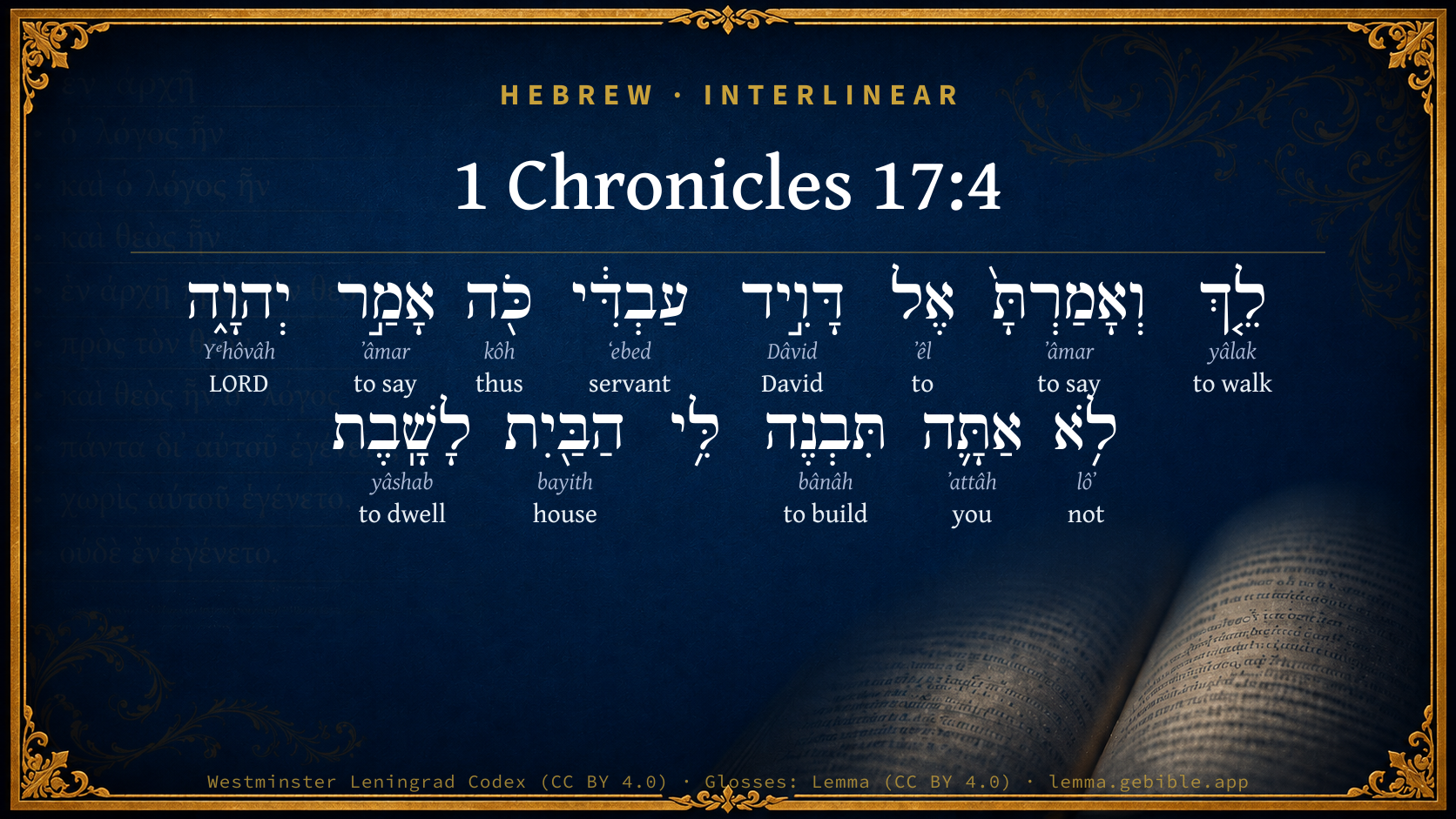
1 Chronicles 17:4

Hebrew (Westminster Leningrad Codex) 1 Chronicles 17:4 appears in the Hebrew Old Testament. The text above is from the Westminster Leningrad Codex. Each word links to its Strong’s number, a concise gloss, and parsing drawn from the Open Scriptures Hebrew Bible morphology. Click any word for its full Brown-Driver-Briggs (BDB) entry.
Download image
Cite this verse

1 Chronicles 17:4 (World English Bible). Public Domain. Lemma interlinear Bible study tool, https://lemma.gebible.app/v/1-chronicles/17/4.

Show BibTeX & RIS
BibTeX
RIS
English Translation
Go and tell David my servant, Thus says Yahweh, You shall not build me a house to dwell in:
World English Bible · Public Domain
Download a study sheet

One document with this verse’s original text, its word-by-word gloss line, the meaning frame, cross-references with their text, attributed commentary, and full source and license credits — printable, and it pastes into notes with its structure intact.

This verse Autodidact and up

Study sheet (.html) Plain text (.txt)

A passage Seminary Student

Up to 50 verses in one chapter. A passage sheet keeps up to 6 commentary sources and 12 cross-references per verse, in the order this page ranks them, and says so on the sheet whenever that leaves anything out. Ask for a single verse and you get the Autodidact verse sheet above.

Everything on this page stays free to read, with no account — the sheet is a download of what is already on screen, not access to it.

Want to remove ads? Support Godless Engineer
Compare translations 3

The same verse in 3 English versions, stacked beneath the original-language interlinear above. Click any original word for its lexicon entry.

Each is an independent rendering of the whole verse — the interlinear is not word-aligned to these translations.

Highlighted words mark where these versions differ — a whole-verse word diff, not a word-by-word alignment.

  • World English Bible Public Domain
    Go and tell David my servant, Thus says Yahweh, You shall not build me a house to dwell in:
  • King James Version Public Domain
    Go and tell David my servant, Thus saith the LORD, Thou shalt not build me an house to dwell in:
  • unfoldingWord Literal Text CC BY-SA 4.0
    “Go, and you shall say to David my servant, ‘Thus says Yahweh, “You, you shall not build for me a house for dwelling.

unfoldingWord Literal Text — © unfoldingWord, licensed CC BY-SA 4.0. Word-aligned USFM3 via Door43 (git.door43.org/unfoldingWord/en_ult).

Versions to compare (up to 4)

3 of 4 selected

Show all 18 translations

Every available English version of this verse, each an independent rendering of the whole verse.

  • World English Bible Public Domain
    Go and tell David my servant, Thus says Yahweh, You shall not build me a house to dwell in:
  • Berean Standard Bible Public Domain
    “Go and tell My servant David that this is what the LORD says: You are not the one to build Me a house in which to dwell.
  • Majority Standard Bible Public Domain
    “Go and tell My servant David that this is what the LORD says: You are not the one to build Me a house in which to dwell.
  • King James Version Public Domain
    Go and tell David my servant, Thus saith the LORD, Thou shalt not build me an house to dwell in:
  • American Standard Version (1901) Public Domain
    Go and tell David my servant, Thus saith Jehovah, Thou shalt not build me a house to dwell in:
  • Revised Version (1885) Public Domain
    Go and tell David my servant, Thus saith the LORD, Thou shalt not build me an house to dwell in:
  • Geneva Bible (1599) Public Domain
    Goe, and tell Dauid my seruant, Thus saith the Lord, Thou shalt not buylde me an house to dwell in:
  • Douay-Rheims (1899) Public Domain
    Go, and speak to David my servant: Thus saith the Lord: Thou shalt not build me a house to dwell in.
  • Young's Literal Translation Public Domain
    `Go, and thou hast said unto David My servant, Thus said Jehovah, Thou dost not build for Me the house to dwell in:
  • Literal Standard Version CC BY-SA 4.0
    “Go, and you have said to My servant David, Thus said YHWH: You do not build for Me the house to dwell in.
  • Unlocked Literal Bible CC BY-SA 4.0
    “Go and tell David my servant, 'This is what Yahweh says: You will not build me a house in which to live.
  • unfoldingWord Literal Text CC BY-SA 4.0
    “Go, and you shall say to David my servant, ‘Thus says Yahweh, “You, you shall not build for me a house for dwelling.
  • Darby Bible Public Domain
    Go and say to David my servant, Thus saith Jehovah: Thou shalt not build me a house to dwell in;
  • World Messianic Bible Public Domain
    “Go and tell David my servant, ‘The LORD says, “You shall not build me a house to dwell in;
  • Webster's Bible Public Domain
    Go and tell David my servant, Thus saith the LORD, Thou shalt not build me a house to dwell in:
  • Free Bible Version CC BY-SA 4.0
    “Go and talk to my servant David. Tell him, this is what the Lord says: You are not to build a house for me to live in.
  • Bible in Basic English Public Domain
    Go and say to David my servant, The Lord says, You are not to make me a house for my living-place:
  • JPS Tanakh (1917) Public Domain
    'Go and tell David My servant: Thus saith the LORD: Thou shalt not build Me a house to dwell in;

Literal Standard Version (2020), Covenant Press — licensed CC BY-SA 4.0. Text via the HelloAO Bible API (eBible.org). Unlocked Literal Bible (unfoldingWord) — licensed CC BY-SA 4.0. Text via the HelloAO Bible API (eBible.org). unfoldingWord Literal Text — © unfoldingWord, licensed CC BY-SA 4.0. Word-aligned USFM3 via Door43 (git.door43.org/unfoldingWord/en_ult). Free Bible Version, Dr. Jonathan Gallagher — licensed CC BY-SA 4.0. Text via the HelloAO Bible API (eBible.org).

Word by word

More ways to search: Search by grammar → Find every occurrence → Compare this word →

Practice this passage: Drill this verse → Learn its vocabulary →

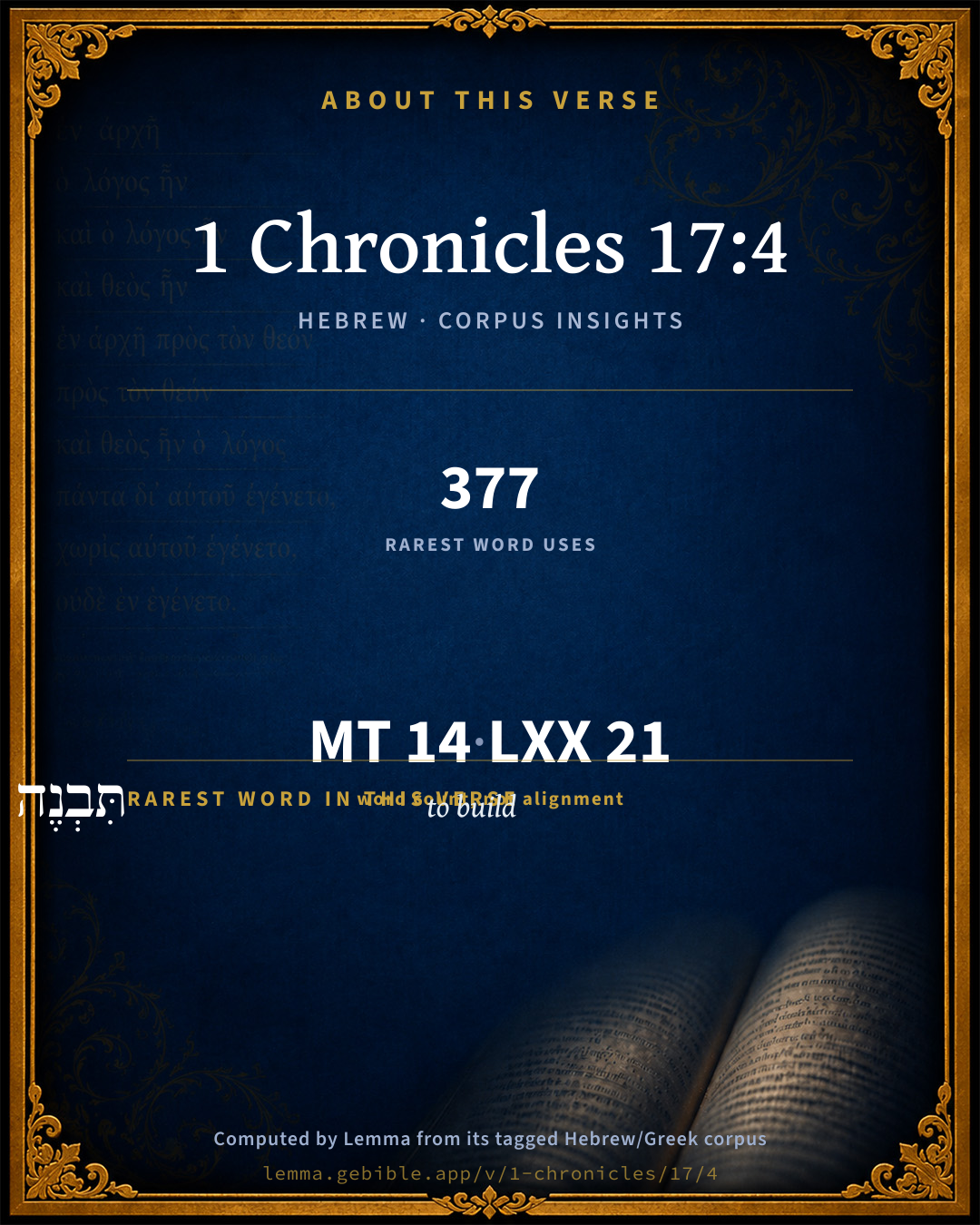
תִּבְנֶה
bânâh
H1129
“to build”
Verb, Qal, Imperfect, 2nd Person, Masculine, Singular
Part of Speech
Verb
Stem
Qal
Form
Imperfect
Person
2nd Person
Gender
Masculine
Number
Singular
Full BDB Definition

Origin: a primitive root

TWOT: 255

to build, rebuild, establish, cause to continue - (Qal) - to build, rebuild - to build a house (i.e., establish a family) - (Niphal) - to be built - to be rebuilt - established (of restored exiles) (figuratively) - established (made permanent) - to be built up (of childless wife becoming the mother of a family through the children of a concubine)
  1. לֵ֤ךְ yâlak H3212 “walk” Verb, Qal, Imperative, 2nd Person, Masculine, Singular
  2. וְאָמַרְתָּ֙ ʼâmar H559 “and · to say” Conjunction + Verb, Qal, Sequential Perfect, 2nd Person, Masculine, Singular
  3. אֶל ʼêl H413 “to” Preposition
  4. דָּוִ֣יד Dâvid H1732 “David” Noun, Proper
  5. עַבְדִּ֔י ʻebed H5650 “servant · my” Noun, Common, Masculine, Singular, Construct + Suffix, Personal, 1st Person, Common, Singular
  6. כֹּ֖ה kôh H3541 “thus” Adverb
  7. אָמַ֣ר ʼâmar H559 “to say” Verb, Qal, Perfect, 3rd Person, Masculine, Singular
  8. יְהוָ֑ה Yᵉhôvâh H3068 “LORD” Noun, Proper
  9. לֹ֥א lôʼ H3808 “not” Particle, Negative
  10. אַתָּ֛ה ʼattâh H859 “you” Pronoun, Personal, 2nd Person, Masculine, Singular
  11. הַבַּ֖יִת bayith H1004 “the · house” Particle, Definite Article + Noun, Common, Masculine, Singular, Absolute
  12. לָשָֽׁבֶת yâshab H3427 “to dwell” Preposition + Verb, Qal, Infinitive Construct

About this verse

These counts appear in no published source. They are computed here, from the morphology-tagged text and Lemma’s own curated glosses. What Lemma adds →

14
words
12
distinct lemmas
Historical
section

Grammatical profile

  • 5 verbs
  • 4 nouns
  • 1 pronoun
  • 2 prepositions
  • 1 adverb
  • 1 particle

Verb forms

  • לֵ֤ךְ Qal · Imperative
  • וְאָמַרְתָּ֙ Qal · Sequential Perfect
  • אָמַ֣ר Qal · Perfect
  • תִּבְנֶה Qal · Imperfect
  • לָשָֽׁבֶת Qal · Infinitive Construct

Repetition

A word recurs within this verse — often emphatic in Hebrew:

  • וְאָמַרְתָּ֙ to say H559 ×2

Hebrew & Septuagint length

In English translation the verse runs 19 words from the Hebrew and 24 from the Septuagint (LXX English) — closely comparable.

A rough comparison of the two English renderings, which tokenize alike — not a word-level alignment.

Word counts can differ between the Hebrew and the Greek without any difference in meaning — e.g. the Hebrew direct-object marker אֵת has no separate Greek word, and Greek often adds the article ὁ.

In the original languages it is 14 Hebrew tokens and 21 Greek tokens — but the two are counted differently (Hebrew bundles its prefixes and suffixes into one token; the Greek is in lemma form), so that isn’t a like-for-like length.

Cross-references

7

Topical passages linked to 1 Chronicles 17:4 in the Treasury of Scripture Knowledge — connected by theme and wording, ordered by reader-vote popularity; previews shown in the World English Bible.

  • 1 Chronicles 28:2–3 Then David the king stood up on his feet, and said, Hear me, my brothers, and my people: as for me, it was in my heart to build a house of rest for the ark of the covenant of Yahweh, and for the footstool of our God; and I had made ready for the building.
  • 2 Samuel 7:4–5 It happened the same night, that the word of Yahweh came to Nathan, saying,
  • 1 Kings 8:19 nevertheless you shall not build the house; but your son who shall come forth out of your loins, he shall build the house for my name.
  • Isaiah 55:8–9 For my thoughts are not your thoughts, neither are your ways my ways, says Yahweh.
  • 1 Chronicles 22:7–8 David said to Solomon his son, As for me, it was in my heart to build a house to the name of Yahweh my God.
  • 2 Chronicles 6:8–9 But Yahweh said to David my father, Whereas it was in your heart to build a house for my name, you did well that it was in your heart:
  • Romans 11:33–34 Oh the depth of the riches both of the wisdom and the knowledge of God! How unsearchable are his judgments, and his ways past tracing out!

Cross-references courtesy of OpenBible.info (CC BY 4.0).

Hebrew and Greek witnesses Masoretic Hebrew ↔ Greek Septuagint

The same verse in the two great witnesses to the Old Testament, shown verse-for-verse.

These are two independent witnesses, not word-aligned to each other, and the Septuagint is shown in lemma (dictionary) form.

Hebrew 1 Chronicles 17:4 Masoretic · Westminster Leningrad Codex

לֵ֤ךְ וְאָמַרְתָּ֙ אֶל דָּוִ֣יד עַבְדִּ֔י כֹּ֖ה אָמַ֣ר יְהוָ֑ה לֹ֥א אַתָּ֛ה תִּבְנֶה לִּ֥י הַבַּ֖יִת לָשָֽׁבֶת

Go and tell David my servant, Thus says Yahweh, You shall not build me a house to dwell in:

World English Bible · Public Domain

Greek LXX 1 Chronicles 17:4 Septuagint · lemma form

πορεύομαι καί εἶπον πρός δαυίδ ὁ παῖς ἐγώ οὕτως εἶπον κύριος οὐ σύ οἰκοδομέω ἐγώ οἶκος ὁ καταοἰκέω ἐγώ ἐν αὐτός

Go and say to David my servant, Thus said the Lord, You shall not build me a house for me to dwell in it.

LXX2012 (modern English Septuagint) · Public Domain

Hebrew: Westminster Leningrad Codex (CC BY 4.0). Greek: Septuagint (public domain); English from LXX2012 (modern English Septuagint) (Public Domain). How the Septuagint differs from the Hebrew →

Commentary

Notes on 1 Chronicles 17:4 from classic Christian and Jewish commentators (each source and its license shown beneath its notes). The classic Christian expositions comment on the surrounding passage and are grouped to its opening verse, so a note may address several verses; the Jewish commentaries on the Tanakh (Rashi and others) are per-verse, so they appear only where the commentator wrote on this verse.

Lemma curates 59 commentaries, every one of them public domain or Creative Commons licensed, each selected and text-cleaned for this edition rather than reprinted as found. About our sources →

Ellicott's Commentary for English Readers

(4) David my servant.—Samuel, “unto my servant, unto David.”

Thou shalt not build me an house to dwell in.—Rather, It is not thou that shalt build me the house to dwell in. Samuel, interrogatively, implying a negation, “Wilt thou build me a house for me to dwell in?” The chronicler, thinking of the famous Temple of Solomon, writes, “the house.”

A Bible Commentary for English Readers, edited by Charles John Ellicott (1878–1897) — public domain. Text from a community e-Sword module.

The Pulpit Commentary

Vers. 4-15. These verses are the unfolding to David of the magnificent and far-stretching purposes of God"s grace towards him in his son Solomon and his descendants for ever. The revelation is made by the mouth of Nathan.

Thou shalt not build. The Hebrew marks the personal pronoun here as emphatic," Not thou shalt build," i.e. but some one else. In the parallel this prohibition is conveyed by that interrogative particle which expects the answer No, and may be thus translated: "Is it thou shalt build for me," etc.?

Unfitness for some parts of God"s work.

God sent a distinct refusal of David"s request by the Prophet Nathan. "Thou shalt not build me a house to dwell in" But this refusal may not be regarded as an act of mere sovereignty; it was based upon the Divine recognition of the unfitness of David as the instrument for this particular work. Much he might do for God, but this he may not do; and the disability even followed upon his very fitness for the other work which God had called him to do. He was a man of war. His work had been the extending and settling of the new kingdom. But the "man of blood" must give place to the "man of rest," to whom could be more wisely committed the work of building a temple for God. We are here taught that God"s work, which he would have done on earth, is divided into pieces; that one piece only is usually committed to the trust of each man; that every man finds he has one such trust, and that all the pieces and parts fit together, and make up one great whole of Divine purpose. There is a Divine arrangement of the pieces. There is a Divine allotment of the pieces to individuals. And this involves the selection of individuals upon a Divine recognition of particular gifts and endowments. Then a man may be either fitted or unfitted for some positions and for some work; and God will, by his providence, guide each man to the work that he may hopefully do; and no man has occasion to envy the place or work of another man.

I MAN MAY WISH FOR SPHERES or SERVICE. God does not reproach David for wishing to build the temple. He now says, "Thou didst well that it was in thine heart." It is a good sign that we want to serve; though so often it is only a sign of our restlessness in the work we have, and our foolish fancying that some one else"s work is better, or easier, or nobler than our own. Faithful doing of present duty may be quite consistent with earnest desire to do something else and better, provided it finds expression, as David"s did, in patient waiting on God, and earnest prayer for Divine direction.

II MAN MAY BE UNDER DISABILITIES WHICH HINDER HIM FROM THE SPHERES HE SEEKS. Such disabilities may arise out of natural disposition and character; educational conditions; local circumstances; or, as in David"s case, out of the very life-work which may be entrusted to us. When we remember how actions bear the stamp of the character of those who perform them, and men receive their impressions of the thing itself from the person who does it, we realize how God may properly refuse to permit us to do just the work we may wish to do. We need to satisfy ourselves that God knows both us and our work, and so can fitly match the two together, and keep us from unfitting spheres.

III THE GREAT SECRET OF OUR DUTY IS THE DOING WELL WHAT WE PLAINLY HAVE TO DO. Forming a very high value of our present trust. Quite sure that it is the very thing for us; and cherishing the assurance that God makes our work fit into the work that others do, and that the very thing which we would like to have done ourselves, God gets done in his own time and way, and by the agents he pleases. "One planteth, another watereth," and God gives the increase that crowns the union of various labourers and labours.

We may learn:

1. The lesson of submissive obedience to the Divine appointments.

2. The importance of keeping our minds free from all envy of otherworkers, even of those who seem to he doing the very work which we would like to have done.

3. And to be thankful for the work that is entrusted to us; quick to discernthe dignity and importance of it; and supremely anxious that we should be found of God faithful in the doing of it. R.T.

The Pulpit Commentary (1880–1919), ed. H.D.M. Spence-Jones & Joseph S. Exell — public domain. Text from a community e-Sword module.

Lesson kit

Teaching starters — assembled from the data on this page, not authored interpretation. Every prompt links to the verse data it draws on. Edit before teaching.

1 Chronicles, in the Historical, opens this verse with 14 words (12 distinct Hebrew lemmas). Its most distinctive word is bânâh (“to build”). A historical commentator’s framing appears above. Read the whole chapter for the surrounding context.

Discussion questions

  1. The word bânâh carries the sense “to build.” How does it shape the verse?
  2. How does 1 Chronicles 28:2–3, which shares this passage’s theme, read alongside this verse?
  3. What does the repetition of “to say” (2× in this one verse) do in this verse?
  4. These translations render this verse differently; the difference is in the English rendering, not the original. What questions does that raise?
  5. «לֵ֤ךְ» is a Qal Imperative verb. How does that grammatical form shape the action described?
  6. Compare how Ellicott's Commentary for English Readers and The Pulpit Commentary read this verse. Where do they agree or differ?

Things to notice

Reading settings

Reading text

Shown beneath each verse's original-language words.

Old Testament
Old Testament edition

Read the OT as the Masoretic Hebrew (MT) or the Greek Septuagint (LXX).

English shown for the Greek Septuagint (in the Hebrew ↔ Greek comparison).

Comparing translations? Open the Compare panel on any verse page to stack up to four side by side.