1 Chronicles 4:31

Hebrew (Westminster Leningrad Codex) 1 Chronicles 4:31 appears in the Hebrew Old Testament. The text above is from the Westminster Leningrad Codex. Each word links to its Strong’s number, a concise gloss, and parsing drawn from the Open Scriptures Hebrew Bible morphology. Click any word for its full Brown-Driver-Briggs (BDB) entry.
Download image
Cite this verse

1 Chronicles 4:31 (World English Bible). Public Domain. Lemma interlinear Bible study tool, https://lemma.gebible.app/v/1-chronicles/4/31.

Show BibTeX & RIS
BibTeX
RIS
English Translation
and at Beth Marcaboth, and Hazar Susim, and at Beth Biri, and at Shaaraim. These were their cities to the reign of David.
World English Bible · Public Domain
Highlights
  • 2 first appearances in the Hebrew Bible
Full analysis ↓
Download a study sheet

One document with this verse’s original text, its word-by-word gloss line, the meaning frame, cross-references with their text, attributed commentary, and full source and license credits — printable, and it pastes into notes with its structure intact.

This verse Autodidact and up

Study sheet (.html) Plain text (.txt)

A passage Seminary Student

Up to 50 verses in one chapter. A passage sheet keeps up to 6 commentary sources and 12 cross-references per verse, in the order this page ranks them, and says so on the sheet whenever that leaves anything out. Ask for a single verse and you get the Autodidact verse sheet above.

Everything on this page stays free to read, with no account — the sheet is a download of what is already on screen, not access to it.

Want to remove ads? Support Godless Engineer
Compare translations 3

The same verse in 3 English versions, stacked beneath the original-language interlinear above. Click any original word for its lexicon entry.

Each is an independent rendering of the whole verse — the interlinear is not word-aligned to these translations.

Highlighted words mark where these versions differ — a whole-verse word diff, not a word-by-word alignment.

  • World English Bible Public Domain
    and at Beth Marcaboth, and Hazar Susim, and at Beth Biri, and at Shaaraim. These were their cities to the reign of David.
  • King James Version Public Domain
    And at Bethmarcaboth, and Hazarsusim, and at Bethbirei, and at Shaaraim. These were their cities unto the reign of David.
  • unfoldingWord Literal Text CC BY-SA 4.0
    and in Beth Markaboth and in Hazar Susim,and in Beth Biri and in Shaaraim. These their cities unto the reign of David.

unfoldingWord Literal Text — © unfoldingWord, licensed CC BY-SA 4.0. Word-aligned USFM3 via Door43 (git.door43.org/unfoldingWord/en_ult).

Versions to compare (up to 4)

3 of 4 selected

Show all 18 translations

Every available English version of this verse, each an independent rendering of the whole verse.

  • World English Bible Public Domain
    and at Beth Marcaboth, and Hazar Susim, and at Beth Biri, and at Shaaraim. These were their cities to the reign of David.
  • Berean Standard Bible Public Domain
    Beth-marcaboth, Hazar-susim, Beth-biri, and Shaaraim. These were their cities until the reign of David.
  • Majority Standard Bible Public Domain
    Beth-marcaboth, Hazar-susim, Beth-biri, and Shaaraim. These were their cities until the reign of David.
  • King James Version Public Domain
    And at Bethmarcaboth, and Hazarsusim, and at Bethbirei, and at Shaaraim. These were their cities unto the reign of David.
  • American Standard Version (1901) Public Domain
    and at Beth-marcaboth, and Hazar-susim, and at Beth-biri, and at Shaaraim. These were their cities unto the reign of David.
  • Revised Version (1885) Public Domain
    and at Beth-marcaboth, and Hazar-susim, and at Beth-biri, and at Shaaraim. These were their cities unto the reign of David.
  • Geneva Bible (1599) Public Domain
    And at Beth-marcaboth, and at Hazar Susim, at Beth-birei, and at Shaaraim, these were their cities vnto the reigne of Dauid.
  • Douay-Rheims (1899) Public Domain
    And in Bethmarchaboth, and in Hasarsusim, and in Bethberai, and in Saarim. These were their cities unto the reign of David.
  • Young's Literal Translation Public Domain
    and in Beth-Marcaboth, and in Hazar-Susim, and in Beth-Birei, and in Shaarim; these `are' their cities till the reigning of David.
  • Literal Standard Version CC BY-SA 4.0
    and in Beth-Marcaboth, and in Hazar-Susim, and in Beth-Birei, and in Shaarim; these [are] their cities until the reigning of David.
  • Unlocked Literal Bible CC BY-SA 4.0
    Beth Markaboth, Hazar Susim, Beth Biri, and Shaaraim. These were their cities until the reign of David.
  • unfoldingWord Literal Text CC BY-SA 4.0
    and in Beth Markaboth and in Hazar Susim,and in Beth Biri and in Shaaraim. These their cities unto the reign of David.
  • Darby Bible Public Domain
    and at Beth-marcaboth, and Hazar-susim, and at Beth-biri, and at Shaaraim. These were their cities until the reign of David.
  • World Messianic Bible Public Domain
    at Beth Marcaboth, Hazar Susim, at Beth Biri, and at Shaaraim. These were their cities until David’s reign.
  • Webster's Bible Public Domain
    And at Beth-marcaboth, and Hazar-susim, and at Beth-birei, and at Shaaraim. These were their cities to the reign of David.
  • Free Bible Version CC BY-SA 4.0
    Beth Marcaboth, Hazar Susim, Beth Biri, and Shaaraim. These were their towns until David became king.
  • Bible in Basic English Public Domain
    And at Beth-marcaboth, and at Hazarsusim, and at Beth-biri, and at Shaaraim. These were their towns till David became king.
  • JPS Tanakh (1917) Public Domain
    and at Beth-marcaboth, and Hazar-susim, and at Beth-biri, and at Shaaraim. These were their cities unto the reign of David.

Literal Standard Version (2020), Covenant Press — licensed CC BY-SA 4.0. Text via the HelloAO Bible API (eBible.org). Unlocked Literal Bible (unfoldingWord) — licensed CC BY-SA 4.0. Text via the HelloAO Bible API (eBible.org). unfoldingWord Literal Text — © unfoldingWord, licensed CC BY-SA 4.0. Word-aligned USFM3 via Door43 (git.door43.org/unfoldingWord/en_ult). Free Bible Version, Dr. Jonathan Gallagher — licensed CC BY-SA 4.0. Text via the HelloAO Bible API (eBible.org).

Word by word

More ways to search: Search by grammar → Find every occurrence → Compare this word →

Practice this passage: Drill this verse → Learn its vocabulary →

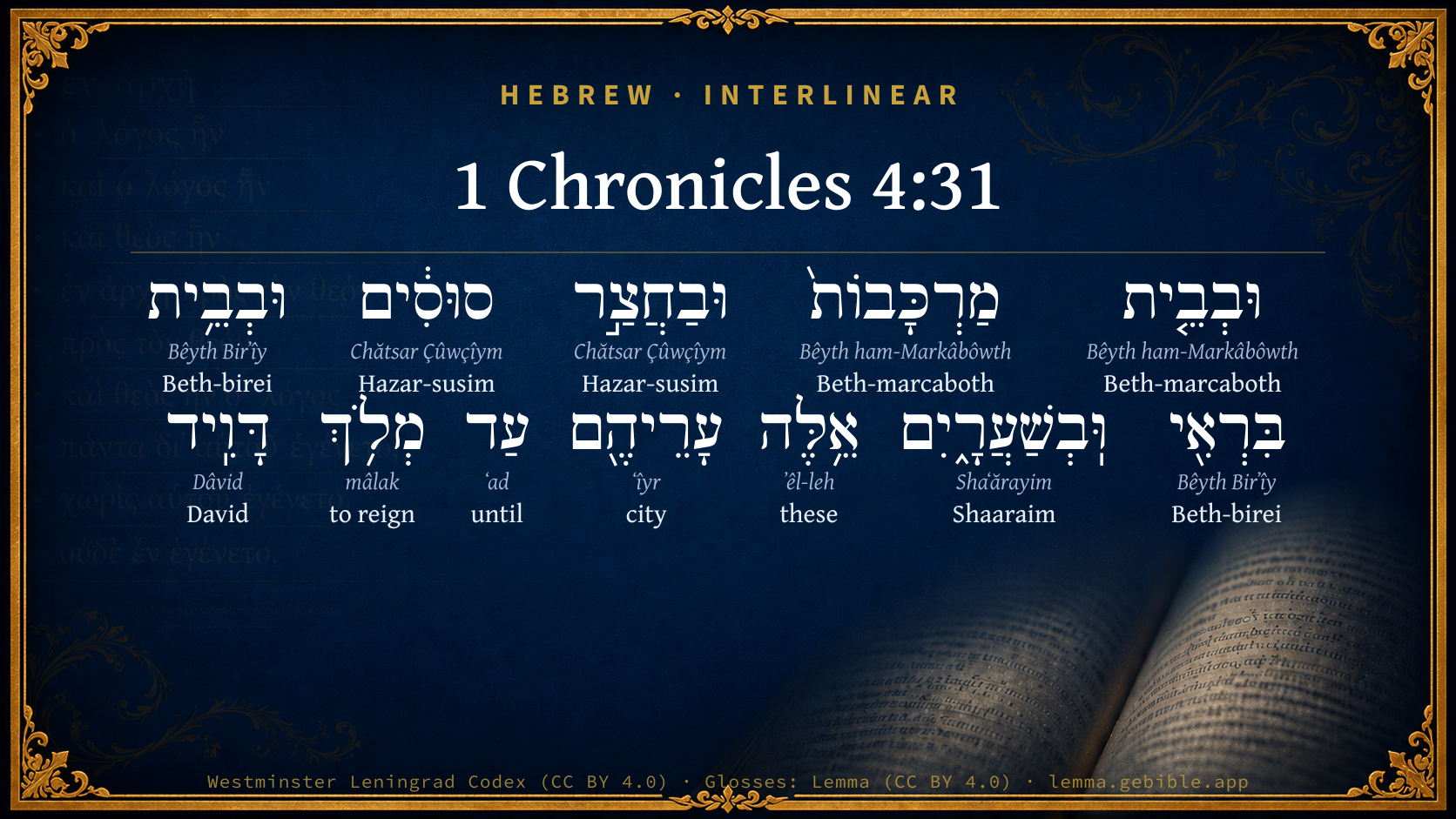
וּבַחֲצַ֣ר
Chătsar Çûwçîym
H2702
“and · in/at · Hazar-susim”
Conjunction + Preposition + Noun, Proper
Part of Speech
Conjunction + Preposition + Noun
Type
Proper
Full BDB Definition

Origin: from H2691 and the plural of H5483

TWOT: None

Hazar-susim = "village of horses" - a place in Simeon
  1. וּבְבֵ֤ית Bêyth ham-Markâbôwth H1024 “and · in/at · Beth-marcaboth” Conjunction + Preposition + Noun, Proper
  2. מַרְכָּבוֹת֙ Bêyth ham-Markâbôwth H1024 “Beth-marcaboth” Noun, Proper
  3. סוּסִ֔ים Chătsar Çûwçîym H2702 “Hazar-susim” Noun, Proper
  4. וּבְבֵ֥ית Bêyth Birʼîy H1011 “and · in/at · Beth-birei” Conjunction + Preposition + Noun, Proper
  5. בִּרְאִ֖י Bêyth Birʼîy H1011 “Beth-birei” Noun, Proper
  6. וּֽבְשַׁעֲרָ֑יִם Shaʻărayim H8189 “and · in/at · Shaaraim” Conjunction + Preposition + Noun, Proper
  7. אֵ֥לֶּה ʼêl-leh H428 “these” Pronoun, Demonstrative, Common, Plural
  8. עָרֵיהֶ֖ם ʻîyr H5892 “cities · their” Noun, Common, Feminine, Plural, Construct + Suffix, Personal, 3rd Person, Masculine, Plural
  9. עַד ʻad H5704 “until” Preposition
  10. מְלֹ֥ךְ mâlak H4427 “to reign” Verb, Qal, Infinitive Construct
  11. דָּוִֽיד Dâvid H1732 “David” Noun, Proper

About this verse

These counts appear in no published source. They are computed here, from the morphology-tagged text and Lemma’s own curated glosses. What Lemma adds →

12
words
9
distinct lemmas
Historical
section

Notable vocabulary

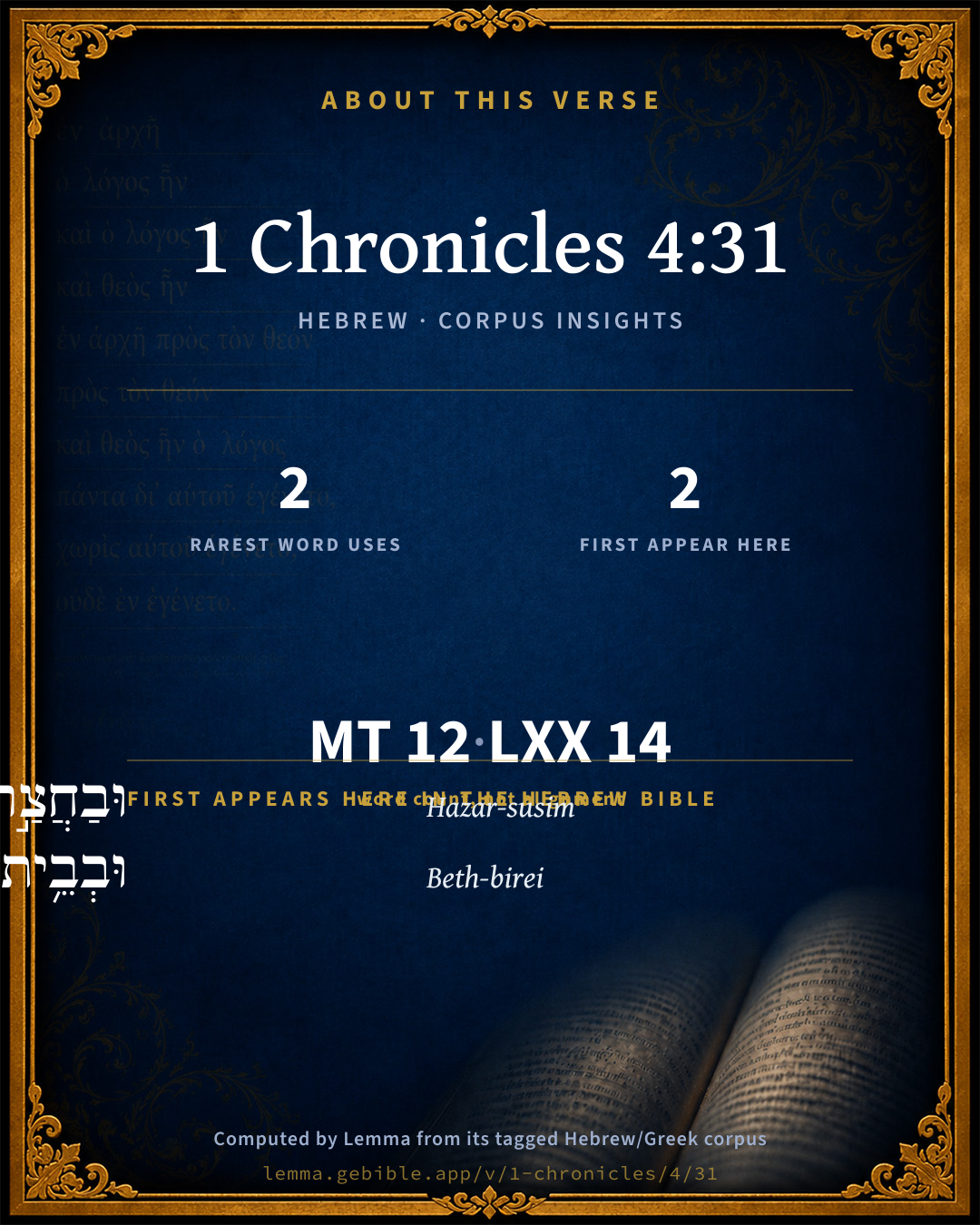
The rarest word here is וּבַחֲצַ֣ר Hazar-susim H2702 — appearing just 2 times in the whole Hebrew Bible.

First appearance in Scripture

These words make their first canonical appearance in the Hebrew Bible here:

  • וּבַחֲצַ֣ר Hazar-susim H2702
  • וּבְבֵ֥ית Beth-birei H1011

Grammatical profile

  • 1 verb
  • 9 nouns
  • 1 pronoun
  • 1 preposition

Verb forms

  • מְלֹ֥ךְ Qal · Infinitive Construct

Repetition

Words recur within this verse — often emphatic in Hebrew:

  • וּבְבֵ֤ית Beth-marcaboth H1024 ×2
  • וּבַחֲצַ֣ר Hazar-susim H2702 ×2
  • וּבְבֵ֥ית Beth-birei H1011 ×2

Hebrew & Septuagint length

In English translation the verse runs 23 words from the Hebrew and 20 from the Septuagint (LXX English) — closely comparable.

A rough comparison of the two English renderings, which tokenize alike — not a word-level alignment.

Word counts can differ between the Hebrew and the Greek without any difference in meaning — e.g. the Hebrew direct-object marker אֵת has no separate Greek word, and Greek often adds the article ὁ.

In the original languages it is 12 Hebrew tokens and 14 Greek tokens — but the two are counted differently (Hebrew bundles its prefixes and suffixes into one token; the Greek is in lemma form), so that isn’t a like-for-like length.

Cross-references

1

Topical passages linked to 1 Chronicles 4:31 in the Treasury of Scripture Knowledge — connected by theme and wording, ordered by reader-vote popularity; previews shown in the World English Bible.

Cross-references courtesy of OpenBible.info (CC BY 4.0).

Hebrew and Greek witnesses Masoretic Hebrew ↔ Greek Septuagint

The same verse in the two great witnesses to the Old Testament, shown verse-for-verse.

These are two independent witnesses, not word-aligned to each other, and the Septuagint is shown in lemma (dictionary) form.

Hebrew 1 Chronicles 4:31 Masoretic · Westminster Leningrad Codex

וּבְבֵ֤ית מַרְכָּבוֹת֙ וּבַחֲצַ֣ר סוּסִ֔ים וּבְבֵ֥ית בִּרְאִ֖י וּֽבְשַׁעֲרָ֑יִם אֵ֥לֶּה עָרֵיהֶ֖ם עַד מְלֹ֥ךְ דָּוִֽיד

and at Beth Marcaboth, and Hazar Susim, and at Beth Biri, and at Shaaraim. These were their cities to the reign of David.

World English Bible · Public Domain

Greek LXX 1 Chronicles 4:31 Septuagint · lemma form

καί βαιθμαρχαβωθ καί ἥμισυς σωσιμ καί οἶκος βαρουμσεωριμ οὗτος πόλις αὐτός ἕως βασιλεύς δαυίδ

and in Baethmarimoth, and Hemisuseosin, and the house of Baruseorim: these were their cities until the time of king David.

LXX2012 (modern English Septuagint) · Public Domain

Hebrew: Westminster Leningrad Codex (CC BY 4.0). Greek: Septuagint (public domain); English from LXX2012 (modern English Septuagint) (Public Domain). How the Septuagint differs from the Hebrew →

Commentary

Notes on 1 Chronicles 4:31 from classic Christian and Jewish commentators (each source and its license shown beneath its notes). The classic Christian expositions comment on the surrounding passage and are grouped to its opening verse, so a note may address several verses; the Jewish commentaries on the Tanakh (Rashi and others) are per-verse, so they appear only where the commentator wrote on this verse.

Lemma curates 59 commentaries, every one of them public domain or Creative Commons licensed, each selected and text-cleaned for this edition rather than reprinted as found. About our sources →

Trapp's Complete Commentary

John Trapp

1Ch 4:31 And at Bethmarcaboth, and Hazarsusim, and at Bethbirei, and at Shaaraim. These [were] their cities unto the reign of David.

Ver. 31. Unto the reign of David.] Who restored Ziklag and some others of them to the tribe of Judah, saith Lyra.

John Trapp, A Commentary or Exposition upon All the Books of the Old and New Testament (1647–1656) — public domain. Text from a community e-Sword module.

Joseph Benson's Commentary

1Ch 4:31. These were their cities — Several of these cities, though given to Simeon by Joshua, yet, through the sloth or cowardice of that tribe, were not taken from the Philistines until David’s time, who took some of them, and, the Simeonites having justly forfeited their right to them by their neglect, gave them to his own tribe. For it is evident concerning Ziklag, one of them, that it was in the Philistines’ hands in David’s time, and by them given to him, and by him annexed to the tribe of Judah, 1Sa 27:6.

Joseph Benson's Commentary on the Old and New Testaments (1811–1818) — public domain. Text from a community e-Sword module.

Geneva Bible (1599)

Geneva Bible translators

Then David restored them to the tribe of Judah.

Geneva Bible (1599) marginal notes — public domain. Text via Bolls.life.

Jamieson, Fausset & Brown

Robert Jamieson, A. R. Fausset & David Brown

These were their cities unto the reign of David--In consequence of the sloth or cowardice of the Simeonites, some of the cities within their allotted territory were only nominally theirs. They were never taken from the Philistines until David's time, when, the Simeonites having forfeited all claim to them, he assigned them to his own tribe of Judah (Sa1 27:6).

Jamieson, Fausset & Brown — Commentary Critical and Explanatory on the Whole Bible (1871) — public domain (CC PDM 1.0). Text via the HelloAO Bible API.

Adam Clarke's Commentary

Verse 31. These were their cities unto the reign of David.] It appears that David took some of the cities of the Simeonites, and added them to Judah; Ziklag for instance, 1Sa 27:6.

As the tribe of Simeon had withdrawn their allegiance from the house of David, the kings of Judah extended their domination as far as possible into the territories of that tribe, so that they were obliged to seek pasture for their flocks at Gedor, and in the mountains of Seir, as we find 1Ch 4:39-42.

Adam Clarke's Commentary on the Bible (1810–1826) — public domain. Text from a community e-Sword/MySword module.

Ellicott's Commentary for English Readers

(31) Beth-marcaboth = “house of chariots.”

Hazar - susim = “village of horses;” for which Hazarsusah is an equivalent (susah being used as a collective word).

Beth-birei.—Probably a corrupt writing of Beth-lebaoth, “house of lionesses” (Jos_19:6), for which Jos_15:32 has the contraction Lebaoth. There were lions in the wilds of Judah (1Sa_17:34). (Comp. Jdg_14:5; 1Ki_13:24.)

Shaaraim (two gates) is Sharuhen (Jos_19:6), and Shilhim (Jos_15:32). Sharuhen is known from Egyptian inscriptions (Sharuhuna).

These were their cities unto the reign of David, and their villages.—Jos_19:6 shows that this is the right punctuation: “And Beth-lebaoth and Sharuhen: thirteen towns, and their villages.”

Unto the reign of David.—Does this mean that in the age of David the thirteen cities passed from the possession of the Simeonites? Ziklag, at all events, was at that time a Philistine borough (1Sa_27:6).

A Bible Commentary for English Readers, edited by Charles John Ellicott (1878–1897) — public domain. Text from a community e-Sword module.

The Cambridge Bible for Schools and Colleges

gen. ed. J. J. S. Perowne

31. Beth-marcaboth … Hazar-susim] These names mean respectively, House of chariots, and Court of horses. They may have been royal chariot-cities, 1Ki_9:19.

Shaaraim] 1Sa_17:52.

These were their cities unto the reign of David] This may he a reference to David’s census, which doubtless shewed generally the possessions of tribes or families as well as their numbers. It does not necessarily mean that these cities ceased to belong to Simeon after David’s day.

The Cambridge Bible for Schools and Colleges (gen. ed. J. J. S. Perowne; Cambridge University Press, 1878–1918) — public domain. Text from a community e-Sword module.

Albert Barnes' Notes on the Bible

Unto the reign of David - It is not quite clear why this clause is added. Perhaps the writer is quoting from a document belonging to David’s reign. Or, he may mean that some of the cities, as Ziklag 1Sa 27:6, were lost to Simeon about David’s time.

Albert Barnes' Notes on the Bible (1834–1885) — public domain. Text from a community e-Sword/MySword module.

Haydock's Catholic Bible Commentary

David, who had Siceleg given to him, 1 Kings xxvii. 6. (Haydock) --- After the schism, Juda straitened the tribe of Simeon; so that it was forced to seek for other habitations in Gador, under Ezechias, ver. 39., &c. (Calmet) --- It could no longer reside among those of the tribe of Juda, (Du Hamel) and acknowledge another king. (Haydock)

George Leo Haydock (1774–1849), Haydock's Catholic Family Bible and Commentary, 1859 edition — public domain. Excludes Psalms (Douay-Rheims chapter numbering differs from Protestant) and Deuterocanonical books (Catholic canon only).

Matthew Poole's English Annotations

Either,

1. Of David’s posterity, i.e. as long as the kingdom of Judah lasted, or until the captivity of Babylon. But this seems not to be true, for Simeon was gone into captivity with the rest of the ten tribes long before that time. Or rather,

2. Of David himself. And this may seem to be added, because some of these cities, though given to Simeon by Joshua, yet through the sloth or cowardice of that tribe were not taken from the Philistines until David’s time, who took some of them, and, the Simeonites having justly forfeited their right to them by their neglect, gave them to his own tribe. For it is evident concerning Ziklag, one of them, that it was in the Philistines’ hands in David’s time, and by them given to him, and by him annexed to the tribe of Judah, 1Sa 27:6.

Matthew Poole's English Annotations on the Holy Bible (1683–1685) — public domain. Text from a community e-Sword/MySword module.

The Pulpit Commentary

Vers. 31-43.

The Simeonites.

This tribe is classed with that of Judah, as their possessions were partly taken out of their extensive territory. (see Jos_19:1) As Simeon hadonly a limited portion of the land of Judah, they were forced to seek accommodation elsewhere. In consequence of their sloth or cowardice, some of the cities within their allotted territory were only nominally theirs, and were never taken from the Philistines till David"s time, when, the Simeonites having forfeited all claim to them, he transferred them to the tribe of Judah. (see 1Sa_27:6) Let us learn two lessons from this tribe first, with reference to this transfer, and second, with reference to the sad results that followed the supineness or cowardice which characterized it.

1. We learn from Gen_49:5-7 that cruelty characterized this son of Jacob, and that righteous retribution followed. Also we see how one sin begets another. Cruelty has in its train cowardice. True bravery and magnanimity is the result of a nature ennobled by Divine grace. Wherever we find cruelty, there we may be certain to find cowardice and supineness. One strengthened grace strengthens every other in the man. One indulged sin weakens every grace, and begets sins which bear that sin"s "image and superscription" at every turn and throughout many generations. Simeon"s

2. descendants, though not personally guilty of their father"s sin, have the brand upon them. Their sins are but the outward ripple on the stream where their father cast in the first stone of crime. Thus Simeon"s sin lived in his generations. Thus men live long after they are dead. All true living influence begins to be potent after we have disappeared from the scene. How solemn, then, how awfully responsible, is each one"s life!

3. Now look at the sad results of their supineness. Inasmuch as they did not fight the Philistines and gain possession of their cities, David took them from them and allotted them to Judah. What a remarkable confirmation of our Lord"s words, "To him that hath Judah shall more be given; and from him that hath not Simeon even that he hath shall be taken away"! See another consequence of this supineness. They sought larger territory, and found it in the pastures of Gederah. For a time all seemed bright and prosperous. But soon they were attacked by foes, and had to fly to Mount Seir. This would have been unnecessary had they been valiant, fought the Philistines, and become possessed in reality of what they had only nominal possession before. Reader, learn the solemn warning. "Fight the good fight of faith, lay hold on eternal life;" Make your calling and election sure. " Make that nominal possession of Christ that profession of religion you wear a reality, a true and living possession. Thus will you, too, save yourself from similar results, and will reap your reward. W.

The Pulpit Commentary (1880–1919), ed. H.D.M. Spence-Jones & Joseph S. Exell — public domain. Text from a community e-Sword module.

John Wesley's Explanatory Notes

Their cities - Several of these cities though given to Simeon by Joshua, yet through the sloth or cowardice of that tribe, were not taken from the Philistines, until David's time, who took some of them; and, the Simeonites having justly forfeited their right to them by their neglect, gave them to his own tribe. For it is evident concerning Ziklag, one of them, that it was in the Philistines hands in David's time, and by them given to him, and by him annexed to the tribe of Judah, 1 Sam. xxvii, 6.

John Wesley, Explanatory Notes Upon the Whole Bible (1754–1765) — public domain. Text via the GEBible commentary corpus.

Rashi

Rabbi Shlomo Yitzchaki (Rashi)

these were their cities until David reigned The meaning is that when [the population of] the children of Judah grew, they complained about the children of Simeon in the days of Saul and wanted to drive them out of their land, but they could not drive them out, especially since all his [Saul’s] days were occupied with trouble and wars; but when David reigned, his tribe came to request from the children of Simeon the land that they had lent them, and David went and drove them out, for Saul had not been concerned with this matter because of [his] hatred for David, who was from Judah. This is the meaning of what is written: “... these were their cities until David reigned,” but when he reigned, he drove them out. [I heard this] from Rabbi Eliezer the son of Meshullam of blessed memory, and so did Rabbi Solomon the son of Levi, the brother of Rabbi Moshe Hadarshan explain it.

Rashi on the Tanakh — English translations: “The Judaica Press complete Tanach with Rashi, translated by A. J. Rosenberg” (CC BY 4.0); “Pentateuch with Rashi's commentary by M. Rosenbaum and A.M. Silbermann, 1929-1934” (public domain); “The Metsudah Tanach series, Lakewood, N.J” (CC BY 4.0); and “The Book of Joshua, Metsudah Publications, 1997” (CC BY 4.0). Text via Sefaria.

Lesson kit

Teaching starters — assembled from the data on this page, not authored interpretation. Every prompt links to the verse data it draws on. Edit before teaching.

1 Chronicles, in the Historical, opens this verse with 12 words (9 distinct Hebrew lemmas). Its most distinctive word is Chătsar Çûwçîym (“Hazar-susim”). A historical commentator’s framing appears above. Read the whole chapter for the surrounding context.

Discussion questions

  1. How does “Hazar-susim” (Chătsar Çûwçîym) shape what this verse is saying?
  2. 2 words make their first appearance in Scripture here. What does this debut establish?
  3. How does Joshua 19:5–6, which shares this passage’s theme, read alongside this verse?
  4. What does the repetition of “Beth-marcaboth” (2× in this one verse) do in this verse?
  5. The translations on this page render this verse differently — a whole-verse word diff, not a word-by-word alignment. What might account for the different wordings?
  6. «מְלֹ֥ךְ» is a Qal Infinitive Construct verb. How does that grammatical form shape the action described?
  7. Compare how Trapp's Complete Commentary and Joseph Benson's Commentary read this verse. Where do they agree or differ?

Things to notice

Reading settings

Reading text

Shown beneath each verse's original-language words.

Old Testament
Old Testament edition

Read the OT as the Masoretic Hebrew (MT) or the Greek Septuagint (LXX).

English shown for the Greek Septuagint (in the Hebrew ↔ Greek comparison).

Comparing translations? Open the Compare panel on any verse page to stack up to four side by side.