
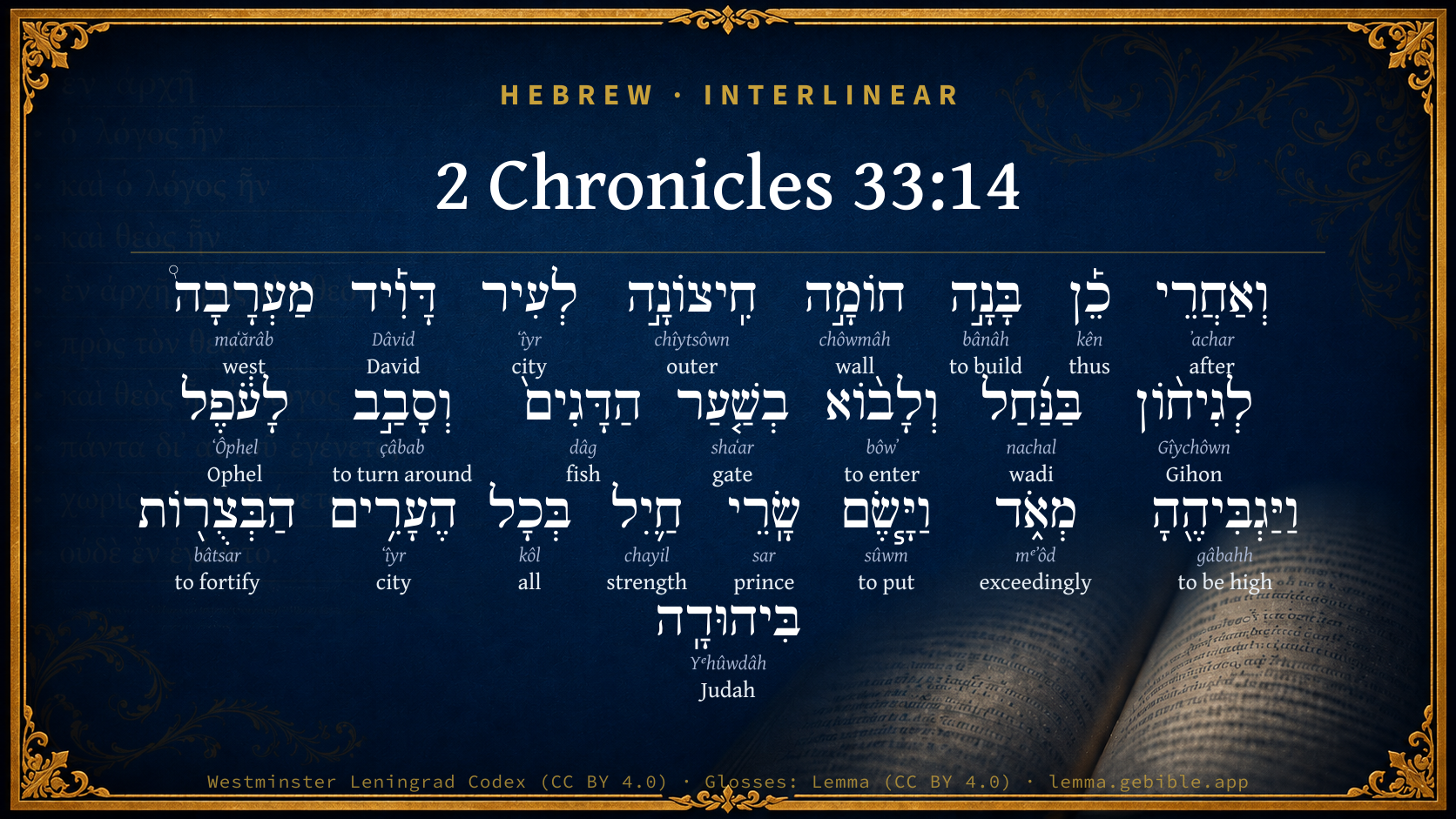
2 Chronicles 33:14

Hebrew (Westminster Leningrad Codex) 2 Chronicles 33:14 appears in the Hebrew Old Testament. The text above is from the Westminster Leningrad Codex. Each word links to its Strong’s number, a concise gloss, and parsing drawn from the Open Scriptures Hebrew Bible morphology. Click any word for its full Brown-Driver-Briggs (BDB) entry.
Download image
Cite this verse

2 Chronicles 33:14 (World English Bible). Public Domain. Lemma interlinear Bible study tool, https://lemma.gebible.app/v/2-chronicles/33/14.

Show BibTeX & RIS
BibTeX
RIS
English Translation
Now after this he built an outer wall to the city of David, on the west side of Gihon, in the valley, even to the entrance at the fish gate; and he compassed Ophel about [with it], and raised it up to a very great height: and he put valiant captains in all the fortified cities of Judah.
World English Bible · Public Domain
Download a study sheet

One document with this verse’s original text, its word-by-word gloss line, the meaning frame, cross-references with their text, attributed commentary, and full source and license credits — printable, and it pastes into notes with its structure intact.

This verse Autodidact and up

Study sheet (.html) Plain text (.txt)

A passage Seminary Student

Up to 50 verses in one chapter. A passage sheet keeps up to 6 commentary sources and 12 cross-references per verse, in the order this page ranks them, and says so on the sheet whenever that leaves anything out. Ask for a single verse and you get the Autodidact verse sheet above.

Everything on this page stays free to read, with no account — the sheet is a download of what is already on screen, not access to it.

Want to remove ads? Support Godless Engineer
Compare translations 3

The same verse in 3 English versions, stacked beneath the original-language interlinear above. Click any original word for its lexicon entry.

Each is an independent rendering of the whole verse — the interlinear is not word-aligned to these translations.

Highlighted words mark where these versions differ — a whole-verse word diff, not a word-by-word alignment.

  • World English Bible Public Domain
    Now after this he built an outer wall to the city of David, on the west side of Gihon, in the valley, even to the entrance at the fish gate; and he compassed Ophel about [with it], and raised it up to a very great height: and he put valiant captains in all the fortified cities of Judah.
  • King James Version Public Domain
    Now after this he built a wall without the city of David, on the west side of Gihon, in the valley, even to the entering in at the fish gate, and compassed about Ophel, and raised it up a very great height, and put captains of war in all the fenced cities of Judah.
  • unfoldingWord Literal Text CC BY-SA 4.0
    And after this, he built an outer wall for the city of David, on the west of Gihon, in the valley, and at the entrance of the Fish Gate, and around the hill, and he made it very high. And he put chiefs of the army in all the fortified cities in Judah.

unfoldingWord Literal Text — © unfoldingWord, licensed CC BY-SA 4.0. Word-aligned USFM3 via Door43 (git.door43.org/unfoldingWord/en_ult).

Versions to compare (up to 4)

3 of 4 selected

Show all 18 translations

Every available English version of this verse, each an independent rendering of the whole verse.

  • World English Bible Public Domain
    Now after this he built an outer wall to the city of David, on the west side of Gihon, in the valley, even to the entrance at the fish gate; and he compassed Ophel about [with it], and raised it up to a very great height: and he put valiant captains in all the fortified cities of Judah.
  • Berean Standard Bible Public Domain
    After this, Manasseh rebuilt the outer wall of the City of David from west of Gihon in the valley to the entrance of the Fish Gate, and he brought it around the hill of Ophel and heightened it considerably. He also stationed military commanders in all the fortified cities of Judah.
  • Majority Standard Bible Public Domain
    After this, Manasseh rebuilt the outer wall of the City of David from west of Gihon in the valley to the entrance of the Fish Gate, and he brought it around the hill of Ophel and heightened it considerably. He also stationed military commanders in all the fortified cities of Judah.
  • King James Version Public Domain
    Now after this he built a wall without the city of David, on the west side of Gihon, in the valley, even to the entering in at the fish gate, and compassed about Ophel, and raised it up a very great height, and put captains of war in all the fenced cities of Judah.
  • American Standard Version (1901) Public Domain
    Now after this he built an outer wall to the city of David, on the west side of Gihon, in the valley, even to the entrance at the fish gate; and he compassed Ophel about `with it', and raised it up to a very great height: and he put valiant captains in all the fortified cities of Judah.
  • Revised Version (1885) Public Domain
    Now after this he built an outer wall to the city of David, on the west side of Gihon, in the valley, even to the entering in at the fish gate; and he compassed about Ophel, and raised it up a very great height: and he put valiant captains in all the fenced cities of Judah.
  • Geneva Bible (1599) Public Domain
    Nowe after this he built a wall without the citie of Dauid, on the Westside of Gihon in the valley, euen at the entrie of the fish gate, and compassed about Ophel, and raised it very hie, and put captaines of warre in all the strong cities of Iudah.
  • Douay-Rheims (1899) Public Domain
    After this he built a wall without the city of David, on the west side of Gihon in the valley, from the entering in of the fish gate round about to Ophel, and raised it up to a great height: and he appointed captains of the army in all the fenced cities of Juda:
  • Young's Literal Translation Public Domain
    And after this he hath built an outer wall to the city of David, on the west of Gihon, in the valley, and at the entering in at the fish-gate, and it hath gone round to the tower, and he maketh it exceeding high, and he putteth heads of the force in all the cities of the bulwarks in Judah.
  • Literal Standard Version CC BY-SA 4.0
    And after this he has built an outer wall for the City of David, on the west of Gihon, in the valley, and at the entering in at the Fish Gate, and it has gone around to the tower, and he makes it exceedingly high, and he puts heads of the force in all the cities of the bulwarks in Judah.
  • Unlocked Literal Bible CC BY-SA 4.0
    After this, Manasseh built an outer wall to the city of David, on the west side of Gihon, in the valley, to the entrance at the Fish Gate. He surrounded the hill of Ophel with it and raised the wall up to a very great height. He put courageous commanders in all the fortified cities of Judah.
  • unfoldingWord Literal Text CC BY-SA 4.0
    And after this, he built an outer wall for the city of David, on the west of Gihon, in the valley, and at the entrance of the Fish Gate, and around the hill, and he made it very high. And he put chiefs of the army in all the fortified cities in Judah.
  • Darby Bible Public Domain
    And after this he built the outer wall of the city of David, on the west, toward Gihon, in the valley, even to the entrance of the fish-gate, and carried it round Ophel, and raised it up a very great height; and he put captains of war in all the fortified cities of Judah.
  • World Messianic Bible Public Domain
    Now after this, he built an outer wall to David’s city on the west side of Gihon, in the valley, even to the entrance at the fish gate. He encircled Ophel with it, and raised it up to a very great height; and he put valiant captains in all the fortified cities of Judah.
  • Webster's Bible Public Domain
    Now after this, he built a wall without the city of David, on the west side of Gihon, in the valley, even to the entrance at the fish-gate, and compassed about Ophel, and raised it up a very great highth, and put captains of war in all the fortified cities of Judah.
  • Free Bible Version CC BY-SA 4.0
    After this, Manasseh rebuilt the outer wall of the City of David from west of Gihon in the valley to the Fish Gate, and around the hill of Ophel, and made it much higher. He also assigned army commanders to all the fortified towns of Judah.
  • Bible in Basic English Public Domain
    After this he made an outer wall for the town of David, on the west side of Gihon in the valley, as far as the way into the town by the fish doorway; and he put a very high wall round the Ophel; and he put captains of the army in all the walled towns of Judah.
  • JPS Tanakh (1917) Public Domain
    Now after this he built an outer wall to the city of David, on the west side of Gihon, in the valley, even to the entrance at the fish gate; and he compassed about Ophel, and raised it up a very great height; and he put captains of the army in all the fortified cities of Judah.

Literal Standard Version (2020), Covenant Press — licensed CC BY-SA 4.0. Text via the HelloAO Bible API (eBible.org). Unlocked Literal Bible (unfoldingWord) — licensed CC BY-SA 4.0. Text via the HelloAO Bible API (eBible.org). unfoldingWord Literal Text — © unfoldingWord, licensed CC BY-SA 4.0. Word-aligned USFM3 via Door43 (git.door43.org/unfoldingWord/en_ult). Free Bible Version, Dr. Jonathan Gallagher — licensed CC BY-SA 4.0. Text via the HelloAO Bible API (eBible.org).

Word by word

More ways to search: Search by grammar → Find every occurrence → Compare this word →

Practice this passage: Drill this verse → Learn its vocabulary →

לָעֹ֔פֶל
ʻÔphel
H6077
“to/for the · Ophel”
Preposition, Determined + Noun, Proper
Part of Speech
Preposition + Noun
Type
Proper
Full BDB Definition

Origin: the same as H6076

TWOT: 1662a

Ophel = "hill" - a ridge of hills in Jerusalem, fortified for defense of the city
  1. וְאַחֲרֵי ʼachar H310 “and · after” Conjunction + Preposition
  2. כֵ֡ן kên H3651 “thus” Adverb
  3. בָּנָ֣ה bânâh H1129 “to build” Verb, Qal, Perfect, 3rd Person, Masculine, Singular
  4. חוֹמָ֣ה chôwmâh H2346 “wall” Noun, Common, Feminine, Singular, Absolute
  5. חִֽיצוֹנָ֣ה chîytsôwn H2435 “outer” Adjective, Adjective, Feminine, Singular, Absolute
  6. לְעִיר ʻîyr H5892 “to/for · city of” Preposition + Noun, Common, Feminine, Singular, Construct
  7. דָּוִ֡יד Dâvid H1732 “David” Noun, Proper
  8. מַעְרָבָה֩ maʻărâb H4628 “west · toward” Noun, Common, Masculine, Singular, Absolute + Suffix, Demonstrative
  9. לְגִיח֨וֹן Gîychôwn H1521 “to/for · Gihon” Preposition + Noun, Proper
  10. בַּנַּ֜חַל nachal H5158 “in/at the · wadi” Preposition, Determined + Noun, Common, Masculine, Singular, Absolute
  11. וְלָב֨וֹא bôwʼ H935 “and · to enter” Conjunction + Preposition + Verb, Qal, Infinitive Construct
  12. בְשַׁ֤עַר shaʻar H8179 “in/at · gate of” Preposition + Noun, Common, Masculine, Singular, Construct
  13. הַדָּגִים֙ dâg H1709 “the · fish” Particle, Definite Article + Noun, Common, Masculine, Plural, Absolute
  14. וְסָבַ֣ב çâbab H5437 “and · to turn around” Conjunction + Verb, Qal, Perfect, 3rd Person, Masculine, Singular
  15. וַיַּגְבִּיהֶ֖הָ gâbahh H1361 “and · to be high · her” Conjunction + Verb, Hiphil, Sequential Imperfect, 3rd Person, Masculine, Singular + Suffix, Personal, 3rd Person, Feminine, Singular
  16. מְאֹ֑ד mᵉʼôd H3966 “exceedingly” Adverb
  17. וַיָּ֧שֶׂם sûwm H7760 “and · to put” Conjunction + Verb, Qal, Sequential Imperfect, 3rd Person, Masculine, Singular
  18. שָֽׂרֵי sar H8269 “princes of” Noun, Common, Masculine, Plural, Construct
  19. חַ֛יִל chayil H2428 “strength” Noun, Common, Masculine, Singular, Absolute
  20. בְּכָל kôl H3605 “in/at · all of” Preposition + Noun, Common, Masculine, Singular, Construct
  21. הֶעָרִ֥ים ʻîyr H5892 “the · cities” Particle, Definite Article + Noun, Common, Feminine, Plural, Absolute
  22. הַבְּצֻר֖וֹת bâtsar H1219 “the · fortified” Particle, Definite Article + Adjective, Adjective, Feminine, Plural, Absolute
  23. בִּיהוּדָֽה Yᵉhûwdâh H3063 “in/at · Judah” Preposition + Noun, Proper

About this verse

These counts appear in no published source. They are computed here, from the morphology-tagged text and Lemma’s own curated glosses. What Lemma adds →

24
words
23
distinct lemmas
Historical
section

Notable vocabulary

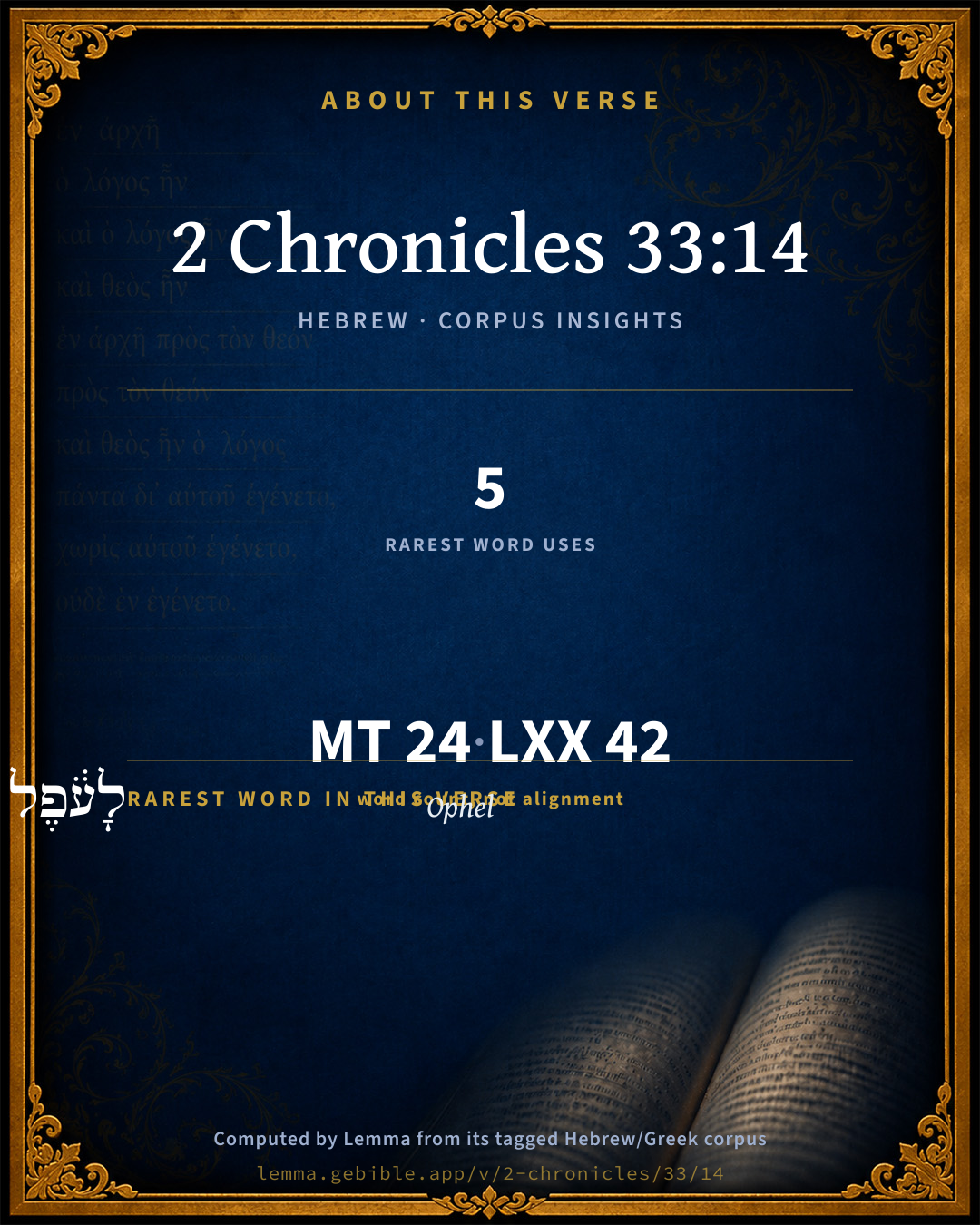
The rarest word here is לָעֹ֔פֶל Ophel H6077 — appearing just 5 times in the whole Hebrew Bible.

Shared distinctive vocabulary

לָעֹ֔פֶל Ophel H6077 occurs in 5 verses of the Hebrew Bible. Also found in:

Grammatical profile

  • 5 verbs
  • 14 nouns
  • 2 adjectives
  • 1 preposition
  • 2 adverbs

Verb forms

  • בָּנָ֣ה Qal · Perfect
  • וְלָב֨וֹא Qal · Infinitive Construct
  • וְסָבַ֣ב Qal · Perfect
  • וַיַּגְבִּיהֶ֖הָ Hiphil · Sequential Imperfect
  • וַיָּ֧שֶׂם Qal · Sequential Imperfect

Repetition

A word recurs within this verse — often emphatic in Hebrew:

  • לְעִיר city H5892 ×2

Hebrew & Septuagint length

In English translation the verse runs 58 words from the Hebrew and 57 from the Septuagint (LXX English) — closely comparable.

A rough comparison of the two English renderings, which tokenize alike — not a word-level alignment.

Word counts can differ between the Hebrew and the Greek without any difference in meaning — e.g. the Hebrew direct-object marker אֵת has no separate Greek word, and Greek often adds the article ὁ.

In the original languages it is 24 Hebrew tokens and 42 Greek tokens — but the two are counted differently (Hebrew bundles its prefixes and suffixes into one token; the Greek is in lemma form), so that isn’t a like-for-like length.

Cross-references

11

Topical passages linked to 2 Chronicles 33:14 in the Treasury of Scripture Knowledge — connected by theme and wording, ordered by reader-vote popularity; previews shown in the World English Bible.

  • 1 Kings 1:33 The king said to them, Take with you the servants of your lord, and cause Solomon my son to ride on my own mule, and bring him down to Gihon:
  • 2 Chronicles 27:3 He built the upper gate of the house of Yahweh, and on the wall of Ophel he built much.
  • Nehemiah 3:3 The fish gate did the sons of Hassenaah build; they laid the beams of it, and set up the doors of it, the bolts of it, and the bars of it.
  • Nehemiah 12:39 and above the gate of Ephraim, and by the old gate, and by the fish gate, and the tower of Hananel, and the tower of Hammeah, even to the sheep gate: and they stood still in the gate of the guard.
  • Zephaniah 1:10 In that day, says Yahweh, there will be the noise of a cry from the fish gate, a wailing from the second quarter, and a great crashing from the hills.
  • 1 Kings 1:45 and Zadok the priest and Nathan the prophet have anointed him king in Gihon; and they are come up from there rejoicing, so that the city rang again. This is the noise that you have heard.
  • 2 Chronicles 11:11–12 He fortified the strongholds, and put captains in them, and stores of food, and oil and wine.
  • 2 Chronicles 17:19 These were those who waited on the king, besides those whom the king put in the fortified cities throughout all Judah.
  • 2 Chronicles 32:5 He took courage, and built up all the wall that was broken down, and raised [it] up to the towers, and the other wall outside, and strengthened Millo [in] the city of David, and made weapons and shields in abundance.
  • 2 Chronicles 32:30 This same Hezekiah also stopped the upper spring of the waters of Gihon, and brought them straight down on the west side of the city of David. Hezekiah prospered in all his works.
  • Nehemiah 3:26–27 (Now the Nethinim lived in Ophel, to the place over against the water gate toward the east, and the tower that stands out.)

Cross-references courtesy of OpenBible.info (CC BY 4.0).

Hebrew and Greek witnesses Masoretic Hebrew ↔ Greek Septuagint

The same verse in the two great witnesses to the Old Testament, shown verse-for-verse.

These are two independent witnesses, not word-aligned to each other, and the Septuagint is shown in lemma (dictionary) form.

Hebrew 2 Chronicles 33:14 Masoretic · Westminster Leningrad Codex

וְאַחֲרֵי כֵ֡ן בָּנָ֣ה חוֹמָ֣ה חִֽיצוֹנָ֣ה לְעִיר דָּוִ֡יד מַעְרָבָה֩ לְגִיח֨וֹן בַּנַּ֜חַל וְלָב֨וֹא בְשַׁ֤עַר הַדָּגִים֙ וְסָבַ֣ב לָעֹ֔פֶל וַיַּגְבִּיהֶ֖הָ מְאֹ֑ד וַיָּ֧שֶׂם שָֽׂרֵי חַ֛יִל בְּכָל הֶעָרִ֥ים הַבְּצֻר֖וֹת בִּיהוּדָֽה

Now after this he built an outer wall to the city of David, on the west side of Gihon, in the valley, even to the entrance at the fish gate; and he compassed Ophel about [with it], and raised it up to a very great height: and he put valiant captains in all the fortified cities of Judah.

World English Bible · Public Domain

Greek LXX 2 Chronicles 33:14 Septuagint · lemma form

καί μετά οὗτος οἰκοδομέω τεῖχος ἔξω ὁ πόλις δαυίδ ἀπό λίψ κατά γιων ἐν ὁ χειμάροος καί ἐκπορεύομαι ὁ πύλη ὁ κυκλόθεν καί εἰς ὁ οφλα καί ὑψόω σφόδρα καί καταἵστημι ἄρχων ὁ δύναμις ἐν πᾶς ὁ πόλις ὁ τειχήρεσις ἐν ἰουδά

And afterward he built a wall without the city of David, from the southwest southward in the valleys and at the entrance through the fish-gate, as men go out by the gate round about, even as far as Opel: and he raised it much, and set captains of the host in all the fortified cities in Juda.

LXX2012 (modern English Septuagint) · Public Domain

Hebrew: Westminster Leningrad Codex (CC BY 4.0). Greek: Septuagint (public domain); English from LXX2012 (modern English Septuagint) (Public Domain). How the Septuagint differs from the Hebrew →

Commentary

Notes on 2 Chronicles 33:14 from classic Christian and Jewish commentators (each source and its license shown beneath its notes). The classic Christian expositions comment on the surrounding passage and are grouped to its opening verse, so a note may address several verses; the Jewish commentaries on the Tanakh (Rashi and others) are per-verse, so they appear only where the commentator wrote on this verse.

Lemma curates 59 commentaries, every one of them public domain or Creative Commons licensed, each selected and text-cleaned for this edition rather than reprinted as found. About our sources →

Trapp's Complete Commentary

John Trapp

2Ch 33:14 Now after this he built a wall without the city of David, on the west side of Gihon, in the valley, even to the entering in at the fish gate, and compassed about Ophel, and raised it up a very great height, and put captains of war in all the fenced cities of Judah.

Ver. 14. Now after this he built a wall.] It is uncertain how he got out of prison; whether with the king of Babylon’s good leave, or by making escape. There are that tell us, that the prison doors were opened, his chains loosened, and he delivered, as afterwards Peter was. {Act 12:3-11} Howsoever, he thought good to fortify himself against the Babylonians, and whatsoever enemies. This, though it be here set down first, yet Josephus saith, that the first work he did after his return, was to reform religion.

John Trapp, A Commentary or Exposition upon All the Books of the Old and New Testament (1647–1656) — public domain. Text from a community e-Sword module.

Joseph Benson's Commentary

2Ch 33:14. After this he built a wall without the city of David — He repaired and strengthened that wall which Hezekiah had built, (2Ch 32:5,) and which, possibly, the king of Assyria, or of Babylon rather, when he last took Jerusalem, had caused to be thrown down, either wholly or in part. On the west side of Gihon — On the west side of the city of David, to which Hezekiah had brought the watercourse down, mentioned 2Ch 32:30, into the great pool which he had made to receive it: and possibly this wall was built to secure the free use of it to the citizens, when they should be distressed or besieged by an enemy.

Joseph Benson's Commentary on the Old and New Testaments (1811–1818) — public domain. Text from a community e-Sword module.

Tyndale Open Study Notes

Tyndale Open Resources

33:14-17 Manasseh might have been repairing damage done to the walls when he was taken captive. His religious reforms were similar to Hezekiah’s but incomplete; Josiah later removed the Temple altars that Manasseh built (2 Kgs 23:12).

Tyndale Open Study Notes — © Tyndale Open Resources, licensed CC BY-SA 4.0. Text via the HelloAO Bible API.

Geneva Bible (1599)

Geneva Bible translators

Read 2 Chron. 32:30.

Read 2 Chron. 27:3.

Geneva Bible (1599) marginal notes — public domain. Text via Bolls.life.

Jamieson, Fausset & Brown

Robert Jamieson, A. R. Fausset & David Brown

he built a wall without the city . . . on the west side of Gihon . . . even to the entering in at the fish gate--"The well-ascertained position of the fish gate, shows that the valley of Gihon could be no other than that leading northwest of Damascus gate, and gently descending southward, uniting with the Tyropœon at the northeast corner of Mount Zion, where the latter turns at right angles and runs towards Siloam. The wall thus built by Manasseh on the west side of the valley of Gihon, would extend from the vicinity of the northeast corner of the wall of Zion in a northerly direction, until it crossed over the valley to form a junction with the outer wall at the trench of Antonia, precisely in the quarter where the temple would be most easily assailed" [BARCLAY].

Jamieson, Fausset & Brown — Commentary Critical and Explanatory on the Whole Bible (1871) — public domain (CC PDM 1.0). Text via the HelloAO Bible API.

Adam Clarke's Commentary

Verse 14. He built a wall] This was probably a weak place that he fortified; or a part of the wall which the Assyrians had broken down, which he now rebuilt.

Adam Clarke's Commentary on the Bible (1810–1826) — public domain. Text from a community e-Sword/MySword module.

Ellicott's Commentary for English Readers

(14) Now after this . . . valley.—Rather, And afterwards he built an outer wall to the city of David westward unto Gihon in the ravine. Manasseh completed the wall begun by Hezekiah (2Ch_32:5). This highly circumstantial account of the public works undertaken by Manasseh after his restoration, is utterly unlike fiction, and almost compels the assumption of a real historical source, no longer extant, from which the whole section has been derived.

Even to the entering in of the fish gate.—The fish-gate lay near the north-east corner of the lower city (Neh_3:3). The direction of the outer wall is described first westward, and then eastward.

And compassed about Ophel.—And surrounded the Ophel (mound); seil., with the wall, which he carried on from the north-east to the south-east. Uzziah and Jotham had already worked upon these fortifications (2Ch_26:9; 2Ch_27:3). Manasseh now finished them, “raising them up to a very great height.”

Raised it—i.e., the outer wall.

And put captains of war.—(Comp. 2Ch_17:2; 2Ch_32:6.) Literally, captains of an army ( sârê chayil).

Of Judah.—Heb., in Judah. Some MSS. and the Vulgale read as the Authorised Version.

A Bible Commentary for English Readers, edited by Charles John Ellicott (1878–1897) — public domain. Text from a community e-Sword module.

The Cambridge Bible for Schools and Colleges

gen. ed. J. J. S. Perowne

14–17 (not in 2 Kin.). The Later Deeds of Manasseh

14. a wall without the city] R.V. an outer wall to the city.

even to the entering in] Or, “and [on the west] of the entering in.”

and compassed about] R.V. and he compassed about.

Ophel] Cp. 2Ch_27:3 (note).

and put captains of war] R.V. and he put valiant captains.

The Cambridge Bible for Schools and Colleges (gen. ed. J. J. S. Perowne; Cambridge University Press, 1878–1918) — public domain. Text from a community e-Sword module.

John Gill's Exposition

And he took away the strange gods, and the idol out of the house of the Lord,.... Which he had set there, Ch2 33:7.

and all the altars that he had built in the mount of the house of the Lord, and in Jerusalem; see Ch2 33:4,

and cast them out of the city; perhaps into the brook Kidron; all this he did to show the sincerity of his repentance for his idolatry, and his abhorrence of it.

John Gill's Exposition of the Whole Bible (1746–1763) — public domain (CC PDM 1.0). Text via the HelloAO Bible API.

Albert Barnes' Notes on the Bible

Rather, “he built the outer wall of the city of David on the west of Gihon-in-the-valley.” The wall intended seems to have been that toward the northeast, which ran from the vicinity of the modern Damascus gate across the valley of Gihon, to the “fish-gate” at the northeast corner of the “city of David.”

We may gather from this verse that, late in his reign, Manasseh revolted from the Assyrians, and made preparations to resist them if they should attack him. Assyria began to decline in power about 647 B.C., and from that time her outlying provinces would naturally begin to fall off. Manasseh reigned until 642 B.C.

Albert Barnes' Notes on the Bible (1834–1885) — public domain. Text from a community e-Sword/MySword module.

Haydock's Catholic Bible Commentary

Without, including what is styled the second city; (4 K. xxii. 14,) or he perfected the works begun by his father, or repaired the wall which the Assyrians had thrown down, though we read not of their taking the city. C. --- Fish-gate....to Ophel, from the north-eastern corner, to the place opposite to the eastern gate of the temple, C. xxvii. 3. M. --- The fish-gate led towards Joppe, whence the city was supplied with fish. S. Jerom, Trad. --- It was also called David’s gate, because it stood near this city. By it, the Chaldeans afterwards rushed in, Sophonias i. 10. T.

George Leo Haydock (1774–1849), Haydock's Catholic Family Bible and Commentary, 1859 edition — public domain. Excludes Psalms (Douay-Rheims chapter numbering differs from Protestant) and Deuterocanonical books (Catholic canon only).

Matthew Poole's English Annotations

He built a wall; he repaired and strengthened that wall which Hezekiah had built, 2Ch 32:5, and which possibly the king of Assyria, when he last took Jerusalem, had caused to be thrown down, either wholly or in part.

On the west side of Gihon; on the west side of the city of David, to which Hezekiah had brought this water-course down, 2Ch 32:30, into the great pool which he had made to receive it; and possibly this wall was built to secure the free use of it to the citizens when they should be distressed or besieged by an enemy.

Compassed about Ophel with a wall. Of Ophel see before, 2Ch 27:3.

Matthew Poole's English Annotations on the Holy Bible (1683–1685) — public domain. Text from a community e-Sword/MySword module.

Whedon's Commentary on the Bible

Daniel D. Whedon

14. He built a wall without the city of David — A wall on the north side of the city, (as we infer from the description that follows,) where besieging armies pitched their camps, and where, accordingly, there was need of the strongest possible fortifications. Whether this was a new wall, first built by Manasseh, or the repair and strengthening of an older one, cannot be positively determined, but the expression built a wall, points rather to the erection of a new wall.

On the west side of Gihon — Rather, westward to Gihon, in the valley. The description seems to begin from the centre of the northern wall, and pass first westward to the valley, (either of Gihon, which was the northern part of the Hinnom valley, or of that branch of the Tyropoeon which begins near the modern Yaffa gate,) and then eastward even to the entering in at the fish gate, which was near the northeast corner of the ancient city. Neh_3:3, note.

Compassed about Ophel — The southern slope of Moriah, on whose wall Jotham had “built much.” See note on 2Ch_27:8. Manasseh strengthened and completed this work of his great-grandfather.

Raised it up a very great height — This wall, as exposed by modern excavations at Jerusalem, is found at present to be over seventy feet in height. “Upward of fifty shafts,” says Captain Warren, “were sunk about Ophel in search of the wall. Eight of these shafts were in connexion with the line of wall which is now found to extend as far as seven hundred feet from the first tower in a southeasterly direction along the eastern ridge of Ophel.”

Daniel D. Whedon (gen. ed.), Commentary on the Old and New Testaments (1874–1909) — public domain. Text from a community e-Sword module.

The Pulpit Commentary

The wall without; or, Revised Version, the outer wall, is probably one with that of Hezekiah, (2Ch_32:5) which now Manasseh repairs, or rebuilds, and perhaps lengthens as well as heightens.

The fish gate, (Neh_13:16) left on the north of Jerusalem, and opened on the main road for the sea (Conder"s "Handbook," etc., p. 343). The wall traversed the north and east sides to Ophel, "on the wall" of which, it is said, (2Ch_27:3) "Jotham built much." Hezekiah also built much there, and now Manasseh raised it up a very great height.

The Pulpit Commentary (1880–1919), ed. H.D.M. Spence-Jones & Joseph S. Exell — public domain. Text from a community e-Sword module.

Keil & Delitzsch

C. F. Keil & F. Delitzsch

After his return, Manasseh took measures to secure his kingdom, and especially the capital, against hostile attacks. "He built an outer wall of the city of David westward towards Gihon in the valley, and in the direction of the fish-gate; and he surrounded the Ophel, and made it very high." The words היצונה חומה (without the article) point to the building of a new wall. But since it has been already recorded of Hezekiah, in Ch2 32:5, that he built "the other wall without," all modern expositors, even Arnold in Herz.'s Realenc. xviii. S. 634, assume the identity of the two walls, and understand ויּבן of the completion and heightening of that "other wall" of which it is said מאד ויּגבּיהה, and which shut in Zion from the lower city to the north. In that case, of course, we must make the correction החומה. The words "westward towards Gihon in the valley, and לבוא ב, in the direction to (towards) the fish-gate," are then to be taken as describing the course of this wall from its centre, first towards the west, and then towards the east. For the valley of Gihon lay, in all probability, outside of the western city gate, which occupied the place of the present Jaffa gate. But the fish-gate was, according to Neh 3:3, at the east end of this wall, at no great distance from the tower on the north-east corner. The valley (הנּהל) is a hollow between the upper city (Zion) and the lower (Acra), probably the beginning of the valley, which at its south-eastern opening, between Zion and Moriah, is called Tyropoion in Josephus. The words, "he surrounded the Ophel," sc. with a wall, are not to be connected with the preceding clauses, as Berth. connects them, translating, "he carried the wall from the north-east corner farther to the south, and then round the Ophel;" for "between the north-east corner and the Ophel wall lay the whole east wall of the city, as far as to the south-east corner of the temple area, which yet cannot be regarded as a continuation of the wall to the Ophel wall" (Arnold, loc. cit.). Jotham had already built a great deal at the Ophel wall (Ch2 27:3). Manasseh must therefore only have strengthened it, and increased its height. On the words שׂ ויּשׂם cf. Ch2 32:6 and Ch2 17:2.

Keil & Delitzsch — Biblical Commentary on the Old Testament (1861–1891) — public domain (CC PDM 1.0). Text via the HelloAO Bible API. (Old Testament only.)

unfoldingWord translationNotes

Door43 World Missions Community

General Information:

See: How to Translate Names

Manasseh built ... He surrounded ... He took away ... he had built on the mount

Manasseh did not do the building and construction himself, rather, he commanded his workers to do it. AT: "Manasseh commanded his workers to build ... They surrounded ... He commanded his workers to take away ... they had previously built on the mount" (See: Metonymy)

Gihon

This was the name of a spring and a stream. See how you translated the "waters of Gihon" in 2 Chronicles 32:30. AT: "the waters of Gihon" (See: How to Translate Names)

the hill of Ophel

Translate the name of this hill as you did in 2 Chronicles 27:3. (See: How to Translate Names)

raised the wall up

"built the wall up"

the fortified cities

This refers to cities with walls around them.

the foreign gods

"the false gods from other countries"

translationWords

city of David

false god

altar

unfoldingWord translationNotes — © Distant Shores Media and the Door43 World Missions Community, licensed CC BY-SA 4.0. Source: git.door43.org/Door43/en_tn.

Rashi

Rabbi Shlomo Yitzchaki (Rashi)

of Gihon in the valley beside the valley of Gihon, the name of a place.

and he surrounded the Ophel And he surrounded from there the strength of the towers built with the work of Ophel.

Rashi on the Tanakh — English translations: “The Judaica Press complete Tanach with Rashi, translated by A. J. Rosenberg” (CC BY 4.0); “Pentateuch with Rashi's commentary by M. Rosenbaum and A.M. Silbermann, 1929-1934” (public domain); “The Metsudah Tanach series, Lakewood, N.J” (CC BY 4.0); and “The Book of Joshua, Metsudah Publications, 1997” (CC BY 4.0). Text via Sefaria.

Lesson kit

Teaching starters — assembled from the data on this page, not authored interpretation. Every prompt links to the verse data it draws on. Edit before teaching.

2 Chronicles, in the Historical, opens this verse with 24 words (23 distinct Hebrew lemmas). Its most distinctive word is ʻÔphel (“Ophel”). A historical commentator’s framing appears above. Read the whole chapter for the surrounding context.

Discussion questions

  1. How does “Ophel” (ʻÔphel) shape what this verse is saying?
  2. How does 2 Chronicles 27:3, which shares the word «Ophel», read alongside this verse?
  3. What does the repetition of “city” (2× in this one verse) do in this verse?
  4. The translations on this page render this verse differently — a whole-verse word diff, not a word-by-word alignment. What might account for the different wordings?
  5. «בָּנָ֣ה» is a Qal Perfect verb. How does that grammatical form shape the action described?
  6. Compare how Trapp's Complete Commentary and Joseph Benson's Commentary read this verse. Where do they agree or differ?

Things to notice

Reading settings

Reading text

Shown beneath each verse's original-language words.

Old Testament
Old Testament edition

Read the OT as the Masoretic Hebrew (MT) or the Greek Septuagint (LXX).

English shown for the Greek Septuagint (in the Hebrew ↔ Greek comparison).

Comparing translations? Open the Compare panel on any verse page to stack up to four side by side.