
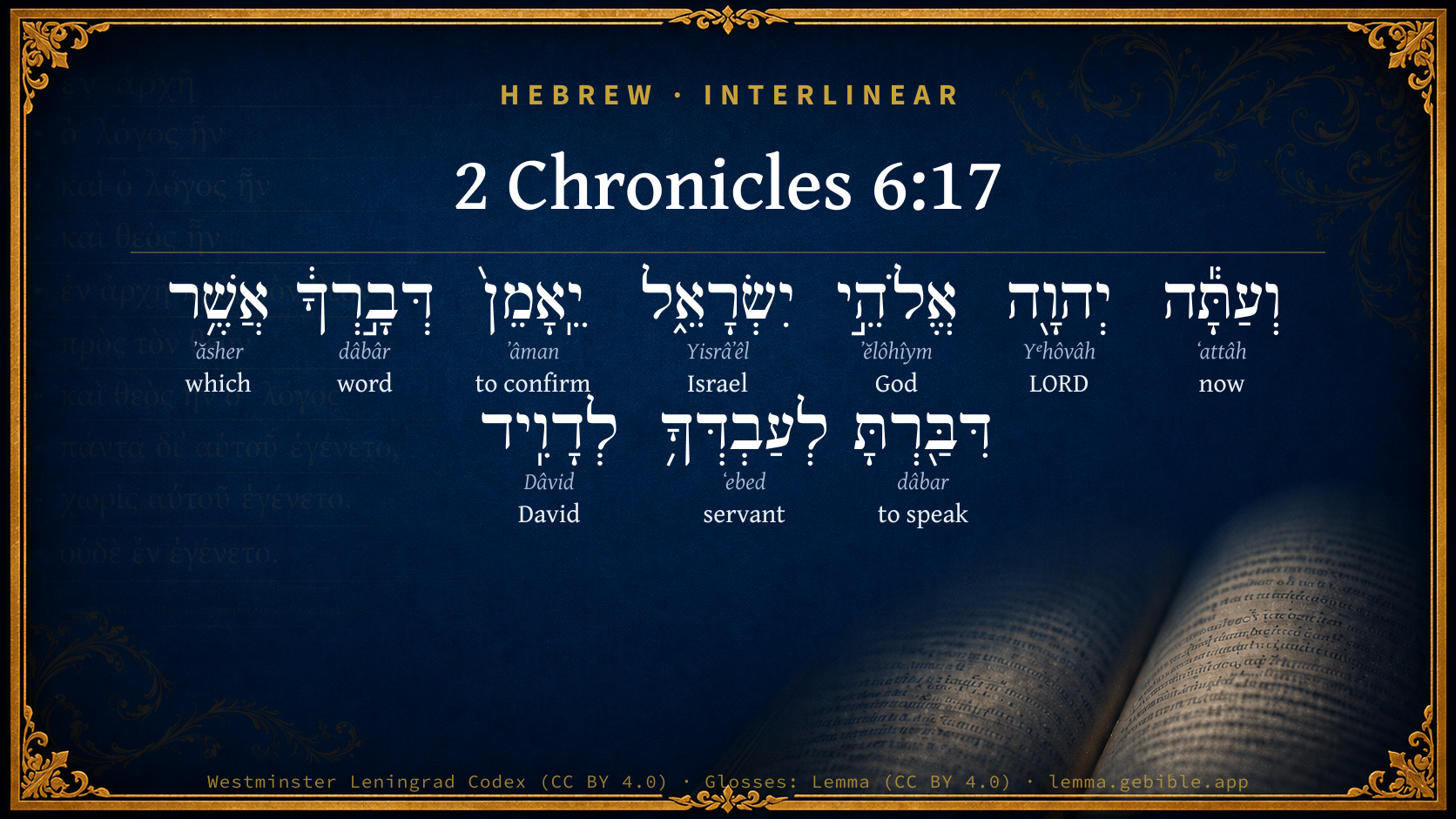
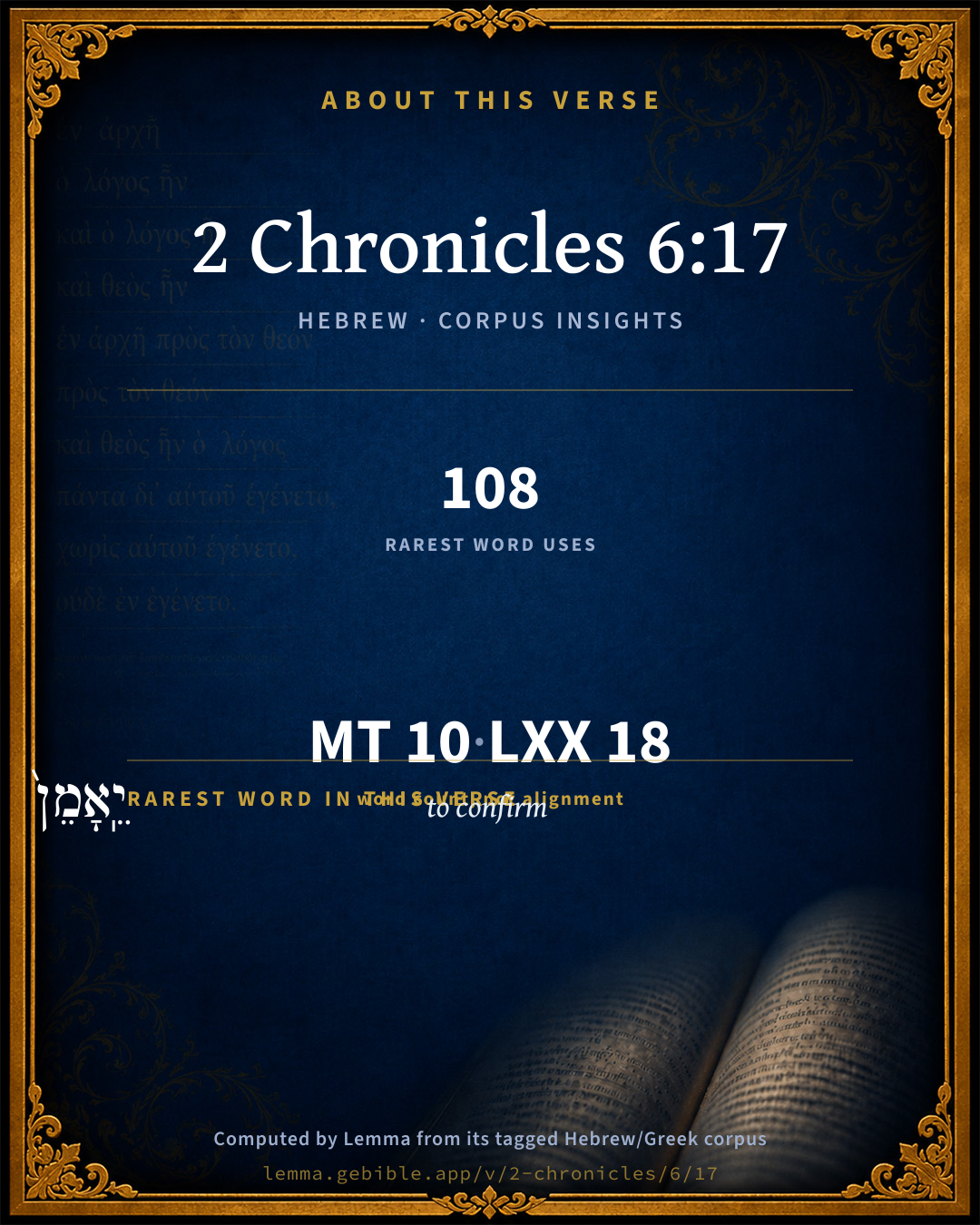
2 Chronicles 6:17

Hebrew (Westminster Leningrad Codex) 2 Chronicles 6:17 appears in the Hebrew Old Testament. The text above is from the Westminster Leningrad Codex. Each word links to its Strong’s number, a concise gloss, and parsing drawn from the Open Scriptures Hebrew Bible morphology. Click any word for its full Brown-Driver-Briggs (BDB) entry.
Download image
Cite this verse

2 Chronicles 6:17 (World English Bible). Public Domain. Lemma interlinear Bible study tool, https://lemma.gebible.app/v/2-chronicles/6/17.

Show BibTeX & RIS
BibTeX
RIS
English Translation
Now therefore, Yahweh, the God of Israel, let your word be verified, which you spoke to your servant David.
World English Bible · Public Domain
Download a study sheet

One document with this verse’s original text, its word-by-word gloss line, the meaning frame, cross-references with their text, attributed commentary, and full source and license credits — printable, and it pastes into notes with its structure intact.

This verse Autodidact and up

Study sheet (.html) Plain text (.txt)

A passage Seminary Student

Up to 50 verses in one chapter. A passage sheet keeps up to 6 commentary sources and 12 cross-references per verse, in the order this page ranks them, and says so on the sheet whenever that leaves anything out. Ask for a single verse and you get the Autodidact verse sheet above.

Everything on this page stays free to read, with no account — the sheet is a download of what is already on screen, not access to it.

Want to remove ads? Support Godless Engineer
Compare translations 3

The same verse in 3 English versions, stacked beneath the original-language interlinear above. Click any original word for its lexicon entry.

Each is an independent rendering of the whole verse — the interlinear is not word-aligned to these translations.

Highlighted words mark where these versions differ — a whole-verse word diff, not a word-by-word alignment.

  • World English Bible Public Domain
    Now therefore, Yahweh, the God of Israel, let your word be verified, which you spoke to your servant David.
  • King James Version Public Domain
    Now then, O LORD God of Israel, let thy word be verified, which thou hast spoken unto thy servant David.
  • unfoldingWord Literal Text CC BY-SA 4.0
    And now, Yahweh, God of Israel, let your word be confirmed, which you spoke to your servant, to David.

unfoldingWord Literal Text — © unfoldingWord, licensed CC BY-SA 4.0. Word-aligned USFM3 via Door43 (git.door43.org/unfoldingWord/en_ult).

Versions to compare (up to 4)

3 of 4 selected

Show all 18 translations

Every available English version of this verse, each an independent rendering of the whole verse.

  • World English Bible Public Domain
    Now therefore, Yahweh, the God of Israel, let your word be verified, which you spoke to your servant David.
  • Berean Standard Bible Public Domain
    And now, O LORD, God of Israel, please confirm what You promised to Your servant David.
  • Majority Standard Bible Public Domain
    And now, O LORD, God of Israel, please confirm what You promised to Your servant David.
  • King James Version Public Domain
    Now then, O LORD God of Israel, let thy word be verified, which thou hast spoken unto thy servant David.
  • American Standard Version (1901) Public Domain
    Now therefore, O Jehovah, the God of Israel, let thy word be verified, which thou spakest unto thy servant David.
  • Revised Version (1885) Public Domain
    Now therefore, O LORD, the God of Israel, let thy word be verified, which thou spakest unto thy servant David.
  • Geneva Bible (1599) Public Domain
    And now, O Lord God of Israel, let thy worde be verified, which thou spakest vnto thy seruant Dauid.
  • Douay-Rheims (1899) Public Domain
    And now, Lord God of Israel, let thy word be established which thou hast spoken to thy servant David.
  • Young's Literal Translation Public Domain
    `And now, O Jehovah, God of Israel, is Thy word stedfast that Thou hast spoken to Thy servant, to David,
  • Literal Standard Version CC BY-SA 4.0
    And now, O YHWH, God of Israel, let Your word be steadfast that You have spoken to Your servant, to David.
  • Unlocked Literal Bible CC BY-SA 4.0
    Now then, Yahweh, God of Israel, let your word be confirmed, which you have spoken to your servant David.
  • unfoldingWord Literal Text CC BY-SA 4.0
    And now, Yahweh, God of Israel, let your word be confirmed, which you spoke to your servant, to David.
  • Darby Bible Public Domain
    And now, Jehovah, God of Israel, let thy word be verified which thou hast spoken unto thy servant David.
  • World Messianic Bible Public Domain
    Now therefore, LORD, the God of Israel, let your word be verified, which you spoke to your servant David.
  • Webster's Bible Public Domain
    Now then, O LORD God of Israel, let thy word be verified, which thou hast spoken to thy servant David.
  • Free Bible Version CC BY-SA 4.0
    Now, Lord God of Israel, please fulfill this promise you made to your servant David.
  • Bible in Basic English Public Domain
    So now, O Lord, the God of Israel, make your word come true which you said to your servant David.
  • JPS Tanakh (1917) Public Domain
    Now therefore, O LORD, the God of Israel, let Thy word be verified, which Thou spokest unto Thy servant David.

Literal Standard Version (2020), Covenant Press — licensed CC BY-SA 4.0. Text via the HelloAO Bible API (eBible.org). Unlocked Literal Bible (unfoldingWord) — licensed CC BY-SA 4.0. Text via the HelloAO Bible API (eBible.org). unfoldingWord Literal Text — © unfoldingWord, licensed CC BY-SA 4.0. Word-aligned USFM3 via Door43 (git.door43.org/unfoldingWord/en_ult). Free Bible Version, Dr. Jonathan Gallagher — licensed CC BY-SA 4.0. Text via the HelloAO Bible API (eBible.org).

Word by word

More ways to search: Search by grammar → Find every occurrence → Compare this word →

Practice this passage: Drill this verse → Learn its vocabulary →

יֵֽאָמֵן֙
ʼâman
H539
“to confirm”
Verb, Niphal, Imperfect, 3rd Person, Masculine, Singular
Part of Speech
Verb
Stem
Niphal
Form
Imperfect
Person
3rd Person
Gender
Masculine
Number
Singular
Full BDB Definition

Origin: a primitive root

TWOT: 116

to support, confirm, be faithful - (Qal) - to support, confirm, be faithful, uphold, nourish - foster-father (substantive) - foster-mother, nurse - pillars, supporters of the door - (Niphal) - to be established, be faithful, be carried, make firm - to be carried by a nurse - made firm, sure, lasting - confirmed, established, sure - verified, confirmed - reliable, faithful, trusty - (Hiphil) - to stand firm, to trust, to be certain, to believe in - stand firm - trust, believe
  1. וְעַתָּ֕ה ʻattâh H6258 “and · now” Conjunction + Adverb
  2. יְהוָ֖ה Yᵉhôvâh H3068 “LORD” Noun, Proper
  3. אֱלֹהֵ֣י ʼĕlôhîym H430 “God(s) of” Noun, Common, Masculine, Plural, Construct
  4. יִשְׂרָאֵ֑ל Yisrâʼêl H3478 “Israel” Noun, Proper
  5. דְּבָ֣רְךָ֔ dâbâr H1697 “word · your” Noun, Common, Masculine, Singular, Construct + Suffix, Personal, 2nd Person, Masculine, Singular
  6. אֲשֶׁ֥ר ʼăsher H834 “which” Particle, Relative
  7. דִּבַּ֖רְתָּ dâbar H1696 “to speak” Verb, Piel, Perfect, 2nd Person, Masculine, Singular
  8. לְעַבְדְּךָ֥ ʻebed H5650 “to/for · servant · your” Preposition + Noun, Common, Masculine, Singular, Construct + Suffix, Personal, 2nd Person, Masculine, Singular
  9. לְדָוִֽיד Dâvid H1732 “to/for · David” Preposition + Noun, Proper

About this verse

These counts appear in no published source. They are computed here, from the morphology-tagged text and Lemma’s own curated glosses. What Lemma adds →

10
words
10
distinct lemmas
Historical
section

Grammatical profile

  • 2 verbs
  • 6 nouns
  • 1 adverb
  • 1 particle

Verb forms

  • יֵֽאָמֵן֙ Niphal · Imperfect
  • דִּבַּ֖רְתָּ Piel · Perfect

Hebrew & Septuagint length

In English translation the verse runs 19 words from the Hebrew and 22 from the Septuagint (LXX English) — closely comparable.

A rough comparison of the two English renderings, which tokenize alike — not a word-level alignment.

Word counts can differ between the Hebrew and the Greek without any difference in meaning — e.g. the Hebrew direct-object marker אֵת has no separate Greek word, and Greek often adds the article ὁ.

In the original languages it is 10 Hebrew tokens and 18 Greek tokens — but the two are counted differently (Hebrew bundles its prefixes and suffixes into one token; the Greek is in lemma form), so that isn’t a like-for-like length.

Cross-references

7

Topical passages linked to 2 Chronicles 6:17 in the Treasury of Scripture Knowledge — connected by theme and wording, ordered by reader-vote popularity; previews shown in the World English Bible.

  • Jeremiah 11:5 that I may establish the oath which I swore to your fathers, to give them a land flowing with milk and honey, as at this day. Then answered I, and said, Amen, Yahweh.
  • Exodus 24:10 They saw the God of Israel. Under his feet was like a paved work of sapphire stone, like the skies for clearness.
  • 2 Samuel 7:25–29 Now, Yahweh God, the word that you have spoken concerning your servant, and concerning his house, confirm you it forever, and do as you have spoken.
  • 2 Chronicles 6:4 He said, Blessed be Yahweh, the God of Israel, who spoke with his mouth to David my father, and has with his hands fulfilled it, saying,
  • 2 Chronicles 6:14 and he said, Yahweh, the God of Israel, there is no God like you, in heaven, or on earth; who keep covenant and loving kindness with your servants, who walk before you with all their heart;
  • Isaiah 41:17 The poor and needy seek water, and there is none, and their tongue fails for thirst; I, Yahweh, will answer them, I, the God of Israel, will not forsake them.
  • Isaiah 45:3 and I will give you the treasures of darkness, and hidden riches of secret places, that you may know that it is I, Yahweh, who call you by your name, even the God of Israel.

Cross-references courtesy of OpenBible.info (CC BY 4.0).

Hebrew and Greek witnesses Masoretic Hebrew ↔ Greek Septuagint

The same verse in the two great witnesses to the Old Testament, shown verse-for-verse.

These are two independent witnesses, not word-aligned to each other, and the Septuagint is shown in lemma (dictionary) form.

Hebrew 2 Chronicles 6:17 Masoretic · Westminster Leningrad Codex

וְעַתָּ֕ה יְהוָ֖ה אֱלֹהֵ֣י יִשְׂרָאֵ֑ל יֵֽאָמֵן֙ דְּבָ֣רְךָ֔ אֲשֶׁ֥ר דִּבַּ֖רְתָּ לְעַבְדְּךָ֥ לְדָוִֽיד

Now therefore, Yahweh, the God of Israel, let your word be verified, which you spoke to your servant David.

World English Bible · Public Domain

Greek LXX 2 Chronicles 6:17 Septuagint · lemma form

καί νῦν κύριος ὁ θεός ἰσραήλ πιστόω δή ὁ ῥῆμα σύ ὅς λαλέω ὁ παῖς σύ ὁ δαυίδ

And now, Lord God of Israel, let, I pray you, your word be confirmed, which you have spoken to your servant David.

LXX2012 (modern English Septuagint) · Public Domain

On this verse, Ellicott's Commentary for English Readers discusses the Septuagint’s reading. Read the note in Commentary ↓

Hebrew: Westminster Leningrad Codex (CC BY 4.0). Greek: Septuagint (public domain); English from LXX2012 (modern English Septuagint) (Public Domain). How the Septuagint differs from the Hebrew →

Commentary

Notes on 2 Chronicles 6:17 from classic Christian and Jewish commentators (each source and its license shown beneath its notes). The classic Christian expositions comment on the surrounding passage and are grouped to its opening verse, so a note may address several verses; the Jewish commentaries on the Tanakh (Rashi and others) are per-verse, so they appear only where the commentator wrote on this verse.

Lemma curates 59 commentaries, every one of them public domain or Creative Commons licensed, each selected and text-cleaned for this edition rather than reprinted as found. About our sources →

Ellicott's Commentary for English Readers

(17) Be verified.—1Ch_17:23. LXX. and Syriac add, “I pray” (Heb., nâ), as in Kings.

Thy word.—Or promise (2Ch_6:10; 2Ch_6:15, supr.)

Unto thy servant David.—Heb., to thy servant, to David. Kings, “to thy servant David my father.” So Syriac here.

A Bible Commentary for English Readers, edited by Charles John Ellicott (1878–1897) — public domain. Text from a community e-Sword module.

The Pulpit Commentary

Let thy word be verified. (so 1Ch_17:9-13)

The Pulpit Commentary (1880–1919), ed. H.D.M. Spence-Jones & Joseph S. Exell — public domain. Text from a community e-Sword module.

Lesson kit

Teaching starters — assembled from the data on this page, not authored interpretation. Every prompt links to the verse data it draws on. Edit before teaching.

2 Chronicles, in the Historical, opens this verse with 10 words (10 distinct Hebrew lemmas). Its most distinctive word is ʼâman (“to confirm”). A historical commentator’s framing appears above. Read the whole chapter for the surrounding context.

Discussion questions

  1. What does “to confirm” (ʼâman) contribute to the verse as a whole?
  2. Jeremiah 11:5 shares this passage’s theme. How do the two illuminate each other?
  3. These translations render this verse differently. What is at stake in choosing one wording over another?
  4. The verb «יֵֽאָמֵן֙» is Niphal Imperfect. How does its form color the action?
  5. Reading how Ellicott's Commentary for English Readers and The Pulpit Commentary read this verse, where do the two commentators agree and where do they part?

Things to notice

Reading settings

Reading text

Shown beneath each verse's original-language words.

Old Testament
Old Testament edition

Read the OT as the Masoretic Hebrew (MT) or the Greek Septuagint (LXX).

English shown for the Greek Septuagint (in the Hebrew ↔ Greek comparison).

Comparing translations? Open the Compare panel on any verse page to stack up to four side by side.