
Amos 9:11

Hebrew (Westminster Leningrad Codex) Amos 9:11 appears in the Hebrew Old Testament. The text above is from the Westminster Leningrad Codex. Each word links to its Strong’s number, a concise gloss, and parsing drawn from the Open Scriptures Hebrew Bible morphology. Click any word for its full Brown-Driver-Briggs (BDB) entry.
Download image
Cite this verse

Amos 9:11 (World English Bible). Public Domain. Lemma interlinear Bible study tool, https://lemma.gebible.app/v/amos/9/11.

Show BibTeX & RIS
BibTeX
RIS
English Translation
In that day I will raise up the tent of David who is fallen, and close up its breaches, and I will raise up its ruins, and I will build it as in the days of old;
World English Bible · Public Domain
Highlights
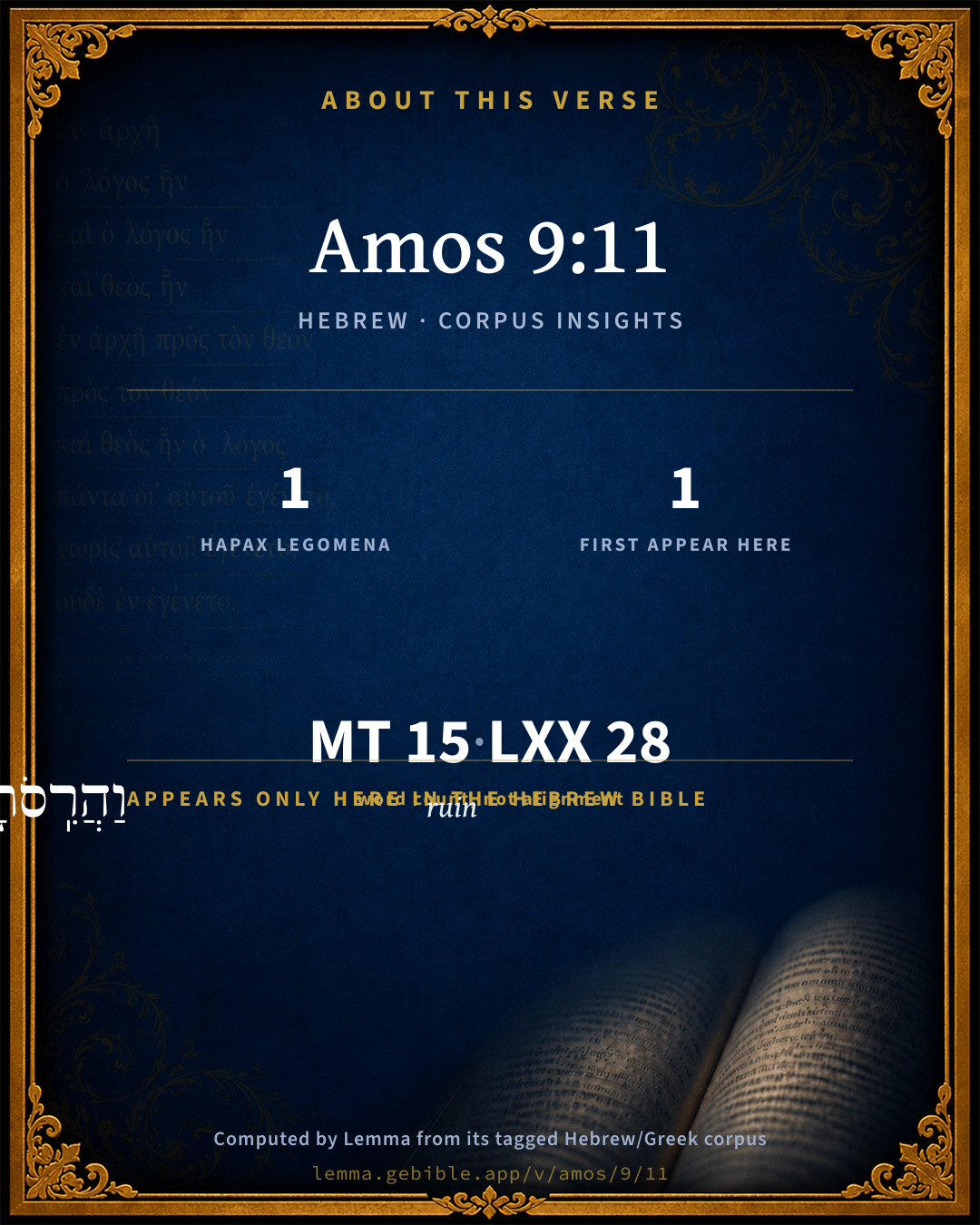
  • 1 hapax legomenon — only here in the Hebrew Bible
  • 1 first appearance in the Hebrew Bible
Full analysis ↓
Download a study sheet

One document with this verse’s original text, its word-by-word gloss line, the meaning frame, cross-references with their text, attributed commentary, and full source and license credits — printable, and it pastes into notes with its structure intact.

This verse Autodidact and up

Study sheet (.html) Plain text (.txt)

A passage Seminary Student

Up to 50 verses in one chapter. A passage sheet keeps up to 6 commentary sources and 12 cross-references per verse, in the order this page ranks them, and says so on the sheet whenever that leaves anything out. Ask for a single verse and you get the Autodidact verse sheet above.

Everything on this page stays free to read, with no account — the sheet is a download of what is already on screen, not access to it.

Want to remove ads? Support Godless Engineer
Compare translations 3

The same verse in 3 English versions, stacked beneath the original-language interlinear above. Click any original word for its lexicon entry.

Each is an independent rendering of the whole verse — the interlinear is not word-aligned to these translations.

Highlighted words mark where these versions differ — a whole-verse word diff, not a word-by-word alignment.

  • World English Bible Public Domain
    In that day I will raise up the tent of David who is fallen, and close up its breaches, and I will raise up its ruins, and I will build it as in the days of old;
  • King James Version Public Domain
    In that day will I raise up the tabernacle of David that is fallen, and close up the breaches thereof; and I will raise up his ruins, and I will build it as in the days of old:
  • unfoldingWord Literal Text CC BY-SA 4.0
    In that day I will raise up the tent of David that has fallen, and close up its breaches. I will raise up its ruins, and rebuild it as in the days of old,

unfoldingWord Literal Text — © unfoldingWord, licensed CC BY-SA 4.0. Word-aligned USFM3 via Door43 (git.door43.org/unfoldingWord/en_ult).

Versions to compare (up to 4)

3 of 4 selected

Show all 18 translations

Every available English version of this verse, each an independent rendering of the whole verse.

  • World English Bible Public Domain
    In that day I will raise up the tent of David who is fallen, and close up its breaches, and I will raise up its ruins, and I will build it as in the days of old;
  • Berean Standard Bible Public Domain
    “In that day I will restore the fallen tent of David. I will repair its gaps, restore its ruins, and rebuild it as in the days of old,
  • Majority Standard Bible Public Domain
    “In that day I will restore the fallen tent of David. I will repair its gaps, restore its ruins, and rebuild it as in the days of old,
  • King James Version Public Domain
    In that day will I raise up the tabernacle of David that is fallen, and close up the breaches thereof; and I will raise up his ruins, and I will build it as in the days of old:
  • American Standard Version (1901) Public Domain
    In that day will I raise up the tabernacle of David that is fallen, and close up the breaches thereof; and I will raise up its ruins, and I will build it as in the days of old;
  • Revised Version (1885) Public Domain
    In that day will I raise up the tabernacle of David that is fallen, and close up the breaches thereof; and I will raise up his ruins, and I will build it as in the days of old;
  • Geneva Bible (1599) Public Domain
    In that day will I raise vp the tabernacle of Dauid, that is fallen downe, and close vp the breaches therof, and I will rayse vp his ruines, and I will builde it, as in the dayes of olde,
  • Douay-Rheims (1899) Public Domain
    In that day I will raise up the tabernacle of David, that is fallen: and I will close up the breaches of the walls thereof, and repair what was fallen: and I will rebuild it as in the days of old.
  • Young's Literal Translation Public Domain
    In that day I raise the tabernacle of David, that is fallen, And I have repaired their breaches, And its ruins I do raise up, And I have built it up as in days of old.
  • Literal Standard Version CC BY-SA 4.0
    In that day I raise the dwelling place of David that is fallen, || And I have repaired their breaches, || And I raise up its ruins, || And I have built it up as in days of old,
  • Unlocked Literal Bible CC BY-SA 4.0
    In that day I will raise up the tent of David that has fallen, and close up its breaches. I will raise up its ruins, and rebuild it as in the days of old,
  • unfoldingWord Literal Text CC BY-SA 4.0
    In that day I will raise up the tent of David that has fallen, and close up its breaches. I will raise up its ruins, and rebuild it as in the days of old,
  • Darby Bible Public Domain
    In that day will I raise up the tabernacle of David which is fallen, and close up the breaches thereof; and I will raise up its ruins, and I will build it as in the days of old:
  • World Messianic Bible Public Domain
    In that day I will raise up the tent of David who is fallen and close up its breaches, and I will raise up its ruins, and I will build it as in the days of old,
  • Webster's Bible Public Domain
    In that day will I raise up the tabernacle of David that is fallen, and close up their breaches; and I will raise up its ruins, and I will build it as in the days of old:
  • Free Bible Version CC BY-SA 4.0
    On that day I will restore the fallen kingdom of David; I will repair the broken walls, I will rebuild the ruins, and I will make it as it was in days of old.
  • Bible in Basic English Public Domain
    In that day I will put up the tent of David which has come down, and make good its broken places; and I will put up again his damaged walls, building it up as in the past;
  • JPS Tanakh (1917) Public Domain
    In that day will I raise up the tabernacle of David that is fallen, and close up the breaches thereof, and I will raise up his ruins, and I will build it as in the days of old;

Literal Standard Version (2020), Covenant Press — licensed CC BY-SA 4.0. Text via the HelloAO Bible API (eBible.org). Unlocked Literal Bible (unfoldingWord) — licensed CC BY-SA 4.0. Text via the HelloAO Bible API (eBible.org). unfoldingWord Literal Text — © unfoldingWord, licensed CC BY-SA 4.0. Word-aligned USFM3 via Door43 (git.door43.org/unfoldingWord/en_ult). Free Bible Version, Dr. Jonathan Gallagher — licensed CC BY-SA 4.0. Text via the HelloAO Bible API (eBible.org).

Word by word

More ways to search: Search by grammar → Find every occurrence → Compare this word →

Practice this passage: Drill this verse → Learn its vocabulary →

וַהֲרִֽסֹתָיו֙
hărîyçâh
H2034
“and · ruins · his”
Conjunction + Noun, Common, Feminine, Plural, Construct + Suffix, Personal, 3rd Person, Masculine, Singular
Part of Speech
Conjunction + Noun
Type
Common
Gender
Feminine
Number
Plural
State
Construct
Full BDB Definition

Origin: from H2040

TWOT: 516b

ruin
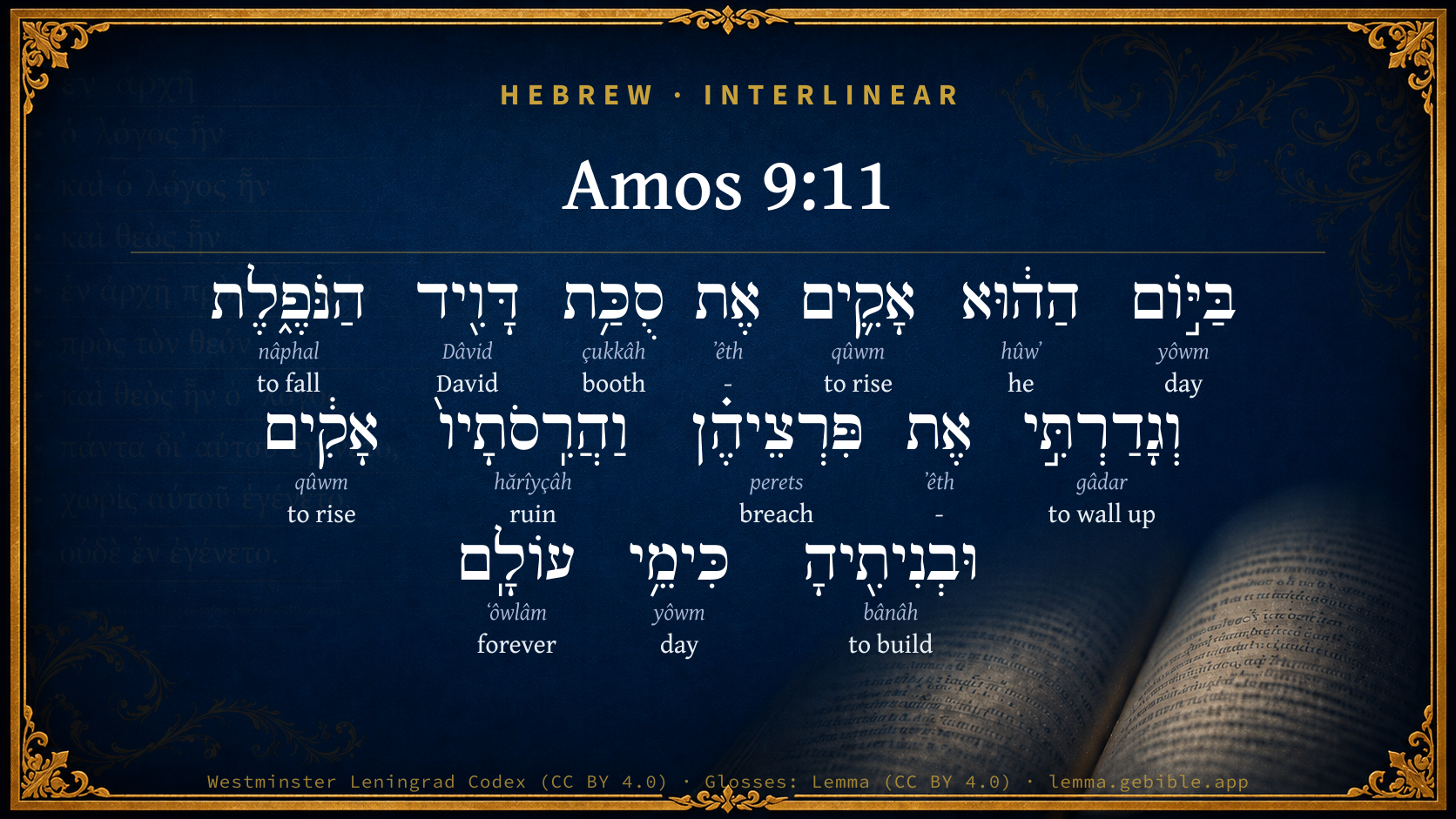
  1. בַּיּ֣וֹם yôwm H3117 “in/at the · day” Preposition, Determined + Noun, Common, Masculine, Singular, Absolute
  2. הַה֔וּא hûwʼ H1931 “the · he” Particle, Definite Article + Pronoun, Personal, 3rd Person, Masculine, Singular
  3. אָקִ֛ים qûwm H6965 “to rise” Verb, Hiphil, Imperfect, 1st Person, Common, Singular
  4. אֶת ʼêth H853 “-” Particle, Direct Object
  5. סֻכַּ֥ת çukkâh H5521 “booth of” Noun, Common, Feminine, Singular, Construct
  6. דָּוִ֖יד Dâvid H1732 “David” Noun, Proper
  7. הַנֹּפֶ֑לֶת nâphal H5307 “the · falling” Particle, Definite Article + Verb, Qal, Participle Active, Feminine, Singular, Absolute
  8. וְגָדַרְתִּ֣י gâdar H1443 “and · to wall up” Conjunction + Verb, Qal, Sequential Perfect, 1st Person, Common, Singular
  9. אֶת ʼêth H853 “-” Particle, Direct Object
  10. פִּרְצֵיהֶ֗ן perets H6556 “breaches · their” Noun, Common, Masculine, Plural, Construct + Suffix, Personal, 3rd Person, Feminine, Plural
  11. אָקִ֔ים qûwm H6965 “to rise” Verb, Hiphil, Imperfect, 1st Person, Common, Singular
  12. וּבְנִיתִ֖יהָ bânâh H1129 “and · to build · her” Conjunction + Verb, Qal, Perfect, 1st Person, Common, Singular + Suffix, Personal, 3rd Person, Feminine, Singular
  13. כִּימֵ֥י yôwm H3117 “like/as · days of” Preposition + Noun, Common, Masculine, Plural, Construct
  14. עוֹלָֽם ʻôwlâm H5769 “forever” Noun, Common, Masculine, Singular, Absolute

About this verse

These counts appear in no published source. They are computed here, from the morphology-tagged text and Lemma’s own curated glosses. What Lemma adds →

15
words
12
distinct lemmas
Prophets
section

Notable vocabulary

1 hapax legomenon — a word that appears only here in the entire Hebrew Bible:

  • וַהֲרִֽסֹתָיו֙ ruin H2034

First appearance in Scripture

This word makes its first canonical appearance in the Hebrew Bible here:

  • וַהֲרִֽסֹתָיו֙ ruin H2034

Shared distinctive vocabulary

וְגָדַרְתִּ֣י to wall up H1443 occurs in 10 verses of the Hebrew Bible. Also found in:

Grammatical profile

  • 5 verbs
  • 7 nouns
  • 1 pronoun
  • 2 particles

Verb forms

  • אָקִ֛ים Hiphil · Imperfect
  • הַנֹּפֶ֑לֶת Qal · Participle Active
  • וְגָדַרְתִּ֣י Qal · Sequential Perfect
  • אָקִ֔ים Hiphil · Imperfect
  • וּבְנִיתִ֖יהָ Qal · Perfect

Repetition

Words recur within this verse — often emphatic in Hebrew:

  • בַּיּ֣וֹם day H3117 ×2
  • אָקִ֛ים to rise H6965 ×2

Hebrew & Septuagint length

In English translation the verse runs 37 words from the Hebrew and 43 from the Septuagint (LXX English) — closely comparable.

A rough comparison of the two English renderings, which tokenize alike — not a word-level alignment.

Word counts can differ between the Hebrew and the Greek without any difference in meaning — e.g. the Hebrew direct-object marker אֵת has no separate Greek word, and Greek often adds the article ὁ.

In the original languages it is 15 Hebrew tokens and 28 Greek tokens — but the two are counted differently (Hebrew bundles its prefixes and suffixes into one token; the Greek is in lemma form), so that isn’t a like-for-like length.

Cross-references

26

Topical passages linked to Amos 9:11 in the Treasury of Scripture Knowledge — connected by theme and wording, ordered by reader-vote popularity; previews shown in the World English Bible.

  • Acts 15:15–17 This agrees with the words of the prophets. As it is written,
  • Jeremiah 33:14–16 Behold, the days come, says Yahweh, that I will perform that good word which I have spoken concerning the house of Israel and concerning the house of Judah.
  • Isaiah 16:5 A throne shall be established in loving kindness; and one shall sit thereon in truth, in the tent of David, judging, and seeking justice, and swift to do righteousness.
  • Jeremiah 23:5–6 Behold, the days come, says Yahweh, that I will raise to David a righteous Branch, and he shall reign as king and deal wisely, and shall execute justice and righteousness in the land.
  • Psalms 80:12 Why have you broken down its walls, So that all those who pass by the way pluck it?
  • Isaiah 63:11 Then he remembered the days of old, Moses [and] his people, [saying], Where is he who brought them up out of the sea with the shepherds of his flock? where is he who put his holy Spirit in the midst of them?
  • Jeremiah 46:26 and I will deliver them into the hand of those who seek their lives, and into the hand of Nebuchadrezzar king of Babylon, and into the hand of his servants; and afterwards it shall be inhabited, as in the days of old, says Yahweh.
  • Ezekiel 17:24 All the trees of the field shall know that I, Yahweh, have brought down the high tree, have exalted the low tree, have dried up the green tree, and have made the dry tree to flourish; I, Yahweh, have spoken and have done it.
  • Job 1:10 Haven't you made a hedge around him, and around his house, and around all that he has, on every side? You have blessed the work of his hands, and his substance is increased in the land.
  • Isaiah 5:5 Now I will tell you what I will do to my vineyard. I will take away its hedge, and it will be eaten up. I will break down its wall of it, and it will be trampled down.
  • Isaiah 9:6–7 For to us a child is born, to us a son is given; and the government shall be on his shoulder: and his name shall be called Wonderful, Counselor, Mighty God, Everlasting Father, Prince of Peace.
  • Isaiah 11:1–10 There shall come forth a shoot out of the stock of Jesse, and a branch out of his roots shall bear fruit.
  • Jeremiah 33:20–26 Thus says Yahweh: If you can break my covenant of the day, and my covenant of the night, so that there shall not be day and night in their season;
  • Lamentations 5:21 Turn you us to you, Yahweh, and we shall be turned; Renew our days as of old.
  • Ezekiel 34:23–24 I will set up one shepherd over them, and he shall feed them, even my servant David; he shall feed them, and he shall be their shepherd.
  • Ezekiel 36:11 and I will multiply on you man and animal; and they shall increase and be fruitful; and I will cause you to be inhabited after your former estate, and will do better [to you] than at your beginnings: and you shall know that I am Yahweh.
  • Ezekiel 37:24–25 My servant David shall be king over them; and they all shall have one shepherd: they shall also walk in my ordinances, and observe my statutes, and do them.
  • Hosea 3:5 Afterward the children of Israel shall return, and seek Yahweh their God, and David their king, and shall come with trembling to Yahweh and to his blessings in the last days.
  • Luke 1:31–33 Behold, you will conceive in your womb, and bring forth a son, and will call his name 'Jesus.'
  • Luke 1:69–70 And has raised up a horn of salvation for us in the house of his servant David
  • Jeremiah 30:9 but they shall serve Yahweh their God, and David their king, whom I will raise up to them.
  • Ezekiel 21:25–27 You, deadly wounded wicked one, the prince of Israel, whose day is come, in the time of the iniquity of the end,
  • Micah 5:2 But you, Bethlehem Ephrathah, Being small among the clans of Judah, Out of you one will come forth to me that is to be ruler in Israel; Whose goings forth are from of old, from everlasting.
  • Acts 2:30–36 Therefore, being a prophet, and knowing that God had sworn with an oath to him that of the fruit of his body, according to the flesh, he would raise up the Christ to sit on his throne,
  • Psalms 143:5 I remember the days of old. I meditate on all your doings. I contemplate the work of your hands.
  • Micah 7:14 Shepherd your people with your staff, The flock of your heritage, Who dwell by themselves in a forest, In the midst of fertile pasture land, let them feed; In Bashan and Gilead, as in the days of old.

Cross-references courtesy of OpenBible.info (CC BY 4.0).

Hebrew and Greek witnesses Masoretic Hebrew ↔ Greek Septuagint

The same verse in the two great witnesses to the Old Testament, shown verse-for-verse.

These are two independent witnesses, not word-aligned to each other, and the Septuagint is shown in lemma (dictionary) form.

Hebrew Amos 9:11 Masoretic · Westminster Leningrad Codex

בַּיּ֣וֹם הַה֔וּא אָקִ֛ים אֶת סֻכַּ֥ת דָּוִ֖יד הַנֹּפֶ֑לֶת וְגָדַרְתִּ֣י אֶת פִּרְצֵיהֶ֗ן וַהֲרִֽסֹתָיו֙ אָקִ֔ים וּבְנִיתִ֖יהָ כִּימֵ֥י עוֹלָֽם

In that day I will raise up the tent of David who is fallen, and close up its breaches, and I will raise up its ruins, and I will build it as in the days of old;

World English Bible · Public Domain

Greek LXX Amos 9:11 Septuagint · lemma form

ἐν ὁ ἡμέρα ἐκεῖνος ἀναἵστημι ὁ σκηνή δαυίδ ὁ πίπτω καί ἀναοἰκοδομέω ὁ πίπτω αὐτός καί ὁ κατασκάπτω αὐτός ἀναἵστημι καί ἀναοἰκοδομέω αὐτός καθώς ὁ ἡμέρα ὁ αἰών

In that day I will raise up the tabernacle of David that is fallen, and will rebuild the ruins of it, and will set up the parts thereof that have been broken down, and will build it up as in the ancient days:

LXX2012 (modern English Septuagint) · Public Domain

On this verse, Keil & Delitzsch discusses the Septuagint’s reading. Read the note in Commentary ↓

Hebrew: Westminster Leningrad Codex (CC BY 4.0). Greek: Septuagint (public domain); English from LXX2012 (modern English Septuagint) (Public Domain). How the Septuagint differs from the Hebrew →

Targum (Aramaic paraphrase)

1

The Targum is the ancient Jewish Aramaic paraphrase of the Hebrew Scriptures — an interpretive translation, not the Hebrew text itself. Onkelos (literal) and Pseudo-Jonathan (expansive) render the Torah, and Jonathan the Prophets. Coverage is partial: where no permissively-licensed English translation exists for a verse, only the Aramaic is shown. This is verse-level text, not a word-by-word alignment to the Hebrew.

  1. Targum Jonathan Prophets (Joshua–Malachi)
    בְּעִדָנָא הַהִיא אָקִים יַת מַלְכוּתָא דְבֵית דָוִד דְנָפְלַת וְאֶבְנֵי יַת כְּרַכֵּיהוֹן וּכְנִישַׁתְהוֹן אַתְקֵין וְתִשְׁלוֹט בְּכָל מַלְכוּתָא וְתִגְמַר וּתְשֵׁיצֵי סַגִי מַשִׁרְיָתָא וְהִיא תִתְבְּנֵי וְתִשְׁתַּכְלֵיל בְּיוֹמֵי עַלְמָא:

    (no public-domain English translation for this verse)

    Targum Jonathan — Aramaic: “Mikraot Gedolot” (public domain). English: “Sefaria Community Translation” (CC0 1.0 (public-domain dedication)); “London "Chaldee Paraphrase," 1871” (public domain). Text via Sefaria.

Commentary

Notes on Amos 9:11 from classic Christian and Jewish commentators (each source and its license shown beneath its notes). The classic Christian expositions comment on the surrounding passage and are grouped to its opening verse, so a note may address several verses; the Jewish commentaries on the Tanakh (Rashi and others) are per-verse, so they appear only where the commentator wrote on this verse.

Lemma curates 59 commentaries, every one of them public domain or Creative Commons licensed, each selected and text-cleaned for this edition rather than reprinted as found. About our sources →

Matthew Henry's Commentary

To him to whom all the prophets bear witness this prophet, here in the close, bears his testimony, and speaks of that day, those days that shall come, in which God will do great things for his church, by the setting up of the kingdom of the Messiah, for the rejecting of which the rejection of the Jews was foretold in the foregoing verses. The promise here is said to agree to the planting of the Christian church, and in that to be fulfilled, Act 15:15-17. It is promised,

I. That in the Messiah the kingdom of David shall be restored (Amo 9:11); the tabernacle of David it is called, that is, his house and family, which, though great and fixed, yet, in comparison with the kingdom of heaven, was mean and movable as a tabernacle. The church militant, in its present state, dwelling as in shepherds' tents to feed, as in soldiers' tents to fight, is the tabernacle of David. God's tabernacle is called the tabernacle of David because David desired and chose to dwell in God's tabernacle for ever, Psa 61:4. Now, 1. These tabernacles had fallen an gone to decay, the royal family was so impoverished, its power abridged, its honour stained, and laid in the dust; for many of that race degenerated, and in the captivity it lost the imperial dignity. Sore breaches were made upon it, and at length it was laid in ruins. So it was with the church of the Jews; in the latter days of it its glory departed; it was like a tabernacle broken down and brought to ruin, in respect both of purity and of prosperity. 2. By Jesus Christ these tabernacles were raised and rebuilt. In him God's covenant with David had its accomplishment; and the glory of that house, which was not only sullied, but quite sunk, revived again; the breaches of it were closed and its ruins raised up, as in the days of old; nay, the spiritual glory of the family of Christ far exceeded the temporal glory of the family of David when it was at its height. In him also God's covenant with Israel had its accomplishment, and in the gospel-church the tabernacle of God was set up among men again, and raised up out of the ruins of the Jewish state. This is quoted in the first council at Jerusalem as referring to the calling in of the Gentiles and God's taking out of them a people for his name. Note, While the world stands God will have a church in it, and, if it be fallen down in one place and among one people, it shall be raised up elsewhere.

II. That that kingdom shall be enlarged, and the territories of it shall extend far, by the accession of many countries to it (Amo 9:12), that the house of David may possess the remnant of Edom, and of all the heathen, that is, that Christ may have them given him for his inheritance, even the uttermost parts of the earth for his possession, Ps. ii. 8. Those that had been strangers and enemies shall become willing faithful subjects to the Son of David, shall be added to the church, or those of them that are called by my name, saith the Lord, that is, that belong to the election of grace and are ordained to eternal life (Act 13:48), for it is true of the Gentiles as well as of the Jews that the election hath obtained and the rest were blinded, Rom 11:7. Christ died to gather together in one the children of God that were scattered abroad, here said to be those that were called by his name. The promise is to all that are afar off, even as many of them as the Lord our God shall call, Act 2:39. St. James expounds this as a promise that the residue of men should seek after the Lord, even all the Gentiles upon whom my name is called. But may the promise be depended upon? Yes, the Lord says this, who does this, who can do it, who has determined to do it, the power of whose grace is engaged for the doing of it, and with whom saying and doing are not two things, as they are with us.

III. That in the kingdom of the Messiah there shall be great plenty, an abundance of all good things that the country produces (Amo 9:13): The ploughman shall overtake the reaper, that is, there shall be such a plentiful harvest every year, and so much corn to be gathered in, that it shall last all summer, even till autumn, when it is time to begin to plough again; and in like manner the vintage shall continue till seed-time, and there shall be such abundance of grapes that even the mountains shall drop new wine into the vessels of the grape-gatherers, and the hills that were dry and barren shall be moistened and shall melt with the fatness or mellowness (as we call it) of the soil. Compare this with Joe 2:24, and Joe 3:18. This must certainly be understood of the abundance of spiritual blessings in heavenly things, which all those are, and shall be, blessed with, who are in sincerity added to Christ and his church; they shall be abundantly replenished with the goodness of God's house, with the graces and comforts of his Spirit; they shall have bread, the bread of life, to strengthen their hearts, and the wine of divine consolations to make them glad-meat indeed and drink indeed - all the benefit that comes to the souls of men from the word and Spirit of God. These had been long confined to the vineyard of the Jewish church; divine revelation, and the power that attended it, were to be found only within that enclosure; but in gospel-times the mountains and hills of the Gentile world shall be enriched with these privileges by the gospel of Christ preached, and professed, and received in the power of it. When great multitudes were converted to the faith of Christ, and nations were born at once, when the preachers of the gospel were always caused to triumph in the success of their preaching, then the ploughman overtook the reaper; and when, the Gentile churches were enriched in all utterance, and in all knowledge, and all manner of spiritual gifts (Co1 1:5), then the mountains dropped sweet wine.

IV. That the kingdom of the Messiah shall be well peopled; as the country shall be replenished, so shall the cities be; there shall be mouths for this meat, Amo 9:14. Those that were carried captives shall be brought back out of their captivity; their enemies shall not be able to detain them in the land of their captivity, nor shall they themselves incline to settle in it, but the remnant shall return, and shall build the waste cities and inhabit them, shall form themselves into Christian churches and set up pure doctrine, worship, and discipline among them, according to the gospel charter, by which Christ's cities are incorporated; and they shall enjoy the benefit and comfort thereof; they shall plant vineyards, and make gardens. Though the mountains and hills drop wine, and the privileges of the gospel-church are laid in common, yet they shall enclose for themselves, not to monopolize these privileges, to the exclusion of others, but to appropriate and improve these privileges, in communion with others, and they shall drink the wine, and eat the fruit, of their own vineyards and gardens; for those that take pains in religion, as men must do about their vineyards and gardens, shall have both the pleasure and profit of it. The bringing again of the captivity of God's Israel, which is here promised, may refer to the cancelling of the ceremonial law, which had been long to God's Israel as a yoke of bondage, and the investing of them in the liberty wherewith Christ came to make his church free, Gal 5:1.

V. That the kingdom of the Messiah shall take such deep rooting in the world as never to be rooted out of it (Amo 9:15): I will plant them upon their land. God's spiritual Israel shall be planted by the right hand of God himself upon the land assigned them, and they shall no more be pulled up out of it, as the old Jewish church was. God will preserve them from throwing themselves out of it by a total apostasy, and will preserve them from being thrown out of it by malice of their enemies; the church may be corrupted, but shall not quite forsake God, may be persecuted, but shall not quite be forsaken of God, so that the gates of hell, neither with their temptations nor with their terrors, shall prevail against it. Two things secure the perpetuity of the church: - 1. God's grants to it: It is the land which I have given them; and God will confirm and maintain his own grants. The part he has given to his people is that good part which shall never be taken from them; he will not revoke his grant, and all the powers of earth and hell shall not invalidate it. 2. Its interest in him: He is the Lord thy God, who has said it, and will make it good, thine, O Israel! who shall reign for ever as thine unto all generations. And because he lives the church shall live also.

Matthew Henry's Commentary on the Whole Bible (1708–1710) — public domain (CC PDM 1.0). Text via the HelloAO Bible API.

The Cambridge Bible for Schools and Colleges

gen. ed. J. J. S. Perowne

11–15. The Epilogue

Amos closes, as the prophets are wont to close their discourses, with the promise of a brighter future. The dynasty of David, though for the time humbled, will be reinstated in its former splendour and power (Amo_9:11-12); and the blessings of peace will be shared in perpetuity by the entire nation (Amo_9:13-15).—On the question of the authenticity of the epilogue, see above, p. 119 ff.

In that day] The day which the prophet has in his mind: here, the day of restoration, which is to succeed the catastrophe of Amo_9:8-10. The expression is a common one in the prophets, especially Isaiah, who use it for the purpose of introducing fresh traits in their pictures of the future (see e.g. Isa_2:20; Isa_3:18; Isa_7:18; Isa_7:20-21; Isa_7:23).

will I raise up the fallen booth (or hut) of David, and fence up the breaches &c.] The succâh, or “booth,” was a rude hut—properly one made of intertwined branches; and the word is used of a cattle-shed (Gen_33:17), of the rough tents used by soldiers in war (2Sa_11:11), or by watchmen in a vineyard (Isa_1:8; Job_27:18), of the “booth” made by Jonah (Amo_4:5), and of the rude temporary huts, constructed of branches of trees, in which the Israelites dwelt during the Feast of Ingathering, or, as it is also called from this circumstance, the ‘Feast of Booths’ (Lev_23:40; Lev_23:42; Deu_16:13). The term itself denotes consequently a very humble structure, which here, in addition, is represented as fallen. In the following words the figure of the booth is neglected; the ‘breaches’ being those of a wall or fortress (cf. Amo_4:3; Isa_30:13). These expressions are evidently intended to represent the humbled state of the Davidic dynasty; though what the humiliation actually referred to is, is uncertain. According to some, the allusion is to the loss sustained by David’s house through the revolt of the ten tribes[203] according to others, it is to the future ruin of Judah, which it appears from Amo_2:5 (cf. the words of rebuke in Amo_3:1, Amo_6:1) that Amos contemplated; others, again, suppose the reference to be to the actual overthrow of David’s dynasty by the Chaldaeans in 586 b.c., and infer accordingly that Amo_9:11-15 was an addition made to the original prophecy of Amos during (or after) the Babylonian exile. On the whole, the second view seems the best (cf. p. 122 f.).

[203] A reference to the blow inflicted upon Judah by Amaziah (2Ki_14:13 f.) is doubtful, as this must have happened some 30 years previously, and under Uzziah Judah appears to have rapidly recovered itself.

ruins] lit. things torn down. The cognate verb (hâras) is often applied to a wall or fortress (e.g. Mic_5:11; Eze_26:12); it is the exact opposite of the following build (see Eze_36:36; Mal_1:4).

as in the days of old] i.e. the age of David and Solomon. The expression used is a relative one, and may denote a period more or less remote according to the context; in Mic_7:14, Isa_63:11, for instance, it denotes the age of Moses, while in Isa_58:12; Isa_61:4 the same word (‘ôlâm), rendered “of old,” denotes merely the beginning of the Babylonian exile, viewed from its close.

The Cambridge Bible for Schools and Colleges (gen. ed. J. J. S. Perowne; Cambridge University Press, 1878–1918) — public domain. Text from a community e-Sword module.

Trapp's Complete Commentary

John Trapp

Amo 9:11 In that day will I raise up the tabernacle of David that is fallen, and close up the breaches thereof; and I will raise up his ruins, and I will build it as in the days of old:

Ver. 11. In that day will I raise up the tabernacle of David] A most sweet conclusion of the prophecy by sundry evangelical promises, after so many very severe and sharp menaces: the Sun of righteousness liketh not to set in a cloud. In that day, that happy day, whensoever it shall dawn, that Christ shall come; for the prophets knew not the certain time when, but made diligent inquiry as far as they might with sobriety, 1Pe 1:11, and well knew that the law, which they preached and explained, was an introduction to a better hope, Heb 7:19, which they saw afar off and saluted, Heb 11:13.

Will I raise up the tabernacle of David] That is, the kingdom of the house of David, saith the Chaldee paraphrast; meaning, of the Messiah, whom the sounder sort of Rabbis from this text call Ben Niphlei, the repairer of the breach, the restorer of paths to dwell in. Now the Church is here called the tabernacle of David, because that once stately palace of David was by many desolations reduced to a tent, as it were, and that ready to drop too. The Branch grew out of the root of Jesse, when that goodly family was sunk so low as from David the king to Joseph the carpenter. Besides, all was out of order both in Church and State when Christ came.

And close up the breaches thereof] Heb. wall up; by unwalling (as the Hebrew hath it, Num 24:17) all the children of Seth; by subduing the sons of men, the godly seed, to the obedience of faith; by bringing into captivity every haughty thought, 2Co 10:4-5 (that at the name of Jesus every knee may bow, Php 2:10), and getting a full conquest by the preaching of the gospel, which shall quickly close up all ruptures, and raise up all ruins, by chasing away terrors and false worships, doctrines of devils, and traditions of men, whereby the scribes and Pharisees had made the commandment of God of none effect.

And I will build it as in the days of old] In those purer times of David and the other holy patriarchs, who made up but one and the same Church with us, and were saved by the same faith in Christ Jesus, that Lamb of God slain from the foundation of the world, Rev 13:8. Mine antiquity is Jesus Christ, said Ignatius, the martyr. As we prefer the newest philosophy, so the most ancient divinity, saith another.

John Trapp, A Commentary or Exposition upon All the Books of the Old and New Testament (1647–1656) — public domain. Text from a community e-Sword module.

The Biblical Illustrator

Joseph S. Exell

Amo_9:11

In that day will I raise up the tabernacle of David that is fallen.

The tabernacle of David ruined by man, and reared up by the mighty God

Things to take notice of.

1. The designation that the prophet Amos, by Gods commission, gives unto the kingdom of Israel. A sinful kingdom (verse 8).

2. An advertisement that the prophet Amos gives unto this sinful kingdom. He says, The eyes of the Lord are upon it.

3. Gods purpose and resolution with reference to the sinful kingdom. I will destroy it from off the face of the earth.

4. The limitation of the awful sentence. Saving that I will not utterly destroy the house of Jacob.

5. An account of Gods management with respect to that remnant. Yet shall not the least grain fall to the earth.

6. We are told what will become of the chaff. Shall die by the sword. Now follows another scene: a scene of mercy is opened up in verse 11. Notice--

(1) The designation that God gives unto His Church, particularly the New Testament Church. The tabernacle of David.

(2) The present case of the tabernacle of David; it is fallen; there are breaches made in it; it is in a ruinous condition.

(3) We have a promise of rebuilding Davids tabernacle. I will raise up his ruins, and I will build it as in the days of old.

(4) The time or season when this is to be done. In that day. Observation. That God many times ushers in a glorious work of reformation by very cloudy, dark, and dismal dispensations of providence. This is Gods ordinary way of working, both towards particular persons and particular Churches. Illustrate by Gods planting a Church for Himself in the land of Canaan. The return of the children of Israel from Babylonish captivity. The times of Constantine. The revival of the Church upon the downfall of Antichrist. Why is it that God goes to work in this way?

1. That He may be avenged on the persecutors and enemies of His Church and people.

2. That He may remove the abounding offences in the visible Church, and roll away the impediments that hinder her reformation.

3. And there is something godlike, greatlike, and majestic in this manner of procedure. There is something admirable in this way of working in respect of God Himself; in respect of religion itself. In respect of the people of God, and the effect that this way of working has upon them. Doctrine. That God has His own time and way of rebuilding or reforming His Church, when she is brought to a very low and ruinous condition.

I. Why the Church of Christ is represented under the name and notion of the Tabernacle of David. There is evident allusion to the tabernacle which, by Gods special command unto Moses, was reared in the wilderness.

1. The tabernacle was Gods lodging and habitation in the camp of Israel, a symbol of Gods gracious presence among them.

2. The Divine oracles, the law and the testimony, were preserved and kept in the tabernacle, and from thence they were given out for the use of Israel. So to the Church pertain the oracles of God; His revealed mind and will in the Scriptures of truth is committed to her trust.

3. The tabernacle was the place of worship. So the Church of Christ is the place where He will be worshipped and sanctified of all that are about Him.

4. The pattern of the tabernacle was given by God unto Moses in the mount. So the model of the Church, with a perfect system of laws, by which she is to be governed, is given of God in the mount of revelation.

5. No man was to intrude himself into the service of the tabernacle. So, in the New Testament Church, no man is to intrude himself into the sacred offices of the Church, without he is qualified and called of God unto that work.

6. The greatest and most sacred thing in the tabernacle was the ark and mercy-seat. And it is the great business of ministers of the Gospel, now under the New Testament, to disclose or open the ark of the covenant of grace, to preach Christ.

7. The ark was a portable or movable kind of tent. In like manner the Church of God, while in this world, is not fixed to any particular nation.

II. When may the Tabernacle of David be said to be fallen, broken, and ruinous?

1. When the God of the tabernacle is departed.

2. When the oracles of God are not carefully kept and purely dispensed.

3. When the God of the tabernacle is not worshipped according to His appointment.

4. When it is not kept according to the pattern in the mount.

5. When men are entered upon tabernacle service, without being called, qualified, and sanctified for such service.

III. How is it that God raises up his tabernacle when it is fallen?

1. In a time of defection He raises up witnesses to bear testimony against the corruptions and mismanagements of men about His tabernacle.

2. The Lord puts it in the hearts of His people and ministers to take pleasure in the stones and rubbish of His fallen tabernacle, and to mourn and lament over their own sins and the tokens of the Lords anger that have gone out against them.

3. The Lord polishes and prepares some for tabernacle work and service, as He did Bezaleel and Aholiab.

4. His tabernacle is raised up by a plentiful downpouring of the Spirit.

5. Sometimes He inspires great men, kings, and nobles, to espouse the cause of His fallen tabernacle.

6. Sometimes He rears up His fallen tabernacle in the very blood and sufferings of His witnesses.

IV. Offer some thoughts anent the time or day of the Lords building up the tabernacle of David.

1. It is a time which God hath kept in His own power, and therefore we should beware of diving with too much curiosity into it.

2. When men think the time at hand, and their expectations are big, things frequently take another turn, and defeat all their hopes for that season.

3. Gods time of building up His tabernacle is commonly when things axe brought to the last extremity.

4. Gods time is a day of vengeance and vexation unto the wicked and ungodly world.

5. Yet is it a day of joy and gladness to all Zions friends and well-wishers.

In order to the successful building of the broken and fallen tabernacle of David.

1. It is necessary that every one of us prepare a habitation for the mighty God of Jacob in our hearts.

2. That we be well acquainted with the pattern showed in the mount, particularly of the New Testament revelation.

3. That, like Elijah, we be very zealous for the Lord God of hosts.

4. We need to count the cost; to reckon what tabernacle work may cost.

5. Sympathise with and help all ministers or Christians who are endeavouring honestly, in their spheres, to build up the tabernacle of God. (E. Erksine.)

The restoration of the true moral theocracy

The old Hebrew world was for ages governed by a theocracy. God was their King. He had under Him, and by His appointment, human rulers and other functionaries; but they were simply His instruments and He was their King. That form of government has passed away, but it was symbolical. It was the emblem of a higher theocracy. Of which we note--

I. It rose from the humblest condition. In that day I will raise up the tabernacle of David that is fallen. Its founder was a poor Jewish peasant. Its first apostles, who were they? In its origin, indeed, its symbols are the little stone, the grain of mustard seed, and the few particles of leaven.

II. Heathens are subject to its authority. That they may possess the remnant of Edom, and of all the heathen, which are called by My name, saith the Lord that doeth this. The old theocracy was confined to the Jews; this one, this moral theocracy, is to extend to the heathen. Even Edom--the old and inveterate foe of the theocratic people, who may be regarded as the representative of the whole heathen world--is to be subjected to it. It shall inherit the Gentiles. It is to have the heathen for its inheritance, and the uttermost parts of the earth for its possession.

III. Abundant material provisions will attend it. Behold, the days come, saith the Lord, that the ploughman shall overtake the reaper, and the treader of grapes him that soweth seed; and the mountains shall drop sweet wine, and all the hills shall melt. The metaphorical language here employed is at once in the highest degree bold and pleasing. The Hebrews were accustomed to construct terraces on the sides of the mountains and other elevations, on which they planted vines. Of this fact the prophet avails himself, and represents the immense abundance of the produce to be such that the eminences themselves would appear to be converted into the juice of the grape. Just as this moral theocracy extends, pauperism will vanish. With the kingdom of God and His righteousness all necessary material good comes. Godliness is profitable unto all things.

IV. Lost privileges are restored as it advances. Three blessings, which man has lost through depravity, are here indicated.

1. Freedom. I will bring again the captivity, or rather, I will reverse the captivity, give them liberty. Man in a state of depravity is a slave, a slave to lust, worldliness etc. etc. This moral theocracy ensures freedom to all its subjects. Ye shall know the truth, and the truth shall make you free.

2. Prosperity. Shall build the desolate cities and inhabit them; and they shall plant vineyards and drink the wine thereof. One of the sad evils connected with mans fallen depravity is, that he does not reap the reward of his labours. He builds cities and plants vineyards and makes gardens for others. Through the reign of social injustice he is prevented from enjoying the produce of his honest labours. Under this theocracy it will not be so. What a man produces he will hold and enjoy as his own.

3. Settledness. I will plant them upon their land, and they shall no more be pulled up out of their land which I have given them, saith the Lord thy God. Unregenerate man has ever been restless, homeless, unsettled. He stands not on a rock, but rather on planks floating on surging waters; he is never at rest. All the subjects of the true theocracy are established. God is their refuge and strength. Let us have faith in this predicted future of the world. (Homilist.)

The Biblical Illustrator, edited by Joseph S. Exell (c. 1880s–1900s) — public domain. Text from a community e-Sword module.

Joseph Benson's Commentary

Amo 9:11. In that day — In this and the following verses, to the end of the chapter, we have a most consolatory conclusion of this prophecy in sundry evangelical promises, after so many very severe and sharp menaces. The phrase, in that day, signifies here the same as afterward, or, after this, for so St. James interprets it when quoting this very verse, Act 15:16. And there are other places of Scripture where then, or in that day, signifies afterward. Will I raise up the tabernacle of David — This promise seems, at least in the first place, to be intended of the return of the Jews from the land of their captivity, their resettlement in Judea, rebuilding Jerusalem, and attaining to that height of power and glory which they enjoyed in the days of the Maccabees. This restoration was an event so extraordinary, and the hope of it so necessary to be maintained in the minds of the Jewish people, in order to their support under the calamity of their seventy years’ captivity, that God was pleased to foretel it by the mouth of all his prophets. And though we suppose the prophecy before us to appertain chiefly to the kingdom of Israel, yet a promise of a future restoration was no less proper and necessary, in order to their encouragement, to be annexed to God’s threatenings against them: because it was his purpose to restore Israel in general, that is, the whole twelve tribes, and to make them one nation, as they were before their unhappy division. The edict of Cyrus was general, giving liberty to all the posterity of Jacob, wheresoever dispersed, to return to Judea. And many of the ten tribes certainly did return, though the main body of those who returned consisted of the two tribes of Judah and Benjamin. This prophecy, however, must also be extended to the days of the Messiah, and to the calling of the Gentiles to the knowledge of the true God: and so St. James expounds it, Act 15:16; for this was, emphatically speaking, raising up the tabernacle of David, both in the person of Christ, who is frequently styled David, and the seed of David in the prophets, and also in respect to what peculiarly distinguished David and Israel in God’s sight, namely, their having the knowledge of the true God, and worshipping of him alone.

Joseph Benson's Commentary on the Old and New Testaments (1811–1818) — public domain. Text from a community e-Sword module.

Whedon's Commentary on the Bible

Daniel D. Whedon

THE EPILOGUE — PROMISES OF A BRIGHTER FUTURE, Amo_9:11-15.

In Amo_9:9 the prophet promises the preservation of a remnant, in Amo_9:10 the destruction of the wicked. Nothing more need be said about the latter, for they are annihilated; but what will become of the former? It will be exalted to glory and honor. This exaltation is the subject of 11-15. Like the other prophets, our author is convinced that the remnant will be the nucleus of the new kingdom of God, which will be ruled by the restored dynasty of David (11); its boundaries will extend to the limits of the empire of David (12); famine and want will be no more, for the soil will be blessed with extraordinary fertility (13); the exiles scattered abroad will be restored and the waste cities will be rebuilt (14); and in prosperity and felicity the people will be established in their own land forever (15).

11. In that day — When the judgment has fallen, the sinners have been destroyed, and a righteous nucleus has been saved.

Tabernacle of David — The word, also translated “hut,” is used of a temporary structure of boughs, or the reed hut of soldiers in the field (2Sa_11:11; Isa_1:8); it is descriptive here, by way of contrast, of the house of David (1Ki_12:19-20; Zec_12:7-8; compare 2Sa_7:11; 2Sa_7:16), the royal dynasty, which at that time will be in dire straits, but which will be raised again to honor from its humiliation (see further Introduction, p. 216).

Fallen — Into ruin. It is no longer a desirable hut (compare Isa_11:1). In the next three clauses the figure of a broken wall is substituted.

Breaches — Made by the enemy; a figure of damages inflicted upon the dynasty of David, by which it is rendered defenseless.

His ruins — David’s. R.V., “its,” that is, of the tabernacle. In either case the sense remains the same.

Build — Or, rebuild.

It — The tabernacle.

As in the days of old — During the splendid reign of David. Once more the dynasty will become a house stately and majestic.

Daniel D. Whedon (gen. ed.), Commentary on the Old and New Testaments (1874–1909) — public domain. Text from a community e-Sword module.

The Preacher's Complete Homiletical Commentary

Joseph S. Exell (gen. ed.)

CRITICAL NOTES.]

Amo_9:11. The booth] The fallen shepherd, hut (not the palace), indicating the feeble condition of the family and nation. Wall up] the rents; the two divided nations should become one. Raise up] Enlarge and finish the building as of old (2Sa_7:11-16).

Amo_9:12. They] God’s people possess Edom, the enemies of the Church, as the gift of God: some, “the remnant of Edom and of all the heathen that are or shall be called by My name, shall possess Me, the Lord.” There shall be a grand future restoration.

Amo_9:13.] The land shall be blessed. The plowman overtakes the reaper. One harvest shall scarcely be gathered before preparation shall be made for another; a fulfilment of Lev_26:5. Eminences themselves shall drop down in rich juice of grape.

Amo_9:14.] The kingdom shall be prosperous; fallen cities rebuilt; vines planted and enjoyed no longer by the enemy. Reviving activity would be seen everywhere.

Amo_9:15.] All this perpetual. Plant] Firm and lasting establishment of them; trees not torn up, but firmly rooted and eternally flourishing in joy and peace (Jer_32:41). This is a beautiful type of the building up, enlargement, and establishment of the Christian Church through Christ. In Him earth will become an Eden, and the Lord will again dwell with a holy people.

HOMILETICS

THE FALLEN TABERNACLE REARED AND ENLARGED.—Amo_9:11-12

The book which began with dreadful judgments ends in sublime visions. The prophet has bewailed the sins of different cities and denounced the wrath of God against them. Now we find him predicting blessings for the heathen. The funeral dirge is turned into a song of mercy. The prophet is rewarded for faithful service, and is comforted with the thought, that after the destruction of ungodly elements, Divine grace shall rear, enlarge, and prosper a kingdom which shall never be destroyed. Amo_9:11-15 might be taken together as including the vision, but we shall treat them separately. From Amo_9:11-12, we get a description of the restored tabernacle.

I. The fallen tabernacle shall be reared up. “In that day will I raise up the tabernacle of David.”

1. Raised from its fallen condition. It was not a magnificent palace, but “the fallen but.” It had been rent and ruined by divisions and wars. Sin will cause any kingdom to decay and any Church to fall. It impoverishes royalty, impairs human dignity, and throws into the lowest condition. But Divine grace can build up and beautify what sin has pulled down. In the human heart, the Christian Church, and the heathen world God is building up a holy temple for the perpetual residence of His Spirit (Eph_2:22).

2. Repaired in its breaches. “And close up the breaches thereof.” Sin breaks down moral barriers, creates divisions in the family and the fold. God sets up new stones in the walls, heals divisions, and unites men in love and loyalty to himself.

3. Completed in its original design. “I will build it as in the days of old.” God will finish and complete the building according to its ancient grandeur in the days of David and Solomon (2Sa_7:11-16); and in harmony with his purpose. The kingdom of David is a type of the kingdom of Christ, the Son of David. The Christian Church may be reduced in circumstances, and almost ruined in prospect; but that is no reason for despair. The humble cot, the shattered tent, may be raised to greater worth and adorned with greater beauty than the temple of old. “Thou shalt arise and have mercy upon Zion: for the time to favour her, yea, the set time is come.”

II. The fallen tabernacle shall be greatly enlarged. “That they may possess the remnant of Edom,” &c. Formerly the Church was confined in narrow limits, but now it shall spread itself over all nations.

1. The Edomites, near neighbours, yet bitter enemies, shall become peaceful citizens.

2. The heathens, the Gentiles, should be called. The prophet pronounced woe upon these nations at first, but now he speaks of them as called by the name of Jehovah. The most desperate and the most distant may be converted to Christ. We should be glad at the conversion of others, and remember that the promise is unto us and our children, and as many as the Lord our God shall call. There is a bright vision for the future. God is daily increasing the number of his people. Jew and Gentile shall be called, enrolled in one family, and be distinguished by one name. “Ask of Me, and I shall give thee the heathen for thine inheritance, and the uttermost parts of the earth for thy possession.”

THE SPIRITUAL GLORY OF THE RAISED TABERNACLE.—Amo_9:13-15

Behold, the days come, there are more blessings in store yet. From the fulfilment of Amo_9:11-12, shall result abundance of produce in the land, Amo_9:13, great prosperity in the nation, and perpetual duration of the kingdom [Keil].

I. The land shall be blessed with the greatest fertility. No more curse, nor failing crops. We have in this scene—

1. Earnest activity. The seedsman, the ploughman, and the reaper are all engaged in their special duties.

2. Abundant crops. So rich and productive is the land, that the mountains drop down sweet wine, and all the hills melt (Joe_3:18).

3. Wonderful rapidity. The harvest lasts unto the vintage, and the vintage continues to the seed-time. There is one continuous produce, one perpetual round of toil and success.

II. The inhabitants shall enjoy the greatest privileges. As the land of Israel shall be no more smitten with drought, so the citizens shall enjoy the rich benefits of their peaceful labour.

1. Joy would be restored. “I will bring again the captivity of my people.” Misfortune and misery should once more be turned into prosperity.

2. Freedom would be reclaimed. “They shall build the waste cities.” Delivered from the fear of the enemy, they are active for God. Men are captives, and only made free in Christ. In the gospel Christian Churches are chartered with liberty of worship and action. Hence they build waste places, and inhabit them with renewed blessings.

3. The fruits of labour would be enjoyed. Wicked men toil for others, and not for themselves. The Jews would no longer sow and others reap. They would build cities, plant vineyards, and make gardens, and enjoy the fruits of their efforts. “My servants shall build houses and inhabit them, and plant vineyards and eat the fruit of them.”

4. Perpetual security would be granted. They would be no longer a homeless, wandering people. God would fix them, perpetually establish them in the land. When God plants, man cannot uproot or destroy. “I will plant them in this land assuredly with my whole heart and my whole soul.”

HOMILETIC HINTS AND OUTLINES

Amo_9:12. The restoration was not to be for themselves alone. No gifts of God end in the immediate object of his bounty and love. They were restored in order that they, the first objects of God’s mercies, might win others to God; not Edom only, but all nations upon whom God says my name is called [Pusey].

The call of the Gentiles.

1. The call of a remnant as in Edom; so Scripture everywhere speaks of the converted as a residue.

2. The call of those specially related to God. Those who sincerely invoke his name and seek his covenanted mercy (Act_15:15-17).

Amo_9:13. Mountains. Symbols of barrenness, idolatry, and difficulty of cultivation set forth the fertility and fulness of the Christian Church.

Amo_9:15.

1. The prosperity of the Church. “I will plant them.”

2. The security of the Church. “Saith the Lord thy God.”

3. The perpetuity of the Church. “They shall no more be pulled up.”

ILLUSTRATIONS TO CHAPTER 9

Amo_9:11-15. Future days. Nothing good bursts forth all at once. The lightning may dart out of a black cloud; but the day sends his bright heralds before him, to prepare the world for his coming [Hare].

The brightest day has not yet dawned, the widest conquests have not yet been achieved. Is not the Church challenged to nerve herself for greater effort, and to array herself in a more imposing habit? “Put on thy strength, O Zion, put on thy beautiful garments, O Jerusalem!”

“O! scene surpassing fable, and yet true,

Scene of accomplished bliss, which who can see,

Though but in distant prospect, and not feel

His soul refreshed with foretaste of the joy?”

HOMILETIC COMMENTARY

ON

OBADIAH

INTRODUCTION

THIS book consists only of twenty-one verses, and is the shortest in the Bible.

The Author. Obadiah (Servant of Jehovah) is a proper name frequently met with, but little is known concerning our Author. Some identify him with the pious courtier in the palace of Ahab (1Ki_18:3); some with the overseer of the workmen in 2Ch_34:12; but the silence of Scripture is in significant contrast with the anxiety of men to know something of him.

The Time. “In all probability the prophecy was delivered between the year B. C. 588, when Jerusalem was taken by the Chaldeans, and the termination of the siege of Tyre by Nebuchadnezzar. During this interval, that monarch subdued the Idumeans and other neighbouring nations” [A. Elzaz]. The contents of the book and its relation to the prophecy of Jeremiah seem to confirm this view.

The Book. “The subjects of the prophecy are the judgments to be inflicted upon the Idumeans on account of their wanton and cruel conduct towards the Jews at the time of the Chaldean invasion, and the restoration of the latter from captivity. The book may therefore be fitly divided into two parts; the first comprising Oba_1:1-15, which contain a reprehension of the pride, self-confidence, and unfeeling cruelty of the former people, and definite predictions of their destruction; the latter Oba_1:17-21, in which it is promised that the Jews should not only be restored to their own land, but possess the territories of the surrounding nations, especially Idumea” [Elzaz].

The style is original and fresh. “Vividness, connectedness, power, are characteristics of it. As it begins so it continues and ends. It has no breaks, nor interruptions. Thought follows on thought, as wave rolls upon wave, but all marshalled to one end, marching on, column after column, to the goal which God hath appointed for them. Each verse grows out of that which was before it, and carries on its thought. The cadence of the words in the original is a singular blending of pathos and strength. The pathos of the cadence consists in a somewhat long-sustained measure, in which the Prophet dwells on the one thought which he wishes to impress; the force, in the few brief words in which he sums up some sentence” [Pusey]. “Among all the prophets,” says one, “he is the briefest in number of words; in the grace of mysteries he is their equal.”

“The reason why the book occupies its present unchronological position in the Hebrew Bible is supposed to be the connection between the subjects of which it treats and the mention made of ‘the residue of Edom,’ at the conclusion of the preceding book of Amos” [Elzaz]. “The chronological position of Obadiah illustrates an important truth concerning God’s dealings with mankind, viz. that he never executes a judgment, or inflicts a punishment, on a nation or individual, without having given some previous warning as to the hateful character and dangerous consequences of the sins for which the judgments are inflicted. He did not denounce his judgments on Nineveh by Nahum, before he had given warning to Nineveh by Jonah; and he did not denounce his judgment upon Edom by Jeremiah, before he had given warning of the approaching visitation by Obadiah” [Wordsworth].

The Preacher's Complete Homiletical Commentary (gen. ed. Joseph S. Exell; Funk & Wagnalls, c. 1892) — public domain (pre-1929). A full-Bible homiletical/sermon-outline anthology covering 65 of 66 books (2 John is absent from the source module). Text from a community e-Sword module.

Keil & Delitzsch

C. F. Keil & F. Delitzsch

The Kingdom of God Set Up. - Since God, as the unchangeable One, cannot utterly destroy His chosen people, and abolish or reverse His purpose of salvation, after destroying the sinful kingdom, He will set up the new and genuine kingdom of God. Amo 9:11. "On that day will I set up the fallen hut of David, and wall up their rents; and what is destroyed thereof I will set up, and build it as in the days of eternity. Amo 9:12. That they may taken possession of the remnant of Edom, and all the nations upon which my name shall be called, is the saying of Jehovah, who doeth such things." "In that day," i.e., when the judgment has fallen upon the sinful kingdom, and all the sinners of the people of Jehovah are destroyed. Sukkâh, a hut, indicates, by way of contrast to bayith, the house or palace which David built for himself upon Zion (Sa2 5:11), a degenerate condition of the royal house of David. This is placed beyond all doubt by the predicate nōpheleth, fallen down. As the stately palace supplies a figurative representation of the greatness and might of the kingdom, so does the fallen hut, which is full of rents and near to destruction, symbolize the utter ruin of the kingdom. If the family of David no longer dwells in a palace, but in a miserable fallen hut, its regal sway must have come to an end. The figure of the stem of Jesse that is hewn down, in Isa 11:1, is related to this; except that the former denotes the decline of the Davidic dynasty, whereas the fallen hut represents the fall of the kingdom. There is no need to prove, however, that this does not apply to the decay of the Davidic house by the side of the great power of Jeroboam (Hitzig, Hofmann), least of all under Uzziah, in whose reign the kingdom of Judah reached the summit of its earthly power and glory. The kingdom of David first became a hut when the kingdom of Judah was overcome by the Chaldeans, - an event which is included in the prediction contained in Amo 9:1., and hinted at even in Amo 2:5. But this hut the Lord will raise up again from its fallen condition. This raising up is still further defined in the three following clauses: "I wall up their rents" (pirtsēhen). The plural suffix can only be explained from the fact that sukkâh actually refers to the kingdom of God, which was divided into two kingdoms ("these kingdoms," Amo 6:2), and that the house of Israel, which was not to be utterly destroyed (Amo 9:8), consisted of the remnant of the people of the two kingdoms, or the ἐκλογή of the twelve tribes; so that in the expression גדרתי פרציהן there is an allusion to the fact that the now divided nation would one day be united again under the one king David, as Hosea (Hos 2:2; Hos 3:5) and Ezekiel (ch. Eze 37:22) distinctly prophesy. The correctness of this explanation of the plural suffix is confirmed by הרסתיו in the second clause, the suffix of which refers to David, under whom the destroyed kingdom would rise into new power. And whilst these two clauses depict the restoration of the kingdom from its fallen condition, in the third clause its further preservation is foretold.

בּנה does not mean to "build" here, but to finish building, to carry on, enlarge, and beautify the building. The words כּימי עולם (an abbreviated comparison for "as it was in the days of the olden time") point back to the promise in Sa2 7:11-12, Sa2 7:16, that God would build a house for David, would raise up his seed after him, and firmly establish his throne for ever, that his house and his kingdom should endure for ever before Him, upon which the whole of the promise before us is founded. The days of the rule of David and of his son Solomon are called "days of eternity," i.e., of the remotest past (compare Mic 7:14), to show that a long period would intervene between that time and the predicted restoration. The rule of David had already received a considerable blow through the falling away of the ten tribes. And it would fall still deeper in the future; but, according tot he promise in 2 Samuel 7, it would not utterly perish, but would be raised up again from its fallen condition. It is not expressly stated that this will take place through a shoot from its own stem; but that is implied in the fact itself. The kingdom of David could only be raised up again through an offshoot from David's family. And that this can be no other than the Messiah, was unanimously acknowledged by the earlier Jews, who even formed a name for the Messiah out of this passage, viz., בר נפלין, filius cadentium, He who had sprung from a fallen hut (see the proofs in Hengstenberg's Christology, vol. i. p. 386 transl.). The kingdom of David is set up in order that they (the sons of Israel, who have been proved to be corn by the sifting, Amo 9:9) may take possession of the remnant of Edom and all the nations, etc. The Edomites had been brought into subjection by David, who had taken possession of their land. At a late period, when the hut of David was beginning to fall, they had recovered their freedom again. This does not suffice, however, to explain the allusion to Edom here; for David had also brought the Philistines, the Moabites, the Ammonites, and the Aramaeans into subjection to his sceptre, - all of them nations who had afterwards recovered their freedom, and to whom Amos foretels the coming judgment in Amo 1:1-15. The reason why Edom alone is mentioned by name must be sought for, therefore, in the peculiar attitude which Edom assumed towards the people of God, namely, in the fact "that whilst they were related to the Judaeans, they were of all nations the most hostile to them" (Rosenmller). On this very ground Obadiah predicted that judgment would come upon the Edomites, and that the remnant of Esau would be captured by the house of Jacob. Amos speaks here of the "remnant of Edom," not because Amaziah recovered only a portion of Edom to the kingdom (Kg2 14:7), as Hitzig supposes, but with an allusion to the threat in Amo 1:12, that Edom would be destroyed with the exception of a remnant. The "remnant of Edom" consists of those who are saved in the judgments that fall upon Edom. This also applies to כּל־הגּוים. Even of these nations, only those are taken by Israel, i.e., incorporated into the restored kingdom of David, the Messianic kingdom, upon whom the name of Jehovah is called; that is to say, not those who were first brought under the dominion of the nation in the time of David (Hitzig, Baur, and Hofmann), but those to whom He shall have revealed His divine nature, and manifested Himself as a God and Saviour (compare Isa 63:19; Jer 14:9, and the remarks on Deu 28:10), so that this expression is practically the same as אשׁר יהוה קרא (whom Jehovah shall call) in Joe 3:5. The perfect נקרא acquires the sense of the futurum exactum from the leading sentence, as in Deu 28:10 (see Ewald, 346, c). יירשׁוּ, to take possession of, is chosen with reference to the prophecy of Balaam (Num 24:18), that Edom should be the possession of Israel (see the comm. on this passage). Consequently the taking possession referred to here will be of a very different character from the subjugation of Edom and other nations to David. It will make the nations into citizens of the kingdom of God, to whom the Lord manifests Himself as their God, pouring upon them all the blessings of His covenant of grace (see Isa 56:6-8). To strengthen this promise, נאם יי וגו ("saith Jehovah, that doeth this") is appended. He who says this is the Lord, who will also accomplish it (see Jer 33:2).

The explanation given above is also in harmony with the use made by James of our prophecy in Act 15:16-17, where he derives from Amo 9:11 and Amo 9:12 a prophetic testimony to the fact that Gentiles who became believers were to be received into the kingdom of God without circumcision. It is true that at first sight James appears to quote the words of the prophet simply as a prophetic declaration in support of the fact related by Peter, namely, that by giving His Holy Spirit to believers from among the Gentiles as well as to believers from among the Jews, without making any distinction between Jews and Gentiles, God had taken out of the Gentiles a people ἐπὶ τῶ ὀνόματι αὐτοῦ, "upon His name" (compare Act 15:14 with Act 15:8-9). But as both James and Peter recognise in this fact a practical declaration on the part of God that circumcision was not a necessary prerequisite to the reception of the Gentiles into the kingdom of Christ, while James follows up the allusion to this fact with the prophecy of Amos, introducing it with the words, "and to this agree the words of the prophets," there can be no doubt that James also quotes the words of the prophet with the intention of adducing evidence out of the Old Testament in support of the reception of the Gentiles into the kingdom of God without circumcision. But this proof is not furnished by the statement of the prophet, "through its silence as to the condition required by those who were pharisaically disposed" (Hengstenberg); and still less by the fact that it declares in the most striking way "what significance there was in the typical kingdom of David, as a prophecy of the relation in which the human race, outside the limits of Israel, would stand to the kingdom of Christ" (Hofmann, Schriftbeweis, ii. 2, pp. 84, 85). For the passage would contain nothing extraordinary concerning the typical significance possessed by the kingdom of David in relation to the kingdom of Christ, if, as Hofmann says (p. 84), the prophet, instead of enumerating all the nations which once belonged to the kingdom of David, simply mentions Edom by name, and describes all the others as the nations which have been subject like Edom to the name of Jehovah. The demonstrative force of the prophet's statement is to be found, no doubt, as Hofmann admits, in the words כּל־הגּוים אשׁר נקרא שׁמי עליהם. But if these words affirmed nothing more than what Hofmann finds in them - namely, that all the nations subdued by David were subjected to the name of Jehovah; or, as he says at p. 83, "made up, in connection with Israel, the kingdom of Jehovah and His anointed, without being circumcised, or being obliged to obey the law of Israel" - their demonstrative force would simply lie in what they do not affirm, - namely, in the fact that they say nothing whatever about circumcision being a condition of the reception of the Gentiles. The circumstance that the heathen nations which David brought into subjection to his kingdom were made tributary to himself and subject to the name of Jehovah, might indeed by typical of the fact that the kingdom of the second David would also spread over the Gentiles; but, according to this explanation, it would affirm nothing at all as to the internal relation of the Gentiles to Israel in the new kingdom of God. The Apostle James, however, quotes the words of Amos as decisive on the point in dispute, which the apostles were considering, because in the words, "all the nations upon whom my name is called," he finds a prediction of what Peter has just related, - namely, that the Lord has taken out of the heathen a people "upon His name," that is to say, because he understands by the calling of the name of the Lord upon the Gentiles the communication of the Holy Ghost to the Gentiles.

(Note: Moreover, James (or Luke) quotes the words of Amos according to the lxx, even in their deviations from the Hebrew text, in the words ὅπως ἂν ἐκζητήσωσιν οἱ κατάλοιποι τῶν ἀνθρώπων με (for which Luke has τὸν κύριον, according to Cod. Al.), which rest upon an interchange of למען יירשׁוּ את־שׁארית אדום with למען ידרשׁוּ שׁארית אדם; because the thought upon which it turned was not thereby altered, inasmuch as the possession of the Gentiles, of which the prophet is speaking, is the spiritual sway of the people of the Lord, which can only extend over those who seek the Lord and His kingdom. The other deviations from the original text and from the lxx (compare Act 15:16 with Amo 9:11) may be explained on the ground that the apostle is quoting from memory, and that he alters ἐν τῆ ἡμερᾶ ἐκείνη ἀναστήσω into μετὰ ταῦτα ἀναστρέψω καὶ ἀνοικοδομήσω, to give greater clearness to the allusion contained in the prnophecy to the Messianic times.)

Keil & Delitzsch — Biblical Commentary on the Old Testament (1861–1891) — public domain (CC PDM 1.0). Text via the HelloAO Bible API. (Old Testament only.)

Tyndale Open Study Notes

Tyndale Open Resources

9:11-15 As the prophets often did, Amos closes his litany of judgments with a message of hope and restoration. Though Jerusalem and its Temple would be destroyed, David’s line of kings cut off (Ps 89:38-51), and its people taken into captivity, God would restore a remnant of Israel (see also Isa 2:2-4; 4:2; 11:1-5).

9:11-12 Amos portrays true worship of God as built around the Jerusalem Temple, with a descendant of David ruling over a united kingdom including both Israel and Judah (cp. Isa 9:6-7; 11:1-5).

Tyndale Open Study Notes — © Tyndale Open Resources, licensed CC BY-SA 4.0. Text via the HelloAO Bible API.

Geneva Bible (1599)

Geneva Bible translators

I will send the Messiah promised, and restore by him the spiritual Israel, Acts 15:16.

Geneva Bible (1599) marginal notes — public domain. Text via Bolls.life.

Jamieson, Fausset & Brown

Robert Jamieson, A. R. Fausset & David Brown

In that day--quoted by James (Act 15:16-17), "After this," that is, in the dispensation of Messiah (Gen 49:10; Hos 3:4-5; Joe 2:28; Joe 3:1).

tabernacle of David--not "the house of David," which is used of his affairs when prospering (Sa2 3:1), but the tent or booth, expressing the low condition to which his kingdom and family had fallen in Amos' time, and subsequently at the Babylonian captivity before the restoration; and secondarily, in the last days preceding Israel's restoration under Messiah, the antitype to David (Psa 102:13-14; Jer 30:9; Eze 34:24; Eze 37:24; see on Isa 12:1). The type is taken from architecture (Eph 2:20). The restoration under Zerubbabel can only be a partial, temporary fulfilment; for it did not include Israel, which nation is the main subject of Amos prophecies, but only Judah; also Zerubbabel's kingdom was not independent and settled; also all the prophets end their prophecies with Messiah, whose advent is the cure of all previous disorders. "Tabernacle" is appropriate to Him, as His human nature is the tabernacle which He assumed in becoming Immanuel, "God with us" (Joh 1:14). "Dwelt," literally, tabernacled "among us" (compare Rev 21:3). Some understand "the tabernacle of David" as that which David pitched for the ark in Zion, after bringing it from Obed-edom's house. It remained there all his reign for thirty years, till the temple of Solomon was built, whereas the "tabernacle of the congregation" remained at Gibeon (Ch2 1:3), where the priests ministered in sacrifices (Ch1 16:39). Song and praise was the service of David's attendants before the ark (Asaph, &c.): a type of the gospel separation between the sacrificial service (Messiah's priesthood now in heaven) and the access of believers on earth to the presence of God, apart from the former (compare Sa2 6:12-17; Ch1 16:37-39; Ch2 1:3).

breaches thereof--literally, "of them," that is, of the whole nation, Israel as well as Judah.

as in . . . days of old--as it was formerly in the days of David and Solomon, when the kingdom was in its full extent and undivided.

Jamieson, Fausset & Brown — Commentary Critical and Explanatory on the Whole Bible (1871) — public domain (CC PDM 1.0). Text via the HelloAO Bible API.

Adam Clarke's Commentary

Verse 11. Will I raise up the tabernacle of David] It is well known that the kingdom of Israel, the most profane and idolatrous, fell first, and that the kingdom of Judah continued long after, and enjoyed considerable prosperity under Hezekiah and Josiah. The remnant of the Israelites that were left by the Assyrians became united to the kingdom of Judah; and of the others, many afterwards joined them: but this comparatively short prosperity and respite, previously to the Babylonish captivity, could not be that, as Calmet justly observes, which is mentioned here. This could not be called closing up the breaches, raising up the ruins, and building it as in the days of old; nor has any state of this kind taken place since; and, consequently, the prophecy remains to be fulfilled. It must therefore refer to their restoration under the Gospel, when they shall receive the Lord Jesus as their Messiah, and be by him restored to their own land. See these words quoted by James, Ac 15:16-17. Then indeed it is likely that they shall possess the remnant of Edom, and have the whole length and breadth of Immanuel's land, Am 9:12. Nor can it be supposed that the victories gained by the Asmoneans could be that intended by the prophet and which he describes in such lofty terms. These victories procured only a short respite, and a very imperfect re-establishment of the tabernacle of David; and could not warrant the terms of the prediction in these verses.

Adam Clarke's Commentary on the Bible (1810–1826) — public domain. Text from a community e-Sword/MySword module.

John Calvin's Commentaries

Here now the Prophet begins to set forth the consolation, which alone could support the minds of the godly under afflictions so severe. Threatening alone might have cast the strongest into despair; but the event itself must have overwhelmed whatever hope there might have been. Hence the Prophet now applies comfort by saying, that God would punish the sins of the people of Israel in such a way as to remember still his own promise. We know, that whenever the Prophets designed to give some hope to a distressed people, they set forth the Messiah, for in him all the promises of God, as Paul says, are Yea and Amen, (2 Corinthians 1:20) and there was no other remedy for the dispersion than for God to gather all the scattered members under one head. Hence, when the head is taken away, the Church has no head; especially when it is scattered and torn, as was the case after the time of Amos. It is no wonder then that the Prophets, after having prophesied of the destruction of the people, such as happened after the two kingdoms were abolished, should recall the minds of the faithful to the Messiah; for except God had gathered the Church under one head, there would have been no hope. This is, therefore, the order which Amos now observes.

In that day, he says, will I raise up the tabernacle of David: as though he had said, that the only hope would be, when the redeemers who had been promised would appear. This is the import of the whole. After having shown then that the people had no hope from themselves, for God had tried all means, but in vain and after having denounced their final ruin, he now subjoins, “The Lord will yet have mercy on his people, for he will remember his covenant.” How will this be? “The Redeemer shall come.” We now then understand the design of the Prophet and the meaning of the verse.

But when he speaks of the tabernacle of David, he refers, I doubt not, to the decayed state of things; for a tabernacle does notcomport with royal dignity. It is the same as though Amos had said, “Though the house of David is destitute of all excellency, and is like a mean cottage, yet the Lord will perform what he has promised; he will raise up again his kingdom, and restore to him all the power which has been lost.” The Prophet then had regard to that intervening time, when the house of David was deprived of all splendor and entirely thrown down. I will then raise up the tabernacle of David: he might have said the tabernacle of Jesse; but he seems to have designedly mentioned the name of David, that he might the more fully strengthen the minds of the godly in their dreadful desolation, so that they might with more alacrity flee to the promise: for the name of Jesse was more remote. As then the name of David was in repute, and as this oracle,

‘Of the fruit of thy loins I will set on thy throne,’ (Psalm 132:11)

was commonly known, the Prophet brings forward here the house of David, in order that the faithful might remember that God had not in vain made a covenant with David: The tabernacle then of David will I then raise up, and will fence in its breaches, and its ruins will I raise up; and I will build it as in the days of old Thus the Prophet intimates that not only the throne of David would be overthrown but also that nothing would remain entire in his mean booth, for it would decay into ruins and all things would be subverted. In short, he intimates that mournful devastation would happen to the whole family of David. He speaks, as it is well understood, metaphorically of the tabernacle: but the sense is clear, and that is, that God would restore the royal dignity, as in former times, to the throne of David.

This is a remarkable prediction, and deserves to be carefully weighed by us. It is certain that the Prophet here refers to the advent of Christ; and of this there is no dispute, for even the Jews are of this opinion, at least the more moderate of them. There are indeed those of a shameless front, who pervert all Scripture without any distinction: these and their barking we may pass by. It is however agreed that this passage of the Prophet cannot be otherwise explained than of the Messiah: for the restitution of David’s family was not to be expected before his time; and this may easily be learnt from the testimonies of other Prophets. As then the Prophet here declares, that a Redeemer would come, who would renew the whole state of the kingdom, we see that the faith of the Fathers was ever fixed on Christ; for in the whole world it is he alone who has reconciled us to God: so also, the fallen Church could not have been restored otherwise than under one head, as we have already often stated. If then at this day we desire to raise up our minds to God, Christ must immediately become a Mediator between us; for when he is taken away, despair will ever overwhelm us, nor can we attain any sure hope. We may indeed be raised up by some wind or another; but our empty confidence will shortly come to nothing, except we have a confidence founded on Christ alone. This is one thing. We must secondly observe, that the interruption, when God overthrew the kingdom, I mean, the kingdom of Judah, is not inconsistent with the prediction of Jacob and other similar predictions. Jacob indeed had said,

‘Taken away shall not be the scepter from Judah, nor a lawgiver from his bosom, or from his feet, until he shall come, the Shiloh,’ (Genesis 49:10)

Afterwards followed this memorable promise,

‘Sit of thy progeny on thy throne shall he, who shall call me his Father, and in return I will call him my Son, and his throne shall perpetually remain,’ (Psalm 132:11,12)

Here is promised the eternity of the kingdom; and yet we see that this kingdom was diminished under Rehoboam, we see that it was distressed with many evils through its whole progress, and at length it was miserably destroyed, and almost extinguished; nay, it had hardly the name of a kingdom, it had no splendor, no throne, no dignity, no scepter, no crown. It then follows, that there seems to be an inconsistency between these events and the promises of God. But the Prophets easily reconcile these apparent contrarieties; for they say, that for a time there would be no kingdom, or at least that it would be disturbed by many calamities, so that there would appear no outward form of a kingdom, and no visible glory. As then they say this, and at the same time add, that there would come a restoration, that God would establish this kingdom by the power of his Christ, — as then the Prophets say this, they show that its perpetuity would really appear and be exhibited in Christ. Though then the kingdom had for some time fallen, this does not militate against the other predictions. This then is the right view of the subject: for Christ at length appeared, on whose head rests the true diadem or crown, and who has been elected by Gods and is the legitimate king, and who, having risen from the dead, reigns and now sits at the Father’s right hand, and his throne shall not fail to the end of the world; nay, the world shall be renovated, and Christ’s kingdom shall continue, though in another form, after the resurrection, as Paul shows to us; and yet Christ shall be really a king for ever.

And the Prophet, by saying, as in ancient days, confirms this truth, that the dignity of the kingdom would not continue uniform, but that the restoration would yet be such as to make it clearly evident that God had not in vain promised an eternal kingdom to David. Flourish then shall the kingdom of David for ever. But this has not been the case; for when the people returned from exile, Zerobabel, it is true, and also many others, obtained kingly power; yet what was it but precarious? They became even tributaries to the kings of the Persian and of the Medes. It then follows, that the kingdom of Israel never flourished, nor had there existed among the people anything but a limited power; we must, therefore, necessarily come to Christ and his kingdom. We hence see that the words of the Prophet cannot be otherwise understood than of Christ. It follows —

John Calvin's Commentaries (1540-1563) — public domain. Text from the Calvin Translation Society English edition (1840s-50s) via the Christian Classics Ethereal Library (ccel.org). Calvin's coverage is partial (roughly two-thirds of the Bible); uncommented books and verses are honest gaps, never fabricated. The 19th-century editor's footnotes and remarks are omitted so the notes are faithfully Calvin's own voice.

Ellicott's Commentary for English Readers

(11, 12) These verses present some difficulties, as the quotation of the passage in Act_15:15-17 is a free reproduction by St. James of the rendering of the LXX. The apostle uses it to show that there was a prophetic promise that after the dispersion of Israel the power and throne of David should be so re-established that it might be a rallying-place of the rest of the nations, “that the residue of men should seek after the Lord” (LXX. “me”). The clause which is quoted shows that the LXX. made their translation from a different Hebrew text from ours, and probably an inferior one. The word for “men” (âdâm) was read in place of Edom in the Masoretic text. The rendering “seek” can also be accounted for by a slight modification of the Hebrew characters. The remarks of Dr. Stanley Leathes (Old Testament Prophecy, p. 70) upon this passage are worthy of attention:—“The Greek text, which the apostle did not make, but found, lent itself even more forcibly than the Hebrew to the peculiar circumstances of the time . . . That he was not speaking critically we are willing to admit, but are we sure that he was bound to do so? At all events, our criticism will best display itself in judging his words according to his standard, and not according to one which, it is plain, he did not follow.”

A Bible Commentary for English Readers, edited by Charles John Ellicott (1878–1897) — public domain. Text from a community e-Sword module.

John Gill's Exposition

In that day will I raise up the tabernacle of David that is fallen,.... Not in the day of Israel's ruin, but in the famous Gospel day, so often spoken of by the prophets; and this prophecy is referred to the times of the Messiah by the ancient (q) Jews; and one of the names they give him is taken from hence, "Barnaphli" (r), the Son of the fallen. R. Nachman said to R. Isaac, hast thou heard when Barnaphli comes? to whom he said, who is Barnaphli? he replied, the Messiah; you may call the Messiah Barnaphli; for is it not written, "in that day will I raise up the tabernacle of David that is fallen down?" and they call him so, not because the son of Adam; but because he was the son of David, and was to spring from his family, when fallen into a low and mean condition; yea, they sometimes seem by the tabernacle of David to understand the dead body of the Messiah to be raised, whose human nature is by the New Testament writers called a tabernacle, Heb 8:2; see Joh 1:14; for, having mentioned (s) that passage in Jer 30:9; "they shall serve the Lord their God, and David their King, whom I will raise up unto them", add, whom I will raise up out of the dust; as it is said, "I will raise up the tabernacle of David that is fallen down"; but elsewhere (t) it is better interpreted of the Messiah's raising up Israel his people out of captivity; they say,

"her husband shall come, and raise her out of the dust; as it is said, "I will raise up the tabernacle of David", &c. in the day the King Messiah shall gather the captivity from the ends of the world to the ends of it, according to Deu 30:4;''

and which they understand of their present captivity, and deliverance from it, as in Amo 9:14. Tobit (u) seems to have reference to this passage, when he thus exhorts Zion,

"praise the everlasting King, that his tabernacle may be built again in thee;''

and expresses (w) his faith in it, that so it would be,

"afterwards they (the Jews) shall return from all places of their captivity, and build up Jerusalem gloriously; and the house of God shall be built in it, as the prophets have spoken concerning it, for ever;''

agreeably to which Jarchi paraphrases it,

"in the day appointed for redemption;''

and so the Apostle James quotes it, and applies it to the first times of the Gospel, Act 15:15. The Targum interprets this "tabernacle" of the kingdom of the house of David: this was in a low estate and condition when Jesus the Messiah came, he being the carpenter's son; but it is to be understood of the spiritual kingdom of Christ, the church; Christ is meant by David, whose son he is, and of whom David was an eminent type, and is often called by his name, Eze 34:23; and the church by his "tabernacle", which is of his building, where he dwells, and keeps his court; and which in the present state is movable from place to place: and this at the time of Christ's coming was much fallen, and greatly decayed, through sad corruption in doctrine by the Pharisees and Sadducees; through neglect of worship, and formality in it, and the introduction of things into it God never commanded; through the wicked lives of professors, and the small number of truly godly persons; but God, according to this promise and prophecy, raised it up again by the ministry of John the Baptist, Christ and his apostles, and by the conversion of many of the Jews, and by bringing in great numbers of the Gentiles, who coalesced in one church state, which made it flourishing, grand, and magnificent; and thus the prophecy was in part fulfilled, as the apostle has applied it in the above mentioned place: but it will have a further and greater accomplishment still in the latter day, both in the spiritual and personal reign of Christ: and though this tabernacle or church of Christ is fallen to decay again, and is in a very ruinous condition; the doctrines of the Gospel being greatly departed from; the ordinances of it changed, or not attended to; great declensions as to the exercise of grace among the people of God; and many breaches and divisions among them; the outward conversation of many professors very bad, and few instances of conversion; yet the Lord will raise it up again, and make it very glorious: he will

close up the breaches thereof, and will raise up his ruins; the doctrines of the Gospel will be revived and received; the ordinances of it will be administered in their purity, as they were first delivered; great numbers will be converted, both of Jews and Gentiles; and there will be much holiness, spirituality, and brotherly love, among the saints:

and I will build it as in the days of old; religion shall flourish as in the days of David and Solomon; the Christian church will be restored to its pristine glory, as in the times of the apostles.

(q) Zohar in Exod. fol. 96. 2. (r) T. Bab. Sanhedrin, fol. 96. 2. (s) Zohar in Gen. fol. 53. 2. (t) Zohar in Exod. fol. 4. 2. (u) Ch. xiii. 10. (w) Ch. xiv. 7.

John Gill's Exposition of the Whole Bible (1746–1763) — public domain (CC PDM 1.0). Text via the HelloAO Bible API.

Albert Barnes' Notes on the Bible

In that day I will raise up - Amos, as the prophets were taught to do, sums up his prophecy of woe with this one full promise of overflowing good. For the ten tribes, in their separate condition, there was no hope, no future. He had pronounced the entire destruction of “the kingdom” of Israel. The ten tribes were, thenceforth, only an aggregate of individuals, good or bad. They had no separate corporate existence. In their spiritual existence, they still belonged to the one family of Israel; and, belonging to it, were heirs of the promises made to it. When no longer separate, individuals out of its tribes were to become Apostles to their whole people and to the Gentiles. Of individuals in it, God had declared His judgment, anticipating the complete exactness of the Judgment of the Great Day. “All the sinners of” His “people” should “die” an untimely death “by the sword;” not one of those who were the true grain should perish with the chaff.

He now foretells, how that salvation, of those indeed His own, should be effected through the house of David, in whose line Christ was to come. He speaks of the house of David, not in any terms of royal greatness; he tells, not of its palaces, but of its ruins. Under the word “tabernacle,” he probably blends the ideas, that it should be in a poor condition, and yet that it should be the means whereby God should protect His people. The “succah, tabernacle” (translated “booth” in Jonah) Jon 4:5; Gen 33:17, was originally a rude hut, formed of “intertwined” branches. It is used of the cattle-shed Gen 33:17, and of the rough tents used by soldiers in war 2Sa 11:11, or by the watchman in the vineyard Isa 1:8; Job 27:18, and of those wherein God “made the children of Israel to dwell, when” He “brought them out of the land of Egypt Lev 23:43. The name of the feast of “tabernacles, Succoth,” as well as the rude temporary huts in which they were commanded to dwell, associated the name with a state of outward poverty under God’s protection.

Hence, perhaps, the word is employed also of the secret place of the presence of God Psa 18:11; Job 36:29. Isaiah, as well as Amos, seems, in the use of the same word Isa 4:6, to hint that what is poor and mean in man’s sight would be, in the Hands of God, an effectual protection. This “hut of David” was also at that time to be “fallen.” When Amos prophesied, it had been weakened by the schism of the ten tribes, but Azariah, its king, was mighty 2Ch 26:6-15. Amos had already foretold the destruction of the “palaces of Jerusalem by fire” Amo 2:5. Now he adds, that the abiding condition of the house of David should be a state of decay and weakness, and that from that state, not human strength, but God Himself should “raise” it. “I will raise up the hut of David, the fallen.” He does not say, of “that” time, “the hut that is fallen,” as if it were already fallen, but “the hut, the fallen,” that is, the hut of which the character should then be its falling, its caducity.

So, under a different figure, Isaiah prophesied, “There shall come forth a rod out of the stump Isa 11:1 of Jesse, and a Branch shall put forth from its roots.” When the trunk was hewn down even with the ground, and the rank grass had covered the “stump,” that “rod” and “Branch” should come forth which should rule the earth, and “to” which “the Gentiles should seek” Isa 11:10. From these words of Amos, “the Son of the fallen,” became, among the Jews, one of the titles of the Christ. Both in the legal and mystical schools the words of Amos are alleged, in proof of the fallen condition of the house of David, when the Christ should come. “Who would expect,” asks one , “that God would raise up the fallen tabernacle of David? and yet it is said, “I will raise up the tabernacle of David which is fallen down.” And who would hope that the whole world should become one band? as it is written, “Then I will turn to the people a pure language, that they may all call upon the name of the Lord, to serve him with one shoulder” Zep 3:9. This is no other than the king Messiah.” And in the Talmud ; “R. Nachman said to R. Isaac; Hast thou heard when ‘the Son of the fallen’ shall come? He answered, Who is he? R. Nachman; The Messiah. R. Isaac; Is the Messiah so called? R. Nachman; Yes; ‘In that day will I raise up the tabernacle of David which is fallen down. ‘“

And close up - Literally, “wall up, the breaches thereof.” The house of David had at this time sustained breaches. It had yet more serious breaches to sustain thereafter. The first great breach was the rending off of the ten tribes. It sustained breaches, through the Assyrians; and yet more when itself was carried away captive to Babylon, and so many of its residue fled into Egypt. Breaches are repaired by new stones; the losses of the house of David were to be filled up by accessions from the Gentiles. God Himself should “close up the breaches;” so should they remain closed; and “the gates of hell should not prevail against” the Church which He builded. Amos heaps upon one another the words implying destruction. A “hut” and that “falling; breaches; ruins;” (literally, “his ruinated, his destructions”). But he also speaks of it in a way which excludes the idea of “the hut of David,” being “the royal Dynasty” or “the kingdom of Judah.” For he speaks of it, not as an abstract thing, such as a kingdom is, but as a whole, consisting of individuals.

He speaks not only of “the hut of David,” but of “‘their (fem.)’ breaches,” “‘his’ ruins,” that God would “build ‘her’ up,” “that ‘they’ (masc.) may inherit;” using apparently this variety of numbers and genders , in order to show that he is speaking of one living whole, the Jewish Church, now rent in two by the great schism of Jeroboam, but which should be reunited into one body, members of which should win the pagan to the true faith in God. “I will raise up,” he says, “the tabernacle of David, the fallen, and will wall up ‘their’ breaches,” (the breaches of the two portions into which it had been rent) and I will raise up “his” ruins (the “ruinated places” of David) and I will build “her” (as one whole) as in the days of old, (before the rent of the ten tribes, when all worshiped as one), that “they,” (masculine) that is, individuals who should go forth out of her, “may inherit, etc.”

Albert Barnes' Notes on the Bible (1834–1885) — public domain. Text from a community e-Sword/MySword module.

Haydock's Catholic Bible Commentary

David. St. James, after St. Peter, explains this of the vocation of the Gentiles, Acts xv. 15. (Worthington) --- After the fall of Israel, Juda still flourished: but this cannot be meant. The prosperity after the return from Babylon, or rather under Jesus Christ, must fulfil the prediction. Zorobalel had a very precarious authority, and the Machabees were not of the tribe of Juda, nor was their kingdom so flourishing or durable. (Calmet)

George Leo Haydock (1774–1849), Haydock's Catholic Family Bible and Commentary, 1859 edition — public domain. Excludes Psalms (Douay-Rheims chapter numbering differs from Protestant) and Deuterocanonical books (Catholic canon only).

Matthew Poole's English Annotations

This promise I nothing doubt hath a double aspect, both to the return out of captivity, and to the Messiah’s kingdom, and each part is to be considered by us: if we would duly explain this and the following verse, let us look first to the letter and historical reference, and next to the mystical and spiritual sense of the words.

In that day; a very usual phrase in Scripture, whereby a time fixed and certain, yet unknown to us, is intended in the set time which God hath prefixed.

I will raise up; lay the foundation and build up. reduce out of captivity and re-establish in their own land. The tabernacle of David; the house of David, and those that did adhere to David’s family, which are here called a tabernacle, partly for that it never did after the captivity rise to a free and independent kingdom, and partly because he would distinguish the Jews from the apostate Israelites, who did wholly forsake David’s house.

That is fallen; by a revolt of ten tribes in twelve, whereby their state is low, and as fallen to the ground.

And close up the breaches, which are in it by that long division, since Jeroboam the First’s time, which breaches shall, upon the return out of captivity, be made up by the voluntary union of the remnant of the ten tribes which shall return with the two tribes out of the Babylonish captivity.

I will raise up his ruins; disposing the minds of the kings of Persia to advance David’s line to the government of the restored captives, and continuing it in the Supreme power till Messiah’s coming; and by rebuilding Jerusalem, and the temple, and settling true religion amongst them.

And I will build it as in the days of old; much what it was before the sack of the city and temple, and the carrying the people captive. All which, as far as they are temporal concerns, do suppose and did require a sound turning to God; as did the like promises made by other prophets. And how far soever they fell short of these promises, it was through unbelief and other sins, as Haggai, Zechariah, and Malachi complain in their prophecies. Now as it refers to Messiah’s kingdom, it is a prophecy of the conversion of the Gentiles, as appears Act 15:16,17; of which no more here, because our work is to give the literal sense of the text: who would see more may consult larger commentators on this place, and on Act 15:16,17.

Matthew Poole's English Annotations on the Holy Bible (1683–1685) — public domain. Text from a community e-Sword/MySword module.

The Pulpit Commentary

Vers. 11-15. Part IV EPILOGUE. THE ESTABLISHMENT OF THE NEW KINGDOM AND THE REIGN OF MESSIAH. THE KINGDOM SHALL EMBRACE ALL NATIONS (vers. 11, 12), SHALL BE ENRICHED WITH SUPERABUNDANT SPIRITUAL BLESSINGS (vers. 13, 14), AND SHALL ENDURE FOREVER (ver. 15).

In that day. When the judgment has fallen. The passage is quoted by St. James, (Act_15:16, Act_15:27) mostly from the Greek, in confirmation of the doctrine that the Church of God is open to all, whether Jew or Gentile. The tabernacle (sukkah): hut, or tent; (as Jon_4:5) no palace now, but fallen to low esthete, a "little house". (Amo_6:11) The prophet refers probably to the fall of the kingdom of David in the ruin wrought by the Chaldeans. Interpreted spiritually, the passage shadows forth the universal Church of Christ, raised from that of the Jews. Pusey notes that in the Talmud Christ is called "the Son of the fallen." The breaches. The house of David had sustained breaches under the hands of Jeroboam and Joash, and in the severance of the ten tribes at the hands of Assyriaus and Chaldees; these should be repaired. Unity should be restored, the captives should return, and another kingdom should be established under another David, the Messiah. Judah"s temporary prosperity under Uzziah and Hezekiah would have been a totally inadequate fulfilment of the prophecy. Prophecies of the temporal and spiritual are, as usual, blended together and run up into each other. His ruins. The destroyed places of David! will build it; Hebrew, her. The whole Jewish Church. (comp. Jer_31:4 Jer_33:7) As in the days of old. The days of David and Solomon, the most flourishing times of the kingdom. (2Sa_7:11, 2Sa_7:12, 2Sa_7:16) In the expression, "of old," Hebrew, "of eternity," may lurk an idea of the length of time that must elapse before the fulfilment of the promise. Septuagint, jAnoikodomhsw aujthn kaqwrai tou aijwnov, "I will build it up as are the days of eternity." This seems to signify that the building is to last forever.

Vers. 11, 12.

The rebuilding of the waste places.

hath not cast away his people, which he foreknew," as the cumulative series of woes announced might seem to indicate. As a people they conspire, rebel, and cast him off, and as a people they are scattered, decimated, and disowned. In their corporate character they cannot longer survive, But there were individuals among them who had either remained loyal or come back to their allegiance, and these stood in a different position. Not only would they be spared, but made the nucleus of a new people, and their existence the occasion of a new dispensation. Such is the burden of these verses. The sinners are destroyed, and a new prosperity blooms for the faithful remnant that survives. The waifs of the national wreck are drawn in safety from the waves, and the desolated land is renovated for their home.

I THE RESTORATION OF DAVID"S HOUSE. David"s house here is not merely the dynasty of David, but the kingdom of David, and this as a type of the kingdom of Christ. Its restoration, in the ultimate sense, is accomplished only in the establishment of the Messianic kingdom which it symbolized. "The raising up of the fallen hut of David commenced with the coming of Christ and the founding of the Christian Church by the apostles" (Keil). Interpreting the passage thus, the rabbis adopted "the Son of the fallen" as one of the titles of Christ.

1. This house has degenerated into a fallen hut before its true dignity is reached. Judah shrinks into a petty province, the royal line is represented by a carpenter"s wife, and the Jewish Church is a little flock with many a black sheep, ere the set time to favour Zion comes. "Strange comment on human greatness, that the royal line was not to be employed in the salvation of the worm until it was fallen. The royal palace had to become the hut of Nazareth ere the Redeemer of the worm could be born, whose glory and kingdom were not of this world" (Pusey).

2. Its restoration will be to a state of ideal perfection. The "breaches" would be repaired, and the "ruins" rebuilt, with the effect of making it "as in the days of old;" i.e. restoring it so as to embody the original design. This restoration to an as yet unrealized ideal could be only spiritual, and the Restorer Jesus Christ. The "hut" into which the "palace" had deteriorated (2Sa_5:11) was transformed into a far more glorious structure when Christ sat "upon the throne of David to order it," etc. (Isa_9:7; Luk_1:32, Luk_1:33) The ideal of the Davidic kingdom is realized in the Christian Church; there fully, and there only.

3. This restoration will be a work of Divine power. "In the days of these kingdoms shall the God of heaven set up a kingdom which shall never be destroyed". (Dan_2:44) The Church, composed of Spirit-quickened men, is the creature of God as no political kingdom can be. Redeemed by Jesus Christ, quickened by the Holy Ghost, made one in the white heat of heavenly grace, it is altogether a Divine thing. Every energy it has is God-given; every grace is Spirit-wrought. In this is the special glory of the Jerusalem which is above. And when, among the ruins of a Hebrew monarchy, there rises, radiant in the beauties of holiness, the kingdom of our God, then indeed the bricks are changed to hewn stones, and the sycamores to cedars, and the palace of David is rebuilt as in the days of old.

II THE WIDE CIRCLE OF INTERESTS TO BE ADVANCED BY THIS RESTORATION. "The restoration was not to be for themselves alone. No gifts of God end in the immediate objects of his bounty and love.

They were restored in order that they, the first objects of God"s mercies, might win others to God" (Pusey). Those brought in were to be:

1. Gentiles as well as Jews. (Ver. 12.) James, in his speech at the council of Jerusalem, (Act_15:14-17) declares the fulfilment of this prophecy in the calling of the Gentiles. Edom, as the nation most hostile to the Jews and furthest from David"s house, is put by a natural figure for the whole Gentile world. The "remnant of Edom," whether mystic or natural, are the few called in each case out of the many (Mat_20:16; Amo_1:12) "All the nations," etc., is a fuller and more literal statement of the ingathering of "the fulness of the Gentiles," when God brings his sons from afar, and his daughters from the ends of the earth. The gospel kingdom is to be the universal kingdom, "filling the whole earth," covering it with the knowledge of God, and making it, as the home of righteousness, a transfigured place.

2. The Gentiles by means of the Jews. "That they may take possession," etc. It is in Abraham and his seed that the nations are blessed. In our spiritual freedom and fulness of privilege we may not forget that Christ who founded the Church, the apostles who preached the kingdom of God and organized it, and the holy men who wrote the Scriptures as they were moved by the Holy Ghost, were, almost without exception, Jews. It is thus that "out of Zion has gone forth the law, and the word of the Lord from Jerusalem." To those we owe to the Jews there are no earthly obligations parallel, and the time of their graffing in again is one for which by every tie we are bound to pray.

3. Both these in virtue of a Divine appropriating act. "And all the nations upon which my Name is called;" i.e. appropriated, or marked as God"s own (Gen_48:16; Deu_28:9, Deu_28:10; Jer_15:16) Those whom God saves are such as he has graciously chosen to be his own. "Whom he did foreknow them he also called." Salvation is the evolution of an external plan, which in turn is the expression of Divine electing love.

III GOD"S PURPOSE IN THIS MATTER POTENTIALLY A FACT. "Saith Jehovah who doeth this.

1. The Divine energy is the efficient cause of events. Second causes are not independent of or coordinate with the First Cause, but the instruments in its bands. Behind all and in all is the Divine Omnipotent energy, the ultimate cause, direct or indirect, of whatever is.

2. The Divine word pledges the exercise of this Divine energy. God"s word is absolute truth. It cannot be broken. If it goes before, the corresponding act will follow. As well divorce the lightning from the thunder as the work from the word of God. When he says, and what he says, and as he says, he does infallibly.

3. The Divine will constitutes the Divine energy. God wills all things into existence. His choosing that a thing shall be brings it to pass. What a source of unfailing consolation is this fact to the gracious soul! Its rich future is assured. Omnipotent power and unchanging truth have the issue in hand, and miscarriage is not to be named.

The reconstruction of the tabernacle of David.

The reference is probably not to that tabernacle which was replaced and superseded by the temple of Solomon, but to the house of David. The booth or hut may well serve as an emblem of the depressed state of the Jewish monarchy and people, not simply as they were in the time of Amos, but as the prophet foretold that they should be in days about to come. The language is very expressive, and depicts a restoration very complete. Breaches shall be closed, ruins shall be repaired, the structure shall be rebuilt. The fortunes of the people of David must indeed he dark for a season, but a brighter day shall surely dawn.

I THE MOST GLORIOUS FULFILMENT OF THIS PROPHECY WAS IN THE ADVENT OF THE DIVINE SON OF DAVID. Jesus was recognized by the people as the descendant and successor of their national hero. They shouted, "Hosanna to the Son of David!" He himself made the claim, only that he asserted that he was not only David"s Son, but also David"s Lord. Like David, he was "after God"s heart;" like David, he sang praises unto God in the midst of the Church; like David, he overcame the enemies of Jehovah and of his people; like David, he reigned over the nation of Israel But unlike David, he was Divine in his nature and faultless in his character; unlike David, he was rather a spiritual than a worldly Conqueror; unlike David, he was King, not over one people, but over all mankind. In Christ the true Israel has found more than the Israel "according to the flesh" lost in David"s removal.

II THE MAIN PROOF OF THIS FULFILMENT OF PROPHECY IS TO BE FOUND IN THE ESTABLISHMENT OF THE MESSIAH"S SPIRITUAL KINGDOM. Time has given an interpretation to this language which was impossible beforehand. How truly the house of David has been more than rebuilt, the kingdom of David more than re-established, is apparent to every observer of what has occurred in the Christian centuries. The kingdom of the Redeemer is:

1. Spiritual. In which respect it is more admirable and more glorious thanthat of David, which was founded upon the sword, and whose sway was over, not the heart, but the outward life.

2. Universal. For whilst David reigned over a strip of Syrian Territory,christ"s empire is vast, and is widening year by year. "The kingdoms of this world shall become the kingdoms of our Lord and of his Christ.

3. Everlasting. The few brief glorious years of David"s reign wereprophetic of that sway which shall endure forever. Of Christ"s kingdom "there shall be no end. T.

Vers. 11-15.

The restoration of the true moral theocracy.

that day will I raise up the tabernacle of David that is fallen, and close up the breaches thereof; and I will raise up his ruins, and I will build it as in the days of old," etc. In the previous verses we have had to notice the destruction of the sinful kingdom; in this paragraph we have the establishment of the true kingdom the true moral theocracy. "In that day," i.e. when the judgment has fallen upon the sinful kingdom, and all the sinners of the people of Israel are destroyed. "The Israelites," says Dr. Henderson, "now disappear from the scene, in order to give place to a brief and prominent exhibition of the restoration of the Jews from their repressed condition during their anticipated captivity in Babylon." The Apostle James, at the first ecclesiastical council at Jerusalem, quotes this prophecy (Act_15:16, Act_15:17) not, however, in its identical phraseology, but in its general meaning and applies it to the establishment of Christ"s kingdom in the world by the admission of the Gentiles into it. The old Hebrew world was for ages governed by a theocracy. God was their King. He had under him and by his appointment human rulers and other functionaries; but they were simply his instruments, and he was their King. That form of government has passed away; but it was symbolical: it was the emblem of a higher theocracy that is to be established, not over the Jews merely, but over the Gentiles and over the whole world. It was to stand forever. We shall use these words as an illustration of this theocratic government. Four thoughts are suggested concerning it.

I IT ROSE FROM THE HUMBLEST CONDITION. "In that day will I raise up the tabernacle of David that is fallen." "The fallen hut of David" (Delitzsch). Not the magnificent palace of David, which the monarch built for himself on Mount Zion. (2Sa_5:11) "It is striking that Amos, prophesying in Israel, closes with a promise, not to the ten tribes primarily, but to the royal house of David, and to Israel only through its restoration. Strange comment on human greatness, that the royal line was not to be employed in the salvation of the world until it was fallen. The royal palace had to become the hut of Nazareth ere the Redeemer of the world could be born, whoso glory and kingdom were not of this world, who came to take from us nothing but our nature that he might sanctify it, our misery that he might bear it for us" (Pusey). Ay, this true moral theocracy had in truth a humble origin! Its Founder, who was he? The Son of a poor Jewish peasant, who commenced his life in a stable. Its first apostles, who were they? They were amongst the poorest of the poor. In its origin, indeed, its symbols are the little stone, the grain of mustard seed, and the few particles of leaven.

II HEATHENS ARE SUBJECT TO ITS AUTHORITY. "That they may possess the remnant of Edom, and of all the heathen, which are called by my Name, saith the Lord that doeth this." The old theocracy was confined to the Jews; this one, this moral theocracy, is to extend to the heathen. Even Edom the old and inveterate foe of the theocratic people, who may be regarded as the representative of the whole heathen world is to be subjected to it. It shall "inherit the Gentiles." It is to have the heathen for its inheritance, and the uttermost parts of the earth for its possession. The Bible assures us, in language most explicit and of frequent occurrence, that the time will come when from the rising of the sun to the going down of the same his Name that is, the Name of this great moral King, Christ shall be great among the Gentiles. Or, in the language of Daniel, "Whenthe kingdom and dominion, and the greatness of the kingdom under the whole heaven, shall be given to the people of the saints of the most High, whose kingdom is an everlasting kingdom, and all dominions shall serve and obey him". (Dan_7:27)

III ABUNDANT MATERIAL PROVISIONS WILL ATTEND IT. "Behold, the days come, saith the Lord, that the ploughman shall overtake the reaper, and the treader of grapes him that soweth seed; and the mountains shall drop sweet wine, and all the hills shall melt." "The metaphorical language here employed is at once in the highest degree bold and pleasing. The Hebrews were accustomed to construct terraces on the sides of the mountains and other elevations, on which they planted vines. Of this fact the prophet avails himself, and represents the immense abundance of the produce to be such that the eminences themselves would appear to be converted into the juice of the grape." Just as this moral theocracy extends, pauperism will vanish. With the kingdom of God and his righteousness all necessary material good comes. "Godliness is profitable unto all things." Let this theocracy, which means the reign in human hearts of Christliness, extend, and the earth "shall yield her increase, and God, even our own God, shall bless us.

IV LOST PRIVILEGES ARE RESTORED AS IT ADVANCES. "I will bring again the captivity of my people of Israel, and they shall build the waste cities, and inhabit them; and they shall plant vineyards, and drink the wine thereof; they shall also make gardens, and cat the fruit of them." Three blessings, which man has lost through depravity, are here indicated.

1. Freedom. "I will bring again the captivity," or rather, "I will reverse the captivity," give them liberty. Man in a state of depravity is a slave a slave to lust, worldliness, etc. This moral theocracy ensures freedom to all its subjects. "Ye shall know the truth, and the truth shall make you free". (Joh_8:32)

2. Prosperity. "Shall build the waste cities, and inhabit them; and they shall plant vineyards, and drink the wine thereof." One of the sad evils connected with man"s fallen depravity is that he does not reap the reward of his labours. He builds cities and plants vineyards and makes gardens for others. Through the reign of social injustice he is prevented from enjoying the produce of his honest labours. Under this theocracy it will not be so. What a man produces he will hold and enjoy as his own.

3. Settledness. "I will plant them upon their land, and they shall no more be pulled up out of their land which I have given them, saith the Lord thy God." Unregenerate man has ever been restless, homeless, unsettled. He stands not on a rock, but rather on planks floating on surging waters; he is never at rest. All the subjects of the true theocracy are established. "God is their Refuge and Strength.

CONCLUSION. Let us have faith in this predicted future of the world. This faith can alone sustain us in our arduous work; this faith has ever been the nerve of all the great men who have toiled for the world"s good.

Poet and seer that question caught Above the din of life"s fears and frets; It marched with letters, it toiled with thought, Through schools and creeds which the earth forgets. And statesmen trifle and priests deceive, And traders barter our world away; Yet hearts to the golden promise cleave, And still at times, "Is it come?" they say.

The days of the nations bear no trace Of all the sunshine so far foretold; The cannon speaks in the teacher"s place, The age is weary with work and gold And high hopes wither, and memories wane, On hearths and altars the fires are dead: But that brave faith hath not lived in vain, And this is all that our watcher said. (Frances Brown.)

D.T.

The Pulpit Commentary (1880–1919), ed. H.D.M. Spence-Jones & Joseph S. Exell — public domain. Text from a community e-Sword module.

John Wesley's Explanatory Notes

In that day - In the set time which I have fixt. Raise up - Bring back out of captivity, and re-establish in their own land, the house of David, and those that adhere to his family. Fallen - By the revolt of the ten tribes. The breaches - Which are in it by that long division.

John Wesley, Explanatory Notes Upon the Whole Bible (1754–1765) — public domain. Text via the GEBible commentary corpus.

Kretzmann's Popular Commentary

Paul E. Kretzmann

The Kingdom of Messiah Established

v. 11. In that day, in the great Messianic period to which the entire Old Testament looks forward, will I raise up the tabernacle of David that is fallen, the monarchy and family of David, and close up the breaches thereof; and I will raise up his ruins, and I will build it as in the days of old, so that the kingdom of the true Son of David, of the Messiah, would once more be secure, established forever,

v. 12. that they may possess the remnant of Edom, and of all the heathen which are called by My name, rather, "upon whom My name is called," that is, all those whom He had chosen from all the people of the earth, saith the Lord that doeth this.

v. 13. Behold, the days come, saith the Lord, that the plowman shall overtake the reaper, and the treader of grapes him that soweth seed, by spreading it broadcast. So fruitful would the land be that the ripe grain would be cut while the plowman was still preparing the soil for the seed, and the harvest of grapes would be so plentiful that it would take till seeding-time to tread out the grapes. And the mountains shall drop sweet wine, so that new wine would be continually dripping from them, and all the hills shall melt, dissolving themselves in blessings.

v. 14. And I will bring again the captivity of My people of Israel, all those who accept the deliverance from the powers of evil being assembled in the congregation of the Lord’s people, and they shall build the waste cities, being secure in their citizenship, and inhabit them; and they shall plant vineyards and drink the wine thereof; they shall also make gardens and eat the fruit of them.

v. 15. And I will plant them upon their land, and they shall no more be pulled up out of their land which I have given them, saith the Lord, thy God. Thus the prophet, in the conclusion of his book, under the type of Israel restored to its land, pictures the peace and prosperity of the true spiritual Israel, of the Church of the New Testament, in which every congregation is a garden of His mercy, and the streams of His love come down in the preaching of the Gospel, in order to bring peace to the hearts of poor sinners throughout the world.

Paul E. Kretzmann, Popular Commentary of the Bible (1921–1924) — public domain. Text from a community e-Sword module.

unfoldingWord translationNotes

Door43 World Missions Community

In that day

"At that time"

I will raise up the tent of David that has fallen

Causing the people of Israel to be great again is spoken of as if David's kingdom were a tent that fell down and Yahweh will set it back up. AT: "David's kingdom will be like tent that has fallen down, but I will raise it back up again" (See: Metaphor)

close up its breaches

"I will repair its walls"

I will raise up its ruins, and rebuild it as in the days of old

"I will rebuild its ruins and make it strong like it was long ago"

breaches

parts of a wall that have fallen down

the remnant of Edom

"the remaining part of Edom's territory"

all the nations that are called by my name

Here "name" represents Yahweh. The idiom "called by my name" means they once belonged to Yahweh. This means that in the past the people had conquered and taken control of these territories. AT: "all the nations that once belonged to me" or "all the nations that I caused the people of Israel to conquer in the past" (See: Metonymy and Idiom and Assumed Knowledge and Implicit Information)

this is Yahweh's declaration

Yahweh speaks of himself by name to express the certainty of what he is declaring. See how you translated this in Amos 2:11. AT: "this is what Yahweh has declared" or "this is what I, Yahweh, have declared" (See: First, Second, or Third Person)

translationWords

raise

tent

David

ruin

possess

remnant

Edom

nation

call

name

declare

Yahweh

unfoldingWord translationNotes — © Distant Shores Media and the Door43 World Missions Community, licensed CC BY-SA 4.0. Source: git.door43.org/Door43/en_tn.

Rashi

Rabbi Shlomo Yitzchaki (Rashi)

On that day—And, after all these will befall him, that day will come, the day destined for the redemption, and thereon... I will raise up the fallen Tabernacle of David—Jonathan renders: the kingdom of the house of David.

Rashi on the Tanakh — English translations: “The Judaica Press complete Tanach with Rashi, translated by A. J. Rosenberg” (CC BY 4.0); “Pentateuch with Rashi's commentary by M. Rosenbaum and A.M. Silbermann, 1929-1934” (public domain); “The Metsudah Tanach series, Lakewood, N.J” (CC BY 4.0); and “The Book of Joshua, Metsudah Publications, 1997” (CC BY 4.0). Text via Sefaria.

Lesson kit

Teaching starters — assembled from the data on this page, not authored interpretation. Every prompt links to the verse data it draws on. Edit before teaching.

Amos, in the Prophets, opens this verse with 15 words (12 distinct Hebrew lemmas). Its most distinctive word is hărîyçâh (“ruin”). A historical commentator’s framing appears above. Read the whole chapter for the surrounding context.

Discussion questions

  1. The word hărîyçâh carries the sense “ruin.” How does it shape the verse?
  2. 1 word here appears nowhere else in the Hebrew Bible. Why might the author reach for such rare wording?
  3. This is the first place “ruin” appears in Scripture (first appears here). What does its debut here establish?
  4. How does 2 Kings 12:12, which shares the word «to wall up», read alongside this verse?
  5. What does the repetition of “day” (2× in this one verse) do in this verse?
  6. These translations render this verse differently. What is at stake in choosing one wording over another?
  7. «אָקִ֛ים» is a Hiphil Imperfect verb. How does that grammatical form shape the action described?
  8. Compare how Matthew Henry's Commentary and The Cambridge Bible for Schools and Colleges read this verse. Where do they agree or differ?

Things to notice

  • 1 word in this verse appears nowhere else in the Hebrew Bible.
  • 1 word makes its first canonical appearance in Scripture here.
  • This verse counts 15 Hebrew ↔ 28 Greek words.
  • These translations choose different wording for 7 words in this verse.
  • “day” occurs 2× in this single verse.

Reading settings

Reading text

Shown beneath each verse's original-language words.

Old Testament
Old Testament edition

Read the OT as the Masoretic Hebrew (MT) or the Greek Septuagint (LXX).

English shown for the Greek Septuagint (in the Hebrew ↔ Greek comparison).

Comparing translations? Open the Compare panel on any verse page to stack up to four side by side.