
1 Chronicles 26:31

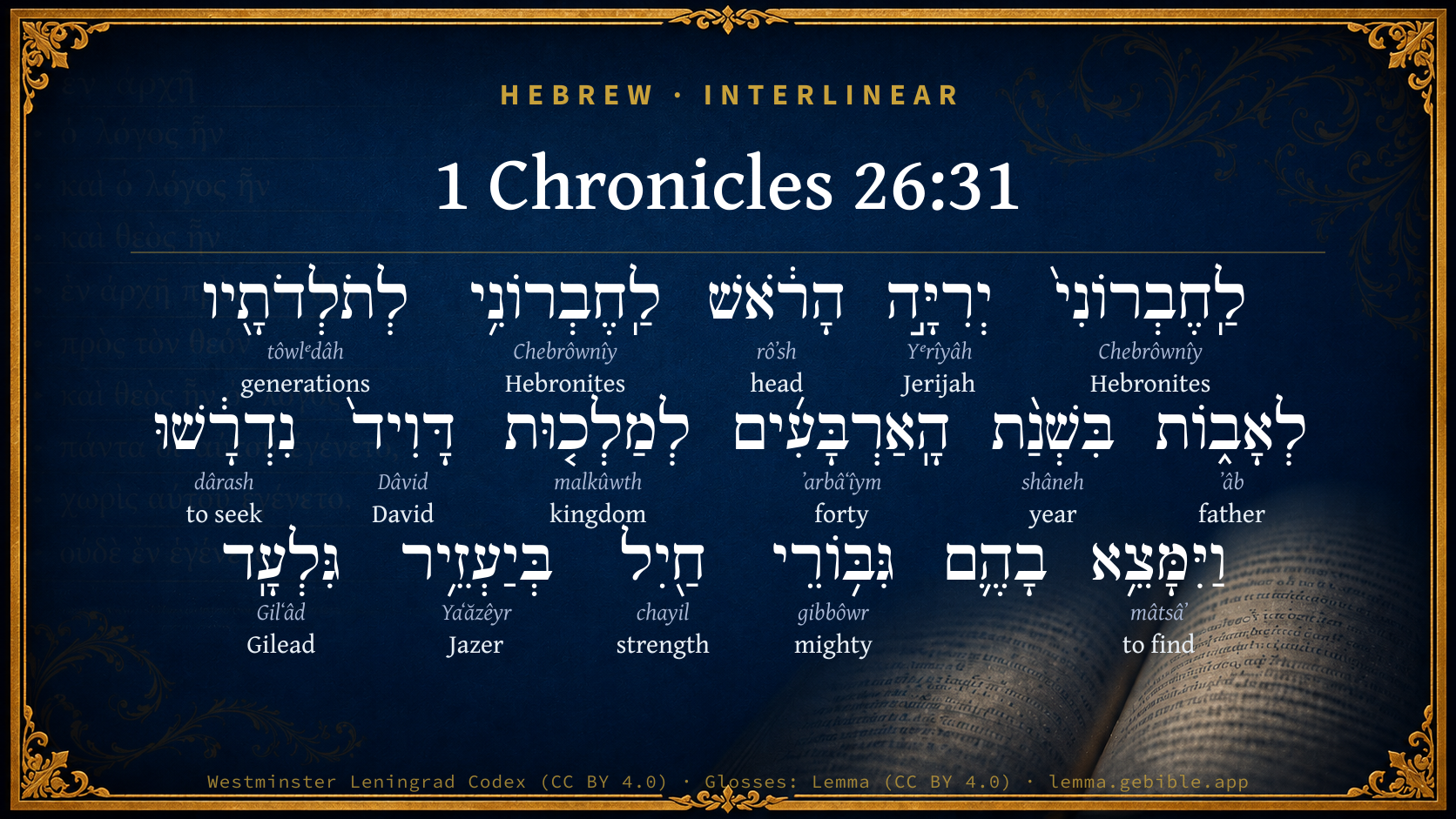
Hebrew (Westminster Leningrad Codex) 1 Chronicles 26:31 appears in the Hebrew Old Testament. The text above is from the Westminster Leningrad Codex. Each word links to its Strong’s number, a concise gloss, and parsing drawn from the Open Scriptures Hebrew Bible morphology. Click any word for its full Brown-Driver-Briggs (BDB) entry.
Download image
Cite this verse

1 Chronicles 26:31 (World English Bible). Public Domain. Lemma interlinear Bible study tool, https://lemma.gebible.app/v/1-chronicles/26/31.

Show BibTeX & RIS
BibTeX
RIS
English Translation
Of the Hebronites was Jerijah the chief, even of the Hebronites, according to their generations by fathers' [houses]. In the fortieth year of the reign of David they were sought for, and there were found among them mighty men of valor at Jazer of Gilead.
World English Bible · Public Domain
Download a study sheet

One document with this verse’s original text, its word-by-word gloss line, the meaning frame, cross-references with their text, attributed commentary, and full source and license credits — printable, and it pastes into notes with its structure intact.

This verse Autodidact and up

Study sheet (.html) Plain text (.txt)

A passage Seminary Student

Up to 50 verses in one chapter. A passage sheet keeps up to 6 commentary sources and 12 cross-references per verse, in the order this page ranks them, and says so on the sheet whenever that leaves anything out. Ask for a single verse and you get the Autodidact verse sheet above.

Everything on this page stays free to read, with no account — the sheet is a download of what is already on screen, not access to it.

Want to remove ads? Support Godless Engineer
Compare translations 3

The same verse in 3 English versions, stacked beneath the original-language interlinear above. Click any original word for its lexicon entry.

Each is an independent rendering of the whole verse — the interlinear is not word-aligned to these translations.

Highlighted words mark where these versions differ — a whole-verse word diff, not a word-by-word alignment.

  • World English Bible Public Domain
    Of the Hebronites was Jerijah the chief, even of the Hebronites, according to their generations by fathers' [houses]. In the fortieth year of the reign of David they were sought for, and there were found among them mighty men of valor at Jazer of Gilead.
  • King James Version Public Domain
    Among the Hebronites was Jerijah the chief, even among the Hebronites, according to the generations of his fathers. In the fortieth year of the reign of David they were sought for, and there were found among them mighty men of valor at Jazer of Gilead.
  • unfoldingWord Literal Text CC BY-SA 4.0
    Of the Hebronite, Jeriah the head of the Hebronite, according to his generations of fathers. In year 40 of the reign of David, they were sought, and it was found among them warriors of valor in Jazer of Gilead.

unfoldingWord Literal Text — © unfoldingWord, licensed CC BY-SA 4.0. Word-aligned USFM3 via Door43 (git.door43.org/unfoldingWord/en_ult).

Versions to compare (up to 4)

3 of 4 selected

Show all 18 translations

Every available English version of this verse, each an independent rendering of the whole verse.

  • World English Bible Public Domain
    Of the Hebronites was Jerijah the chief, even of the Hebronites, according to their generations by fathers' [houses]. In the fortieth year of the reign of David they were sought for, and there were found among them mighty men of valor at Jazer of Gilead.
  • Berean Standard Bible Public Domain
    As for the Hebronites, Jerijah was the chief of the Hebronites, according to the genealogies of his ancestors. In the fortieth year of David’s reign the records were searched, and strong, capable men were found among the Hebronites at Jazer in Gilead.
  • Majority Standard Bible Public Domain
    As for the Hebronites, Jerijah was the chief of the Hebronites, according to the genealogies of his ancestors. In the fortieth year of David’s reign the records were searched, and strong, capable men were found among the Hebronites at Jazer in Gilead.
  • King James Version Public Domain
    Among the Hebronites was Jerijah the chief, even among the Hebronites, according to the generations of his fathers. In the fortieth year of the reign of David they were sought for, and there were found among them mighty men of valor at Jazer of Gilead.
  • American Standard Version (1901) Public Domain
    Of the Hebronites was Jerijah the chief, even of the Hebronites, according to their generations by fathers' `houses'. In the fortieth year of the reign of David they were sought for, and there were found among them mighty men of valor at Jazer of Gilead.
  • Revised Version (1885) Public Domain
    Of the Hebronites was Jerijah the chief, even of the Hebronites, according to their generations by fathers’ houses. In the fortieth year of the reign of David they were sought for, and there were found among them mighty men of valour at Jazer of Gilead.
  • Geneva Bible (1599) Public Domain
    Among the Hebronites was Iediiah the chiefest, euen the Hebronites by his generations according to the families. And in the fourtieth yere of the reigne of Dauid they were sought for: and there were founde among them men of actiuitie at Iazer in Gilead.
  • Douay-Rheims (1899) Public Domain
    And the chief of the Hebronites was Jeria according to their families and kindreds. In the fortieth year of the reign of David they were numbered, and there were found most valiant men in Jazer Galaad,
  • Young's Literal Translation Public Domain
    Of the Hebronite, Jerijah `is' the head, of the Hebronite, according to his generations, for the fathers -- in the fortieth year of the reign of David they have been sought out, and there are found among them mighty ones of valour, in Jazer of Gilead --
  • Literal Standard Version CC BY-SA 4.0
    Of the Hebronite, Jerijah [is] the head of the Hebronite, according to the generations of his fathers. In the fortieth year of the reign of David they have been sought out, and there are found among them mighty men of valor, in Jazer of Gilead—
  • Unlocked Literal Bible CC BY-SA 4.0
    From Hebron's descendants, Jeriah was the leader of his descendants, counted from the lists of their families. In the fortieth year of the reign of David they examined the records and found among them men of ability in Jazer of Gilead.
  • unfoldingWord Literal Text CC BY-SA 4.0
    Of the Hebronite, Jeriah the head of the Hebronite, according to his generations of fathers. In year 40 of the reign of David, they were sought, and it was found among them warriors of valor in Jazer of Gilead.
  • Darby Bible Public Domain
    Of the Hebronites was Jerijah the head; (as to the Hebronites, according to their families according to the fathers: in the fortieth year of the reign of David they were sought for, and there were found among them mighty men of valour at Jaazer in Gilead;)
  • World Messianic Bible Public Domain
    Of the Hebronites, Jerijah was the chief of the Hebronites, according to their generations by fathers’ households. They were sought for in the fortieth year of the reign of David, and mighty men of valor were found among them at Jazer of Gilead.
  • Webster's Bible Public Domain
    Among the Hebronites was Jerijah the chief, even among the Hebronites, according to the generations of his fathers. In the fortieth year of the reign of David they were sought for, and there were found among them mighty men of valor at Jazer of Gilead.
  • Free Bible Version CC BY-SA 4.0
    Also from the Hebronites came Jerijah, the leader of the Hebronites according to the family genealogies. In the fortieth year of David's reign the records were examined, and men of great ability were discovered at Jazer in Gilead.
  • Bible in Basic English Public Domain
    Of the Hebronites, Jerijah was the chief of all the Hebronites, in their generations by families. In the fortieth year of the rule of David a search was made, and able men were seen among them at Jazer of Gilead.
  • JPS Tanakh (1917) Public Domain
    Of the Hebronites was Jerijah the chief, even of the Hebronites, according to their generations by fathers' houses. In the fortieth year of the reign of David they were sought for, and there were found among them mighty men of valour at Jazer of Gilead.

Literal Standard Version (2020), Covenant Press — licensed CC BY-SA 4.0. Text via the HelloAO Bible API (eBible.org). Unlocked Literal Bible (unfoldingWord) — licensed CC BY-SA 4.0. Text via the HelloAO Bible API (eBible.org). unfoldingWord Literal Text — © unfoldingWord, licensed CC BY-SA 4.0. Word-aligned USFM3 via Door43 (git.door43.org/unfoldingWord/en_ult). Free Bible Version, Dr. Jonathan Gallagher — licensed CC BY-SA 4.0. Text via the HelloAO Bible API (eBible.org).

Word by word

More ways to search: Search by grammar → Find every occurrence → Compare this word →

Practice this passage: Drill this verse → Learn its vocabulary →

יְרִיָּ֣ה
Yᵉrîyâh
H3404
“Jerijah”
Noun, Proper
Part of Speech
Noun
Type
Proper
Full BDB Definition

Origin: from H3384 and H3050

TWOT: None

Jerijah or Jeriah = "taught by Jehovah" - a Kohathite Levite and chief of the house of Hebron when David organised the service
  1. לַֽחֶבְרוֹנִי֙ Chebrôwnîy H2276 “to/for the · Hebronites” Preposition, Determined + Noun, Gentilic, Masculine, Singular, Absolute
  2. הָרֹ֔אשׁ rôʼsh H7218 “the · head” Particle, Definite Article + Noun, Common, Masculine, Singular, Absolute
  3. לַֽחֶבְרוֹנִ֥י Chebrôwnîy H2276 “to/for the · Hebronites” Preposition, Determined + Noun, Gentilic, Masculine, Singular, Absolute
  4. לְתֹלְדֹתָ֖יו tôwlᵉdâh H8435 “to/for · generations · his” Preposition + Noun, Common, Feminine, Plural, Construct + Suffix, Personal, 3rd Person, Masculine, Singular
  5. לְאָב֑וֹת ʼâb H1 “to/for · fathers” Preposition + Noun, Common, Masculine, Plural, Absolute
  6. בִּשְׁנַ֨ת shâneh H8141 “in/at · year of” Preposition + Noun, Common, Feminine, Singular, Construct
  7. הָֽאַרְבָּעִ֜ים ʼarbâʻîym H705 “the · forty” Particle, Definite Article + Adjective, Cardinal number, Both, Plural, Absolute
  8. לְמַלְכ֤וּת malkûwth H4438 “to/for · kingdom of” Preposition + Noun, Common, Feminine, Singular, Construct
  9. דָּוִיד֙ Dâvid H1732 “David” Noun, Proper
  10. נִדְרָ֔שׁוּ dârash H1875 “to seek” Verb, Niphal, Perfect, 3rd Person, Common, Plural
  11. וַיִּמָּצֵ֥א mâtsâʼ H4672 “and · to find” Conjunction + Verb, Niphal, Sequential Imperfect, 3rd Person, Masculine, Singular
  12. גִּבּ֥וֹרֵי gibbôwr H1368 “mighty of” Adjective, Adjective, Masculine, Plural, Construct
  13. חַ֖יִל chayil H2428 “strength” Noun, Common, Masculine, Singular, Absolute
  14. בְּיַעְזֵ֥יר Yaʻăzêyr H3270 “in/at · Jazer” Preposition + Noun, Proper
  15. גִּלְעָֽד Gilʻâd H1568 “Gilead” Noun, Proper

About this verse

These counts appear in no published source. They are computed here, from the morphology-tagged text and Lemma’s own curated glosses. What Lemma adds →

17
words
15
distinct lemmas
Historical
section

Notable vocabulary

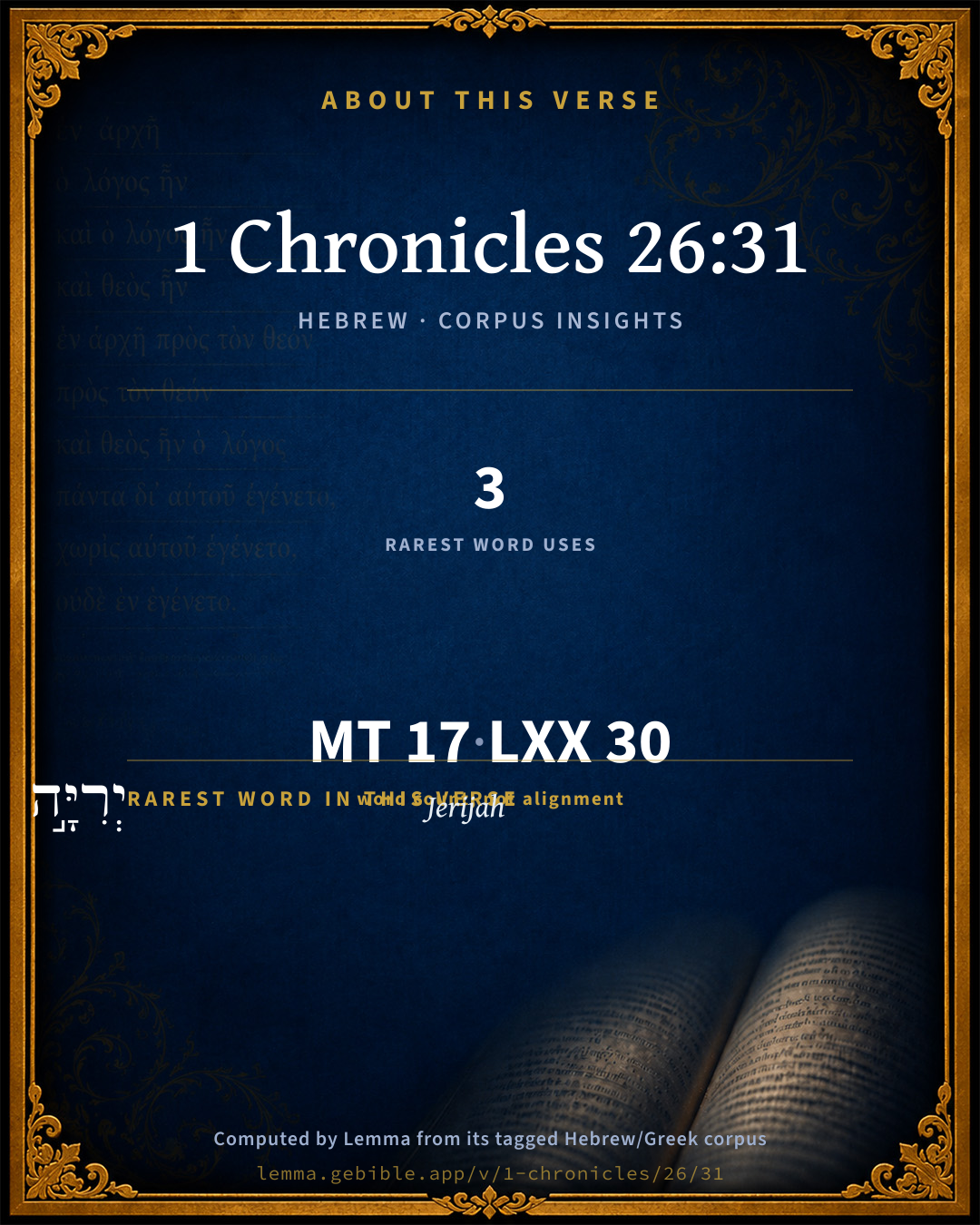
The rarest word here is יְרִיָּ֣ה Jerijah H3404 — appearing just 3 times in the whole Hebrew Bible.

Shared distinctive vocabulary

יְרִיָּ֣ה Jerijah H3404 occurs in 3 verses of the Hebrew Bible. Also found in:

Grammatical profile

  • 2 verbs
  • 12 nouns
  • 2 adjectives
  • 1 preposition

Verb forms

  • נִדְרָ֔שׁוּ Niphal · Perfect
  • וַיִּמָּצֵ֥א Niphal · Sequential Imperfect

Repetition

A word recurs within this verse — often emphatic in Hebrew:

  • לַֽחֶבְרוֹנִי֙ Hebronites H2276 ×2

Hebrew & Septuagint length

In English translation the verse runs 45 words from the Hebrew and 42 from the Septuagint (LXX English) — closely comparable.

A rough comparison of the two English renderings, which tokenize alike — not a word-level alignment.

Word counts can differ between the Hebrew and the Greek without any difference in meaning — e.g. the Hebrew direct-object marker אֵת has no separate Greek word, and Greek often adds the article ὁ.

In the original languages it is 17 Hebrew tokens and 30 Greek tokens — but the two are counted differently (Hebrew bundles its prefixes and suffixes into one token; the Greek is in lemma form), so that isn’t a like-for-like length.

Cross-references

6

Topical passages linked to 1 Chronicles 26:31 in the Treasury of Scripture Knowledge — connected by theme and wording, ordered by reader-vote popularity; previews shown in the World English Bible.

  • 1 Chronicles 23:19 The sons of Hebron: Jeriah the chief, Amariah the second, Jahaziel the third, and Jekameam the fourth.
  • Joshua 21:39 Heshbon with its suburbs, Jazer with its suburbs; four cities in all.
  • 1 Kings 2:11 The days that David reigned over Israel were forty years; seven years reigned he in Hebron, and thirty-three years reigned he in Jerusalem.
  • 1 Chronicles 6:81 and Heshbon with its suburbs, and Jazer with its suburbs.
  • 1 Chronicles 29:27 The time that he reigned over Israel was forty years; he reigned seven years in Hebron, and thirty-three [years] reigned he in Jerusalem.
  • Isaiah 16:9 Therefore I will weep with the weeping of Jazer for the vine of Sibmah; I will water you with my tears, Heshbon, and Elealeh: for on your summer fruits and on your harvest the [battle] shout is fallen.

Cross-references courtesy of OpenBible.info (CC BY 4.0).

Hebrew and Greek witnesses Masoretic Hebrew ↔ Greek Septuagint

The same verse in the two great witnesses to the Old Testament, shown verse-for-verse.

These are two independent witnesses, not word-aligned to each other, and the Septuagint is shown in lemma (dictionary) form.

Hebrew 1 Chronicles 26:31 Masoretic · Westminster Leningrad Codex

לַֽחֶבְרוֹנִי֙ יְרִיָּ֣ה הָרֹ֔אשׁ לַֽחֶבְרוֹנִ֥י לְתֹלְדֹתָ֖יו לְאָב֑וֹת בִּשְׁנַ֨ת הָֽאַרְבָּעִ֜ים לְמַלְכ֤וּת דָּוִיד֙ נִדְרָ֔שׁוּ וַיִּמָּצֵ֥א בָהֶ֛ם גִּבּ֥וֹרֵי חַ֖יִל בְּיַעְזֵ֥יר גִּלְעָֽד

Of the Hebronites was Jerijah the chief, even of the Hebronites, according to their generations by fathers' [houses]. In the fortieth year of the reign of David they were sought for, and there were found among them mighty men of valor at Jazer of Gilead.

World English Bible · Public Domain

Greek LXX 1 Chronicles 26:31 Septuagint · lemma form

ὁ χεβρωνι ἰουδιας ὁ ἄρχων ὁ χεβρωνι κατά γένεσις αὐτός κατά πατριά ἐν ὁ τεσσαρακοστός ἔτος ὁ βασιλεία αὐτός ἐπισκέπτομαι καί εὑρίσκω ἀνήρ δυνατός ἐν αὐτός ἐν ιαζηρ ὁ γαλααδίτις

Of the family of Chebron Urias was chief, even of the Chebronites according to their generations, according to their families. In the fortieth year of his reign they were numbered, and there were found mighty men among them in Jazer of Galaad.

LXX2012 (modern English Septuagint) · Public Domain

Hebrew: Westminster Leningrad Codex (CC BY 4.0). Greek: Septuagint (public domain); English from LXX2012 (modern English Septuagint) (Public Domain). How the Septuagint differs from the Hebrew →

Commentary

Notes on 1 Chronicles 26:31 from classic Christian and Jewish commentators (each source and its license shown beneath its notes). The classic Christian expositions comment on the surrounding passage and are grouped to its opening verse, so a note may address several verses; the Jewish commentaries on the Tanakh (Rashi and others) are per-verse, so they appear only where the commentator wrote on this verse.

Lemma curates 59 commentaries, every one of them public domain or Creative Commons licensed, each selected and text-cleaned for this edition rather than reprinted as found. About our sources →

Joseph Benson's Commentary

1Ch 26:31. In the fortieth year of the reign of David — His last year, in which he made all the orders of families and officers recorded in these chapters. We should be so much the more diligent in doing good, as we see the day approaching. If we live not to enjoy the fruit of our labours, let us not grudge it to them that come after us.

Joseph Benson's Commentary on the Old and New Testaments (1811–1818) — public domain. Text from a community e-Sword module.

Tyndale Open Study Notes

Tyndale Open Resources

26:31 Jazer was a Levitical city (Josh 21:39) that became an administrative center during the monarchy. David and his descendants could depend on the loyalty of the Levites from Hebron (1 Sam 30:27-31; 2 Sam 2:1-11).

Tyndale Open Study Notes — © Tyndale Open Resources, licensed CC BY-SA 4.0. Text via the HelloAO Bible API.

Ellicott's Commentary for English Readers

(31, 32) Among the Hebronites was Jerijah the chief.—Rather, To the Hebronites there was the head Jeriah (as to the Hebronites, according to their registers, according to families, in the fortieth year of the reign of David, they were sought out; and there were found among them valiant warriors in Jazer-Gilead); and his brethren, sons of might, two thousand seven hundred heads of families: and David the king made them overseers over the Reubenites, &c. The long parenthesis obscures the meaning or these two verses. The general statement is that other Hebronites were charged with the supervision of the land east of Jordan: the parenthesis accounts for the fact.

(31) Jerijah.—1Ch_23:19, “Jeriah.” The Hebrew is the same (Yĕrîyâh).

In the fortieth year of the reign of David.—This datum is important as fixing the time of these last regulations of David. (Comp. 1Ch_23:1.) It evidently points to an ancient source.

Jazer of Gilead.—A Merarite city (Jos_21:39); whereas the Hebronites were Kohathites. Perhaps we should read, “In the cities of Gilead.”

(32) Two thousand and seven hundred chief fathers.—Rather, heads of the families, i.e., of single households. Sometimes the Hebrew phrase means heads of father-houses or clans; but it obviously cannot be so here, as the whole number of Levites appointed to be “officers and judges” was only 6,000 (1Ch_23:4). The 2,700 fathers mentioned here, with the 1,700 of 1Ch_26:30, make a total of 4,400. The remaining 1,600 (6,000 minus 4,400) may probably be assigned to Chenaniah (1Ch_26:29). It is strange that the house of Hebron should be twice mentioned (1Ch_26:30-31) and the house of Uzziel not at all (see 1Ch_26:23). Further, of the three great branches of Levi, none but Kohathite houses are named in connexion with “the outward business.” The account appears to be incomplete.

A Bible Commentary for English Readers, edited by Charles John Ellicott (1878–1897) — public domain. Text from a community e-Sword module.

The Cambridge Bible for Schools and Colleges

gen. ed. J. J. S. Perowne

31. Among the Hebronites was … fathers] R.V. Of the Hebronites was Jerijah the chief, even of the Hebronites, according to their generations by fathers’ houses. Jerijah is called Jeriah (Heb. Jerijahu) in 1Ch_23:19.

in the fortieth year] Cp. 1Ch_23:27, By the last words (R.V. mg., In the last acts) of David the sons of Levi were numbered.

at Jazer] Cp. 1Ch_6:81 (1Ch_6:66 Heb.); Num_21:32, R.V. The Eastern Hebronites were given office east of Jordan; cp. 1Ch_26:32.

The Cambridge Bible for Schools and Colleges (gen. ed. J. J. S. Perowne; Cambridge University Press, 1878–1918) — public domain. Text from a community e-Sword module.

Haydock's Catholic Bible Commentary

Jazer, a city of Gad, in Galaad. (Adrichomius) (Menochius)

George Leo Haydock (1774–1849), Haydock's Catholic Family Bible and Commentary, 1859 edition — public domain. Excludes Psalms (Douay-Rheims chapter numbering differs from Protestant) and Deuterocanonical books (Catholic canon only).

Matthew Poole's English Annotations

In the fortieth year; which was his last year, in which he made all the orders and distributions of families and offices recorded in these chapters.

Jazer of Gilead is here named, either because they were seated in or near that place, but for what cause it is now unknown; or because they were numbered there by some person sent by David to that purpose.

Matthew Poole's English Annotations on the Holy Bible (1683–1685) — public domain. Text from a community e-Sword/MySword module.

The Pulpit Commentary

This verse is at first sight obscure; but its purport is to say that the Hebronite family was, in the lust year of David"s reign, found at Jazer of Gilead, which seems a Merarite city (Jos_13:25 Jos_21:39; Num_21:32) and that Jerijah (1Ch_23:19 1Ch_24:23) was then chief of them. He and his brethren were now appointed to the superintendence of the two tribes and a half eastward of Jordan, while "Hashabiah and his brethren" fulfilled the like duties westward of Jordan The number of those east of Jordan constituted overseers seems large in proportion to those mentioned on the west; but we must bear in mind that the numbers of Chenaniah and their range of sphere are not stated. These will presumably complete the six thousand of 1Ch_23:4. Otherwise we have but to fall back on the conviction that the present account is imperfect as well as brief.

The Pulpit Commentary (1880–1919), ed. H.D.M. Spence-Jones & Joseph S. Exell — public domain. Text from a community e-Sword module.

John Wesley's Explanatory Notes

Fortieth year - His last year, in which he made all the orders of families and officers recorded in these chapters. We should be so much the more diligent in doing good, as we see the day approaching. If we live not to enjoy the fruit of our labours, let us not grudge it to them that come after us.

John Wesley, Explanatory Notes Upon the Whole Bible (1754–1765) — public domain. Text via the GEBible commentary corpus.

unfoldingWord translationNotes

Door43 World Missions Community

Hebron

See how you translated this man's name in 1 Chronicles 23:12. (See: How to Translate Names)

Jeriah

See how you translated this man's name in 1 Chronicles 23:19. (See: How to Translate Names)

counted from the lists

This can be stated in active form. AT: "their names were on the lists" (See: Active or Passive)

In the fortieth year of the reign of David

"When David had been king for 40 years" (See: Ordinal Numbers and Numbers)

men of ability

"capable men"

Jazer

This is the name of a city. (See: How to Translate Names)

2,700 relatives

"two thousand seven hundred family members" (See: Numbers)

translationWords

family

reign

David

Gilead

oversee

tribe

Reuben

Gad

Manasseh

God

unfoldingWord translationNotes — © Distant Shores Media and the Door43 World Missions Community, licensed CC BY-SA 4.0. Source: git.door43.org/Door43/en_tn.

Rashi

Rabbi Shlomo Yitzchaki (Rashi)

to his generations to the fathers in the fortieth year, etc. And also all these computations were in the fortieth year.

Rashi on the Tanakh — English translations: “The Judaica Press complete Tanach with Rashi, translated by A. J. Rosenberg” (CC BY 4.0); “Pentateuch with Rashi's commentary by M. Rosenbaum and A.M. Silbermann, 1929-1934” (public domain); “The Metsudah Tanach series, Lakewood, N.J” (CC BY 4.0); and “The Book of Joshua, Metsudah Publications, 1997” (CC BY 4.0). Text via Sefaria.

Lesson kit

Teaching starters — assembled from the data on this page, not authored interpretation. Every prompt links to the verse data it draws on. Edit before teaching.

1 Chronicles, in the Historical, opens this verse with 17 words (15 distinct Hebrew lemmas). Its most distinctive word is Yᵉrîyâh (“Jerijah”). A historical commentator’s framing appears above. Read the whole chapter for the surrounding context.

Discussion questions

  1. How does “Jerijah” (Yᵉrîyâh) shape what this verse is saying?
  2. How does 1 Chronicles 23:19, which shares the word «Jerijah», read alongside this verse?
  3. What does the repetition of “Hebronites” (2× in this one verse) do in this verse?
  4. The translations on this page render this verse differently — a whole-verse word diff, not a word-by-word alignment. What might account for the different wordings?
  5. «נִדְרָ֔שׁוּ» is a Niphal Perfect verb. How does that grammatical form shape the action described?
  6. Compare how Joseph Benson's Commentary and Tyndale Open Study Notes read this verse. Where do they agree or differ?

Things to notice

Reading settings

Reading text

Shown beneath each verse's original-language words.

Old Testament
Old Testament edition

Read the OT as the Masoretic Hebrew (MT) or the Greek Septuagint (LXX).

English shown for the Greek Septuagint (in the Hebrew ↔ Greek comparison).

Comparing translations? Open the Compare panel on any verse page to stack up to four side by side.