
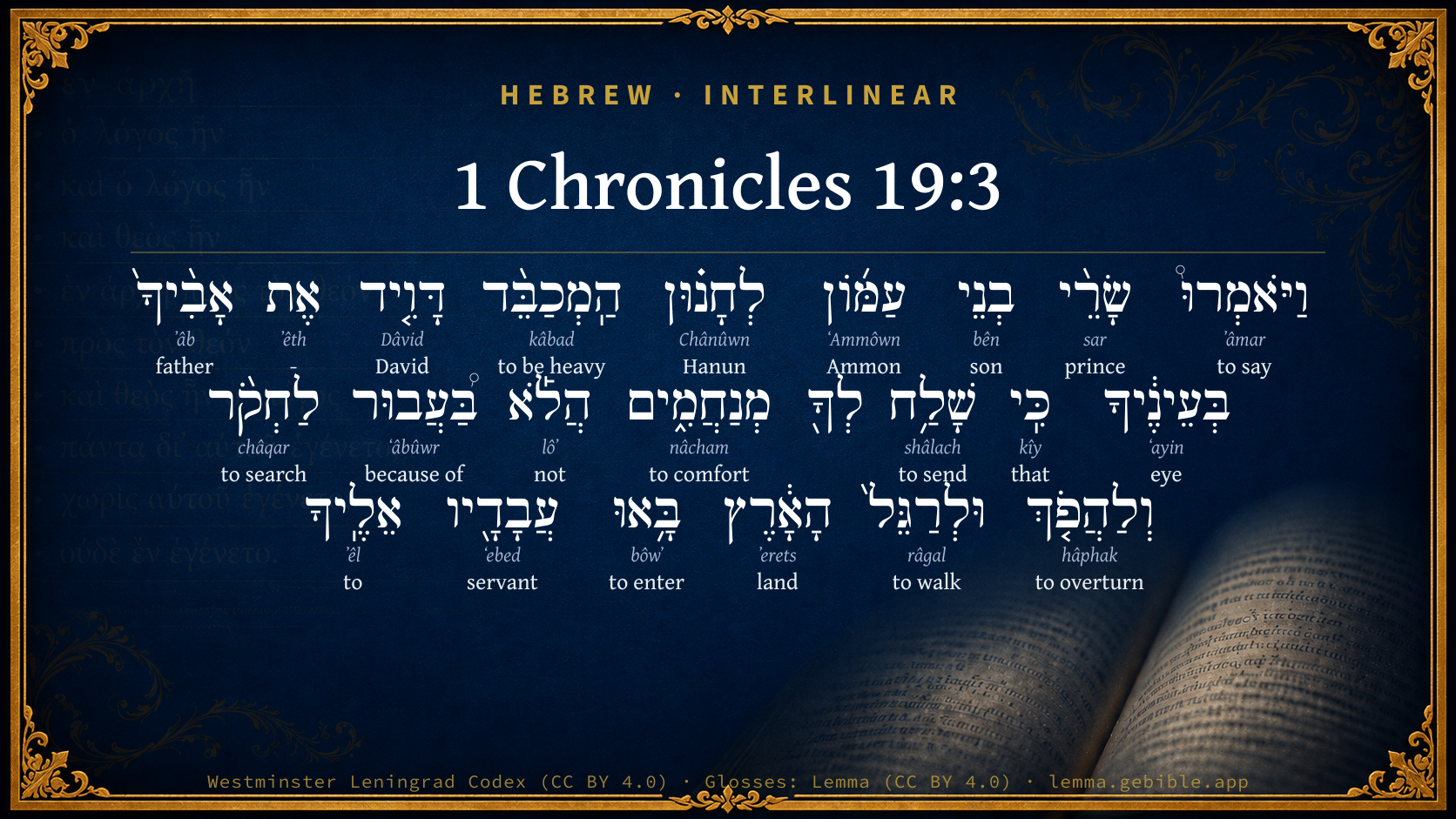
1 Chronicles 19:3

Hebrew (Westminster Leningrad Codex) 1 Chronicles 19:3 appears in the Hebrew Old Testament. The text above is from the Westminster Leningrad Codex. Each word links to its Strong’s number, a concise gloss, and parsing drawn from the Open Scriptures Hebrew Bible morphology. Click any word for its full Brown-Driver-Briggs (BDB) entry.
Download image
Cite this verse

1 Chronicles 19:3 (World English Bible). Public Domain. Lemma interlinear Bible study tool, https://lemma.gebible.app/v/1-chronicles/19/3.

Show BibTeX & RIS
BibTeX
RIS
English Translation
But the princes of the children of Ammon said to Hanun, Think you that David does honor your father, in that he has sent comforters to you? Aren't his servants come to you to search, and to overthrow, and to spy out the land?
World English Bible · Public Domain
Download a study sheet

One document with this verse’s original text, its word-by-word gloss line, the meaning frame, cross-references with their text, attributed commentary, and full source and license credits — printable, and it pastes into notes with its structure intact.

This verse Autodidact and up

Study sheet (.html) Plain text (.txt)

A passage Seminary Student

Up to 50 verses in one chapter. A passage sheet keeps up to 6 commentary sources and 12 cross-references per verse, in the order this page ranks them, and says so on the sheet whenever that leaves anything out. Ask for a single verse and you get the Autodidact verse sheet above.

Everything on this page stays free to read, with no account — the sheet is a download of what is already on screen, not access to it.

Want to remove ads? Support Godless Engineer
Compare translations 3

The same verse in 3 English versions, stacked beneath the original-language interlinear above. Click any original word for its lexicon entry.

Each is an independent rendering of the whole verse — the interlinear is not word-aligned to these translations.

Highlighted words mark where these versions differ — a whole-verse word diff, not a word-by-word alignment.

  • World English Bible Public Domain
    But the princes of the children of Ammon said to Hanun, Think you that David does honor your father, in that he has sent comforters to you? Aren't his servants come to you to search, and to overthrow, and to spy out the land?
  • King James Version Public Domain
    But the princes of the children of Ammon said to Hanun, Thinkest thou that David doth honor thy father, that he hath sent comforters unto thee? are not his servants come unto thee for to search, and to overthrow, and to spy out the land?
  • unfoldingWord Literal Text CC BY-SA 4.0
    And the commanders of the sons of Ammon said to Hanun, “In your eyes, is David honoring your father because he has sent comforters to you? not in order to explore and to overthrow and to spy on the land his servants have come to you?”

unfoldingWord Literal Text — © unfoldingWord, licensed CC BY-SA 4.0. Word-aligned USFM3 via Door43 (git.door43.org/unfoldingWord/en_ult).

Versions to compare (up to 4)

3 of 4 selected

Show all 18 translations

Every available English version of this verse, each an independent rendering of the whole verse.

  • World English Bible Public Domain
    But the princes of the children of Ammon said to Hanun, Think you that David does honor your father, in that he has sent comforters to you? Aren't his servants come to you to search, and to overthrow, and to spy out the land?
  • Berean Standard Bible Public Domain
    the princes of the Ammonites said to Hanun, “Just because David has sent you comforters, do you really believe he is showing respect for your father? Have not his servants come to you to explore the land, spy it out, and overthrow it?”
  • Majority Standard Bible Public Domain
    the princes of the Ammonites said to Hanun, “Just because David has sent you comforters, do you really believe he is showing respect for your father? Have not his servants come to you to explore the land, spy it out, and overthrow it?”
  • King James Version Public Domain
    But the princes of the children of Ammon said to Hanun, Thinkest thou that David doth honor thy father, that he hath sent comforters unto thee? are not his servants come unto thee for to search, and to overthrow, and to spy out the land?
  • American Standard Version (1901) Public Domain
    But the princes of the children of Ammon said to Hanun, Thinkest thou that David doth honor thy father, in that he hath sent comforters unto thee? are not his servants come unto thee to search, and to overthrow, and to spy out the land?
  • Revised Version (1885) Public Domain
    But the princes of the children of Ammon said to Hanun, Thinkest thou that David doth honour thy father, that he hath sent comforters unto thee? are not his servants come unto thee for to search, and to overthrow, and to spy out the land?
  • Geneva Bible (1599) Public Domain
    And the princes of the children of Ammon said to Hanun, Thinkest thou that Dauid doeth honour thy father, that he hath sent comforters vnto thee? Are not his seruants come to thee to search, to seeke and to spie out the land?
  • Douay-Rheims (1899) Public Domain
    The princes of the children of Ammon said to Hanon: Thou thinkest perhaps that David to do honour to thy father hath sent comforters to thee: and thou dost not take notice, that his servants are come to thee to consider, and search, and spy out thy land.
  • Young's Literal Translation Public Domain
    and the heads of the sons of Ammon say to Hanun, `Is David honouring thy father, in thine eyes, because he hath sent to thee comforters? in order to search, and to overthrow, and to spy out, the land, have not his servants come in unto thee?'
  • Literal Standard Version CC BY-SA 4.0
    and the heads of the sons of Ammon say to Hanun, “Is David honoring your father in your eyes because he has sent comforters to you? Have his servants not come to you in order to search, and to overthrow, and to spy out the land?”
  • Unlocked Literal Bible CC BY-SA 4.0
    But the Ammonite princes said to Hanun, “Do you think that David is honoring your father because he has sent men to comfort you? Do not his servants come to you to explore and examine the land in order to overthrow it?”
  • unfoldingWord Literal Text CC BY-SA 4.0
    And the commanders of the sons of Ammon said to Hanun, “In your eyes, is David honoring your father because he has sent comforters to you? not in order to explore and to overthrow and to spy on the land his servants have come to you?”
  • Darby Bible Public Domain
    And the princes of the children of Ammon said to Hanun, Is it, in thine eyes, to honour thy father that David has sent comforters to thee? Is it not to search and overthrow, and to spy out the land that his servants are come to thee?
  • World Messianic Bible Public Domain
    But the princes of the children of Ammon said to Hanun, “Do you think that David honors your father, in that he has sent comforters to you? Haven’t his servants come to you to search, to overthrow, and to spy out the land?”
  • Webster's Bible Public Domain
    But the princes of the children of Ammon said to Hanun, Thinkest thou that David doth honor thy father, that he hath sent comforters to thee? are not his servants come to thee to search, and to overthrow, and to explore the land?
  • Free Bible Version CC BY-SA 4.0
    But the Ammonite princes said to Hanun, “Do you really think that David is honoring your father by sending comforters to you? Haven't these ‘comforters’ only come to spy out the land to find ways to conquer it?”
  • Bible in Basic English Public Domain
    But the chiefs of the children of Ammon said to Hanun, Does it seem to you that David is honouring your father, by sending comforters to you? is it not clear that these men have only come to go through the land and to make secret observation of it so that they may overcome it?
  • JPS Tanakh (1917) Public Domain
    But the princes of the children of Ammon said to Hanun: 'Thinkest thou that David doth honour thy father, that he hath sent comforters unto thee? are not his servants come unto thee to search, and to overthrow, and to spy out the land?'

Literal Standard Version (2020), Covenant Press — licensed CC BY-SA 4.0. Text via the HelloAO Bible API (eBible.org). Unlocked Literal Bible (unfoldingWord) — licensed CC BY-SA 4.0. Text via the HelloAO Bible API (eBible.org). unfoldingWord Literal Text — © unfoldingWord, licensed CC BY-SA 4.0. Word-aligned USFM3 via Door43 (git.door43.org/unfoldingWord/en_ult). Free Bible Version, Dr. Jonathan Gallagher — licensed CC BY-SA 4.0. Text via the HelloAO Bible API (eBible.org).

Word by word

More ways to search: Search by grammar → Find every occurrence → Compare this word →

Practice this passage: Drill this verse → Learn its vocabulary →

לְחָנ֗וּן
Chânûwn
H2586
“to/for · Hanun”
Preposition + Noun, Proper
Part of Speech
Preposition + Noun
Type
Proper
Full BDB Definition

Origin: from H2603

TWOT: None

Hanun = "gracious" - son of Nahash and king of Ammon who dishonoured David's ambassadors and lost the subsequent war with David - a man who, with the people of Zanoah, repaired the ravine gate in the wall of Jerusalem - the 6th son of Zalaph, who also assisted in the repair of the wall of Jerusalem, apparently on the east side
  1. וַיֹּאמְרוּ֩ ʼâmar H559 “and · to say” Conjunction + Verb, Qal, Sequential Imperfect, 3rd Person, Masculine, Plural
  2. שָׂרֵ֨י sar H8269 “princes of” Noun, Common, Masculine, Plural, Construct
  3. בְנֵי bên H1121 “sons of” Noun, Common, Masculine, Plural, Construct
  4. עַמּ֜וֹן ʻAmmôwn H5983 “Ammon” Noun, Proper
  5. הַֽמְכַבֵּ֨ד kâbad H3513 “being heavy” Particle, Interrogative + Verb, Piel, Participle Active, Masculine, Singular, Absolute
  6. דָּוִ֤יד Dâvid H1732 “David” Noun, Proper
  7. אֶת ʼêth H853 “-” Particle, Direct Object
  8. אָבִ֨יךָ֙ ʼâb H1 “father · your” Noun, Common, Masculine, Singular, Construct + Suffix, Personal, 2nd Person, Masculine, Singular
  9. בְּעֵינֶ֔יךָ ʻayin H5869 “in/at · eyes · your” Preposition + Noun, Common, Both, Dual, Construct + Suffix, Personal, 2nd Person, Masculine, Singular
  10. כִּֽי kîy H3588 “that” Conjunction
  11. שָׁלַ֥ח shâlach H7971 “to send” Verb, Qal, Perfect, 3rd Person, Masculine, Singular
  12. מְנַחֲמִ֑ים nâcham H5162 “comforting” Verb, Piel, Participle Active, Masculine, Plural, Absolute
  13. הֲלֹ֡א lôʼ H3808 “not” Particle, Interrogative + Particle, Negative
  14. בַּ֠עֲבוּר ʻâbûwr H5668 “in/at · because of of” Preposition + Noun, Common, Masculine, Singular, Construct
  15. לַחְקֹ֨ר châqar H2713 “to search” Preposition + Verb, Qal, Infinitive Construct
  16. וְלַהֲפֹ֤ךְ hâphak H2015 “and · to overturn” Conjunction + Preposition + Verb, Qal, Infinitive Construct
  17. וּלְרַגֵּל֙ râgal H7270 “and · to walk” Conjunction + Preposition + Verb, Piel, Infinitive Construct
  18. הָאָ֔רֶץ ʼerets H776 “the · land” Particle, Definite Article + Noun, Common, Both, Singular, Absolute
  19. בָּ֥אוּ bôwʼ H935 “to enter” Verb, Qal, Perfect, 3rd Person, Common, Plural
  20. עֲבָדָ֖יו ʻebed H5650 “servants · his” Noun, Common, Masculine, Plural, Construct + Suffix, Personal, 3rd Person, Masculine, Singular
  21. אֵלֶֽיךָ ʼêl H413 “to · you” Preposition + Suffix, Personal, 2nd Person, Masculine, Singular

About this verse

These counts appear in no published source. They are computed here, from the morphology-tagged text and Lemma’s own curated glosses. What Lemma adds →

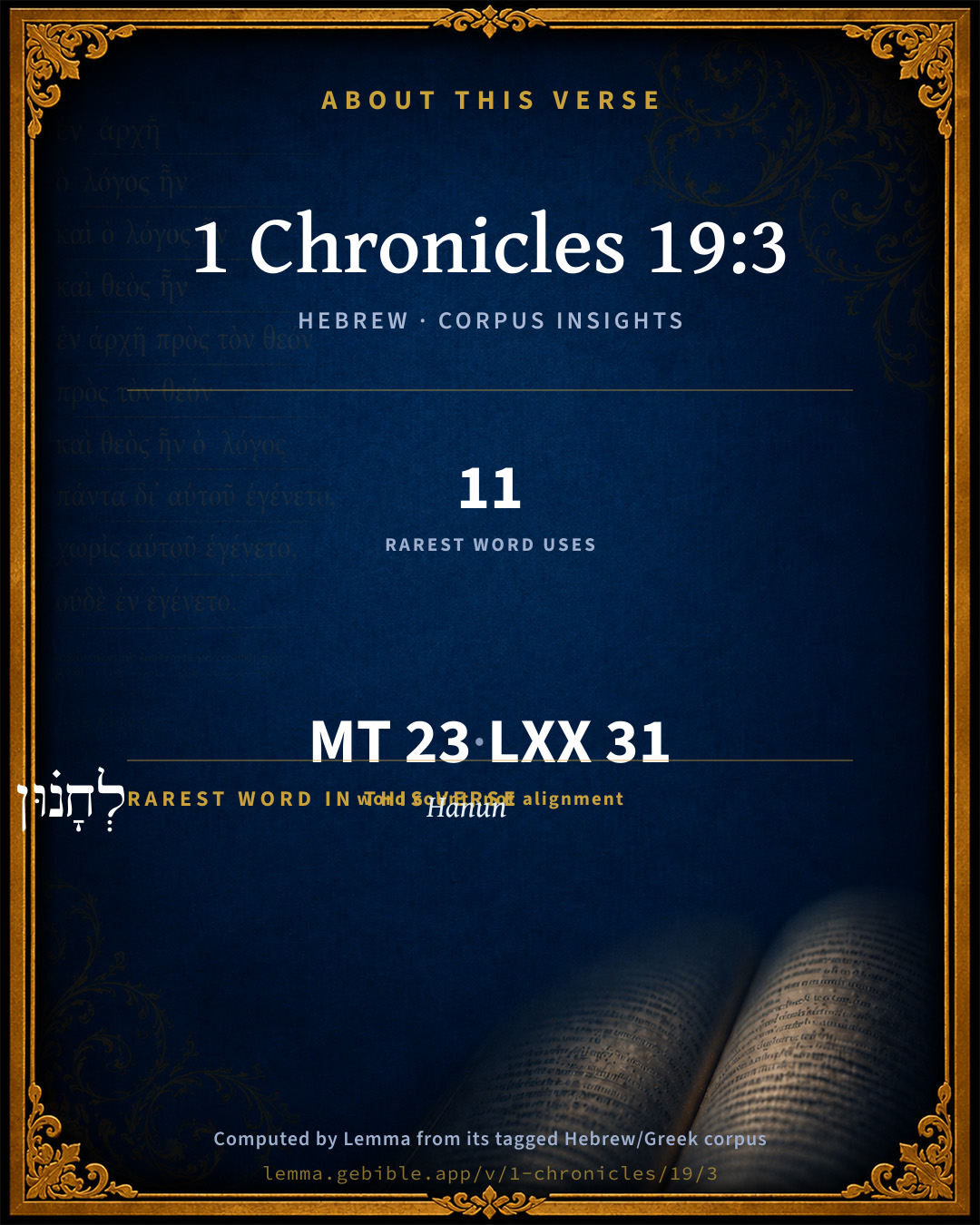
23
words
22
distinct lemmas
Historical
section

Notable vocabulary

The rarest word here is לְחָנ֗וּן Hanun H2586 — appearing just 11 times in the whole Hebrew Bible.

Shared distinctive vocabulary

לְחָנ֗וּן Hanun H2586 occurs in 10 verses of the Hebrew Bible. Also found in:

Grammatical profile

  • 8 verbs
  • 10 nouns
  • 2 prepositions
  • 1 conjunction
  • 2 particles

Verb forms

  • וַיֹּאמְרוּ֩ Qal · Sequential Imperfect
  • הַֽמְכַבֵּ֨ד Piel · Participle Active
  • שָׁלַ֥ח Qal · Perfect
  • מְנַחֲמִ֑ים Piel · Participle Active
  • לַחְקֹ֨ר Qal · Infinitive Construct
  • וְלַהֲפֹ֤ךְ Qal · Infinitive Construct
  • וּלְרַגֵּל֙ Piel · Infinitive Construct
  • בָּ֥אוּ Qal · Perfect

Hebrew & Septuagint length

In English translation the verse runs 44 words from the Hebrew and 45 from the Septuagint (LXX English) — closely comparable.

A rough comparison of the two English renderings, which tokenize alike — not a word-level alignment.

Word counts can differ between the Hebrew and the Greek without any difference in meaning — e.g. the Hebrew direct-object marker אֵת has no separate Greek word, and Greek often adds the article ὁ.

In the original languages it is 23 Hebrew tokens and 31 Greek tokens — but the two are counted differently (Hebrew bundles its prefixes and suffixes into one token; the Greek is in lemma form), so that isn’t a like-for-like length.

Cross-references

9

Topical passages linked to 1 Chronicles 19:3 in the Treasury of Scripture Knowledge — connected by theme and wording, ordered by reader-vote popularity; previews shown in the World English Bible.

  • Genesis 42:9–18 Joseph remembered the dreams which he dreamed about them, and said to them, "You are spies! You have come to see the nakedness of the land."
  • Joshua 2:1–3 Joshua the son of Nun sent out of Shittim two men as spies secretly, saying, Go, view the land, and Jericho. They went and came into the house of a prostitute whose name was Rahab, and lay there.
  • Judges 1:23–24 The house of Joseph sent to spy out Bethel. (Now the name of the city before was Luz.)
  • Judges 18:2 The children of Dan sent of their family five men from their whole number, men of valor, from Zorah, and from Eshtaol, to spy out the land, and to search it; and they said to them, Go, search the land. They came to the hill-country of Ephraim, to the house of Micah, and lodged there.
  • Judges 18:8–10 They came to their brothers to Zorah and Eshtaol: and their brothers said to them, What [say] you?
  • 1 Samuel 29:4 But the princes of the Philistines were angry with him; and the princes of the Philistines said to him, Make the man return, that he may go back to his place where you have appointed him, and let him not go down with us to battle, lest in the battle he become an adversary to us: for with what should this [fellow] reconcile himself to his lord? should it not be with the heads of these men?
  • 1 Samuel 29:9 Achish answered David, I know that you are good in my sight, as an angel of God: notwithstanding the princes of the Philistines have said, He shall not go up with us to the battle.
  • 1 Kings 12:8–11 But he forsook the counsel of the old men which they had given him, and took counsel with the young men who had grown up with him, who stood before him.
  • 1 Corinthians 13:5–7 doesn't behave itself inappropriately, doesn't seek its own way, is not provoked, takes no account of evil;

Cross-references courtesy of OpenBible.info (CC BY 4.0).

Hebrew and Greek witnesses Masoretic Hebrew ↔ Greek Septuagint

The same verse in the two great witnesses to the Old Testament, shown verse-for-verse.

These are two independent witnesses, not word-aligned to each other, and the Septuagint is shown in lemma (dictionary) form.

Hebrew 1 Chronicles 19:3 Masoretic · Westminster Leningrad Codex

וַיֹּאמְרוּ֩ שָׂרֵ֨י בְנֵי עַמּ֜וֹן לְחָנ֗וּן הַֽמְכַבֵּ֨ד דָּוִ֤יד אֶת אָבִ֨יךָ֙ בְּעֵינֶ֔יךָ כִּֽי שָׁלַ֥ח לְךָ֖ מְנַחֲמִ֑ים הֲלֹ֡א בַּ֠עֲבוּר לַחְקֹ֨ר וְלַהֲפֹ֤ךְ וּלְרַגֵּל֙ הָאָ֔רֶץ בָּ֥אוּ עֲבָדָ֖יו אֵלֶֽיךָ

But the princes of the children of Ammon said to Hanun, Think you that David does honor your father, in that he has sent comforters to you? Aren't his servants come to you to search, and to overthrow, and to spy out the land?

World English Bible · Public Domain

Greek LXX 1 Chronicles 19:3 Septuagint · lemma form

καί εἶπον ἄρχων αμμων πρός αναν μή δοξάζω δαυίδ ὁ πατήρ σύ ἐναντίον σύ ἀποστέλλω σύ παρακαλέω οὐ ὅπως ἐκἐρευνάω ὁ πόλις ὁ κατασκοπέω ὁ γῆ ἔρχομαι παῖς αὐτός πρός σύ

And the chiefs of the children of Ammon said to Anan, Is it to honor your father before you, that David has sent comforters to you? Have not his servants come to you that they might search the city, and to spy out the land?

LXX2012 (modern English Septuagint) · Public Domain

On this verse, Ellicott's Commentary for English Readers discusses the Septuagint’s reading. Read the note in Commentary ↓

Hebrew: Westminster Leningrad Codex (CC BY 4.0). Greek: Septuagint (public domain); English from LXX2012 (modern English Septuagint) (Public Domain). How the Septuagint differs from the Hebrew →

Commentary

Notes on 1 Chronicles 19:3 from classic Christian and Jewish commentators (each source and its license shown beneath its notes). The classic Christian expositions comment on the surrounding passage and are grouped to its opening verse, so a note may address several verses; the Jewish commentaries on the Tanakh (Rashi and others) are per-verse, so they appear only where the commentator wrote on this verse.

Lemma curates 59 commentaries, every one of them public domain or Creative Commons licensed, each selected and text-cleaned for this edition rather than reprinted as found. About our sources →

Geneva Bible (1599)

Geneva Bible translators

Thus the malicious ever interpret the purpose of the godly in the worst sense.

Geneva Bible (1599) marginal notes — public domain. Text via Bolls.life.

Jamieson, Fausset & Brown

Robert Jamieson, A. R. Fausset & David Brown

are not his servants come unto thee for to search?--that is, thy capital, Rabbah (Sa2 10:3).

Jamieson, Fausset & Brown — Commentary Critical and Explanatory on the Whole Bible (1871) — public domain (CC PDM 1.0). Text via the HelloAO Bible API.

Ellicott's Commentary for English Readers

(3) Are not his servants come . . . for to search, and to overthrow, and to spy out the land?—Literally, Is it not for to search . . . that his servants are come unto thee? This is hardly an improvement on Samuel: “Is it not to search the city (Rabbath-Ammon, the capital), and to spy it out, and to overthrow it, that David hath sent his servants unto thee?” The Syriac and Arabic agree with Samuel in reading “city;” LXX. and Vulg., “land.”

A Bible Commentary for English Readers, edited by Charles John Ellicott (1878–1897) — public domain. Text from a community e-Sword module.

The Cambridge Bible for Schools and Colleges

gen. ed. J. J. S. Perowne

3. the land] 2Sa_10:3, the city, i.e. Rabbah.

The Cambridge Bible for Schools and Colleges (gen. ed. J. J. S. Perowne; Cambridge University Press, 1878–1918) — public domain. Text from a community e-Sword module.

Haydock's Catholic Bible Commentary

Land, or city, 2 Kings x. 3. (Calmet) --- What evils proceed from evil counsellors!

George Leo Haydock (1774–1849), Haydock's Catholic Family Bible and Commentary, 1859 edition — public domain. Excludes Psalms (Douay-Rheims chapter numbering differs from Protestant) and Deuterocanonical books (Catholic canon only).

The Pulpit Commentary

Thinkest thou that David, etc.? The Hebrew is, "In thine eyes doth David?" The order of to overthrow, and to spy out is reversed in Samuel.

The evil of the suspicious mind.

Shown by the counsellors of Hanun. Observe the difficulty men find when they attempt to estimate motives; and the sad tendency of depraved human nature to light upon, and to prefer, the evil motive as the explanation of conduct. These points may be readily illustrated by instances within the experience of every preacher. It may be shown that

I THINGS MAY LOOK WELL WITHOUT BEING WELL, and that therefore

II THERE IS ALWAYS NEED OF DUE CAUTION LEST WE SHOULD BE DECEIVED. But it should be carefully shown and impressed

III THAT THE SUSPICIOUS HABIT OF MIND EASILY FANCIES THERE IS EVIL IN WHAT WAS MEANT WELL.

Then it may be shown that the suspicious habit is only a reflection of a man"s own conscious untrustworthiness or badness. We suspect in others what we know there would have been in the act if we ourselves had done it. These mean and low-natured counsellors of Hanun measured David by the measure of their own meanness. They would have taken such an opportunity to spy out a neighbour"s land; so they felt sure that David had a deceptive and hostile intention. When we do not go this length, we sometimes assume evil by establishing some general principle, by which we force an explanation to everything; without being prepared to allow exceptions in individual cases. The mischief of the suspicious temper in society and in the Church may be fully illustrated; especially its influence in starting jealousy and creating enmity, and separating "very friends." From the incident connected with the verse show how it may even lead to terrible miseries for many. Press that the suspicious temper grows on a man, dwarfing and crushing out the trustfulness which, toned by wisdom, is man"s true dignity and blessedness, and the basis of good social relations.

R.T.

The Pulpit Commentary (1880–1919), ed. H.D.M. Spence-Jones & Joseph S. Exell — public domain. Text from a community e-Sword module.

Rashi

Rabbi Shlomo Yitzchaki (Rashi)

Do you think that David honors your father Is it not written in their Torah (Deut. 23:7): “You shall not seek their peace or their prosperity?” Do you think that he is forsaking the commandment of his God and is coming to greet you, and that he sent comforters in honor of your father? Is it not in order to investigate, etc.?

Rashi on the Tanakh — English translations: “The Judaica Press complete Tanach with Rashi, translated by A. J. Rosenberg” (CC BY 4.0); “Pentateuch with Rashi's commentary by M. Rosenbaum and A.M. Silbermann, 1929-1934” (public domain); “The Metsudah Tanach series, Lakewood, N.J” (CC BY 4.0); and “The Book of Joshua, Metsudah Publications, 1997” (CC BY 4.0). Text via Sefaria.

Lesson kit

Teaching starters — assembled from the data on this page, not authored interpretation. Every prompt links to the verse data it draws on. Edit before teaching.

1 Chronicles, in the Historical, opens this verse with 23 words (22 distinct Hebrew lemmas). Its most distinctive word is Chânûwn (“Hanun”). A historical commentator’s framing appears above. Read the whole chapter for the surrounding context.

Discussion questions

  1. How does “Hanun” (Chânûwn) shape what this verse is saying?
  2. 2 Samuel 10:1 shares the word «Hanun» with this verse. How do the two illuminate each other?
  3. These translations render this verse differently; the difference is in the English rendering, not the original. What questions does that raise?
  4. The verb «וַיֹּאמְרוּ֩» is Qal Sequential Imperfect. How does its form color the action?
  5. Reading how Geneva Bible (1599) and Jamieson, Fausset & Brown read this verse, where do the two commentators agree and where do they part?

Things to notice

Reading settings

Reading text

Shown beneath each verse's original-language words.

Old Testament
Old Testament edition

Read the OT as the Masoretic Hebrew (MT) or the Greek Septuagint (LXX).

English shown for the Greek Septuagint (in the Hebrew ↔ Greek comparison).

Comparing translations? Open the Compare panel on any verse page to stack up to four side by side.